

A demo takes an afternoon. A product takes months. And somewhere in between, most AI projects quietly fall apart.
You’ve probably watched it happen. Someone connects a language model to a handful of sample documents, the answers look sharp in Monday’s review, and by Friday there’s a slide promising a launch next quarter. Then real users arrive with messy questions, the data turns out to be half broken, and nobody can say whether the thing is actually working. The model wasn’t the problem. What was missing was a proper AI product development lifecycle.
This guide is for product managers, founders, marketers stepping into AI work, and anyone who has to ship something powered by a model and then keep it running. You’ll walk through seven stages, from validating the idea to deployment and the long stretch of improvement afterwards, with a checklist at each one so you know when it’s safe to move on.
One principle runs through all of it. Begin with a real customer problem, not the excitement around a new technology. Every stage below is really just a way of checking that you haven’t forgotten that.
Table of Contents
What Is an AI Product Development Lifecycle?
An AI product development lifecycle is the end-to-end process of taking an AI product from a validated customer problem to a deployed, monitored and continuously improved product. It covers customer research, data, model development, product design, testing, release and maintenance, and it doesn’t stop at launch. It’s easy to picture the AI product development lifecycle as a straight pipeline. In practice it behaves more like a loop.
In plain English, it’s everything between “someone has a problem” and “that problem is still solved six months later.” The AI product lifecycle ties customer needs, data, model work, design, testing, deployment and upkeep into one connected thread. Pull on any strand and the others move. Great data feeding a model nobody needs is a hobby. A brilliant idea with no usable data is a slide deck.
It also isn’t the same thing as a model-training workflow. Training starts with a dataset and ends with a model that scores well on a test set, which is only one slice of the real work. The lifecycle asks the awkward extra questions. Who is the user? What happens when the model is wrong? Who answers the support ticket? What does each query cost? Who gets the alert when quality slips?
And it’s a loop, not a straight line. Evaluation sends you back to the data. Pilot feedback sends you back to the problem statement. A surprise bill can change your model choice entirely.
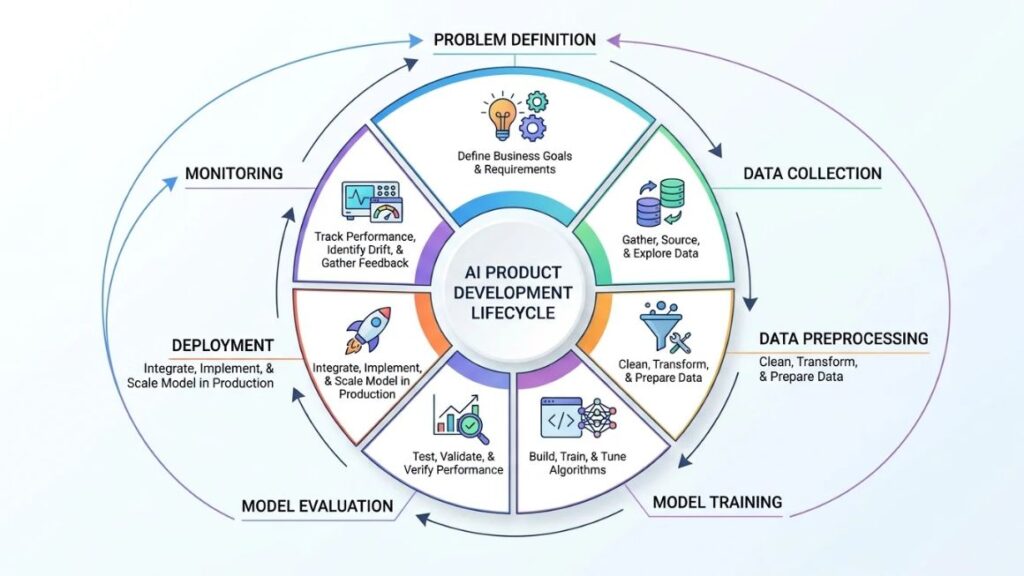
An AI product development lifecycle covers everything from validating a customer problem to monitoring and improving the live product. It is broader than model training, which is only one stage, and it is iterative: evaluation and monitoring results routinely send teams back to earlier stages.
Why Building AI Products Is Different From Building Traditional Software
Traditional software follows rules a developer wrote, so the same input gives the same output. The AI product development lifecycle exists because AI doesn’t work that way. AI products learn patterns from data, so their outputs are probabilistic and can drift as the world changes. That one difference reshapes how you test, launch and run the product.
Ask a calculator app for 2 + 2 a thousand times and you’ll get 4 every time. Ask an AI assistant the same question a thousand times in slightly different words, and what comes back depends on training data, prompts, settings and sometimes plain luck.
Data becomes the foundation. Weak, stale or unrepresentative data gives weak results however clever the model is, and real-world conditions don’t sit still. Customers change how they write. Policies get updated. Testing changes too, because passing a unit test only proves the code ran, not that the answer was any good. You have to measure output quality directly.
Then there’s the bill. Many AI products cost money every time someone uses them, which makes privacy, reliability and cost ongoing responsibilities instead of launch-week tasks.
| Area | Conventional software | AI-based product |
| Behaviour | Deterministic, rule-based | Probabilistic, learned from data |
| Main quality driver | Code correctness | Data quality plus model behaviour |
| Testing | Pass or fail against expected outputs | Quality scored across representative examples |
| After launch | Changes when developers change it | Can degrade as data and usage shift |
| Running cost | Mostly fixed infrastructure | Often grows with usage |
| Typical risks | Bugs, downtime | Wrong answers, bias, privacy leaks |
Conventional software is deterministic, while AI products are probabilistic and depend on data that keeps changing. That means AI teams must test output quality, monitor drift after launch, and treat cost, privacy and reliability as ongoing responsibilities.
The Seven Stages of Building an AI Product
The AI product development process has seven stages: discover the problem, assess data and feasibility, choose a model and prototype, build the product, evaluate, deploy, then monitor and improve. These AI product development steps overlap and loop back, but each has a clear job and a clear exit test.
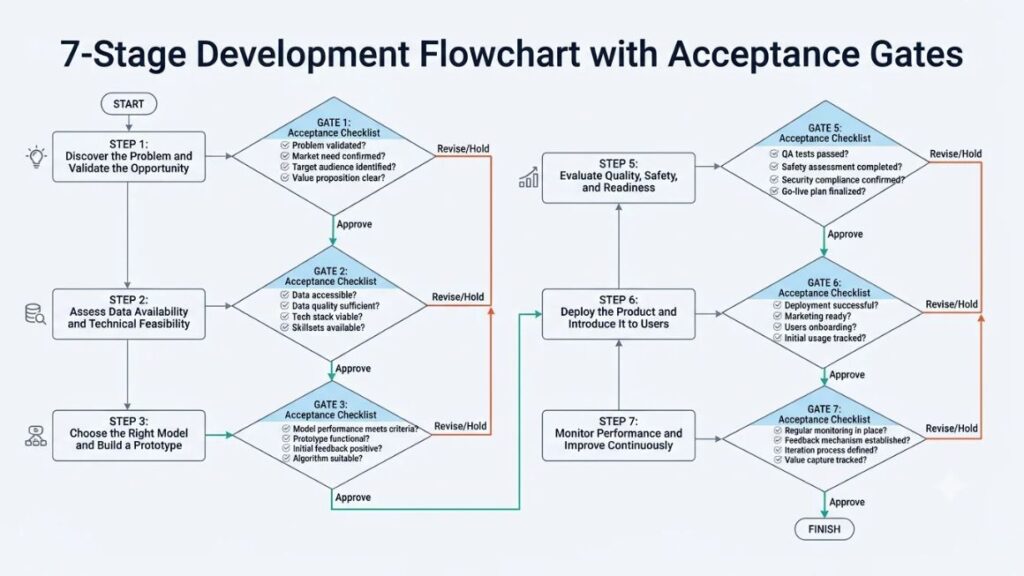
- Discover the problem and validate the opportunity
- Assess data availability and technical feasibility
- Choose a model and build a prototype
- Develop the product experience and infrastructure
- Evaluate quality, safety and readiness
- Deploy and introduce the product to users
- Monitor performance and improve continuously
Each stage below follows the same pattern: objective, key actions, a practical example, deliverables, and a checklist for moving forward. Treat the checklist as a gate, not a suggestion. A team that skips a gate in the AI product development lifecycle doesn’t save time, it just finds the problem later and pays more for it. The examples are illustrative, built around one invented lender, and every number in them is made up.
Step 1: Discover the Problem and Validate the Opportunity
Objective: Confirm that a specific, painful problem exists and that AI is a sensible way to solve it.
Key actions:
- Interview customers and watch how they do the job today, workarounds included.
- Ask honestly whether rules, search or a better form would do the job. Sometimes they do.
- Pick one measurable outcome and write down today’s baseline. Without it, “improved” is just an opinion.
- Talk to the people who’ll live with the product, not only the people paying for it.
Practical example: Say a lending startup hears that loan officers lose hours re-keying details from salary slips. Before touching a model, the team times the task and counts the errors. Assume 11 minutes per file and a few mistakes per hundred (illustrative numbers). Now there’s a baseline to beat, and a way to tell the team whether the project is worth another month.
Deliverables: A problem statement, target audience and initial success criteria.
Move forward when:
- You can state the problem in one sentence without mentioning AI.
- A baseline number exists.
- Someone has said what “good enough” looks like.
Also Read: Product Prioritization Frameworks Every PM Should Know: RICE, MoSCoW, and When to Use Which
Step 2: Assess Data Availability and Technical Feasibility
Objective: Find out whether the data, budget and infrastructure exist before anyone commits to building.
Key actions:
- List the data sources you’d need, who owns each, and who’s allowed to touch them.
- Check quality, relevance, access permissions and whether the data represents your real users.
- Estimate infrastructure, development and operating costs, because AI product development cost is easy to underestimate when you only price the prototype.
- Review privacy and security before collecting or processing anything. India’s Digital Personal Data Protection Rules were notified on 13 November 2025, with full compliance obligations phasing in by May 2027, so consent and retention questions belong here.
Practical example: The lender discovers its salary slips are stored as photos across three systems, and some customers only consented to underwriting use. That alone reshapes the plan. It might push the team toward a smaller first scope, or toward fixing the data capture before building anything clever. Better to hear that in week two than in month five.
Deliverables: A feasibility assessment and an initial data plan.
Move forward when:
- The data is accessible and permitted.
- A cost range is agreed.
- Privacy has been reviewed by someone qualified to review it.
Step 3: Choose the Right Model and Build a Prototype
Objective: Pick the simplest model approach that clears your quality bar, and prove it small before building big.
Key actions:
- Compare hosted APIs, open-weight models and custom training on quality, latency, cost and integration effort. For generative AI application development, a hosted model with good prompts is usually the cheapest first test.
- Build a proof of concept on real samples, not hand-picked ones.
- Decide when the model should abstain or pass the work to a human. Most teams skip this, and it shows.
- Keep the prototype deliberately ugly. A polished interface makes a weak model look better than it is.
Practical example: The lender tests two hosted models and one open-weight model on 200 real slips. The cheapest one keeps missing a field on handwritten forms. The rule that comes out of it: low confidence goes to a person. The team also learns the open-weight option would need a GPU budget the project doesn’t have yet, which settles that debate early.
Deliverables: A tested prototype and a documented model choice.
Move forward when:
- The prototype beats the baseline on real data.
- The abstain rule is written down.
- Cost per task is known.
Step 4: Develop the Product Experience and Supporting Infrastructure
Objective: Turn the prototype into something people can use and a team can maintain.
Key actions:
- Build the interface, APIs, data pipelines and integrations.
- Design error messages, fallback behaviour and human review.
- Version your models, prompts, datasets and configurations, so you can explain why Tuesday’s output differs from Monday’s.
- Cover accessibility and security from day one, not after launch.
- Decide where humans step in, and make that handoff feel like part of the product rather than an apology.
Practical example: Loan officers see extracted fields right beside the original slip, with shaky ones highlighted and a one-click fix. Every correction gets saved for later evaluation, so the product quietly collects the examples it will need to improve. Small design choice, big payoff later.
Deliverables: An integrated, testable product.
Move forward when:
- Each failure path has a designed response.
- Anything that changes output is versioned.
- A user can finish the whole task in a staging environment.
Also Read: How to Write a Product Requirements Document (PRD) Engineers Actually Use
Step 5: Evaluate Quality, Safety, and Readiness
Objective: Decide with evidence, not instinct, whether the product is ready to release.
Key actions:
- Build a representative evaluation set, ugly cases included.
- Run AI model evaluation on task success, consistency, latency and cost.
- Probe edge cases, hallucinations, bias, privacy risks and security weaknesses.
- Compare every result against the acceptance criteria you set back in Stage 1. If the numbers miss and the team quietly lowers the bar, that’s the moment to stop and ask why.
Practical example: In February 2024, a British Columbia tribunal ordered Air Canada to compensate a customer after its chatbot gave wrong advice about bereavement refunds. The airline argued the correct policy sat on a linked page. The tribunal didn’t accept that, saying the company is responsible for what its website tells customers, chatbot or not.
NIST’s AI Risk Management Framework, published in January 2023, offers a useful structure here with four functions: govern, map, measure and manage.
Deliverables: Evaluation results, a risk assessment and a release decision.
Move forward when:
- Scores meet the thresholds you agreed before building.
- High-severity risks are fixed, or accepted in writing by a named owner.
- Someone with authority has signed the release decision.
Step 6: Deploy the Product and Introduce It to Users
Objective: Release in a way that limits the damage if something is wrong.
Key actions:
- Start with an internal test, a pilot or a limited rollout. AI model deployment should never be a switch flipped for everyone at once.
- Set up monitoring, access controls and incident reporting.
- Prepare support documentation and plain-language user guidance.
- Agree rollback procedures and name one launch owner. Shared ownership usually means no ownership.
Practical example: The lender pilots with ten loan officers in a single branch for three weeks (hypothetical). Support is told in advance what the tool can’t do, so nobody is surprised. Officers can flag any wrong extraction in one click, and the launch owner reviews those flags every morning for the first week.
Deliverables: A controlled release with operational safeguards.
Move forward when:
- The rollback has been tested at least once.
- The launch owner is named.
- Support can answer “why did it say that?”
Step 7: Monitor Performance and Improve Continuously
Objective: Keep the product useful after the launch excitement fades.
Key actions:
- Track adoption, satisfaction, quality, latency and cost together.
- Watch for changes in data and performance over time. MLOps, short for machine learning operations, is the set of practices for deploying and maintaining models in production, and this is where it earns its keep.
- Review feedback, investigate incidents and update your evaluation set.
- Retrain or replace a model only when evidence supports it.
- Retire the product responsibly if it stops delivering enough value. Switching one off, with notice to users and a plan for their data, is part of the AI product development lifecycle too.
Practical example: A bank changes its salary slip template and accuracy dips on that one format. The team checks the logs before touching the model and finds the new layout is the only thing that changed. The fix turns out to be a parsing update, not a retrained model. Diagnosis first, retraining second.
Deliverables: An improvement roadmap and an ongoing monitoring plan.
Move forward when (this one loops):
- Review meetings are on the calendar.
- Alert thresholds are set.
- Someone owns the backlog.
Also Read: 15 Best Product Analytics Tools

A Practical Example: Building an AI Customer Support Assistant
Picture a hypothetical online home-goods retailer, called Nestwell here, drowning in support tickets. Walking through the AI product development lifecycle with one concrete case makes the stages easier to picture. Everything below, including the numbers, is invented for illustration.
Nestwell’s team starts with the problem, not the tool. Agents spend most of their day answering the same questions about order status and returns. So the first version covers only those two topics. Refunds, complaints and anything legal stay with humans.
Next comes content. The team gathers its approved help-centre articles, return policy and shipping terms, gives each document an owner and a review date, and builds a prototype that answers only from those documents and shows which article it used.
Then testing. They replay 300 past tickets (hypothetical) that agents have already labelled, checking answers for correctness and tone. When the assistant isn’t confident, it says so and offers a handoff to a person. Angry customers, refund disputes and legal threats skip the assistant altogether.
After a limited launch, the team tracks:
- Share of tickets fully resolved without an agent
- Escalation rate and why tickets escalate
- Wrong-answer rate from weekly agent audits
- Customer satisfaction on assisted tickets
- Response time and cost per resolved ticket
The numbers that matter most aren’t the flashy ones. A high resolution rate means nothing if the audits show customers getting wrong refund advice.
Tools and Technologies Used Throughout the Process
There’s no single stack that suits every product. The right AI product development tools depend on your use case, your team’s skills, your budget and how sensitive your data is, so decide on those four things before you look at a single logo.
Here’s how the categories map across the lifecycle:
- Model providers and development platforms: hosted APIs from OpenAI, Anthropic and Google, cloud platforms like Amazon Bedrock, Google Vertex AI and Azure Machine Learning, and Hugging Face for open-weight models.
- Data preparation, storage and versioning: warehouses such as BigQuery or Snowflake, plus DVC for versioning datasets alongside code.
- Experiment tracking and evaluation: MLflow and Weights & Biases for experiments, LangSmith or Langfuse for tracing and evaluating LLM apps.
- Deployment, monitoring and observability: Datadog for infrastructure, Evidently AI or Arize for data and model drift.
- Security, access management and governance: your cloud’s identity controls, a secrets manager, and the OWASP Top 10 for LLM Applications as a risk checklist.
A solo founder at the start of the AI product development lifecycle doesn’t need half of this. A bank running a regulated model needs all of it and more. Start small. Add a tool only when a real gap starts hurting.
Common Mistakes That Can Derail an AI Product
Most teams that stumble in the AI product development lifecycle do it for dull reasons, not exotic ones. A 2024 RAND report, built on interviews with 65 experienced data scientists and engineers, noted that by some estimates more than 80% of AI projects fail, about twice the rate of non-AI IT projects. Its most common root cause was people misunderstanding or miscommunicating the problem the AI was meant to solve. Treat the 80% as an estimate, not a measured fact. The pattern is hard to argue with, though.
Gartner made a similar call in 2024, predicting that at least 30% of generative AI projects would be abandoned after proof of concept by the end of 2025, citing poor data quality, weak risk controls, rising costs and unclear business value.
Watch for these:
- Starting with a model instead of a customer problem.
- Underestimating data preparation, which almost always takes longer than planned.
- Skipping baselines and realistic evaluation, then having nothing to compare against.
- Treating a prototype as production-ready because the demo went well.
- Ignoring operating costs and the actual user experience.
- Launching without monitoring or a rollback plan.
- Retraining by reflex. When performance drops, diagnose first. A changed data source, a broken pipeline or a new type of user can all cause it, and retraining fixes none of them.
A 2024 RAND report based on 65 practitioner interviews found that misunderstanding the problem to be solved is the most common reason AI projects fail. Gartner similarly predicted in 2024 that at least 30% of generative AI projects would be abandoned after proof of concept, citing poor data quality, weak risk controls, rising costs and unclear value.
Best Practices for Managing the Full Lifecycle
Managing the full AI product development lifecycle comes down to a few habits that sound boring and work anyway.
Start with ownership. Product, engineering, data, security and operations each need a named person, because AI product management falls apart the moment everyone assumes someone else is watching quality. Set acceptance criteria before you build anything, while nobody is emotionally attached to the result. And use small experiments to test the expensive assumptions early. “Will users trust this?” and “Is our data good enough?” are cheaper to answer in a week than in a quarter.
Build risk management and documentation into routine work instead of saving them for a pre-launch scramble. Responsible AI checks on bias, privacy and safety belong in the same sprint rituals as code review. NIST’s framework is a decent skeleton if you need one.
Keep two scoreboards. One for technical performance, like accuracy and latency. A separate one for business value, like resolved tickets or hours saved. A model can improve on the first and do nothing for the second.
Last, treat feedback and monitoring as part of building the product, not optional extras. They’re how the next version gets better.
Conclusion
Strip away the tooling and the AI product development lifecycle comes down to four habits: validate the problem before building, check that your data can carry the weight, test against criteria you set in advance, and keep improving after launch.
Move forward because the evidence says so, not because the demo felt exciting. That sounds obvious. It’s also the thing teams skip most often.
So here’s a small first step. Pick one customer problem you’re already hearing about. Write it in a sentence without mentioning AI, then describe what a successful solution would look like in numbers. If you can’t, no model will do it for you. If you can, you’ve just finished Stage 1 of your AI product development lifecycle.
If you’re building AI products, or moving into a product role that touches them, structure helps. YUP’s 12-week, mentor-led Product Management Course covers the product cycle from discovery and requirements to analytics and experimentation, and includes a module on tech skills and GenAI for PMs.
FAQs About Building AI Products
What are the main stages of AI product development?
The AI product development lifecycle has seven main stages: problem discovery, data and feasibility assessment, model selection and prototyping, product and infrastructure development, evaluation, deployment, and ongoing monitoring and improvement. The stages overlap and loop back. Evaluation results often send teams to earlier stages, which is normal and healthy. Skipping one rarely saves time.
How long does it take to build an AI product?
It depends on scope, data readiness and how regulated the use case is. A narrow prototype on a hosted model can come together in weeks. A production-ready product with integrations, evaluation, monitoring and governance usually takes months. Data preparation is the most common source of delay.
How much does AI product development cost?
There’s no honest universal number. The main cost drivers are team time, data preparation, model usage fees or compute, infrastructure, evaluation, monitoring and ongoing support. A prototype is cheap enough to test an idea. The bills that surprise teams show up later, at scale.
Do all AI products need a custom-trained model?
No. Many products work well with a hosted model or an open-weight model plus good prompts, retrieval and clean data. Custom training or fine-tuning makes sense once you’ve shown that those options can’t reach your quality, cost or latency targets.
How do you know whether an AI product is ready to launch?
A product is ready when it meets the acceptance criteria you set before building, measured on representative data. High-severity risks should be closed or accepted by a named owner, and monitoring, human escalation and rollback should all be tested. Even then, start with a limited rollout.
What happens after an AI product goes live?
The work shifts to monitoring and improvement. Teams track quality, adoption, cost and latency, watch for drift, review user feedback and incidents, and update their evaluation sets. They retrain or replace models only when evidence supports it, and eventually retire the product if it stops delivering value.