
AI-related roles now dominate the top of LinkedIn’s Jobs on the Rise 2026 list, with AI engineers at number one and AI consultants and strategists at number two. Product management is one of the most common backgrounds people transition from into both roles. But a specific title is also growing fast alongside them: the AI product manager.
AI product management is not the same as regular product management with an AI project bolted on. It’s a distinct role with different skill demands, different failure modes, and a different relationship with engineering. If you’re a PM, a marketer, a data analyst, or a technologist wondering whether this career path is for you, this article will give you a clear, honest picture.
You’ll learn exactly what AI PMs do, how the role differs from traditional product management, what skills you actually need, and a step-by-step roadmap for getting there.
Table of Contents
What is AI Product Management?
AI product management is the discipline of defining, building, and shipping products that use artificial intelligence or machine learning as a core part of the user experience or business function. An AI PM owns the product vision for features or entire products where the output isn’t just code – it’s a model’s prediction, recommendation, classification, or generation.
That distinction matters more than it sounds. A traditional product manager ships features with deterministic behaviour: you click the button, this thing happens. An AI product manager ships systems with probabilistic behaviour: the model gives its best answer, which changes depending on the data, the context, and the user.
Think about the PM behind Spotify’s Discover Weekly playlist feature. They’re not just managing a UI. They’re managing a recommendation model that has to be accurate enough to feel personalised but exploratory enough to introduce new music. Success isn’t a binary function. It’s a distribution of outcomes that need to be measured, monitored, and constantly improved.

Or consider the team at Swiggy managing delivery time predictions. Every order shows the user an estimated delivery window. That number comes from a model. If the model is wrong too often, trust drops, refund requests spike, and retention suffers. The AI PM owns that. Not just the display – the prediction engine behind it.
AI product management is the practice of building products where artificial intelligence or machine learning is central to the user experience or core business output. Unlike traditional product management, AI PMs manage probabilistic systems where success is measured by model accuracy, user trust, and continuous improvement rather than binary feature completion. The role sits at the intersection of product thinking, data science, and business strategy.
How is an AI PM Different from a Regular PM?
Most PM skills transfer. Defining user problems, writing specs, prioritising roadmaps, working with engineers and designers, analysing data to make decisions. That foundation doesn’t go away. But AI product management adds a layer of complexity that most PMs haven’t had to deal with before.
Here’s where the roles diverge in practice.
You manage uncertainty, not just scope
Traditional PM: the feature either works or it doesn’t. AI PM: the feature works with varying degrees of confidence. A fraud detection model might flag 92% of fraud cases but also flag 3% of legitimate transactions. Is that good enough? Should you optimise for precision or recall? Those are business decisions, and the AI PM owns them. This edge matters most in high-risk sectors, where document fraud detection has to keep up with increasingly sophisticated synthetic threats.
Data is your product’s raw material
Regular PMs deal with data as output. AI PMs deal with data as input. The quality, freshness, and structure of training data directly affects what your product can do. A regular PM can ship a feature without thinking much about the database schema. An AI PM who ignores data pipelines is building on sand.
Your definition of “done” is different
In traditional product work, launching a feature is a milestone. In AI product work, launching is when the real work begins. Models drift. User behaviour changes. The data distribution shifts. AI PMs plan for post-launch model monitoring, retraining cycles, and A/B testing of model versions – not just UI experiments.
You have to manage explainability and trust
When a feature breaks, you can point to a bug. When a model behaves unexpectedly, explaining why to users, regulators, or executives is much harder. AI PMs have to think about how to communicate model limitations, handle edge cases, and build user trust in systems that aren’t fully transparent by nature.
The core difference between an AI PM and a traditional PM is that AI PMs manage probabilistic systems, not deterministic features. They own data quality, model evaluation, post-launch monitoring, and the communication of uncertainty to stakeholders. These responsibilities require a working knowledge of machine learning fundamentals that most traditional PM roles don’t demand.
What Does an AI Product Manager Actually Do Day to Day?
This is where most articles get vague. So let’s be specific.
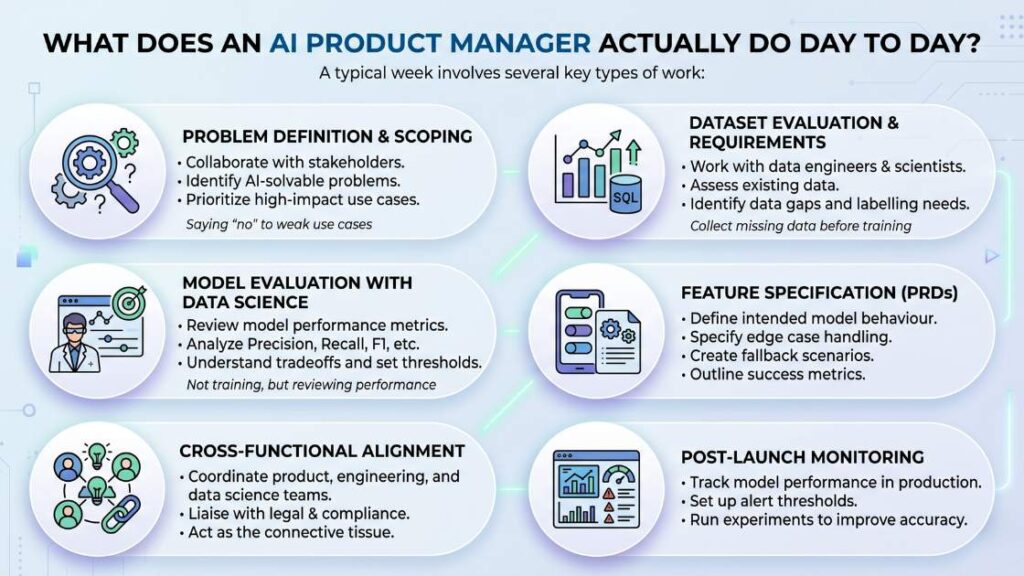
An AI PM’s week typically spans across several types of work:
- Problem definition and scoping: Working with business stakeholders to identify where AI can actually solve a real problem. This involves a lot of saying no to AI use cases that sound impressive but don’t have sufficient data, clear success metrics, or a strong enough user need to justify the investment.
- Dataset evaluation and requirements: Working with data engineers and data scientists to understand what data exists, what’s missing, and what labelling or collection work is needed before a model can be trained.
- Model evaluation with the data science team: Not training the model, but reviewing model performance metrics – precision, recall, F1, AUC-ROC depending on the use case – understanding tradeoffs, and making calls about acceptable thresholds.
- Feature specification: Writing PRDs that describe not just the UI but also the expected model behaviour, edge case handling, fallback scenarios when the model is uncertain, and success metrics.
- Cross-functional alignment: AI projects require closer coordination between product, engineering, data science, legal, and sometimes compliance teams. AI PMs are the connective tissue.
- Post-launch monitoring: Setting up dashboards to track model performance in production, defining alert thresholds, and running experiments to improve model accuracy over time.
At companies like Google, Meta, and Amazon, AI PMs often sit embedded within ML teams. At startups, they might be the only person connecting the data science function to the business. The scope varies, but the core accountability is the same: own the outcome the AI system produces, not just the product surface it lives in.
What Skills Do You Need to Become an AI PM?
There are four skill areas that matter. You don’t need to be an expert in all of them, but you need honest working competence in each.
1. Core product management skills
User research, problem framing, prioritisation, roadmapping, writing specs, stakeholder management, and metrics thinking. If you’re a solid PM already, this is covered. If you’re new to product management, this is actually where to start — before layering in AI.
2. Machine learning fundamentals (non-coding)
You don’t need to write Python or train models. But you do need to understand: supervised vs unsupervised learning, classification vs regression, what training data is and why quality matters, basic model evaluation metrics, what overfitting and underfitting mean, and the difference between a rule-based system and an ML system.
This knowledge lets you have credible conversations with data scientists, write meaningful specs, and catch problems before they become expensive. Without it, you’re just a gatekeeper.
3. Data literacy
SQL basics, an ability to read dashboards critically, and enough statistical intuition to understand what a metric is actually telling you. You should be able to set up an A/B test, interpret results without just trusting p-values, and identify when a metric is being gamed vs genuinely improving.
4. AI ethics and responsible AI thinking
Bias in training data, fairness across user segments, transparency, and the regulatory environment. AI PMs in fintech, healthcare, or edtech have to understand GDPR and India’s Digital Personal Data Protection Act (DPDPA). Even for less regulated domains, the reputational risk of shipping a biased or harmful AI feature is significant.
To become an AI product manager, you need four competencies: strong core PM skills, working knowledge of machine learning fundamentals without needing to code, data literacy including SQL and statistical thinking, and an understanding of AI ethics and responsible AI principles. Technical depth matters less than the ability to make sound product and business decisions in AI-driven contexts.
Do You Need a Technical Background to Be an AI PM?
Short answer: no. But you do need to learn some technical concepts. There’s a difference.
A lot of current AI PMs have engineering or data science backgrounds. That’s partly historical. AI products used to live deep inside technical organisations and the PMs who worked on them were usually ex-engineers who drifted into product. That’s changing fast.
Companies are now building AI into customer-facing products, marketing tools, HR platforms, legal tech, and everything in between. These products need PMs who understand users and business outcomes as much as they understand models. Strong business or domain knowledge combined with ML literacy is actually more valuable in many of these roles than a computer science degree.
From what we’ve seen with YUP course learners who have made this transition, the biggest edge often goes to people who combine product instincts with a specific domain – a marketer who understands how recommendation engines work, a finance professional who understands fraud detection, a healthcare administrator who can scope clinical AI tools. That specificity gets you hired faster than a general technical profile with no business context.
That said, you can’t be entirely hands-off with the technical side. At minimum, you need to be able to sit in a model review meeting and ask the right questions. That requires learning the vocabulary and the core concepts, even if you’re never writing the code.
Also Read: What is PDCA Cycle – Product Management Framework?
How to Become an AI PM: Step-by-Step Roadmap
This is the practical path. It assumes you’re coming from a product, marketing, data, or business background and want to move into AI product management within 6-18 months.
Step 1: Audit your current skills honestly
Map yourself against the four skill areas above. Be specific about your gaps. “I don’t know ML” is too vague. “I don’t know what precision vs recall means or when each matters more” is a gap you can close in a few hours.
Step 2: Build ML literacy without coding
Google’s Machine Learning Crash Course (free) and fast.ai’s Practical Deep Learning course are both well-suited to non-engineers. You’re not training to become an ML engineer. You’re training to understand what your data science teammates are doing and why their decisions matter to the product.
Step 3: Get hands-on with AI tools as a product user
Use ChatGPT, Claude, Gemini, Midjourney, and Perplexity actively – not casually. Analyse them as products. What’s the user intent they’re solving for? Where do they fail? What prompting strategies improve output quality? What are their latency tradeoffs? This product-level analysis of AI tools builds intuition faster than any course.
Step 4: Build or contribute to an AI project
This doesn’t have to be a job. It can be a side project, an internal tool at your current company, or a contribution to an open-source product. The goal is to have a real experience of scoping an AI feature, working with data, and evaluating a model’s performance against a user need. Without this, your resume is purely theoretical.
Step 5: Build your AI PM portfolio
Write case studies. Tear down AI features in products you use. Publish analyses of how Swiggy’s delivery prediction or Zepto’s substitution recommendation or Nykaa’s personalisation engine works from a product perspective. This builds both your thinking and your visibility.
Step 6: Target the right roles and companies
Look for roles with titles like AI PM, ML PM, Product Manager (AI/ML), or Applied AI Product Manager. At the company level, the best early AI PM opportunities are at companies where AI is central to the product, not an add-on. In India, that includes Zepto, PhonePe, Razorpay, Meesho, and CRED. Globally, Spotify, LinkedIn, Salesforce, HubSpot, and every major AI platform are actively hiring.
Step 7: Prepare for AI PM interviews specifically
AI PM interviews include standard PM interview formats – product design, estimation, strategy, metrics – but often add specific questions around model evaluation, data requirements, handling model failures, and responsible AI. Practice articulating tradeoffs between precision and recall in business terms. Know how to define success metrics for a model, not just a feature.
AI PM Career Path: Roles, Companies, and Salaries
The AI PM career path is still forming, which is actually good news for people entering now. The titles vary significantly across companies.
Common AI PM role titles
- AI Product Manager or ML Product Manager
- Applied AI Product Manager (focused on applying existing AI models to business problems)
- Technical PM with AI/ML focus
- AI Platform PM (building the infrastructure and tools used by other AI teams)
- Responsible AI Product Manager (focused on fairness, safety, and compliance)
Salaries
In India, according to Glassdoor data as of early 2026, the average AI PM salary sits around Rs 30 LPA. The 75th percentile reaches Rs 45-46 LPA, and top earners at the 90th percentile report upwards of Rs 82 LPA. Entry-level roles typically start at Rs 18-22 LPA at mid-size tech companies, while senior AI PMs at high-growth product-first companies like PhonePe, CRED, or Razorpay can reach Rs 60 LPA and above including variable and ESOPs.
In the US, Glassdoor data from April 2026 puts the average AI PM base salary at $194,644 per year. The 75th percentile sits at $240,069 and top earners at the 90th percentile report up to $288,009. That’s base salary only. At AI-native companies, total compensation including equity is substantially higher – Levels.fyi data shows median total comp for PMs at OpenAI at $860K and at Meta at $559K, though these figures reflect all PM levels and include significant equity components.
The premium over general PM compensation is real in both markets. An AI PM earns meaningfully more than a PM with a comparable experience profile who hasn’t built AI-specific skills. That gap is widening, not closing, as demand continues to outpace supply.
Common Mistakes People Make When Transitioning to AI PM
These mistakes cost people months of wasted preparation or cost them the role in interview.
Thinking AI knowledge is enough without strong PM fundamentals. Most people who want to be AI PMs underinvest in the product side. User research, problem scoping, and metrics thinking are not optional extras. They’re the job. An ML engineer who takes a course on AI models and calls themselves an AI PM will not make it past a rigorous product design interview.
Treating AI as a solution before identifying the problem. “We should use AI for this” is not a product strategy. The discipline is to start with the user problem and then ask whether AI is the right tool. In most cases, a simpler rules-based system solves the problem faster and at lower cost. AI PMs who can make that call honestly are far more valuable than those who chase AI for its own sake.
Not understanding data constraints early enough. Many AI projects fail because the data needed to train a useful model either doesn’t exist, isn’t labelled, or is too biased to produce fair outputs. AI PMs who don’t evaluate data feasibility before scoping features waste months of engineering time.
Ignoring post-launch model behaviour. Shipping a model and moving on is one of the most common AI product mistakes. Models degrade. Distribution shifts. User patterns change. The PM who monitors production model behaviour and closes the feedback loop is the one whose product keeps improving.
Underestimating the ethical and compliance layer. AI products operating in India need to account for the DPDPA. Products in healthcare, finance, or hiring need additional scrutiny. Ignoring this until lawyers flag it is expensive. AI PMs who build responsible AI thinking into the product spec from day one save companies significant downstream risk.
The most common transition mistake for aspiring AI PMs is prioritising AI technical knowledge over product fundamentals. Strong user research, problem framing, and metrics thinking remain the foundation of the role. AI PMs also frequently underinvest in understanding data constraints and post-launch model monitoring – both of which are distinct responsibilities compared to traditional product management.
Frequently Asked Questions about AI Product Manager Role
What is AI product management?
AI product management is the practice of building and managing products where artificial intelligence or machine learning drives the core user experience or business output. AI PMs own the product vision, the data strategy, model evaluation, and post-launch monitoring for AI-powered features or entire AI products.
What’s the difference between an AI PM and a regular PM?
A regular PM ships deterministic features where success is binary. An AI PM ships probabilistic systems where success is a distribution of outcomes measured by model accuracy, user trust, and improvement over time. AI PMs also manage data requirements, model evaluation, and responsible AI considerations that don’t apply in traditional product work.
Do I need to know coding to become an AI PM?
No, you don’t need to write code. But you do need working knowledge of machine learning fundamentals – including how models are trained and evaluated, what training data is, and what model performance metrics mean. This knowledge lets you work credibly with data science teams and write specifications that are technically sound.
Can a marketer or non-technical person become an AI PM?
Yes. Domain expertise combined with ML literacy is genuinely competitive in many AI PM roles, especially for AI products in marketing, commerce, edtech, or healthcare. The key is investing in learning the ML fundamentals and data concepts that let you work effectively with technical teams, even without an engineering background.
How long does it take to become an AI PM?
For someone with existing product management experience, 6-12 months of focused learning and project work is a realistic timeline to become competitive for mid-level AI PM roles. For someone starting from a non-PM background, 12-18 months is more realistic, including building foundational PM skills alongside AI-specific knowledge.
What is a good AI PM salary in India?
According to Glassdoor data from early 2026, the average AI PM salary in India is around Rs 30 LPA. The 75th percentile is approximately Rs 45-46 LPA, and top earners at the 90th percentile report upwards of Rs 82 LPA. Senior AI PMs at product-led startups and large tech companies can exceed this with variable pay and ESOPs included.
Is AI product management only for large tech companies?
No. AI is being built into products across industries – from D2C brands using recommendation engines to healthtech startups using diagnostic models to fintech companies using fraud detection. Some of the most interesting AI PM opportunities are at mid-size companies where you own a much larger scope than you would at a large tech firm.
What are the most important metrics an AI PM tracks?
This varies by product type, but AI PMs typically track: model accuracy (precision, recall, or F1 depending on the use case), user engagement with AI-generated outputs, user trust signals (did the user follow the recommendation?), model latency, and data pipeline health. Business impact metrics like conversion rate or retention are tracked alongside model metrics, not instead of them.
The Bottom Line on AI Product Management
AI product management is a real, distinct discipline. It’s not just regular PM with “AI” in the job title. The role requires a specific combination of product thinking, ML literacy, data skills, and responsible AI awareness that most PMs haven’t needed before.
But it’s accessible. You don’t need a computer science degree. You need to learn the right concepts, build something real, and develop the ability to make sound product and business decisions in contexts where the output is probabilistic rather than deterministic.
The demand is real, the compensation premium is significant, and the window for building an early advantage in this field is still open. The PMs who invest now will be well positioned as AI moves from a technical specialisation into the default expectation for anyone building digital products.