

Most sales teams don’t have a lead problem in 2026. They have a bandwidth problem. Reps are drowning in research, follow-ups, and CRM data entry, and the fifty prospects on their list this week get the same generic template as the fifty from last week. That’s the gap an AI Agent for Sales Outreach is built to close, and it’s why revenue leaders who ignored the category in 2024 are now scrambling to catch up.
This guide walks through what these systems actually do, which platforms are worth evaluating, how to set one up without wrecking your domain reputation, and where the honest limitations still sit. By the end, you’ll know whether your team is ready, what to buy, and what to measure before you spend a rupee or a dollar on it.
Table of Contents
What Does an AI Sales Agent Actually Do?
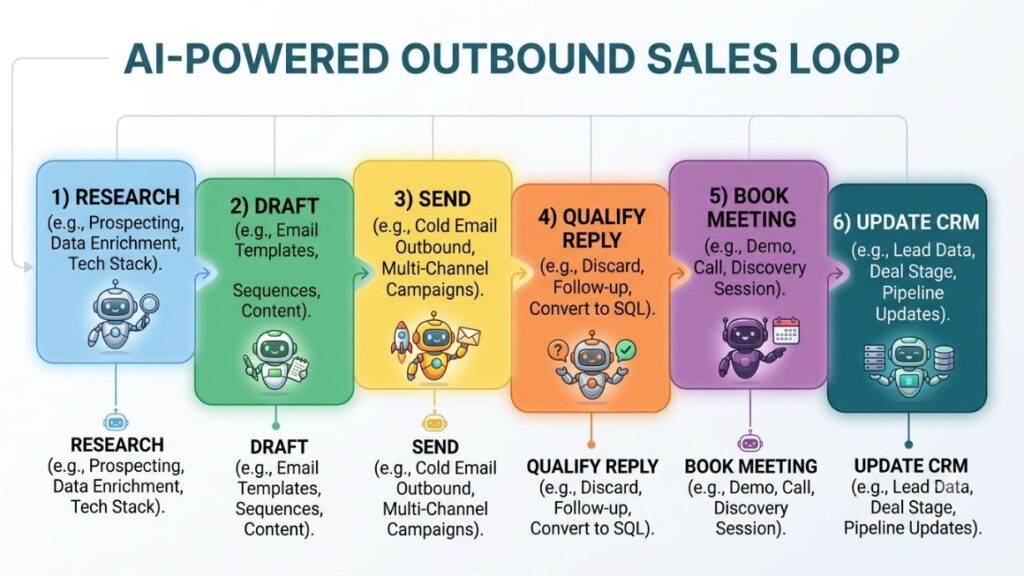
An AI sales agent is software that takes real actions across the outbound cycle: researching accounts, drafting messages, sending follow-ups, qualifying replies, booking meetings, and updating the CRM, with varying degrees of autonomy. That’s a broader definition than an “AI SDR,” which usually refers to just the top-of-funnel slice of the same job.
The distinction matters because vendors use the terms loosely. Some tools only draft copy and leave everything else to a human. Others run the whole loop, from finding a prospect’s LinkedIn activity to scheduling the call on a rep’s calendar. Neither approach is wrong. They just solve different problems.
Here’s the simplest way to think about it: a chatbot responds when prompted. An agent plans, uses tools, remembers context, and acts across multiple systems without someone typing a new instruction every step. That’s what separates this generation of software from the sequencing tools sales teams used five years ago.
Why Sales Teams Are Racing to Adopt AI in 2026
The honest answer is competitive pressure, not novelty. AI usage among sales reps jumped from 24% in 2023 to 43% in 2024, a 79% year-over-year increase, according to HubSpot’s State of Sales 2025 report. Teams that sat out that shift are now competing against reps who send five times the qualified volume in the same working week.
Cost is the other driver. Laxis’s 2026 industry benchmark on agentic sales tools reports that around 75% of B2B sales organizations expect to use some form of AI-driven sales development by the end of the year, with reported first-year returns commonly landing between 300% and 500% once a deployment is past its first quarter. That’s a hard number for a VP of Sales to ignore in a budget meeting.
But volume alone doesn’t win. Sopro’s State of Prospecting 2026 report found that highly personalized outreach earns an 18% reply rate against 9% for generic messages, exactly double. That single data point is why the smarter deployments in 2026 aren’t chasing send volume. They’re using automation to make personalization possible at a scale no human team could match by hand.
AI usage among sales reps grew from 24% to 43% between 2023 and 2024, a 79% jump reported by HubSpot’s State of Sales 2025 study. Personalized outreach nearly doubles reply rates compared to generic messaging, per Sopro’s 2026 prospecting research, which is why volume without personalization is no longer a winning strategy.
Sales Outreach has quietly shifted from a numbers game to a personalization game over the last two years, and that shift is exactly what’s pulling budget toward automation. Adoption is no longer confined to Silicon Valley either. Microsoft reports that 93% of Indian business leaders intend to use AI agents to extend their workforce’s capabilities within the next 12 to 18 months, a signal that this shift is global, not a US-only trend.
Read More: AI Agents for Marketing
Core Capabilities: What These Systems Handle End to End
A serious deployment covers most or all of five jobs that used to sit entirely with a human SDR.
Account and contact research. The system pulls firmographic data, recent funding news, hiring signals, and technology stack information, then compiles it into a usable brief before a message is ever drafted.
Message drafting and personalization. Instead of a single mail-merge template, the tool writes a first-draft email or LinkedIn message referencing something specific about that account, then adjusts tone based on the persona it’s targeting.
Sequencing and follow-up. Multi-step cadences fire automatically across email and LinkedIn, with the system deciding whether to escalate, pause, or change channel based on how the prospect has engaged so far.
Reply handling and qualification. When a prospect responds, the tool classifies intent, whether it’s interest, an objection, an out-of-office, or a flat no, and routes the reply accordingly instead of dumping it into one inbox.
Meeting booking and CRM sync. Once someone agrees to talk, the agent checks calendar availability, sends the invite, and writes the full interaction history back into the CRM without a rep touching a keyboard.
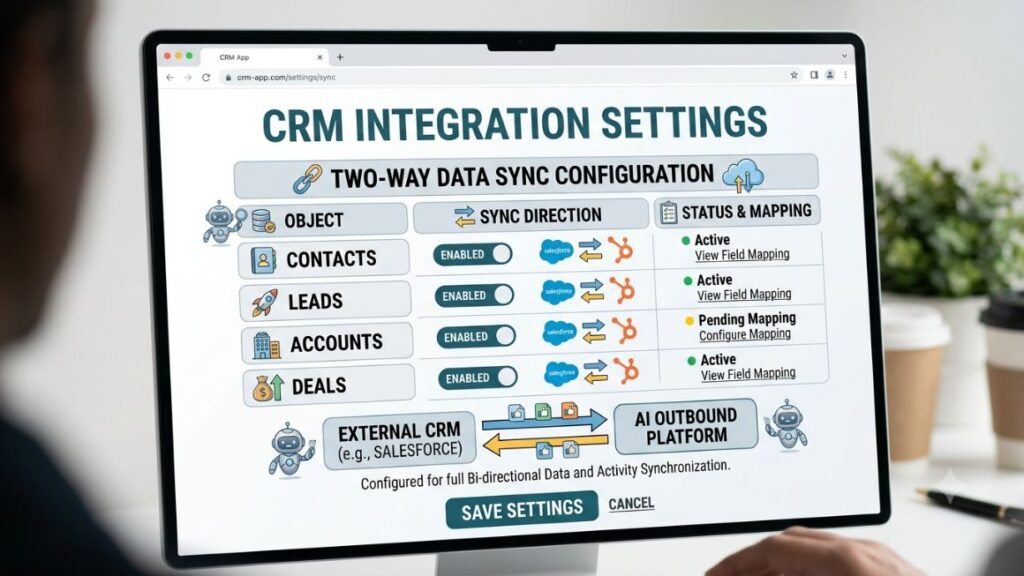
Laxis’s 2026 report is blunt about where deployments fail: broken CRM write-back is the single most common point of failure, because reps stop trusting a tool the moment its data doesn’t match what’s actually happening in the pipeline.
There’s a sixth job worth naming separately: signal detection. The stronger platforms in 2026 monitor buying signals continuously, things like a prospect changing jobs, a company posting a relevant hire, or a competitor’s contract coming up for renewal, and surface those moments as trigger events rather than waiting for a rep to notice them manually. This is the piece that turns a static list into something closer to a living account plan.
Read More: AI Agent for Video Marketing: Automate Video Creation, Publishing & Analytics
Best AI Sales Agents Worth Evaluating Right Now
You don’t need to test every vendor in the category. A handful of platforms cover most use cases well in 2026.
- Artisan (Ava) builds a fully autonomous outbound rep that handles research, copywriting, and sequencing in one interface, aimed at teams that want minimal manual setup.
- 11x (Alice) positions itself as a digital worker that runs continuous outbound campaigns and reports pipeline contribution the way you’d track a human SDR’s quota.
- Regie.ai focuses on generating on-brand messaging at scale while giving reps editing control before anything ships, which suits teams wary of full autonomy.
- Apollo.io pairs a large contact database with built-in sequencing and AI drafting, making it a common starting point for teams without an existing data provider.
- Clay is less an agent and more an orchestration layer, letting teams stitch together enrichment, scoring, and message generation from multiple data sources into one workflow.
- Salesloft and Outreach.io have both layered agentic features onto their existing cadence platforms, a natural fit for teams already standardized on one of them.
- Freshworks’ Freddy AI gives Indian and APAC-based teams already on Freshsales a native agent option without adding another vendor to the stack.
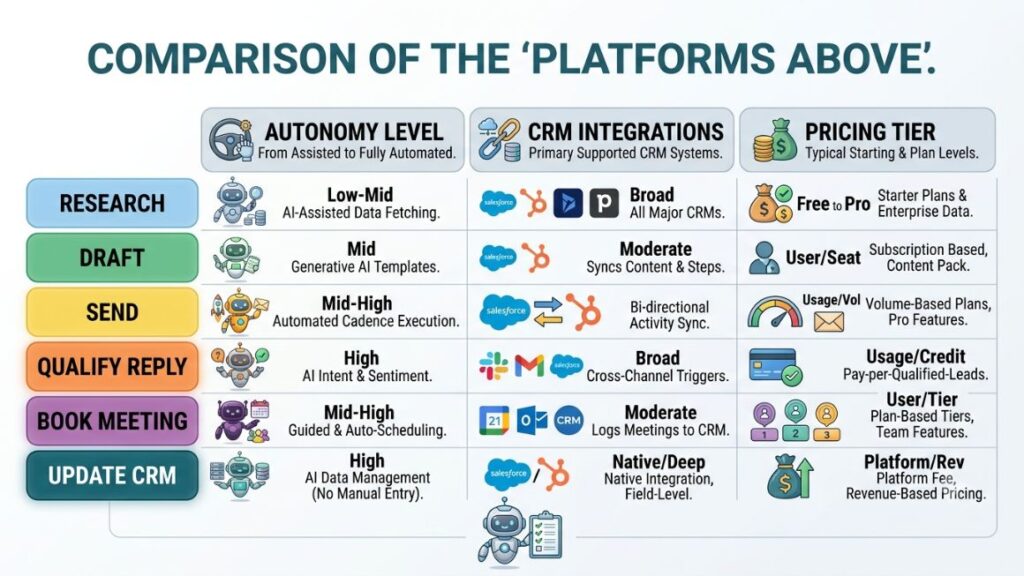
Pick based on how much autonomy your team is actually comfortable handing over, not on which tool has the flashiest demo. That distinction decides more deployments than any feature checklist.
Read More: AI Agent for Affiliate Marketing: Automate Content, SEO & Conversions
How to Roll Out an AI Sales Agent Across Your Team
Rolling one of these tools out well takes more planning than flipping a switch. Follow these steps in order.
- Audit your current outbound data. Pull your ICP definition, your best-performing email templates, and your CRM field structure before you touch a vendor demo. A tool trained on messy data produces messy outreach.
- Choose a scope, not a platform. Decide whether you want the agent handling research only, drafting only, or the full send-to-CRM loop. Start narrower than you think you need to.
- Connect the CRM first. Set up two-way sync before you send a single message. This is the integration Laxis’s research flags as the most common failure point, so treat it as non-negotiable.
- Warm up sending domains gradually. Ramp volume over two to three weeks rather than switching on full capacity immediately, to protect deliverability and domain reputation.
- Set human review checkpoints. Require rep approval on drafts for the first month, even on tools marketed as fully autonomous. You want to catch tone problems before a prospect does.
- Run a 30-day pilot with one segment. Test against a single ICP tier or territory instead of your entire book of business, so a bad batch of messaging doesn’t touch every account you own.
- Review reply quality weekly, not just volume. Read a sample of actual replies every week during the pilot. Send counts tell you activity. Reply quality tells you whether the thing is working.
- Expand only after CRM data holds up. Scale to more reps or segments only once the write-back accuracy has been verified over multiple weeks, not days.
Where AI Sales Agents Win and Where They Still Fall Short
Give credit where it’s due. The 2026 data on this is more nuanced than the hype cycle suggested two years ago.
Fully autonomous setups book more raw meetings, but they convert noticeably worse. Laxis’s controlled 2026 testing found that hybrid human-plus-AI pods generate roughly 2.3 times more revenue from fewer, higher-quality meetings than fully autonomous configurations chasing volume. That’s a meaningful gap, not a rounding error.
Honestly, this is the part vendors gloss over in sales calls. Full autonomy sounds impressive in a demo. In production, most teams that actually protect revenue keep a human reviewing tone and context before a message ships, at least for their higher-value accounts.
Where these tools clearly earn their keep is repetitive, well-structured work: research compilation, first-draft copy, cadence timing, and CRM logging. Where they still struggle is judgment calls that depend on unstated context, like reading between the lines of a vague reply from a skeptical VP who’s been burned by a vendor before.
Gartner’s often-cited warning is worth repeating here: over 40% of agentic AI projects are expected to be cancelled by 2027 due to unclear ROI and weak governance. That’s not a reason to avoid the category. It’s a reason to scope your pilot tightly and measure honestly instead of assuming autonomy alone will fix a broken pipeline.
Read More: AI Agents for Marketers: The Complete 2026 Guide
Measuring ROI: The Metrics That Actually Matter
Skip vanity metrics. Track these instead, and review them on a fixed weekly cadence rather than only at quarter-end.
- Reply rate by personalization tier, not just overall reply rate, so you can see whether the tool’s personalization is actually earning better responses than a generic template would.
- Meeting-to-opportunity conversion, which exposes whether the volume the tool generates is translating into real pipeline or just noisy calendar bookings.
- CRM write-back accuracy, checked against a manual sample, since this is the metric most likely to quietly break without anyone noticing until pipeline reporting looks wrong.
- Payback period, benchmarked against the 3.4-month median that BCG and Forrester’s 2026 research reports for SDR-focused agent deployments specifically.
- Deliverability health, tracked through domain reputation and spam-complaint rate, since a volume spike that tanks your sending domain can undo months of pipeline work in days.
SDR-focused AI deployments report a median payback period of 3.4 months, according to BCG and Forrester’s 2026 research, the fastest of any agentic AI use case measured. That number only holds up when teams track CRM write-back accuracy and deliverability alongside raw reply volume rather than in isolation.
If a vendor can’t tell you how their tool performs against these five, that’s a red flag worth raising before you sign a contract, not after.
Ask for a reference customer in your industry, not just a case study slide. A vendor confident in their product will connect you with an existing customer willing to talk honestly about deployment friction, not just the polished win they feature in marketing.
Build vs. Buy: Should You Build Your Own Outreach Agent?
Some engineering-heavy companies ask a fair question: why buy a vendor platform when you could wire together an outbound workflow using an LLM API, a CRM connector, and an orchestration layer like Clay?
The honest answer is it depends on team size and maintenance appetite. A custom build gives you full control over prompts, data sources, and how aggressively the system escalates a reply. That flexibility comes at a cost, though. You own every prompt update, every deliverability fix, and every integration break when a CRM vendor changes its API.
Vendor platforms like Artisan, 11x, and Regie.ai bundle in deliverability infrastructure, pre-built CRM connectors, and ongoing model updates that a two-person growth team would struggle to maintain long term. For most mid-market sales organizations, buying gets you to a working pilot in weeks instead of a quarter.
The middle path, and one that’s becoming more common in 2026, is buying the core sending and sequencing layer while building custom enrichment logic on top of it through a tool like Clay. That gives you proprietary data advantages without owning the entire deliverability stack yourself. Teams with a data engineering function already in place, similar to how Zepto’s growth team approaches internal tooling, tend to lean toward this hybrid setup rather than picking one extreme.
If your team has never shipped an internal automation project before, start with a vendor platform. You can always migrate pieces in-house later or Hire AI Developer experts once you know exactly which part of the workflow needs custom logic.
Common Mistakes Teams Make When Deploying These Tools
The failure pattern repeats often enough across 2026 deployments that it’s worth naming directly.
Teams turn on full sending volume in week one, before deliverability infrastructure is ready, and burn their domain reputation before the tool ever gets a fair test. Others skip the CRM integration step entirely, assuming they’ll “connect it later,” and end up with pipeline data nobody trusts within a month.
A subtler mistake: treating every reply the same way a human SDR would have, without recalibrating for how AI-drafted outreach reads to a skeptical buyer. Academic research from the Nuremberg Institute has found that labeling content as AI-generated measurably reduces perceived sincerity and engagement likelihood, even when the underlying content is identical to a human-written version. That doesn’t mean hide the tool. It means the copy still has to sound like it came from a person who did their homework, not a template with a name swapped in.
And then there’s the budget mistake: buying the most autonomous, most expensive tier available because it demos well, instead of scoping to what your team can actually operationalize with proper review checkpoints in the first quarter.
Conclusion
The teams winning with automated outbound in 2026 aren’t the ones who bought the flashiest tool. They’re the ones who scoped a narrow pilot, connected their CRM properly before sending a single message, and kept a human reviewing tone until the data proved the system earned more autonomy. Reply quality and CRM write-back accuracy matter more than send volume, every time.
Done right, an AI Agent for Sales Outreach becomes a force multiplier for your existing reps rather than a replacement for the judgment they bring to a deal. If you’re weighing whether to start now, start with one segment, one clear success metric, and a 30-day window before you scale anything further. That’s a smaller bet than most vendors will pitch you, and it’s the one that actually protects your pipeline while you learn what the tool is good at.
If you want a structured way to actually build and prompt these systems rather than just buying a black box, Hotskill’s course library walks through practical AI tool workflows step by step, including how to set up automation like this without a technical background.
Frequently Asked Questions
What is an AI sales agent, exactly?
It’s software that researches prospects, drafts and sends outbound messages, qualifies replies, and books meetings with some degree of autonomy, syncing every step back into your CRM. It goes beyond a simple email sequencer because it can make decisions mid-cycle, like changing channel or escalating a warm reply, without a human manually triggering the next step.
How is an AI sales agent different from a chatbot?
A chatbot responds only when someone prompts it, usually inside a single conversation window. An agent plans multi-step work, uses external tools like a CRM or email inbox, remembers context across the outbound cycle, and takes action without waiting for a new instruction at every stage.
How is this different from regular sales automation tools like Outreach or Salesloft?
Traditional cadence tools follow a fixed sequence you build in advance and wait for a human to adjust it. Agentic platforms make in-cycle decisions themselves, drafting fresh copy per account and deciding how to handle a reply, rather than just executing a pre-set script on schedule.
How do I set one of these up without hurting my email deliverability?
Warm up your sending domain gradually over two to three weeks instead of switching on full volume immediately, and keep send counts modest during the first pilot. Most deliverability damage in 2026 deployments comes from teams skipping this ramp-up step entirely.
Who should actually use an AI sales agent, and who shouldn’t?
Teams with a defined ICP, existing CRM discipline, and at least one person who can review output weekly get the most value. Teams without a clear ideal customer profile or clean CRM data tend to just automate confusion faster, so fix those basics first.
Is this actually worth the cost, or is it overhyped?
The data suggests real returns when scoped correctly. Reported first-year ROI commonly falls between 300% and 500%, per Laxis’s 2026 benchmark, with SDR-focused deployments paying back in a median of 3.4 months according to BCG and Forrester. That said, Gartner projects more than 40% of agentic AI projects will be cancelled by 2027 due to weak governance, so results depend heavily on how carefully a team implements it.
Why isn’t my deployment generating quality meetings even though volume looks fine?
This usually traces back to broken CRM write-back or over-reliance on full autonomy without human review. Fully autonomous setups book more raw meetings but convert worse, while hybrid human-reviewed deployments generate significantly more revenue from fewer, better-fit conversations.
Do prospects notice when a message was written by AI?
Often, yes, especially generic or template-heavy copy. Research from the Nuremberg Institute found that content labeled as AI-generated is perceived as less sincere, even when identical to human-written text, which is why personalization and specific account detail matter more than ever, not less.
Can small sales teams use this, or is it only for enterprise?
Small teams often see faster payback because they have less legacy process to unwind. Tools like Apollo.io and Freshworks’ Freddy AI are built with lighter onboarding specifically for teams without a dedicated revenue operations function.
What should I measure in the first 30 days of a pilot?
Track reply rate by personalization tier, meeting-to-opportunity conversion, and CRM write-back accuracy weekly rather than waiting until month-end. Those three numbers tell you whether the tool is working long before quarterly pipeline reports would reveal a problem.