

Most people think brand management is about logos and color palettes. It isn’t.
Those are artifacts. Brand management is what holds everything together when a company grows, hires faster than planned, launches new products, or hits a rough patch in public. It’s the ongoing discipline of making sure the brand means something specific – and keeps meaning that same thing over time.
Most customers don’t consciously analyze brands. They absorb them. A tone here, a delayed response there, a confusing message, a surprisingly good support interaction. Those moments stack up. Over time they calcify into a belief. That belief decides whether someone trusts the brand, recommends it, or quietly moves on.
What is brand management, exactly? It’s the work that prevents drift. Not a one-time launch or a refresh every few years – it’s what happens in between. The unglamorous, ongoing discipline of keeping what the company says aligned with what it does.
This article breaks down what brand management really means, how it works in practice, the core components that hold it together, and what separates brands that stay trusted from those that slowly become unrecognizable.
Table of Contents
What is Brand Management? (Definition)
Brand management is the discipline of ensuring a brand means something specific and continues to mean that same thing as the company grows.
It’s not about control in a rigid sense. It’s about direction. Setting guardrails so that as more people touch the brand – employees, partners, agencies, customers – the story doesn’t drift.
A few distinctions worth getting straight.
Brand identity is the visible layer: logos, colors, typography, visual rules. Important, yes. But identity alone doesn’t create trust. Brand management is what ensures those elements aren’t rewritten every time someone new joins the team or a new agency gets briefed.
Branding is often treated like an event. A launch. A refresh. A big moment. Brand management is everything that happens after the excitement wears off. It’s the quiet, ongoing work of keeping things coherent when no one is applauding.
Marketing focuses on execution – campaigns, reach, promotion, results. Brand management is about meaning. It asks harder, slower questions. What does this brand stand for? What should it never do? What happens when short-term gains conflict with long-term trust?
When those questions aren’t answered clearly, brands become reactive. They still grow sometimes, but unevenly. And fragile growth rarely lasts.
Brand management is the discipline of ensuring a brand means something specific and continues to mean that same thing over time. It differs from branding (which is an event) and marketing (which focuses on campaigns and reach). Brand management is the ongoing work of keeping what a company says aligned with what it does – across every channel, team, and customer interaction.
How Brand Management Works in Practice
Brand management doesn’t unfold in tidy, sequential steps. It evolves. But certain patterns show up consistently.
It starts with clarity – not slogans, actual clarity. Who the brand is for. What problem it genuinely solves. What it refuses to be. Without this foundation, teams improvise. And that’s exactly where mixed signals come from.
Once that foundation is set, brand management shifts from creation to decision-making. How teams write. How they design. How they respond publicly. What they say no to. The day-to-day work isn’t glamorous, but it’s where the brand either holds or fragments.
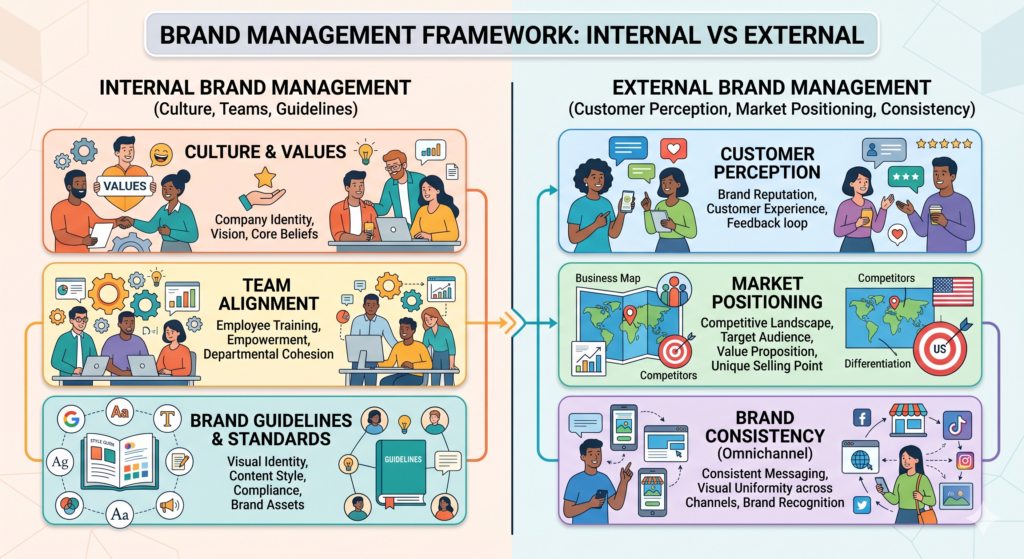
There’s a split most people don’t discuss enough. Internal brand management shapes culture – how employees understand and represent the brand. External brand management shapes perception – what customers, press, and partners feel when they encounter it. If those two don’t align, people sense the disconnect immediately. A brand can’t sound confident externally and function as confused internally for long.
Consistency is the quiet hero. Not repetition for its own sake, but coherence. Everything feeling like it came from the same place. Nothing feeling accidental.
As companies scale, the nature of the work shifts. Early on, it’s about figuring out what the brand is. Later, it’s about protecting what works while allowing the brand to evolve. That balance is genuinely uncomfortable. Too rigid, and the brand feels stale. Too loose, and it loses its shape entirely.
Done well, brand management doesn’t draw attention to itself. It just makes everything else work better.
Core Components of Brand Management
Brand management falls apart when treated as one large, abstract idea. In practice, it’s built on specific components that work together. Miss one, and the rest wobble.
Brand Awareness
Brand awareness means being known – but not just recognized. Plenty of brands are recognizable and still forgettable. Real awareness means people know what the brand stands for, not just what it sells.
Strong brand management builds awareness through repetition with intent. Same message, same personality, same promise – appearing consistently across different contexts. Over time, the brand starts to feel familiar. And familiarity lowers resistance. People are more willing to click, try, or trust something they’ve seen consistently.
High-awareness brands didn’t get there by accident. They made deliberate choices about how they show up and stuck to those choices long enough for them to register.
Brand Equity
Brand equity is where things get interesting. It’s the value people assign to a brand beyond the product itself.
Two products can do the same job, but one feels worth more. That difference lives in brand equity. It’s built slowly, through reliable experiences, clear positioning, and emotional associations that feel earned rather than manufactured.
When people associate a brand with quality, confidence, or a certain way of seeing the world, they become more forgiving. They’re also more willing to pay a premium. That pricing power doesn’t come from product features alone – it comes from perception reinforced over time.
Brands with strong equity don’t need to explain themselves constantly. The name carries weight on its own.
Brand Consistency
Consistency sounds boring. It isn’t. It’s discipline.
Brand consistency means the brand feels like the same brand wherever someone encounters it. Same tone. Same level of care. Same underlying point of view – not identical messaging, but coherent messaging.
When consistency slips, trust erodes quietly. A polished website paired with sloppy email communication. A confident ad paired with timid follow-through in support. People may not articulate what feels off, but they feel it.
Brand management exists to prevent that drift. Not to stifle creativity, but to give creativity a stable frame to work within.
Brand Loyalty
Brand loyalty is the long game. Awareness and equity get attention. Loyalty keeps the business alive.
Loyal customers don’t just buy again. They defend the brand. They recommend it unprompted. They stick around when alternatives appear, because the relationship has depth that a competitor can’t instantly replicate.
That loyalty isn’t built through clever campaigns. It’s built through consistent delivery – meeting expectations, sometimes exceeding them, and handling problems in a way that feels human and fair. Brand management plays a quiet but critical role in making sure the experience matches the promise, every time.
The four core components of brand management are brand awareness (being known for the right things), brand equity (the value assigned beyond the product), brand consistency (coherent experience across all touchpoints), and brand loyalty (repeat behavior driven by trust and expectation-setting). Each component reinforces the others – weakness in one undermines the rest.
Why Brand Management Matters for Business Growth
Brand management isn’t a “nice to have” once a company gets big enough. It’s foundational to growth itself.
As businesses scale, complexity increases. More people, more channels, more decisions being made without founders in the room. Brand management creates a shared reference point so those decisions don’t pull the brand in five different directions simultaneously.
It’s also a trust engine. Customers don’t just evaluate products – they evaluate risk. A well-managed brand feels safer. More predictable. Easier to commit to. That trust shortens buying cycles and increases repeat behavior without requiring ongoing persuasion.
From a competitive standpoint, brand management is often the real differentiator. Features get copied. Pricing gets matched. But a brand that stands for something clear occupies mental space that competitors can’t simply replicate. That’s genuinely hard to displace.
The financial impact shows up in ways that don’t always fit neatly on a dashboard:
- Stronger customer retention
- Higher lifetime value
- Lower sensitivity to price changes
- Greater resilience during market downturns
That last one matters more than most teams appreciate. When customers pull back during difficult periods, they don’t pull back evenly. They stay with brands they trust. Brands that feel familiar. Brands that haven’t surprised them in the wrong ways.
Brand management turns short-term attention into long-term advantage. Without it, growth is possible – but it’s fragile.
Benefits of Effective Brand Management
The payoff from strong brand management rarely arrives dramatically. It accumulates. That’s partly why it gets deprioritized until something breaks.
The most visible benefit is genuine recall – the kind where a brand comes to mind without effort, without comparison-shopping, without hesitation. When that happens, the buying journey shortens. The brand already feels familiar. Trust is pre-established.
Over time, that familiarity extends the relationship. Customers stay. They try new products from the same brand. They’re more forgiving after a rough patch, because they have a baseline belief in what the brand is about. That’s where customer lifetime value actually grows – not through aggressive retention tactics, but through consistency.
Pricing works differently for well-managed brands. They don’t need to explain or justify their price constantly. The value feels assumed. People pay more because the brand feels dependable and intentional.
There’s also an internal benefit that rarely makes it into brand strategy decks. Clear brand management removes friction inside the organisation. Teams waste less time debating tone or direction. Decisions move faster because there’s a shared understanding of what fits and what doesn’t. Fewer rewrites. Fewer mixed signals. Less energy spent on alignment that should already exist.
And then there’s risk reduction. Strong brand management prevents slow, unnoticed drift. Messages don’t gradually contradict each other. The brand doesn’t inch toward something unrecognizable. In crowded markets, that protection matters quietly – until it’s gone.
Brand Management Strategy: How to Build One That Holds
A solid brand strategy isn’t about looking good. It’s about choosing – and then sticking with those choices under pressure.
Everything starts with foundations: mission, vision, values, positioning. These aren’t decorative statements for the About Us page. They’re decision tools. They help answer tough questions – what to say no to, where not to play, how to respond when short-term pressure conflicts with long-term trust. Without them, brand management becomes reactive. Whoever shouts loudest wins.
Audience clarity is a pressure point most brands get wrong. Broad appeal sounds attractive. It weakens brands fast. The strongest brands know exactly who they’re for – and, just as importantly, who they’re not trying to impress. That focus sharpens everything else.
The brand promise is the expectation being set, whether it’s written down or not. Every interaction either reinforces that promise or quietly erodes it. There is no neutral ground.
Voice and messaging give the brand its personality. Not cleverness for its own sake – consistency. The same tone when things are going well and when they aren’t. The same point of view across formats and moments. Emotional resonance works when it’s earned. When it’s forced, people notice.
Brand guidelines are where strategy becomes practical. They spell out how the brand behaves visually and verbally. What’s permitted. What’s off-limits. Good guidelines don’t kill creativity – they prevent confusion. Governance matters equally. Without clear ownership and approval processes, brands fracture as they grow.
A smart brand strategy also leaves room to evolve. Markets shift. Audiences change. But the core stays intact. Five years in, the brand should feel familiar – not frozen, not unrecognizable.
Brand Management vs Marketing: What’s the Difference?
Brand management and marketing get conflated constantly. They’re connected, but they solve different problems.
Marketing focuses on action: campaigns, channels, launches, performance metrics. It’s about generating attention and driving results now. Brand management is slower and broader. It’s about meaning, perception, and direction over time.
Think of it this way: brand management decides what the brand stands for. Marketing decides how to express that in the market right now. When those roles blur, campaigns feel disconnected. Messages shift tone too often. Short-term wins start quietly chipping away at long-term trust.
The focus differs too. Marketing looks outward – at audiences, competitors, and timing. Brand management looks both outward and inward. It cares how the brand is experienced externally and how it’s understood internally. A brand that says one thing publicly and operates differently internally doesn’t hold up for long.
In early-stage companies, marketing often leads out of necessity. Visibility matters. Growth matters. Over time, brand management steps in to protect what’s working. It brings structure and coherence to the noise.
The healthiest organisations connect both. Brand management sets the direction. Marketing builds momentum in that direction. One without the other falls short.
When they work together properly, the brand stops feeling like a series of disconnected campaigns. It starts to feel like a presence – something people recognize, remember, and trust without having to consciously think about why.
Brand management and marketing are related but distinct disciplines. Marketing focuses on campaigns, reach, and short-term results. Brand management focuses on meaning, consistency, and long-term perception. Brand management decides what the brand stands for; marketing decides how to express that in the market. When both work together, the brand becomes a presence rather than a series of disconnected campaigns.
Real-World Brand Management Examples
Brand management is easiest to understand when looking at companies that have stayed recognizable for decades, even as markets shifted around them.
Coca-Cola is the classic case. The product hasn’t changed much, but the brand has been carefully managed to remain emotionally relevant across generations. The messaging consistently returns to shared moments, familiarity, and optimism. Campaigns change constantly. The feeling doesn’t. That’s brand management doing its job – protecting the emotional core while letting the expression evolve.
Nike approaches it differently. The brand was never really about footwear. It’s about identity, effort, and self-belief. Everything from athlete partnerships to product launches reinforces that idea. The brand voice is confident, sometimes confrontational, but always aligned. Nike doesn’t chase every audience. It speaks clearly to people who see sport as part of who they are.
Apple built its brand management on restraint. Fewer messages. Fewer words. A tight, consistent focus on design, simplicity, and premium experience. That consistency allowed Apple to command a significant price premium without constantly having to justify it. The brand trained its audience to expect a certain level of quality – and rarely broke that expectation.
Mamaearth is a sharper example for the Indian market. The brand built its identity around being “natural and toxin-free” at a time when mass market personal care was still dominated by chemical-heavy formulations. Every product extension, campaign, and packaging choice reinforced that positioning. The consistency of that message across D2C channels and offline retail is a significant reason the brand scaled as quickly as it did.
Procter & Gamble shows how brand management works at portfolio scale. Each brand – Ariel, Pampers, Olay – has its own identity, tone, and audience. The challenge isn’t consistency across brands; it’s clarity within each one. That’s a different kind of brand management problem, and P&G has a dedicated governance structure to solve it.
Role and Responsibilities of a Brand Manager
A brand manager’s job isn’t limited to logos and campaigns. It’s stewardship.
At a practical level, brand managers oversee both tangible and intangible elements. The tangible side – visual identity, messaging frameworks, guidelines – is visible and measurable. The intangible side is where the real work lives: perception, emotion, expectation. What people feel when they interact with the brand.
Brand managers spend significant time asking uncomfortable questions. Does this align with what the brand stands for? Does this reinforce the promise or quietly dilute it? Are short-term gains eroding long-term trust?
They also act as translators. Brand strategy has to make sense to designers, product teams, marketers, and leadership simultaneously. When brand intent gets lost between strategy and execution, it’s usually because this translation failed.
Measurement is part of the role, but it’s not always clean. Brand performance shows up in sentiment, consistency, preference, and resilience – not just immediate revenue. Brand managers look for patterns over time, not spikes.
The skill set is genuinely broad. Strategic thinking, judgment, strong communication, the ability to say no without blocking progress, and the patience to protect something that doesn’t always show immediate financial returns.
Good brand managers don’t chase attention. They protect meaning.
Brand Management in the Digital Era
Brand management today happens in public, whether a company intends it or not. Every channel, every comment section, every half-updated social profile becomes part of the brand story. There’s no single “brand moment” anymore. There are hundreds of small ones, scattered across platforms, formats, and contexts that the brand may not even be monitoring.
Managing a brand across this landscape is less about control and more about coherence. The website can’t sound like a different company from the Instagram account. Ads can’t promise what the product experience doesn’t deliver. Marketplaces, support responses, even error messages – all of it contributes.
As brands expand into more channels, the risk isn’t invisibility. It’s distortion. The brand starts to blur at the edges. Messages get oversimplified. Tone shifts depending on who’s posting that week. Over time, the brand loses its shape without anyone making a conscious decision to change it.
Governance matters more in this environment, not heavy-handed oversight, but clear guardrails. Who can speak for the brand? What’s acceptable improvisation and what crosses the line? Without shared answers to these questions, well-meaning teams pull the brand in different directions simultaneously.
User-generated content adds another layer. Customers, creators, and online communities now actively shape brand perception. That can be powerful – but it can also dilute meaning if the brand doesn’t consistently reinforce its core. Strong brands participate in these spaces without chasing every trend. They show up as themselves, even when the format changes.
Modern brand management isn’t about being everywhere. It’s about being recognizable wherever you show up.
Common Brand Management Challenges
Most brand management problems don’t start with bad ideas. They start with small compromises that nobody flags at the time.
Inconsistent messaging across teams is one of the biggest. Sales says one thing. Marketing says another. The product communicates a slightly different story. None of it is wrong in isolation, but together it creates confusion – and confused customers don’t convert.
Asset misuse is a quieter problem. Outdated logos, old brand guidelines, off-brand presentation templates floating around long after they should have been retired. It signals disorganisation, even when the business itself is running well.
Scaling makes everything harder. What worked for a ten-person team breaks when the company expands globally. Cultural differences, local adaptations, and speed pressures test consistency constantly. Without a clear brand center, local execution starts rewriting the brand rather than expressing it.
Rapid growth brings its own risks. When demand spikes, brands often cut corners to keep pace. Messaging becomes rushed. Customer experience becomes uneven. Trust erodes faster than expected, and the damage is hard to reverse.
And then there’s the creative tension that never fully resolves. Too much control and the brand feels rigid and stale. Too little and it becomes unrecognizable. Finding that balance is ongoing work, not a one-time decision.
Best Practices for Brand Management
Strong brand management starts inside the organisation. If teams don’t understand or believe in the brand, customers won’t either. Internal alignment isn’t about slogans on walls – it’s about clarity. People should know what the brand stands for and how that affects their daily decisions.
Centralise brand assets and guidelines. When everyone knows where to find the right materials, consistency becomes the default. Confusion fills the gaps left by missing structure. A shared, accessible asset library is one of the highest-leverage investments a brand team can make.
Review brand strategy regularly. Markets shift. Audiences evolve. A brand strategy set three years ago may not fully reflect where the business is heading. The goal is adjustment, not reinvention. The core should stay intact; the expression can evolve.
Measure brand health, not just campaign performance. Track sentiment, consistency, preference, and trust over time. These move slowly. But patterns tell more than spikes. A brand that performs well in campaigns but is quietly losing trust in customer service isn’t in a healthy position.
Leave room for evolution. The best-managed brands aren’t frozen in time. They change carefully, thoughtfully, and with intent. Consistency doesn’t mean repetition. It means continuity of meaning.
When brand management is done well, it fades into the background. The brand just feels right. Familiar. Trustworthy. That’s usually the point.
Frequently Asked Questions – What is Brand Management
What exactly is brand management?
Brand management is the ongoing discipline of ensuring a brand means something specific and continues to mean that same thing as the company grows. It covers visual identity, messaging consistency, customer experience alignment, and the internal culture that shapes how the brand behaves. It’s not a one-time project – it’s the continuous work of keeping what a company says and does in alignment.
Why does brand management matter?
Without it, a brand drifts. Messages get inconsistent. Customer experience becomes uneven. Trust erodes, often before anyone notices. With strong brand management, a business builds familiarity, credibility, and pricing power that competitors can’t easily replicate. It also makes internal decision-making faster, because teams share a clear understanding of what the brand stands for.
What’s the difference between brand management and branding?
Branding is the setup phase: defining identity, designing logos, crafting positioning statements. Brand management is the ongoing follow-through. Branding creates the foundation. Brand management protects it, evolves it, and makes sure it’s applied consistently across every channel and touchpoint.
How is brand management different from marketing?
Marketing focuses on campaigns, reach, and short-term performance. Brand management focuses on meaning, consistency, and long-term perception. Marketing decides how to express the brand in the market right now. Brand management decides what the brand stands for in the first place – and ensures that meaning stays intact as the company grows.
Can small businesses do brand management?
Yes. It doesn’t require a large budget or a dedicated team. Even a small business benefits from deciding early what the brand stands for, keeping its tone consistent across social, email, and in-person interactions, and building recognition over time. Consistency is the core skill – and it’s available to any business willing to be deliberate about how it shows up.
What does a brand manager do?
A brand manager oversees both the visible elements of a brand – visual identity, messaging, guidelines – and the intangible ones: perception, emotion, and reputation. They ask whether brand decisions align with the long-term strategy, translate brand intent into practical execution across teams, and measure brand health over time. The role requires strategic thinking, strong judgment, and the ability to protect long-term meaning against short-term pressure.
What are the main components of brand management?
The four core components are brand awareness (being known and understood), brand equity (the value attributed to the brand beyond the product), brand consistency (coherent experience across all touchpoints), and brand loyalty (repeat behavior built on trust and expectation). Each component reinforces the others.
What makes brand management hard?
The biggest challenges are inconsistency across teams, asset misuse as companies grow, and the difficulty of balancing creative freedom with brand discipline. Rapid scaling is particularly difficult – what worked for a small team breaks when the company expands into new markets or adds hundreds of employees. Governance, clear guidelines, and shared understanding of brand intent are the practical solutions.
Conclusion
Brand management isn’t a task with a finish line. It’s a discipline that runs underneath everything else – the quiet infrastructure that makes marketing work better, keeps customers coming back, and gives the business something competitors can’t simply copy.
The companies that handle it well don’t constantly explain themselves. They feel familiar. They feel reliable. And when they make a mistake, they’re forgiven faster – because the relationship had depth before anything went wrong.
That doesn’t happen by accident. It happens through the daily, unglamorous work of keeping what the brand says aligned with what it does.
The brands that last aren’t always the most innovative or the most aggressive. They’re the ones that stayed coherent long enough for people to trust them.
If brand management is a skill you want to build professionally, Young Urban Project’s Brand Management course covers positioning, equity-building, governance, and the practical tools brand managers use across industries. It’s a six-week live programme designed for marketers who want to move from executing campaigns to owning brand strategy. Apply Here.