

Ad costs keep climbing. Shoppers expect the store to remember them. And some new competitor launches every other week, usually with a decent product and a lot of Instagram budget.
Sound familiar? Entrepreneur India reported in January 2026 that experts see the era of easy funding and growth at any cost in Indian D2C as over, with brands now expected to earn repeat purchases. That’s the backdrop for AI marketing for D2C brands. It isn’t a magic switch, and it won’t fix a weak product. What it does is read your customer data faster, send messages that fit the person receiving them, and test ads without a team of ten.
Here’s what you’ll get: what AI marketing really means, eight places it earns its keep, tools matched to the problems they solve, two documented case studies, a five-step rollout, and the mistakes that quietly burn budget.
Table of Contents
What Is AI Marketing and Why Does It Matter for D2C Brands?
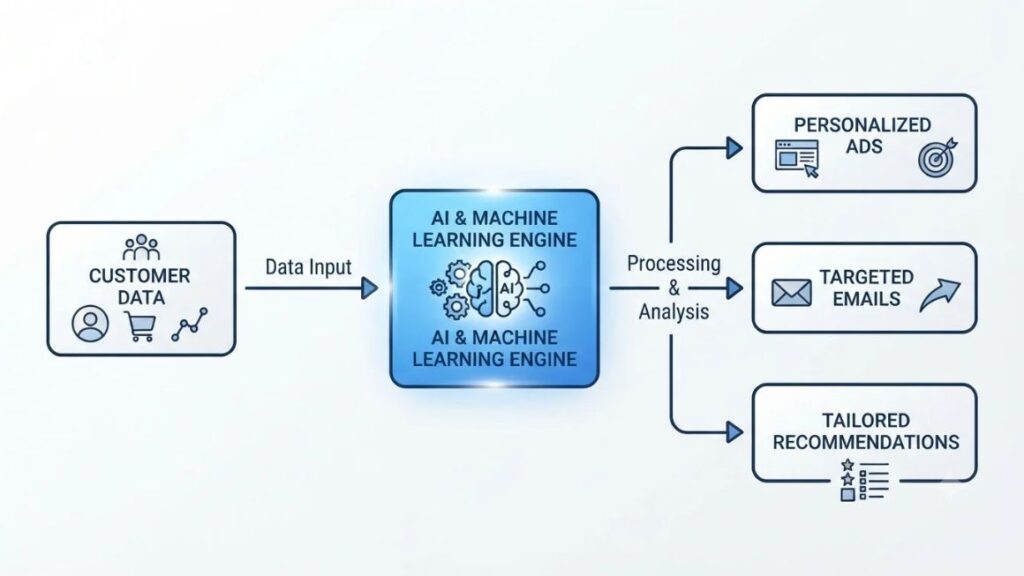
AI marketing for D2C brands means using machine learning and generative AI to analyse customer data, predict what shoppers will do next, and automate the content, ads and messages that respond to it. It matters because it takes guesswork out of the decisions that eat margin: who to target, what to say, and when.
Understanding AI in Digital Marketing
AI in digital marketing is software that learns from data instead of following fixed rules. That’s the whole definition. Everything else is application.
The data comes from places you already own: store orders, site behaviour, email clicks, ad results, support tickets. AI marketing for ecommerce works by finding patterns across all of it, then acting. Which customers are drifting away? Which ad is tiring out? Which product do first-time buyers usually come back for?
Traditional marketing automation is the older cousin. You write the rule (send an abandoned cart email after one hour, to everyone) and it runs forever. AI-powered tools decide who gets the email, when, and which product leads it, then adjust as results come in.
Why D2C Businesses Are Adopting AI
The case for AI marketing for D2C brands starts with competition. Unicommerce data, reported by Whalesbook in 2026, counts more than 11,000 D2C companies in India, with only a few reaching substantial revenue. The same report says D2C orders grew 33% in FY26, yet some analyses suggest acquiring a customer can cost as much as the profit from their first order.
That squeeze explains the rest of the list. Shoppers want personalization. Decisions need to happen in days, not quarters. And customer lifetime value (CLV), the total profit a customer brings over time, has to carry the economics because customer acquisition cost (CAC) keeps eating the first sale.
One warning. AI should answer a specific business problem, not a trend. “We should use AI” gets you three subscriptions and no result. “Our repeat purchase rate is stuck” gets you a test.
AI marketing for D2C brands uses machine learning and generative AI to analyse customer data, predict behaviour and automate content, ads and messages. D2C brands adopt it because rising acquisition costs and higher personalization expectations make guesswork expensive. The best results start with one named business problem, not with a tool.
8 Ways AI Is Transforming D2C Marketing
The eight biggest uses of AI marketing for D2C brands are personalization, ad optimization, content creation, predictive analytics, automated messaging, customer support, segmentation and conversion rate optimization. Each one ties to a measurable KPI, so you can test it before you scale it.
1. Personalized Customer Experiences
Picture a hypothetical skincare brand. A shopper lands on the site, answers three questions about oily, breakout-prone skin, and the homepage reshuffles: gel cleanser up front, heavy night cream buried. Her next email talks about the products she browsed, not the whole catalogue.
AI personalization in ecommerce covers dynamic product recommendations, customized site experiences and behaviour-based messages. It matters because McKinsey’s 2021 research found 71% of consumers expect personalized interactions, and 76% get frustrated when they don’t get them.
KPI to track: revenue per visitor.
2. Smarter Advertising and Campaign Optimization
Most D2C ad accounts don’t have an audience problem. They have a creative problem.
AI reads performance patterns, drafts creative variations and flags campaigns that are quietly wasting money. On Meta, Sales campaigns now run on Advantage+ by default for new setups, a change that landed in February 2026 according to Segwise. Meta’s system picks audiences and placements, so creative volume becomes the main lever you control. Google’s Performance Max shows where spend lands through channel performance reporting, expanded in March 2026, which makes feed and asset problems easier to spot.
AI advertising for ecommerce rewards brands that feed it clean conversion data and genuinely different angles. A hypothetical fashion brand selling one dress might test “fits true to size”, “wear it to three weddings” and “under ₹2,500” as three separate stories, then back the winner.
Platform numbers overlap, so check them against blended revenue to keep marketing attribution honest.
3. AI-Powered Content Creation
Generative AI content creation gets you from blank page to rough draft in about two minutes. Product descriptions, captions, blog topics, content briefs, email copy: all fair game.
The rough draft is the point, though. Treat every output like a junior copywriter’s first pass. It needs your brand voice, and a human has to fact-check anything about ingredients, sizing or results before a customer reads it. Publish unedited AI copy at scale and your brand starts sounding like everyone else’s.
KPI to track: content production time, plus conversion rate on the pages you rewrote.
4. Predictive Customer Analytics
Predictive analytics in marketing means using past behaviour to estimate future behaviour. Who’s likely to buy again? Who’s about to lapse? Which product will sell out in three weeks? Where should next month’s budget go?
Take a hypothetical beauty brand. A customer buys a 50 ml serum roughly every seven weeks, so the replenishment reminder lands in week six, based on her actual pattern rather than a calendar blast.
One catch. Predictions get noisy when order history is thin, so a store with a few hundred orders should treat them as hints.
KPI to track: repeat purchase rate.
5. Automated Email, SMS and WhatsApp Marketing
AI-powered marketing automation turns automated email campaigns from blasts into something closer to a conversation. Welcome messages, abandoned cart reminders, post-purchase check-ins, replenishment nudges, personalized offers: the flows are familiar, but AI decides who gets what and when.
In India, WhatsApp often matters more than SMS, and it needs proper opt-in. Nobody wants the same discount code for the fortieth time.
KPI to track: revenue per recipient for each flow, alongside unsubscribe rate.
6. AI-Powered Customer Support
AI chatbots handle the repetitive stuff: order tracking, delivery updates, product questions, FAQs. Complicated complaints should go to a person, fast.
How good are they, really? Gorgias published a benchmark in October 2026 testing 13 vendors on live ecommerce stores. The top five averaged 70% full resolution, and the median vendor managed 48%. Gorgias runs that benchmark and sells in the category, so read it with that in mind. Still, order tracking, usually the biggest ticket type for a store, scored well below returns-policy questions.
Better support is part of an AI-driven customer experience, but only when “resolved” means the customer actually got helped. KPI to track: AI resolution rate and customer satisfaction together.
7. Customer Segmentation and Targeting
AI customer segmentation groups shoppers by what they actually did, not by guesses about who they are. High-value buyers, first-timers, repeat customers, people going quiet: each gets a different message.
Klaviyo, for instance, lets you describe a segment in plain words and builds it for you. The savings show up in ad spend. Why keep paying to show acquisition ads to someone who ordered last week?
KPI to track: share of ad spend reaching existing customers.
8. Conversion Rate Optimization
Customer journey mapping used to mean a workshop and sticky notes. AI tools now show where people leave: product pages, delivery estimates, checkout. Then they help test fixes, from landing page variations to better product recommendations.
Payment friction matters in India. Base’s 2026 D2C statistics roundup puts cash on delivery at about 45% of Indian D2C orders, down from 55% in 2024, so a checkout that handles COD badly leaks revenue.
KPI to track: checkout completion rate.
Also Read: Top Conversion Rate Optimization Tools (2026 Guide)
The eight highest-impact uses of AI in D2C marketing are personalization, ad optimization, content creation, predictive analytics, automated messaging, support, segmentation and conversion optimization. Each should be tied to one KPI, such as revenue per visitor, repeat purchase rate or checkout completion rate, and tested on a small scale first.

Best AI Marketing Tools for D2C Brands in 2026
A workable stack for AI marketing for D2C brands is small and matched to problems. Use ChatGPT, Jasper or Shopify Magic for content, Klaviyo or Postscript for retention, Triple Whale plus the ad platforms’ own automation for advertising, and Gorgias or Richpanel for support. Most AI tools for D2C brands overlap, so pick by problem, not by brand name.
AI Tools for Content and Marketing Copy
ChatGPT is a flexible assistant for campaign ideas, briefs and first drafts, but it only knows your brand if you teach it. Jasper is built for marketing teams, with brand voice controls and marketing agents, and it takes real setup before output stops sounding generic. Shopify Magic and Sidekick sit inside your Shopify admin and draft product descriptions and email subject lines, and edit product images, for the store you already run.
AI Tools for Email and Customer Retention
Klaviyo handles segmentation, email and SMS, with AI features for building segments, flows and subject lines. Postscript focuses on SMS for Shopify stores, including AI-assisted message testing. One catch for Indian brands: Postscript is US-centric, so check channel and country coverage, WhatsApp included, before you commit.
AI Tools for Advertising and Analytics
Triple Whale combines first-party attribution with Moby, its AI assistant. Its Moby 2 release arrived in April 2026, and the company says over 60,000 brands use the platform. It’s Shopify-first. Meta Advantage+ and Google Performance Max automate targeting, creative mix and bidding inside the ad platforms themselves.
AI Tools for Customer Support
Gorgias and Richpanel both put an AI agent on top of an ecommerce helpdesk, handling order questions and returns. Billing differs. Gorgias charges around $0.90 per resolved conversation according to SaaStr’s October 2026 write-up, so get each vendor’s definition of “resolved” in writing.
Pick tools by current needs, budget, existing stack and data quality. You don’t need every name on this list. Most brands need two.
Also Read: AI Tools for Marketing: 150+ Tools to Build Your Stack in 2026
Real-World Examples of AI Marketing in D2C Businesses
Documented results beat hypotheticals. These two cases show AI marketing for D2C brands in practice, with one caveat: both come from the vendors selling the tools, so treat the numbers as proof of possibility, not a promise.
Tata Harper: Improving Sign-Up Form Performance with AI
Tata Harper, a plant-based skincare brand, moved its email and SMS marketing into Klaviyo and began testing sign-up forms with Klaviyo AI in February 2024. Before, the team manually tested two variations at a time. This time, AI generated 20 variations of placement and timing across desktop and mobile pop-ups.
The result, per Klaviyo’s Tata Harper case study: form submissions grew by more than 65% in the 30 days after the winning variations went live. Welcome flow revenue rose 27%.
Shopify Merchants: Using AI to Improve Daily Operations
Maggy London sells through six fashion labels with a four-person ecommerce team. According to Shopify’s case study, the team used Shopify Sidekick to cut weekly reporting from three to four hours down to 20 to 30 minutes, a reduction of over 80%.
It didn’t stop at reporting. The same team audited 199 product collections and built a Shopify Flow that tags the week’s 20 best-sellers as “trending”, then removes the tag after seven days.
What D2C Brands Can Learn From These Examples
- Test before scaling. Tata Harper ran a contained experiment, not a site-wide overhaul.
- Use actual customer data. Both brands fed the AI their own performance numbers.
- Chase measurable improvements.
- Keep humans in the loop. Maggy London’s team still decided what to do with the answers.
- Don’t assume one brand’s result transfers to yours.
Klaviyo reports that Tata Harper grew sign-up form submissions by more than 65% in 30 days by testing 20 AI-generated variations. Shopify reports that Maggy London cut weekly reporting time by over 80% using Sidekick. Both are vendor-published results, so brands should run their own tests.
Also Read: First-Party Data Strategy: How to Build Trust & Drive Growth in 2026
How to Implement AI Marketing in Your D2C Business?
Rolling out AI marketing for D2C brands comes down to one sequence: start with one problem, clean the data behind it, pick one or two tools, run a small test, and measure against a baseline. Everything else is detail.
Step 1. Identify Your Biggest Marketing Challenge
Which hurts most: low conversions, high acquisition costs, poor retention, messy campaign management, or a support inbox that never empties? Pick one. Only one. Write it as a number you can move, like repeat purchase rate or cost per purchase.
Step 2. Organize Your Customer and Marketing Data
Gather purchase history and site analytics, tidy customer records, connect the platforms involved, and check quality. Duplicates and wrong tags make AI confidently wrong.
Consent comes with it. India’s DPDP Rules were notified in November 2025, and the main consent and notice obligations take effect on 13 May 2027, according to law-firm summaries. Affirmative opt-in, no pre-ticked boxes. Build it into your first-party customer data now, not later.
Step 3. Choose the Right AI Tools
Start with one or two. Favour tools that integrate with your current platform. Weigh pricing, scalability and data security. A tool that can’t talk to your store isn’t a shortcut.
Step 4. Start with Small Experiments
Test personalized email campaigns, AI-generated ad variations, better product recommendations, or one repetitive task you can automate. Give each test a full buying cycle before judging it. Small, boring, measurable.
Step 5. Measure Performance and Improve
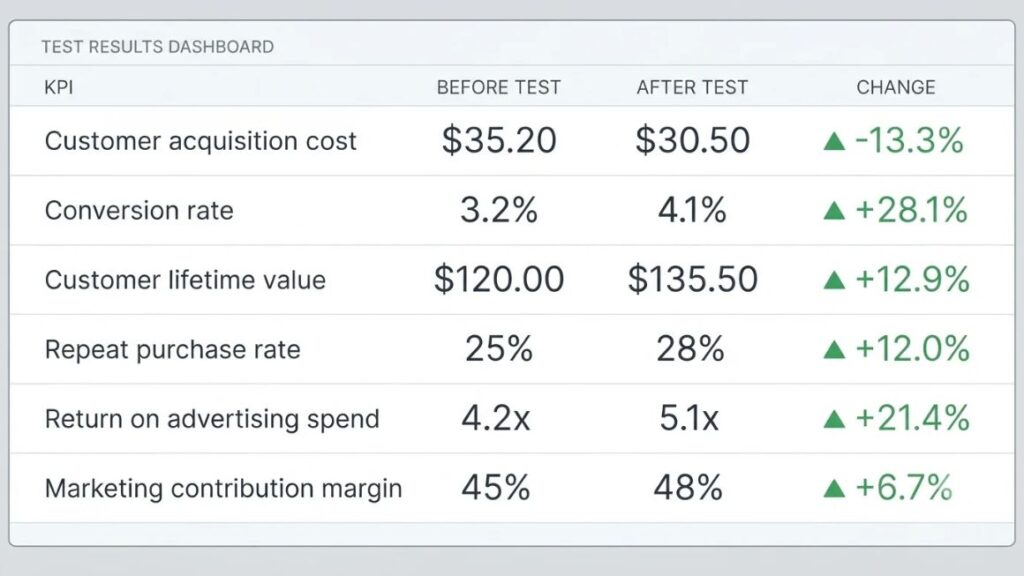
Track these against a baseline you recorded before the test:
- Customer acquisition cost
- Conversion rate
- Customer lifetime value
- Repeat purchase rate
- Return on advertising spend
- Marketing contribution margin
AI Marketing Strategies for Small and Growing D2C Brands
AI marketing for D2C brands rewards selectivity, not software spend. Smaller teams can win by choosing carefully.
Start Small Instead of Investing in an Expensive AI Stack
Use what your ecommerce platform already includes. Shopify, for example, bundles Magic and Sidekick. Automate repetitive tasks first, and don’t buy anything without a clear use case. Maggy London runs six brands with four people, so headcount isn’t the real limit.
Focus on Retention Before Increasing Advertising Spend
AI for customer retention is usually the cheapest first move. Build a better post-purchase journey, add personalized recommendations, encourage the second order, and identify customers who may stop buying. Every repeat order lowers your blended CAC without touching your ad budget.
Combine Human Creativity with AI Efficiency
Let AI handle research and execution. Keep humans on strategy, positioning and anything customer-facing. Authenticity can’t be outsourced.
Common AI Marketing Mistakes D2C Brands Should Avoid
Most disappointing rollouts of AI marketing for D2C brands trace back to the same five mistakes.
Relying Completely on AI-Generated Content
Generic copy weakens your identity, and customers notice before you do. Trust erodes slowly, then all at once.
Using Poor-Quality Customer Data
Incomplete or wrong data produces misleading recommendations. A duplicate record can double-count a buyer and skew every segment. Garbage in, confident garbage out.
Automating Every Customer Interaction
Damaged parcels, refund disputes and upset customers need a human. Automate the routine, escalate the rest.
Ignoring Privacy and Data Protection
Collect consent properly, handle data responsibly, and follow applicable regulations, DPDP included. Trust is harder to rebuild than a consent form.
Measuring Success Only Through ROAS
ROAS can look healthy while margins stay thin. Look at revenue, contribution margin, CLV and profitability too. BrandLoom Consulting made the same argument in April 2026, urging D2C brands to judge marketing on contribution margin and payback.
The Future of AI Marketing for D2C Brands
None of this is settled. Still, a few directions look fairly clear.
Hyper-Personalized Shopping Experiences
Shopping experiences will get more individual: homepages, bundles, timing and tone fitted to one shopper rather than a segment.
AI Agents and Conversational Commerce
More product discovery may start inside AI assistants. Maggy London’s team has already set up an LLMs.txt file so AI shopping tools can discover its storefront, a step most brands haven’t thought about.
Predictive and Automated Marketing Decisions
Systems will suggest, and sometimes make, calls on budgets and campaign timing. Triple Whale already offers an autopilot mode. Keep a human approving the big ones.
First-Party Data Will Become More Important
Permission-based data you collect yourself will matter more as privacy rules tighten. Reliable, consented information is the fuel for everything above.
Conclusion
AI marketing for D2C brands pays off in practical ways: sharper targeting, faster testing, more relevant messages, and less time lost to reporting. But technology alone doesn’t create growth, and no tool fixes a weak offer or messy data. So pick the one challenge costing you most, test small, measure honestly, and keep improving what works.
Want a structured way to build these skills? Young Urban Project’s digital marketing courses and workshops are designed for marketers who need to apply AI, not just read about it.
FYQ: Frequently Asked Questions About AI Marketing for D2C Brands
How can D2C brands use AI in marketing?
They use it for ad optimization, content drafting, personalization, predictive analytics and retention. Start with one problem, such as abandoned carts or creative testing, then expand once the first test shows a measurable gain.
Which AI tools are best for D2C businesses?
It depends on the job.
Content: ChatGPT, Jasper or Shopify Magic.
Retention: Klaviyo or Postscript.
Advertising and analytics: Triple Whale, Meta Advantage+ or Google Performance Max.
Support: Gorgias or Richpanel. No single platform wins everywhere.
Can AI help reduce customer acquisition costs?
It can, through better targeting, faster creative testing and sharper audience insights. Lower costs aren’t guaranteed, though. Results depend on data quality, creative and offer strength, so test against a baseline.
How does AI improve customer retention?
Predictive insights flag customers likely to lapse, personalized messages keep offers relevant, and automated post-purchase campaigns prompt the second order. Together, they raise repeat purchase rate without extra ad spend.
Is AI marketing suitable for small D2C businesses?
Yes. AI marketing for D2C brands works at small scale, because smaller brands can start with affordable tools already inside their platforms, such as Shopify’s built-in features, and automate one repetitive task before adding anything new.
Will AI replace digital marketers in D2C companies?
Unlikely. AI marketing for D2C brands automates tasks, but strategy, creativity, judgment and customer understanding still need people. Marketers who learn to direct AI will likely do better than those who ignore it.