
Most businesses that hire a social media agency end up disappointed. Not because agencies are bad at what they do, but because the company didn’t know what to look for before signing the contract.
They picked an agency based on a flashy deck, a low price, or a big client name on the website. Six months later, they had a hundred posts but no results. No leads, no growth, no idea whether any of it was working.
Choosing the right social media marketing company is genuinely one of the more consequential marketing decisions a business can make. A good one builds your brand, brings in customers, and compounds over time. The wrong one burns your budget and leaves you worse off than when you started.
This guide breaks down everything you need to know: what social media marketing companies actually do, how to evaluate them, what to pay, what to avoid, and what questions to ask before you commit.
Table of Contents
What Is a Social Media Marketing Company?
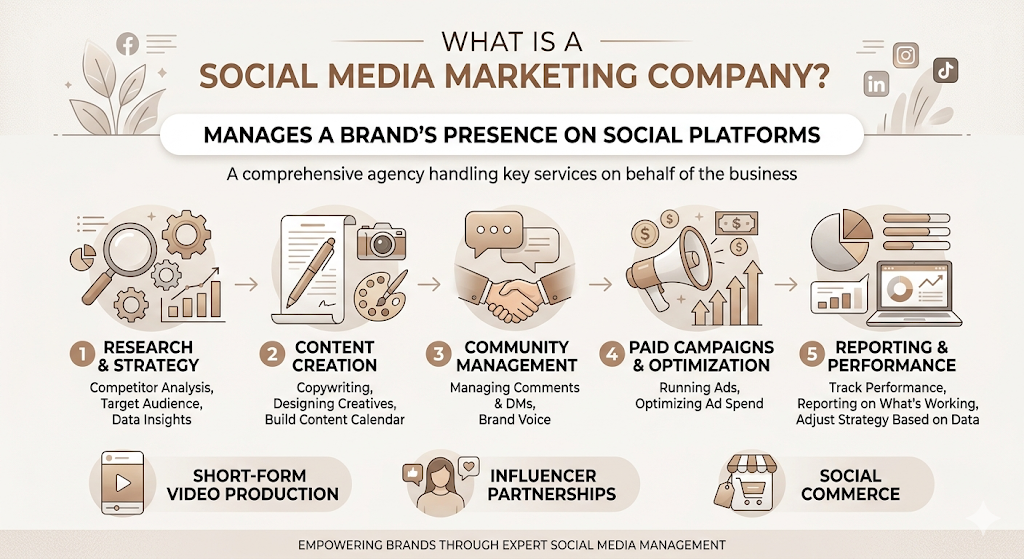
A social media marketing company is an agency or firm that manages a brand’s presence across social platforms –creating content, running ads, building community, and tracking performance -on behalf of the business.
That sounds simple. But the work involved is much broader than most people expect.
A decent agency isn’t just posting on your behalf. It’s doing competitor research, building content calendars, writing copy, designing creatives, managing comments and DMs, running and optimising paid campaigns, reporting on what’s working, and adjusting strategy based on data. Some also handle influencer partnerships, short-form video production, and social commerce.
How Social Media Marketing Companies Differ from Digital Marketing Agencies
A digital marketing agency typically covers SEO, paid search, email, and sometimes social. A social media marketing company specialises only in social, which means its team is usually deeper on platforms, formats, and social-specific tactics.
If you want one agency to handle everything, a digital marketing agency might work. If social is your primary acquisition or brand-building channel, a specialist social media agency almost always gets better results.
Who Should Consider Hiring One?
Startups, ecommerce brands, SaaS companies, local businesses, and enterprise teams all hire social media marketing companies -but for different reasons.
Startups hire them to build brand awareness fast without a full in-house team. Ecommerce brands hire them to run performance-driven content and paid social that drives sales. SaaS companies tend to focus on LinkedIn and thought leadership content. Local businesses want help managing their presence and community on platforms like Instagram and Facebook. Enterprise brands often work with agencies for specific campaigns or markets where internal teams are stretched thin.
What Services Do Social Media Marketing Companies Offer?
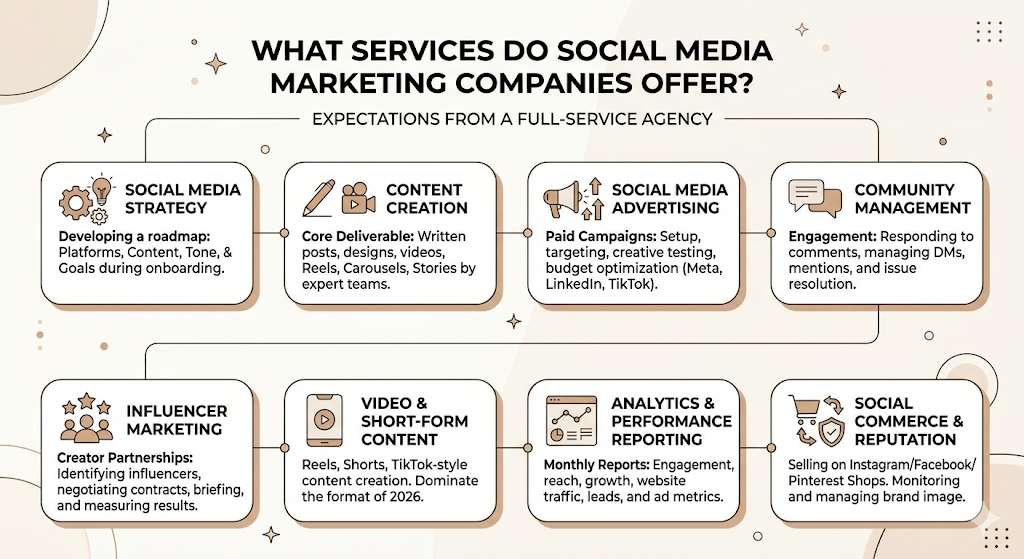
The service list varies by agency, but here’s what you should expect from a full-service social media marketing company.
Social Media Strategy
Before any content goes live, there should be a strategy. That means identifying which platforms your audience actually uses, what content formats work best, how often to post, what tone to use, and how to connect social to your broader marketing goals.
Most agencies include this in onboarding. Some charge separately for it. Either way, if an agency skips the strategy conversation and goes straight to producing content, that’s a problem.
Content Creation
This is the core deliverable for most clients -written posts, design creatives, videos, reels, carousels, stories. A strong agency has designers, copywriters, and video editors in-house or on retainer.
Quality here varies massively between agencies. Ask to see samples of work done for brands in your industry, not just the agency’s own social profiles.
Social Media Advertising
Organic content builds brand. Paid social drives results faster. Social media management services that include advertising cover campaign setup, targeting, creative testing, budget optimisation, and reporting across platforms like Meta Ads Manager, LinkedIn Campaign Manager, and TikTok Ads.
Not every agency that handles organic is strong at paid. These are genuinely different skill sets.
Community Management
Responding to comments, handling DMs, managing mentions, flagging issues -this is community management, and it matters more than most brands realise. Slow or no response to social comments signals neglect. A good agency either handles this directly or trains your team on it.
Influencer Marketing
Some social media marketing companies have their own influencer networks or partnerships. Others manage influencer campaigns as a service -identifying creators, negotiating contracts, briefing content, and measuring results.
For D2C brands in India, this is increasingly a core channel. Brands like Mamaearth and boAt built significant awareness through influencer campaigns at scale before layering in performance marketing.
Video and Short-Form Content
Short-form video is the dominant content format in 2026. Any agency that can’t produce Reels, Shorts, and TikTok-style content is already behind. Some agencies specialise in this. Most now offer it as part of standard packages.
Analytics and Performance Reporting
You should get a monthly report that covers engagement, reach, follower growth, website traffic from social, leads generated, and ad performance if you’re running paid campaigns. The best agencies give you dashboards you can access any time.
If an agency only sends you a PDF with follower counts and likes, they’re measuring the wrong things.
Social Commerce and Brand Reputation Management
Social commerce -selling directly through Instagram Shops, Facebook Shops, or Pinterest -is a growing service offering. Not all agencies handle it, but it’s worth asking if ecommerce is your goal.
Brand reputation management covers monitoring what’s being said about your brand, handling negative sentiment, and building a positive online presence over time.
A full-service social media marketing company handles strategy, content creation, paid advertising, community management, influencer partnerships, and performance reporting. The strongest agencies combine organic and paid expertise, since these require different skills and produce different outcomes for the client’s business.
The Real Benefits of Hiring a Social Media Marketing Company
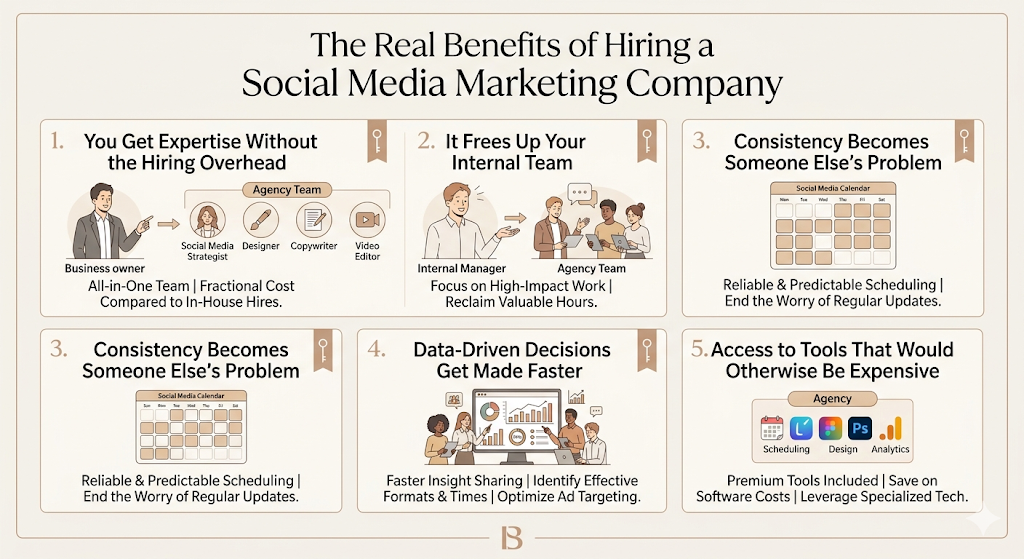
You Get Expertise Without the Hiring Overhead
Building an in-house social media team means hiring a strategist, a designer, a copywriter, a video editor, and a paid ads specialist. That’s a large payroll before you even start. A social media agency brings all of that in a single engagement, usually at a fraction of the cost of five full-time hires.
It Frees Up Your Internal Team
The founders and marketers who end up managing social in-house are almost always the same people who should be focusing on something higher-leverage. Social media is time-consuming. Outsourcing it returns those hours to the people who should be using them differently.
Consistency Becomes Someone Else’s Problem
Posting consistently is harder than it sounds. A social media marketing company has processes and schedules built for exactly this. You stop worrying about whether something went out this week.
Data-Driven Decisions Get Made Faster
Agencies that manage multiple accounts across industries spot patterns faster. They know what formats are gaining traction, what posting times work for different audiences, and which ad targeting approaches are currently over- or underperforming. That knowledge compounds into better results for you.
Access to Tools That Would Otherwise Be Expensive
Sprout Social, Hootsuite, Brandwatch, Canva Pro, and most paid analytics tools carry high monthly costs. Agencies spread those costs across clients, meaning you get access to premium tools through your agency relationship without paying for them directly.
Signs Your Business Needs a Social Media Marketing Company
You don’t need an agency just because you’re not posting every day. But there are real signals that it’s time to bring one in.
Poor engagement on every post is one sign. If you’re publishing regularly but getting almost no response, something is wrong with either the content or the strategy. An agency can diagnose this and fix it faster than most in-house teams.
Low conversions from social is another. If social drives traffic but none of it converts, the issue is usually weak messaging, wrong audience targeting, or a disconnect between your content and your landing pages. A good agency fixes this at the campaign level.
No clear content strategy -just posting things as they come up -is probably the most common signal. If your social presence has no thread connecting it, no consistent message, and no goal alignment with your business, you need strategy help more than execution help.
A small internal team that’s already stretched thin shouldn’t be managing social on top of everything else. That’s where an agency earns its fee most clearly.
How to Choose the Best Social Media Marketing Company
This is where most businesses go wrong. They compare agencies on surface things: the proposal deck, the price, the client logos. Those things matter, but they’re not where the decision should live.
Industry Experience Matters More Than Agency Size
An agency that has worked with brands in your industry already knows your audience, your competitive landscape, and what content approaches have worked. That’s not something you can teach in an onboarding call.
Ask specifically: “Have you worked with brands in my category? Can I speak with those clients?” If the answer is vague, that’s information.
Look at the Portfolio, Not Just the Pitch
Proposals are marketing documents. The portfolio is the actual work. Ask to see real examples -not just the best posts from their best clients, but actual content calendars, campaign results, and what happened when something didn’t work. How an agency handles underperformance tells you a lot.
Platform Expertise Needs to Match Where Your Audience Lives
Not every agency is equally strong on every platform. One that excels at Instagram Reels may be mediocre on LinkedIn. One that’s strong on Meta Ads may have no TikTok experience. Know which platforms matter for your business before you evaluate agencies, and score them specifically on those platforms.
Check Their Reporting Process Before You Sign
Ask to see a sample report from a current or past client. What metrics do they track? How often do they report? Is it a generic PDF or something built around your specific goals? Agencies that can’t show you a clear reporting process before you hire them almost always disappoint in reporting after.
Communication Style and Cadence
Who is your day-to-day contact? Is it a senior strategist or a junior account manager? How do they prefer to communicate -Slack, email, weekly calls? What’s the turnaround time on approvals and feedback?
These logistics sound boring. They become the primary source of frustration in most agency relationships that go wrong.
Pricing Transparency
Any agency that won’t share a ballpark number until you’ve been through three calls is wasting your time. You have a budget. They have a cost structure. There’s no reason to make that a mystery.
Choosing the right social media marketing company requires evaluating industry experience, platform expertise, portfolio quality, and reporting processes, not just agency size or proposal quality. The agencies that consistently deliver results are those with deep specialisation in the client’s industry and a clear, transparent approach to measuring success.
Questions to Ask Before You Hire a Social Media Marketing Company
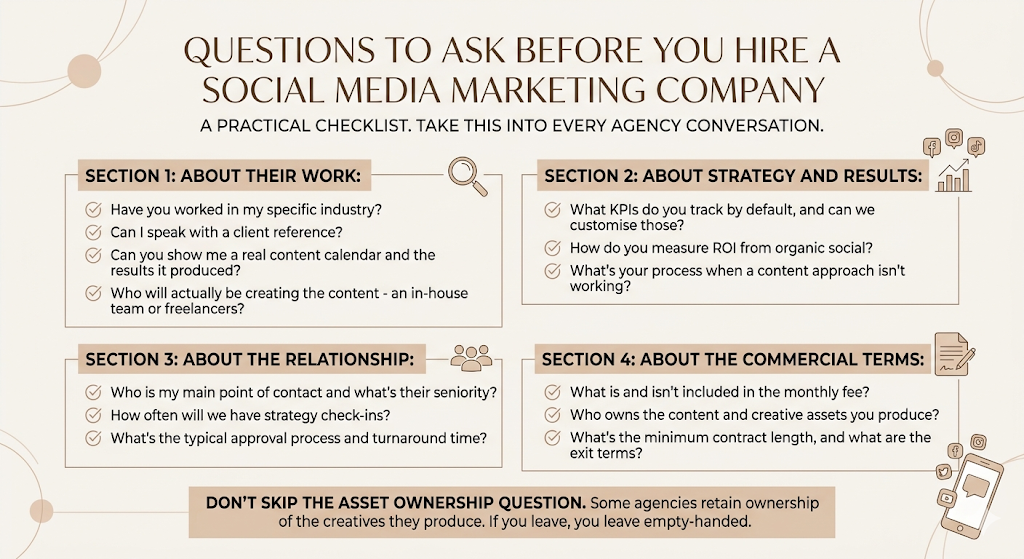
Here’s a practical checklist. Take this into every agency conversation.
About their work:
- Have you worked in my specific industry? Can I speak with a client reference?
- Can you show me a real content calendar and the results it produced?
- Who will actually be creating the content -an in-house team or freelancers?
About strategy and results:
- What KPIs do you track by default, and can we customise those?
- How do you measure ROI from organic social?
- What’s your process when a content approach isn’t working?
About the relationship:
- Who is my main point of contact and what’s their seniority?
- How often will we have strategy check-ins?
- What’s the typical approval process and turnaround time?
About the commercial terms:
- What is and isn’t included in the monthly fee?
- Who owns the content and creative assets you produce?
- What’s the minimum contract length, and what are the exit terms?
Don’t skip the asset ownership question. Some agencies retain ownership of the creatives they produce. If you leave, you leave empty-handed.
How Much Does a Social Media Marketing Company Charge?
Social media marketing costs vary widely depending on the scope of work, the agency’s size and location, and what’s included in the engagement.
Monthly Retainer (Most Common)
Most social media marketing services run on a monthly retainer. In India, retainers for small businesses typically start around ₹15,000–₹40,000 per month for basic social media management. Mid-tier agencies working with growth-stage brands charge ₹50,000–₹1.5 lakh per month for a full-service engagement. Larger agencies or enterprise engagements can run significantly higher.
Global benchmarks look different. According to data aggregated by Clutch in 2024, small-to-mid-size businesses in the US spending on social media management services typically pay between $1,000 and $5,000 per month, with full-service engagements including paid ads often exceeding $10,000 monthly.
Project-Based Pricing
Some agencies price specific deliverables rather than ongoing retainers. A social media audit, a content calendar build-out, a one-off campaign, or a strategy document are common project-based engagements. These typically range from ₹20,000 to ₹2 lakh, depending on the scope.
Performance-Based Pricing
A small number of agencies tie part of their fee to results: lead volume, ROAS, and follower growth. Honestly, this model is harder to make work well because social results are affected by so many variables outside the agency’s control. It can work, but go in with eyes open.
What Drives the Cost Up
More platforms managed means more work and a higher cost. Paid advertising management usually adds 10–20% of ad spend as a management fee on top of the base retainer. Video production is expensive regardless of who’s doing it. And agencies with strong track records charge more. That premium often pays for itself.
In-House Team vs Social Media Marketing Company
There’s no universally right answer here. The right choice depends on your budget, your team, your goals, and how central social is to your growth strategy.
| Factor | In-House Team | Social Media Marketing Company |
| Cost | High fixed cost (salaries + tools + benefits) | Variable, scales with scope |
| Expertise | Depends entirely on who you hire | Multi-specialist team day one |
| Speed to start | Weeks to months (hiring takes time) | Typically, 2–4 weeks to onboard |
| Brand knowledge | Deep over time | Takes time to build |
| Scalability | Slow -requires new hires | Fast -agency scales the team |
| Tools access | You pay for each tool separately | Included in the agency’s stack |
| Accountability | Internal -harder to manage objectively | Contract-driven -clearer KPIs |
| Flexibility | Limited -can’t easily dial down | Can adjust the scope by contract |
The honest answer: if social is your primary growth channel and you’re at a stage where it genuinely matters, building even a small in-house core (a strategist and a content lead) while partnering with an agency for specialist work (ads, video, influencer) often outperforms either option alone.
Brands like Zepto have been vocal about running strong in-house social teams augmented by agency support for specific campaigns. That hybrid model is increasingly common among fast-growing Indian D2C brands.
Top Social Media Marketing Companies to Consider
Rather than a long, padded list, here are agencies that consistently come up in honest recommendations across different business categories. Do your own research before engaging any of them -this is a starting point, not an endorsement.
Webchutney (Dentsu Creative India)
Best for: Enterprise brands and large-scale campaign work. Core services: Social strategy, content, ORM, paid social. Pricing: Not publicly available; enterprise-tier retainers. Strengths: Deep creative muscle, strong track record with large Indian brands. Watch out for: Not the right fit if you need responsive account management at a smaller scale
Social Beat
Best for: D2C and ecommerce brands in India. Core services: Social media management, influencer marketing, paid social, video. Pricing: Mid-range retainers starting around ₹50,000/month. Strengths: India-specific expertise, strong regional language capabilities. Watch out for: Works best when you have clear performance goals upfront
Gozoop
Best for: SMBs and mid-size brands wanting a full-service social partner. Core services: Content creation, community management, performance marketing. Pricing: Mid-range. Strengths: Good client communication, flexible engagement structures. Watch out for: Less specialised on paid social compared to pure performance agencies
SocialPilot (for SMBs managing in-house with light agency support)
Best for: Small businesses wanting tools plus managed services. Core services: Scheduling, analytics, white-label reporting. Pricing: Starts at approximately $25/month for tools; managed services are priced separately. Strengths: Transparent pricing, easy to use, good for lean teams. Watch out for: Lighter on strategic input compared to full-service agencies
Hootsuite Agency Program (Global, mid-size)
Best for: Businesses wanting a platform-first approach with agency support. Core services: Social media management, publishing, analytics. Pricing: Varies by scope. Strengths: Strong platform with extensive integrations. Watch out for: Agency quality varies significantly across their partner network
Thrive Internet Marketing Agency (Global, performance-focused)
Best for: Businesses that want measurable results from social media advertising. Core services: Paid social, content creation, strategy. Pricing: Starts around $1,000–$2,500/month. Strengths: Strong performance marketing focus, clear reporting. Watch out for: Less creative-led than some boutique agencies
Red Flags to Watch Out For When Hiring a Social Media Marketing Company
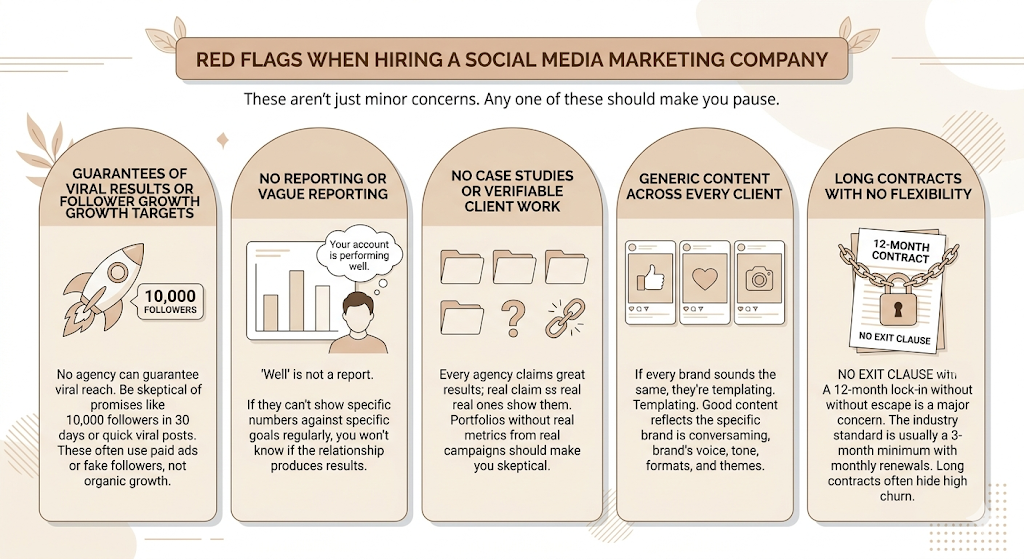
These aren’t just minor concerns. Any one of these should make you pause.
Guarantees of Viral Results or Follower Growth Targets
No agency can guarantee viral reach. It doesn’t work that way. If someone promises you 10,000 followers in 30 days or a viral post within the first month, ask them how. The answer will either be paid advertising (which is just buying reach, not organic growth) or fake followers. Neither is what it sounds like.
No Reporting or Vague Reporting
“Your account is performing well” is not a report. If an agency can’t show you specific numbers against specific goals on a regular schedule, you have no way to know if the relationship is producing anything.
No Case Studies or Verifiable Client Work
Every agency will tell you they get great results. The ones that actually do will show you. If a portfolio doesn’t include real metrics from real campaigns, be skeptical.
Generic Content Across Every Client
If you look at an agency’s client work and every brand sounds the same, they’re templating. Good social media content is brand-specific. Voice, tone, format choices, and content themes should all reflect the specific brand, not a generic agency template.
Long Contracts With No Flexibility
A 12-month locked contract with no exit clause is a red flag. The standard in the industry is a 3-month minimum with monthly renewals after that. Agencies that insist on long lock-ins are often compensating for high churn.
Common Mistakes Businesses Make When Hiring a Social Media Marketing Company
Choosing the cheapest option without understanding why it’s cheap. Low-cost agencies often cut corners on content quality, use freelancers with no brand context, or churn through clients quickly. The price difference between a ₹15,000/month retainer and a ₹60,000/month retainer is usually the difference between template content and actual strategy.
Measuring success by follower count. Follower growth is a vanity metric. It tells you almost nothing about whether social media is working for your business. What matters is engagement rate, website traffic, lead quality, and ultimately, revenue.
Not setting goals before the engagement starts. This is probably the single most common mistake. If you hire an agency without defining what success looks like in six months, you’ll have no way to evaluate whether they’re delivering. Set specific, measurable goals in writing before the work begins.
Ignoring the contract details. Asset ownership, notice periods, what happens to your accounts if you leave, and what’s included in the fee are all negotiable. Most businesses don’t negotiate them and end up surprised later.
Expecting overnight results. Organic social takes time. A new content strategy typically needs 60–90 days before you see meaningful engagement shifts. Paid social can show results faster, but even there, testing and optimisation take time. Set realistic timelines.
Social Media Marketing Trends in 2026 You Should Know About
Knowing what’s changing in the social media space helps you evaluate whether an agency is actually keeping up.
AI-Assisted Content Creation Has Become Standard
Every serious social media marketing company is now using AI tools in some part of the content workflow, whether it’s research, caption writing, visual generation, or performance prediction. The agencies that use these tools well are faster and more consistent. The ones that use them poorly produce generic, low-quality content at scale.
The question to ask any agency in 2026: “How do you use AI in your workflow, and how do you ensure the output doesn’t read like it was generated?”
Employee-Generated Content Is Outperforming Polished Brand Content
Brands like Swiggy and Razorpay have seen this play out directly. Content created by real employees, especially in authentic behind-the-scenes or opinion-style formats, consistently outperforms slick brand content on engagement. A good agency in 2026 knows how to build an employee-generated content program, not just manage a brand account.
Social Search Optimisation Is Now a Real Discipline
According to a 2024 survey by Adobe, 40% of Gen Z users in the US prefer searching on social platforms over traditional search engines for product discovery and recommendations. In India, Instagram and YouTube have become primary search surfaces for young consumers. Agencies that treat social as a search channel, not just an entertainment channel, are ahead.
Community-First Marketing Is Replacing Broadcast Marketing
The most effective brands on social in 2026 aren’t broadcasting to followers. They’re building communities around specific interests, problems, or values. This requires a different mindset than traditional content marketing. Look for agencies that understand community strategy, not just content production.
Short-Form Video Dominance Isn’t Slowing Down
Reels, Shorts, TikTok, YouTube Clips. Short-form video continues to be the highest-reach format across every major social platform. Brands that aren’t consistently producing short-form video are ceding organic reach to those that are. Any social media agency you hire in 2026 needs to have credible short-form video production capabilities.
AI-Powered Customer Engagement
Automated responses, AI chatbots in social DMs, and predictive engagement tools are becoming standard features of social media management services. This isn’t replacing human community management. But it’s reducing response times and improving the quality of first-contact customer interactions.
The defining social media trends in 2026 are AI-assisted content workflows, social search optimisation, short-form video dominance, and community-first brand building. Agencies that haven’t built capabilities in these areas are already operating with outdated strategies. When evaluating a social media marketing company, their fluency with these trends is a reliable signal of how current their thinking is.
How to Measure Success After Hiring a Social Media Marketing Company
These are the metrics that actually matter, organised from awareness to revenue impact.
Engagement Rate
Engagement rate measures how actively your audience interacts with your content. It’s calculated as (likes + comments + shares + saves) divided by reach or followers. A strong engagement rate varies by platform and audience size, but as a rough benchmark, 1–3% on Instagram is average, and anything above 5% is strong.
Reach and Impressions
Reach is how many unique accounts saw your content. Impressions is how many times it was viewed in total. Both matter, but reach is more meaningful because it tells you how many people your brand is actually touching.
Website Traffic from Social
This is where social connects to business outcomes. Google Analytics 4 shows you exactly how much traffic comes from each social platform and what those visitors do on your site. If social traffic is high but conversion rates are low, the issue is either audience mismatch or landing page quality.
Lead Generation
For B2B companies, SaaS brands, and service businesses, lead generation is often the primary social media goal. Track form fills, demo requests, and content downloads that originate from social traffic.
Conversion Rate and Return on Ad Spend (ROAS)
For ecommerce brands, ROAS from paid social is the most important metric. Return on ad spend is calculated as revenue from ads divided by the cost of ads. A ROAS of 3x means every ₹100 spent on ads returned ₹300 in revenue. For most D2C brands, a ROAS above 3x is considered viable, though this depends heavily on margins.
Customer Acquisition Cost (CAC)
Social media marketing cost should ultimately be evaluated against the cost per customer acquired. If you spend ₹1 lakh per month on social and it generates 20 new paying customers, your social CAC is ₹5,000. Whether that’s good or bad depends on your customer lifetime value.
The most important social media metrics connect directly to business outcomes: website traffic from social, lead volume, conversion rate from paid campaigns, ROAS, and customer acquisition cost. Engagement rate matters as a signal of content quality, but it should never be the primary measure of whether a social media marketing company is delivering business value.
Conclusion
The best social media marketing companies aren’t always the biggest ones, or the cheapest, or the ones with the most impressive client logos.
The right one for your business is the one that understands your industry, can show you real work from comparable clients, reports on metrics that matter to your goals, and communicates like a partner rather than a vendor. That’s a shorter list than you’d expect.
Before you sign with anyone, do three things. Define what success looks like in six months, in specific numbers. Ask to speak with at least two current or past clients. Read the contract, especially the sections on asset ownership and exit terms.
Social is a long game. A good agency gets that. A bad one just needs your retainer.
Frequently Asked Questions
How do social media marketing companies work?
A social media marketing company takes over some or all of your brand’s social media activities, including content creation, posting, community management, paid advertising, and reporting. Most work on a monthly retainer, with a defined scope of platforms, post frequency, and included services. You typically go through a strategy and onboarding phase before content production begins.
What services do social media marketing companies provide?
The core services are social media strategy, content creation, social media advertising, community management, influencer marketing, video and short-form content production, analytics reporting, and brand reputation management. Not every agency offers all of these, so confirm the scope before signing.
How much does it cost to hire a social media marketing company?
In India, retainers for social media management services start at roughly ₹15,000–₹40,000 per month for basic packages and rise to ₹50,000–₹1.5 lakh or more for full-service engagements. Globally, small businesses typically pay $1,000–$5,000 per month, according to Clutch’s 2024 benchmarks. Paid advertising fees are usually charged separately on top of the management retainer.
Are social media marketing companies worth it?
For most businesses, yes, if you choose the right one. The key is defining clear goals before hiring and measuring performance against those goals, not against vanity metrics like follower count. Businesses that see weak results from agencies usually either choose the wrong agency for their needs or don’t set measurable objectives at the start.
Can small businesses benefit from hiring a social media marketing company?
Absolutely. Small businesses often benefit most because they’re least likely to have internal expertise or bandwidth for social. The key is finding an agency that works with businesses of your size, not one that handles only enterprise clients. Expect to start with a leaner scope and scale up as results come in.
How long does it take to see results from a social media marketing company?
Organic social typically shows meaningful engagement improvements within 60–90 days of a new strategy being implemented. Paid social campaigns can show early signals within 2–4 weeks, though meaningful optimisation usually takes 60 days. Building a real audience from scratch on organic alone takes several months. Don’t evaluate an agency after 30 days.
What’s the difference between a social media agency and a digital marketing agency?
A social media agency focuses specifically on social platforms -content, community, and paid social. A digital marketing agency covers a broader remit, including SEO, Google Ads, email, and website optimisation. If social is your main channel, a specialist social media marketing company will usually be stronger. If you need everything covered, a digital marketing agency may be more efficient.
Should I hire an agency or build an in-house social media team?
It depends on your budget, the importance of social to your growth, and how quickly you need to move. In-house teams have deeper brand knowledge over time but cost more and take longer to build. Agencies bring immediate expertise but need time to understand your brand. Many scaling brands use a hybrid model: an in-house strategist plus an agency for execution or specialist work.
How do I compare different social media marketing companies?
Score them on industry experience, platform expertise, quality of past work, reporting process, communication structure, and pricing transparency. Ask for client references in your industry. Look at the actual work they’ve done, not just their pitch materials.
Which social media platforms should my business focus on?
It depends on where your audience actually spends time. B2B companies get the most value from LinkedIn. D2C and consumer brands typically focus on Instagram and YouTube. Businesses targeting younger audiences are increasingly active on Instagram Reels and YouTube Shorts. A good social media marketing company should help you answer this for your specific business in the strategy phase.