

Most product marketing campaigns fail before they launch. Not because the product is bad. Not because the budget is too small. They fail because the team skipped three things: a sharp positioning statement, a clearly defined audience, and a reason for those two to connect in a way that feels urgent.
You can have a well-designed campaign deck, a decent creative budget, and a cross-functional team -and still land flat if the messaging doesn’t match what your buyer actually needs to hear. This is more common than anyone admits.
This guide covers how product marketing campaigns actually work: what separates the ones that drive real adoption from the ones that generate noise. You’ll get a practical framework, real campaign examples across SaaS, e-commerce, and consumer products, the metrics that actually matter, and the mistakes that quietly kill campaigns that should have worked.
Table of Contents
What Are Product Marketing Campaigns?
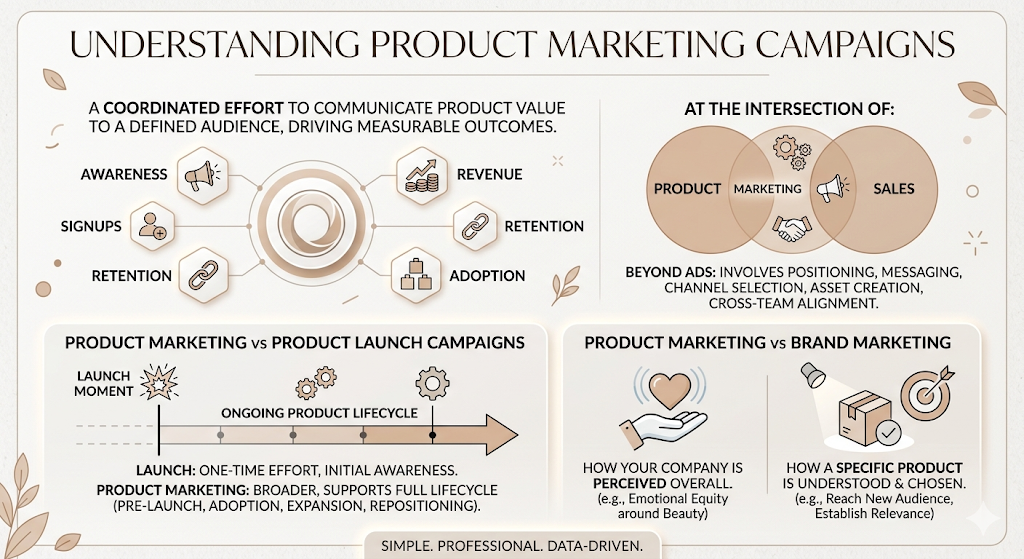
A product marketing campaign is a coordinated effort to communicate the value of a specific product or feature to a defined audience, with the goal of driving a measurable outcome. That outcome might be awareness, signups, revenue, retention, or adoption. Usually, it’s a combination.
Product marketing campaigns sit at the intersection of product, marketing, and sales. They’re not just ads. They involve positioning, messaging, channel selection, asset creation, and cross-team alignment -all built around a clear understanding of what the customer needs and how this product meets it.
Product Marketing vs Product Launch Campaigns
These terms get used interchangeably. They shouldn’t be.
A product launch campaign is a one-time effort tied to the initial release of a product. It creates a moment of awareness. Product marketing campaigns are broader and ongoing -they support the full lifecycle of a product, from pre-launch through adoption, expansion, and eventual repositioning.
Think of the launch as one campaign inside a longer product marketing strategy.
Product Marketing vs Brand Marketing
Brand marketing is about how your company is perceived overall. Product marketing is about how a specific product is understood, positioned, and chosen by a specific buyer.
Nykaa’s brand campaigns build emotional equity around beauty and confidence. But when Nykaa launched its Nykaa Man line, the product marketing campaign had to do a different job: reach a new audience, establish relevance in a new category, and overcome the mental model that Nykaa was “a women’s platform.” Those are product marketing challenges.
A product marketing campaign is a coordinated, time-bound effort to communicate a product’s value to a specific audience and drive a measurable business outcome. Unlike brand campaigns, which build overall perception, product marketing campaigns target adoption, conversion, or revenue tied directly to a product or feature. They require alignment across product, marketing, and sales teams to be effective.
Why Product Marketing Campaigns Matter More Than You Think
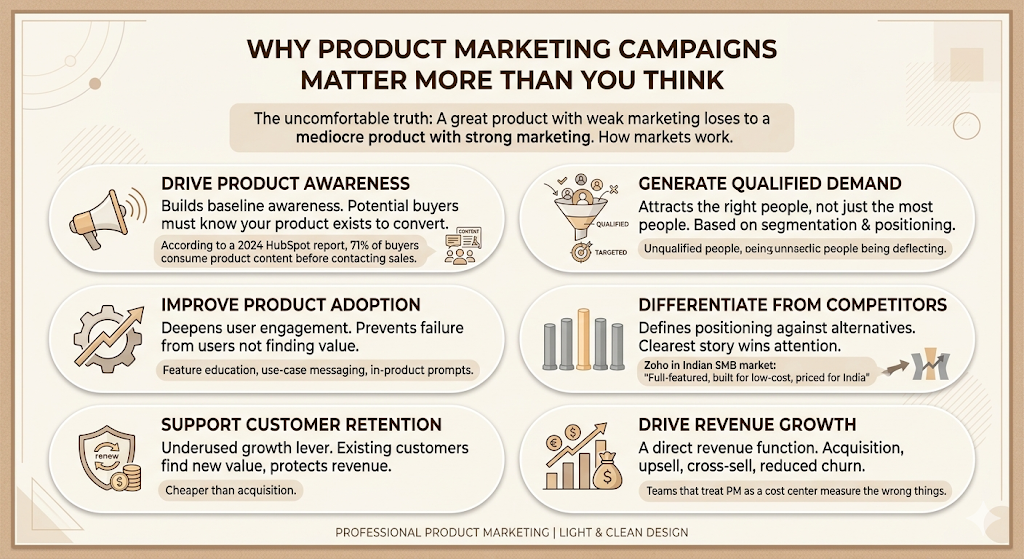
Here’s the uncomfortable truth: a great product with weak marketing will lose to a mediocre product with strong marketing, at least in the short term. That’s not a cynical observation. It’s how markets work.
They Drive Product Awareness
Awareness is not vanity. A potential buyer who has never heard of your product cannot be converted. Product marketing campaigns build the baseline awareness that makes every other conversion effort possible.
According to a 2024 report by HubSpot, 71% of buyers consume product-related content before making a first contact with a sales team. If your campaigns aren’t creating that content and placing it where buyers look, your sales team starts every conversation from behind.
They Generate Qualified Demand
Not all demand is useful. A campaign that brings in 10,000 unqualified visitors is worse than one that brings in 500 people who actually need what you sell. Product marketing campaigns, when built on proper segmentation and positioning, attract the right people rather than the most people.
They Improve Product Adoption
Many SaaS products fail not because of churn at renewal -they fail because users never get deep enough into the product to find its value. Campaigns targeting existing users with feature education, use-case messaging, and in-product prompts are a genuine growth lever that most teams underuse.
They Differentiate From Competitors
In crowded markets, the product with the clearest story wins the most attention. Product marketing campaigns are where you define your positioning against alternatives -not by attacking competitors, but by making your specific value so clear that the comparison becomes obvious.
Zoho did this well in the Indian SMB market. Their campaigns consistently reinforced the message: full-featured software, built for businesses that need to watch costs, priced for India. That’s not vague. It’s a direct positioning statement against international alternatives like Salesforce and HubSpot, and it’s been effective because they’ve stayed consistent with it.
They Support Customer Retention
Retention campaigns are underrated. A campaign that helps existing customers discover a feature they’ve never used, or reminds them of value they’re already getting, is cheaper than any acquisition campaign. And it protects revenue that’s already on the books.
They Drive Revenue Growth
Ultimately, product marketing campaigns are a revenue function. Whether through new customer acquisition, upsell, cross-sell, or reduced churn, well-executed campaigns have a direct line to the P&L. Teams that treat product marketing as a cost center are measuring the wrong things.
Key Components of a Campaign That Actually Works
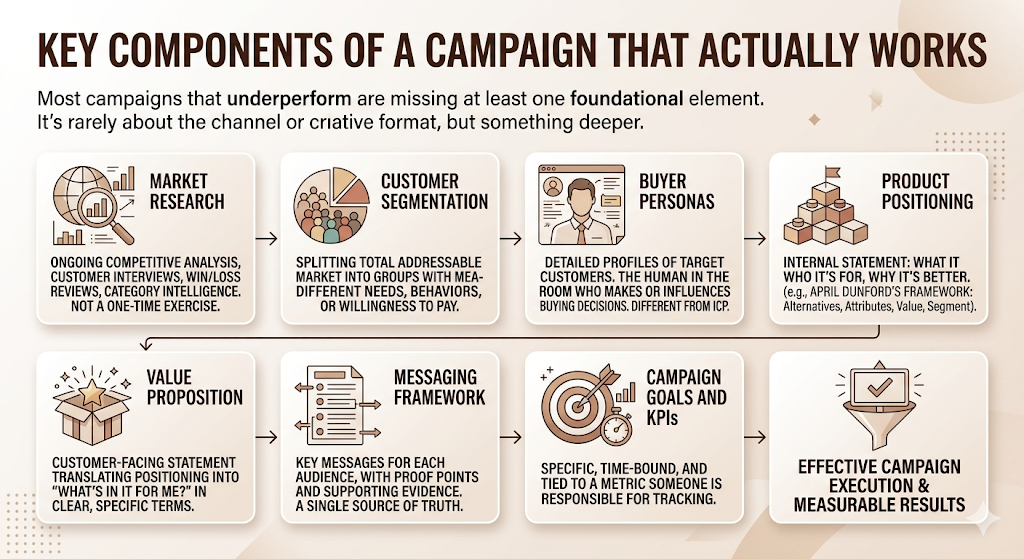
Most campaigns that underperform are missing at least one of these. Not a channel. Not a creative format. Usually, it’s something more foundational.
Market Research
You cannot position a product without knowing what the market already believes. That means competitive analysis, customer interviews, win/loss reviews, and category intelligence. Market research is not a one-time pre-launch exercise. It’s ongoing input that should shape every campaign brief.
Customer Segmentation
Segmentation means splitting your total addressable market into groups that have meaningfully different needs, behaviors, or willingness to pay. A campaign aimed at “everyone who might need this” is a campaign aimed at no one. The sharper your segment, the more relevant your message.
Buyer Personas
A buyer persona is a detailed profile of your target customer, including their role, goals, pain points, information sources, and objections. It’s not the same as your ICP (Ideal Customer Profile), which describes company-level characteristics. The persona is the human in the room who makes or influences the buying decision.
Product Positioning
Product positioning is a statement that defines what your product does, who it’s for, and why it’s better than the alternative. It’s internal -it’s not your tagline. It’s the foundation that every piece of campaign messaging should reflect.
April Dunford’s positioning framework (from her book “Obviously Awesome”) is widely used in product marketing. It forces teams to define: competitive alternatives, unique attributes, the value those attributes enable, and the buyer segment that cares most about that value. If your team hasn’t done this work before a campaign brief is written, the campaign will drift.
Value Proposition
The value proposition translates positioning into a customer-facing statement. It answers: “What’s in it for me?” in clear, specific terms. “The fastest checkout experience in Indian e-commerce” is a value proposition. “A better way to shop online” is not.
Messaging Framework
A messaging framework documents the key messages for each audience segment, along with proof points and supporting evidence. It’s the single source of truth for what the campaign says and what it doesn’t. Without one, every team member writing copy or creating assets will drift toward their own interpretation of the product’s value.
Campaign Goals and KPIs
Goals without KPIs are wishes. A campaign goal should be specific, time-bound, and tied to a metric someone is responsible for tracking. “Increase product awareness” is a goal. “Reach 50,000 unique users in the 25-35 age group in metros within 60 days of launch” is a campaign KPI.
Types of Product Marketing Campaigns
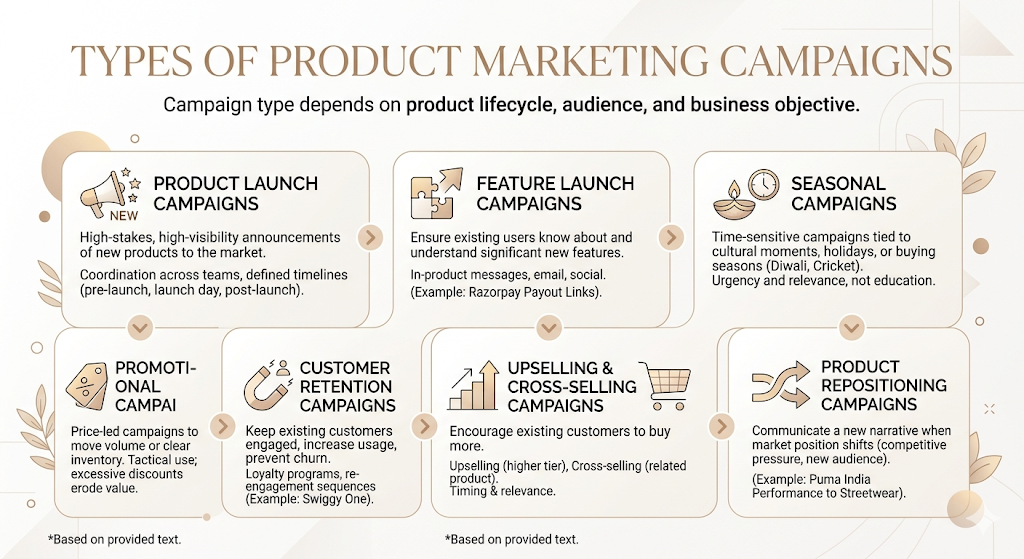
Not all campaigns are the same. The type of campaign you run should depend on the product lifecycle stage, the audience, and the business objective.
Product Launch Campaigns
The high-stakes, high-visibility campaign that announces a new product to the market. This is the campaign most people picture when they hear “product marketing.” It requires the most coordination across teams and typically runs on a defined timeline from pre-launch buzz to launch day to post-launch reinforcement.
Feature Launch Campaigns
Often neglected. When a product team ships a significant new feature, marketing needs to make sure existing users know about it and understand why it matters. Feature launch campaigns can run entirely in-product (in-app messages, onboarding flows) or extend to email and social. Razorpay does this well -when they released their Payout Links feature, they ran targeted email campaigns to existing merchant accounts explaining the specific use case it solved.
Seasonal Campaigns
Time-sensitive campaigns tied to cultural moments, holidays, or buying seasons. For Indian brands, this means Diwali, New Year, cricket seasons, and the back-to-college window. Seasonal campaigns are primarily about urgency and relevance, not education.
Promotional Campaigns
Price-led campaigns are designed to move volume or clear inventory. They work in the short term. But running them too frequently trains your audience to wait for discounts, which erodes perceived value. Use them tactically, not as a default.
Customer Retention Campaigns
Campaigns designed to keep existing customers engaged, increase their product usage, or prevent churn. This includes loyalty programs, re-engagement sequences, and milestone-based outreach. Swiggy One, Swiggy’s membership program, is built on this kind of campaign logic -the goal is to deepen the relationship with frequent users rather than just acquire new ones.
Upselling and Cross-Selling Campaigns
Campaigns that encourage existing customers to buy more. Upselling moves them to a higher tier or plan. Cross-selling introduces them to a related product. Both require strong timing and relevance -done poorly, they feel like spam. Done well, they feel like a useful recommendation.
Product Repositioning Campaigns
When a product’s market position needs to shift -because of competitive pressure, category evolution, or a change in target audience -a repositioning campaign communicates the new narrative. This is difficult because you’re asking customers to update their mental model. But sometimes it’s necessary. Puma shifted its India positioning from performance-focused to streetwear and lifestyle, and that required consistent campaign messaging across multiple years to land.
How to Build a Product Marketing Campaign Step by Step
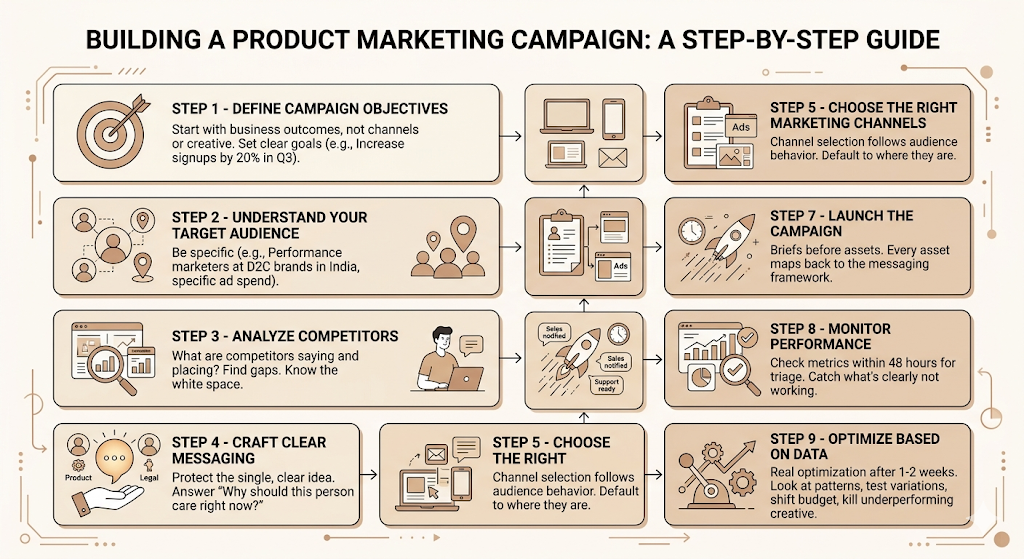
There are a lot of campaign planning templates out there. Most of them are too long or too abstract to be useful. Here’s a process that actually maps to how campaigns get built at real companies.
Step 1 -Define Campaign Objectives
Start with the business outcome, not the channel or creative. What does the company need this campaign to do? Increase signups by 20% in Q3? Improve feature adoption among a specific user cohort? Reduce churn in the SMB segment? Objectives set the scope for everything else.
Step 2 -Understand Your Target Audience
Who is this campaign for? Be specific. Not “marketers” -“performance marketers at D2C brands in India with a monthly ad spend between 5 and 50 lakhs.” That level of specificity shapes your channel choices, your message, and your creative.
Step 3 -Analyze Competitors
What are competitors saying? Where are they placing their messages? Where are the gaps? You don’t need to directly counter what competitors are doing, but you do need to know where the white space is. If everyone in your category is making the same claims, that’s actually an opportunity to be different.
Step 4 -Craft Clear Messaging
This step is where most campaigns get diluted. Everyone on the team has an opinion. Legal wants to hedge. The CEO wants the tagline to mention three different value props. Product wants the feature list front and center.
Your job as a product marketer is to protect the single, clear idea that the campaign is built around. That idea should answer one question: “Why should this specific person care about this specific product right now?”
Step 5 -Choose the Right Marketing Channels
Channel selection should follow audience behavior. Where does your target audience spend time? Where do they make decisions? A campaign targeting B2B software buyers might run heavily on LinkedIn with supporting content on email. A D2C campaign targeting urban women in their 20s might run primarily on Instagram Reels and YouTube Shorts.
Don’t default to what you know. Default to where your audience actually is.
Step 6 -Develop Creative Assets
Briefs before assets. Every creative -whether it’s a landing page, an ad, a video, or an email -should map back to the messaging framework. If a designer or copywriter can’t tell what message a piece of creative is trying to convey, the brief isn’t tight enough.
Step 7 -Launch the Campaign
Coordinate the internal release. Make sure the sales team knows what’s going live and what to say. Make sure customer support knows about any new feature or product change. A campaign that goes live while your support team answers questions about a feature they’ve never heard of creates a bad customer experience at the exact moment you’re trying to create a good one.
Step 8 -Monitor Performance
Check campaign metrics within 48 hours of launch. Not to make panicked decisions, but to catch anything that’s clearly not working -a broken landing page, an ad that’s not delivering, an email that went to the wrong segment. Early monitoring is triage, not optimization.
Step 9 -Optimize Based on Data
Real optimization happens after you have enough data to see patterns. That’s usually 1-2 weeks into a campaign, depending on volume. Look at what’s converting and what isn’t. Test messaging variations. Shift budget toward channels performing above target. Kill underperforming creatives early.
Building an effective product marketing campaign requires nine sequential steps: defining business objectives, identifying a specific target audience, analyzing the competitive landscape, crafting a focused message, selecting channels based on audience behavior, developing brief-backed creative assets, coordinating the internal launch, monitoring early performance, and optimizing based on data patterns. Campaigns that skip the first three steps consistently underperform despite strong creative execution.
The Best Marketing Channels for Product Campaigns
There’s no universally right channel. There’s only the right channel for your audience, objective, and budget.
Content Marketing
Educational content builds long-term awareness and trust. Blog posts, guides, comparison pages, and case studies work well for products with a longer consideration cycle. HubSpot built its first hundred thousand customers largely through content, and it remains one of the most cost-effective channels for SaaS companies.
Email Marketing
Email is underrated in product marketing. For existing customer campaigns, feature adoption campaigns, and renewal campaigns, email consistently outperforms paid channels on cost per conversion. The key is segmentation -a well-segmented email to 2,000 relevant users will outperform a blast to 20,000.
Social Media Marketing
Platform choice matters more than the fact of being on social media. LinkedIn for B2B. Instagram and YouTube for consumer products and younger demographics. X (formerly Twitter) for tech and developer audiences. Running the same creative across every platform is a common mistake.
Paid Advertising
Meta Ads and Google Ads remain the backbone of performance-driven product campaigns. Zomato and Blinkit run aggressive performance campaigns on Meta because the conversion window is short and the audience is broad. For B2B SaaS, LinkedIn Ads typically have higher CPCs but better targeting precision for small buying committees.
SEO
Search engine optimization is a long-term investment that produces compounding returns. Category-level keywords (“best project management tools for startups”) and comparison keywords (“X vs Y”) are especially valuable because they capture buyers in an active evaluation mode.
Influencer Marketing
Works best for consumer products and lifestyle brands in India. boAt’s early growth was driven substantially by an influencer marketing strategy that leaned into micro-influencers in music, gaming, and sports communities, which helped the brand feel culturally embedded rather than just distributed. The key is finding creators whose audience genuinely overlaps with your target segment.
Video Marketing
Short-form video has become the highest-reach format in India. YouTube Shorts, Instagram Reels, and Moj reach massive audiences at low cost. For product marketing, demonstration videos, testimonial videos, and use-case stories tend to outperform product-feature highlight videos.
Webinars and Events
More relevant for B2B than consumer. A product demo webinar targeting a defined industry segment can generate more qualified pipeline than a generic paid campaign at a fraction of the cost. Zoho and Freshworks both run significant webinar programs for their Indian SMB customer base.
Product-Led Growth Channels
PLG channels include in-product onboarding flows, in-app messages, triggered emails based on user behavior, and usage-based expansion campaigns. They’re not traditional marketing channels, but they’re increasingly where the best product marketing happens. Notion’s referral program and Figma’s collaborative sharing model are both examples of the product itself being the distribution mechanism.
A Practical Product Marketing Campaign Framework
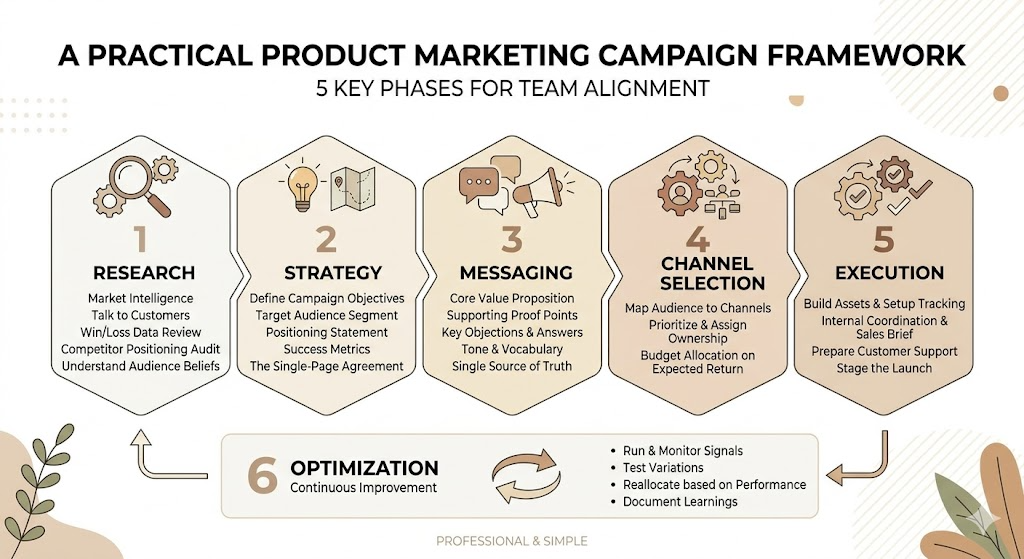
You don’t need a 40-slide campaign deck to run a good campaign. You need a clear framework that keeps the team aligned across the five phases that matter.
Research
Gather market intelligence before writing a single line of copy. Talk to customers. Review win/loss data. Audit competitor positioning. Understand what the audience already believes about the problem your product solves.
Strategy
Define the campaign objective, the target audience segment, the positioning statement, and the success metrics. This is the one-page document that everyone should agree on before work starts. If there’s disagreement at the strategy level, it will surface as conflict at the execution level.
Messaging
Build the messaging framework. Core value prop. Supporting proof points. Key objections and how to address them. Tone and vocabulary for the audience. This document is the single source of truth for everyone writing copy or building creative assets.
Channel Selection
Map your audience to channels. Prioritize based on where they spend time and where conversion is most likely to happen. Assign ownership -who is responsible for which channel? Budget allocation should follow expected return, not historical comfort.
Execution
Build assets, set up tracking, get approvals, and launch. Coordinate internally before going external. Brief the sales team. Prepare customer support. Stage the launch if it’s a major product release.
Optimization
Run the campaign. Monitor early signals. Test variations. Reallocate based on performance. Document what worked and what didn’t for the next campaign. Optimization is not a phase that starts after the campaign ends -it starts the moment the campaign goes live.
Real Campaign Examples Worth Studying
Mamaearth -D2C Consumer Products
Campaign Objective: Build trust in a market skeptical of natural beauty claims.
Strategy Used: Mamaearth built a campaign combining influencer credibility, transparent ingredient labeling, and cause marketing (planting a tree per order). The messaging was consistent across channels: toxin-free, natural, made for Indian families.
Why It Worked: The target audience was parents, particularly mothers, who were actively skeptical of chemical ingredients in baby and personal care products. The positioning hit the fear directly rather than trying to sell around it.
Key Takeaway: Positioning directly against the fear your customer already has is more powerful than positioning toward an aspirational outcome they might want.
Zoho -B2B SaaS
Campaign Objective: Win Indian SMB customers who were spending on expensive international software.
Strategy Used: Zoho’s campaign messaging consistently led with price and completeness: all the tools you need, at a price built for India. They reinforced this through case studies featuring Indian small businesses, content marketing in regional languages, and direct sales outreach to SMB owners.
Why It Worked: The value proposition was genuinely differentiated. There was no other player offering a comparable product suite at that price point for the Indian market. The campaign didn’t need to be clever. It needed to be clear.
Key Takeaway: If your differentiation is real, say it directly. Don’t bury it in brand language.
Zepto -Quick Commerce
Campaign Objective: Shift consumer perception from “grocery delivery” to “instant needs” -broadening the category.
Strategy Used: Zepto’s campaigns used a 10-minute delivery promise as the hero message, supported by performance marketing on Meta and Google targeting urban tier-1 apartment dwellers, with strong hyperlocal retargeting.
Why It Worked: The 10-minute promise is specific and testable. Consumers either believe it or they try it. The campaign created curiosity and provided a concrete reason to try. First purchase experience, then did the retention work.
Key Takeaway: A specific, verifiable promise beats a vague aspiration every time.
Notion -SaaS Product-Led Growth
Campaign Objective: Accelerate user acquisition through existing user networks.
Strategy Used: Notion offered additional storage and premium features to users who referred others. But more importantly, Notion templates went viral on Twitter and YouTube. Power users creating and sharing templates became a genuine distribution channel.
Why It Worked: The product’s collaborative nature made sharing natural. The campaign didn’t need to force sharing -it created an environment where sharing was the obvious move.
Key Takeaway: The best product marketing campaigns are built on genuine product behavior, not synthetic incentives.
boAt -Consumer Electronics
Campaign Objective: Build brand equity among Indian youth in the 18-30 age segment at a time when the earbuds market was dominated by established global brands.
Strategy Used: boAt ran a multi-year influencer campaign across gaming, cricket, and music communities. They also partnered with Indian cricketers as brand ambassadors and focused content on the cultural identity of their audience rather than the technical specs of their products.
Why It Worked: boAt recognized that their audience didn’t buy earbuds to listen to music. They bought them to signal identity. The campaign met that need directly.
Key Takeaway: Understand what your customer is really buying. It’s rarely the product itself.
The most effective product marketing campaigns studied across Indian and global markets share a consistent trait: they lead with a customer’s existing belief, fear, or desire rather than a product feature. Campaigns by Mamaearth, Zoho, Zepto, and boAt succeeded because they entered a conversation the customer was already having, not because they started a new one.
Metrics That Tell You If It’s Working
The problem with campaign measurement isn’t a shortage of metrics. It’s a shortage of discipline about which metrics actually matter for your specific objective.
Reach
How many unique people saw your campaign? Reach matters most in awareness-stage campaigns where your primary goal is building a new audience’s familiarity with your product.
Engagement
Clicks, shares, comments, saves, time on page. Engagement signals relevance -the message is resonating with the people who saw it. But engagement without conversion is a warning sign that something in the funnel is broken.
Website Traffic
Measure campaign-attributed traffic separately from organic. Use UTM parameters on every link. If traffic increases but conversions don’t, the problem is on the site, not in the campaign.
Conversion Rate
The percentage of people who complete the desired action after seeing the campaign. Landing page conversion rate, email click-to-conversion rate, and ad click-to-trial conversion rate. This is the most direct measure of whether your messaging is landing.
Product Sign-Ups
For SaaS and app-based products, sign-ups are often the primary campaign conversion metric. Track sign-ups by channel, by creative, and by audience segment. The segment with the lowest CAC and highest activation rate is your priority segment for the next campaign.
Customer Acquisition Cost (CAC)
CAC is the total campaign spend divided by the new customers acquired. It’s the metric that determines whether a campaign is economically viable. Track it by channel -CAC on Meta might be very different from CAC on LinkedIn or referral.
Customer Lifetime Value (CLV)
CLV without CAC context is interesting but incomplete. The ratio that matters is CLV: CAC -ideally above 3:1 for most SaaS businesses. A campaign that acquires customers cheaply but attracts low-LTV users is still a bad campaign.
Return on Investment (ROI)
ROI = (Revenue from campaign – Campaign cost) / Campaign cost. Simple in theory. Complicated in practice because attribution is hard, especially for awareness-stage campaigns with long conversion windows.
Revenue Generated
The bottom line. How much revenue can be directly or indirectly attributed to this campaign? Track it by cohort -customers acquired during the campaign period, measured over 90 and 180 days post-acquisition.
Mistakes That Quietly Kill Campaigns
These don’t show up as obvious failures. They just make campaigns underperform without anyone clearly understanding why.
Weak Positioning
If the positioning isn’t sharp, the messaging will be vague, the creative will be generic, and the campaign will blend into the background. Weak positioning is the root cause of most underperforming campaigns, and it almost never gets diagnosed correctly.
Ignoring Customer Research
Campaigns built on what the team thinks customers care about, rather than what customers have actually said, consistently miss. Assumptions are expensive. A week of customer interviews before a campaign brief is cheaper than six weeks of a campaign that doesn’t convert.
Poor Messaging Consistency
When the ad says one thing, the landing page says something slightly different, and the email follow-up uses completely different language, the buyer loses trust. Messaging inconsistency is one of the most common causes of poor conversion rates between campaign touchpoints.
Choosing the Wrong Channels
Running your B2B campaign on Instagram because everyone is on Instagram. Running your consumer product campaign on LinkedIn because that’s where the marketing team spends time. Channel selection based on comfort rather than audience behavior is extremely common and consistently costly.
Launching Without Testing
Even a basic A/B test on the headline or CTA before full campaign launch can prevent significant waste. Landing page copy, email subject lines, and ad creatives should be tested before scale. Most teams skip this because they’re in a hurry. Most teams regret it.
Focusing Only on Vanity Metrics
Reach, impressions, and social follower counts look good in status updates. They don’t tell you whether the campaign is actually doing its job. Teams that optimize for vanity metrics will consistently run campaigns that look successful and deliver nothing.
Lack of Post-Launch Optimization
Treating the campaign as done once it launches is a mistake. Campaigns that aren’t actively optimized in-flight typically underperform by 20-30% against campaigns that are. The data is there. Someone has to actually use it.
Best Practices for High-Performing Campaigns
Keep Customer Value at the Center
The campaign is not about your product. It’s about what the customer gets from it. Every headline, every visual, every email subject line should answer: “What does the customer gain?” -not “What features does the product have?”
Personalize Messaging
Personalization doesn’t require advanced AI. Segmenting your audience by job title and sending different emails to a startup founder versus an enterprise buyer is personalization. The more specific the message, the higher the conversion rate.
Align Sales and Marketing, Teams
A campaign that generates leads the sales team can’t convert -because they don’t know what was promised, what message was used, or what the prospect’s expectation is -is a failed campaign, regardless of the top-of-funnel numbers. Alignment is not optional. It’s operational.
Use Customer Feedback
Customer interviews, support tickets, NPS comments, and sales call notes are all inputs for better campaign messaging. The customers who are clearest about why they chose your product are telling you exactly what your campaign should say.
Test and Iterate Continuously
The goal isn’t to launch a perfect campaign. The goal is to launch a good campaign and improve it quickly. Teams that ship fast and optimize aggressively outperform teams that plan exhaustively and launch slowly.
Maintain Brand Consistency
Across channels, across campaigns, across time. Brand consistency compounds. The more often your audience sees a consistent visual language and consistent message, the faster they recognize and trust your product.
Use AI for Campaign Optimization
In 2026, AI tools will be genuinely useful for product marketing tasks. ChatGPT and Claude can help pressure-test messaging frameworks and generate variant copy. Tools like Jasper and Copy.ai speed up asset creation. Mutiny and Dynamic Yield personalize landing page content by audience segment in real time. These are force multipliers for small teams, not replacements for sharp strategic thinking.
Tools That Support Campaign Execution
CRM Tools
Salesforce and HubSpot CRM are the most widely used in B2B. Freshsales is a strong option for Indian SMBs that want a full-featured CRM without enterprise pricing. CRM data is essential for segmenting audiences for targeted campaigns.
Marketing Automation Platforms
HubSpot Marketing Hub, Marketo, and Mailchimp for mid-market. MoEngage and CleverTap are strong India-first options for mobile and app-led businesses -both are widely used by Indian consumer brands for retention and lifecycle campaigns.
Analytics Tools
Google Analytics 4 for web. Mixpanel or Amplitude for product analytics and in-product campaign measurement. Hotjar for understanding landing page behavior. Supermetrics for pulling campaign data from multiple ad platforms into a single dashboard.
Social Media Management Tools
Hootsuite, Buffer, and Sprout Social for scheduling and monitoring. For Indian brands with regional content needs, Zoho Social is increasingly popular because of its integration with the broader Zoho CRM and marketing stack.
A/B Testing Platforms
VWO (Visual Website Optimizer) was built in India and is widely used for landing page testing. Optimizely is the enterprise standard. Google Optimize was deprecated in 2023, so teams relying on it should have migrated by now.
Project Management Tools
Notion, Asana, and Linear are the most common choices for campaign project management. The tool matters less than the process -what matters is that the campaign timeline, ownership, and deliverables are visible to everyone involved.
Emerging Trends in Product Marketing Campaigns in 2026
AI-Powered Personalization
Campaigns that adapt messaging based on user behavior, industry, role, and stage in the buying cycle in real time are no longer a futuristic concept. Tools like Mutiny and Salesforce Einstein are making this accessible for mid-market companies. The brands that invest in this now will have a structural advantage in conversion rates.
Interactive Product Experiences
Demos, interactive calculators, product simulators, and “try before you buy” tools are becoming standard campaign assets in SaaS. Buyers want to experience the product before they talk to sales. Campaigns that deliver that experience will see higher conversion rates than campaigns that promise value through copy alone.
Community-Led Marketing
Slack communities, Discord servers, LinkedIn groups, and WhatsApp groups built around specific professional identities are emerging as significant campaign channels. The trust levels in community contexts are significantly higher than in paid media, and the conversion rates reflect that.
First-Party Data Strategies
With third-party cookie deprecation continuing across major browsers and iOS privacy updates limiting mobile ad tracking, product marketers are investing in building owned audiences -email lists, SMS subscribers, loyalty program members. First-party data is becoming the most valuable campaign input.
Short-Form Video Campaigns
YouTube Shorts and Instagram Reels have overtaken long-form video for awareness-stage reach in India. The creative challenge is communicating product value in under 60 seconds without losing nuance. Brands like Mamaearth and Myntra have built strong short-form playbooks that prioritize hook, problem, and proof in that order.
Omnichannel Marketing
Buyers don’t stay on one channel. They see an Instagram ad, visit the website, read a review, get a retargeted ad on YouTube, and then convert via direct search. Omnichannel campaigns track and coordinate this journey rather than optimizing each channel in isolation.
Product-Led Growth (PLG)
Product-led growth as a campaign strategy means using the product itself as the primary channel for customer acquisition and expansion. Free trials, freemium tiers, in-product referral mechanisms, and viral sharing features are all PLG tools. Figma and Canva built category-defining businesses primarily through PLG rather than traditional marketing campaigns.
In 2026, the most significant shifts in product marketing campaigns are driven by three forces: AI-powered personalization enabling real-time message adaptation at scale, the collapse of third-party data forcing investment in first-party audience building, and product-led growth positioning the product itself as the primary marketing channel. Brands that adapt their campaign strategies to these shifts will compound their advantages over the next three to five years.
How to Know If Your Campaign Succeeded
Compare KPIs Against Goals
This sounds obvious, but gets skipped more often than you’d think. Pull the original campaign brief. Compare every KPI against the target. Don’t let narrative override data -a campaign that got great press coverage but missed its sign-up target is a campaign that missed its target.
Analyze Customer Feedback
What did customers say? What did the sales team hear in calls? What objections came up repeatedly? Customer feedback is qualitative campaign data. It tells you whether the message was understood and believed.
Measure Sales Impact
How many opportunities were generated? How many closed? What was the win rate for leads from this campaign versus other sources? Sales impact is the most concrete measure of campaign effectiveness.
Review ROI
Total revenue directly attributable to the campaign divided by total campaign cost. Set the attribution window in advance -not post-campaign, to make the numbers look better. A 90-day attribution window is standard for most B2B campaigns. Shorter for the consumer.
Document Learnings for Future Campaigns
The most valuable output of any campaign isn’t the results. It’s the learning. What messaging worked? Which channel over-delivered? What creative underperformed despite looking good in testing? Document this in a format the next campaign team will actually use. Most teams don’t do this. The ones that do get measurably better with every campaign.
Final Thoughts
The best product marketing campaigns aren’t the most creative ones or the ones with the biggest budgets. They’re the ones built on the clearest understanding of a specific customer’s real problem and a direct, credible explanation of how the product solves it.
That’s harder than it sounds. It requires customer research that most teams rush. It requires positioning discipline that most teams abandon under internal pressure. And it requires post-launch optimization that most teams skip in favor of moving to the next thing.
But when those three things come together -genuine customer insight, sharp positioning, and continuous improvement -campaigns stop feeling like executions and start feeling like genuine business drivers.
Product marketing campaigns work when they’re built on truth. Truth about the customer. Truth about the product. And the truth about the gap between them.
If you’re building a career in product marketing or trying to build one, the clearest path is to get strong on the fundamentals: positioning, customer research, and measurement. Everything else is execution.
The Young Urban Project’s Product Marketing course covers each of these areas in depth. If you’re serious about getting good at this, it’s worth exploring.
Frequently Asked Questions About Product Marketing Campaigns
What is a product marketing campaign?
A product marketing campaign is a coordinated, time-bound effort to communicate a product’s value to a specific audience with the goal of driving a measurable business outcome. This includes awareness, adoption, conversion, or revenue. It involves positioning, messaging, channel selection, creative execution, and cross-team coordination.
What’s the difference between product marketing and product advertising?
Product advertising refers specifically to paid placement in media channels -ads on Meta, Google, YouTube, or print. Product marketing is broader. It includes the strategy, positioning, messaging framework, channel selection, and content that support the entire customer journey, of which advertising is one component.
How do you create a successful product marketing campaign?
Start with customer research and a clear positioning statement. Define a specific audience segment and a measurable goal. Build a messaging framework before creating any assets. Select channels based on where your audience actually makes decisions. Launch with tracking in place. Optimize based on data within the first two weeks.
Which channels work best for product marketing campaigns?
It depends on your audience and product. B2B SaaS campaigns typically perform best on LinkedIn, email, and SEO. Consumer D2C campaigns in India perform best on Instagram, YouTube, and Meta Ads. There’s no universally right channel -there’s only the right channel for your specific audience behavior and budget.
How long should a product marketing campaign run?
Product launch campaigns typically run for 6 to 12 weeks, including pre-launch, launch day, and post-launch reinforcement. Ongoing product marketing campaigns like retention campaigns or feature adoption campaigns often run continuously with rotating creative. The length should be dictated by the objective, not by convention.
What KPIs should you track in a product marketing campaign?
The right KPIs depend on the campaign objective. Awareness campaigns track reach and brand recall. Demand-generation campaigns track leads, sign-ups, and CAC. Retention campaigns track engagement rate, churn reduction, and NPS change. Revenue campaigns track conversion rate, ROI, and CLV: CAC ratio.
What are some examples of successful product marketing campaigns?
Zepto’s 10-minute delivery campaign drove rapid trial by making a specific, verifiable promise. Mamaearth’s toxin-free positioning built trust with a skeptical audience. Zoho’s value-pricing campaign effectively displaced international competitors in the Indian SMB market. Notion’s template-sharing campaign turned power users into a distribution channel. Each succeeded because it led with a clear customer insight, not a feature list.
How much does a product marketing campaign cost?
Costs vary widely. A lean campaign from a startup might run on 50,000 to 5 lakh rupees, using performance marketing, content, and email. An enterprise campaign across multiple channels and markets might run to several crores. The more important numbers are CAC and ROI, not total spend. A small campaign with a CAC of Rs 500 and a CLV of Rs 5,000 outperforms a large campaign with the reverse ratio.
What tools are used to manage product marketing campaigns?
Common tools include HubSpot or Salesforce for CRM, MoEngage or CleverTap for lifecycle and retention campaigns in India, Google Analytics 4 for web measurement, Mixpanel or Amplitude for in-product analytics, Meta Ads Manager and Google Ads for paid media, and Notion or Asana for project management.
How can small businesses create effective product marketing campaigns?
Start with what you know most precisely: your best current customers. Interview them. Understand exactly why they chose you. Use their language in your campaign messaging. Focus on one or two channels where your audience is most active rather than trying to be everywhere. Track every rupee. The constraint of a small budget forces the discipline that large-budget campaigns often lack.
Is product marketing only relevant for product companies?
No. Any company that sells a defined product or service can use product marketing principles. Consultancies use positioning and messaging frameworks to differentiate their service lines. Retailers run product-level campaigns for specific categories. D2C food brands use feature-benefit messaging just like SaaS companies do. The underlying logic applies