
Posting every day doesn’t make a brand. Plenty of businesses run an Instagram page, a LinkedIn profile and a folder full of festival creatives, and still nobody would recognise their content if the logo were covered. That’s the real problem. Having accounts is easy. Being remembered is the hard part.
Some brands get recognised in half a second. Others, with bigger budgets and more followers, blur into the feed. The gap usually isn’t talent or money. It’s a clear social media branding strategy. It’s a deliberate decision about what your brand stands for, how it looks, how it sounds and where it shows up. Without one, every post becomes a fresh guess. Your audience can feel the guessing.
This guide covers what social media branding actually means, the elements every brand needs, an eight-step process for building your own, platform choices, content techniques, AI tools, measurement and common mistakes. A 30-day action plan sits near the end.
Table of Contents
What Is Social Media Branding and Why Does It Matter?
Social media branding is the work of shaping how people see and remember your business through everything you publish on social platforms. Your visuals, voice, messaging and personality all feed into it. If it’s done well, someone recognises your post before they read the name on it.
Understanding the Meaning of Social Media Branding
Think of branding as the impression you leave behind when you’re not in the room. Social media marketing for businesses is usually about a result. A sale. A signup. A click on a campaign. Branding is slower and quieter. It’s what makes a stranger think of you first when they finally need what you sell.
Marketing asks for the action. Branding earns the right to ask.
Four things carry the weight. Perception is what people believe about you. Personality is how you come across. Messaging is what you keep repeating. Visuals are what people notice before they read a word. If your visuals say premium and your captions sound like a clearance sale, nobody knows who they’re dealing with. So they scroll on.
Why Businesses Need a Strong Brand Presence
Familiar brands get picked more often. A social media branding strategy is how you become one. A strong presence builds recognition, earns credibility, separates you from competitors who sell almost the same thing. It gives customers something to feel about you. That feeling is what turns a one-time buyer into a repeat one. That’s where long-term growth comes from.
Trust deserves a closer look. Edelman’s 2025 Trust Barometer Special Report on brands found that trust now sits level with price and quality as a purchase consideration. That’s a big shift. Whether a brand can be believed now weighs as much as whether it’s cheap and whether it’s any good.
Nike is the example most people reach for, and there’s a reason. Its “Just Do It” line dates to 1988. The first television push featured ordinary people of all ages rather than only elite athletes. That told everyday viewers the brand was for them too. On social media, that motivational storytelling shows up through athlete-led stories and a bold, stripped-back look you’d recognise at a glance. In 2025, Nike turned the line into “Why Do It?” for a campaign aimed at young people who hesitate to start. The execution changed. The personality didn’t.
Social media branding shapes how people perceive and remember a business through its visuals, voice and messaging. Unlike campaign-driven marketing, which chases a single result, branding builds the familiarity and trust that make people choose you later. Edelman’s 2025 Brand Trust report found that trust now carries as much weight as price and quality in purchase decisions.
Essential Elements of a Successful Social Media Brand
A successful social media brand needs four things: a clear mission and positioning, a consistent visual identity, a recognisable voice and messaging that real actions back up. Miss one and the rest start to wobble. Every social media branding strategy worth following is built on these four.
A Clear Brand Mission and Positioning
Start with three blunt questions. What does the business stand for? What problem does it solve? And why should a customer pick it over the other five options open in their browser? If you can’t answer each in a sentence, your content will wander. That’s because nobody has decided where it’s supposed to go.
A Consistent Visual Identity
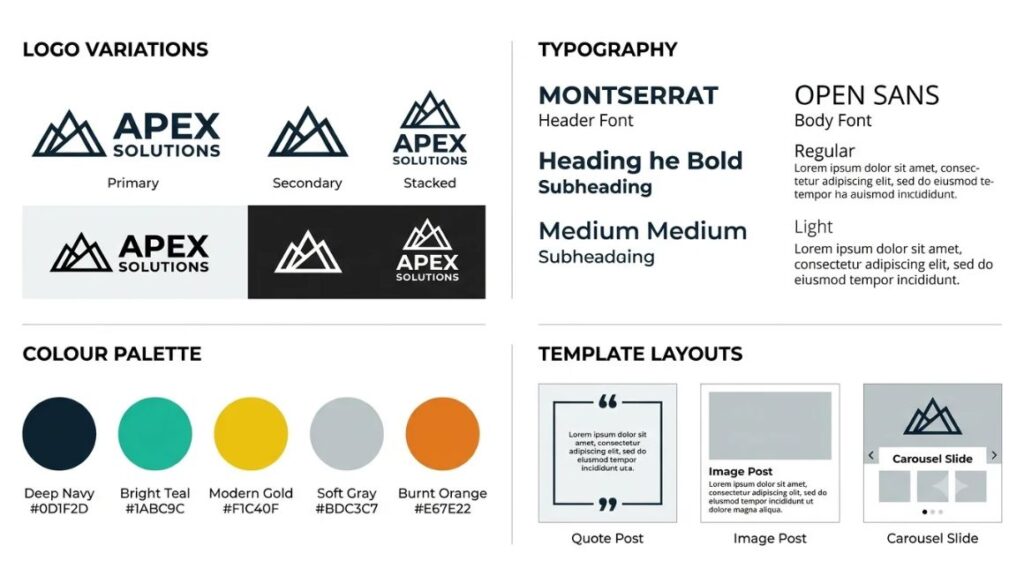
Your logo and profile pictures, brand colours and typography, photography and graphic styles, and a set of reusable templates together make up your social media brand identity. Choose them once. Write the rules down as social media brand guidelines. Use them everywhere.
Why be this strict? Because brand consistency on social media shows up in money. Lucidpress’s 2019 State of Brand Consistency research (the company is now called Marq) found that 68% of companies said consistent presentation contributed to their revenue growth. It’s self-reported survey data, so read it as a direction, not a promise. Still, plenty of businesses own guidelines they never enforce, and that’s where the leak is.
A Recognizable Brand Voice
Voice is how you sound when nobody’s editing you. Friendly or formal? Playful or plain-spoken? Write down the words you’ll use and the ones you won’t. Then hold that line across platforms. Your social media brand voice can flex between LinkedIn and Instagram. But it shouldn’t turn into a different person. Swiggy is a useful Indian example. The Drum’s 2022 profile credits its quirky, relatable tone, repeated across touchpoints, for making its marketing memorable.
Clear Messaging and Brand Values
Pick one central message and keep coming back to it. Values only count when actions prove them, so if you say you care about sustainability, show the packaging or the supplier, not just a green leaf emoji. Keep the message steady across campaigns even when the creative changes.
A quick brand identity checklist before you publish
- Are the logo, colours and fonts used the way your guidelines say?
- Does the caption sound like your brand, or like anyone?
- Does the post belong to one of your content pillars?
- Would a regular follower recognise it with your name covered?
- Does it match what you said last month?
- Has someone checked the facts, spelling and tags?
How to Build an Effective Social Media Branding Strategy?
A social media branding strategy comes together in eight steps: set goals, understand your audience, study competitors, choose platforms, build the identity, plan content pillars, publish on a schedule and engage with people. Follow them in order, because each step shapes the next.
Step 1: Define Your Brand Goals
Decide what the brand needs first. Awareness, recognition and recall, engagement, community, website traffic and leads or customer retention? Pick one or two. Chasing all six means measuring none of them well. A new brand usually needs to be recognised before it needs to convert.
Step 2: Understand Your Target Audience
Go beyond age and city. Find out what your audience cares about, what frustrates them, when they’re online and which formats they actually stop for. Comments, polls, surveys and social listening will tell you more than guesses do. Good social media audience targeting starts with real people’s words, not an imagined persona on a slide.
Step 3: Research Your Competitors
List the direct competitors, then the indirect ones fighting for the same attention. Open their profiles. Which themes do they repeat? What gets a response? What’s missing? The gaps are your opening. If everyone posts polished product shots, a raw behind-the-scenes angle could be what sets you apart.
Step 4: Choose the Right Social Platforms
Go where your audience already is, but only commit to what you can produce well. This is the step where a social media branding strategy gets realistic about time and budget. Two platforms done properly beat five done halfway. Each one also has its own manners. So a repurposed post needs adapting, not just pasting.
Step 5: Create a Distinct Brand Identity
Lock down colours, fonts, imagery and design rules and build a way of speaking that sounds like one person wrote it. Then make reusable templates so you (or your team) don’t redesign from scratch every Monday.
Step 6: Develop Your Content Pillars
Pillars are the recurring themes that keep your social media content strategy from turning random. Common ones are educational, entertaining, inspirational, behind-the-scenes, product or service, and customer stories. Three to five is plenty.
Step 7: Build a Consistent Publishing Schedule
Make a calendar you can honestly keep. Plan posts ahead, repurpose with care (one long video can become clips, quotes and a carousel), then review performance and adjust. Buffer’s 2025 analysis of more than 2 million Instagram posts found that posting three to five times a week more than doubled follower growth compared with one or two posts. Frequency isn’t magic, though. Quality still decides whether those posts deserve to be seen.
Step 8: Engage With Your Audience
Reply to comments and messages. Start conversations. Share customer experiences. Join discussions already happening in your space. Social media engagement works like any relationship. It grows when you keep showing up. It dies when you only announce things. Chasing follower counts is the shortcut that leads nowhere.
Illustrative example (hypothetical, not a real case study): Picture a small Jaipur label called Gulab & Thread that sells block-printed kurtas. Its social media branding strategy might run like this. The goal is to become the name working women in their late twenties think of for everyday ethnic wear. The audience research comes from questions in comments and DMs, mostly about fit and fabric.
A look at competitors shows everyone posting flat-lay catalogue shots and nobody showing the printers. So the label starts with Instagram alone. The identity is terracotta and cream, one serif font and natural-light photos. Pillars are styling tips, artisan stories, customer photos and new arrivals. The schedule is four posts a week, shot in one batch each month. And engagement means answering every comment within a day and asking customers to share how they styled their kurta. No results are claimed here. It’s only a picture of how the eight steps fit together.
A social media branding strategy has eight parts: clear goals, audience research, competitor analysis, the right platforms, a distinct identity, content pillars, a realistic schedule and genuine engagement. Start with one or two goals and no more than two platforms, then build consistency before volume.
Choosing the Best Social Media Platforms for Your Brand
The best platform for your social media branding strategy is the one where your audience already spends time and where you can post well every week. For most Indian businesses that starts with Instagram, then adds LinkedIn for B2B or YouTube for teaching. DataReportal’s mid-2026 update puts India at roughly 600 million social media users, second only to China, so the audience is there. The harder question is where yours is.
Instagram for Visual Storytelling and Brand Discovery
Reels, Stories, carousels and product demonstrations all live here, and visual consistency matters more than anywhere else because people judge a profile grid in seconds. Creator partnerships help new audiences find you. NapoleonCat’s 2026 estimates put Instagram in India well above 500 million users, which is why so many brands start here. Swiggy’s “Voice of Hunger” campaign, built with Dentsu Webchutney around 2019 to 2020, was designed to make it the millennial favourite and grow its Instagram following. That’s a brand using the platform on purpose.
Facebook for Community Building and Customer Relationships
Facebook still works for groups and communities, local business discovery and day-to-day customer conversations through comments and Messenger. It also connects neatly with paid campaigns through Meta’s advertising tools. Think of it as the place for neighbours and regulars, less so for trends.
LinkedIn for Professional and B2B Branding
LinkedIn rewards thought leadership, industry insights, case studies and the faces behind the company. This is where personal branding on social media does the most work for a business. Founders and employees often get more attention than a company page does. NapoleonCat counted about 190 million LinkedIn users in India in May 2026. Buffer’s study of more than 2 million LinkedIn posts points to two to five posts a week as the sweet spot.
YouTube for Educational and Long-Form Branding
Tutorials, product demonstrations, Shorts and longer videos all earn their place here. YouTube is also the closest thing to a searchable library for your brand. So a useful video can keep building topical authority for years. Slower to produce. Longer to pay off.
TikTok for Creative and Culture-Led Content
Here’s a catch for Indian readers. India banned TikTok in June 2020, and as of 2026 the app hasn’t been restored. If your audience is in India, the same ideas (short-form storytelling, trend participation, creator collaborations and an honest brand personality) belong on Instagram Reels and YouTube Shorts. For brands selling abroad, TikTok remains a strong place for culture-led content.
| Platform | Audience fit | Recommended formats | Branding opportunity |
| Consumer brands, lifestyle, D2C, creators | Reels, Stories, carousels | Visual identity and discovery | |
| Local businesses, communities, older audiences | Groups, posts, Messenger replies | Community and customer relationships | |
| B2B, services, hiring, professionals | Text posts, documents, founder posts | Thought leadership and credibility | |
| YouTube | Education, product research, long-form interest | Tutorials, demos, Shorts | Topical authority and trust |
| TikTok (not available in India) | Global Gen Z and culture-led audiences | Short videos, trends, collaborations | Personality and cultural relevance |
Content Creation Techniques That Make Your Brand Memorable
Memorable brands tell stories, make useful short videos, invite customers into the content and keep a recognisable style. Promotion is the smaller part. That balance matters inside any social media branding strategy.
Focus on Storytelling Rather Than Constant Promotion
Nobody follows a brand to be sold to every day. Share how the business started. Introduce the people who make the work happen. Let customers describe their experience. Show how the product solves a real problem. Brand storytelling works because people remember a story long after they’ve forgotten a discount.
Use Short-Form Videos to Capture Attention
Make videos that are useful or entertaining, and ideally both. The first couple of seconds decide whether anyone stays. So open with a clear hook and say one thing well. Trends can help, but original content beats imitation. Copying a trend with nothing of your own in it is just noise with better lighting.
Encourage User-Generated Content
Customer reviews, testimonials, product experiences and community contributions do work your own posts can’t. They show real people using the thing. Ask for them. Share them with credit. Make it easy, perhaps with a simple branded hashtag.
Maintain a Consistent Content Style
Repeat the visual elements people already associate with you. Keep the tone and messaging steady. Adapt each post to the platform it’s on, but don’t change the brand to do it. A LinkedIn carousel and an Instagram Reel can look different and still obviously come from the same place.
How AI and Automation Are Changing Social Media Branding
AI speeds up ideas, planning and repetitive admin, but it can’t supply a personality. Brands that use it well treat it as preparation and keep the voice human. Used that way, it can support your social media branding strategy without flattening it.
Using AI Tools for Content Ideation and Planning
ChatGPT can generate content ideas, summarise the questions your audience keeps asking, draft a first content calendar and suggest creative directions to test. Canva’s Brand Kit stores logos, colours and fonts so templates stay on brand. The output is raw material. You still decide what’s worth publishing.
Automating Repetitive Social Media Tasks
Scheduling, reporting, basic customer response workflows and content organisation are the obvious ones. Buffer and Hootsuite handle scheduling across platforms. Meta Business Suite covers Facebook and Instagram posting, messages and insights in one place. Automate the dull parts. Keep the conversations personal.
Why Human Creativity Still Matters
Generic AI content is easy to spot and easy to ignore. Check every fact and statistic before it goes out. That’s because AI tools can state wrong things confidently. Add your own experiences and opinions. Protect the personality that makes the brand yours. A tool can draft a caption. It can’t care about your customers.
How to Measure the Success of Your Branding Efforts?
Measure your social media branding strategy on three levels: awareness, engagement and business results. Each one tells a different part of the story. None of them works alone.
Brand Awareness Metrics
Reach, impressions, audience growth and brand mentions show whether more people are meeting you. These are the early signals of social media brand awareness. So watch the trend over months rather than reacting to one post.
Engagement and Community Metrics
Comments, shares, saves and engagement rate show whether people care. Read the comments too, because sentiment and audience feedback tell you things the numbers can’t. A save usually means the post was worth coming back to. That is a stronger signal than a quick like.
Business Performance Metrics
Website visits, leads, conversion rate, new customers and revenue influenced by social channels connect branding to the bottom line. The link is rarely a straight line. So use tagged links where you can and be honest about what’s influence and what’s attribution.
Tools for Tracking Performance
Use Instagram Insights (inside the professional dashboard), Meta Business Suite, LinkedIn Analytics, YouTube Analytics and Google Analytics 4. Together they make social media analytics a monthly habit rather than a panic when numbers dip.
A warning about follower count. It’s the easiest number to see and the least reliable measure of branding. Followers can be bought, can be inactive, and can be the wrong audience entirely. A smaller account whose followers comment, save and click will do more for your business than a big one nobody listens to.
Common Social Media Branding Mistakes Businesses Should Avoid
Most mistakes in a social media branding strategy come from impatience, not ignorance. Every one of these has a practical fix.
Being Inconsistent With Visuals and Messaging
When colours, fonts and tone change from post to post, people can’t build a memory of you. Fix it with written guidelines and shared templates. Review the last ten posts side by side every month.
Copying Competitors Instead of Building an Identity
Copying feels safe. But it makes you the second-best version of someone else. Study competitors for gaps, then build around what only you can say.
Posting Only Promotional Content
A feed that only sells gets muted. Mix in teaching, stories and behind-the-scenes posts so promotion feels earned.
Ignoring Comments and Customer Feedback
Silence tells people you don’t listen. Reply daily, even briefly, and take repeated complaints seriously.
Following Every Trend Without a Clear Purpose
A trend that doesn’t fit your brand costs trust. Ask whether it suits your voice and audience before you jump in. If not, skip it.
Focusing on Followers Instead of Relationships
Follower counts flatter you. Track saves, replies, DMs and repeat customers instead.
Ignoring Performance Data
Posting without checking results is guessing with extra steps. Review your analytics monthly and let the findings change what you make.
Practical Ways to Strengthen Your Brand on Social Media
Strengthening a brand rarely needs a big move. It needs a handful of habits repeated for months, and these are the ones that matter most for any social media branding strategy.
- Write a brand style guide and keep it somewhere the whole team can find.
- Optimise every profile: matching photo, clear bio, link and consistent handle.
- Settle on three to five recurring content pillars.
- Publish original, helpful content, not recycled fluff.
- Collaborate with creators who genuinely fit your audience.
- Get customers involved through reviews, tags and questions.
- Look at analytics once a month.
- Adjust the plan when audience feedback says something’s off.
Your 30-Day Social Media Branding Action Plan
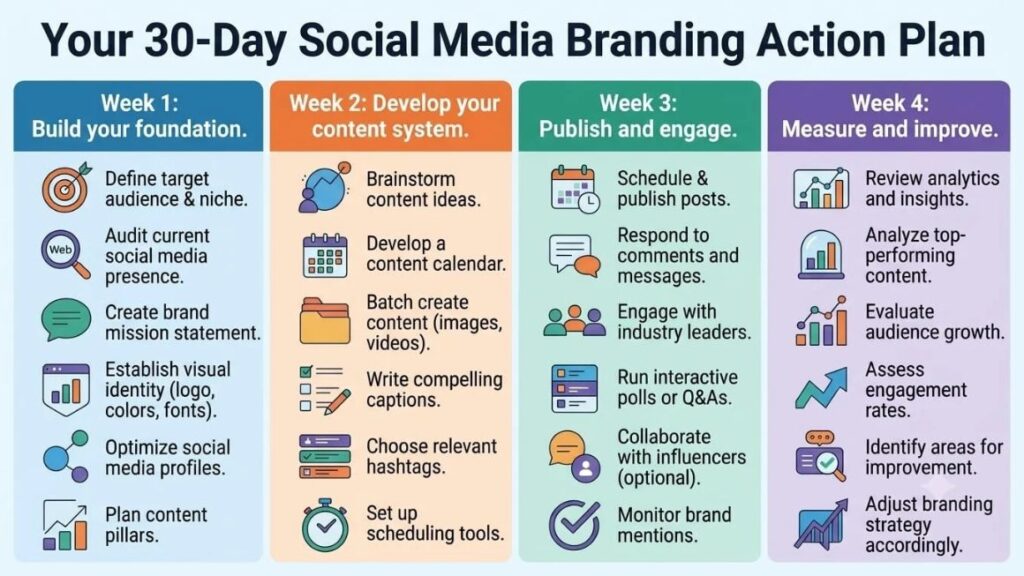
Thirty days is enough to turn a social media branding strategy from a document into a habit. Here’s a four-week roadmap you can start on Monday.
- Week 1: Build your foundation. Audit your existing accounts, define your brand identity and goals, research competitors and get clear on who your audience is.
- Week 2: Develop your content system. Choose your priority platforms, define your content pillars, prepare brand templates and build the content calendar.
- Week 3: Publish and engage. Start posting consistently, try videos and carousels, reply to everyone who interacts and test different storytelling angles.
- Week 4: Measure and improve. Review reach and engagement, spot the content that worked, read the audience feedback and sketch next month’s plan.
Don’t expect polish in week one. The point of this month is rhythm.
Conclusion
Consistency, authenticity and a real understanding of your audience do most of the work. Branding is a long game. No single post will make or break it. Start with a clear identity instead of chasing every trend. Let the brand get a little more recognisable each month. That’s what a good social media branding strategy really does.
If you’d like help turning this into a working plan, take a look at Young Urban Project’s social media course. It walks through the strategy, content and analytics side by side, so you can build a brand that people actually remember.
Frequently Asked Questions (FAQ)
What is a social media branding strategy?
A social media branding strategy is a documented plan for how your brand looks, sounds and behaves on social platforms. It covers goals, audience, positioning, visual identity, voice, content themes and measurement. So every post builds the same recognisable impression.
How do you create a strong brand on social media?
Define what your brand stands for, learn who you’re speaking to, then set your visual identity and voice. Plan three to five content pillars, publish consistently and reply to people. Start with one or two platforms rather than all of them.
Which social media platform is best for branding?
It depends on your audience. Instagram suits visual consumer brands, LinkedIn suits B2B and personal brands, YouTube suits education, and Facebook suits local communities. In India, where TikTok is banned, Instagram Reels and YouTube Shorts fill the short-video gap.
How can small businesses build their brand on social media?
Pick one platform and master it. Write down your colours, fonts and tone, choose a few content pillars and show the people and process behind the business. Answer every comment. Free design tools such as Canva make consistent visuals affordable.
How often should a business post on social media?
Buffer’s 2025 data points to three to five Instagram posts a week and two to five LinkedIn posts a week for most accounts. Choose a pace you can keep without quality dropping. Consistency beats occasional bursts.
How long does it take to build a recognisable social media brand?
Plan for at least three to six months of consistent posting before judging results. That’s a practical rule of thumb, not a studied figure. Timing varies with your niche, content quality and how often people see you.
What are the most important elements of social media branding?
A clear mission and positioning, a consistent visual identity, a recognisable brand voice, and steady messaging backed by real actions. Understanding your audience ties them together.
How can businesses measure social media branding success?
Track awareness (reach, impressions, mentions), engagement (comments, shares, saves) and business results (visits, leads, conversions). Use Instagram Insights, Meta Business Suite, LinkedIn Analytics, YouTube Analytics and Google Analytics 4. Judge trends, not single posts.