

If you’ve been trying to figure out how to become a Product Marketing Manager, you’ve probably done what most people do.
Watched hours of videos.
Saved LinkedIn threads.
Taken notes. Maybe even bought a course or two.
It feels productive. Almost like you’re moving forward.
But then… nothing happens.
There’s no portfolio built.
There’re are no interviews.
And, there’s no real clarity.
And that’s frustrating.
Not because you’re not working hard, but because effort without structure doesn’t compound.
That’s the uncomfortable truth.
For many people, the end goal isn’t just landing a role, it’s gaining the ability to earn money online, build flexible career paths, and create long-term financial independence through in-demand skills like product marketing.
Breaking into product marketing isn’t about learning more. It’s about learning the right things in the right order – and applying them deliberately.
So instead of another vague guide, here’s a focused question:
If you had exactly 6 months to become job-ready as a Product Marketing Manager (PMM), what would you actually do?
Let’s break that down.
Table of Contents
Month 1: Learn Product Marketing Foundations (But Only What Matters)
This is where most beginners either overcomplicate or oversimplify things.
Some people consume random content across marketing topics.
Others go deep into theory – frameworks, jargon, and definitions – without understanding how it applies in the real world.
Neither works.
What You Actually Need to Learn
Instead of “marketing in general,” focus specifically on:
- What Product Marketing Managers actually do day-to-day
- Core concepts like positioning, messaging, and ICP (Ideal Customer Profile)
- How SaaS products grow through:
- Acquisition
- Activation
- Retention
This is the foundation. Not everything – just what matters.
Practical Exercise (Non-Negotiable)
Pick 3 products you already use. For example:
- Notion
- Spotify
- Duolingo
Now answer:
- Who is this product for?
- What problem does it solve?
- Why is it different from alternatives?
If you struggle to explain this simply, that’s your signal.
Because clarity is the core skill in product marketing.
Month 2: Master Positioning (The Most Important PMM Skill)
If there’s one skill that separates average candidates from strong ones, it’s this:
👉 Positioning
Product Marketing Managers are not paid to write fancy lines.
They’re paid to make things make sense.
The Problem With Most Beginner Positioning
You’ll often see statements like:
“An all-in-one platform for modern teams”
Sounds good. Means nothing.
It’s vague, generic, and forgettable.
A Practical Positioning Framework
Use this structure:
For [target audience],
who struggle with [specific problem],
this product helps [primary value],
unlike [alternative], because [key difference].
Now test it:
- Is it specific?
- Is it clear?
- Would someone actually care?
Weekly Practice System
Every week:
- Pick one product
- Rewrite its positioning
- Refine it until it feels sharp
Do this 8-10 times.
Something interesting happens around attempt 5 or 6.
You stop sounding like a beginner.
Month 3: Build a Product Marketing Portfolio (Proof > Learning)
This is where things shift from passive to active.
Because at this point, learning without output becomes a bottleneck.
Hiring managers don’t care how much you’ve studied.
They care about:
- How you think
- How you communicate
- How you solve problems
What Your PMM Portfolio Should Include
Focus on 2–3 high-quality case studies:
1. Product Teardown
- Analyze positioning and messaging
- Identify gaps
- Suggest improvements
2. Feature Launch Plan
- Even hypothetical is fine
- Show your GTM thinking
3. Competitor Analysis
- Compare positioning
- Highlight differentiation opportunities
The Key Rule
Don’t just explain what companies are doing.

Enroll Now: Product Marketing Course Online
Explain:
What you would do differently – and why.
That’s where your thinking shows up.
And that’s what gets noticed.
Month 4: Build Go-To-Market (GTM) Thinking
Now you simulate the actual job.
Because being a PMM isn’t about isolated skills.
It’s about connecting everything into a strategy.
What a Strong GTM Plan Includes
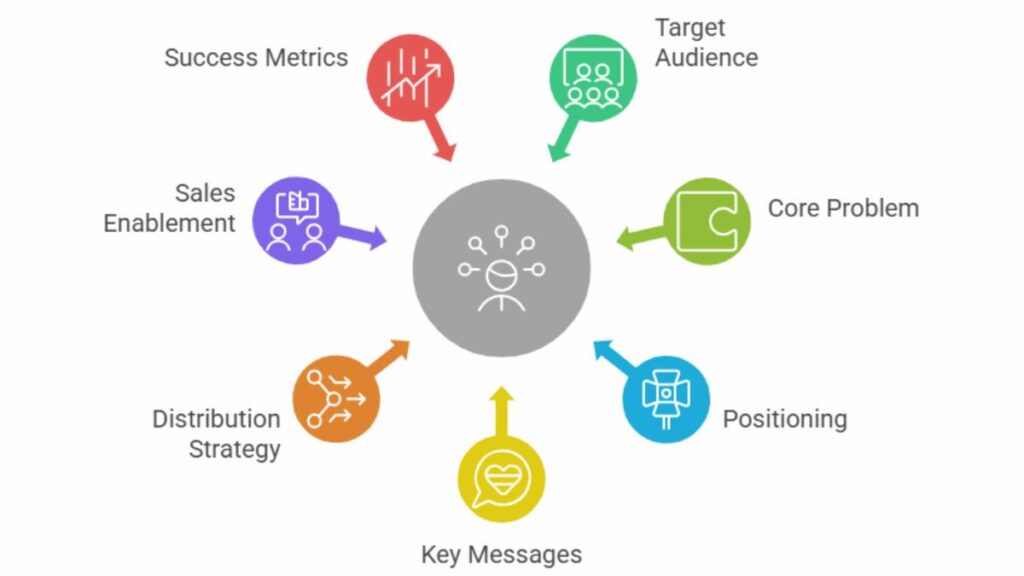
Pick a product or feature and create a one-page GTM strategy:
- Target audience
- Core problem
- Positioning
- Key messages
- Distribution strategy
- Sales enablement ideas
- Success metrics
What Most People Get Wrong
They treat GTM like a checklist.
But strong GTM plans are:
- Coherent
- Opinionated
- Structured
Ask yourself:
- Does this feel specific or generic?
- Would this actually influence user behavior?
If not, refine.
Month 5: Networking (Without Being Transactional)
Networking is misunderstood.
Most people either:
- Avoid it completely
- Or immediately ask for jobs
Neither works.
A Better Approach
Start conversations, not requests.
For example:
“I’m learning product marketing and working on a few projects. Would love your feedback if you’re open.”
That’s it.
There’s no pressure and no agenda.
What Actually Works
- Reach out to PMMs on LinkedIn
- Share your work publicly
- Document your learning journey
Not everyone will reply.
But the few who do?
They matter more than dozens of job applications.
Month 6: Interview Preparation (Clarity Under Pressure)
At this stage, you’re not starting from scratch.
You have:
- Projects
- Case studies
- Opinions
Now the goal is to communicate clearly.
What Interviews Really Test
Not knowledge.
But:
- Structured thinking
- Clarity
- Decision-making
Practice Framework
Take one project and answer:
- What was the goal?
- What was your approach?
- What changed as a result?
- What would you improve?
Record yourself.
It will feel uncomfortable.
Do it anyway.
That’s where improvement happens.
The Bigger Truth About Breaking Into Product Marketing
Let’s be honest.
You don’t need:
- 10 certifications
- Endless courses
- More saved content
What you need is:
- Clear thinking
- Deliberate practice
- Visible proof of work
Six months is more than enough.
Not to know everything, but to become dangerously clear.
And clarity is what matters.
Finally…
Most people delay progress because they keep preparing.
But product marketing rewards people who start before they feel ready.
If you follow this roadmap with intent, not perfection…
Six months should be good enough to change your career trajectory.
All the best!
FAQs: How to Become a Product Marketing Manager Roadmap
Can I become a Product Marketing Manager in 6 months?
Yes, it is possible to become job-ready in 6 months if you focus on practical skills like positioning, go-to-market strategy, and portfolio building instead of just consuming content. The key is structured learning and consistent execution.
What skills are required to become a Product Marketing Manager?
Core PMM skills include:
– Positioning and messaging
– Customer understanding (ICP)
– Go-to-market strategy
– Analytical thinking
– Communication and storytelling
These skills are more important than certifications.
Do I need prior experience to get into product marketing?
Not necessarily. A strong portfolio with real projects, case studies, and GTM strategies can compensate for lack of formal experience and help you stand out in interviews.
What should a Product Marketing portfolio include?
A strong PMM portfolio should include:
– Product teardowns
– Feature launch plans
– Competitor analysis
– Messaging and positioning frameworks
The focus should be on your thinking, not just execution.
How important is networking for breaking into product marketing?
Networking is critical, but it should be approached as relationship-building rather than job-seeking. Conversations, feedback, and visibility often lead to opportunities organically.
What is the fastest way to learn product marketing?
The fastest way is to combine:
– Learning core concepts
– Practicing on real products
– Publishing your work
– Getting feedback
This creates a feedback loop that accelerates growth. The 8-week Product Marketing Course by Young Urban Project is a live & interactive mentor-led program that can take away guesswork and help you crack into PMM roles easily.