

No backlinks. No authority. Still ranking. Sounds unrealistic? It’s not anymore.
A few years ago, if someone told you that a brand-new website with zero backlinks could outrank established players, you’d probably dismiss it.
I would too, honestly.
Because for the longest time, SEO felt predictable. Almost mechanical.
- More backlinks = better rankings
- Older domain = more trust
- More content = more traffic
Simple. Linear. Comfortable.
But in 2026, that playbook is… not exactly broken, but definitely incomplete.
Something deeper has shifted.
And if you understand this shift early, you’re actually at an advantage, especially if you’re starting from scratch.
Table of Contents
The Big Shift: From Domain Authority to Topical Authority
Let’s get straight to it.
SEO is no longer just about how big your site is.
It’s about how deeply you understand a topic.
Google’s core question has evolved from:
“Which site is the most authoritative overall?”
to:
“Which site understands this topic best?”
That’s a subtle shift, but it changes everything.
What is Topical Authority (Really)?
Topical authority means becoming the most comprehensive, structured, and useful resource on a very specific subject.
Not broad.
Deep.
For example:
- ❌ “Digital Marketing.”
- ✅ “Content marketing for B2B SaaS startups”
See the difference?
One is vague and competitive.
The other is focused and… winnable.
Why New Websites Are Suddenly Winning
This is the part that surprises most people.
New sites aren’t winning because Google is broken.
They’re winning because they’re playing a different game.
Google Has Gotten Smarter
Search engines today don’t just scan keywords anymore.
They evaluate:
- Depth of topic coverage
- Content relationships (how pages connect)
- User engagement (do people stay and read?)
- Completeness (are all related questions answered?)
So if your site looks like a well-structured map of a topic, you can outperform bigger websites that only cover fragments.
That’s the loophole. Or maybe… the opportunity.
Old SEO vs New SEO (Quick Reality Check)
Let’s simplify this.
Old SEO Approach:
- Write blogs targeting keywords
- Build backlinks
- Wait for rankings
New SEO Approach:
- Choose a niche
- Map the entire topic
- Build a connected content ecosystem
- Demonstrate real expertise
It’s less about publishing content…
And more about designing knowledge.
What Topical Authority Looks Like in Practice
Let’s say your niche is:
👉 Weight loss for busy professionals
The Old Way:
- Write a few blogs
- Target keywords like “weightloss.”
- Try to get backlinks
The New Way:
You build a topic ecosystem.
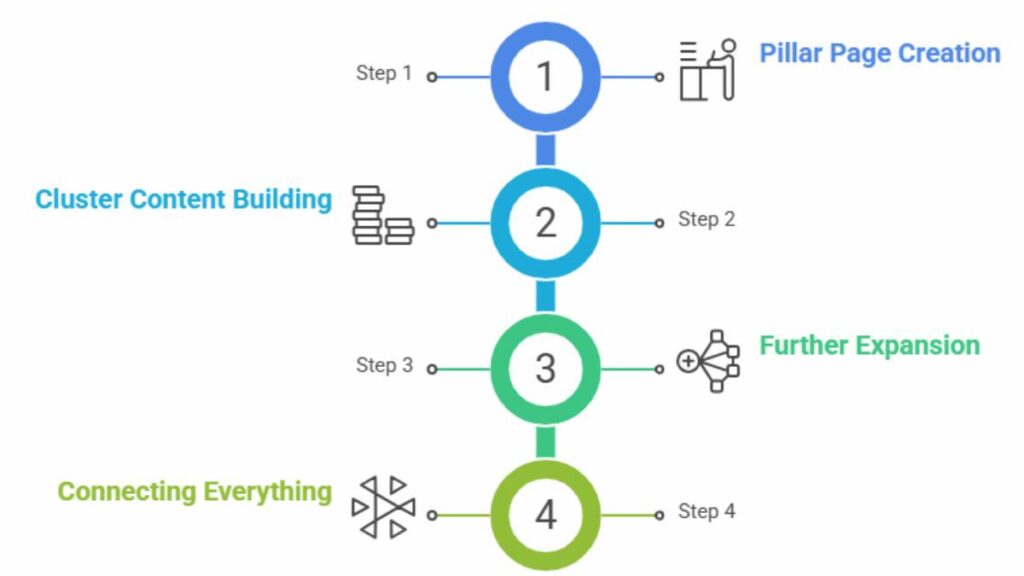
Step 1: Create a Pillar Page
Instead of writing random blogs, you start with a strong foundation:
“The Complete Guide to Weight Loss for Busy Professionals”
This page covers:
- Why traditional diets fail for busy people
- Time-efficient workout strategies
- Meal planning for tight schedules
- Common mistakes and myths
It’s not just an article.
It’s the hub of your entire content system.
Step 2: Build Cluster Content
Now you break that big topic into focused, detailed articles:
- 20-minute home workouts for fat loss
- High-protein meal prep for a 9–5 schedule
- How to lose weight without going to the gym
- Best diets for busy professionals
- How to stay consistent when you’re always tired
Each article solves one specific problem.
And more importantly, they all connect back to the main pillar.
Step 3: Expand Further
Now you go deeper:
- Real transformation case studies
- “Day in the life” routines
- Mistakes people make in the first 30 days
- Tools and apps that help with consistency
Now your site doesn’t just talk about weight loss…
It covers it completely for a specific type of person.
Step 4: Connect Everything
Every article links to:
- The main guide
- Other related articles
Now, instead of scattered posts, you’ve built a structured ecosystem.
And that’s what signals authority to Google.
The Practical Framework (If You’re Starting Today)
Alright, let’s make this actionable.
Because theory is nice, but execution is where most people struggle.
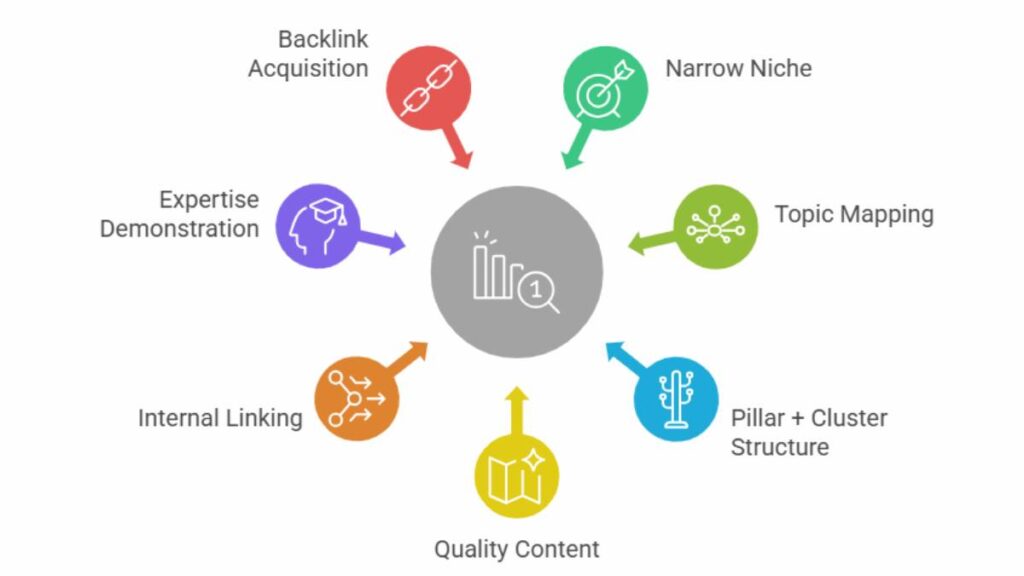
1. Choose a Narrow Niche
This is where most people mess up.
They go too broad.
Instead of:
- “Fitness”
Go for:
- “Strength training for beginners at home”
Narrow = faster authority.
2. Map the Topic Before Writing Anything
This is non-negotiable.
Before writing a single article, list out:
- 50 to 100 subtopics
Use:
- Keyword tools
- Google “People Also Ask”
- Reddit, Quora
- Competitor blogs
You’re not writing content.
You’re designing coverage.
3. Build a Pillar + Cluster Structure
Think like this:
- 1 Pillar Page (broad, comprehensive)
- 10–30 Cluster Pages (deep dives)
Everything should connect logically.
Most websites skip this step.
And that’s exactly why they struggle.
4. Create Content That Actually Deserves to Rank
Let’s be honest.
A lot of content out there is… average.
And average doesn’t rank anymore.
Winning content usually includes:
- Real examples
- Step-by-step breakdowns
- Visual explanations
- Updated insights
- Clear structure
If your content feels like it was written just to “fill space,” it won’t work.
5. Use Internal Linking Strategically
This is underrated.
Seriously.
Internal links:
- Help Google understand relationships
- Distribute authority
- Improve user experience
Every article should strengthen the system.
Not sit alone like an island.
6. Demonstrate Real Expertise (E-E-A-T)
Google cares about credibility more than ever.
That includes:
- Author experience
- Real case studies
- Credible references
- Consistency
You don’t just say you’re an expert.
You prove it.
7. Earn Relevant Backlinks (Not Just More Backlinks)
Backlinks still matter.
But relevance matters more.
Think:
- 10 links from niche-relevant sites ✅
- 100 random links ❌
Quality > quantity.
Always.

Check out our: 12-Week Advanced Digital Marketing Course.
The Hidden Advantage: Momentum
This is something most people underestimate.
Topical authority today isn’t built slowly over years.
It’s built through focused bursts.
A Typical Winning Timeline:
- Month 1–2:
- Publish pillar + initial clusters
- Month 3–5:
- Expand aggressively
- After that:
- Update, refine, strengthen
This creates a signal:
“This site is serious about this topic.”
Publishing one random blog per week?
That doesn’t send the same signal.
Where Most People Go Wrong
Not because they’re lazy.
But because they’re using outdated thinking.
Common Mistakes:
- Choosing topics that are too broad
- Writing shallow content
- Publishing inconsistently
- Ignoring structure
- Chasing trends
All of this leads to one thing:
👉 Fragmented authority
And fragmented authority doesn’t rank anymore.
The Bigger Shift (And Why It Matters More Than You Think)
This isn’t just about SEO.
It’s about how information is being evaluated online.
Both:
- AI systems
are rewarding depth + clarity + structure.
The sites that win aren’t just publishing content.
They’re building:
A clear point of view on a topic
That’s what “topical authority” really is.
So… Is This Good News or Bad News?
Honestly?
It’s great news.
Especially if you’re starting fresh.
Because now you don’t need:
- A 10-year-old domain
- Thousands of backlinks
- Hundreds of random blogs
You need:
- Clarity
- Focus
- Depth
And a bit of patience, sure.
Final Thought
SEO today is no longer a volume game.
It’s a precision game.
You don’t win by doing more.
You win by doing the right things, deeply.
And maybe that’s how it should have always been.