
Product Launch day feels like the finish line.
The landing page is live. Campaigns are running. Sales decks are polished. Slack is buzzing with emojis and screenshots. For a brief moment, everything feels… complete.
But if you’ve been in product marketing long enough, you probably know this feeling doesn’t last.
Because a launch isn’t the finish line.
It’s the starting line of a much harder, less visible phase.
And here’s the uncomfortable truth: most products don’t fail on launch day. They fail quietly in the 30–60 days that follow.
That’s exactly where a strong post-launch product marketing strategy makes all the difference.
Table of Contents
Why Most Product Launches Quietly Fail
Let’s call this out early.
Most teams over-invest in the launch and under-invest in what happens after.
You’ll see:
- Weeks (sometimes months) spent planning GTM campaigns
- Endless iterations on messaging and creative
- Cross-functional alignment meetings that never seem to end
And then… silence.
Once the product is out, teams shift focus. Marketing moves to the next campaign. Product moves to the next feature. Leadership looks at top-level metrics and assumes things are “fine.”
But underneath?
- Users don’t fully understand the value
- Adoption is inconsistent
- Sales struggles to position it clearly
- Retention never picks up
This isn’t hypothetical.
According to McKinsey & Company, a significant percentage of product launches fail to meet expectations—not because of poor initial visibility, but due to weak post-launch execution and lack of sustained customer engagement.
So the question isn’t: Did we launch well?
It’s: Did the product actually stick?
Also Read: How to Become a Product Marketing Manager?
What a Strong Post-Launch Product Marketing Strategy Looks Like
A good PMM doesn’t disappear after launch.
They shift gears.
From broadcasting to diagnosing.
From campaigns to customer reality.
From visibility to adoption.
Let’s break down what that actually looks like in practice.
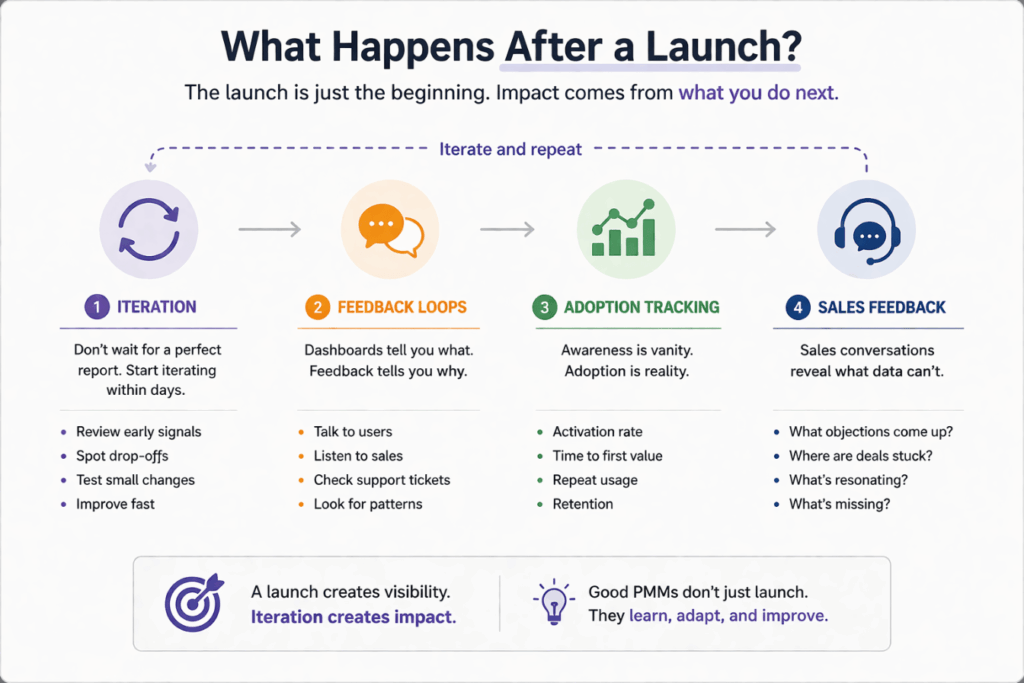
1. Iteration Starts Immediately (Not After “Results Come In”)
Here’s a common mistake:
“Let’s wait a few weeks and review performance.”
Sounds reasonable. Feels structured.
But it’s also one of the biggest growth killers.
Because early signals—messy as they are—are incredibly valuable.
What Strong PMMs Do Instead
They start iterating within days.
Not recklessly. Not randomly. But intentionally.
They look at:
- Are users understanding the value proposition?
- Which messages are getting traction?
- Where are users dropping off?
Let’s take a real-world style scenario.
Example: Feature Launch Iteration
You launch a new feature.
- Traffic: Healthy
- CTR: Decent
- Signups: Acceptable
But activation?
Low.
A weaker team waits.
A strong PMM reacts:
- Refines the headline to clarify the use case
- Adds a short product demo video
- Simplifies onboarding steps
These aren’t massive changes. But they compound quickly.
And this approach aligns with how companies like HubSpot continuously optimize their onboarding and product messaging based on early user behavior data.
Key Insight
Iteration isn’t a phase after launch.
It’s a system that begins immediately.
Also Read: The Impact of AI on Product Marketing
2. Feedback Loops: Where Real Insight Lives
Analytics dashboards are great.
But they only tell you what is happening.
They rarely tell you why.
That’s where feedback loops come in.
And honestly, this is where most PMMs either level up—or plateau.
Sources of High-Quality Feedback
After launch, strong PMMs actively collect insights from three places:
1. Customers
- What confused them?
- What almost stopped them from trying?
- What made them convert?
2. Sales Teams
- What objections keep coming up?
- Where are prospects hesitating?
- What messaging actually resonates in calls?
3. Customer Support
- What questions are repeated?
- Where are users getting stuck?
- What friction points show up consistently?
The Mistake Most Teams Make
They collect feedback…
…but don’t synthesize it.
So it becomes noise.
What Strong PMMs Do Differently
They look for patterns.
If multiple users say:
“I don’t really understand how this helps me.”
And sales says:
“It’s hard to explain quickly.”
That’s not random feedback.
That’s a positioning problem.
This is something emphasized heavily in product-led growth discussions by leaders like Wes Bush, who stresses the importance of aligning product experience with clear, immediate value communication.
Key Insight
Feedback isn’t just validation.
It’s diagnosis.
3. Adoption Tracking: The Reality Check Most Teams Avoid
Here’s where things get uncomfortable.
Because this is where assumptions get tested.
You might see:
- Strong traffic
- Solid signups
And think: We’re doing well.
But then…
- Feature usage is low
- Retention drops
- Users don’t come back
This gap between awareness and adoption is where most launches fail.
Metrics That Actually Matter
A strong post-launch product marketing strategy focuses on:
- Activation Rate – Did users actually try the feature?
- Time to First Value (TTFV) – How quickly did they experience value?
- Repeat Usage – Did it become part of their workflow?
Companies like Amplitude have built entire analytics frameworks around these metrics because they reflect real product success—not vanity metrics.
Example: Diagnosing Adoption Issues
Let’s say users are signing up but not using the feature.
Possible reasons:
- Messaging is unclear
- Onboarding is confusing
- Value isn’t immediate
Each of these requires a completely different fix.
And without tracking adoption properly, you’ll never know which one to address.
Key Insight
Awareness tells you people showed up.
Adoption tells you they stayed.
4. Sales Feedback: The Most Underrated Growth Lever
Sales teams are often treated as execution arms.
But post-launch?
They’re one of your most valuable insight engines.
If you’re listening properly.
The Wrong Way to Ask for Feedback
- “Is the feature working?”
- “Are people interested?”
You’ll get vague answers.
The Right Way
Ask:
- Where are deals getting stuck?
- What objections are hardest to handle?
- What are prospects comparing us to?
What You’ll Actually Hear
- “They don’t see enough differentiation.”
- “Pricing is confusing.”
- “They don’t understand the use case.”
This isn’t just sales feedback.
This is positioning feedback in disguise.
Even companies like Salesforce invest heavily in aligning product marketing with sales insights to refine messaging and improve win rates.
Key Insight
Sales conversations are real-time market research.
Ignore them, and you’re guessing.
5. A Real-World Scenario: Weak vs Strong Post-Launch Execution
Let’s bring this together.
Scenario: Analytics Dashboard Launch
Week 1:
- Strong traffic
- High curiosity
- Good demo requests
Week 3:
- Low daily usage
- Sales struggling to explain value
- Users saying: “Looks interesting, but not urgent”
Weak Response
- Increase ad spend
- Push more traffic
- Double down on campaigns
This treats the symptom, not the problem.
Strong PMM Response
- Refine positioning → Focus on one clear use case
- Update sales narrative → Sharper, simpler talk track
- Improve onboarding → Faster time to value
- Adjust messaging → Remove vague claims
Same product.
Completely different trajectory.
Want to become a Product Marketer? Check our our 8-week Live Product Marketing Mentorship Program

6. Why This Matters More Than Ever in 2026
Let’s zoom out for a second.
We’re operating in a world where:
- AI tools are accelerating product development
- Competition is increasing across almost every category
- Attention spans are shrinking
This means one thing:
You don’t get multiple chances to prove value.
If users don’t “get it” quickly, they move on.
This is why companies like Notion and Figma obsess over onboarding and early user experience – they know adoption is won (or lost) in the first few interactions.
7. How to Talk About This in Interviews (And Stand Out Instantly)
This is a bit of a cheat code.
Most PMM candidates talk about:
- Launch plans
- Campaign strategies
- Channel execution
Very few talk about what happens after.
If you say something like:
“After launch, I’d focus on early adoption signals, gather structured feedback from users and sales, and iterate messaging and onboarding quickly based on patterns.”
You immediately sound different.
More grounded. More practical.
Because you understand something most people don’t:
A launch is not success.
Adoption is.
8. A Simple Post-Launch Product Marketing Checklist
If you want something practical, here’s a quick checklist you can actually use:
Post-Launch Questions to Ask
- Are users understanding the value proposition?
- Where are users dropping off?
- What are customers confused about?
- What objections are sales teams facing?
- What changed after launch compared to expectations?
If you can answer these clearly, you’re already ahead of most teams.
The Bigger Idea Most PMMs Miss
Launches create visibility.
Iteration creates impact.
And the best PMMs?
They don’t just launch products.
They improve them continuously.
They listen more than they assume.
They adjust faster than they plan.
They care more about adoption than applause.
And maybe that’s the real shift.
Because in modern product marketing, success isn’t about making noise.
It’s about making the product stick.
Frequently Asked Questions
What is a post-launch product marketing strategy?
A post-launch product marketing strategy is the set of actions taken after a product or feature goes live to drive adoption, improve messaging, and optimize user experience. It focuses on analyzing early user behavior, collecting feedback, refining positioning, and ensuring the product delivers ongoing value rather than just initial visibility.
Why do most product launches fail after release?
Most product launches fail after release because teams focus heavily on pre-launch campaigns but neglect post-launch optimization. While awareness and traffic may be strong initially, poor onboarding, unclear value propositions, and lack of iteration lead to low adoption, weak retention, and declining engagement over time.
What should product marketers do immediately after a launch?
Immediately after a launch, product marketers should start analyzing early signals such as user behavior, activation rates, and messaging performance. They should also begin collecting feedback from customers, sales teams, and support channels, then use those insights to quickly iterate on messaging, onboarding, and positioning.
What metrics matter most after a product launch?
The most important post-launch metrics include:
– Activation rate (how many users try the product or feature).
– Time to first value (how quickly users experience benefit).
– Feature adoption rate.
– Retention and repeat usage.
These metrics are more meaningful than traffic or impressions because they reflect real product engagement and long-term success.
How long should post-launch optimization last?
Post-launch optimization typically lasts 30 to 90 days, but in practice, it should be continuous. The first 30–60 days are critical because that’s when early adoption patterns emerge, but strong product marketing teams treat iteration as an ongoing process rather than a fixed phase.
How do you improve product adoption after launch?
To improve product adoption after launch, teams should refine messaging to clarify the core use case, simplify onboarding to reduce friction, and highlight immediate value to users. Continuous testing, user feedback analysis, and aligning sales narratives with product benefits also play a key role in increasing adoption.
What is the difference between product launch success and product adoption?
Product launch success refers to short-term outcomes like traffic, signups, and campaign performance. Product adoption, on the other hand, measures whether users actually use the product, find value in it, and continue using it over time. True success is defined by adoption, not just initial visibility.
How can product marketers use customer feedback after launch?
Product marketers can use customer feedback to identify confusion, friction points, and unmet expectations. By analyzing patterns across user interviews, support tickets, and surveys, they can refine positioning, improve onboarding experiences, and adjust messaging to better align with customer needs.
Why is sales feedback important after a product launch?
Sales feedback is critical after a product launch because it reveals real-world objections, competitive comparisons, and gaps in positioning. Sales teams interact directly with prospects, making their insights valuable for refining messaging, improving differentiation, and increasing conversion rates.
What are common mistakes in post-launch product marketing?
Common mistakes include:
– Waiting too long to iterate.
– Relying only on dashboards instead of qualitative feedback.
– Focusing on traffic instead of adoption.
– Ignoring sales and support insights.
– Treating launch as the final milestone instead of the starting point.
These mistakes often lead to poor product adoption and missed growth opportuniti
How often should messaging be updated after a launch?
Messaging should be reviewed and refined continuously in the first few weeks after launch. Small adjustments based on early data and feedback can significantly improve clarity, engagement, and conversion. Strong teams treat messaging as a dynamic asset rather than a fixed deliverable.
What role does onboarding play in post-launch success?
Onboarding plays a critical role in post-launch success because it directly impacts how quickly users experience value. A clear, simple onboarding flow reduces friction, shortens time to first value, and increases the likelihood of long-term product adoption and retention.
Can a product succeed if the launch was weak?
Yes, a product can still succeed even if the launch was weak, as long as post-launch iteration is strong. By improving positioning, refining messaging, enhancing onboarding, and responding to user feedback, teams can significantly increase adoption and turn early underperformance into long-term success.
What is the biggest mindset shift for modern product marketers?
The biggest mindset shift is understanding that launch is not the goal—adoption is. Modern product marketers focus less on campaign execution and more on continuous improvement, user behavior, and long-term product impact.