

A $4,000 invoice is worth roughly ₹3,84,000 at today’s rate. Send it through the wrong route and it can land closer to ₹3,55,000. Nobody emails you about the missing ₹29,000. It just disappears into spreads, platform fees and GST on those fees.
That’s the quiet problem with freelancer payments when your clients live in other countries. The work was good. The client paid on time. And you still lost a chunk of a month’s income somewhere between their bank and yours. The rupee makes it sharper. When the dollar moves by even a few rupees, the same foreign-currency invoice can translate into a materially different amount in your Indian account.
This article covers how to get paid as a freelancer when clients pay in dollars, euros or pounds. You’ll see which freelancer payment routes suit which clients, how to cut exchange losses, which documents to keep, and where GST and income tax fit in. It’s written for freelancers in India, because the paperwork is where most people trip, though the money logic applies anywhere. One more thing: new RBI export rules start on 1 October 2026, and they shorten the deadline for bringing your money home. The nine-month realisation window for service exports is already back in place from 5 June 2026. We’ll get to that. We’ll get to that.
Table of Contents
Why Is Getting Paid Across Currencies So Hard for Freelancers?
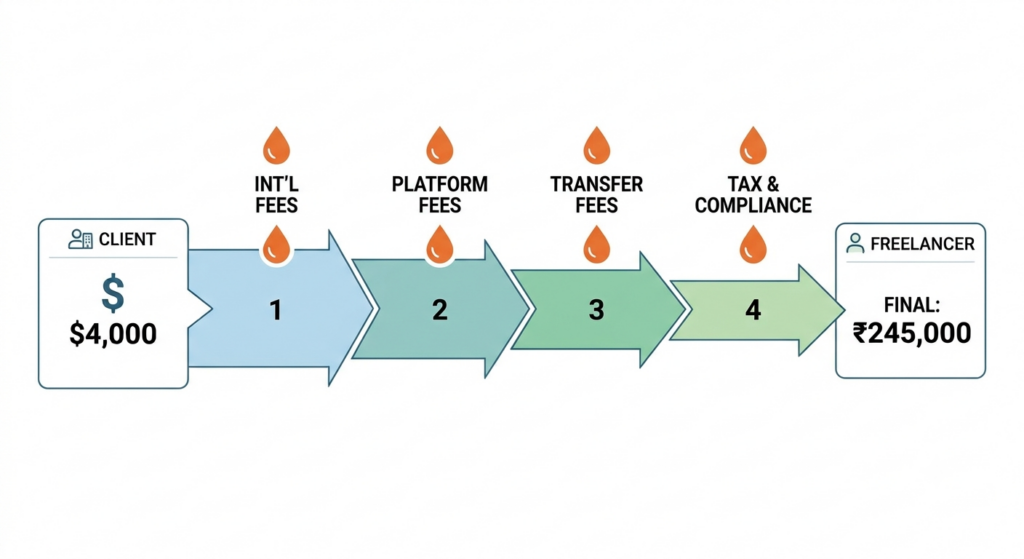
Because every stop between your client’s bank and yours takes a cut, and most of those cuts aren’t labelled. The money can pass through the client’s bank, a middle bank, a payment platform and your own bank. Each one adds a fee or pads the exchange rate, so you often can’t say what the whole trip cost until it lands. That’s why a freelancer payment so rarely arrives at the amount on the invoice.
Put a number on it. Xflow’s 2026 breakdown of PayPal’s India pricing puts the all-in cost of a freelancer payment at roughly 7% to 8%. On a $4,000 invoice, that’s $280 to $320 gone before you see a rupee.
Where your money actually leaks
There are four leaks, and platforms usually show you only the first.
- Sender-side fees. The client’s bank or platform may charge to send the money, and you rarely see that line.
- Middle-bank deductions. A SWIFT wire can pass through intermediary banks that each trim a little, with no warning.
- Padding in the exchange rate. The platform converts at a rate worse than the real one. It’s the biggest single cost and the hardest to spot, because it hides inside the rate instead of showing up as a fee.
- GST on the platform’s fee. In India, 18% GST lands on top of platform fees, which turns a 1.7% fee into roughly 2%.
Add them up and a freelancer payment that looked like a 1% affair quietly becomes 3%, 5% or worse. That’s the money you earned.
What changed in 2026
The rupee has been sliding. Trading Economics data showed it down about 10.7% against the dollar over the 12 months to late March 2026. If you’re paid in dollars, that helps in rupee terms. It also means every percentage point of padding costs you more rupees than it did two years ago.
Rules moved too. On 22 September 2026, the RBI amended its new FEMA export and import regulations. It start on 1 October, and set the window for bringing service export money home at nine months from the invoice date (SCC Online, 29 September 2026). The Income-tax Act 2025 replaced the 1961 Act on 1 April 2026. And India now has a licensed class of platforms for collecting export money: by January 2026 the RBI had fully authorised 19 of them, according to Business Standard.
A freelancer payment across currencies costs more than the headline fee suggests, because spreads, middle-bank deductions and 18% GST on platform fees stack up. For Indian freelancers in 2026, PayPal’s all-in cost runs about 7% to 8% and Wise’s about 2%, while the RBI’s new export rules from 1 October 2026 give you nine months from the invoice date to bring the money home.
What Does a Reliable Freelancer Payment System Look Like?
A reliable freelancer payment system has four parts. An invoice currency you chose on purpose. A receiving route that fits your client. A rule for when you convert. A paper trail for every credit. Skip any one and you’re guessing with real money.
Think of it as plumbing, not a platform choice. Most people pick a freelancer payment tool first, usually whichever one the first client mentioned, and work backwards from there. Flip that. Decide the four parts, then pick tools that fit.
Which currency should you invoice in?
Invoice in the currency your client earns and pays in, usually USD, EUR or GBP. It keeps the freelancer payment trail clean for FEMA and GST purposes, and it saves the client from doing their own conversion.
Rupee invoices look tempting because the conversion risk moves to the client. They also come with strings. The RBI allows a longer window for INR-invoiced or INR-settled exports, 12 months against 9 from 1 October 2026, but rupee settlement works only through RBI-permitted routes, which most solo freelancers can’t use. And if a foreign company’s Indian office hires you, the invoice is a domestic supply, so 18% GST applies if you’re registered (Freelancebook, 2026).
| Invoice currency | Works well when | Watch out for |
| USD | Most clients, marketplaces, SaaS and agency work | Rupee swings change your take-home; pick the route carefully because fees add up |
| EUR or GBP | Clients in Europe or the UK | Fees differ by currency, so get a quote for each before you commit |
| INR | The client is an Indian entity, or pays through an RBI-approved rupee route | Indian-entity invoices are domestic and attract 18% GST; rupee routes are rare for individuals |
Should you match your client’s currency or your costs?
Match your costs where you can. If you pay for US software, ad spend or hosting in dollars, keeping part of your dollar earnings in dollars means you convert once, not twice. Each conversion is a fresh cut.
The tool for this in India isn’t a fintech wallet. It’s an EEFC account at a bank, which we’ll cover below. For now, just note that your invoice currency and your cost currency don’t have to be strangers.
Also Read: How to Make Money Offering Marketing Services (Side Hustle to Full-Time)
Which Payment Method Works Best for Each Type of Client?
The best freelancer payment route is the one your client will actually use and you can document. Marketplace clients usually leave you with Payoneer or the platform’s own payout. Direct clients paying by bank transfer suit Wise or a licensed exporter platform. PayPal is the fallback for clients who refuse everything else, and it costs the most.
One warning before the details. Indian comparison blogs often disagree with each other and with the platforms’ own pricing pages. Treat the numbers below as ranges checked on 1 October 2026. Run a small test payment before you move a big invoice.
Marketplace clients: Payoneer and platform payouts
If you work through Upwork, Fiverr or similar marketplaces, Payoneer is usually already wired in. Skydo’s 2026 comparison counts more than 2,000 marketplace integrations, which is the real reason people use it. On a marketplace, the platform picks the freelancer payment route for you, and your only choice is how you withdraw.
The costs sit in two places. Receiving is often free or around 1% depending on the route. The bigger hit is the exchange margin when you withdraw to rupees: Indian guides put it anywhere between 0.5% and 3% over the interbank rate, so you have to test it yourself. You get a free digital FIRA, though it can take 24 to 72 hours. Payoneer India received only in-principle RBI approval to operate as a cross-border aggregator on 22 January 2026 (Business Standard), not the final licence.
Direct clients paying by bank transfer: Wise and local receiving details
Wise Business gives you local account details in currencies like USD, GBP and EUR, so a US client pays you as if you had an American bank account. Nobody has to explain SWIFT. For a direct freelancer payment, that’s a big part of the appeal.
In India, though, there’s a catch. Incoming money converts to rupees automatically, and Indian accounts can’t keep a foreign balance (Skydo’s 2026 Wise review). The fee for USD to INR runs about 1.6% to 1.7%, plus $2 to $2.50 for each eFIRC and 18% GST on the fees, which lands near 2% all-in. ProductGrowth’s 2026 review also points out that the 0.33% figure in Wise’s global marketing doesn’t reflect the Indian USD route. Money usually reaches your bank in one to two business days, and Wise says the eFIRC arrives within about three.
What about a plain wire to your bank? It works, and your bank issues the paperwork automatically. But the sender’s bank fee, middle-bank deductions and your bank’s exchange margin all stack, and you don’t know the total until the credit arrives. Honestly, a wire only makes sense when a client’s finance team won’t use anything else, or when the invoice is big enough to negotiate your bank’s rate.
Clients who insist on PayPal
PayPal’s India pricing has four layers: a 4.4% fee, a $0.30 fixed fee per USD payment (in effect since 28 March 2024), a 3% to 4% exchange markup and 18% GST on the fees. Xflow’s September 2026 breakdown puts the total near 7% to 8%.
PayPal also converts every international receipt to rupees automatically, so you can’t hold dollars. Withdrawals usually take 24 to 72 hours (Karbon, 2026). On a $1,000 invoice, expect to lose $70 to $80, which is about ₹6,720 to ₹7,680 at ₹96.
If a client only pays via PayPal, add the cost to your quote instead of absorbing it. Treat the fee as part of the freelancer payment price, not an afterthought. Most will accept that once you explain it.
Also Read: How to Price Your Freelance Services When You’re Just Starting Out
India-focused exporter platforms: Skydo, Razorpay, Cashfree and others
A newer group of platforms is built for exactly this kind of freelancer payment. They hold the RBI’s PA-CB licence, short for payment aggregator cross-border, which is the legal permission to collect export money on your behalf. Business Standard’s January 2026 report named Skydo, BriskPe, Razorpay and Cashfree among the fully authorised firms.
Many advertise flat per-invoice pricing, which gets better as invoices grow, because a percentage fee keeps scaling while a flat fee doesn’t. Several also issue the FIRA automatically. Before onboarding, check the platform against the RBI’s own authorised-aggregator list, since blog posts lag behind new approvals and cancellations.
Also Read: Freelancer Tools Stack: What You Actually Need vs What’s Overkill
| Route | Typical cost (ranges from Indian guides) | Proof document | Speed | Best for |
| Wise Business | About 1.6% to 1.7% fee, $2 to $2.50 eFIRC, 18% GST on fees; roughly 2% all-in | eFIRC, about 3 business days | 1 to 2 business days | Direct clients paying by bank transfer |
| Payoneer | Receiving free to about 1%; INR withdrawal margin reported at 0.5% to 3% | Free digital FIRA, 24 to 72 hours | 2 to 4 days | Marketplace payouts |
| PayPal | 4.4% + $0.30, 3% to 4% markup, 18% GST on fees; roughly 7% to 8% all-in | Separate request process | Withdrawal in 24 to 72 hours | Clients who refuse anything else |
| Wire to your bank | Sender fee + middle-bank deductions + bank margin; total unknown until it lands | FIRA from your bank | Varies | Big one-off invoices, finance teams that only do wires |
For Indian freelancers, the cheapest freelancer payment route usually depends on the client. Wise Business suits direct bank transfers at roughly 2% all-in. Payoneer suits marketplace payouts. PayPal should be the last resort at about 7% to 8% all-in. Published fees vary between guides, so test with one small payment first.
How Do You Set Up Your Payment System Step by Step?
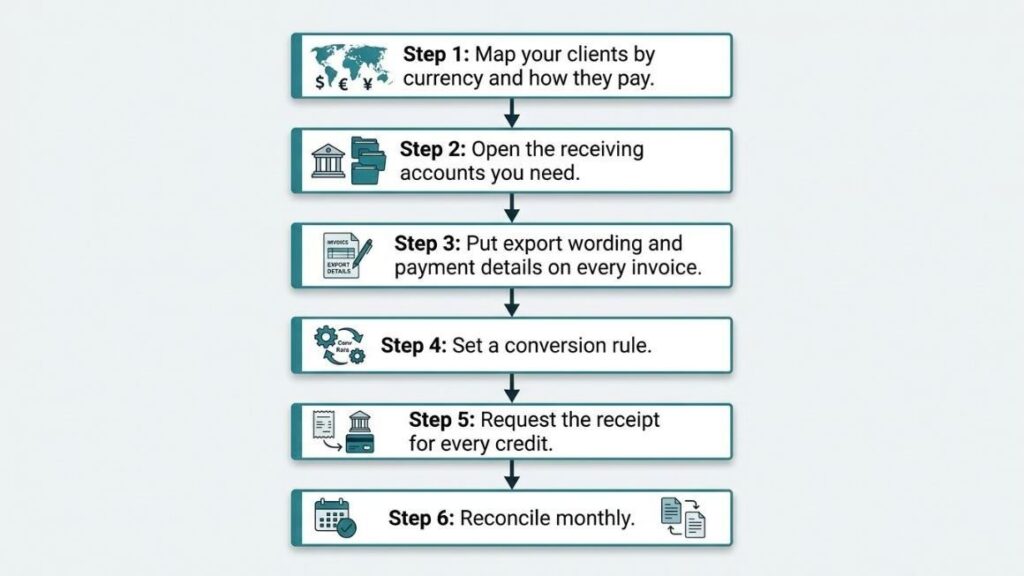
Here’s how to get paid as a freelancer without relying on luck: set up the whole flow in one sitting, with your KYC documents ready (PAN, Aadhaar, bank details). Do it in this order, because each step feeds the next.
- Step 1: Map your clients by currency and how they pay. Write a short list: client, invoice currency, usual payment method. Two columns of notes will tell you which freelancer payment accounts you actually need.
- Step 2: Open the receiving accounts you need. That might be Wise Business for direct clients, Payoneer for marketplaces, and an EEFC account at your bank if you want to hold dollars for a few weeks.
- Step 3: Put export wording and payment details on every invoice. Include the client’s full foreign address, the currency, your account details, your GSTIN and your LUT reference if you’re registered. A missing endorsement can stall a refund later (Xflow, 2026).
- Step 4: Set a conversion rule. Convert every receipt within a fixed number of days, or hold in an EEFC account until the month-end deadline. Pick one rule and stick with it.
- Step 5: Request the receipt for every credit. Ask for the FIRA or eFIRC in the same week the money lands. Chasing last year’s receipts is miserable.
- Step 6: Reconcile monthly. Match invoice, receipt and bank credit, and note the date each invoice’s nine-month clock ends.
Do this properly once and every future freelancer payment follows the same path. That’s the whole point.
Also Read: How to Land Your First Freelance Client as a Marketer (Step-by-Step Guide)
How Do You Cut Exchange Rate Losses and Currency Swings?
Cut the losses you can control first: the spread and fees on each conversion. Then deal with rate swings by choosing when you convert and what goes in your contract. Most freelancers chase the second and ignore the first, even though fees are certain and swings aren’t.
Reading the real cost of a conversion
Start with a benchmark. The mid-market rate is the halfway point between what banks buy and sell a currency for, and it’s the fairest yardstick for judging any quote. Look it up on the day the money lands, multiply by your invoice, and compare it with the rupees you received. The gap, as a percentage of the benchmark, is your true cost.
Here’s a worked example at ₹96 per dollar, on a $5,000 invoice. At the benchmark, it’s ₹4,80,000. Through Wise at about 2% all-in, you lose roughly ₹9,600 and land near ₹4,70,400. Through PayPal at 7% to 8%, you lose ₹33,600 to ₹38,400 and land between ₹4,41,600 and ₹4,46,400.
Same work. Same client. A gap of about ₹24,000 to ₹29,000.
When you add up a route’s currency conversion fees, remember to include the markup inside the rate and the GST on the fee. The visible fee is rarely the whole story.
Holding balances vs converting at once
Wise and PayPal both convert automatically for Indian users, so holding foreign money means using a bank. The route is an EEFC account, short for Exchange Earners’ Foreign Currency account. You can credit up to 100% of your foreign earnings to it, it pays no interest, and any unused balance has to be converted by the last day of the following calendar month (Xflow, 2026). Money that arrives in July can sit until 31 August. That’s a window, not a savings plan.
A multi-currency account sounds like the obvious fix, but for Indian residents the options are narrower than the marketing suggests. The EEFC is the main legal way to keep dollars, and fintech virtual accounts differ in their holding rules, so ask for the exact rule in writing.
Should you hold? Only if you pay dollar costs, so you avoid converting twice. Otherwise holding is where forex risk turns real: a ₹2 move on $5,000 is ₹10,000 either way. Trying to time the rupee is a coin flip with a small prize.
Simple protection: milestone billing, rate clauses and price reviews
Three habits do more than any trading trick.
First, shorten the gap between work and money. Invoice on delivery or at milestones, with net-15 or net-30 terms instead of 60 days. The shorter the wait, the less the rate can drift, and the nine-month FEMA clock starts at the invoice date anyway.
Second, add a rate clause on retainers. Price in dollars, and agree to revisit the fee if the dollar-rupee rate moves beyond a band you both accept. Run the wording past a lawyer, but the idea is simple and clients usually respect it.
Third, review your prices twice a year. Cambridge Currencies forecasts a 93 to 98 range for the rupee through the rest of 2026, which is a wide band. Forecasts miss, so plan for both ends of it.
What Paperwork Proves Your Foreign Income Is Legitimate?
Every freelancer payment that reaches India needs three things. A bank-issued proof of receipt. The right RBI code on the credit. An invoice that matches. Together, they show the money arrived through proper channels. They back up your GST and tax positions later.
Receipts: FIRC vs FIRA, and who issues them
A FIRC is a Foreign Inward Remittance Certificate. India’s banks stopped issuing paper FIRCs for export payments in June 2016, after a FEDAI circular, and moved to an electronic version (Commenda, 2026). A FIRA stands for foreign inward remittance advice, a lighter proof of credit that banks and fintech partners often issue instead. In everyday talk the two get mixed up, and for most freelancers they do the same job.
Who issues what? Payoneer gives a free digital FIRA. Wise charges $2 to $2.50 per eFIRC. PayPal began issuing FIRCs after its May 2025 in-principle approval, but the process sits apart from your dashboard (Playto, 2026). Your own bank issues one for direct wires.
Each freelancer payment also carries a purpose code, a short RBI-defined code that tells the bank what the money is for. Software services use P0802, for example, according to Xflow’s GST guide. Ask your platform which code it tags, and fix wrong ones early.
Why PayPal, Wise and Payoneer credits can complicate the receipt
Here’s where people get stuck. Money from these platforms often reaches your bank as a domestic rupee credit from the platform’s Indian partner, not as a foreign remittance. In that case your bank may not issue a FIRA at all (FaiirPe, 2026), and you rely on the platform’s document.
Save every payout statement. And don’t treat a consolidated payout report as a FIRA, because it isn’t one (Playto, 2026).
The realisation clock: nine months from 1 October 2026
Realisation means a freelancer payment has actually reached you. Under the FEMA (Export and Import of Goods and Services) Regulations, 2026, which start on 1 October 2026, service export proceeds must be realised and repatriated within nine months of the invoice date. If the invoice is in rupees or settled in rupees, the window is 12 months (SCC Online, 29 September 2026).
The rule has bounced around. The window was 9 months, went to 15 on 13 November 2025, went back to 9 on 5 June 2026, and the January 2026 text of the new regulations said 15 and 18, before the 22 September 2026 amendment cut it again to 9 and 12 (NiftyTrader, 2026). Plenty of guides that still rank say 15 months. They’re out of date.
Missing the deadline is a FEMA contravention, with penalties of up to three times the amount involved, according to Razorpay’s 2026 explainer. So put each invoice date in a tracker and chase the client at month six, not month eight.
GST runs its own clock: Rule 96A of the CGST Rules expects payment within one year of the invoice for LUT exports. The FEMA window is shorter, so work to that.
Mistakes That Break The Paper Trail
- Skipping the receipt on small payments because it “doesn’t matter yet”
- Mixing personal transfers and client money in one account
- Letting the invoice amount and the credited amount drift apart without a note explaining why
- Accepting a payment through an unlicensed channel just because it’s convenient
Indian freelancers should collect a FIRC or FIRA for every foreign credit, check the RBI code on it, and match it to an invoice. From 1 October 2026, service export money must reach India within nine months of the invoice date, or 12 months if invoiced or settled in rupees. Guides that still say 15 months predate the RBI’s 22 September 2026 amendment.
How Does GST Work When Your Clients Are Abroad?
Services you supply to a client outside India are zero-rated under GST, meaning 0% tax on your invoice, as long as five conditions hold. You still need the right paperwork, and whether you register depends on turnover and on whether you want to file an LUT.
Why exports are zero-rated, and the five conditions
Section 16 of the IGST Act zero-rates exports. Section 2(6) defines an export of services, and it counts only when all five conditions are met:
- You, the supplier, are located in India.
- The client is located outside India.
- The place of supply is outside India.
- Payment arrives in convertible foreign exchange, or in rupees where the RBI permits.
- You and the client aren’t merely branches or offices of the same person.
Two traps are worth knowing. A foreign company’s Indian office is a domestic client, so the invoice isn’t an export (Freelancebook, 2026). And services later classed as “intermediary” in nature are a frequent cause of refund rejections (Greenvissage, 2026), so check your contract wording if you arrange work between two other parties.
Registration threshold vs voluntary registration
For services, registration becomes mandatory above ₹20 lakh of aggregate turnover in a financial year, or ₹10 lakh in special category states. Export income counts toward that figure (Freelancebook, 2026).
Below the threshold, you can stay unregistered and charge no GST on foreign invoices. The cost: you can’t file an LUT or claim refunds without registering (Wisemonk, 2026). Many freelancers register voluntarily to file the LUT and claim input tax credit, and some US and UK clients simply ask for a GSTIN on the invoice (SmartGST, 2026). Sources differ on edge cases here, so confirm your own situation with a CA.
LUT filing and invoice wording
A letter of undertaking, or LUT, is a declaration filed in Form GST RFD-11 that lets you export without paying IGST upfront. It’s valid for one financial year, so you file it before your first export of the year and renew it every April.
Without an LUT, you pay IGST on each invoice and claim it back later, which locks up cash. And if payment for an LUT export doesn’t arrive within one year of the invoice, IGST becomes payable with 18% annual interest (Xflow, 2026).
On the invoice, add a clear note that the supply is an export under LUT without payment of IGST, include your LUT reference number, plus your GSTIN, the client’s full address, the currency, and zero GST values.
How Is Foreign Freelance Income Taxed in India?
Foreign or domestic, freelance income is taxed as business or professional income. Most eligible freelancers use presumptive taxation. This treats half of gross receipts as profit and skips detailed books. Every freelancer payment you receive counts toward gross receipts, so track the total.
Presumptive taxation for professionals: the 50% rule
Under this scheme, long known as Section 44ADA, an eligible resident professional declares 50% of gross receipts as income. The limit is ₹50 lakh of receipts, rising to ₹75 lakh if at least 95% of receipts arrive through banking channels (Taxgarden, 2026). You file ITR-4, and no tax audit is needed if you declare at least 50%.
Does that mean you’ll pay tax on half your earnings? Roughly, yes. Treelife’s 2026 guide adds that under the new tax regime, the Section 87A rebate wipes out tax on taxable income up to ₹12 lakh, so receipts of about ₹24 lakh can come out at zero tax. Check this against your own numbers, because other income changes the picture.
What the Income-tax Act 2025 changes
From tax year 2026-27, the Income-tax Act 2025 consolidates the old Sections 44AD, 44ADA and 44AE into a single Section 58. The rates and limits stay the same. An existing opt-in carries forward without fresh election (Treelife, 2026). Only the section number moves. If your accountant says “Section 58” and your old notes say “44ADA”, they’re talking about the same rule.
Tax in your client’s country: the W-8BEN
US clients, and platforms like Upwork, will usually ask Indian freelancers for a Form W-8BEN. Without a valid form, the default US withholding rate of 30% can apply. With one on file and work done entirely in India, withholding on service income is generally nil under the India-US tax treaty (Wisemonk, 2026).
Some payers also ask for Form 8233 on top, so follow their workflow. If tax is withheld anyway, you can claim a foreign tax credit on your Indian return by filing Form 67 (Karbon, 2026).
Advance tax and when to get a CA
Under the presumptive scheme, advance tax is one instalment, due by 15 March, not four. Miss it and interest follows.
Hire a CA if you cross the ₹50 lakh or ₹75 lakh line, mix salary and freelance income, have capital gains, deal with foreign tax withheld, or run both Indian and foreign clients. Honestly, a CA costs less than one badly handled year.
What Are the Newest Shifts in How Freelancers Get Paid?
Three shifts matter this year in how a freelancer payment reaches you. Licensing is getting tighter, fee claims need more scrutiny, and the shiny new options aren’t all compliant.
Licensing first. More platforms now hold RBI authorisation, and from 1 October the new FEMA regulations fold export and import rules, replacing 167 earlier circulars, into one rulebook (Tradebridge Advisors, 2026). That’s good for clarity. It also means cross-border payments get tracked more closely, so informal routes carry more risk than before.
Next, fees. Headline numbers and real numbers have drifted apart: Wise’s 0.33% claim versus roughly 1.6% to 1.7% on the Indian USD route is the clearest case. Check your effective rate every quarter by running the benchmark test from earlier on your last three invoices.
And stablecoins? Tempting, because they’re fast. But India has no stablecoin law, they fall under virtual digital asset rules with a 30% tax on gains and 1% TDS on transfers. A wallet transfer gives you no FIRA (Sumsub, 2026; Karbon, 2026). Keep any stablecoin leg offshore and bring only regulated currency into India.
Also Read: Diversifying Income as a Freelancer: Beyond Just Client Work
Mistakes That Quietly Cost Freelancers Money
Most of these are boring, and that’s why they hurt.
- Choosing the platform before the client. The right route depends on how your client pays, so ask first.
- Judging a route by its headline fee. The exchange-rate padding and GST on fees decide the real cost.
- Treating a freelancer payment as finished once the money lands. If you can’t produce a FIRA or eFIRC, you can’t back up a GST or tax claim.
- Letting invoices age. The nine-month clock starts on the invoice date, not the day you remember it.
- Ignoring the W-8BEN until payouts freeze. Marketplaces ask for it at setup. Do it then.
Conclusion
Three things carry most of the weight. Choose your route by how each client pays, not by which app is trendy. Measure every conversion against the real rate, because that’s where the money leaks. And keep a receipt and an invoice date for every credit, because the nine-month clock starts on the invoice, not when you remember.
Your next step takes ten minutes. Pull your last three foreign invoices, compare the rupees you received with the interbank rate on each credit date, and see what your current route really costs. Then set up the six steps above before your next freelancer payment is due. That’s how to get paid as a freelancer without handing a chunk of it to the middle.
If you want practical, India-specific breakdowns like this on the career and marketing side of freelancing, the Crystal Clear Newsletter lands in your inbox with the stuff worth acting on. Join it and keep one step ahead of the next rule change.
Frequently Asked Questions
What’s the cheapest way to receive USD in India?
It depends on how your client pays, since each freelancer payment route has its own cost. For direct bank transfers, Wise Business costs about 2% all-in after GST and the eFIRC fee. Payoneer is the practical choice for marketplace payouts, with an INR withdrawal margin that guides put between 0.5% and 3%. Flat-fee platforms like Skydo can beat both on larger invoices, so run the numbers on your usual invoice size.
Wise vs Payoneer: which is better for freelancers?
Wise tends to win when a client pays you directly, because it converts at the real rate and states its fee. Payoneer wins when a marketplace like Upwork or Fiverr already pays through it, since it saves hassle and comes with a free digital FIRA. Plenty of freelancers use both. Test a small withdrawal on each and compare the rupees received with the interbank rate.
Do I need GST registration if all my clients are abroad?
Not always. Registration is mandatory for services only above ₹20 lakh of turnover in a financial year (₹10 lakh in special category states), and export income counts toward it. Below that you can stay unregistered and charge no GST on foreign invoices. But you can’t file an LUT or claim refunds without registering, so many freelancers register anyway.
What is a FIRA and do I really need one?
A FIRA is the bank or platform document proving foreign money reached you through proper banking channels. It backs your GST zero-rating, your FEMA compliance and your income records. Treat it as mandatory: banks and tax officers ask for it, and GST claims lean on it. Request one for every credit.
Should I invoice in USD or INR?
USD, unless the client pays through an RBI-approved rupee route. Dollar invoices keep the export clean for GST and FEMA. Rupee invoicing earns a longer window (12 months against 9), but rupee settlement works only through specific routes, and a client’s Indian entity turns it into a domestic invoice with 18% GST.
How long do I have to bring foreign payments into India?
Nine months from the invoice date for services exports under the rules effective 1 October 2026, or 12 months if the invoice is in rupees or settled in rupees. Guides saying 15 months predate the RBI’s 22 September 2026 amendment. GST adds a one-year deadline under Rule 96A for LUT exports. Work to the shorter clock.
Is PayPal worth it for Indian freelancers?
Only when a client leaves you no alternative. PayPal’s India pricing combines a 4.4% fee, a $0.30 fixed fee, a 3% to 4% exchange markup and 18% GST on fees, which adds up to roughly 7% to 8%. If a client insists, add the cost to your quote or ask them to use a bank transfer instead.
Is it legal to get paid in crypto or stablecoins in India?
Owning crypto is legal, but getting paid for client work in it is a bad idea. India has no stablecoin law, stablecoins fall under virtual digital asset rules with a 30% tax on gains and 1% TDS on transfers, and a wallet transaction doesn’t give you a FIRA. That leaves you unable to show your export money came through banking channels. Skip it unless a CA has cleared your setup.
Why did my client’s payment arrive short by 5 percent?
Usually three things stacked: a fee the platform took, a markup hidden inside the exchange rate, and 18% GST on that fee. On wires, a middle bank may also have trimmed the amount. Compare your rupee credit with the interbank rate on the credit date, work out the gap, then check each fee line. For wires, ask the client’s bank whether the sender can cover all charges.
What do most freelancers get wrong about foreign payments?
They treat every freelancer payment the same, judge a route by its headline fee and skip the paperwork. The real cost hides in the exchange rate. The real risk sits in missing receipts and missed deadlines. Fix those two things and most other problems stay small.