

You’ve just quoted a number to a client. Your cursor is hovering over send. Your stomach already knows something is wrong, but you can’t tell if the number is too high or too low. That single moment, the guess-and-flinch cycle of figuring out how to price freelance services with zero reference point, is where most freelance careers either take off or quietly stall.
Here’s what actually happens on both sides of that guess. Price too low and you win the project, then spend three months resenting a client who’s paying you less than your old internship stipend. Price too high with no framework behind it and you get silence, or worse, a slow “we’ll get back to you” that never comes. Neither outcome teaches you anything, because neither number was based on math.
This guide fixes that. You’ll walk out with an actual formula for your rate, a clear-eyed look at what freelancing costs you that a salary never did, four pricing models mapped to different types of work, and a way to raise your price later without sounding like you’re apologising for it.
Table of Contents
Why Most New Freelancers Underprice Themselves
New freelancers price like employees, because employee math is the only math they’ve ever done. A monthly salary divided by working hours gives you an hourly figure that feels honest. It isn’t. That number assumes someone else is paying for your laptop, your electricity, your sick days, and the eight hours a week you’ll spend chasing invoices once you go independent.
This is the psychological gap that wrecks first-year pricing. An employee thinks in terms of “what am I worth per hour of work.” A freelancer needs to think in terms of “what does an hour of billable work need to cover, given that half my week isn’t billable at all.” Those are different questions with very different answers, and almost nobody teaches the second one.
Take a common pattern seen among freelance content writers moving out of a corporate copywriting job. The first quote they send a client comes straight from their old monthly CTC divided by 160 hours, landing somewhere around ₹400 an hour. It feels fair, because it beats their old per-hour salary math. It also doesn’t account for the fact that they’ll lose an entire day every week to client calls, revisions, and admin that their old employer absorbed without them ever noticing. Six months in, many end up working more hours than their old job for less take-home pay, and have no idea why until they actually sit down and do the real math.
That’s the pattern. It isn’t laziness or bad negotiation. It’s applying salary logic to a completely different economic structure, and not realising it until the damage is already done.
The Real Cost of Freelancing Nobody Tells You About
Before you can price anything, you need to know what you’re actually pricing against. A freelance rate has to absorb costs a salaried job quietly handles for you, and most beginners only discover these costs after they’ve already underquoted a year of work.
Taxes and GST Thresholds in India
GST registration becomes mandatory for freelancers in India once your aggregate annual turnover crosses ₹20 lakh, or ₹10 lakh if you’re based in a special category state. This threshold applies for most states at Rs. 20 lakhs and for special category states like Manipur, Mizoram, Nagaland, Meghalaya, Tripura, Arunachal Pradesh, Sikkim, and Uttarakhand at Rs. 10 lakhs. Cross that line and most services attract 18% GST, which you charge on top of your fee and remit, not something you absorb.
There’s a wrinkle beginners miss: inter-state supply of services, meaning your client sits in a different state from you, can trigger mandatory registration from the first rupee, regardless of how small your turnover is. If you’re in Pune and your client is in Delhi, that’s inter-state. Check this early, not after your third invoice.
Section 44ADA can simplify tax calculations for eligible resident individuals and partnership firms in specified professions. The scheme generally covers gross receipts up to ₹50 lakh, with the threshold extending to ₹75 lakh when cash receipts are within the prescribed 5% limit. Eligibility depends on whether your profession falls within the specified categories, so don’t assume every freelancer qualifies.
Freelancers in India must register for GST once turnover crosses ₹20 lakh a year (₹10 lakh in special category states), with most services taxed at 18%. Section 44ADA lets eligible professionals declare only 50% of gross receipts as taxable income, up to a ₹50 lakh limit (₹75 lakh if 95% of receipts are digital), without maintaining full books of account.
Read More: How to Build a Marketing Portfolio With No Experience (Step-by-Step)
Platform Fees Eating Into Your Quoted Rate
If you’re finding clients through Upwork or Fiverr, your quoted rate is not your take-home rate. Upwork currently charges freelancers a 0–15% service fee depending on the contract, and the applicable percentage is shown before you commit to the work. Fiverr’s take is a flat 20% on every order. That means a $30/hour quote on Fiverr nets you $24. Build the platform cut into your number before you quote it, not as an afterthought when the payout lands short.
Unpaid Hours Nobody Bills For
Admin, revision rounds, discovery calls, and chasing a late invoice all eat hours that never make it onto a timesheet. Most working freelancers lose somewhere between one and two days a week to this kind of unbillable overhead once client volume picks up. If your pricing model assumes every hour of your working week is billable, you’ve already underpriced yourself by roughly 20-30% before you’ve done a single project.
Business Overhead You Need to Budget For
Beyond tax and platform cuts, there’s a quieter category of cost: the tools and cover that a salaried job simply provided without you noticing. This is where most beginner rate calculations stop short.
Add up your equipment costs (a decent laptop doesn’t last forever), software subscriptions (Canva, an SEO tool, invoicing software, cloud storage), a portfolio website or domain renewal, and basic health insurance, which is a real gap for Indian freelancers since a salaried job typically bundled this in and a freelancer has to buy it independently. None of these are optional line items you can skip until you’re “bigger.” They’re the cost of running a one-person business, and if your rate doesn’t cover them, you’re subsidising your clients out of your own pocket.
A simple way to fold this in: total your annual overhead, divide it by your annual billable hours, and add that per-hour figure on top of your income-goal-based rate before you apply the tax-and-platform multiplier from the next section.
How to Price Freelance Services – The Core Framework
To price freelance services, start with your monthly income goal, divide it by the hours you can realistically bill, then add a multiplier for taxes, platform fees, and unbillable time. This gives you a base hourly rate grounded in your actual cost of doing business, not your old salary.
A billable hour is an hour of work you can invoice a client for directly, as opposed to the hours you spend on research, revisions, discovery calls, or admin, which most beginners give away for free without noticing. Confusing the two is the single biggest reason first-year freelance rates fall apart.
Freelance hourly rate = (Monthly income goal ÷ realistic billable hours) × cost-and-buffer multiplier.
Here’s how to actually run that formula.
- Set your monthly income goal. Use the number that covers your real expenses plus savings, not a number that sounds impressive on paper. If you need ₹60,000 a month to live comfortably and save something, that’s your goal, regardless of what a “senior freelancer” on LinkedIn claims to charge.
- Calculate your realistic billable hours. A widely used industry rule of thumb puts the split at roughly 60% billable and 40% nonbillable time across a freelancer’s working week, once pitching, admin, and revisions are accounted for. For a 40-hour week, that’s about 24 billable hours, so beginners should assume the lower end of the 25-to-30-hour range until their pipeline proves otherwise.
- Get your baseline hourly number. Divide your income goal by your billable hours. ₹60,000 divided by 100 billable hours a month gives you a baseline of ₹600 an hour.
- Apply the cost-and-buffer multiplier. Multiply your baseline by 1.4 to 1.5 to cover GST once you cross the ₹20 lakh threshold, platform fees if you’re sourcing work on Upwork or Fiverr, your business overhead from the previous section, and a buffer for slow months. That pushes ₹600 to somewhere between ₹840 and ₹900 an hour, which is your actual target rate, not your baseline.
- Stress-test the number against a second income level. Run the same formula at a higher goal to check the model holds. At a ₹1,20,000 monthly goal with the same 100 billable hours, your baseline jumps to ₹1,200 an hour, and after the multiplier, your target rate lands between ₹1,680 and ₹1,800. The formula scales cleanly because it’s built from your real costs, not from a single guessed figure.
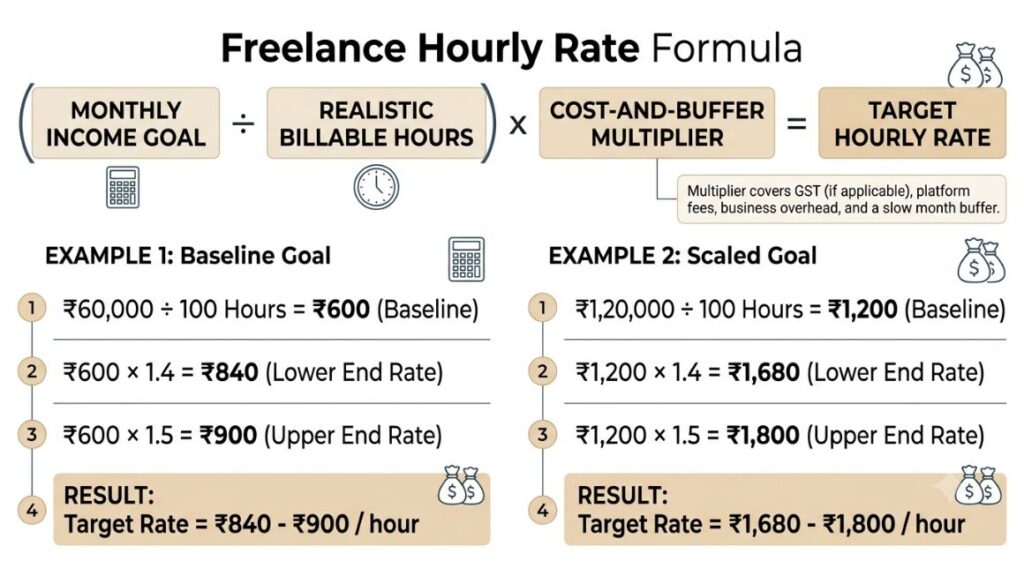
The step almost every underpriced freelancer skips is step 4. They calculate the baseline, feel good about it because it beats their old per-hour salary math, and quote that number directly to a client. The multiplier is what turns a baseline into a rate that actually survives GST, platform cuts, and the months when client work is thin. Skip it, and you’re not pricing your services. You’re pricing your services as if freelancing had none of the costs that make it different from a salaried job in the first place.
To price freelance services, divide your monthly income goal by the hours you can realistically bill (industry benchmarks put this at roughly 60% of a working week, or 25-30 hours out of a 40-hour week), then multiply that baseline by 1.4 to 1.5 to account for GST, platform fees, overhead, and unbillable admin time. A ₹60,000 monthly goal at 100 billable hours produces a real target rate of ₹840-900 an hour, not the ₹600 baseline most beginners stop at.
The Four Freelance Pricing Models – Which One Fits You?
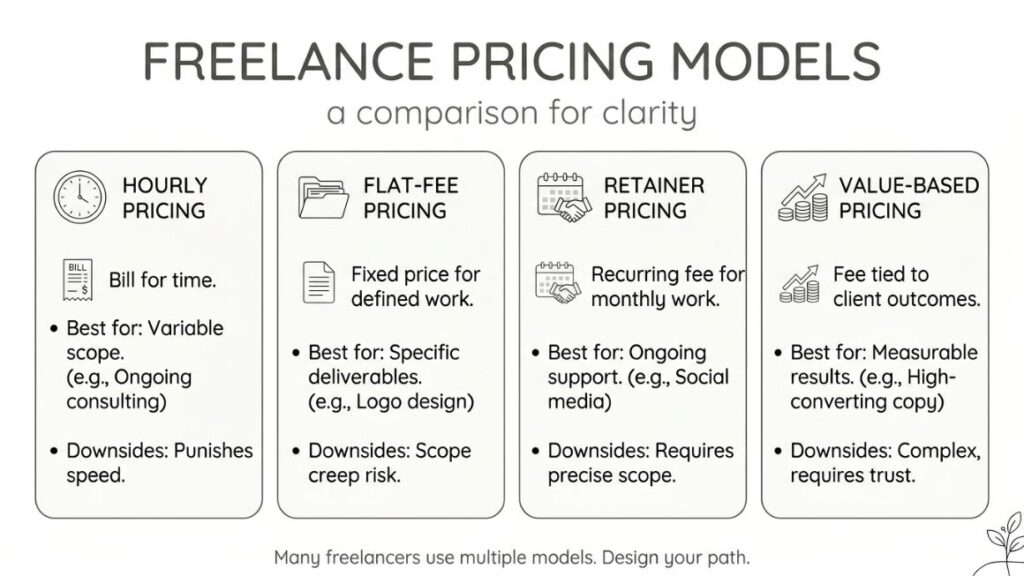
There is no single correct way to price freelance work. There are four common models, and the right one depends on the type of work, how predictable it is, and how much trust you’ve built with a specific client. Most experienced freelancers end up using two or three of these simultaneously across different clients.
Hourly Pricing
Hourly pricing means you bill for time spent, tracked and invoiced against an agreed rate. It works best for open-ended work where scope keeps shifting, like ongoing consulting or support retainers where nobody can predict the hours in advance.
The problem with hourly pricing as a beginner default is that it punishes you for getting faster. The better you get at your craft, the fewer hours a task takes, and the less you earn for delivering the same value. It also makes clients nervous, because an hourly quote feels open-ended to them even when it isn’t to you.
Project-Based or Flat-Fee Pricing
Flat-fee pricing means you quote one number for a defined deliverable, regardless of how many hours it actually takes you. A logo package, a set of five blog posts, a landing page redesign, all fit naturally here.
This model rewards efficiency instead of punishing it. Once you’re fast at a task, your effective hourly rate climbs even though your quote to the client stays the same. The catch is scope creep. Without a written scope document specifying exactly what’s included and what counts as a paid revision, flat-fee work quietly turns into unpaid hourly work the moment a client asks for “just one more small change.”
Retainer Pricing
A retainer is a recurring flat fee for an ongoing, defined scope of work delivered monthly, common for social media management, SEO, or content calendars. Retainers give you predictable income and let a client budget predictably too, which is why agencies push for them constantly.
The risk with retainers as a beginner is underscoping them. A ₹25,000 monthly retainer that quietly expands from “four posts a month” to “four posts, plus strategy calls, plus reporting, plus ad-hoc requests” is a trap that takes months to notice, because each individual addition feels small.
Value-Based Pricing
Value-based pricing means your fee is tied to the measurable outcome you create for the client, not the hours or the deliverable. A freelancer who rewrites a client’s landing page copy and it lifts conversion by even a few percentage points has created value that’s worth far more than the two days it took to write.
This is genuinely the hardest model to execute as a beginner, and most freelance advice oversells it. You need enough track record and enough client trust to have a conversation about outcomes at all, and you need to be able to actually measure the outcome you’re claiming. It’s the right model to grow into, not the right one to start with.
How to Benchmark Your Rate Against the Market?
Guessing your rate in a vacuum is how underpricing happens in the first place. Before you quote, check what the market is actually paying for comparable work at your experience level.
Upwork’s own Freelance Rate Calculator is a genuinely useful starting point here. You enter your monthly expenses, your minimum required income, and your desired working hours, and it builds a base rate for you. Treat its output as a first draft, not a final number. It’s a good sanity check against the formula in the core framework section above, not a replacement for it, since it won’t know your specific niche or India-specific costs like GST.
Beyond a calculator, Upwork’s annual In-Demand Skills report gives you a sense of which skills are commanding a premium right now. The 2026 report found hourly rates across in-demand freelance skills ranging from $10 for virtual assistance to $200 for machine learning engineering, with AI-related hiring growing 109% year over year, more than four times the 23% growth rate for other in-demand skills. If you have any AI-adjacent capability, even something as basic as prompt-assisted content workflows, that’s worth foregrounding in your pitch, because demand is visibly shifting toward it.
USD Rate Benchmarks If You’re Serving International Clients
If you’re pricing for clients outside India, your reference point needs to shift to USD ranges, since Indian rupee bands don’t map cleanly onto what a US or European client expects to pay. Upwork’s published rate estimates for common beginner-to-intermediate freelance roles put writers at $30 to 40/hour. Graphic designers at $15-35/hour. Web designers at $15 to 35/hour. Digital marketers at $35 to 45/hour. Data analysts at $20 to 50/hour. Virtual assistants at $10 to 25/hour.
These are US-market reference points, not a floor you have to hit immediately. But they tell you where the ceiling actually is, which matters if you’ve only ever benchmarked against domestic Indian rates and assumed that’s the whole market.
Read More: How to Land Your First Freelance Client as a Marketer (Step-by-Step Guide)
What Else Justifies a Higher Rate Beyond Your Costs
Two freelancers doing the same task at the same experience level can reasonably charge different rates, and cost alone doesn’t explain the gap. Experience level is the most obvious modifier: a freelancer with a decade of client history can justifiably charge more than someone six months in, for the same deliverable. Specialisation depth matters too. A designer who works across brand identity, motion graphics and UI design can price higher than one who does only static social graphics. That is because the client is buying range as well as output. Project complexity is the third lever. A rushed turnaround. A niche technical requirement. Or coordination across multiple stakeholders all justify a premium over a straightforward and well-scoped brief.
Certifications and portfolio strength function as trust shortcuts for a client who can’t yet judge your work directly. They don’t replace a real portfolio, but they can tip a hesitant client toward saying yes at your stated rate instead of asking for a discount.
Beyond your own skill set, peer freelancer communities on Reddit, Discord, and LinkedIn groups specific to your niche are often more useful than any published report, because people share what they’re actually being paid right now, not a platform-wide average. Cross-check three sources before you settle on a number. A platform’s published range. A peer community’s real quotes. Your own cost-based calculation from the core framework section. Where those three roughly agree, you have a defensible rate.
Pricing by Skill: What Beginners in Different Niches Actually Charge
Rate ranges vary enormously by niche. Pretending there’s one universal freelance rate is part of why beginners get confused. Here’s a rough starting-point band for common beginner-to-intermediate niches serving Indian clients. It is based on current platform and market data.
Content writing for Indian clients typically starts around ₹300 to ₹600 an hour for beginners. It moves to ₹800 to ₹1,500 for writers with a strong portfolio and a specific niche like fintech or SaaS. Graphic design for small businesses runs a similar beginner band. Logo and brand identity packages command flat fees rather than hourly rates once you’re past the first few projects. SEO work tends to price higher per hour even at entry level. That is because clients associate it with measurable revenue impact.
Beginner SEO freelancers in India often start around ₹500 to ₹1,000 an hour for audits and on-page work. Social media management is usually sold as a monthly retainer rather than hourly, with beginner packages for a handful of platforms starting around ₹15,000 to ₹30,000 a month.
None of these numbers are fixed. A freelancer targeting international clients on Upwork may price meaningfully higher in dollar terms than someone building a purely domestic Indian client base. That is because the market they’re competing in is different, as the USD benchmarks above make clear.
Beginner freelance rates in India vary sharply by niche: content writing typically starts at ₹300-600/hour, SEO work at ₹500-1,000/hour, and social media management is usually sold as a monthly retainer starting around ₹15,000-30,000. Rates rise significantly once a freelancer builds a portfolio, a niche specialisation or an international client base.
Read More: How Digital Marketing Works in 2026
How to Present Your Price Without Undercutting Yourself?
The number matters less than how you say it. A hesitant delivery undermines even a well-calculated rate. Clients read hesitation as a signal that the price is negotiable or wrong.
Frame value, not apology. Instead of “I charge ₹15,000 for this, I hope that’s okay,” say “This project is ₹15,000, which covers two rounds of revisions and delivery within ten days.” The second version states a fact. The first one asks permission.
Offer tiered packages instead of a single number wherever the work allows it. A basic, standard and premium tier for the same service does two things at once. It lets the client feel like they’re choosing rather than being told a price. It anchors your middle tier as the reasonable option by comparison. Most clients pick the middle tier, which is usually the one you actually wanted to sell.
When a client pushes back on price, resist the instinct to immediately drop the number. Ask what specifically feels high. Sometimes the pushback is really about scope, not price and a smaller deliverable at the same rate solves it. If the client genuinely has a smaller budget, offer a reduced scope at your rate rather than your full scope at a reduced rate. That protects the rate itself from becoming negotiable in future conversations with that same client.
Read More: Making a Digital Marketing Proposal – Step-by-Step Guide
When and How to Raise Your Rates Later
Your starting rate is not your rate forever, and treating it as fixed is its own kind of underpricing. Watch for three signals that it’s time to move: you’re consistently booked out weeks in advance, you have repeat clients who keep coming back without being chased, and your portfolio now includes work you’d have been unable to land a year ago.
Raising rates with new clients is simple: you just quote the new number. Raising rates with existing clients needs more care, because you’re changing terms on a relationship, not opening one. Give existing clients advance notice, ideally 30 to 60 days before the new rate applies, and frame the increase around the value you’ve built rather than your rising costs. “Starting next quarter, my rate for this scope moves to X, reflecting the additional strategy input I’ve been adding over the last six months” lands better than “I need to raise my rates because things are expensive now.”
Most freelancers wait too long to do this, worried that a repeat client will walk. A well-communicated increase, tied to genuine added value, rarely ever loses a client who was happy with the work in the first place.
Conclusion
The number you quote today isn’t just this project’s fee. It’s the anchor every future client conversation gets measured against. That is exactly why guessing is so expensive. Learn how to price freelance services, especially when you’re just starting out. Build your rate from your actual costs and income goal. Pick the pricing model that fits the specific work in front of you. Revisit both every few months as your portfolio and demand shift.
If you want more of this kind of practical, no-fluff breakdown on building a sustainable marketing or freelance career, the Crystal Clear Newsletter covers exactly this territory every week. These are real numbers, real frameworks and no generic advice. It’s a good next step if today’s piece was useful.
FAQ
Should I charge hourly or per project as a beginner?
Project-based pricing is usually safer for beginners because it protects your income as you get faster at the work. Use hourly pricing only for genuinely open-ended engagements where scope can’t be defined upfront, like ongoing technical support.
Is value-based pricing realistic for someone just starting out?
Not usually. Value-based pricing needs a track record and enough trust with a client to have a conversation about measurable outcomes. Beginners typically don’t have that yet. Start with hourly or project-based pricing. Then grow into value-based pricing once you have case studies to point to.
Do I need to register for GST as a new freelancer?
Only once your aggregate annual turnover crosses ₹20 lakh (₹10 lakh in special category states), unless you’re supplying services across state lines, in which case registration can be mandatory from your very first invoice. Below that threshold, GST registration is optional, though some freelancers register voluntarily to work with larger clients who require a GSTIN on the invoice.
How do I actually calculate my freelance hourly rate?
Divide your monthly income goal by your realistic billable hours, not your total working hours. Then multiply by 1.4 to 1.5 to cover taxes, platform fees, overhead and unbillable admin time. This gives you a rate that actually sustains your income goal instead of one that looks fair on paper.
What’s a freelance rate calculator, and should I use one?
A freelance rate calculator is a tool that automates the income-goal-to-hourly-rate formula. That lets you plug in your target income, working days and expenses to get a starting number. Upwork’s own calculator works this way. They’re a good sanity check but shouldn’t replace the manual calculation, since most calculators don’t account for niche-specific market rates or India-specific costs like GST.
Is hourly vs project pricing really that different for the same work?
Yes, because they shift who bears the risk of scope creep and slow work. Hourly pricing protects you if a project runs long. Project-based pricing protects your income if you finish fast. The “right” choice depends on how well-defined the deliverable is, not on which model sounds more professional.
Do I really need to think about GST if I’m earning less than ₹20 lakh a year?
If all your clients are in your own state and your turnover stays under the threshold, GST registration isn’t mandatory yet. But track your turnover monthly anyway, because crossing the line partway through a year means registering immediately, not at year-end.
Why do clients keep pushing back on my rate even though I researched it?
Pushback is often about how the price was presented, not the number itself. A rate stated as fact, tied to a specific scope and deliverable, gets challenged far less often than the same rate delivered with hedging language or an apology built into the sentence.
What do most new freelancers get wrong about pricing?
The most common mistake is pricing off an old salary instead of building the rate from freelance-specific costs. GST, platform fees, overhead and the 20-30% of a working week that never becomes billable hours are better options. The second most common mistake is treating the first quoted rate as permanent instead of a starting point to revise as demand and portfolio grow.