

A retainer client emails on a Tuesday morning to say they’re pausing the engagement. Budget cuts, new CMO, doesn’t matter why. If that one client was 40% of your monthly income, you don’t have a slow month. You have a crisis.
This is the part nobody mentions when they sell you on freelancing. The freedom is real, but so is the fragility. Diversifying income as a freelancer means building revenue from more than one client relationship, so that losing any single source doesn’t threaten your ability to pay rent. It’s not about hustling harder. It’s about restructuring where the money actually comes from.
Most freelancers in India are earning well right now. Indian freelancers report average annual incomes around ₹20 lakh, and 23% cross ₹40 lakh. But average income and stable income aren’t the same thing. This article walks through what diversification actually looks like for a working freelancer: productized services, passive income streams, audience-led income, and where investing fits into the picture. By the end, you’ll have a framework for building this without torching the client work that’s paying your bills right now.
Table of Contents
Why Relying Only on Client Work Puts Freelancers at Risk
Client-only income concentrates all your risk in a handful of relationships you don’t control. One dropped retainer, one delayed invoice, one client going through layoffs, and your entire month is compromised.
The freelance economy in India has grown fast enough to hide this problem. Gig workers in India increased to 12 million in FY2025, up from 7.7 million in FY2021. That is a 55% jump driven by smartphone penetration and UPI adoption, according to the Economic Survey 2025-26 tabled in Parliament. More freelancers are earning more money than ever. That doesn’t mean any individual freelancer’s income is more stable.
Feast-or-famine cycles are structural, not a personal failing. You win a big project, work flat out for six weeks, deliver it, and then spend the next two weeks scrambling for the next one because you didn’t have bandwidth to prospect while you were heads-down. Client-only freelancers live this loop on repeat. It’s exhausting and it makes long-term financial planning nearly impossible.
Platform dependency makes it worse. If most of your income routes through Upwork or Fiverr, you’re not just dependent on clients. You’re dependent on a platform’s fee structure, its algorithm for surfacing your profile, and its policies on payment holds and disputes. A platform can change its terms overnight. Your income doesn’t get a vote.
The Economic Survey flagged that income volatility among gig workers leads directly to challenges accessing credit, since banks and lenders still largely underwrite based on predictable, salaried income patterns. That’s a real cost of concentration, not just an inconvenience. Try applying for a home loan on the back of three client invoices with wildly different monthly totals and you’ll feel it.
Client-only freelance income concentrates risk in a small number of relationships the freelancer doesn’t control. A single lost retainer can wipe out a large share of monthly revenue, and gig income volatility in India has been linked by the Economic Survey 2025-26 to difficulty accessing formal credit.
Here’s the thing that gets missed in most “freelance tips” content: the goal isn’t more clients. The goal is fewer eggs in any one basket, whichever basket that happens to be.
What Does Diversifying Income as a Freelancer Actually Mean?
Diversifying income as a freelancer means building revenue across multiple and structurally different sources instead of depending entirely on time-for-money client work. That’s the whole definition, in one sentence, and it’s worth sitting with because most freelancers get this wrong in a specific way.
“Getting more clients” is not diversification. It’s scaling the same risk. If you go from three clients to eight clients, you’ve reduced the damage from any single client leaving, sure. But you’re still trading hours for money in the exact same structural pattern. One bad flu week still costs you income. One burnout month still costs you income. The ceiling on your earnings is still your calendar.
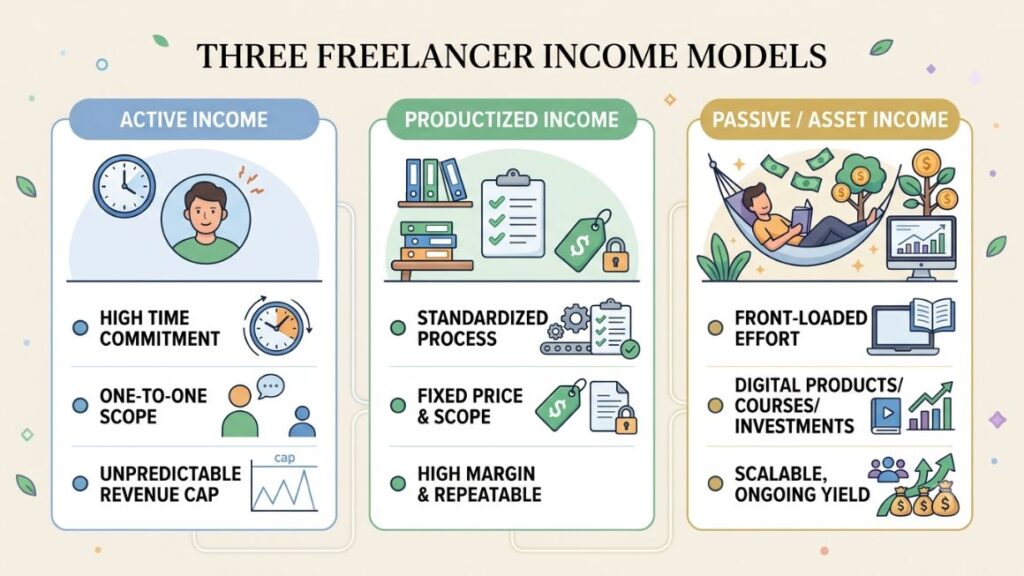
Real diversification changes the type of income, not just the number of sources. A useful framework splits freelance income into three categories:
Active income is what you’re doing now: client retainers, project fees, hourly consulting. You trade time directly for money. It stops the moment you stop working.
Productized income is a packaged version of your skill sold at a fixed scope and price, rather than open-ended hours. You still do the work, but the offer is standardized. That makes it faster to deliver and easier to sell.
Passive or asset income comes from something you built once that keeps generating revenue with minimal ongoing effort. It can be a digital product, a course, an affiliate link or an investment. This is the category most freelancers skip entirely, usually because it doesn’t pay off in week one.
A diversified freelancer isn’t someone juggling twelve clients. It’s someone with revenue sitting in at least two of these three categories, so that a bad month in one doesn’t sink the whole operation.
Also Read: AI Side Hustles: 10 Ways to Make Extra Income With AI Tools in 2026
Productized Services: Turning Your Skills Into Scalable Offers
A productized service is a fixed-scope and fixed-price version of a skill you already sell by the hour. It’s the fastest diversification move available to any freelancer. It doesn’t require learning anything new. It requires repackaging what you already do.
The shift matters because open-ended client work scales terribly. Every new client means a fresh negotiation, a fresh scope discussion and a fresh set of expectations to manage. A productized offer skips most of that. The client sees a defined deliverable at a defined price, says yes or no, and you deliver against a process you’ve already refined.
Examples by Skill
A content writer who’s spent two years doing ad-hoc blog posts for clients can package a “SEO Content Audit” as a five-day and fixed-price engagement. That’s a keyword gap analysis, on-page recommendations and a prioritized action list. Same skillset. Completely different sales motion.
A designer doing one-off logo and brand work can build a “Brand Kit in a Week” offer. That includes a logo, color palette, typography guide and a one-page brand style sheet. It is delivered on a template-driven process instead of a blank-page brief every time.
A marketer who manages social calendars for clients individually can offer a “Done-for-You Social Calendar” as a monthly subscription: 20 posts, scheduled and captioned, using a repeatable content framework instead of custom strategy work for every account.
None of these require new skills. They require turning a service into a product with a name, a scope and a price tag.
Pricing and Packaging a Productized Service
Price a productized service by outcome and scope, not by estimated hours. The moment you price it hourly, you’ve just recreated freelancing with extra steps. Instead, decide what the deliverable is worth to the client and price against that.
Start narrow. A productized service with too much scope creep defeats the purpose. If your SEO audit keeps expanding to include implementation, competitor tracking, and monthly check-ins, you’ve built a retainer wearing a productized costume.
Build the delivery process once, then reuse it every time: Templates, checklists, a standard project brief. The entire point of productizing is that delivery number ten should take a fraction of the time delivery number one took, because you’ve eliminated the improvisation.
Most freelancers underprice their first productized offer out of nervousness. Charge close to what three to five hours of your normal rate would cost, then adjust once you’ve delivered it a few times and know your real time cost.
A productized service converts a freelancer’s open-ended, hourly skill into a fixed-scope, fixed-price offer with a repeatable delivery process. Pricing should reflect the outcome delivered rather than estimated hours, since hourly pricing recreates the same time-for-money constraint productizing is meant to solve.
Also Read: Personal Brand Management: Guide to Build, Manage & Grow
Passive and Semi-Passive Income Streams Worth Building
Passive income for freelancers rarely ever means zero effort. It means front-loaded effort: you build something once and it keeps earning with far less ongoing work than a client relationship demands. This is the category that actually breaks the direct line between hours worked and money earned.
Digital Products and Templates
A content strategist who’s built fifty content calendars for clients can turn that process into a Notion template and sell it for ₹999 a copy. A designer who’s created hundreds of Canva-based Instagram templates can bundle twenty into a pack and sell it on Gumroad. The work happens once. The sale can happen indefinitely.
This works best when the digital product solves the exact problem your client work already solves, just at a lower price point and without the customization. You’re not competing with your own retainer clients. You’re serving people who can’t afford or don’t need a full engagement yet.
Online Courses and Cohort-Based Programs
If you’ve built genuine expertise doing client work, that expertise has value beyond the clients who can afford you directly. A performance marketer who’s managed ₹2 crore in ad spend can teach a cohort-based course on budget allocation across Meta and Google. The course doesn’t replace client work. It monetizes the knowledge sitting alongside it.
Cohort-based programs, run live over two to four weeks, tend to command higher prices than self-paced courses because they include direct access and feedback. They’re also more work per cohort. Self-paced courses trade a lower ceiling for genuinely passive delivery once recorded.
Affiliate Marketing and Partnerships
If you already recommend tools to clients, freelance writing platforms, design software, project management apps, affiliate partnerships turn recommendations you’re making anyway into a small revenue stream. This rarely becomes a primary income source on its own, but stacked with other passive streams, it adds up.
The honest limitation here: affiliate income depends entirely on traffic or audience. Without either, affiliate links convert close to nothing. This stream works as an addition to audience-led income, covered next, not as a standalone strategy.
Passive income for freelancers is front-loaded, not effort-free. Digital products, templates, and courses convert existing expertise into a repeatable revenue stream that doesn’t scale linearly with hours worked, unlike client retainers.
Audience and Content-Led Income Streams
Building an audience is the slowest income stream to start and the most durable once it exists. A LinkedIn following, a newsletter list, a YouTube channel: none of these pay rent in month one. Given eighteen months of consistency, they can become a freelancer’s most resilient income source, because they don’t depend on any single client or platform staying loyal to you.
Paid Newsletters
A freelancer writing a free newsletter on, say, freelance tax and GST compliance in India can eventually gate deeper content behind a paid tier. Substack and Beehiiv both support this directly. The value proposition has to be sharper than the free tier, not just “more of the same content.”
Paid newsletters work best in niches where the reader has money on the line: finance, specific software workflows, niche B2B categories. A broad lifestyle newsletter struggles to convert readers to paid subscriptions because the free version already satisfies most of what they need.
YouTube and Faceless Content
Not every creator needs to be on camera. Faceless YouTube channels, built around voiceover, screen recordings, or animated explainers, have grown into a legitimate content category, particularly for tutorial and how-to content in design, marketing, and finance niches.
A freelance designer can build a channel teaching Figma workflows without ever showing their face. Revenue comes from AdSense once the channel qualifies, plus sponsorships, plus the audience it builds for other income streams like courses or productized services.
This is genuinely slow. Most channels take a year or more of consistent uploads before revenue becomes meaningful. Treat it as a long-term asset, not a near-term income plan.
Audience-led income, paid newsletters, YouTube, and similar formats, takes the longest to build but creates the most durable income stream a freelancer can own, since it depends on the freelancer’s own audience relationship rather than any single client or platform.
Investment-Based Income Streams for Freelancers in India
Diversifying income isn’t only about earning more actively. Part of it is putting existing surplus to work so it earns on its own, independent of whether you land the next client.
SIPs and Mutual Funds
A Systematic Investment Plan lets you invest a fixed amount into a mutual fund every month, smoothing out market timing risk over years. For freelancers with irregular income, SIPs solve a real problem: they force savings discipline during good months, which matters more when your income doesn’t arrive on a predictable schedule the way a salary does.
SIP contributions in India crossed ₹31,000 crore a month through much of 2026, according to AMFI data, with SIP assets making up over 20% of the mutual fund industry’s total assets under management. Retail participation at this scale reflects a broader shift in how Indians, freelancers included, are building long-term wealth outside of fixed deposits.
The freelancer-specific adjustment: don’t set a SIP amount you can only sustain in your best months. Set it against your worst realistic month, and treat any additional surplus as a top-up rather than the baseline.
Real Estate and REITs
Direct real estate needs capital most freelancers don’t have sitting around, and it’s illiquid when you need cash fast. Real Estate Investment Trusts solve both problems. A REIT lets you buy units in commercial property, offices, malls, and collect a share of the rental income, starting from a few hundred rupees per unit.
Indian REITs currently distribute yields in the range of 7 to 9 percent, and India’s REIT market overtook Hong Kong’s in size, with combined market capitalization crossing ₹1.66 lakh crore. Embassy Office Parks, Mindspace Business Parks, Brookfield India Real Estate Trust, and Nexus Select Trust are the established names trading on Indian exchanges.
REITs won’t make you rich fast. What they do is convert idle freelance savings into a quarterly income stream that has nothing to do with whether a client renews.
SIPs and REITs let freelancers convert existing income into a separate revenue stream that isn’t tied to client work at all. Indian REITs currently distribute yields of roughly 7 to 9 percent, while SIP participation has become the dominant vehicle for retail investing in India.
How to Diversify Income Without Sacrificing Client Work?
The single biggest mistake in this whole conversation is treating diversification as a reason to quit client work early. It isn’t. Client income is what funds the runway for everything else on this list.
Start with time-boxing. Set aside a fixed, protected block, four to six hours a week is realistic for most freelancers, dedicated only to building a new income stream. Not “whenever I have spare time,” because that block never materializes on its own. Put it on the calendar like a client call.
A useful allocation model here is the 70/20/10 split. Put 70% of your working hours into client work that pays the bills today. Put 20% into a productized service or an emerging passive stream that’s showing early traction. Put the last 10% into pure experimentation: testing a new format, a new platform, a new idea that might not go anywhere.
Timing matters more than most freelancers admit. Don’t start diversifying the week your client income gets shaky. That’s reactive, and reactive decisions under financial pressure tend to be bad ones. Start when client income is stable and boring. The best time to build a second stream is precisely when you don’t feel the urgency to.
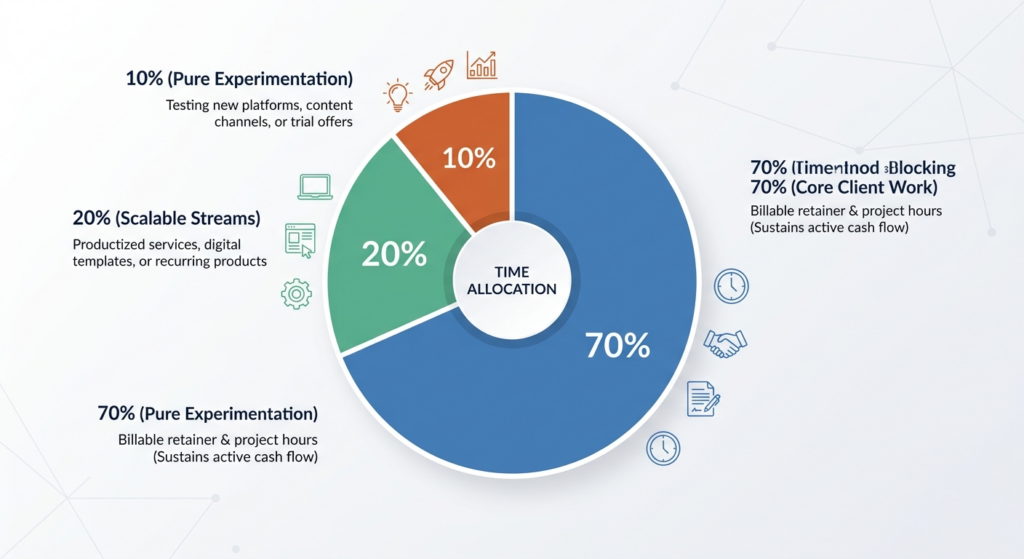
The 70/20/10 model allocates most working hours to stable client income, a smaller share to a growing productized or passive stream, and a minimal share to pure experimentation. Diversification works best when it starts from a position of financial stability, not desperation.
Mistakes Freelancers Make When Diversifying Income
Chasing too many streams at once is the most common failure mode. A freelancer decides to launch a course, start a newsletter, and build a digital product all in the same quarter, and ends up doing all three badly instead of one well. Pick one new stream. Get it earning something meaningful before adding a second.
Quitting a stable client to “focus on diversification” without runway is a close second. Passive and audience income takes months, sometimes years, to become meaningful. Walking away from paying client work before a new stream has proven itself removes the very stability that made experimentation possible in the first place.
Ignoring GST and tax implications catches freelancers off guard more often than it should. Digital product sales, course revenue, and affiliate income all carry their own tax treatment in India, and mixing income types without tracking them separately creates a mess at filing time. A freelancer earning from client retainers, a Gumroad store, and REIT distributions in the same financial year has three different income characterizations to account for, not one.
Conclusion
Diversifying income as a freelancer isn’t a single decision. It’s a slow shift from one income source to several, built over months, funded by the client work you’re already doing. Start with the lowest-effort move: productize one thing you already sell by the hour. Let that earn for a few months before you touch anything else on this list.
The freelancers who feel financially secure five years in aren’t the ones with the most clients. They’re the ones who stopped depending on any single source, whether that’s one retainer, one platform, or one type of income entirely.
If you’re building toward that kind of stability and want structured, practical guidance on the marketing and career side of freelancing, Crystal Clear, YUP’s newsletter, breaks down exactly this kind of framework every week: real strategies, not generic hustle advice. It’s a natural next step if this article gave you more questions than it answered.
FAQ
What does diversifying income as a freelancer mean?
It means earning from multiple, structurally different sources, active client work, productized services, passive income, and investments, rather than depending entirely on hourly or project-based client billing. The goal is reducing how much any single client or income type controls your financial stability.
Is diversifying income the same as having a side hustle?
Not quite. A side hustle is usually a separate, unrelated venture. Income diversification for freelancers typically builds directly on the skill you already sell, repackaged into a product, a course, or a passive asset, rather than starting something disconnected from your expertise.
How do I start diversifying my income as a freelancer?
Start by productizing one service you already offer, since it requires no new skills, just repackaging into a fixed-scope, fixed-price offer. Once that’s earning consistently, add a passive stream like a digital product or a SIP, and build audience-led income last since it takes the longest to pay off.
Is diversifying income only for experienced freelancers?
No, but timing matters more than experience. A freelancer six months in with unstable client income should stabilize that first. A freelancer with 12 to 18 months of consistent client revenue is usually in a stronger position to start building a second stream.
Is it worth the time if my client work already pays well?
Client income paying well today doesn’t protect against it disappearing tomorrow. Diversification is insurance against concentration risk, not a signal that your current income is inadequate. The freelancers who diversify while things are going well are the ones least stressed when a client leaves.
How much time should I spend on building a new income stream?
Four to six protected hours a week is realistic for most working freelancers, treated as a fixed commitment rather than leftover time. The 70/20/10 allocation model, most hours to client work, a smaller share to a growing stream, a minimal share to experimentation, keeps this sustainable.
Can passive income actually replace client income for freelancers?
Rarely, and not quickly. Passive and audience-led streams typically take months to years to reach meaningful revenue. They’re best treated as a complement that reduces risk, not a replacement plan for existing client income in the near term.
What’s the easiest income stream to start as a freelancer?
Productized services, since they use skills you already have and require no new capital, audience, or product-building timeline. A fixed-scope offer built from your existing service can start generating revenue within weeks of launch.
Do freelancers in India need to worry about GST when diversifying income?
Yes. Different income types, digital product sales, course revenue, affiliate commissions, client invoices, carry different GST and tax treatment. Freelancers adding new income streams should track each type separately rather than lumping all revenue together, especially once income crosses GST registration thresholds.
Why isn’t my digital product or course selling even though I built it well?
This usually comes down to audience, not product quality. A well-built digital product with no existing audience or distribution channel has no way to reach buyers. Audience-building and product-building need to happen roughly in parallel, not one after the other.
Is investing in REITs or SIPs really “diversifying income” or is that just saving?
Both, in a useful way. SIPs and REITs convert savings into a recurring return that arrives independent of client work, which functionally behaves like a separate income stream over time, even though the mechanism is investment rather than active work.
Should I diversify income if I’m just starting out as a freelancer?
Focus on stabilizing client income first. Diversification works best once you have a predictable baseline of client revenue to fund the time and, in some cases, the money that building a new stream requires.