

Somewhere between the third overpriced coworking desk and the fourth confusing consulate website, most people planning a year abroad hit the same wall. The best countries for digital nomads in 2026 are not the ones with the prettiest Instagram feed. They are the ones where your visa, your tax bill, and your client calls actually line up. For professionals building careers around remote work opportunities, that alignment matters just as much as the destination itself. By picking on vibes alone, you can end up with a gorgeous apartment in a city where your work visa expires mid-lease. Avoid any “tax-free” destination that still leaves you owing money back home.
Dozens of countries now run dedicated digital nomad visa programs. That number is up from a small handful in 2020. An expansion is good news. But it also means more ways to get the choice wrong. This guide walks through what actually separates a workable base from an expensive mistake. We cover everything, country by country, with the visa costs, income rules and time zones that matter for 2026.
Table of Contents
What Makes a Country One of the Best Countries for Digital Nomads in 2026?
The best countries for digital nomads in 2026 share four traits. A visa you can actually qualify for. An income threshold you can clear without stress. A time zone that overlaps with your clients or employer. Infrastructure that doesn’t collapse the moment you need a stable video call. Miss any one of these and the rest of the plan falls apart, no matter how good the coffee is.
Visa Accessibility and Legal Clarity
This is the first filter and it’s the one most people skip. A country can look perfect and still be closed to you if the visa route is unclear, oversubscribed or effectively unavailable to your passport. Portugal and Spain publish detailed and English-friendly guidance. Others, like Vietnam, simply don’t have a dedicated remote-work visa at all. This pushes everyone onto tourist e-visas and periodic border runs.
Cost of Living and Minimum Income Requirements
Every digital nomad visa sets a minimum income floor. These numbers vary wildly. Spain asks for €2,442 a month in 2026. Estonia asks for €4,500. Neither number means anything on its own. What matters is that threshold against your actual take-home pay and the local cost of living, which is where a lot of applicants get the math wrong.
Time Zone Compatibility With Clients or Employers
A cheap, beautiful base is worthless if it forces you into 2 a.m. client calls for six months straight. Mexico and Colombia keep you inside US working hours. Georgia and the UAE sit closer to European and South Asian time zones. Bali and Thailand work well if your clients are in Australia, Singapore, or East Asia, and considerably less well if they’re in New York.
Internet Speed and Coworking Infrastructure
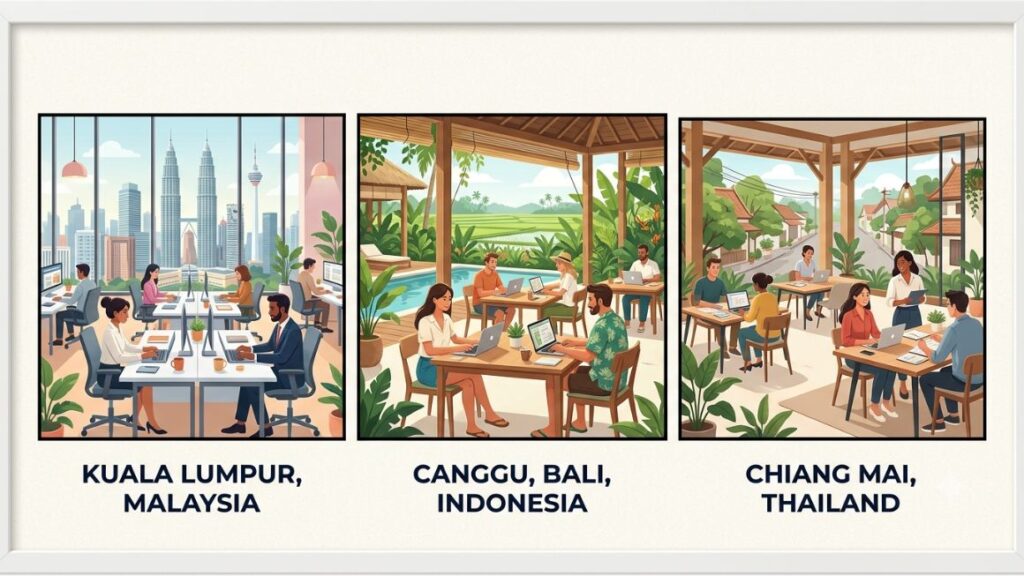
Estonia, Portugal’s Madeira, and Thailand’s DTV hubs in Chiang Mai and Bangkok have dense, reliable coworking scenes and fiber-grade connectivity. Smaller Greek islands and rural stretches of Georgia are far more inconsistent. Check average fixed broadband speeds for the specific city, not just the country, before you commit to a lease.
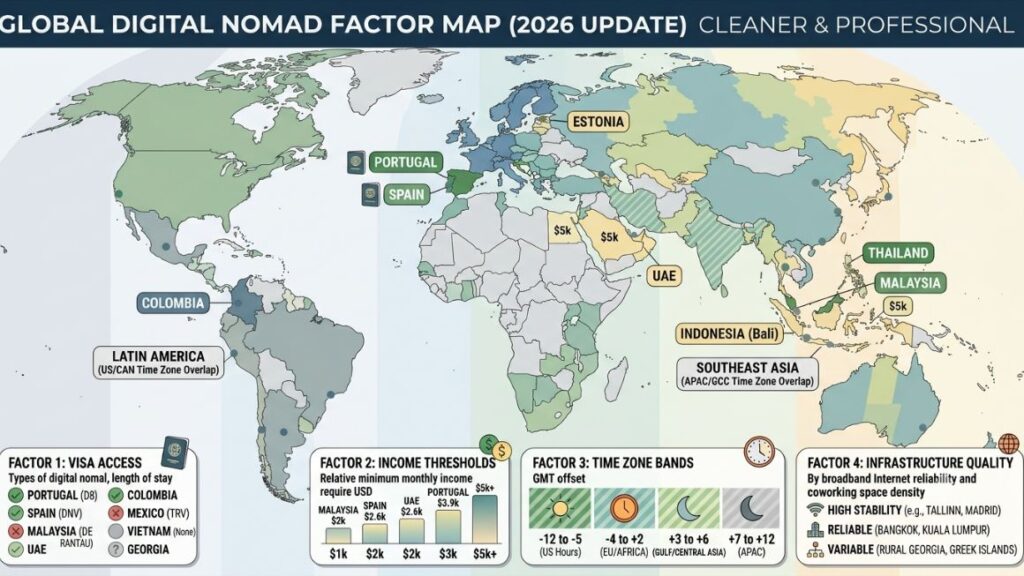
None of these four factors works in isolation. A country can clear the income bar easily and still fail on time zone fit, or offer excellent infrastructure and a hopeless visa queue. Treat this as a checklist you run against every destination on your shortlist. This isn’t a ranking you apply once and forget.
The best countries for digital nomads in 2026 combine four factors: an achievable visa, an income threshold you clear comfortably, a workable time zone overlap with clients and dependable internet infrastructure. No single factor decides the choice on its own, and a country that’s strong on three but fails the fourth usually isn’t worth the move.
Read More: Building a Secure Digital Marketing Workflow for Distributed Teams
Europe’s Top Digital Nomad Visa Destinations
Europe still runs the most mature digital nomad visa market on earth, and 2026 brought income updates across nearly every program on this list.
Portugal: The D8 Visa and a Path to EU Residency
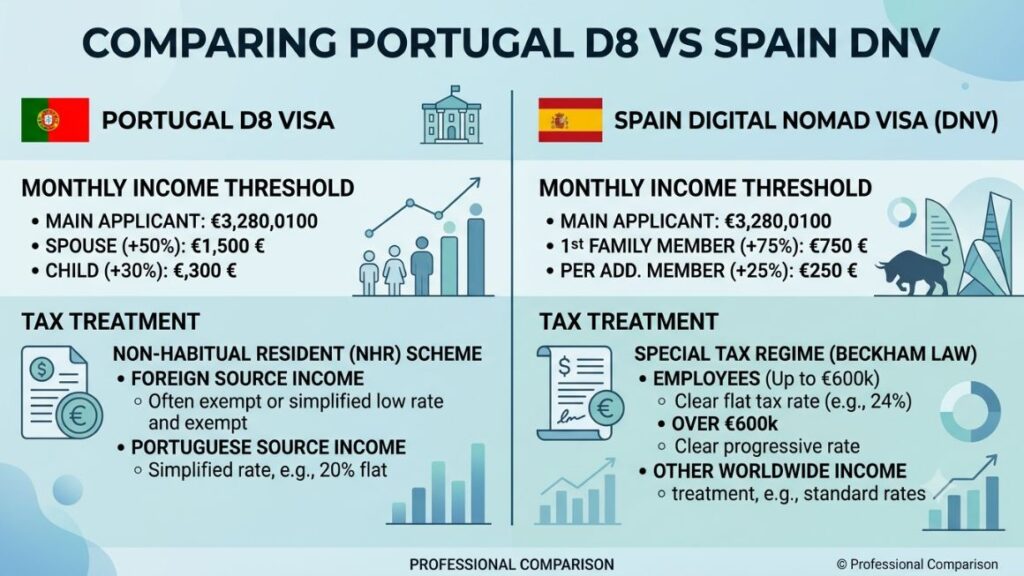
Portugal’s D8 visa requires proof of at least €3,680 a month in 2026, calculated as four times the national minimum wage. You’ll also need to show savings of roughly €11,040. Bring a spouse and the requirement rises by 50%; each dependent child adds 30%.
The D8 residence authorization is initially valid for two years and can then be renewed for successive three-year periods. Five years of legal residence can establish eligibility for permanent residence, subject to the applicable requirements.
Spain: Startup Act Visa and the 15% Flat Tax
Spain’s International Telework Visa, launched under the 2022 Startup Law, sets its 2026 income floor at €2,442 a month, or 200% of the updated SMI (minimum interprofessional salary), following Royal Decree 126/2026. Freelancers can keep Spanish clients, but they can’t exceed 20% of total income from domestic sources.
Here’s the part that actually moves the needle financially. Eligible new Spanish tax residents may be able to elect Spain’s special expatriate tax regime (“Beckham Law”), which generally applies a 24% rate to qualifying employment income up to €600,000, subject to the regime’s eligibility requirements. That is well below Spain’s standard progressive rates that climb past 45%. The visa itself runs for one year if applied for at a consulate, or three years if applied for from inside Spain, and renews toward a full five-year residency.
Croatia and Greece: Lower-Cost EU Bases With Tax Exemptions
Croatia’s digital nomad permit, one of the first in the EU when it launched in 2021, now requires €3,622.50 a month for 2026, a figure recalculated annually as 2.5 times the previous year’s average net Croatian salary. The genuine upside is that qualifying foreign employment income is fully exempt from Croatian tax. The catch: the permit runs up to 18 months and can’t be renewed back to back. You need a six-month gap outside the country before reapplying, which rules out treating Croatia as a permanent base on its own.
Greece asks for €3,500 a month and, since Law 5275/2026 took effect in February 2026, no longer accepts in-country applications. You now have to apply at a Greek consulate before you travel, then convert to a two-year residence permit after arrival. Eligible newcomers who transfer their tax residence to Greece and earn qualifying Greek employment or business income may receive a 50% income-tax exemption on that qualifying income for seven tax years under Article 5C.
Estonia: The Original Digital Nomad Visa, Still Relevant
Estonia’s Digital Nomad Visa was launched in 2020 and is the first dedicated remote-work visa in Europe. The income bar rose to €3,960/month a month gross in 2026, up from €3,504 the year before. This makes it the highest threshold of the major European programs. Cross 183 days in a 12-month period and you become an Estonian tax resident. That is subject to a 22% flat rate on worldwide income with a €700 monthly tax-free allowance. The real edge of Estonia isn’t the visa itself so much as the surrounding infrastructure. e-Residency lets you run a fully digital EU company regardless of where you physically live. Tallinn’s coworking density is hard to match at this price point.
Read More: How to Build a Marketing Portfolio With No Experience (Step-by-Step)

Asia’s Best Time-Zone-Friendly Digital Nomad Destinations
The remote work visas in Asia skew toward Australian, East Asian and Gulf time zones. This makes them a strong fit if your clients aren’t in North America.
Asia’s programs also tend to be newer and less bureaucratically settled than Europe’s. That means requirements shift more often within a single year. Build in time to recheck the official rules close to your application date rather than relying on a guide, including this one, written months earlier.
Thailand’s 5-Year Destination Thailand Visa (DTV)
Thailand’s Destination Thailand Visa doesn’t set an income threshold at all. Instead, you need proof of at least THB 500,000 (roughly $14,000) sitting in your account, generally for at least three months before applying. The visa itself is valid for five years. Each entry grants 180 days that can be extended once for another 180, for up to 360 days per stay. It costs THB 10,000 to apply. Thailand’s Ministry of Foreign Affairs added a mandatory police clearance certificate requirement in August 2026. The DTV explicitly bars holders from taking Thai clients or a Thai work permit, so it’s strictly a bring-your-own-income visa.
Indonesia’s KITAS E33G for Bali-Based Nomads
Indonesia’s E33G Remote Worker KITAS, introduced in April 2024, requires proof of at least $60,000 in annual income, roughly $5,000 a month. That includes an employment contract or client agreements with companies based outside Indonesia. It’s a one-year permit. Indonesia’s immigration authority treats holding a KITAS as evidence you intend to reside there. Spending substantial time in Indonesia can trigger Indonesian tax residency under the applicable tax-residency rules. Tax residents can be subject to Indonesian taxation on worldwide income, subject to domestic rules and applicable tax treaties. Bali remains the center of gravity for this visa. Canggu and Ubud carry most of the coworking infrastructure.
Malaysia and Vietnam as Budget-Friendly Bases
Malaysia’s DE Rantau Nomad Pass, run by the Malaysia Digital Economy Corporation, sets its income floor at $24,000 a year for digital and IT professionals, one of the lowest thresholds on this entire list, though non-digital professions face a steeper $60,000 bar added in 2024. The pass runs three to 12 months initially, renews once, and caps out at 24 months total. Malaysia can be tax-efficient for some remote workers because foreign-source income may receive exemptions under Malaysian rules, but the treatment depends on the nature of the income, where the work is performed, tax-residency status and the applicable exemption.
Vietnam still has no dedicated digital nomad visa. Remote workers there rely on 90-day multi-entry e-visas and periodic visa runs to neighboring countries, which works fine for a few months but isn’t a long-term legal foundation the way Malaysia’s or Thailand’s programs are.
Malaysia’s DE Rantau Nomad Pass requires just $24,000 a year in income for digital professionals, one of the lowest thresholds among Asia’s formal remote-work programs, and pairs it with a territorial tax system that generally exempts foreign-sourced income. Vietnam, by contrast, has no dedicated nomad visa at all as of 2026, leaving e-visa runs as the only practical option.
Latin America for Digital Nomads Working US Hours
Latin America’s biggest structural advantage is time zone overlap with US and Canadian clients, which is worth more to many nomads than any tax break.
Mexico’s Temporary Resident Visa
Mexico does not have a dedicated federal digital-nomad visa. Remote workers commonly use the Temporary Resident Visa, but financial-solvency thresholds vary by consulate and are updated periodically. For 2026, individual consulates publish figures in roughly the $4,000-plus monthly-income / $70,000-plus savings range, but applicants should use the requirements of the consulate handling their application. Requirements vary meaningfully by consulate, and government fees for the process roughly doubled on January 1, 2026. The permit runs up to four years before converting to permanent residency, and Mexico’s proximity to the US makes it the default choice for American clients who need overlapping hours without long flights.
Colombia and Costa Rica: Lower Income Thresholds
Colombia’s Visa V pegs its income floor to three times the national minimum wage, which works out to roughly COP 5,252,715 a month, about $1,400, in 2026, considerably lower than Mexico’s bar. Costa Rica’s rentista-style nomad route asks for around $3,000 a month in verified foreign income, or a $60,000 bank deposit as an alternative, and grants at least two years of stay. Both countries exempt foreign-sourced income from local tax for qualifying visa holders, which combined with the lower thresholds makes them attractive entry points for nomads earlier in their income curve.
For a founder or freelancer still building toward a stable income, this is often the more realistic starting point than jumping straight to Portugal or Spain’s higher thresholds. You can always move up to a European base once your income clears those bars with room to spare.
Read More: How to Land Your First Freelance Client as a Marketer (Step-by-Step Guide)
Tax-Free and Low-Tax Digital Nomad Havens
If minimizing your tax bill is the priority over EU access or coworking density, the Gulf and the Caucasus offer the cleanest routes.
UAE’s Virtual Work Visa
The UAE’s Virtual Working Programme charges 0% personal income tax, full stop, which is the single biggest draw on this list. The bar to entry rose meaningfully in 2026: a joint ICP and GDRFA circular that took full effect in April 2026 lifted the minimum income from $3,500 to $5,000 a month, extended the required bank statement history from three months to six, and more than tripled the required health insurance coverage to AED 500,000. The permit runs one year, renews annually, and needs no local sponsor or UAE-based job, only proof of employment or ownership of a foreign business.
Georgia’s Visa-Free Year for ~95 Nationalities
Georgia doesn’t run a conventional application-based nomad visa. Instead, citizens of roughly 95 countries can enter and legally live, work, or study in Georgia visa-free for up to a year under the long-running “Remotely From Georgia” framework. There’s no formal visa fee for this route, which makes it one of the simplest entry points on this list for nomads who don’t want to build a document package before they travel. Georgia’s territorial-leaning tax treatment for foreign-sourced income adds to the appeal, though anyone planning to invoice local clients or run a registered business should get country-specific tax advice rather than assume the visa-free stay covers it.
The UAE’s Virtual Working Programme now requires $5,000 a month in income as of the 2026 rule change, up from $3,500, but pairs that higher bar with 0% personal income tax. Georgia takes the opposite approach: no formal visa application for around 95 nationalities, a full visa-free year and no income threshold to clear before arrival.
What Indian Remote Workers Need to Check Before Applying
Indian passport holders face a layer of complexity that most global guides skip entirely: what happens to your money and your tax status back home once you leave.
The FEMA and RNOR Tax Trap for Indian Passport Holders
Under India’s Foreign Exchange Management Act (FEMA), the moment you leave India with the intent to stay abroad, you become a “person resident outside India.” That single administrative shift has real consequences: you’re expected to convert Indian savings accounts to NRO status, open an NRE account if you want to repatriate foreign income tax-free, and notify every mutual fund, broker, and insurer of your changed status. Skipping this step doesn’t just risk penalties, it can complicate your ability to move money at all.
On the income tax side, Section 6 of the Income Tax Act, 2025 determines your residency status by counting days. Spend fewer than 182 days in India in a financial year and you’re generally treated as a non-resident, taxed in India only on India-sourced income. Come back and cross that threshold again, and you may qualify for RNOR (Resident but Not Ordinarily Resident) status, a transitional category that applies if you were a non-resident in nine of the last ten years, or spent 729 days or fewer in India over the previous seven years. During the RNOR window, which typically lasts two to three years, foreign income generally stays out of India’s tax net. Get this timeline wrong, and you can end up owing Indian tax on income you already assumed was safely abroad.
Which Visas Are Realistically Open to Indian Applicants
The genuinely good news for 2026: most of the visas covered in this guide accept Indian applicants without issue, since nearly all of them are open by income and documentation rather than by nationality. Portugal’s D8, Spain’s DNV, Croatia, Greece, Estonia, Thailand’s DTV and the UAE’s Virtual Working Programme all process Indian applications through the relevant consulate. The practical bottlenecks for Indian applicants tend to be document-side rather than eligibility-side. This includes a police clearance certificate, proof of six to twelve months of consistent income and sometimes a longer processing queue at consulates that handle high application volumes from India. None of that closes off any specific country. It just means building in extra weeks for paperwork that European or American applicants might clear faster.
Read More: How to Make Money Online in India [Without High Investment]?
How to Match a Country to Your Income, Team, and Time Zone?
Picking the “best” country in the abstract is the wrong exercise. The right one is whichever country clears your specific income threshold, fits how your team is distributed, and doesn’t force a lifestyle you’ll resent by month four.
Matching Visa Income Thresholds to Your Actual Earnings
Take your net monthly income and compare it against the threshold with real margin, not a razor’s edge. If you clear Spain’s €2,442 bar by €50 a month, one slow invoice cycle puts your renewal at risk. Aim to clear a country’s threshold by at least 20 to 30% so a bad month doesn’t jeopardize your legal status.
Weighing Time Zone Overlap Against Cost of Living
If your income depends on real-time collaboration, Slack threads that need same-day answers, or client calls booked during US or European business hours, time zone overlap should outweigh a lower cost of living almost every time. A cheaper base that costs you client relationships isn’t actually cheaper.
| Country/programme | 2026 financial requirement | Stay | Tax headline |
| Portugal D8 | €3,680/month | 2-year initial residence authorization; renewable | Normal Portuguese tax rules generally apply |
| Spain DNV | €2,442/month | Up to 1-year visa / up to 3-year residence authorization | Beckham regime potentially available to eligible applicants |
| Croatia Digital Nomad | €3,622.50/month | Up to 18 months | Qualifying foreign employment/business income exempt under digital-nomad rules |
| Greece Digital Nomad | €3,500/month | 1-year visa → residence permit | Article 5C: 50% exemption for qualifying Greek employment/business income for 7 years, if eligible |
| Estonia DNV | €3,960/month | Up to 365 days | Tax residency can trigger worldwide taxation; 22% personal income-tax rate |
| Thailand DTV | THB 500,000 financial evidence | 5-year visa; 180 days/entry + possible extension | Tax residency and foreign-income remittance rules matter |
| Indonesia E33G | US$60,000/year | 1 year | Tax treatment depends on Indonesian residency and income-source rules |
| Mexico Temporary Resident | Varies by consulate; often $4k+ income / $70k+ savings territory | >180 days, up to 4 years | Mexican tax residency can bring worldwide-income consequences |
| UAE/Dubai | $3,500 federal virtual-work route / $5,000 Dubai programme | 1 year | No UAE federal personal income tax |
Common Mistakes Digital Nomads Make When Choosing a Country
Most rejected applications and abandoned relocations trace back to a handful of repeat mistakes. People chase headline income thresholds without checking whether they can prove that income the way the consulate actually wants it proven, usually six to twelve months of consistent bank statements, not a single strong month. Others assume “tax-free” visas mean tax-free everywhere, when in reality your home country, or India’s RNOR rules if you’re an NRI, may still claim a share depending on how long you stay and where your income is sourced from.
A third mistake is picking a country for its visa terms and ignoring the actual day-to-day time zone math against clients or an employer. And a fourth, surprisingly common one: applying for a renewal-restricted visa like Croatia’s 18-month permit and assuming it will simply extend indefinitely, only to discover the mandatory cooling-off period six months before a lease ends.
Conclusion
The best countries for digital nomads in 2026 aren’t a single ranked list. They’re a match between what you earn, who you work with, and how much bureaucracy you’re willing to handle for a lower tax bill or a better time zone. Portugal and Spain still make the most sense for anyone building toward EU residency. Thailand and Malaysia work best if your clients sit in Asia-Pacific hours. Mexico and Colombia solve the US-overlap problem cleanly, and the UAE remains the cleanest tax play if you can clear the new $5,000 threshold.
Before you commit to any single country, run your actual numbers, income, savings, and the specific documents a consulate will ask for, against the thresholds in this guide rather than the headline figures alone. That’s the step that decides whether your application clears in six weeks or gets sent back for missing paperwork.
If you’re building a career that increasingly depends on reading global career and workplace shifts like this one accurately, YUP’s Crystal Clear Newsletter breaks down exactly these kinds of changes, in plain language, before they show up in every other career blog. It’s a quick weekly read, and it’s built for exactly the kind of practitioner who needs to plan a move like this without wading through twelve consulate websites first.
FAQ
What is a digital nomad visa?
A digital nomad visa is a legal residence permit that lets you live in a country while working remotely for an employer or clients based outside that country. A tourist or visitor status generally does not provide the specific residence/work authorization offered by a digital-nomad programme. Whether remote work is permitted during a visitor stay depends on the destination country’s immigration rules.
Best countries for digital nomads vs regular tourist visas: what’s the real difference?
A tourist visa lets you visit but not legally work, even remotely, and usually caps your stay at 90 days. A digital nomad visa grants legal residency status specifically built around remote income, often for a year or longer, and frequently includes tax provisions a tourist visa never touches.
How do I calculate whether I qualify for a digital nomad visa’s income requirement?
Check whether the programme measures gross income, net income, savings, or a combination. Then compare the required figure with the exact evidence period and documents specified by the immigration authority or consulate.
Which digital nomad visa has the lowest income requirement?
Among the programs covered here, Malaysia’s DE Rantau pass for digital professionals sets the lowest bar at $24,000 a year, and Colombia’s Visa V, at roughly $1,400 a month in 2026, is close behind. Thailand’s DTV has no income threshold at all, relying instead on a savings requirement.
Who should apply for a digital nomad visa?
Freelancers, remote employees of foreign companies, and business owners running operations entirely outside the country they want to live in are the core audience. If your income depends on serving clients physically inside the destination country, a digital nomad visa generally isn’t the right instrument, since most explicitly bar earning from local sources.
Is a digital nomad visa actually worth the paperwork?
For stays longer than about four months, yes, in most cases. The alternative, cycling tourist visas or e-visas, leaves you without legal work authorization even for remote income, exposes you to unpredictable border decisions, and blocks access to any tax benefits the destination offers. Short stays under 90 days are the one case where the paperwork often isn’t worth it.
Do I pay tax in two countries if I move on a digital nomad visa?
It depends on your home country’s rules and any double taxation agreement (DTAA) in place. Indian applicants, for example, generally stop owing India tax on foreign income once they cross into non-resident status under Section 6 of the Income Tax Act, though RNOR transition rules and DTAA specifics still need individual verification.
Why do digital nomad visa applications get rejected?
The most common reasons are inconsistent income documentation, bank statements that don’t cover the full required window, and health insurance policies that don’t explicitly name the destination country as covered. A clean application with matched, boring, verifiable paperwork clears far more often than an impressive but inconsistent one.
Can I bring my family on a digital nomad visa?
Most programs covered in this guide, including Portugal’s D8, Spain’s DNV, Greece, the UAE’s Virtual Working Programme, and Thailand’s DTV, allow spouses and dependent children to apply alongside the primary applicant, usually with an increased income requirement per dependent.
What happens to my Indian bank accounts if I move abroad on a digital nomad visa?
Under FEMA, you’re expected to convert resident savings accounts into NRO accounts once you become a person resident outside India, and you can open an NRE account to repatriate foreign earnings without Indian tax on that inflow. Leaving accounts in resident status after you qualify as an NRI is a compliance gap worth closing early, not after the fact.