

Most companies still think branding is about logos, colors, or running bigger campaigns. That’s part of it, sure, but it’s not really what separates memorable brands from forgettable ones anymore. In 2026, strong brand-building strategies are tied much more closely to trust, visibility across platforms, community, and reputation. People discover brands differently now. Sometimes through creators. Sometimes through Reddit threads or AI-generated answers. Sometimes, after seeing the same company five or six times in completely different places. This guide breaks down what actually helps brands grow today, from founder-led content and community building to brand authority, customer trust, and consistent positioning. Not theory-heavy advice either. Practical stuff that tends to hold up even as platforms keep changing.
Table of Contents
Introduction
Brand building used to be simpler. Not easy, but simpler.
A company could publish content, run ads, rank for a few keywords, maybe build a decent social following, and that alone created momentum. Visibility was enough for a while. In that equation looks very different.
Now people discover brands through AI-generated answers, YouTube clips, Reddit threads, LinkedIn posts, creator recommendations, podcasts, screenshots in group chats… honestly, the journey is messy. Rarely linear anymore.
And because of that, trust carries more weight than traffic.
Google AI Overviews changed a lot of things quietly. Users search, get summarized answers instantly, and move on without clicking ten blue links. ChatGPT, Gemini, Perplexity, all these platforms are shaping discovery, too. They don’t just pull webpages. They surface brands they recognize, entities they trust, and companies with signals spread across the web.
That part matters.
A business can publish hundreds of optimized articles and still struggle to become memorable. Meanwhile, another brand with fewer pages but stronger authority, stronger positioning, and a recognizable presence everywhere keeps getting mentioned naturally.
That’s the shift most companies are still catching up to.
There’s also confusion around the terms themselves. Branding, brand marketing, and brand building strategies often get mixed together, even inside marketing teams.
But they’re different things.
- Branding is identity. How the business looks, sounds, and feels.
- Brand marketing is promotion and visibility.
- Brand-building strategies are the long-term actions that create recognition, trust, loyalty, and reputation over time.
The strongest brands are not necessarily the loudest brands. In many industries, the loudest brands are actually losing trust.
The companies pulling ahead usually have:
- Clear positioning
- Consistent messaging
- Recognizable founders or experts
- Strong communities
- Credibility beyond their own website
- A reputation that people already know before searching
That last point is becoming incredibly important.
Because AI-driven discovery systems seem to favor familiarity. Brands that appear repeatedly across trusted sources tend to gain more visibility. Unknown businesses, even good ones, often get filtered out simply because they lack authority signals.
And audiences behave similarly.
People are overwhelmed with generic content now. Most of it sounds polished but forgettable. Readers skim it and instantly move on. There’s very little emotional stickiness.
Real brand building creates that stickiness.
It gives people a reason to remember the company after the tab closes.
This guide breaks down the brand-building strategies that actually matter in 2026, especially in a world where search, trust, creators, communities, and AI-driven discovery are all blending together.
Some tactics are new. Others are old principles becoming relevant again.
But one thing is becoming obvious across industries: brands that feel credible, recognizable, and human tend to outperform brands chasing visibility alone.
What Are Brand Building Strategies?
Brand building is the long-term process of shaping how people perceive a business.
Not just visually. Emotionally too.
A strong brand creates recognition first, then trust, then preference. Over time, customers begin associating that brand with something specific:
- reliability
- expertise
- creativity
- affordability
- innovation
- simplicity
- status
- community
Usually, a mix of several things.
That perception influences nearly every business outcome. Conversion rates improve. Referrals increase. Customers stay longer. Marketing becomes more efficient because the brand itself carries weight before the pitch even starts.
And unlike short-term growth tactics, brand building compounds slowly in the background.
That’s why established brands often recover faster from algorithm updates, ad cost spikes, or market shifts. People actively seek them out. There’s already trust stored up.
Smaller companies sometimes underestimate this part. They focus heavily on acquisition while ignoring perception. But perception shapes acquisition too. More than most dashboards reveal.
Good brand-building strategies create familiarity long before someone becomes a customer.
Why Brand Building Is Different
The internet changed faster than most branding playbooks did.
A few years ago, companies could rely heavily on search rankings and paid reach. Today, discovery happens across fragmented ecosystems. Someone might hear about a brand on TikTok, validate it through Reddit, check reviews on Google, then ask ChatGPT whether the company is trustworthy.
That behavior is becoming normal.
Which means brands are no longer competing only inside search engines. They’re competing inside conversations, communities, recommendation systems, AI summaries, and creator ecosystems all at once.
There’s another shift happening underneath all this too.
Search engines increasingly understand brands as entities rather than just websites. They analyze patterns across the internet:
- mentions
- reviews
- citations
- social profiles
- author expertise
- audience engagement
- consistency of information
So a brand’s reputation no longer lives in one place. It exists across hundreds of signals connected together.
That’s partly why branded search is becoming more valuable.
When users search specifically for a company name, founders, products, or branded terms, it sends strong trust signals. Search engines interpret that as authority. AI systems seem to do the same.
And honestly, it creates a flywheel:
better brand recognition – more branded search – more trust – stronger visibility – even stronger recognition.
Core Elements of a Strong Brand
The businesses growing fastest right now usually understand this dynamic early.
Most successful brand-building strategies rely on a few foundational pieces working together consistently. Not perfectly. Just consistently enough that customers recognize the brand wherever they encounter it.
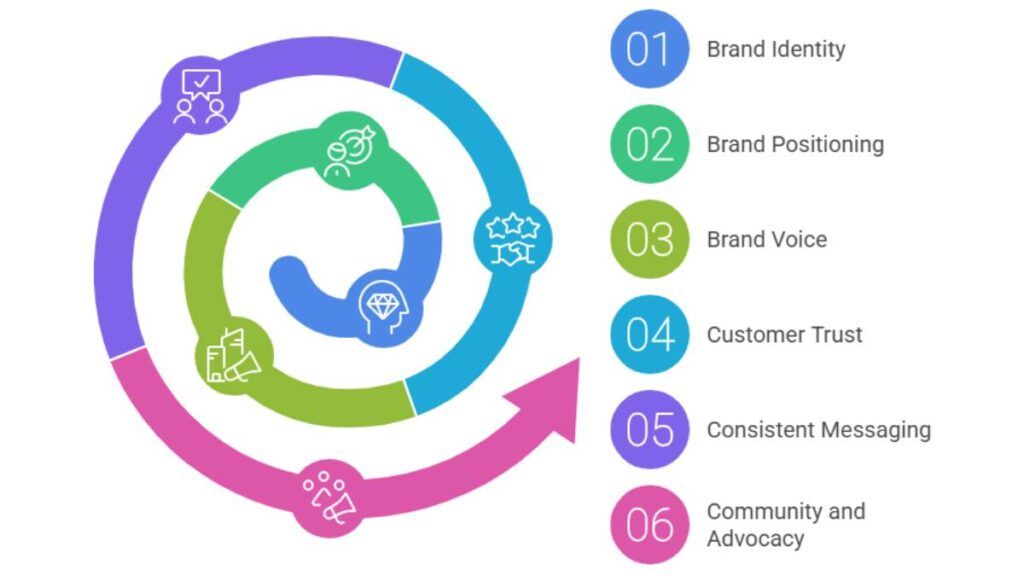
Brand Identity
This is the visual and sensory layer of the brand:
- logo
- typography
- color palette
- design system
- imagery
- visual style
But identity goes deeper than aesthetics.
Certain brands feel premium instantly. Others feel approachable, technical, minimalist, playful, or authoritative. That emotional perception starts forming within seconds.
Strong identities create familiarity fast.
Brand Positioning
Positioning defines what the brand stands for and why people should care.
Weak positioning sounds broad and generic:
“solutions for modern businesses.”
Strong positioning feels specific:
“financial software for independent creators.”
Specificity tends to create stronger recall because people immediately understand who the brand is for.
And in crowded markets, clarity often beats cleverness.
Brand Voice
Voice shapes personality.
Some brands communicate like educators. Others sound sharp, witty, calm, opinionated, analytical, or conversational. The tone itself becomes recognizable over time.
The important part is consistency.
A brand that sounds corporate on its website, trendy on social media, and robotic in email campaigns usually feels fragmented. Customers notice that disconnect, even subconsciously.
Customer Trust
Trust is probably the most valuable brand asset now. Maybe more valuable than reach in some industries.
People trust brands that:
- show expertise clearly
- communicate transparently
- maintain consistency
- deliver reliable experiences
- earn a positive reputation outside their own channels
Trust reduces hesitation. It shortens decision cycles, too.
Consistent Messaging
The strongest brands repeat core ideas constantly, just in different formats.
Not identical wording. Consistent themes.
Customers should understand what the company stands for, whether they discover it through YouTube, LinkedIn, newsletters, podcasts, search results, or community discussions.
Repetition builds memory.
Community and Advocacy
Modern brands grow faster when customers feel involved rather than marketed to.
Communities create:
- retention
- loyalty
- referrals
- user-generated content
- social proof
- emotional connection
And increasingly, communities become distribution engines themselves.
Some of the strongest brand growth today happens inside niche communities long before mainstream attention arrives.
Why Brand Building Matters More Than Ever
Google AI Overviews Are Changing Brand Discovery
Search behavior is changing quietly, but dramatically.
More users now get answers directly inside search results without clicking through multiple websites. AI-generated summaries compress information quickly, which means fewer opportunities for unknown brands to capture attention.
This creates an interesting problem.
When several websites publish similar information, AI systems tend to surface sources that already appear trustworthy or widely recognized. Familiar brands gain visibility more easily because they have stronger authority signals spread across the internet.
Smaller businesses often assume the issue is content quality alone. Sometimes it isn’t.
Sometimes the brand simply lacks recognition.
That’s why brand-building strategies now influence discoverability in ways many companies didn’t expect. Being technically correct is no longer enough. Brands need enough trust signals for platforms to feel confident referencing them.
And users behave similarly, honestly.
Most people skim fast. If a brand name feels unfamiliar or questionable, attention disappears almost instantly.
Strong Brands Get More Organic Traffic and Conversions
Recognition changes behavior.
Users click familiar brands more often. They trust pricing faster. They spend less time comparing alternatives because some level of confidence already exists before the landing page even loads.
That’s why branded search is such an important signal now.
Searches like:
- “best project management software”
and - “Asana pricing”
represent completely different levels of intent.
The second search usually converts better because the trust-building phase already happened earlier through content, community exposure, social proof, or repeated brand encounters.
Strong brands also tend to generate:
- higher click-through rates
- more direct traffic
- stronger referral traffic
- better customer retention
- lower acquisition costs over time
And there’s another advantage people don’t talk about enough: resilience.
Brands built purely on algorithmic reach often struggle when platforms change. Strong brands survive because customers intentionally seek them out.
That distinction matters more every year.
AI Content Saturation Has Increased the Value of Trust
The volume of content online has exploded.
And readers can feel it.
A lot of content today sounds technically polished but emotionally empty. It repeats common ideas without perspective, nuance, or real insight. After a while, everything starts blending together.
As that saturation increases, trust becomes a filter.
People naturally gravitate toward brands that feel credible, experienced, and grounded in reality. Content with actual perspective stands out because it feels harder to replicate.
That’s partly why:
- original research performs well
- founder-led content grows faster
- Expert commentary feels more valuable
- Case studies attract attention
- nuanced opinions outperform generic summaries
Readers are looking for signals that real expertise exists behind the content.
Not perfection. Just substance.
Sometimes, slightly imperfect communication actually feels more believable than overly polished messaging because it resembles how experienced people genuinely speak.
Modern Consumers Buy From Communities, Not Just Companies
Traditional advertising still works in some contexts, but communities increasingly shape trust before brands ever enter the conversation.
People now discover products through:
- Discord groups
- niche Slack communities
- Reddit discussions
- creator recommendations
- LinkedIn conversations
- YouTube audiences
- private newsletters
Community-driven discovery feels more credible because it comes from peers instead of direct brand messaging.
That shift is especially visible among younger audiences.
Consumers want interaction now. Participation. Transparency. They want brands that feel present rather than distant.
This explains why creator-led brands and community-first companies are growing so quickly.
Communities also create compounding effects:
- members generate content
- customers answer questions
- Discussions improve trust
- recommendations spread organically
And unlike rented audiences on social platforms, communities become long-term brand assets.
That difference matters a lot.
15 Best Brand Building Strategies for 2026
Build Entity Authority for AI Search
One of the biggest shifts happening right now is that search engines and AI systems no longer look at websites in isolation. They try to understand brands as entities. Real businesses with reputation, relationships, context, and authority across the internet.
That changes how brand visibility works.
A few years ago, a company could rank simply by publishing heavily optimized content around keywords. In 2026, visibility is much more connected to recognition. If a brand appears consistently across trusted platforms, industry conversations, media mentions, podcasts, social profiles, communities, and educational content, search systems begin treating that brand as credible.
And honestly, users do the same thing.
When people repeatedly encounter a company name across multiple channels, trust forms gradually in the background. Even before the first conversion touchpoint.
Entity authority is essentially digital reputation at scale.
Brands building strong entity signals usually focus on consistency:
- same brand positioning everywhere
- consistent founder visibility
- clear company descriptions
- unified messaging across channels
- accurate business information
- Repeated topical association within one niche
This is where structured data, schema markup, author pages, and organization signals quietly become important. They help search systems connect all those fragmented signals together.
But technical implementation alone is not enough. A business cannot “schema markup” its way into authority if nobody talks about the brand outside its own website.
The strongest entity-driven brands tend to dominate specific conversations repeatedly. Over time, platforms begin associating them with expertise in that category.
And once that happens, discoverability becomes much easier.
Create Topical Authority Content Clusters
Publishing random content rarely builds a strong brand anymore.
What works better now is depth.
Brands growing steadily usually focus on owning a narrow set of topics extremely well instead of chasing every possible keyword or trend. There’s a noticeable difference between a company that publishes scattered content and one that becomes genuinely associated with a category.
That association matters more than traffic spikes.
Topical authority happens when a brand consistently creates valuable content around connected subjects. Over time, audiences start viewing that company as a trusted source within a niche.
For example, a SaaS brand targeting ecommerce founders might build entire content ecosystems around:
- customer retention
- conversion optimization
- email marketing
- subscription growth
- customer lifetime value
Not surface-level articles either. Deep resources.
This approach creates stronger memory structures around the brand because audiences repeatedly encounter expertise within one domain.
It also improves internal content flow naturally. Pillar pages connect to supporting content. Supporting content reinforces broader themes. Readers spend more time exploring because the information architecture feels intentional instead of fragmented.
There’s another reason this works especially well now.
Generic content has exploded. Most industries are flooded with repetitive summaries that say essentially the same thing. Brands creating original thinking immediately stand out because genuine expertise still feels surprisingly rare online.
Best Content Types for Brand Authority
Certain content formats consistently build stronger authority than others because they contain perspective, interpretation, or evidence instead of recycled information.
Original research works particularly well because it creates unique data points that other people reference later. Even small industry surveys or customer trend reports can position a company as a source instead of just another publisher.
Case studies are equally powerful. Not polished marketing fluff, but detailed breakdowns showing real challenges, decisions, and outcomes. Readers trust specifics.
Expert guides also continue to perform well because audiences want depth now. Surface-level explainers rarely create memorable brand perception anymore.
Comparison content matters too, especially in crowded industries. Buyers actively compare alternatives before making decisions, and brands that help simplify those evaluations often build trust faster.
Industry trend reports are another underrated authority asset. They position brands slightly ahead of the conversation rather than reacting to it after everyone else.
The common thread across all these formats is simple: they add interpretation, not just information.
That difference is becoming incredibly important.
Invest in Community-Led Brand Building
Communities are slowly replacing audiences.
That sounds dramatic at first, but the shift is visible almost everywhere now. Followers alone don’t create durable brand relationships anymore. Engagement spikes come and go. Algorithms change constantly. Reach disappears overnight.
Communities behave differently.
When people actively participate inside a brand ecosystem, they develop emotional investment. They interact with each other, not just with the company. That creates stickiness that traditional marketing struggles to replicate.
Some brands are building private Slack groups. Others run Discord servers, niche LinkedIn communities, educational membership spaces, or customer-only forums. The format matters less than the feeling of belonging.
And importantly, communities generate conversations brands cannot manufacture through advertising alone.
Customers answer questions for each other. Members share experiences. People recommend products organically. Discussions surface insights that the marketing team would never discover independently.
That kind of interaction builds trust naturally because it feels peer-driven rather than promotional.
Communities also solve a growing distribution problem.
Organic reach across major platforms continues to become less predictable. Owned communities give brands direct access to their audience without relying entirely on social algorithms.
In many ways, communities are becoming modern brand moats.
Especially for younger audiences who increasingly value participation over passive consumption.
Build a Creator-Led Marketing Ecosystem
Influencer marketing used to feel transactional. A sponsored post here, a paid collaboration there, maybe a discount code attached at the end.
That model still exists, but it’s losing effectiveness fast.
Audiences have become much better at recognizing shallow creator partnerships. When a collaboration feels forced, trust disappears immediately. Sometimes it even damages the brand.
The companies building stronger awareness in 2026 are approaching creators differently. Less like ad inventory, more like long-term ecosystem partners.
That shift changes the quality of attention completely.
Micro creators, especially niche experts with highly engaged audiences, often outperform celebrity-scale influencers now. Their communities trust them more deeply because the relationship feels less commercialized.
And honestly, smaller creators usually produce more authentic conversations around products.
Another major trend is the rise of employee creators and founder creators. People trust humans more than logos. That’s becoming increasingly obvious across LinkedIn, YouTube, newsletters, and short-form video platforms.
Brands that encourage internal voices often build a stronger emotional connection because audiences can actually see the people behind the business.
The important part is consistency.
Creator-led ecosystems work best when partnerships evolve over time. Repeated exposure builds familiarity. Familiarity builds trust.
One-off campaigns rarely create lasting brand equity anymore.
Focus on Brand Search Demand
One of the clearest indicators of brand strength is simple: people searching specifically for the company by name.
Branded search demand reflects recognition. It means the brand already exists in the customer’s mind before the search even begins.
That changes conversion behavior significantly.
Users searching for generic terms are still exploring options. Users searching branded terms usually have some level of pre-existing trust or curiosity. They’ve encountered the company somewhere else already:
- social content
- YouTube
- podcasts
- communities
- newsletters
- referrals
- events
- creator mentions
This is why demand generation matters so much now.
The strongest brands don’t rely entirely on capturing existing intent. They create intent proactively through visibility, education, community presence, and repeated exposure.
And there’s an interesting side effect here.
As branded search volume increases, overall digital authority often strengthens too. Search systems interpret branded behavior as a signal of relevance and recognition.
But beyond algorithms, branded demand creates resilience.
A company heavily dependent on non-branded traffic remains vulnerable to platform shifts. Brands people intentionally seek out operate from a much stronger position long term.
Create AI-Optimized Brand Content
Content formatting is changing because search behavior is changing.
People increasingly want answers quickly. Clear summaries. Structured information. Scannable insights. That doesn’t mean long-form content is dying, far from it, but readability matters much more now.
The brands performing well in AI-driven discovery environments usually structure content in ways that make understanding easier:
- concise definitions
- direct explanations
- clear formatting
- FAQ sections’
- logical hierarchy,
- simple language where possible
Not because audiences are less intelligent. Attention is just fragmented.
Dense walls of text without structure lose readers faster than before.
There’s also growing importance around answer-oriented content. Brands that directly address common customer questions tend to gain more visibility because their information is easier for systems and users to interpret.
That includes:
- practical guides
- comparison pages
- educational explainers
- detailed FAQs
- concise summaries
- real examples
Scannability matters too.
Readers skim heavily before deciding whether deeper attention is worth giving. Good formatting helps information feel approachable instead of exhausting.
And honestly, that’s becoming part of modern brand perception itself. Clear communication signals competence.
Build Trust Through Digital PR
Trust often grows faster when other people talk about the brand first.
That’s why digital PR continues becoming more valuable.
When a company gets mentioned in respected publications, industry newsletters, podcasts, interviews, expert roundups, or creator discussions, those references function as credibility signals. They create external validation.
And external validation carries more weight than self-promotion.
Brands investing in digital PR strategically usually focus less on vanity press coverage and more on relevance. A niche industry podcast can sometimes build more trust than a massive publication mention because the audience alignment is stronger.
Podcast appearances, especially founder interviews or educational discussions, work particularly well right now because they create long-form trust. Audiences hear expertise directly instead of consuming polished ad messaging.
Expert quotes and commentary also matter more than many businesses realize. Journalists, creators, and researchers constantly look for credible voices to reference. Brands consistently contributing useful insights gradually become associated with authority.
Over time, these mentions compound.
Search engines notice them. AI systems notice them. More importantly, people notice them.
Use Short-Form Video for Brand Awareness
Short-form video has become one of the fastest ways to build familiarity online.
Not necessarily because every video goes viral. Most don’t. But repeated face-led exposure creates recognition surprisingly quickly.
People remember personalities far more easily than logos.
Educational short-form content works especially well because it combines usefulness with visibility. Quick insights, breakdowns, commentary, tutorials, reactions, industry opinions- these formats build audience trust over time when done consistently.
And audiences increasingly prefer learning this way.
TikTok, Instagram Reels, and YouTube Shorts have changed how people consume expertise. Short videos often become discovery engines before users ever visit a website.
The brands succeeding here usually avoid overproduction. Highly polished content sometimes performs worse because it feels overly corporate or scripted.
Simple communication often works better:
- direct explanations
- strong hooks
- practical insights
- recognizable faces
- conversational delivery
There’s also growing evidence that face-led content builds stronger trust than faceless brand publishing alone. Audiences connect with humans first.
Especially in crowded industries where products themselves look increasingly similar.
Develop a Strong Founder Brand
Founder branding is no longer optional in many industries.
That may sound uncomfortable for some companies, but audiences consistently trust visible experts more than anonymous businesses. Especially online.
A founder with clear opinions, recognizable expertise, and consistent visibility often becomes the trust bridge between the audience and the company itself.
This is happening heavily on LinkedIn right now. Founder-led content routinely outperforms traditional corporate posting because it feels more human and less filtered.
And honestly, people want perspective.
Not polished corporate statements. Actual thinking.
Founders who share:
- industry observations
- lessons learned
- strategic insights
- behind-the-scenes decisions
- nuanced opinions
usually build a stronger audience connection over time.
That visibility compounds into broader brand recognition, too.
Customers remember people more easily than organizations. When the founder becomes associated with expertise, trust extends naturally toward the business.
Of course, founder branding only works when the content feels genuine. Forced thought leadership is painfully obvious now.
Audiences can tell the difference immediately.
Build Omnichannel Brand Consistency
Modern customer journeys are fragmented.
Someone might discover the brand through YouTube, check LinkedIn later, visit the website weeks afterward, subscribe to the newsletter months later, and finally convert after seeing a podcast clip somewhere else.
That means consistency matters more than ever.
Not identical messaging everywhere. Consistent identity.
The strongest brands maintain recognizable positioning across every touchpoint:
- website
- social channels
- email campaigns
- videos
- events
- landing pages
- community spaces
Customers should feel like they’re interacting with the same company regardless of platform.
Inconsistent branding creates friction because trust weakens when messaging changes too dramatically between channels.
Visual consistency matters too:
- typography
- colors
- design language
- imagery
- tone
- communication style
All these details shape memory subconsciously. Offline branding materials also contribute to omnichannel consistency, which is why many businesses rely on the best printing services in the USA for professionally branded marketing materials and event displays.
Channels Every Brand Should Prioritize
LinkedIn remains one of the strongest platforms for authority building, especially in B2B industries. Thoughtful expertise still performs well there despite increasing noise.
YouTube continues becoming a long-term trust engine because depth compounds over time. Educational content has a remarkable shelf life when executed well.
TikTok drives awareness quickly, particularly among younger audiences, though brands need native-style communication to succeed there.
Email newsletters remain valuable because they create owned audience relationships independent of algorithms.
Communities are increasingly becoming essential because they strengthen retention, advocacy, and direct audience connection.
The key is not being everywhere blindly. It’s maintaining a recognizable presence where the audience already spends attention.
Leverage User-Generated Content (UGC)
Customers trust other customers.
That’s probably always been true, but it feels even more important now because audiences are increasingly skeptical of polished brand messaging.
User-generated content works because it feels less controlled.
Reviews, testimonials, customer videos, tagged social posts, community discussions, and real product experiences create social proof naturally. They show how actual people interact with the brand outside official marketing environments.
And importantly, UGC creates relatability.
Prospective customers often trust imperfect customer content more than professionally produced campaigns because authenticity signals are stronger.
Brands benefiting most from UGC usually encourage participation actively:
- customer spotlights
- reposted community content
- shared success stories
- collaborative campaigns
- audience challenges
- feedback loops
This type of content also strengthens community feeling because customers feel acknowledged rather than treated like transactions.
And over time, that participation deepens loyalty.
Build Brand Loyalty Through Experiences
Digital branding matters, but physical and emotional experiences still shape memory more deeply than most online interactions.
That’s partly why experiential branding is growing again.
Offline events, workshops, pop-ups, meetups, private dinners, creator gatherings, and hybrid community experiences create stronger emotional connection because they involve participation rather than passive consumption.
People remember experiences differently.
Even smaller-scale events can strengthen brand loyalty significantly when they create meaningful interaction. Especially for Gen Z audiences who increasingly value community identity and shared experiences over traditional advertising.
The strongest experiential brands focus less on spectacle and more on connection.
Sometimes, a highly curated niche event builds more loyalty than a massive conference because the environment feels more personal.
Hybrid experiences are growing, too. Online communities combined with offline gatherings create stronger relationships because digital familiarity transfers into real-world trust.
That blend works extremely well for modern brand building.
Prioritize First-Party Data and Owned Audiences
Relying entirely on rented attention is becoming risky.
Social platforms change algorithms constantly. Reach fluctuates. Audience access can disappear overnight. Brands building sustainable growth understand this problem early.
That’s why owned audiences matter more than ever now.
Email lists, private communities, SMS subscribers, membership ecosystems, customer databases- these channels create direct relationships independent of platform volatility.
And owned audiences usually convert better because trust already exists.
The strongest brands treat audience ownership strategically. Instead of optimizing only for impressions or followers, they focus on moving audiences into deeper relationship layers over time.
That progression might look like:
social discovery → newsletter subscription → community participation → customer loyalty.
Every step increases relationship durability.
There’s another advantage too.
Owned audiences create better customer understanding because interactions become more direct. Brands gain clearer insight into behavior, feedback, interests, and retention patterns.
That information becomes incredibly valuable long term.
Use Data and AI for Personalized Branding
Personalization expectations are rising quickly.
Audiences increasingly expect brands to understand context, preferences, behavior, and intent. Generic messaging feels less effective because consumers are constantly exposed to tailored experiences elsewhere online.
But good personalization is subtle.
The goal is not aggressive hyper-targeting that feels invasive. The best personalized branding simply makes interactions feel more relevant and thoughtful.
That can include:
- customized recommendations
- behavior-based email flows
- tailored onboarding experiences
- dynamic website messaging
- audience-specific content
- predictive engagement strategies
The important part is maintaining human relevance inside automation systems.
Some brands over-personalize and accidentally create mechanical experiences. Customers notice when interactions feel algorithmically assembled instead of genuinely useful.
Strong personalization improves customer experience quietly in the background without making the audience overly aware of the process itself.
That balance matters.
Monitor Brand Reputation Across AI Platforms
Brand reputation management now extends beyond social listening and review monitoring.
AI-generated discovery systems increasingly shape public perception too. People ask platforms for recommendations, comparisons, summaries, and evaluations before making decisions.
Which means brands need visibility into how they are represented across these systems.
Sometimes, incorrect information spreads quietly. Sometimes, outdated positioning appears repeatedly. Sometimes competitor narratives dominate because the brand itself lacks enough authoritative presence online.
Reputation monitoring now involves understanding:
- how the brand appears in AI-generated responses
- What sources are influencing those responses
- whether sentiment remains positive
- Which narratives are becoming associated with the company
This is especially important during crises or reputation-sensitive situations because misinformation can compound quickly once systems begin repeating it.
The brands managing this well usually focus on strengthening overall authority signals consistently rather than reacting only when problems appear.
And honestly, that’s probably the bigger lesson across all modern brand-building strategies.
Strong brands are not built through isolated campaigns anymore.
They’re built through sustained trust, repeated visibility, community presence, expertise, and consistent recognition across the entire digital ecosystem.

Enroll Now: Brand Management course
Common Brand Building Mistakes to Avoid
Inconsistent Brand Messaging
One of the fastest ways to weaken a brand is inconsistency.
Not just visual inconsistency, though that matters too. Messaging inconsistency is usually the bigger problem. A company sounds premium on its website, casual on Instagram, overly corporate in email campaigns, then completely trend-chasing on short-form video platforms. Customers notice the disconnect, even if they can’t explain it directly.
Strong brands feel familiar everywhere.
That familiarity creates trust because people know what to expect. When messaging constantly shifts depending on the platform or campaign, the brand starts feeling reactive instead of intentional.
This happens a lot with growing companies. Different teams handle different channels, agencies push separate creative directions, and eventually the brand loses its core identity somewhere in the process.
The solution usually isn’t stricter corporate language. In fact, overly rigid branding often creates another problem entirely. What matters is alignment:
- same core positioning
- same values
- same tone direction
- same audience understanding
- same overall personality
Customers should feel like they’re interacting with one coherent brand, not five disconnected versions of it.
Consistency compounds quietly over time. So does inconsistency.
Chasing Virality Instead of Trust
A lot of brands are optimizing for attention without thinking enough about what kind of attention they’re attracting.
Virality can create reach, sure. But reach alone doesn’t build brand equity.
There are companies generating millions of views while remaining completely forgettable. Audiences engage with the content briefly, laugh maybe, then move on without remembering the brand behind it.
That’s the danger of trend-first marketing.
When every campaign is built around short-term spikes, the brand slowly loses clarity. Customers stop understanding what the company actually stands for because messaging changes every week, depending on whatever format is currently popular.
Strong brands play a longer game.
That doesn’t mean avoiding creativity or cultural relevance. It means filtering trends through the brand instead of abandoning the brand for trends.
Trust builds through repetition, reliability, and recognizable positioning. Virality rarely creates those things on its own.
And honestly, some brands damage their reputation trying too hard to appear relatable online. Forced humor, unnecessary controversy, over-manufactured “authenticity”… audiences can usually tell when it’s performative.
The internet rewards attention quickly. Trust takes longer.
But trust tends to last.
Ignoring Community Building
Many businesses still treat audiences like passive viewers instead of participants.
That mindset is becoming outdated fast.
Modern consumers want interaction. They want spaces to discuss ideas, ask questions, share experiences, and connect with other people who care about similar things. Brands ignoring this shift often struggle to build loyalty because the relationship remains purely transactional.
Community building doesn’t always mean launching a massive Discord server or private membership group. Sometimes it starts smaller:
- responding thoughtfully to customers
- creating conversations instead of announcements
- encouraging participation
- spotlighting audience voices
- building niche spaces around shared interests
The important part is making customers feel involved rather than being constantly marketed to.
Communities create emotional investment. That investment changes customer behavior significantly. People stay longer, recommend the brand more often, defend it publicly during criticism, and contribute ideas voluntarily.
Without community, many brands end up dependent entirely on paid distribution and algorithmic reach.
That’s a fragile position long-term.
Overusing Generic AI Content
The internet is flooded with content that technically says the right things while saying almost nothing memorable at all.
Readers feel this fatigue now.
A lot of brand content sounds interchangeable because it follows the same structure, same phrases, same recycled insights. Everything becomes polished, optimized, and strangely empty at the same time.
And audiences are becoming much better at detecting that emptiness.
The problem isn’t AI itself. The problem is publishing content without perspective, experience, or interpretation. Generic content rarely builds trust because it lacks specificity. It feels detached from reality.
Strong brands inject human judgment into their content:
- nuanced opinions
- practical observations
- original frameworks
- industry context
- actual experience
- clear points of view
Slight imperfections often help too. Real expertise usually sounds more conversational and layered than perfectly sanitized corporate messaging.
Customers don’t just want information anymore. Information is everywhere.
They want insight.
Focusing Only on Followers Instead of Brand Equity
Follower counts can be misleading.
Some brands build massive social audiences while generating very little trust, loyalty, or customer retention underneath the surface. Others grow smaller but highly engaged communities that drive consistent revenue and a strong reputation over time.
Brand equity is deeper than visibility metrics.
It includes:
- customer trust
- recall
- reputation
- emotional connection
- perceived authority
- community loyalty
- direct brand demand
Those signals matter more than vanity growth numbers.
This is especially important because social reach is increasingly unstable. A brand built entirely around follower metrics can lose momentum quickly when algorithms shift or engagement patterns change.
Strong brand equity creates resilience because customers actively seek the company out regardless of platform conditions.
And honestly, some businesses become too obsessed with looking popular instead of becoming genuinely respected.
Those are very different goals.
Neglecting Brand Search and Reputation Management
Brand perception now forms long before a sales conversation ever happens.
People search company names constantly:
- reviews
- Reddit discussions
- founder reputation
- customer complaints
- comparisons
- community feedback
- social mentions
If a business ignores these conversations, perception gets shaped anyway, just without the company participating in it.
Reputation management isn’t only crisis control anymore. It’s ongoing brand maintenance.
Strong brands actively monitor:
- how customers describe them
- where conversations are happening
- What narratives are spreading
- whether sentiment remains positive
- How visible they are across platforms
This becomes even more important in AI-driven discovery environments because systems increasingly summarize public perception from existing information online.
Brands with weak reputation signals often struggle with visibility later because trust gaps become embedded into the broader digital narrative surrounding the company.
And rebuilding trust always takes longer than protecting it early.
Brand Building Trends Shaping 2026 and Beyond
AI Search Will Reward Trusted Brands Over Websites
One of the clearest shifts happening right now is that platforms are prioritizing trust signals over pure content volume.
For years, businesses could compete aggressively through publishing scale alone. More articles. More pages. More keyword coverage. That approach still matters to some extent, but it’s losing effectiveness when every industry is saturated with similar information.
Search systems increasingly evaluate credibility beyond the website itself.
That means:
- Brand mentions matter more
- expertise matters more
- consistent positioning matters more
- Public reputation matters more
- Real authority matters more
In practical terms, recognizable brands have an advantage because trust already exists before discovery even happens.
Smaller businesses can still compete, obviously. But the winning strategy now looks different. Narrow expertise, strong positioning, and deep authority within a specific category often outperform broad generic publishing.
The internet is moving toward reputation-driven visibility.
That trend is probably only getting stronger.
Communities Will Replace Traditional Audiences
Audiences consume and communities participate.
That distinction changes everything.
Traditional digital marketing treated attention as the primary goal. Build a following, increase impressions, maximize reach. But passive attention is becoming less valuable because platforms are overcrowded and engagement is fragmented.
Communities create stronger relationships because people interact with each other, not just with the brand.
This is why more companies are investing in:
- private groups
- niche forums
- membership ecosystems
- educational communities
- creator-led spaces
- customer networks
These environments generate loyalty differently. Customers feel connected to something larger than a product itself.
And importantly, communities become owned assets. Brands no longer rely entirely on algorithmic distribution when they have direct audience ecosystems.
That shift is massive.
The strongest modern brands increasingly behave like networks instead of traditional advertisers.
Founder-Led Brands Will Continue Growing
People trust people more than logos.
That reality keeps shaping modern branding strategies across almost every industry.
Founder-led brands work because audiences want visible expertise, personality, and perspective. Anonymous corporate messaging feels distant now, especially online, where attention spans are short, and skepticism is high.
Founders who consistently share:
- industry insights
- opinions
- lessons
- commentary
- educational content
- behind-the-scenes thinking
often build trust much faster than traditional corporate branding alone.
And there’s another layer here.
Founder visibility humanizes the company. Customers feel like they understand the people behind the business, which lowers psychological distance significantly.
This doesn’t mean every founder needs to become a full-time content creator. Forced personal branding usually backfires.
But visible leadership matters more than it used to. Especially in industries built heavily around trust and expertise.
Video-First Branding Will Dominate
Text still matters. Long-form content still matters too. But video is becoming the default discovery format for a huge percentage of online users.
Especially younger audiences.
Short-form platforms changed consumption behavior dramatically. People increasingly expect fast, visual, personality-driven communication. Brands that rely only on static content are becoming less memorable in crowded digital environments.
Video creates familiarity quickly because audiences process facial expressions, tone, pacing, emotion, and personality simultaneously.
That creates stronger memory structures.
Educational video performs especially well because it combines utility with visibility. Viewers learn while also forming subconscious impressions about expertise and credibility.
And interestingly, lower-production content often performs better than highly polished campaigns because it feels more immediate and authentic.
The polished corporate aesthetic is losing some of its effectiveness online.
People respond more naturally to communication that feels direct and human.
Brand Authority Will Matter More Than Backlinks
Backlinks still matter, of course. But authority is becoming broader than link acquisition alone.
Brands gaining long-term visibility are building reputation ecosystems:
- media mentions
- creator references
- podcast appearances
- community discussions
- customer advocacy
- branded search demand
- topical expertise
- educational content
Authority now behaves more like cumulative trust than technical optimization.
This changes how companies should think about growth.
A brand consistently referenced by industry experts, communities, newsletters, podcasts, and creators develops stronger perceived legitimacy over time, even beyond traditional ranking factors.
That perception influences both users and discovery systems.
And honestly, many businesses still underestimate how much real-world reputation affects digital performance now.
Human Experience Content Will Outperform Generic AI Content
The more automated content becomes, the more valuable human experience becomes.
That trend is already visible.
Audiences increasingly gravitate toward content containing:
- real observations
- nuanced opinions
- practical lessons
- specific examples
- contextual thinking
- emotional realism
Generic informational content is becoming commoditized because everyone can produce it quickly now.
What remains difficult to replicate is perspective.
Brands that communicate with depth, personality, and genuine understanding stand out immediately because the internet is filled with technically correct but emotionally flat material.
This doesn’t mean content needs to become casual or unprofessional. Expertise still matters enormously.
But expertise communicated naturally tends to outperform sterile corporate writing because readers trust voices that sound grounded in actual experience.
People want substance now. Not just information.
How to Measure Brand Building Success
Brand Awareness Metrics
Brand awareness is often misunderstood because businesses try to measure it only through reach numbers.
Reach matters, but awareness runs deeper than impressions.
One of the strongest signals is branded search volume. When people search directly for the company name, products, founders, or branded terms, it usually indicates recognition already exists before discovery begins. That type of demand tends to compound over time because familiarity creates future recall.
Direct traffic is another important indicator. If more users navigate straight to the website instead of discovering it passively through platforms, it often reflects stronger brand memory.
Share of voice matters too, especially within competitive industries. Brands should understand how frequently they appear in relevant conversations compared to competitors. Not just in search results, but across social discussions, media mentions, podcasts, communities, newsletters, and creator ecosystems.
Awareness becomes more meaningful when the audience remembers the brand independently instead of only reacting to temporary visibility spikes.
That distinction matters.
Brand Engagement Metrics
Engagement metrics reveal whether audiences actually care about the brand or simply notice it briefly.
Community participation is one of the clearest signals here. Active discussions, repeat interactions, customer contributions, and audience-driven conversations usually indicate stronger emotional investment.
Social mentions also provide useful insight, especially unprompted mentions. When people reference the brand organically in discussions without direct campaigns driving the conversation, that often reflects growing relevance within the market.
User-generated content is another powerful indicator because customers rarely create content around brands they feel disconnected from. Reviews, tagged posts, tutorials, testimonials, reaction videos, and community storytelling all suggest deeper engagement levels.
And honestly, engagement quality matters more than raw volume now.
A smaller but highly involved audience is often more valuable long-term than massive passive reach.
Brand Trust Metrics
Trust is harder to measure directly, but there are usually clear signals underneath it.
Customer reviews still matter heavily because they shape first impressions quickly. Consistent positive feedback across platforms reinforces credibility while repeated complaints often create long-term perception problems if ignored.
Retention rates are equally important. Strong brands typically retain customers longer because trust reduces switching behavior. Loyalty reflects emotional connection as much as product satisfaction.
Net Promoter Score, while imperfect, can still provide useful directional insight into customer advocacy. Brands with high recommendation willingness usually have stronger emotional equity in the market.
Sentiment analysis also matters increasingly now. Understanding how customers describe the brand publicly helps companies identify whether perception aligns with intended positioning.
Sometimes there’s a surprising gap there.
A company may believe it’s perceived as premium while customers consistently describe it as affordable, fast, beginner-friendly, or something else entirely.
Those perception gaps are important to catch early.
AI Visibility Metrics
AI-driven discovery is creating entirely new visibility categories.
Brands now need to monitor whether they appear in AI-generated recommendations, summaries, and industry discussions across platforms. Visibility inside these systems increasingly shapes awareness before users even visit websites directly.
AI citation tracking is becoming especially important because it reveals whether platforms consider the brand authoritative enough to reference consistently.
Google AI Overview mentions matter too. Brands frequently surfaced within these summaries often benefit from stronger perceived credibility because users associate repeated visibility with trustworthiness.
LLM visibility tracking is still evolving, but it’s quickly becoming relevant for reputation management and discoverability. Businesses need to understand:
- how their brand is represented
- which narratives are appearing
- whether information remains accurate
- How competitors are positioned comparatively
This area will probably become much more important over the next few years as AI-driven search behavior expands further.
And honestly, many companies are still underestimating how quickly that shift is happening.
Best Tools for Brand Building
Brand Monitoring Tools
Strong brands pay attention to perception constantly. Not obsessively, but consistently enough to understand how the market sees them. That’s where monitoring tools become useful. They help brands spot trends early, track visibility, measure demand shifts, and understand whether awareness is actually growing or just appearing active on the surface.
Ahrefs remains valuable because it helps brands understand how often they’re being searched, mentioned, and linked across the web. More importantly, it reveals whether branded demand is increasing over time. That matters because direct brand interest usually signals growing recognition rather than temporary traffic spikes.
Semrush is useful for tracking competitive visibility and brand positioning across categories. Many companies underestimate how often they’re compared against competitors in search behavior and content ecosystems. Seeing those overlaps clearly can shape messaging decisions in a surprisingly practical way.
Google Analytics still matters because direct traffic tells an important story. If more users are visiting the website intentionally instead of discovering it passively, the brand is becoming memorable. Returning visitor behavior, time on site, and engagement patterns also reveal whether audiences genuinely trust the content or simply skim and leave.
The best brands rarely use these platforms just for reporting. They use them to understand audience behavior patterns, reputation shifts, and category perception in real time.
Community and Social Tools
Community-driven branding has become much more intentional over the past few years. Brands are no longer building audiences only for visibility. They’re trying to create participation, loyalty, and direct relationships outside algorithm dependency.
Discord has become surprisingly powerful for niche communities. Especially in creator-led industries, such as gaming, tech, education, and digital products. What makes Discord valuable is the depth of interaction. Conversations feel continuous instead of performative. Brands can build a real culture there if the community is managed well.
Slack communities work differently. They tend to attract more professional and industry-focused discussions. Many B2B brands use Slack spaces for networking, educational conversations, customer engagement, and member-driven support ecosystems. Smaller communities often perform better than massive inactive ones because interaction quality stays higher.
LinkedIn remains one of the strongest authority-building platforms. Not because organic reach is easy anymore, honestly, it isn’t, but because professional trust still compounds there faster than on most platforms. Founder-led content, expert commentary, industry observations, and educational insights continue performing well when they feel thoughtful instead of manufactured.
What matters across all these platforms is consistency. Communities lose momentum quickly when brands appear only during launches or campaigns. Sustained interaction builds stronger long-term equity.
AI and Content Optimization Tools
Perplexity is becoming increasingly useful for understanding how information gets surfaced and summarized across modern search experiences. Brands can observe how categories are interpreted, which sources appear most frequently, and how authority signals influence visibility. That perspective helps companies identify gaps in positioning and content clarity.
ChatGPT has changed how many users discover information, compare solutions, and evaluate brands. Businesses paying attention to conversational search behavior are beginning to understand that discoverability now depends heavily on reputation, clarity, and consistent topical authority across the web.
Gemini plays a similar role in shaping discovery behavior through AI-assisted search experiences. As these systems become more integrated into everyday browsing, brands need to think beyond rankings alone. Visibility increasingly depends on whether platforms perceive the company as credible enough to reference confidently.
The important thing here is not chasing every new platform blindly. Most tools are only useful when paired with clear brand positioning and strong customer understanding. Technology amplifies clarity. It rarely fixes weak branding on its own.
Final Thoughts on Brand Building Strategies
Brand building looks very different from what many companies were taught a decade ago.
It’s no longer only about logos, ad campaigns, or polished brand guidelines sitting untouched inside presentation decks. Those things still matter, obviously, but they are no longer enough to create durable attention in crowded markets.
Modern brand growth is built through recognition, trust, consistency, and repeated exposure across multiple environments.
People discover brands differently now. They encounter companies through AI-generated summaries, creator recommendations, podcasts, communities, YouTube videos, LinkedIn discussions, Reddit threads, newsletters, and short-form content long before they ever visit a homepage.
That means perception forms everywhere.
And honestly, that’s why authority has become such a powerful competitive advantage. Brands that consistently appear credible across platforms tend to outperform businesses relying only on aggressive acquisition tactics or short-term traffic strategies.
Trust compounds.
So does familiarity.
The strongest brands today usually combine several things well at the same time:
- educational content
- community building
- creator partnerships
- founder visibility
- customer experience
- clear positioning
- strong reputation management
Not perfectly. But consistently enough that customers begin associating the company with expertise and reliability naturally.
Another important shift is that audiences are becoming more selective. Generic messaging gets ignored faster now because people are overwhelmed with content. Brands that communicate with specificity, clarity, and actual perspective stand out immediately.
Human signals matter more again.
Real expertise matters more.
Clear positioning matters more.
Reputation matters more.
And maybe that’s the bigger takeaway from all of this.
Brand building is no longer a separate marketing function sitting beside growth. It is growth. The companies winning long term are the ones becoming recognizable before customers are ready to buy.
Because when buying intent finally appears, familiar brands usually win.
FAQs:
What are the best brand-building strategies?
The brands growing fastest right now usually aren’t the loudest ones. They’re the ones people remember later. Big difference. In 2026, strong brand building comes down to trust, repeated visibility, recognizable positioning, and actual authority in a niche. Creator partnerships help. Community helps even more. So does showing up consistently across platforms without sounding like a completely different company everywhere.
How long does it take to build a strong brand?
Longer than most founders expect, honestly.
Awareness can happen fast sometimes. Trust doesn’t. A real brand usually gets built through repetition. Customers seeing the company multiple times, hearing other people mention it, having good experiences consistently… that’s what compounds. Most strong brands look “suddenly successful” from the outside, but the groundwork was usually happening quietly for years.
What is the difference between branding and marketing?
Marketing gets attention. Branding shapes memory.
That’s probably the simplest way to explain it. Marketing pushes campaigns, traffic, reach, offers, visibility. Branding is what stays behind after all of that. It’s the feeling people attach to a company. The assumptions they make. The level of trust they have before buying. Good marketing gets clicks. Strong branding reduces hesitation.
How do brands rank in Google AI Overviews?
Google seems to favor brands it already understands and trusts. That trust gets built through consistent signals across the internet, not just one website trying to rank pages. Strong content matters, obviously, but so do mentions, expertise, reviews, founder credibility, industry references, and overall reputation. Brands with scattered positioning usually struggle because search systems can’t confidently categorize them.
What is entity authority in SEO?
Entity authority is basically how clearly search engines understand a brand as a real, established thing. Not just a website publishing content. A recognizable company with expertise, reputation, and consistent associations. That comes from repeated mentions, branded searches, media coverage, structured information, and strong topical consistency across different platforms over time.
Why is community building important for branding?
Communities create attachment in a way traditional audiences usually don’t.
People stay loyal when they feel involved. When conversations happen around the brand instead of only broadcasts from the brand. That’s why communities work so well now. Customers begin connecting with each other too, not just the company. And once that happens, retention, referrals, and trust tend to increase naturally.
How can small businesses build brand awareness?
Smaller brands usually grow faster when they stop trying to look “big” and start trying to look clear.
Niche positioning helps a lot. So does consistency. A focused brand with a recognizable voice and useful content often outperforms a generic company spending heavily on ads. Founder visibility helps too, especially early on. People trust people before they trust logos most of the time.
What role does AI play in brand building?
AI is changing discovery more than branding itself.
People now encounter brands through summaries, recommendations, generated answers, and conversational search experiences instead of only traditional results pages. That means reputation matters more. Clarity matters more, too. Brands with weak authority signals or inconsistent messaging tend to disappear faster in these environments.
How important is personal branding for founders?
More important than many companies want to admit.
People naturally trust visible expertise more than faceless corporate messaging. A founder consistently sharing thoughtful ideas, industry observations, or practical knowledge can accelerate trust for the entire company. Doesn’t mean every founder needs to become an influencer, though. Forced personal branding usually feels obvious… and audiences pick up on that quickly.
How do you create a successful brand positioning strategy?
Good positioning usually starts with specificity.
The strongest brands know exactly who they help, what problem they solve, and why they’re different. Sounds simple, but most companies stay too broad because narrowing focus feels risky early on. Ironically, broad positioning often makes brands easier to ignore. Clarity tends to outperform versatility in crowded markets.
What are the most effective digital brand-building strategies?
Right now, the strongest digital strategies combine educational content, creator collaborations, community interaction, short-form video, and consistent messaging. But the real differentiator is usually depth. Brands repeating surface-level advice everywhere blend together quickly. The companies building authority are the ones bringing perspective, not just publishing content constantly.
How can social media help in brand building?
Social media builds familiarity through repetition. That’s the real value.
Customers rarely buy after one interaction anyway. They watch for a while first. Social platforms give brands multiple chances to stay visible, show personality, share expertise, and build trust gradually. The brands performing best usually feel consistent and human, not overly polished or aggressively promotional all the time.
What is a brand identity, and why is it important?
Brand identity is the combination of visuals, messaging, tone, personality, and overall perception attached to a company. It’s how people recognize the brand instantly across different platforms. Strong identity creates familiarity. Weak identity creates confusion. And confused brands rarely stay memorable for very long, especially online, where attention moves fast.
How do you measure brand awareness and brand equity?
Branded search volume is a strong signal. Direct traffic, too. Social mentions, customer referrals, returning visitors… all useful indicators. But brand equity goes deeper than visibility metrics. It shows up in trust, loyalty, retention, pricing power, and customer preference. Sometimes people choose a brand simply because it feels more credible. That’s brand equity working quietly.
What are common mistakes in brand building?
A lot of brands chase attention before building trust. That’s probably the biggest mistake.
Other common issues include inconsistent messaging, weak positioning, constantly hopping trends, publishing generic content, and focusing too much on follower counts. Some companies also avoid taking a clear stance because they want broad appeal. Usually, that just makes the brand forgettable instead.
How can startups build a brand with a limited budget?
Smaller startups actually have an advantage sometimes because they can sound more direct and human early on. Clear positioning matters more than polished production in most cases. Useful content, founder visibility, customer experience, niche expertise, and community participation can build strong recognition without massive ad budgets behind them.
Why is customer trust important for brand growth?
Because trust lowers resistance everywhere.
Customers buy faster from brands they already believe in. They compare fewer alternatives. They return more often too. In crowded industries where products start looking similar, trust becomes one of the few durable advantages left. And trust usually gets built slowly through consistency, not campaigns.
What type of content helps build brand authority?
Content with actual perspective tends to perform best now.
Case studies work well. Original research too. Detailed breakdowns, opinion-driven analysis, practical guides, comparison content… all strong formats when they contain real insight. Audiences are getting tired of generic summaries. There’s too much of it already. Brands that sound experienced stand out immediately.
How does AI-generated search impact brand visibility and SEO?
AI-generated search is pushing visibility toward brands that already appear credible across the web. Reputation matters more because search systems increasingly summarize information instead of simply listing pages. Brands with consistent authority signals, strong positioning, and recognizable presence across platforms tend to surface more often in these generated recommendations and summaries.