

You land in a new country, collect your first salary, pay your first month’s rent, and somewhere in the middle your bank takes a small slice of every swipe. Foreign transaction fees are easy to shrug off on a holiday. Over a two-year posting in Toronto, Dubai or Berlin, they stop being small.
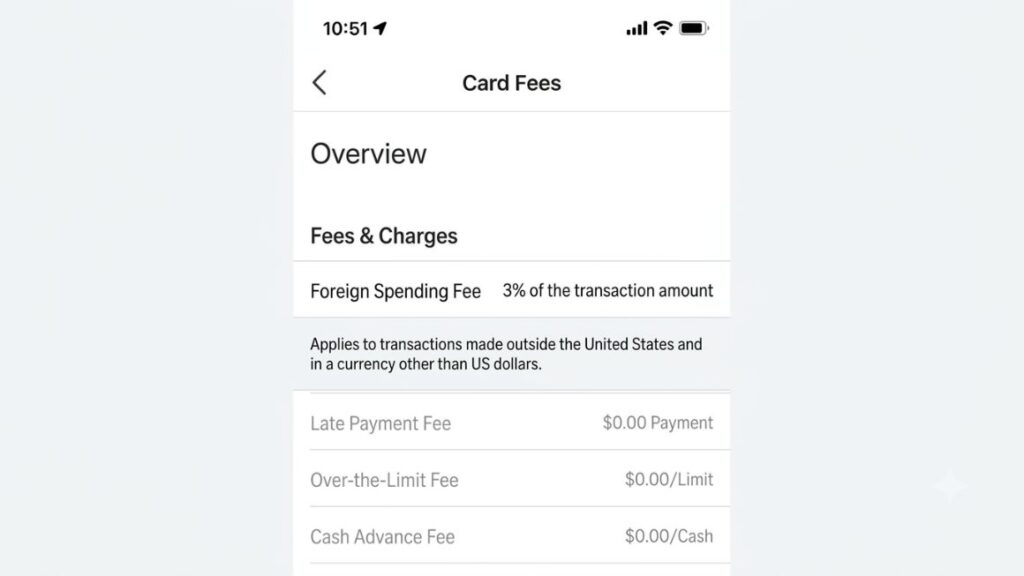
The average card charges about 1.59% in 2026, according to WalletHub’s Credit Card Landscape Report, and plenty charge the full 3%. Indian credit cards often go higher once GST lands on top. On $3,000 of monthly spending, that’s roughly $48 to $90 gone every month, before a single ATM charge or bad exchange rate is counted.
Here’s the frustrating part. Almost none of these foreign transaction fees are compulsory. Most of the cost comes from using the wrong card, the wrong account or the wrong button at the payment terminal.
This guide covers what you’re really paying, what to set up before you fly, which cards and accounts cut the bill, and how to send money home to India without losing a chunk of every transfer. Figures are current as of September 2026, and anything that changed this year is called out.
Table of Contents
Why Do Expats Pay More in Card Fees Than Tourists?
Expats pay more because they spend more, more often, in more places. A tourist swipes a card for two weeks. An expat pays rent, utilities, phone plans, subscriptions and groceries every month for years, so foreign transaction fees, however small the percentage, get applied to a much bigger total.
What the fee actually is, and what it isn’t
A foreign transaction fee is a surcharge your card issuer adds when you pay in a foreign currency or through a merchant that processes payments outside your home country. It’s usually a percentage of the purchase, and it appears as its own line on your statement.
It gets mixed up with the currency conversion fee, which is what a payment network or merchant charges to turn one currency into another. Some banks roll both into a single line. Others list them separately. Your statement won’t always say which is which, and that fuzziness is part of why people overpay.
You’ll also see the same charge labelled an international transaction fee, an FX fee or “intl txn fee”, depending on the bank. Different label, same drain.
And it doesn’t need a border crossing. Forbes Advisor points out that buying from an overseas website, or booking a flight with a foreign airline, can trigger foreign transaction fees even if you never leave home.
Why living abroad multiplies the damage
Once you live abroad, your home country becomes the foreign one. Ordering a gift for your parents from an Indian website with your new Canadian card counts as an overseas purchase. So does paying an Indian insurance premium or a mobile recharge back home.
Now the numbers. At 3% on $3,000 a month, you pay $90 a month, or $1,080 a year. At the 2026 average of 1.59%, it’s about $48 a month, or $572 a year. Stretch that across a three-year contract and the 3% card has quietly cost you $3,240.
Most people don’t see it coming. In a May 2025 WalletHub survey, cited by Navan, 32% of Americans didn’t know whether their own credit card charged foreign transaction fees, and only 12% could name every situation where it applies.
Where the 1% to 3% figure comes from
WalletHub’s 2026 Credit Card Landscape Report puts the average foreign transaction fee at 1.59%, with most cards falling between 1% and 3%. Forbes Advisor treats any card above 3% with suspicion because fees that high are rare in the US, which tells you where the ceiling usually sits.
India is a different story. Card Maven’s August 2026 comparison says most Indian credit cards charge a markup of 3% to 3.5%, with GST added on top. At 3.5%, the 18% GST on the fee pushes the real cost to about 4.13%, which is roughly ₹4,130 on every ₹1 lakh you spend abroad.
The rate isn’t fixed by the card network. Each issuer sets its own foreign transaction fee, so two cards from the same bank can charge different amounts. Some charge nothing: Forbes Advisor says Capital One and Discover apply no such fee on any of their US-issued credit cards.
Foreign transaction fees typically run 1% to 3% of each purchase, with WalletHub putting the 2026 average at 1.59%. Most Indian credit cards charge 3% to 3.5% plus GST, which works out to about 4.13% at the top end. Because expats spend abroad every month, the fee compounds into hundreds of dollars a year.
Also Read: Diversifying Income as a Freelancer: Beyond Just Client Work
Where Does the Money Actually Leak? The Full Cost Stack
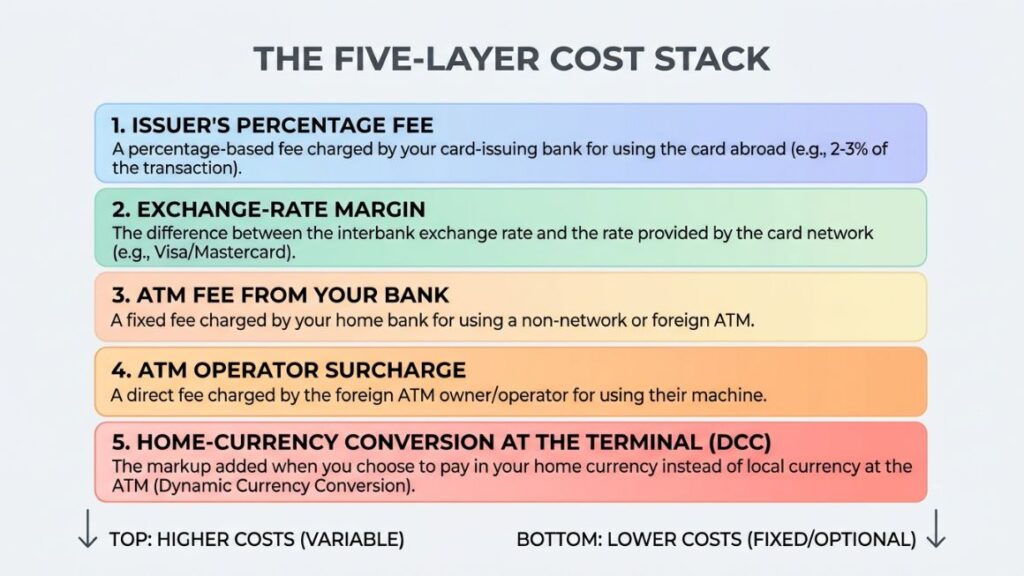
Five separate charges can hit one overseas payment: your issuer’s percentage fee, a margin hidden in the exchange rate, your bank’s ATM fee, the ATM owner’s surcharge, and a home-currency conversion at the terminal. Most people only spot the first. The conversion at the terminal is often the most expensive.
The five layers of cost
Think of it as a stack. Each layer has a different owner, a different size, and a different fix.
| Layer | Who charges it | Typical cost | How to avoid it |
| Issuer’s percentage fee | Your card issuer | 0% to 3%, average 1.59% (WalletHub, 2026) | Use a card that charges none |
| Exchange-rate margin | Bank or payment provider | Varies; one 2026 breakdown puts many banks at 1% to 4% | Pay in local currency on a card or account that converts near the market rate |
| ATM fee from your bank | Your bank | Flat fee plus percentage; up to about $10 with the machine’s fee included (SumUp) | Use an account with ATM rebates or a free allowance |
| ATM operator surcharge | Machine owner | Set by the operator | Pick bank-network machines and withdraw larger amounts less often |
| Home-currency conversion at the terminal (DCC) | Merchant or ATM operator | 3% to 13% (Travel Currency Guide, April 2026) | Always choose the local currency |
Notice something? Two of those five are set by whoever owns the machine, not by your bank. No card fully protects you from them. That’s why the choice you make at the terminal matters as much as the card in your wallet.
Why does paying in your home currency at the terminal backfire?
Dynamic currency conversion is when a shop, hotel or ATM offers to charge you in your home currency instead of the local one, using a rate its own payment processor sets. It looks helpful. You see a number you recognise, and you skip the mental maths.
The catch is the rate. According to Travel Currency Guide’s April 2026 breakdown, the markup is typically around 3% at a major bank’s ATM and 7% to 13% at independent tourist-area ATMs and many hotel and restaurant terminals. That money goes to whoever owns the terminal, and even a card with zero foreign transaction fees can’t undo it.
It’s easy to trip over by accident. MyTripMoney estimates that accepting the home-currency option on most purchases during a two-week trip with $3,000 of card spending adds roughly $90 to $210 in pure markup. Thomas Cook India warns that paying in rupees overseas can hide an extra 3% to 7%.
Some terminals make the wrong choice easy. The “accept conversion” button can be bigger or more colourful, and staff sometimes say paying in your home currency is simpler. Ignore both. Pick the local currency every single time.
What does “the network rate” really mean?
When you pay in local currency, Visa or Mastercard converts the amount at its own daily rate, and your issuer builds on that. The rate usually sits close to the mid-market exchange rate you’d see on Google or Reuters, but it isn’t identical. Thomas Cook India notes that even holders of zero-markup cards pay the network’s rate, which can run slightly above the live market rate.
This is where “no fee” claims get slippery. A provider can advertise zero foreign transaction fees and still earn its money in the rate. Several 2026 remittance comparisons warn about exactly this trap, and it applies to cards as much as transfers.
So judge any option on the total result. How many rupees, dollars or euros did you actually end up paying after the rate and every fee? That’s the only number that counts.
A single overseas payment can carry five charges: the issuer’s percentage fee, an exchange-rate margin, the bank’s ATM fee, the ATM operator’s surcharge, and a home-currency conversion at the terminal. Accepting the home-currency option can cost 3% to 13% depending on the terminal, according to Travel Currency Guide’s April 2026 breakdown. Choosing the local currency at every terminal removes the most expensive layer for free.
What Should You Set Up Before You Land?
Sort out three things before you fly: a card that doesn’t charge for foreign spending, a currency account that can receive money and pay bills, and a plan for opening a local bank account in your first weeks. Check the digital nomad visas in 2026 available in your destination before assuming you can work there legally on a tourist visa. Then you never have to lean on your home card for daily life.
Keep your home card, but stop using it every day
Your Indian card is a backup, not a daily driver. It’s the card you use when a local one fails, when you’re waiting for paperwork, or when a merchant back home only accepts it.
Tell your issuer about the move, too. Chase’s guidance for cardholders is to check card terms and contact the issuer before going abroad, and the same advice holds when the “trip” lasts three years.
One more thing specific to Indians. Your residential status changes when you leave for work, and Indian banks are expected to reflect that. Two 2026 guides on NRI banking say a resident savings account left unchanged after you become non-resident can breach FEMA rules, so ask your bank how your account gets re-designated.
Open a local account early
An expat bank account, meaning a normal local account or a bank’s international package, is where your salary and rent should live. Your employer pays in local currency, your landlord takes local currency, and nothing needs converting. No conversion, no foreign transaction fees.
Be realistic about timing. Traditional banks often ask for proof of address or a residence document, which you won’t have on day one. That’s why many people bridge the first weeks with a fintech account and switch daily spending to the local account once it’s open.
There are some traps. Taxes for Expats notes that FATCA reporting makes some foreign banks reject US citizens or ask for extra paperwork. The same guide lists HSBC Premier’s expat package, with fee-free transfers inside the HSBC network and currency accounts, but flags high minimum balances and strict eligibility.
Add a currency account
A multi-currency account lets you hold balances in several currencies at once and spend from whichever one matches the purchase. Wise, for example, holds more than 40 currencies. If you hold euros and spend in euros, Wise uses that balance first, so no conversion happens at all.
For salaried expats, that mostly serves as a bridge and a travel tool. For freelancers, it’s bigger. Wise says its account can receive money in eight-plus currencies using local bank details, so a client in another country can pay you like a domestic transfer.
Marketers and content people who work with overseas clients feel this one quickly. Working while traveling also means keeping payments, client communication and delivery organised across different locations. Getting paid without a wire fee and a margin buried in the rate is a real raise. If you’re billing clients internationally, pricing freelance services also matters because currency conversion fees can quietly reduce what you actually take home.
Also Read: How to Land Your First Freelance Client as a Marketer (Step-by-Step Guide)
- Read the fee section of your current card’s terms and note the exact percentage.
- Apply for a card that charges nothing for foreign spending, because approval can take up to a week and delivery up to two weeks, according to Forbes Advisor.
- Open a currency account and order its card early; some markets take 7 to 21 days for physical delivery, according to one 2026 review.
- Ask your Indian bank how your account and cards change when you become an NRI.
- Keep a second card on a different network, since American Express is accepted less widely abroad than Visa or Mastercard, as Thrifty Traveler points out.
Which Cards and Accounts Really Cut the Fees?
Four tools do most of the work: a credit card that waives foreign transaction fees, a debit card tied to a fintech or rebate-friendly account, a local account for daily life, and an Indian zero-markup card only if you still pay things back home. Match the tool to the job instead of using one card for everything.
Credit cards that charge nothing for foreign spending
A no foreign transaction fee credit card is the simplest fix, and for many expats it’s the first one to get. Forbes Advisor says Capital One and Discover charge no such fee on any US-issued credit card, and WalletHub adds USAA to that list. Plenty of travel cards from other issuers waive it too.
Watch the fine print. Chase points out that some cards waive foreign transaction fees only for the first year, after which they come back. A card with a $95 annual fee, like the Chase Sapphire Preferred that Forbes Advisor lists, also needs enough spending to justify itself.
Another limit worth admitting: if you’ve just arrived in a country, you have no local credit history. Your first card may be a starter or secured product, and the best no-fee options might not be open to you yet. Plan for that gap.
For Indians: what does zero forex really mean?
A zero forex markup card is a credit card where the issuer adds no markup on foreign-currency spending, so you pay only the converted amount. In India this charge is usually called a forex markup, but it’s foreign transaction fees by another name. Against a regular card at 3.5% plus GST, Card Maven puts the saving at about ₹4,130 per ₹1 lakh spent.
Names that appear in 2026 comparisons include the IDFC FIRST Wow, the Scapia card from Federal Bank, and the Niyo Global card. Read the current terms yourself, though. Card Maven and other sites stress that “low forex” and “zero forex” are different things, and that a premium card isn’t automatically zero-markup.
Run the break-even sum. Take your yearly foreign spending, multiply by the markup you’d otherwise pay, and compare it with the card’s annual fee. If the saving is bigger, the card wins. If it isn’t, a no-fee card with a modest markup might be cheaper, as one August 2026 guide puts it.
Cash is a weak spot. That same guide warns that even zero-markup credit cards usually add cash advance fees and interest from day one on overseas ATM withdrawals.
Promotions also expire. HSBC India ran zero forex markup on all its credit cards from 15 August to 15 September 2026 for existing Indian residents, according to Outlook Business, and that window has now closed. Only the HSBC Prive and HSBC RuPay Cashback cards carry zero markup as a standing feature.
One last check. Most of these products are built for Indian residents. If you’ve moved abroad for work, ask the issuer whether the card and its zero-markup terms survive your change in status.
Debit cards, fintech accounts and ATM rebates
Cards for daily spending abroad fall into two groups: fintech cards that convert near the real rate, and bank debit cards that reimburse ATM charges. Each has trade-offs, and fees vary by country, so treat the numbers below as a snapshot rather than a promise.
Wise
Wise converts at the mid-market rate and adds a visible fee, which starts at 0.41% according to Wise’s own comparison page. There’s no monthly fee. In the US, Wise’s page says the first two ATM withdrawals each month are free up to $100 in total, and the ATM operator can still add its own charge.
Wise changed how ATM pricing works on 1 May 2026, and the free allowance depends on where your card was issued. Check the allowance for your country before you plan your cash withdrawals around it. A VaultLeap breakdown from May 2026 shows a $300 withdrawal past the free limit costing about $7.80 in Wise charges: $1.95 plus 1.95%.
Revolut
Revolut’s US Standard plan costs $0 a month, and Wise’s comparison lists Premium at $9.99 and Metal at $16.99. On Standard, Revolut’s help pages say currency exchanges made outside market hours, from Friday 5pm to Sunday 6pm Eastern, carry a 1% fee, which Premium and Metal customers don’t pay. Wise’s comparison also lists a $1,000 monthly free-exchange cap on Standard, with a 0.5% fee beyond it.
Two caveats. That comparison comes from Wise, a competitor, so verify the figures on Revolut’s own fee page. And the page changes often; Revolut’s UK fee terms were revised for existing customers from 13 February 2026, and its German terms from 9 July 2026.
Schwab (for US citizens)
Schwab Bank Investor Checking charges no foreign transaction fees and offers unlimited ATM fee reimbursement worldwide on its Visa debit card, according to Schwab. The rebate does not cover dynamic conversion charges or merchant fees, which is one more reason to decline the home-currency option.
Eligibility is the sticking point. A June 2026 guide from Savvy Nomad says Americans living abroad generally apply through Schwab International, and that Schwab Bank checking accounts may be closed when a client relocates. It also notes Schwab dropped its $25,000 minimum for international accounts in 2025. Confirm your eligibility before you count on it.
| Option | How it converts | Monthly fee | Cash withdrawals | Best for |
| Wise card | Mid-market rate plus a fee from 0.41% | None | Free allowance varies by country | Currency balances, freelancers |
| Revolut Standard (US) | Market rate, 1% weekend fee, monthly free-exchange cap | $0 | Plan-dependent limits | Weekday spending in app |
| Schwab Bank Investor Checking | Network rate, no foreign fee | None | ATM fees reimbursed | US citizens who qualify |
| Typical bank card | Network rate plus 1% to 3% | Varies | Bank and operator fees | Emergency backup |
What changed in 2026?
Three things moved this year that affect foreign transaction fees and related costs. Wise reworked ATM pricing in May, Revolut updated its fee terms in February and July, and HSBC India’s promotion came and went between August and September. If you’re reading an older article’s numbers, they may already be stale.
The lesson is boring but useful. Set a reminder to reread your provider’s fee page twice a year, because the rules keep shifting.
The cheapest setup for most expats combines a local account for salary and rent, a credit card with no charge for foreign spending, and a fintech or rebate-friendly debit card for cash. Fee levels and ATM allowances changed at Wise, Revolut and HSBC India during 2026, so check current terms before relying on any number. A zero-markup label still leaves the network’s exchange rate in play.
How Do You Handle Rent, Salary and Subscriptions Without Bleeding Money?
Rent is the biggest bill most expats pay, and it’s the easiest one to get right. Have your salary land in a local account, pay rent and utilities from it, and keep cards for purchases that can’t be paid locally. Most of your monthly spending then never touches a conversion, so it never attracts foreign transaction fees. Managing different time zones can also affect meetings, deadlines and availability.
Ask your employer to pay in local currency
If your contract quotes a salary in rupees or dollars while you live elsewhere, ask HR how it’s paid. Local currency into a local account is normally the cleanest route, because there’s nothing to convert before you pay rent.
If part of your pay still arrives in another currency, convert it on your terms. Use a provider that shows the rate and the fee up front, and compare the amount you’ll receive before you confirm.
Move fixed bills to local direct debit
Rent, electricity, internet and phone plans rarely need a card at all. Local direct debit or bank transfer usually costs nothing, and it removes the temptation to pay a local bill with a card that adds a surcharge.
Subscriptions are the sneaky ones. Streaming services, cloud storage and software licences billed from another country can trigger foreign transaction fees each month. Update the payment method to your local card as soon as it arrives.
Check the currency at online checkout
Some checkout pages quietly pre-select the home-currency option. Others show the local price all the way through, then offer a home-currency total at the payment stage. That’s the same conversion trap you’d meet at a shop counter, only quieter.
Before you click pay, look at the currency shown next to the total. If you can change it to the merchant’s local currency, do it.
Cash and ATMs: how much to take out, and where
Never use a credit card at an ATM. Forbes Advisor flags the cash advance fees as high, and Indian zero-markup cards add interest from the first day.
Use a debit card from an account with ATM rebates or a free allowance, and take out larger amounts less often. A 2026 Wise card review gives the same tip: fewer, bigger withdrawals get more out of a free allowance. Pick machines attached to a bank when you can, since the operator’s surcharge is set by the machine’s owner.
At the screen, you’ll likely see a choice between the local currency and your home currency. Press the local one. Every time.
What Is the Cheapest Way to Send Money Home?
The cheapest route is usually the one that delivers the most rupees, not the one with the lowest advertised fee. Compare what lands in the Indian account after fees and exchange-rate margin, using the same amount on the same day.
Bank wires vs specialist transfer services
Banks tend to bundle their profit into the exchange rate, so a transfer with no visible fee can still be expensive. Several 2026 comparisons make the same point: zero-fee transfers often hide the cost in a weaker rate.
Here’s what that looks like. A 1% markup on a $2,000 transfer is $20, which comes to well over ₹1,500 at recent exchange rates. Do that every month and you’ve handed over a five-figure sum in rupees over a few years.
Specialist services usually show the rate and the fee separately. Wise, for instance, starts its fees at 0.41%, according to its own comparison page. Providers change prices often, so run an international money transfer comparison with live quotes each time you send a large amount. Checking two or three options takes minutes.
Where should the money land: NRE or NRO?
An NRE account is a rupee account in India where non-resident Indians hold foreign earnings. Money can move back out freely, and the interest is exempt from Indian tax, according to several 2026 guides including ClearTax and Instarem. An NRO account is for income earned inside India, such as rent or dividends, and repatriation from it is capped at $1 million a year, per Instarem.
Which account you need depends on your status. ClearTax says an Indian citizen who leaves India for employment is a non-resident for tax purposes if they spend fewer than 182 days in India in the previous year. Under FEMA, one 2026 guide adds, you’re treated as an NRI from the day you leave for work, even if you come back within 182 days.
There’s a tax residency change from April 2026 worth knowing about. Citizens with more than ₹15 lakh of Indian-source income who pay no tax anywhere else can be treated as residents, per Nricaservices and Instarem. If that describes you, talk to a chartered accountant.
What do India’s 2026 TCS changes mean, and who do they apply to?
Tax collected at source, or TCS, is collected by your bank when a resident Indian sends money abroad under the Liberalised Remittance Scheme. It applies to outward remittances, not to salary you send home from abroad, according to Regi Tom Antony & Associates.
Budget 2026 changed the rates from 1 April 2026. Per the Press Trust of India, TCS on education and medical remittances above ₹10 lakh fell from 5% to 2%, overseas tour packages now attract a flat 2%, and other purposes still face 20% above ₹10 lakh. The ₹10 lakh threshold is unchanged.
TCS isn’t an extra tax. You can adjust it against your tax bill or claim a refund when you file your return. Still, it ties up cash in the meantime, so it matters if you’re still a resident funding a foreign deposit or rent before you leave. Some bank notices online still show older rates, so check the bank’s current page.
This article gives general information, not tax or financial advice. For residency and remittance rules, confirm the details with your bank and a chartered accountant.
The cheapest way to send money home is the route that delivers the most rupees after fees and exchange-rate margin, not the one with the lowest headline fee. Foreign earnings normally go to an NRE (non-resident external) account, which allows free repatriation and tax-exempt interest, while NRO accounts handle Indian-source income. From 1 April 2026, TCS on education and medical remittances above ₹10 lakh is 2%, and it applies only to outward remittances by residents.
Which Mistakes Cost Expats the Most?
Most of the money lost to foreign transaction fees and their close cousins comes from five repeat mistakes. None needs special knowledge to fix.
The first is believing “no fee” means “no cost.” A card or app can skip the visible fee and still earn from the exchange rate. Check the total you paid.
The second is accepting the home-currency option at the terminal. That single button can cost 3% to 13%, and a great card can’t reverse it.
Third, using a credit card for cash. Forbes Advisor calls out cash advance fees as high, and Indian zero-markup cards add interest from the first day. It’s the wrong tool for the job.
Fourth, forgetting that home is now the foreign country. Paying an Indian merchant with your new local card triggers foreign transaction fees, and it hits gifts, insurance premiums and recharges for family.
The fifth is trusting a promotion. Chase notes some cards waive the fee for only the first year, and HSBC India’s zero-markup window ended on 15 September 2026. Read the terms on the day you sign up, then again every six months.
Skipping the status update belongs on the list too. If you’re an Indian who has moved abroad, leaving a resident savings account unchanged can breach FEMA rules, as two 2026 NRI guides point out.
What Does a 30-Day Setup Plan Look Like?
Thirty days is enough to fix most of this if you go in order. Start before you fly, and finish with a check of what you actually paid.
- Check the foreign transaction fees line in your current card’s terms and write down the percentage.
- Apply for a credit card with no foreign transaction fees, and allow for approval and delivery time.
- Open a currency account and order its card so it arrives before or soon after you land.
- Ask your Indian bank how your account and cards change once you become an NRI, and confirm the re-designation steps.
- Withdraw a small amount of local cash in your first week at a bank-network ATM, and decline any conversion offer.
- Book appointments for a local account, and gather the documents the bank asks for.
- Open the local account and give your employer its details so salary arrives in local currency.
- Move rent and utilities to direct debit or bank transfer.
- Get live quotes from two or three transfer services on the same day for the amount you plan to send home.
- Review your first month’s statements and highlight any line marked as a foreign transaction fee, then ask the issuer about anything you don’t recognise.
Conclusion
Most of what you lose to foreign transaction fees is optional. The fixes are dull but effective: a local account for salary and rent, a card that charges nothing for foreign spending, and a firm habit of choosing the local currency at every terminal. Judge every option by what you actually paid in total, not by the label on the box.
This week, read the fee line on your current card and order a currency account. Both take minutes, and both start paying for themselves the first month you’re abroad.
Working abroad is a career move as much as a money one. If you’re building a marketing career across borders, the Crystal Clear Newsletter sends practical marketing and career ideas to your inbox, and it’s a good next read.
Frequently Asked Questions
Why did my card charge me extra for a purchase in another currency?
Your issuer probably added foreign transaction fees because the payment was processed in a foreign currency or by a merchant outside your home country. It can also come from the exchange-rate margin or a home-currency conversion at the terminal. Check the statement line and the card’s terms to see which one applied.
Is the extra charge on my card the same as the exchange-rate markup?
No, they’re two different costs, although some banks show them as one line. The first is a percentage your issuer adds for foreign spending. The second is the gap between the rate you get and the real market rate. Judge a card on both combined.
How do I find out what my card charges?
Open the fee schedule or cardholder agreement and look for a line covering foreign transaction fees or international spending. If you can’t find it, ask the issuer directly and get the answer in writing. Also check the statement after your first overseas purchase, where the fee usually appears as its own line.
Should I always pay in the local currency?
Yes. Paying in your home currency triggers a conversion at a rate set by the merchant or ATM, which Travel Currency Guide puts at 3% to 13% depending on the terminal. Your card issuer’s rate, even with a small fee, is normally cheaper. Choose the local currency at every terminal and checkout.
Is Wise better than my bank card abroad?
Often, but not always. Wise converts at the mid-market rate plus a visible fee that starts at 0.41%, while many bank cards add 1% to 3% on top of the network rate. If your bank card already charges nothing, the gap narrows. Compare the total cost for how you actually spend.
Do I need a local bank account, or can I keep my Indian one?
For a stay of a year or more, open a local account. It lets your salary land in local currency and lets you pay rent and bills without conversion. Keep your Indian account too, but ask the bank to re-designate it correctly once you become an NRI, because leaving it as a resident account can breach FEMA rules.
Is a zero forex card actually free?
Not entirely. It removes the issuer’s markup, but you still pay the network’s exchange rate, and some cards carry annual fees. Cash withdrawals on a credit card usually add cash advance fees and interest from day one. Do the break-even sum: yearly foreign spending times the markup you’d otherwise pay, against the annual fee.
What do most people get wrong about ATM withdrawals abroad?
They accept the home-currency option and use the wrong card. Decline the conversion, use a debit card from an account with ATM rebates or a free allowance, and take out larger amounts less often. Never use a credit card for cash.
Is it worth the hassle if I don’t spend much abroad?
If you’re only abroad for a short trip and spend little, the saving may be small. On $3,000 of monthly spending, though, 3% foreign transaction fees cost $90 a month. The setup takes an afternoon, so anyone staying more than a few months usually comes out ahead.
Does TCS apply when I send my salary home?
Generally no. TCS is collected on outward remittances by resident Indians under the Liberalised Remittance Scheme, not on money you send into India from abroad. It can apply if you’re still a resident sending money out before you leave. Confirm your status with a chartered accountant.
Why is my card being declined abroad?
Common reasons are a fraud block from your bank, international use switched off, a low per-payment limit, or a merchant that doesn’t accept your card network. American Express is accepted less widely abroad than Visa or Mastercard, per Thrifty Traveler. Contact the issuer, enable international use, and carry a second card on a different network.