
You step off the flight in Dubai at 11 pm. Your cab app needs data. Your bank wants to send an OTP before you can pay the driver. And your Indian SIM is quietly asking your phone to roam at rates you haven’t checked.
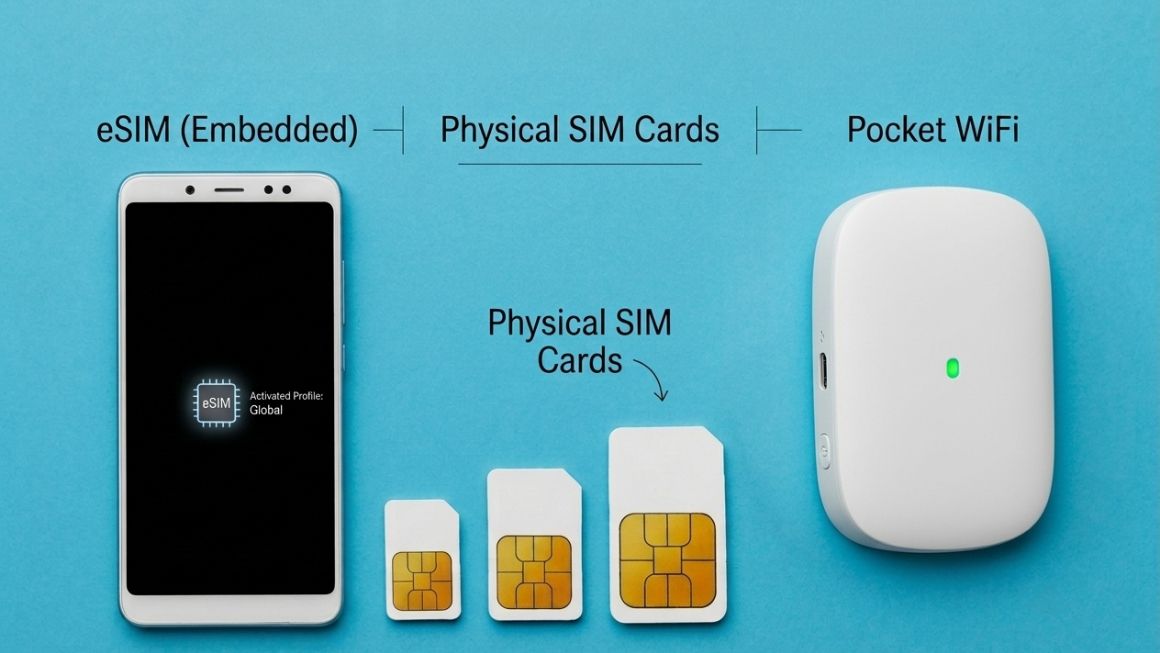
That’s where most travellers make their connectivity decision, usually in a rush at the airport. The choice comes down to eSIM vs physical SIM vs pocket WiFi, and each one solves a different problem.
A lot of people are making that call. Government of India data shows that Indian nationals made about 30.89 million international departures in 2024. The UAE led with 7.79 million, followed by Saudi Arabia (3.42 million), the United States (2.14 million) and Thailand (1.91 million). Those are departures, not unique travellers, but the scale is clear.
Most guides on this topic are written by companies that sell one of the three options, so the winner tends to be whatever they sell. This one isn’t. You’ll see what each option costs, where it breaks, and how to keep your Indian number alive for OTPs. Every figure has a source and a date, and where a number comes from a seller, we say so.
Table of Contents
eSIM vs Physical SIM vs Pocket WiFi – The Quick Answer
An eSIM is the simplest and usually cheapest way to get data abroad for most solo travellers with an eSIM-ready phone. A physical SIM makes sense when your phone can’t take an eSIM or you need a local number. Pocket WiFi wins when several people or devices share one connection.
Here’s how eSIM vs physical SIM vs pocket WiFi looks in one table.
| eSIM | Physical SIM | Pocket WiFi | |
| Cost | Priced by data, usually lowest for one or two people | Cheap, but one card per person | Billed per rental day, cheaper only when shared |
| Setup | Install online before you fly | Buy on arrival, show passport, swap card | Order ahead, collect, return |
| Extra device | No | No | Yes, needs charging |
| Local number | Usually data only | Usually yes | No |
| Sharing | Phone hotspot, if the plan allows | One card per phone | Typically 5 to 10 devices |
| Phone needs | eSIM support, no carrier lock | SIM tray, no carrier lock | Any WiFi device |
| Best for | Solo travellers and couples | Phones without eSIM, longer stays | Families, groups, laptops and cameras |
Notice what’s missing: a universal winner. Anyone who says one option is best for everyone is selling it or hasn’t travelled with a family of five. The right pick depends on how many people you’re connecting, how long you’re staying and which number you need.
An eSIM usually suits solo travellers and couples with an eSIM-ready phone, a physical SIM suits phones without eSIM or trips needing a local number and pocket WiFi suits groups sharing one connection. In the eSIM vs physical SIM vs pocket WiFi decision, people and devices matter more than the technology.
How each option actually works
Before you weigh eSIM vs physical SIM vs pocket WiFi, know that all three do the same job. They connect you to a local mobile network at local prices instead of Indian roaming rates. What differs is where the connection lives. It’s inside your phone (eSIM), on a plastic card (physical SIM) or in a separate box that shares its signal over WiFi (pocket WiFi).
eSIM
An eSIM (embedded SIM) is a digital SIM profile that installs on your phone, with no plastic card involved. You buy a plan from a provider such as Airalo, Holafly, Saily or Nomad. Scan a QR code or tap Install in the app, and it waits until you switch it on.
A travel eSIM is usually sold as data only, a catch we’ll return to with OTPs. Phones can hold several profiles, too: the iPhone 17 stores up to eight eSIMs but uses two at a time (Saily, 2026). So your Indian number stays live on one line while a local plan runs on the other.
Physical local SIM
A physical SIM is a small removable chip that slides into your phone’s tray. Bought at a foreign airport or shop, it’s normally a local SIM card tied to one country’s network. Comes with a local number and prepaid data.
Most countries want your passport at the counter. At well-run kiosks in Thailand, Singapore and the UAE, staff do the registration and swap in five to ten minutes (Simology, 2026). The catch: your Indian SIM comes out, which is exactly when bank OTPs stop arriving.
Pocket WiFi
Pocket WiFi is a portable WiFi router, about the size of a deck of cards. It holds a local SIM and broadcasts a private network your devices can join. You rent it, collect it at the airport or hotel and return it at the end.
Most units connect five to ten devices, and Orange’s travel guide puts battery life at eight to twelve hours. That’s a gadget to carry, charge and return. For a family, a fair trade. For one person, often a chore.
What About International Roaming? The Option Most Indians Default To
Roaming means using your Indian SIM abroad on a partner network, usually through a prepaid pack from Jio, Airtel or Vi. It keeps your number, calls and SMS working, but it’s rarely the cheapest for data, and using your SIM without a pack can get very expensive.
Roaming is the fourth player in the eSIM vs physical SIM vs pocket WiFi debate. Vendor guides rarely treat it fairly. Here’s what the main packs looked like in August 2026, according to TelecomTalk.
| Operator and pack | Price | Validity | Published benefits |
| Published benefits | ₹1,555 | 15 days | 12GB data, 150 voice minutes, 100 SMS |
| Jio, UAE and Gulf | ₹1,598 | 14 days | 3GB data, 300 voice minutes |
| Airtel prepaid pack | ₹1,198 | 10 days | 3GB data, 200 voice minutes, 20 SMS |
| Airtel prepaid pack | ₹2,998 | 30 days | 10GB data, 300 voice minutes, 100 SMS |
| Vi iRoamFree | ₹5,195 | 14 days | Depends on destination category |
Look at the Jio US pack. Twelve gigabytes plus calling minutes for ₹1,555 over 15 days is hard for an eSIM to beat if you also want voice. The UAE pack gives 3GB over two weeks, fine for maps and messages, thin for streaming. Airtel’s structure covers 184 countries, TelecomTalk adds, while Vi sorts destinations into unlimited, discounted and non-pack groups.
The real danger is having no pack at all. TelecomTalk’s example: ₹6.5 per 10KB works out to roughly ₹665 per MB, so a 50MB background sync could cost over ₹33,000. Jio’s lower standard tariff in some destinations is about ₹2 per MB, which still means 1GB costs over ₹2,000. Those aren’t universal rates, but they show how fast international roaming charges pile up when a phone quietly syncs photos.
Activate a pack before you fly, and switch off mobile data on any SIM you aren’t using for data. Prices change often and other comparison sites list different figures, so check your operator’s app on the day you buy.
Roaming packs from Jio, Airtel and Vi keep your number, calls and SMS working abroad, and Jio’s ₹1,555 US pack (12GB for 15 days, per TelecomTalk, August 2026) is competitive. Without a pack, roaming can run to about ₹2 per MB or far more, so buy a pack or keep data off your Indian SIM.
eSIM vs physical SIM vs pocket WiFi: head-to-head on what matters
On cost and convenience for one person, an eSIM usually wins. On sharing, pocket WiFi does. When you need a local number, a physical SIM does. These seven comparisons are the ones that change how a trip feels.
Cost
For one traveller, an eSIM is usually cheapest per gigabyte. The gap widens on longer trips. Pocket WiFi is billed for every day you hold the device. An eSIM is priced by the data you buy. Which side wins the eSIM vs physical SIM vs pocket WiFi cost contest depends on who you ask.
Japan Wireless, which sells pocket WiFi, lists unlimited service from ¥680 a day for up to ten devices, against Airalo’s eSIM at ¥700 for 1GB and a physical SIM at ¥2,300 to ¥3,000 for 3 to 30 days. Split one unit between four people over 14 days and its own maths, with a coupon, comes to about ¥2,700 each.
Flip to eSIM sellers and the story changes. Esim.compare’s April 2026 guide pegs a 10GB eSIM at $10 to $20, against $40 to $60 for a seven-day pocket WiFi rental with 10GB. BetterSIM’s May 2026 comparison has four eSIM plans at about $8 each ($32) for a family of four, versus roughly $70 for one rental. Sources disagree on where the crossover sits, from three people to five or more.
Airport physical SIMs are often the priciest route. Roami’s August 2026 UK guide, itself an eSIM seller’s, puts them at a 100 to 200 percent markup over online eSIM prices.
Setup and convenience
An eSIM takes about five minutes at home on your own WiFi. On setup, the eSIM vs physical SIM vs pocket WiFi gap is widest before you leave. A physical SIM means finding the counter, queuing with your passport and waiting for the swap. Pocket WiFi means booking ahead, collecting the device and returning it before your flight home.
Travel blogger Bronwyn Townsend, who switched from physical SIMs to an eSIM in Japan, noted in November 2024 that every bank passcode meant swapping the SIMs back. Small thing. Over two weeks, it adds up.
Speed and coverage
Coverage is closer than the marketing suggests. Esimphony’s June 2026 comparison says an eSIM and pocket WiFi connect to the same local towers, so signal is about the same. Some pocket WiFi units support more bands or an external antenna, which can help in remote areas.
The bigger question is which network your plan uses. Some eSIM providers connect to several local networks, while a physical SIM or pocket WiFi unit is normally locked to one. Roami says that gives eSIMs broader coverage, but that’s a vendor claim, so test it on your route.
Battery and the extra device
Pocket WiFi’s hidden tax is the battery you’re responsible for. Forget to charge it and your group loses maps.
An eSIM adds no battery to manage. Holiday.com’s May 2026 guide says it uses virtually the same power as a physical SIM. The trap is using your own phone as the connection for everyone, because BetterSIM says the host phone can drain two to three times faster.
Sharing across devices and groups
Sharing is the one category where the eSIM vs physical SIM vs pocket WiFi ranking flips. You can turn one phone into a mobile hotspot and share eSIM data with the family (about $11, per BetterSIM). But the host battery drains fast, everyone must stay within roughly 10 to 15 metres, and some budget plans ban tethering.
Pocket WiFi is built for sharing. Laptops, tablets, cameras and the kids’ iPad just join. The flip side: whoever holds the box is the group’s connection. Split up, even by accident, and the person without it goes offline.
Security and privacy
Every option carries risk, in different places. Holiday.com says an eSIM lowers the exposure that comes with shared devices like pocket WiFi, which matters if you bank over the connection. If you’re working from hotels, airports or cafés, a VPN for remote workers can provide another layer of protection. Orange’s guide adds that pocket WiFi units can be vulnerable in public spaces unless set up properly, so change the default password.
Physical SIMs cost you privacy. Too Many Adapters warns that registering a SIM in Thailand means handing over more personal information than you’d likely choose.
Keeping your Indian number for calls, OTPs and UPI
This is where most eSIM vs physical SIM vs pocket WiFi comparisons stop short. Your bank sends OTPs to your Indian number, and UPI generally stays linked to the mobile number registered with your bank account (TelecomTalk). That matters even more when you’re relying on global payments while travelling.
Jio and Vi say incoming SMS isn’t charged while you roam, provided the Indian SIM is active with international roaming enabled. But OTP delivery still depends on your bank, the sender and the foreign network, and no provider promises every message arrives.
So how does each option treat your Indian SIM?
- eSIM: your Indian SIM stays in the tray, so OTPs keep arriving.
- Physical SIM: the Indian SIM comes out unless you have a second slot, so OTPs stop.
- Pocket WiFi: your phone keeps its Indian SIM. Data comes from the box, so turn mobile data off on the phone.
The two-SIM setup below turns this into a routine.
Will Your Phone Even Work? Compatibility check
Your phone can end the eSIM vs physical SIM vs pocket WiFi debate before it starts. Most phones sold since 2018 take an eSIM, but “supports eSIM” and “works with the eSIM you bought” aren’t the same thing. Your phone must also be free of carrier locks, and India-sold versions can differ from those sold abroad.
The list of eSIM compatible phones is long. It covers every iPhone from the XS and XR (2018), Samsung’s Galaxy S20 series onward and Pixels from the Pixel 3, with dual eSIM from the Pixel 7 (esim.compare, August 2026). In India, Jio, Airtel and Vi all offer eSIM on supported phones, and esim-india.in’s September 2026 list includes the OnePlus 15, OnePlus 13 and OnePlus Open.
Here’s the twist for Indians who buy phones abroad. Apple sells the iPhone 17, 17 Pro and 17 Pro Max without a SIM tray in 12 countries and territories, which per Wikipedia include the US, Canada, Mexico, Japan, Saudi Arabia, the UAE, Qatar, Kuwait, Bahrain and Oman. The iPhone Air has no tray anywhere, while India-sold phones keep a nano-SIM tray beside the eSIM.
Then check for a carrier lock. If you bought on an instalment plan, the operator may have locked the phone, and you need an unlocked phone to use anyone else’s SIM or eSIM. On recent iOS, look under Settings, General, About for a Carrier Lock line reading no SIM restrictions. On Android the path varies by brand, so search settings for “SIM status” or ask your operator. Some carrier-branded and region-specific models also disable eSIM (esim.compare).
If your phone fails any check, you’re choosing between a physical SIM and pocket WiFi. That makes the decision easier.
Which One Wins For Your trip? Real scenarios
The eSIM vs physical SIM vs pocket WiFi answer changes with the trip. Choose by how many people and devices you’re connecting and how long you’re staying. Solo travellers and couples usually do best with an eSIM, groups and non-phone devices with pocket WiFi, and long stays with a local number.
Solo, short trip
Say you’re flying to Bangkok for five days. You need maps, WhatsApp, a cab app and the odd OTP. An eSIM installed at home gives you data the moment you land while your Indian SIM catches OTPs. For a solo trip of a week or so, the eSIM vs physical SIM vs pocket WiFi verdict is almost always eSIM.
One exception: light data plus calls on your Indian number. Jio’s ₹1,598 UAE pack (3GB, 300 voice minutes, 14 days) is that deal, and TelecomTalk lists it as a fit for a short UAE holiday with light use.
Couples
Two phones, two eSIMs. The cost lands near one pocket WiFi and nobody babysits a device. Journey Japan eSIM’s August 2026 guide says couples can do either. Separate lines win on flexibility, because one of you can wander off and both stay online. Share a unit only if you’re both on older phones.
Families and groups
Pocket WiFi earns its place here. Japan Wireless’s example is one unit shared by four people at about ¥2,700 each. But BetterSIM’s maths shows four eSIMs at roughly $32 still beating a $70 rental, so cost alone rarely settles it.
Devices and people do: WiFi-only kids’ tablets, grandparents on older phones, a group that always stays together. Roami says pocket WiFi is cost-effective from about three people, while BetterSIM says five or more. Run the numbers for your destination.
Remote work, laptops and cameras
A laptop without cellular, a camera that uploads over WiFi and a tablet all work with pocket WiFi, which Simology’s July 2026 comparison calls the only portable option covering all of them. Business travellers who can’t afford an outage often run both, an eSIM as primary and pocket WiFi as backup (BetterSIM). For an occasional laptop session, tethering usually works.
Multi-country trips
A physical SIM in every country means queuing and registering each time. A regional eSIM, such as an Asia plan, covers several countries under one profile (Cellesim). Rental units are usually tied to one country’s network, so check the terms.
Long stays and students
For a few months abroad, a local SIM or an eSIM with a local number starts to matter. TelecomTalk suggests keeping your Indian SIM active for banking and India-linked services while using the local line for everything else. If you’re planning to work remotely for longer, compare the best countries for digital nomads in 2026 before choosing where to stay.
Do you really need a local number?
Sometimes. TelecomTalk notes employers, universities, landlords, banks and local apps may require a number from the country you’re in, while others accept international numbers or app-based verification. A French +33 number, for example, won’t satisfy a service that insists on a UAE or Saudi number. Confirm with the specific bank or app before you buy.
Also Read: How to Stay Productive While Traveling Without Losing Client Trust?
Hidden Costs And Failure Points Most Skip
None of the three options in eSIM vs physical SIM vs pocket WiFi is free of surprises. “Unlimited” eSIMs can slow down, pocket WiFi can add late-return and damage fees, physical SIMs need your passport, and data-only eSIMs can’t receive OTPs.
“Unlimited” eSIM throttling
Unlimited rarely means unlimited. Most providers apply a fair-use cap, after which speeds drop. One May 2026 roundup of provider tests puts the throttle point at roughly 3 to 5GB a day for Holafly, 3GB for Airalo’s unlimited plans, and effectively no daily cap for Saily and Nomad on metered plans. Providers change thresholds quietly, so read the fair-use line, and if you’ll stream or upload a lot, consider a metered plan.
Pocket WiFi deposits, late fees and damage charges
Holiday.com’s 2026 guide says hiring a pocket WiFi unit may carry extra charges depending on return timing or device condition. eSIM pricing is usually clear upfront. Before pickup, photograph the device and accessories, ask whether the company holds your card. Note the return deadline and drop-off point.
Passport and ID rules for physical SIMs
A tourist SIM card is designed for foreign passport holders, but it isn’t registration-free. Simology’s August 2026 guide says more than 150 countries ask for a passport or national ID before activating a local SIM, including Thailand, Indonesia, Malaysia, Vietnam, the UAE and Saudi Arabia.
Thailand is especially strict. Other guides say photocopies aren’t accepted, so carry the original, and one report on the regulator NBTC says registration now includes a face check using liveness detection. Keep your passport in hand luggage.
Data-only eSIMs and missing OTPs
TelecomTalk says a data-only eSIM normally gives no phone number, no traditional voice calls, no standard SMS and no guaranteed verification codes. WhatsApp, email and maps work, but not your bank’s SMS. Some eSIMs include a number, yet banks and apps may reject virtual, newly issued or foreign numbers. So ask your bank about app-based or email authentication before you go. TripCabinet’s August 2026 guide notes that HDFC and ICICI offer app-based authentication.
Also Read: Best Apps for Managing Time Zones When Your Team and Clients Are Scattered Globally
The Two-SIM Setup That Works For Indian travellers
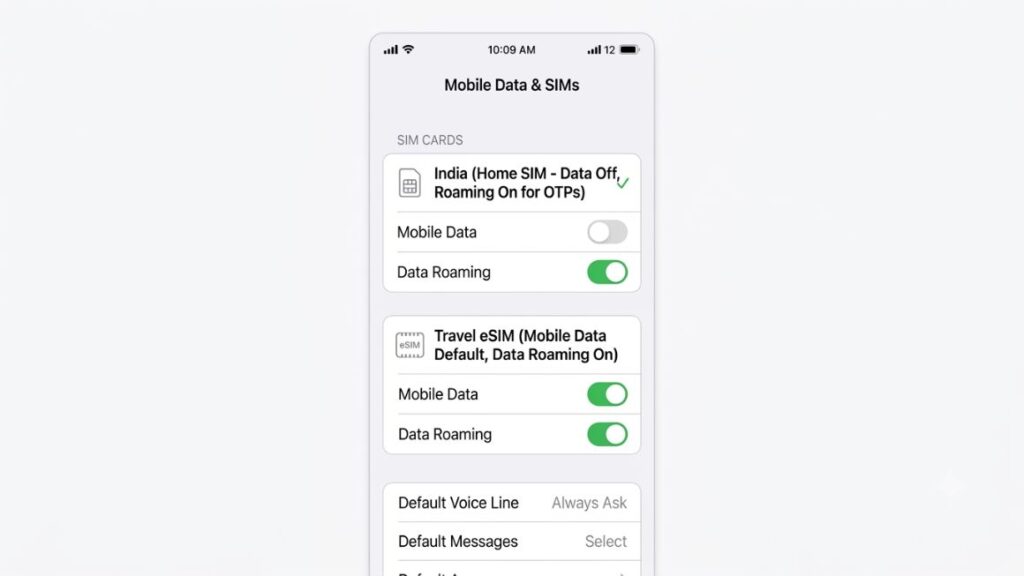
Keep your Indian SIM in the phone with roaming on but mobile data off, and run all your data through the eSIM. You still get OTPs and calls on your Indian number while data runs at local prices.
This routine fits best when your eSIM vs physical SIM vs pocket WiFi decision lands on eSIM, and it needs a phone with dual SIM support, which covers the iPhone models above and most recent Android phones. TelecomTalk recommends a version of it.
- Activate roaming on your Indian SIM before you leave. Use your operator’s app, or call 121 for Airtel. The SIM must be roaming-enabled to register abroad.
- Buy and install the eSIM at home. Do it on your own WiFi a few days before you fly, and label the lines “India” and “Travel”.
- Switch off mobile data, data roaming and automatic data switching on the Indian SIM. This stops background syncs from triggering roaming charges.
- Set the eSIM as your default data line. If the plan’s instructions say so, switch on data roaming for the eSIM line only.
- Land, wait for the eSIM to connect, and test it before leaving arrivals. Open maps and send a WhatsApp message.
- Don’t answer calls on the Indian SIM unless your pack includes incoming calls. TelecomTalk advises against it.
The safest setup for Indian travellers is to keep the Indian SIM active with roaming enabled, switch off its mobile data, and set an eSIM or local SIM as the default data line. Bank OTPs and calls still reach your Indian number while data is billed at local prices (TelecomTalk, August 2026).
Pre-flight checklist
- Confirm your phone supports eSIM and isn’t network-locked.
- Check the plan’s hotspot and fair-use rules, especially if you’ll share data.
- Set up app-based or email authentication with your bank and tell it your travel dates.
- Check whether your phone and operator support WiFi calling, which can route calls over hotel WiFi.
- Keep your eSIM confirmation email offline, because a deleted eSIM usually can’t be reinstalled.
- For a physical SIM, carry your original passport, a SIM ejector tool and a safe holder for your Indian SIM. For pocket WiFi, confirm the pickup point, return deadline and charging cable.
What’s changing in 2026?
The balance in eSIM vs physical SIM vs pocket WiFi is shifting. And eSIM has moved from niche to normal. Holafly’s 2026 Summer Travel and eSIM Report puts traveller adoption at 28.1% for the season. That is up from 19.0% in 2025, a jump of 9.1 percentage points.
Oceania leads at 40.2% and Asia follows at 34.6%. European adoption more than doubles to 44.8% once travellers leave the EU’s free roaming zone. Holafly sells eSIMs, so read its numbers as a market signal, not an audit.
Apple is pushing the same way: US iPhone 14 models went eSIM-only in 2022, and the iPhone Air dropped the tray everywhere. None of this kills pocket WiFi. Simology argues its golden age ran from about 2012 to 2020, and it’s now a niche tool for groups and non-phone devices. For a family with a bag of tablets, it’s still the practical answer.
Conclusion
The eSIM vs physical SIM vs pocket WiFi choice gets simple if you start with two questions. Does your phone support eSIM, and how many people and devices are you connecting? If it does and you’re connecting one or two, buy an eSIM, keep your Indian SIM for OTPs and switch its data off. If it doesn’t, or you’re connecting many devices, a physical SIM or shared pocket WiFi is the better tool.
Whatever you pick, sort it out before the flight. Check your phone’s lock status, set up bank authentication that doesn’t hinge on one SMS, and test the connection in arrivals.
If you’d like more no-fluff, source-checked breakdowns from Young Urban Project, the Crystal Clear Newsletter is the place to get them.
FAQ
What is the difference between eSIM, physical SIM and pocket WiFi?
An eSIM is a digital SIM profile stored on your phone. A physical SIM is a removable chip in the SIM tray. Pocket WiFi is a rented router that shares a local connection over WiFi. The eSIM vs physical SIM vs pocket WiFi choice mostly comes down to how many devices you’re connecting and whether your phone supports eSIM.
Is eSIM cheaper than pocket WiFi?
For one or two people, usually yes, which is why eSIM vs physical SIM vs pocket WiFi leans eSIM on solo trips. Esim.compare’s 2026 figures put a 10GB eSIM at $10 to $20 against $40 to $60 for a week of pocket WiFi. For larger groups, one shared unit can close the gap.
Will I get bank OTPs abroad on an eSIM?
Only if your Indian SIM stays in the phone with roaming enabled. A data-only eSIM has no number and can’t receive standard SMS. Keep the Indian SIM active, switch off its data and use the eSIM for data. Delivery isn’t guaranteed everywhere (TelecomTalk).
Does my phone support eSIM?
Every iPhone from the XS and XR (2018) onward does, along with Samsung’s Galaxy S20 series and later and Pixels from the Pixel 3. Support varies by region, carrier and model. A carrier lock can block it. Look for an eSIM option in your settings before buying a plan.
Can I use my Indian number abroad with an eSIM?
Yes, if you keep the Indian SIM in the phone. The number stays on that SIM for calls, SMS and OTPs while the eSIM handles data. A few eSIMs include a foreign number, with limits, so check the plan.
When is pocket WiFi still worth it?
When three or more people share one connection, someone’s phone lacks eSIM support, or you’re carrying a laptop, tablet or camera that needs WiFi. For a solo traveller with a modern phone, it’s rarely the best pick.
Is a physical SIM still worth buying?
Yes, in two cases: your phone doesn’t support eSIM, or you need a local number for a longer stay. Shop prices are often low, but you’ll usually need your passport.
Are “unlimited” eSIMs really unlimited?
Usually not. Most have a fair-use limit after which speed drops. One May 2026 test roundup found thresholds around 3 to 5GB a day for Holafly and 3GB for Airalo’s unlimited plans. Read the fair-use terms, and consider a metered plan for heavy use.
Is pocket WiFi safe to use?
It can be, if set up properly. Orange’s guide says units may be vulnerable in public spaces unless configured well. Change the default password, use the strongest encryption available and avoid banking on a network you haven’t secured.
What do most travellers get wrong?
They wait until they land. Airport buying is usually the priciest route, and installing an eSIM on weak airport WiFi can fail. Another big mistake is leaving data roaming on for the Indian SIM. Install at home and test in arrivals.