

More traffic doesn’t automatically mean more conversions. IRP Commerce’s July 2026 benchmark put the average ecommerce session conversion rate at 2.22%. Baymard Institute’s analysis of 50 studies puts the average cart abandonment rate at 70.22%. Most of the people you paid to bring in leave without buying.
Fixing that has always been slow and human work. Someone finds the problem, someone writes a hypothesis, someone builds the variant, someone launches the test and waits and someone interprets the result. An AI agent for conversion rate optimization can now take over or speed up several of those steps.
Here’s the catch. “AI-powered” and “agentic” aren’t the same thing, and plenty of products wear the second label while doing the first.
This guide explains what an AI agent for CRO actually does, where it fits into the experimentation workflow, which platforms offer these capabilities today, and how to set one up without handing important decisions over blindly.
Table of Contents
What Is an AI Agent for Conversion Rate Optimization?
An AI agent for conversion rate optimization is a system that analyses conversion data, spots opportunities, makes or recommends decisions, carries out CRO tasks and checks the results, with varying levels of human oversight.
That last part matters. Some agents only suggest. Others build a test and wait for your approval. A few can ship changes on their own inside limits you set. Same label, very different products. In practice, an AI agent for conversion rate optimization sits between your analytics stack and your testing tool. It reads from one and acts through the other.
AI CRO vs traditional CRO
Traditional CRO is manual at every stage. You research the funnel yourself, write the hypotheses yourself, brief a designer or developer, set up the test, and read the results in a dashboard once enough traffic has come through. Good teams do this well. They just can’t do it fast.
The AI version runs closer to continuously. It keeps analysing behaviour in the background, drafts hypotheses from the evidence, sets up the experiment, watches it for problems and remembers what earlier tests taught it. Your job shifts from doing each step to judging each step.
AI tool vs copilot vs workflow vs agent
These four get mixed up constantly, so here’s a clean way to tell them apart.
| System | Can analyse | Can recommend | Can act | Can learn from outcomes |
| AI feature | Yes | Yes | Limited | Limited |
| Copilot | Yes | Yes | With the user | Limited |
| Workflow automation | Yes | Yes | Yes | Limited |
| AI agent | Yes | Yes | Yes | Yes |
Autonomy varies by product. It varies by how your team configures it. A tool sold as an agent may behave like a copilot until you loosen the approval settings.
What “agentic” should mean in CRO
Gartner has warned about “agent washing”, where vendors rebrand chatbots, robotic process automation and assistants as agentic without adding real autonomous capability. Its estimate, as reported by MarTech in 2026, is that only about 130 of the thousands of vendors claiming agentic features actually deliver them.
So use a simple test on any AI agent for conversion rate optimization a vendor shows you. Does the system work toward a goal across several steps, use tools to act, and learn from what happened? If it only answers questions, it’s a copilot with good marketing.
An AI agent for conversion rate optimization works toward a conversion goal across several steps, uses tools to act on data and tests, and learns from each result. If a product only answers questions or drafts suggestions on request, it is closer to a copilot than an agent. Gartner has warned that many vendors rebrand existing assistants as agentic without real autonomous capability.
How Does an AI Agent Improve Conversion Rate Optimization?
An AI agent for conversion rate optimization runs the whole optimisation loop faster. It watches behaviour, finds friction, ranks fixes, drafts tests and feeds each result into the next round. The gain comes from speed and consistency, not magic.
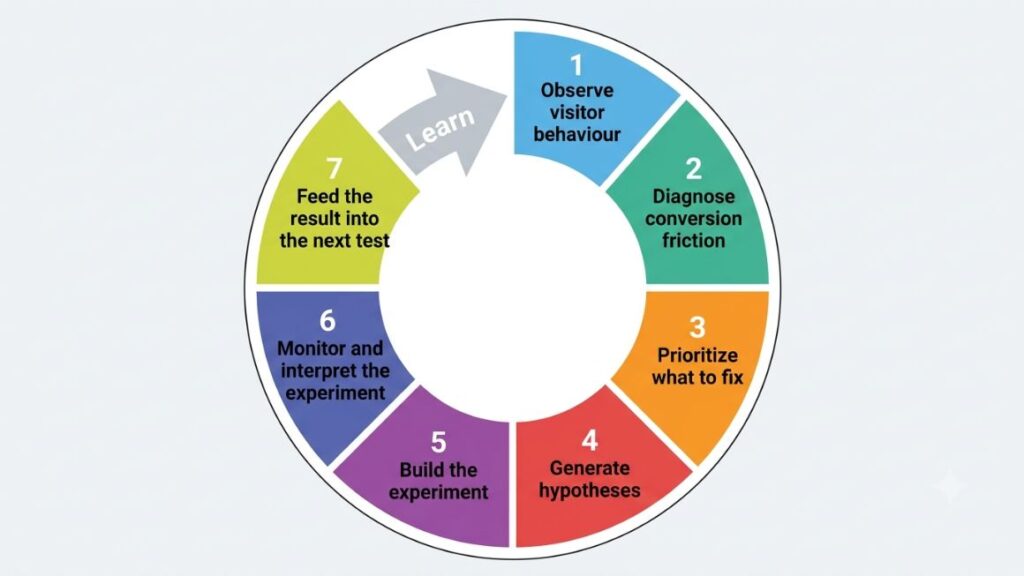
1. Observe visitor behaviour
Every loop starts with raw signals. Funnels, session recordings, heatmaps, form interactions, device behaviour, traffic sources and conversion events all feed in.
A person can watch a few dozen recordings a week. An agent reads all of them. Contentsquare’s Sense Analyst, for instance, works from session replay and heatmap data and summarises the patterns instead of leaving you to hunt for them. That matters most on mobile, where friction often hides in small things, like a keyboard that covers the pay button.
2. Diagnose conversion friction
Observation tells you what happened. Diagnosis asks why. The usual suspects are checkout drop-off, weak CTA engagement, form abandonment, slow pages, confusing menus and navigation, and mobile UX problems.
Contentsquare’s Sense lets you ask in plain language why conversion dropped this week or which journey matters most for mobile users. It then turns the question into the right analysis. That’s conversion funnel analysis without building the report by hand.
3. Prioritize what to fix
Here’s where most tools disappoint. An agent that hands you 50 recommendations hasn’t helped. It should rank them using:
- potential impact
- traffic affected
- confidence in the evidence
- implementation effort
- business value
A small fix on a page with heavy traffic beats a big redesign of a page nobody visits. Ask any vendor how its agent ranks ideas. If the answer is an AI score with no evidence trail, keep looking.
4. Generate hypotheses
Good hypotheses connect evidence to a change.
Observation: mobile users abandon the shipping step at a higher rate than desktop users.
Hypothesis: reducing required fields and showing delivery costs earlier will increase checkout completion.
An agent that writes hypotheses like that, with the supporting data attached, is doing real work. One that writes “try a bigger button” isn’t.
5. Build the experiment
Now the agent turns the hypothesis into something testable: copy, layout, CTA, forms, product page elements or the checkout experience. It can range from a headline swap to a multivariate testing setup.
VWO’s Editor Copilot creates variations from plain-language prompts. Optimizely’s Opal agents can stage experiment configurations directly inside its platform. Contentsquare and Kameleoon have documented a retailer that saw shoppers hesitate around the size selector on mobile product pages. The team described a fix in simple words, and the variant was built in minutes. QA still applies, though. A variant built in minutes can be broken in minutes too.
6. Monitor and interpret the experiment
Launching is the easy bit. The agent watches sample size, experiment health, anomalies and statistical results, then reports on the primary metric and the secondary ones. It should flag a broken variant before it burns a week of traffic. Without that watchfulness, teams peek at results too early and call winners that aren’t real.
7. Feed the result into the next test
This is what separates a workflow from a genuinely useful agent. Every result, win or loss, goes back into the next round of analysis, so test ideas get sharper over time. That memory is what lets an AI agent for conversion rate optimization compound instead of starting from zero every Monday.
Observe → Diagnose → Prioritize → Hypothesize → Build → Test → Learn
What Can an AI CRO Agent Actually Automate?
Vendors say everything. The truth is narrower, and more useful once you see where the human still sits.
An AI agent for conversion rate optimization can automate most of the analysis, drafting and monitoring in an experimentation programme. Approval, QA and final prioritisation stay with people.
| CRO task | What AI can do | Human involvement |
| Funnel analysis | Find unusual drop-offs | Review |
| Session analysis | Summarise friction patterns | Validate |
| Research synthesis | Combine behavioural signals | Review evidence |
| Hypothesis generation | Suggest test ideas | Approve |
| Experiment planning | Define variants and metrics | Approve |
| Variant creation | Generate copy, design or code | QA |
| Test setup | Configure the experiment | Approve |
| Monitoring | Flag anomalies and results | Review |
| Reporting | Summarise findings | Interpret |
| Next-test generation | Suggest follow-up tests | Prioritize |
Some things should stay under human control no matter how good the agent gets:
- brand changes
- pricing
- discounts
- major checkout changes
- legal or compliance-sensitive messaging
- high-value customer segments
- experiments that touch revenue-critical flows
Notice the pattern. The agent does the repetitive work, and a person owns anything with legal, financial or brand consequences. That’s a far better way to think about it than “AI can automate CRO”, which is true and tells you nothing.
Why the caution? Because these are the changes where a bad test costs more than a slow one. A wrong button colour loses you a week. A wrong discount rule can eat margin on every order until someone notices.
An AI agent for conversion rate optimization can automate analysis, drafting, test setup and monitoring. But approvals should stay with people for brand changes, pricing, discounts, checkout redesigns and compliance-sensitive messaging. The goal is to delegate repetitive work while accountability stays human.
Also Read: AI Agents for Marketers: The Complete 2026 Guide
AI CRO Tools and Platforms to Know in 2026
Skip the “best tools” list. What matters is what each agentic marketing platform can see, decide and do. Here’s how the main options compare if you’re shopping for an AI agent for conversion rate optimization in 2026.
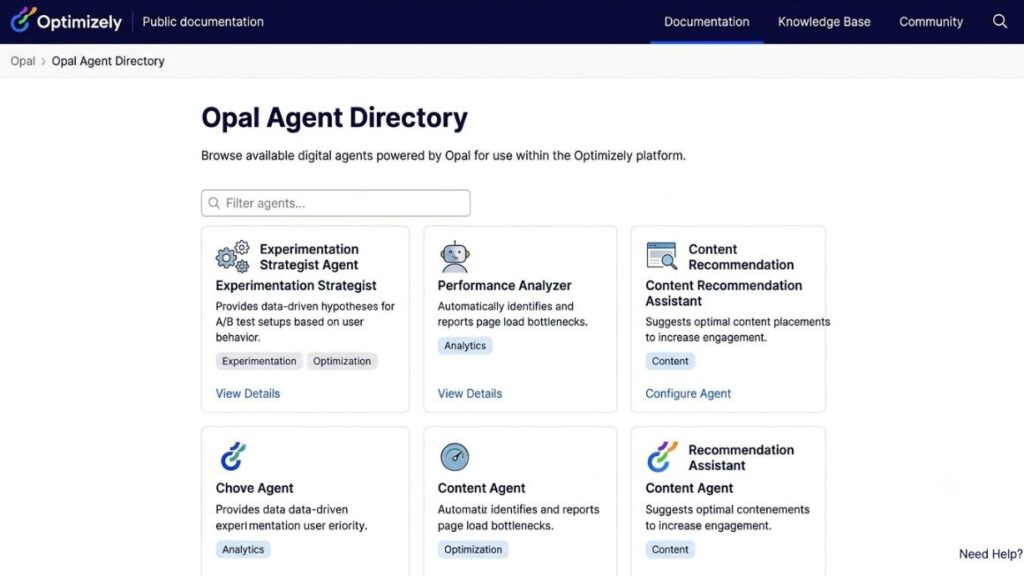
Optimizely Opal
Opal is Optimizely’s agent orchestration platform. Its Experiment Planning agent turns a raw idea into a full plan with hypotheses, metrics, risks and assumptions, according to Optimizely’s July 2026 support documentation. A Variation Development agent builds page-level experiments using automatic element detection, and an Experimentation Program Overview agent writes a quarterly-review style report on how your programme is performing.
Then there’s the CRO Manager. Optimizely announced its Virtual Teammates on 31 August 2026, and the CRO Manager monitors user behaviour, analyses competitor UX patterns and stages experiment configurations inside the platform. Optimizely says companies can decide where human review is required, and an independent write-up notes that a teammate proposes work for approval by default.
It’s an enterprise-scale option, and it makes the most sense if you already run Optimizely for testing or content, since Opal works across that connected stack.
Contentsquare Sense
Contentsquare comes from the behavioral analytics side, which is why its agent is strongest at diagnosis. Sense Analyst went live for beta customers in September 2025 and answers plain-language questions about journeys, friction and opportunities. Contentsquare says it cuts analysis time by up to 70% on average. That is a vendor claim worth testing on your own data. It fits teams that already have traffic and want to know where to test before they spend a sprint building.
The interesting part is what happens next. Through its agent-to-agent testing, Sense Analyst can hand a described change to Kameleoon or Optimizely, and the testing tool builds the variation. Kameleoon’s documentation says you still review and refine the variation, then set traffic, goals and duration yourself before launch. You’ll also need Kameleoon’s PBX add-on and its Chrome extension.
VWO
VWO launched Copilot in 2024 and has kept extending it. Its VWO AI assistant, introduced in June 2026, lets you point the AI at specific data by typing tags such as @recordings or @heatmaps. You can upload screenshots or competitor pages for context, then find a friction point and launch a test in the same conversation.
The Editor Copilot handles the build side. It generates variations from your prompts and can remix an existing variation into new versions. VWO suits teams that want testing, behaviour analysis and AI help in one place. It doesn’t publish list prices for its main plans, according to a 2026 review, so you’ll need a quote.
Newer autonomous and specialist CRO agents
A newer group of tools sells autonomy as the headline. pagent.ai positions itself as agentic experimentation for ecommerce, and Ryze AI describes itself as an agent that applies changes across CRO, paid acquisition and AI visibility for Shopify stores instead of only recommending them.
Treat those claims as vendor descriptions. Before you connect any AI agent for conversion rate optimization to a store that earns real money, do one thing. Ask for a live demo of an approval queue, a change log and a rollback. A single low-risk page is the safest pilot, because you can compare its results against a manual test.

How to compare AI CRO tools?
No platform wins every row. Optimizely is the natural fit for large teams already on its stack, Contentsquare for diagnosis-heavy programmes, and VWO for teams that want testing and behaviour analysis under one roof. Use this table instead of a feature checklist from a sales deck.
| Capability | Why it matters |
| Data access | Can it see real customer behaviour? |
| Diagnosis | Can it identify why conversion drops? |
| Hypothesis generation | Does it connect evidence to tests? |
| Variant creation | Can it actually build changes? |
| Experiment execution | Can it configure and run tests? |
| Monitoring | Can it detect problems? |
| Learning | Does it use previous results? |
| Human approval | Can you control autonomy? |
| Integrations | Does it connect to GA4, your CMS, Shopify and your testing platform? |
How to Implement an AI Agent for CRO?
Start small, give your AI agent for conversion rate optimization one job, and widen its remit only when it earns it. Here’s the sequence that works.
Step 1: Fix your measurement foundation
An agent reading broken data will confidently optimise the wrong thing. Before you switch anything on, check:
- conversion events
- revenue tracking
- attribution
- funnel events
- device segmentation
- data quality
Step 2: Define the business outcome
Don’t optimise blindly for conversion rate. A checkout tweak that lifts orders while pulling in low-value baskets isn’t a win. DRIP Agency’s database of tests on 90+ European ecommerce brands found winning tests lifted conversion by a median 1.88% and its revenue metric by 2.77%, so the two don’t always move together.
Choose the outcome your business actually needs:
- revenue per visitor
- qualified leads
- average order value
- profit
- checkout completion
- activation
Step 3: Choose one funnel first
Pick one path and stay on it:
- landing page to signup
- product page to add to cart
- cart to checkout
- checkout to purchase
If you’re starting with landing page optimization, a signup funnel is the fastest place to see whether the agent’s suggestions hold up.
Step 4: Connect the right data
Give the agent the sources it needs and nothing more: GA4, your ecommerce platform, your experimentation platform, session recordings, heatmaps, your CRM and customer feedback. An AI agent for conversion rate optimization only needs the data tied to the funnel you chose in step three. Extra access adds risk without adding insight.
Step 5: Set the autonomy level
Decide how much the agent may do before it’s allowed to do anything. Here’s a practical ladder:
- Level 1: AI recommends.
- Level 2: AI prepares the work.
- Level 3: AI executes with your approval.
- Level 4: AI executes within defined guardrails.
Most teams jump to Level 4 because the demo looked impressive. Don’t. Start at Level 2 or 3. Gartner’s own governance model, published in May 2026, classifies agents from read-only observation up to fully autonomous action, and says controls should match the level instead of treating every agent the same.
Step 6: Define guardrails
Write these down before the first test:
- approved pages
- traffic limits
- test duration
- sample-size rules
- primary metric
- rollback conditions
- brand rules
- approval requirements
This step gets skipped more than any other. Gartner’s May 2026 research predicts that by 2027, 40% of enterprises will demote or decommission autonomous agents because of governance gaps found only after production incidents. It also says autonomy and scope should be assessed separately. What an agent can do is one question. What it can reach is another.
Gartner’s May 2026 research warns that applying the same governance to every AI agent, regardless of autonomy level and scope, can lead to failure, and it predicts that 40% of enterprises will demote or decommission autonomous agents by 2027 because of governance gaps. For CRO, that means matching approvals, traffic limits and rollback rules to how much the agent is allowed to do.
Step 7: Run a 30-day pilot
Keep it tight:
- Week 1: baseline your funnel metrics.
- Week 2: let the agent identify opportunities and rank them.
- Week 3: launch the first tests.
- Week 4: evaluate what worked and refine the guardrails.
Don’t expect a big lift in 30 days. You’re checking whether the process works, not chasing a headline number.
How to Measure an AI CRO Agent’s Performance?
Measuring an AI agent for conversion rate optimization is different from measuring a campaign. You’re checking two things: whether conversion improved, and whether the agent earned its place. Track both, or you’ll credit the tool for wins that came from a seasonal spike. Teams that also watch experimentation velocity tend to spot a stalled programme sooner.
Business metrics
- Conversion rate
- Revenue per visit
- Average order value
- Lead quality
- Checkout completion
Experimentation metrics
- Tests launched
- Test velocity
- Win rate
- Time to launch
- Time to insight
- Percentage of inconclusive tests
Be careful with win rate. Optimizely’s analysis of more than 127,000 experiments found only 12% produced a statistically significant improvement on the primary metric. DRIP’s database, by contrast, shows 36.3% winners, 22.1% significant losers and 41.6% inconclusive tests. Definitions differ, so compare your agent against your own history, not someone else’s headline number.
Agent performance metrics
- Recommendation acceptance rate
- False-positive rate
- Time saved
- Percentage of tasks needing human intervention
- Revenue impact of accepted recommendations
Review these monthly. A low acceptance rate means the agent’s ideas aren’t landing. A very high one should make you ask whether anyone is really checking.
Also Read: Predictive Analytics in Marketing: A Complete Guide 2026
Where AI Agents Can Go Wrong in CRO
An AI agent for conversion rate optimization tends to fail in predictable ways, and most failures come from the setup, not the model. Gartner’s June 2025 prediction was that over 40% of agentic AI projects would be cancelled by the end of 2027 because of rising costs, unclear business value or weak risk controls. Its 2026 Hype Cycle places agentic AI at the peak of inflated expectations. Expect a shakeout.
Bad data creates bad recommendations
If tracking is wrong, the agent’s diagnosis is wrong, and it will present the mistake with total confidence.
Low traffic limits experimentation
Tests need enough visitors to reach a reliable result. DRIP’s median test ran 42 days. On a small site, an AI agent for conversion rate optimization can suggest ideas faster than your traffic can prove them.
Correlation isn’t causation
Users who watch a product video convert more. That doesn’t mean the video caused it. Only a controlled test answers that.
AI can optimize the wrong metric
More form submissions don’t mean more qualified leads. Contentsquare described its own experiment where AI summary pages lifted engagement but had no effect on conversions. Read the outcome metric, not the flattering one.
Too much autonomy can create expensive mistakes
An agent that can edit a live checkout can also break one. Limit its reach until it has a clean record. Gartner says the highest-autonomy tier needs continuous monitoring, enforced guardrails, fast rollback and circuit breakers that halt the agent when thresholds are breached.
AI-generated variations still need QA
Check every variant for:
- broken layouts
- inaccurate claims
- brand inconsistencies
- accessibility issues
- mobile problems
A winning test isn’t necessarily a winning business decision
A variant can win on clicks and lose on margin, returns or repeat purchases. Ask what the win costs before you ship it.
AI CRO for Ecommerce: What Changes for Indian Teams?
Indian ecommerce runs on mobile, UPI and trust, so an AI agent for conversion rate optimization needs those inputs to be useful. An agent tuned on Western benchmarks will misread Indian funnels. Use these as starting points, not universal rules.
Mobile-first behaviour
Razorpay’s April 2026 analysis says 85% of mobile carts in India are abandoned, driven by network latency, checkout complexity and limited payment options. Treat that as one attributed data point, not a benchmark.
UPI and payment friction
Razorpay also reports UPI intent flow works better than collect flow for mobile users. Ask your agent to compare payment-step completion by method.
COD and trust signals
Split funnels by COD and prepaid. Then test reviews, return policy and delivery-cost visibility.
WhatsApp and recovery journeys
Cart recovery through WhatsApp is worth testing against email, and an agent can compare the two. Ask it to compare recovery rates, not just message opens.
Regional and device segmentation
Razorpay points to packet loss in tier 2 and tier 3 cities. Segment by device and region before you blame the page.
What Is Next for Agentic CRO?
Expect agents to talk to each other. Contentsquare’s agent already hands tests to Kameleoon’s, and Optimizely’s teammates are built to work across products.
Whatever your AI agent for conversion rate optimization does on your own site, the visitor may already be halfway through a decision made inside an AI assistant. Traffic is changing too. Adobe’s July 2026 data showed AI-referral traffic to U.S. retail sites up 62% year on year, converting 60% better than non-AI traffic. As AI shopping agents and agentic commerce grow, and personalization moves toward predictive personalization, your pages will need to serve machines as well as people. Adobe has also found that a significant share of retail sites aren’t fully readable by the models sending that traffic.
Gartner predicts 33% of enterprise software applications will include agentic AI by 2028. Analytics and experimentation will keep merging.
Conclusion
AI doesn’t remove the need for CRO strategy. It changes how much of the repetitive work a team can delegate.
That’s the honest case for an AI agent for conversion rate optimization: it helps a team that already knows what good looks like do more of it. Three things matter most. Fix your data before you add an agent. Set the autonomy level deliberately, and write guardrails before the first test. Judge results by business outcomes, not by whether the tool feels clever.
If you want to build these skills properly, from setting up AI workflows to judging what an agent produces, the YUP Advanced AI Marketing Course is the place to go. It’s built for marketers who want to apply this at work, not just read about it.
Frequently Asked Questions
What is an AI CRO agent?
An AI agent for conversion rate optimization is software that analyses visitor behaviour, recommends or runs conversion tests, checks results and learns from them. How much it does on its own depends on the approval settings your team chooses.
How is an AI CRO agent different from an AI CRO tool?
A tool helps with one task when you ask. An agent works toward a goal across several steps, such as diagnosing a drop-off, drafting a test and reporting the result. Many products sit between the two.
Can an AI agent run A/B tests?
Some can set them up. Contentsquare’s agent can pass a described change to Kameleoon or Optimizely, which builds the variation. In most setups, a person still reviews and launches the test.
Do you need a lot of website traffic to use an AI CRO agent?
Testing needs traffic. DRIP’s median test ran 42 days, so a small site will wait longer for reliable results. With low traffic, use the agent for diagnosis and prioritisation first.
Can AI replace a CRO specialist?
Not today. Gartner’s 2026 Hype Cycle says fully autonomous agents aren’t ready for most enterprise use cases. An agent takes repetitive analysis and setup off your plate. Strategy, judgement and accountability stay with people.
How much do AI CRO tools cost?
It varies widely. A monday.com guide says AI CRO platforms typically cost $500 to $5,000 per month, and puts Optimizely’s full suite at around $50,000 a year. VWO doesn’t publish list prices. Treat all of it as an estimate and ask vendors for quotes.
Is it safe to let an AI agent change a live website?
Only with guardrails. An AI agent for conversion rate optimization shouldn’t get write access to a live checkout on day one. Start with approvals on, limit the pages and traffic it can touch, and keep rollback ready. Widen its autonomy only after it has a clean record.