

Every fresher who wants to end up managing a brand asks the same question in a hundred different ways. Should I take the marketing executive job at a mid-size company, or hold out for an MBA and try for an ABM seat at an FMCG major? Is client servicing at an agency a dead end or a legitimate route in? The honest answer is that there isn’t one path. Most of the confusion around entry-level jobs that lead to brand management comes from people assuming there’s a single correct on-ramp. There are at least seven that actually work.
This guide walks through each of them, what recruiters actually look for at each stage, and how long the climb really takes based on where you start.
Table of Contents
What Does a Brand Manager Actually Do? (So You Know What You’re Working Toward)
A brand manager owns the P&L, positioning and go-to-market strategy for a product or product line, and is measured on market share, revenue, and brand health metrics rather than individual campaigns. That’s the standalone definition. Everything else is detail.
On a normal week, a brand manager might sit in a pricing review in the morning. They may brief a creative agency on a new campaign at noon and review category performance data with sales in the afternoon. They don’t execute the ad or design the pack. But they’re accountable for whether it worked. That distinction matters because it changes what “relevant experience” means. A brand manager needs people who’ve already touched P&L thinking, cross-functional coordination and consumer data. They don’t just want people who’ve run a few Instagram campaigns well.
This is why the entry point you pick shapes your trajectory more than most people realise. A digital marketing executive who has only ever optimised ad spend has a different, narrower skill set than a marketing executive who’s coordinated a product launch across sales, trade, and creative. Both can get to brand management. One route usually gets there faster.
A brand manager owns the strategy, positioning and P&L performance of a product or brand, not just its marketing execution. This distinguishes the role from adjacent titles like digital marketing executive or campaign manager. That explains why FMCG companies weight cross-functional exposure heavily when hiring for the role.
Top Entry-Level Jobs That Lead to Brand Management
Marketing Executive: The Most Common Entry Point Into Brand Management
Recruiters treat the marketing executive role as a natural feeder into brand management because it exposes freshers to the full marketing mix early, not just one channel. This is usually where it starts if you’re building a brand management career path without an MBA.
A marketing executive at a mid-size FMCG, consumer durables, or retail company typically supports campaign execution, coordinates with agencies, tracks competitor activity and assists with launch logistics. None of that is glamorous. But it puts you in the room for decisions a specialist channel role never would.
The progression from marketing executive is fairly standard: two to three years in, you move to senior marketing executive or associate brand manager, where you start owning smaller product lines or regional launches independently. From there, the jump to assistant brand manager or brand manager typically takes another two to four years. That depends on company size and how much ownership you’re given early.
Honestly, this is the route most Indian marketers actually take, even though the MBA-to-ABM path gets more attention online. Companies like Dabur, Godrej Consumer Products and Marico regularly promote marketing executives into brand roles internally rather than hiring only from campus. That internal mobility is worth factoring in when you’re choosing where to start.
Assistant Brand Manager (ABM): The Direct Route (Mostly for MBAs)
The assistant brand manager role is the closest thing to a direct entry point into brand management. It’s almost entirely reserved for MBA graduates from top-tier institutes. FMCG majors like Hindustan Unilever (HUL), ITC and Marico run structured management trainee programmes that hire ABMs straight out of B-school. They put them on a defined path to brand manager within three to four years.
There are rotations designed around live business projects rather than shadowing. ITC and Marico run comparable structured trainee tracks. Most recruiting happens through campus placements at IIMs, ISB, XLRI and a handful of other top MBA in marketing programmes.
This route is faster but narrower. If you get in, the ladder is clear. ABM to brand manager typically takes two to four years. The company invests heavily in training you. If you don’t have the MBA pedigree these companies recruit from, this specific door is mostly closed. However, the marketing executive and market research routes below lead to the same destination eventually.
Compensation reflects how competitive this entry point is. According to Glassdoor’s December 2025 salary data, the average assistant brand manager salary in India sits at roughly ₹13.4 lakh per year, with a typical range between ₹8 lakh and ₹18.7 lakh depending on company and experience. Top earners at the 90th percentile cross ₹23 lakh. PayScale’s 2026 data puts the average base closer to ₹11.8 lakh, which gives you a realistic band to negotiate within.
The assistant brand manager role is the fastest documented route into brand management. But it’s largely gated by MBA pedigree at FMCG majors like HUL, ITC and Marico. According to Glassdoor’s December 2025 data, ABMs in India earn an average of ₹13.4 lakh annually. The top decile crosses ₹23 lakh which reflects how selective and well-compensated this entry point is.
Market Research and Consumer Insights Roles
Here’s the thing about brand management that most people underestimate: it’s built on consumer data. Market research is where you learn to read it properly before you’re responsible for acting on it.
A market research analyst spends their days running surveys, analysing focus group transcripts and building consumer segments. That sounds distant from brand strategy. It isn’t. Every brand manager’s biggest decisions, whether to reposition a product, which consumer segment to chase and how to price against a competitor, rest on exactly this kind of data. Someone who’s spent two years inside consumer insights walks into a brand role already fluent in the language brand managers use to justify their calls to leadership.
Nielsen, Kantar and in-house insights teams at companies like Nestlé and Britannia are common starting points for this route. The transition usually happens laterally, from research analyst to brand or category executive. That’s the case once you’ve built enough domain familiarity in a specific sector (personal care, food and beverage, and so on) to be useful on the brand side.
It’s a slower path than the ABM route. But it produces brand managers who are unusually good at defending their strategy with data, which is a real differentiator once you’re actually in the role.
Trade Marketing and Category Roles
Trade marketing gets overlooked constantly, and that’s a mistake. It teaches commercial judgment that pure brand-side roles don’t.
A trade marketing executive works the retail and distribution side: negotiating shelf space, running in-store promotions, managing distributor relationships and understanding what actually moves product at the point of sale. Brand managers who’ve never done this often build campaigns that look great on a deck and fall flat on the shop floor. That is because they don’t understand retail economics or channel incentives.
Category roles sit adjacent to this. A category executive at a retailer or FMCG company manages pricing, assortment and promotional calendars for an entire product category, not just one brand. This builds the kind of portfolio-level thinking senior brand managers eventually need anyway.
The field exposure here is genuinely undervalued. If you’re weighing entry-level jobs that lead to brand management and you get an offer in trade marketing at a company like Dabur or Britannia, don’t treat it as a consolation prize. It builds instincts the desk-only roles don’t.
Client Servicing at a Marketing or Creative Agency
Agency-side client servicing is a legitimate, if underrated, entry point into brand management. It works because the job forces you to think like the client from day one.
A client servicing executive at an advertising or creative agency manages the relationship between the agency and the brand. They translate business objectives into creative briefs and manage campaign delivery. You’re not making brand decisions, but you’re in every meeting where they’re made, watching how brand managers on the client side actually think through problems.
What transfers well: brief-writing, stakeholder management, campaign thinking and a genuine understanding of how creative execution connects to brand objectives. What doesn’t transfer as cleanly: P&L ownership and category-level strategic thinking, since agency roles rarely expose you to the commercial side of a brand’s business.
The typical move is from agency client servicing directly into a brand or marketing role on the client side, often at the very brand you serviced, since you’ve already built the relationship and proven you understand their business. It’s a slower route than the ABM track, generally three to five years before you’re managing a brand independently, but it’s one of the more accessible entry points for people without an MBA.
Product Marketing and Digital Marketing Executive Roles
The line between product marketing, digital marketing, and brand management has gotten blurrier every year, particularly at D2C and SaaS companies, and that blurring works in your favour if you’re trying to break in.
When Product Marketing Overlaps With Brand Management
A product marketing manager at a company like Zepto or Freshworks owns positioning, messaging and go-to-market for a specific product. That is functionally close to what a brand manager does for a physical product at an FMCG company. The core skill, translating what the product does into why a customer should care, is identical. The difference is mostly semantic and industry-specific rather than a real functional gap.
When Digital Marketing Experience Is Enough
A digital marketing executive role, on the other hand, is narrower by design: campaign execution, performance tracking, channel optimisation. It’s a legitimate starting point, but on its own it rarely gets you straight into brand management, because it doesn’t build the strategic and cross-functional muscle brand roles need. What does work is a digital marketing executive who deliberately pushes for exposure beyond their channel, sitting in on brand strategy meetings, asking to own a full campaign end to end, rather than staying purely execution-focused.
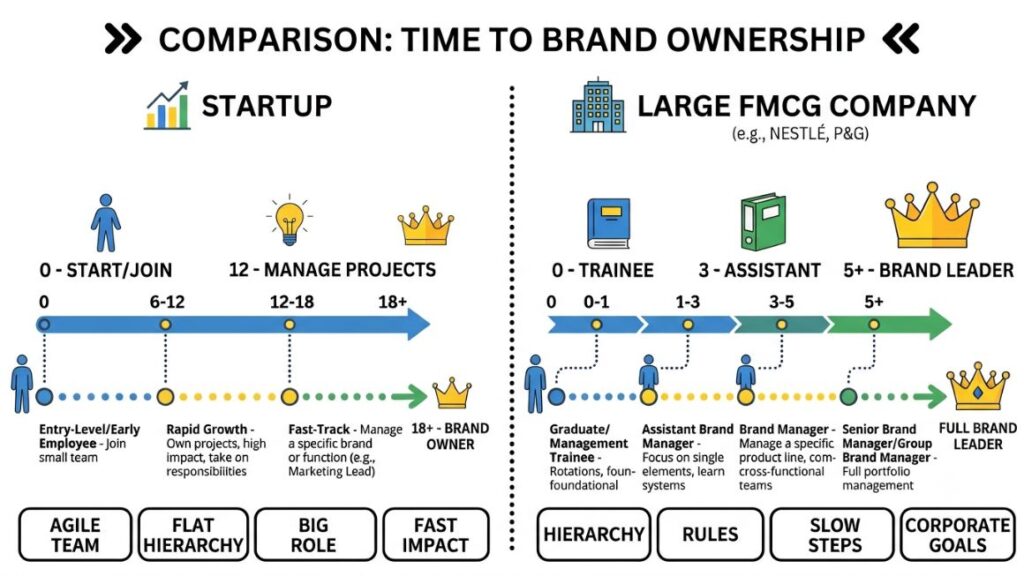
Startups move faster here than FMCG companies do. A digital marketing executive at a fast-growing D2C brand like Mamaearth or boAt can end up with brand-level ownership in eighteen months, purely because the team is small and someone has to own it. At a large FMCG company, the same jump might take three or four years because the structure is more layered.
Sales and Business Development: The Unconventional Entry Point
This one surprises people, but a stint in consumer-facing sales or business development is a legitimate, if slower, route into brand management.
Sales roles put you closer to the customer and the retailer than almost any other entry point. You learn, viscerally, what objections a buyer actually has, what a distributor actually cares about, and where a brand’s messaging breaks down in the real world instead of in a research report. Brand managers who’ve done a sales stint tend to be far more grounded in commercial reality than those who’ve only worked on the marketing side.
The transition usually runs through trade marketing or a regional marketing role first, rather than jumping straight from sales to brand management. It’s not the fastest path. It’s arguably the one that produces the most commercially sharp brand managers, because they’ve already been on the receiving end of a campaign that didn’t land with retailers.

What Skills You Need to Build Regardless of Which Job You Start In
No matter which of these entry-level jobs that lead to brand management you take, the underlying skills you need are the same, and most people don’t build them deliberately.
- Data-to-story translation: the ability to take a spreadsheet of consumer or sales data and turn it into a decision someone can act on, not just a chart
- Cross-functional collaboration: working effectively with sales, finance and creative teams who don’t report to you and don’t share your priorities
- Tool fluency: comfort with tools like Salesforce for customer data, Asana or similar for campaign project management and Tableau or Power BI for reporting
- Campaign planning end to end: owning a campaign from brief to post-launch analysis, not just the execution middle
- Commercial literacy: reading a P&L, understanding margin and connecting marketing spend to business outcomes
Most marketers pick up two or three of these naturally in their first role and never deliberately go after the rest. That’s the single biggest thing that separates people who move into brand management in three years from people who are still marketing executives after six.
How Long Does It Actually Take to Become a Brand Manager?
The honest range is two to six years. Where you land in that range depends almost entirely on your entry point and how aggressively you push for cross-functional exposure.
| Entry Point | Typical Time to Brand Manager | Typical Salary Trajectory |
| ABM via MBA (FMCG major) | 2 to 4 years | ₹13L (ABM) to ₹20L+ (BM) |
| Marketing executive | 4 to 6 years | ₹3 to 4.5L (fresher) to ₹15 to 25L (BM) |
| Client servicing (agency) | 3 to 5 years | ₹3 to 5L (fresher) to ₹15 to 20L (BM) |
| Digital marketing executive (D2C/startup) | 2 to 4 years | ₹3 to 5L (fresher) to ₹15 to 22L (BM) |
| Trade marketing / sales | 5 to 7 years | ₹3 to 4L (fresher) to ₹12 to 20L (BM) |
On salary specifically, brand manager compensation in India varies sharply by company and sector. According to a 2025 guide from upGrad, Unilever pays brand managers an average of ₹29.18 lakh a year, ITC pays around ₹32 lakh and Asian Paints averages ₹30.77 lakh. These are figures that sit well above the broader market. PayScale’s 2026 data puts the national average brand manager salary at a more modest ₹9.81 lakh. That reflects the fact that most brand manager roles in India sit outside the top FMCG majors and pay considerably less.
The spread is the real story here. A brand manager at a legacy FMCG giant and a brand manager at a mid-size regional company can be doing similar work for a 3x difference in pay, so where you land matters almost as much as the title itself.
Brand manager salaries in India range from roughly ₹9.8 lakh at the national median, per PayScale’s 2026 data, to ₹29-32 lakh at top FMCG employers like Unilever and ITC, according to a 2025 upGrad salary guide. The gap reflects company tier far more than it reflects individual skill. This is why choosing the right employer matters as much as choosing the right entry-level job.
Brand Management Career Path at a Glance
There isn’t one fixed brand management career path. Most routes follow the same broad progression:
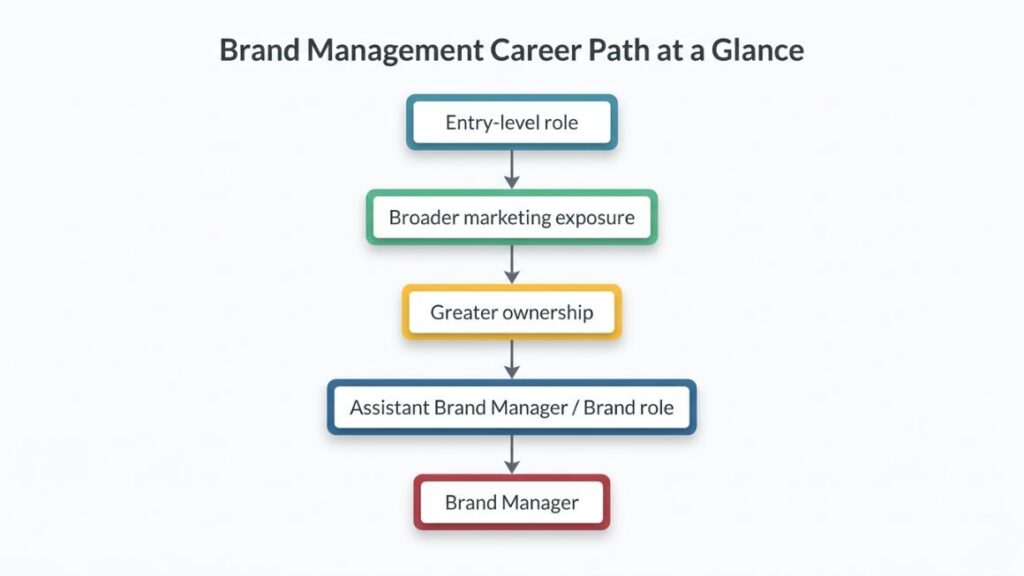
Entry-level role → broader marketing exposure → greater ownership → Assistant Brand Manager / Brand role → Brand Manager
Your first job might be in marketing, market research, trade marketing, client servicing, product marketing, digital marketing or sales. The important shift is from executing individual tasks to taking ownership of campaigns, consumers, budgets, launches and cross-functional projects.
The exact titles and timeline vary by company and industry. What matters is whether each move gives you broader exposure and more responsibility than the role before it.
Also Read: Brand Management vs Brand Marketing: Key Differences Explained
Which Entry-Level Job Should You Choose?
| If you want to build… | Consider starting in… | Why it helps |
| Broad marketing exposure | Marketing Executive | Builds campaign, agency and launch experience |
| Consumer and data skills | Market Research | Builds research and consumer insight skills |
| Commercial and retail understanding | Trade Marketing | Builds pricing, distribution and retail exposure |
| Brand and campaign experience | Client Servicing | Builds briefs, stakeholder and campaign experience |
| Positioning and GTM skills | Product Marketing | Builds messaging and go-to-market experience |
| Digital and performance skills | Digital Marketing | Builds channel, campaign and data skills |
| Customer and sales understanding | Sales / Business Development | Builds direct customer and commercial exposure |
Common Mistakes That Slow Down the Path to Brand Management
Most delays aren’t about talent. They’re about avoidable choices early in the career ladder in marketing.
Staying too narrow in one channel is the biggest one. A digital marketing executive who spends four years only running Meta and Google campaigns without ever touching strategy, budget ownership or cross-functional work may struggle to make the jump to brand management, even with strong execution skills. That is because the role needs breadth they never built.
Not asking for cross-functional exposure is a close second. Nobody hands you a seat in the pricing meeting. You have to ask for it, volunteer for the launch that needs someone from marketing to coordinate with sales, and make it visible that you want the broader view.
Skipping data skills is the third. Brand managers who can’t read their own campaign data or build a basic forecast lean entirely on other teams for numbers they should own themselves. That dependency shows up in performance reviews eventually.
Conclusion
There isn’t a single correct entry point into brand management, and the sooner you stop looking for one, the sooner you can get serious about the path you’re actually on. The MBA-to-ABM route is fastest if you can get in. Marketing executive, trade marketing, client servicing, and even sales roles all get you there too, just on a longer and, in some ways, more commercially grounded timeline.
What actually moves the needle, regardless of which door you walked through, is whether you’ve deliberately built cross-functional exposure and data fluency rather than waiting for someone to hand it to you.
If you’re trying to figure out exactly which skills to prioritise for your specific starting point, the Crystal Clear newsletter breaks down real career moves like this one every week, with the kind of practical detail job descriptions never give you.
FAQs
What is the fastest entry-level job into brand management?
The assistant brand manager route via an MBA at a top FMCG company like HUL, ITC, or Marico is the fastest, typically two to four years to brand manager. It’s also the most selective, since these companies recruit almost exclusively from a handful of top B-schools through campus placements.
Can a digital marketer become a brand manager?
Yes, particularly at D2C and startup companies where roles are less siloed. A digital marketing executive who pushes beyond channel execution into campaign strategy and cross-functional work can move into brand management in two to four years, faster than the traditional FMCG timeline.
Is an MBA compulsory for brand management?
No, but it significantly narrows the timeline for one specific route. Marketing executives, market research analysts and client servicing professionals regularly become brand managers without an MBA. But the journey usually takes longer, four to six years rather than two to four.
Marketing executive vs. assistant brand manager, what’s the real difference?
A marketing executive typically supports execution across campaigns and channels without P&L ownership. An assistant brand manager already holds partial ownership of a product’s strategy and budget under a brand manager’s guidance. The marketing executive to brand manager path usually runs through a senior executive or associate brand manager step first.
How do I move from trade marketing into brand management?
The typical path runs through a regional or category marketing role before brand management, since it bridges the field-level commercial experience trade marketing builds with the brand-side strategic work you’ll need. Most companies value this route precisely because it produces brand managers who understand retail economics.
Is client servicing at an agency actually a good entry point?
Yes, if you deliberately push for exposure to campaign strategy and client business context rather than staying purely in project coordination. The typical move is from agency client servicing into a brand or marketing role on the client side, often three to five years in.
What is the average assistant brand manager salary in India?
According to Glassdoor’s December 2025 data, the average assistant brand manager salary in India is around ₹13.4 lakh per year, with a typical range of ₹8 lakh to ₹18.7 lakh depending on company and location.
Do I need to work in FMCG specifically to become a brand manager?
No. Brand management roles exist across e-commerce, technology, retail and consumer tech. Companies like Amazon, Flipkart and Zepto are hiring for brand and product marketing roles that function similarly to traditional FMCG brand management, sometimes with faster ownership timelines.
Is brand management worth pursuing if I’m already three years into a marketing executive role?
Yes, and arguably you’re better positioned than someone starting from an MBA, provided you’ve built cross-functional exposure in those three years. The gap that matters isn’t years of experience, it’s whether you’ve owned a launch, a budget or a cross-team project independently.
What’s the biggest mistake people make trying to break into brand management?
Staying too specialised in one channel or function without proactively asking for broader exposure. Brand management rewards people who’ve touched strategy, data, and execution together, not people who’ve only ever gone deep on one piece of the marketing mix.