
Most people use these two terms interchangeably. Most companies confuse the two roles when hiring. And most professionals trying to build a career in branding can’t clearly explain the difference in an interview.
That’s a problem – because brand management and brand marketing are genuinely distinct disciplines. They overlap, yes. But they own different things, operate on different timescales, and require a different way of thinking. Getting this wrong at the company level leads to brand inconsistency. Getting it wrong at the career level means you end up in the wrong role.
This article breaks down exactly how Brand Management vs Brand Marketing are different, and what each function does, where they diverge, how they work together, and how to decide which path is right for you.
Table of Contents
What is Brand Management?
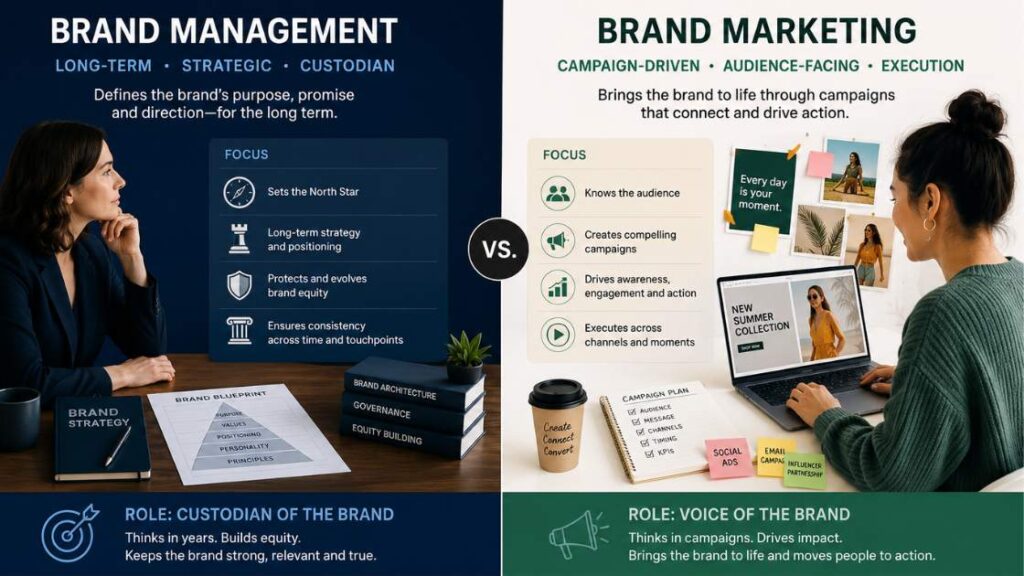
Brand management is the long-term strategic function responsible for defining, protecting, and evolving what a brand stands for. A brand manager owns the brand’s identity – its positioning, personality, values, visual language, and the guidelines that govern how it shows up across every touchpoint.
Think of brand management as custody. The brand manager is the custodian of the brand’s equity. Their job is to ensure that every product launch, every campaign, every piece of communication adds to that equity rather than diluting it. They’re playing a long game.
Hindustan Unilever is a good example to understand this at scale. HUL’s brand managers for Dove don’t run individual campaigns – they own the Dove positioning across markets and product categories. When Dove launched its Real Beauty campaign in India, the brand manager’s job was to ensure the campaign was consistent with the brand’s global equity while being relevant to the Indian consumer. That’s brand management: protecting the essence while allowing for local execution.
At a startup, brand management often doesn’t exist as a formal function until the company is big enough to worry about consistency. Before that point, the founder is effectively the brand manager. Which is why a lot of early-stage startups have a confused brand – no one is explicitly custodying it.
Brand management is the strategic function responsible for defining and protecting a brand’s long-term identity, positioning, and equity. Brand managers set the rules by which the brand shows up across products, campaigns, and touchpoints. Their primary metric is brand equity – the cumulative value and perception that a brand builds over time in the minds of its audience.
What is Brand Marketing?
Brand marketing is the function responsible for building awareness, affinity, and preference for a brand through communication and campaigns. A brand marketer takes the brand’s positioning and translates it into content, campaigns, activations, and experiences that reach the target audience.
If brand management is about defining what the brand is, brand marketing is about making sure people know and feel it.
Brand marketers work on a shorter cycle. They’re running campaigns, managing social presence, producing content, building partnerships, and measuring how audiences respond. Their work is visible. It’s what most people picture when they think of “branding” – the ads, the influencer collabs, the brand films, the Instagram aesthetic.
Mamaearth is a useful Indian example here. Their brand positioning is built around natural, toxin-free products for conscious consumers. Brand marketing at Mamaearth is the function that brings this to life – through YouTube ads, influencer partnerships with parenting creators, Goodness Inside campaigns, and cause-led communication around planting trees. The positioning is set. Brand marketing’s job is to make it land with the right audience.
Brand marketing is also where most companies’ day-to-day branding activity actually happens. It’s the more execution-heavy side of the two functions.
Brand marketing is the execution-focused function that builds awareness and emotional connection between a brand and its audience through campaigns, content, and communication. Brand marketers work within the positioning and identity set by brand management, translating it into creative work that reaches consumers at scale.
Brand Management vs Brand Marketing: The Core Differences
Here’s where most explainers stay surface-level. Let’s go deeper.
Timescale
Brand management operates on a multi-year horizon. A brand manager might spend two years refining positioning before a single campaign is briefed. Brand marketing operates on a quarterly or even monthly cycle. They’re constantly shipping — campaigns, content, activations. The pressure is different. The rhythm is different.
What they own
Brand management owns the brand architecture — the positioning statement, the brand identity system, the tone of voice guidelines, the naming conventions, the rules for how sub-brands relate to the parent brand. These are documents that live for years and govern thousands of decisions downstream.
Brand marketing owns the plan for how the brand shows up in the market in a given period – the campaign calendar, the media strategy, the content mix, the creative briefs, the activation strategy.
How success is measured
Brand management is measured on brand health metrics: brand awareness (aided and unaided), brand consideration, brand preference, net promoter score, and brand equity scores from periodic research. These move slowly. A brand manager might run brand tracking research twice a year.
Brand marketing is measured on campaign metrics: reach, impressions, engagement rate, brand recall lift, share of voice, and sometimes downstream metrics like website traffic or search volume for brand terms. These move fast and are reported often.
Where decisions get made
Brand management decisions tend to be inward-facing and long-term. Should we reposition the brand? Does this new product extension fit our brand architecture? Are we consistent across markets? These are strategic questions answered in boardrooms and brand reviews.
Brand marketing decisions are outward-facing and near-term. Which campaign idea best expresses our positioning? Which platform should we prioritise this quarter? How do we respond to a cultural moment that’s relevant to the brand? These are answered in creative reviews and marketing meetings.
Who they collaborate with
Brand managers work closely with product teams, senior leadership, and often external brand strategy consultancies. They’re often involved in M&A discussions, portfolio strategy, and pricing decisions – because all of these affect brand equity.
Brand marketers work closely with creative agencies, media teams, PR, social media managers, and content creators. Their world is external-facing and execution-oriented.
How the Two Roles Work Together (and Where They Conflict)
In a well-functioning brand organisation, brand management sets the brief and brand marketing executes against it. The brand manager hands over the positioning and identity guidelines. The brand marketer translates those into a campaign that’s on-brand, on-audience, and on-budget.
That’s the theory. In practice, tension is common.
The most frequent source of conflict is timescale. Brand managers think in years. Brand marketers think in quarters. When a campaign needs to go out and the brand manager wants to spend three more months refining the positioning, something has to give. At most companies, the campaign wins. Which is why you’ll often see brand marketing running ahead of brand strategy — and why brands feel inconsistent over time.
The second source of conflict is measurement. Brand management’s metrics are slow and qualitative. Brand marketing’s metrics are fast and quantitative. In organisations that are heavily performance-driven (most startups, most D2C brands), the brand manager’s slower, harder-to-measure work gets deprioritised in favour of what’s generating clicks and conversions this week. The brand erodes gradually. No single decision caused it. The drift just accumulates.
BoAt is a good case study. Their early brand marketing was excellent – high energy, youth-led, disruptive. But as they scaled, the brand started to feel stretched: too many product lines, inconsistent communication across categories, a positioning that had blurred. That’s a brand management problem, not a brand marketing problem. The campaigns were fine. The brand architecture wasn’t being managed tightly enough.
The fix isn’t to pit the two functions against each other. It’s to make their roles explicit and their handoffs clear.
Brand management and brand marketing work best when the former sets strategy and the latter executes it. The most common failure mode is when brand marketing runs faster than brand strategy can keep up – producing campaigns that are individually effective but collectively inconsistent. Over time, this erodes the brand equity that brand management is responsible for building.
Which Role Does Your Company Actually Need Right Now?
This depends almost entirely on your stage and your biggest brand problem.
You need brand management if:
- Your brand feels inconsistent across touchpoints and no one is responsible for fixing it
- You’re launching sub-brands or entering new categories and need architecture decisions
- You’re rebranding or repositioning after growth, a merger, or a reputation issue
- You’ve scaled fast and the brand identity has drifted from what it was at the start
- You’re preparing for fundraising or acquisition and need to articulate brand equity clearly
You need brand marketing if:
- Your brand positioning is clear but not enough people know who you are
- You have a defined identity but it’s not showing up consistently in campaigns
- You’re entering a new audience segment or geographic market
- You want to build emotional affinity, not just performance-driven awareness
- Your competitors are louder in the market and you need to close the share-of-voice gap
Most early-stage companies need brand marketing before they need formal brand management. You build awareness first. But most companies that have scaled past Series B and feel like their brand is slipping need to invest in brand management – even if they haven’t named the problem that way.
Honestly, the right answer for most mid-size companies is both, with a clear hierarchy. Brand management sets the rules. Brand marketing operates within them.
Brand Management vs Brand Marketing as a Career: Which Path Should You Choose?
Both are legitimate, high-value career tracks. But they suit different people.
Choose brand management if:
You think in systems. You’re comfortable with ambiguity and long timescales. You like working on problems that don’t have a single right answer. You’re drawn to research, strategy, and the challenge of building something durable. You’re less interested in the daily execution grind and more interested in the big-picture decisions that shape how a company is perceived over years.
The typical career path runs from assistant brand manager (ABM) at an FMCG company like HUL, P&G, or ITC through brand manager, senior brand manager, and into category or portfolio leadership. These companies still run some of the best brand management training programmes in the world – the P&G brand management track is widely regarded as a gold standard.
Choose brand marketing if:
You’re energised by campaigns and creative work. You like fast feedback loops. You want to see the results of your work quickly. You’re comfortable with content, social media, creative briefing, agency management, and the operational side of getting campaigns out the door. You’re good at connecting a brand idea to a cultural moment and moving fast.
Brand marketing careers are more varied in where they start. You can enter through content, social media, PR, digital marketing, or a generalist marketing role. The path upward typically runs through campaign management, brand marketing manager, and into head of brand or VP Marketing roles.
The honest career advice
If you’re early in your career and want to build strong brand fundamentals, FMCG is still the best training ground for brand management. The rigour is unmatched. If you want to move faster and work on more visible, campaign-led work, a D2C startup or a consumer tech company will give you more scope, more quickly.
The two paths are not mutually exclusive. The best brand leaders tend to have depth in one and fluency in the other. A brand manager who has never run a campaign has a blind spot. A brand marketer who has never thought about positioning architecture will hit a ceiling.
From what we’ve seen with learners in Young Urban Project’s Brand Management Course, the professionals who get the most out of it are often marketers who have been doing brand marketing for a few years and realise they’ve never been taught the strategic layer underneath. They know how to run campaigns. They don’t know how to build a positioning framework or manage brand architecture. That gap is exactly what the course addresses.
Frequently Asked Questions
What is the difference between brand management and brand marketing?
Brand management is the strategic function that defines and protects a brand’s long-term identity, positioning, and equity. Brand marketing is the execution function that builds awareness and affinity through campaigns, content, and communication. Brand management sets the rules. Brand marketing operates within them.
Is brand management the same as brand marketing?
No. Brand management and brand marketing overlap but are distinct disciplines. Brand management is strategic and long-term, focused on brand architecture and equity. Brand marketing is campaign-driven and shorter-cycle, focused on reaching and resonating with audiences. Many organisations conflate them, which leads to inconsistent brands.
Which is more important: brand management or brand marketing?
Neither is more important – they serve different purposes and are both necessary for a healthy brand. Early-stage companies typically need brand marketing first to build awareness. Scaling companies need brand management to ensure the brand stays consistent and intentional as it grows.
What does a brand manager do?
A brand manager owns a brand’s positioning, identity, and architecture. They define how the brand is differentiated in the market, set the guidelines that govern how the brand communicates across all channels, and work with product, marketing, and leadership teams to protect and grow brand equity over time.
What does a brand marketer do?
A brand marketer plans and executes campaigns, content, and activations that bring the brand’s positioning to life for its target audience. They manage creative briefs, agency relationships, campaign calendars, and brand marketing budgets. Their goal is to build awareness, affinity, and preference through communication.
What are the key metrics for brand management vs brand marketing?
Brand management is measured on brand health metrics: aided and unaided awareness, brand consideration, brand preference, and brand equity scores from periodic research. Brand marketing is measured on campaign metrics: reach, impressions, engagement, brand recall lift, and share of voice. Both matter – they just operate on different timescales.
Can one person do both brand management and brand marketing?
At small companies and startups, one person often does both. But as a company scales, the two functions need to be separated – or at minimum, explicitly owned. When one person is doing both, brand strategy tends to get sacrificed in favour of the more urgent, visible campaign work.
Which is a better career: brand management or brand marketing?
Both are strong career paths with clear progression. Brand management suits people who prefer strategy, systems thinking, and long-term problems. Brand marketing suits people who prefer execution, creative work, and fast feedback. The most effective senior brand professionals have depth in one and solid working knowledge of the other.
The Two Functions Are Not Rivals
Brand management and brand marketing are complementary, not competing. One without the other produces either a beautifully defined brand that no one has ever heard of, or a loud, visible brand that means something different every time you look at it.
The companies that get this right – think Tanishq, Asian Paints, or Amul at the Indian level – have a clear brand strategy at the centre and consistently strong marketing execution around it. The brand never feels accidental. It accumulates meaning over time. That doesn’t happen by chance. It happens because someone is managing the brand and someone is marketing it, and they’re working from the same playbook.
If you want to build that playbook – and the strategic skills to sit at the centre of it – Young Urban Project’s Brand Management Course is where to start. It’s built for marketing professionals who want to go beyond campaign execution and understand how brands are actually built, positioned, and managed for the long term.