

Most large companies spend crores on advertising and almost nothing on the one thing that makes advertising work – their brand.
Not the logo. Not the tagline. The actual, living system that tells people what a company stands for, why it exists, and why it’s worth trusting. That’s what corporate brand management is. And most corporations treat it as a design department problem rather than a strategic one.
The cost of ignoring it is real. Inconsistent messaging across markets. Customer confusion occurs when a company launches a new product line. Employees who can’t explain what the business actually stands for. And marketing spend that doesn’t compound because there’s no brand foundation underneath it.
This guide covers what corporate brand management actually involves, why it has a measurable impact on business value, and exactly how to build a system that works at scale.
Table of Contents
What Is Brand Management for Corporations?
Corporate brand management is the ongoing process of defining, communicating, and protecting the identity of a company as a whole, across every market, channel, and audience it operates in.
That’s the clean definition. But here’s what it actually covers in practice: how a company talks about itself to investors, employees, customers, regulators, and the press. How its visual identity is applied consistently across 12 different countries. How it handles a reputational crisis without unravelling a decade of trust-building. How it makes sure a campaign in Bengaluru doesn’t contradict the messaging in Berlin.
It’s not just the brand guidelines document sitting on a shared drive. Corporate brand management is a living system – with governance, tools, workflows, and people responsible for holding it together.
Take the Tata Group. They manage over 100 companies under a single corporate brand umbrella. Tata Steel, Tata Motors, Tata Consultancy Services, Titan, Tanishq – all distinct businesses, all carrying the weight and equity of the Tata name. That brand didn’t stay coherent by accident. It stayed coherent because of decades of deliberate corporate brand management, from the values embedded in their business conduct to the visual consistency of how “Tata” appears across every subsidiary.
Why Is Brand Management Important for Corporations?
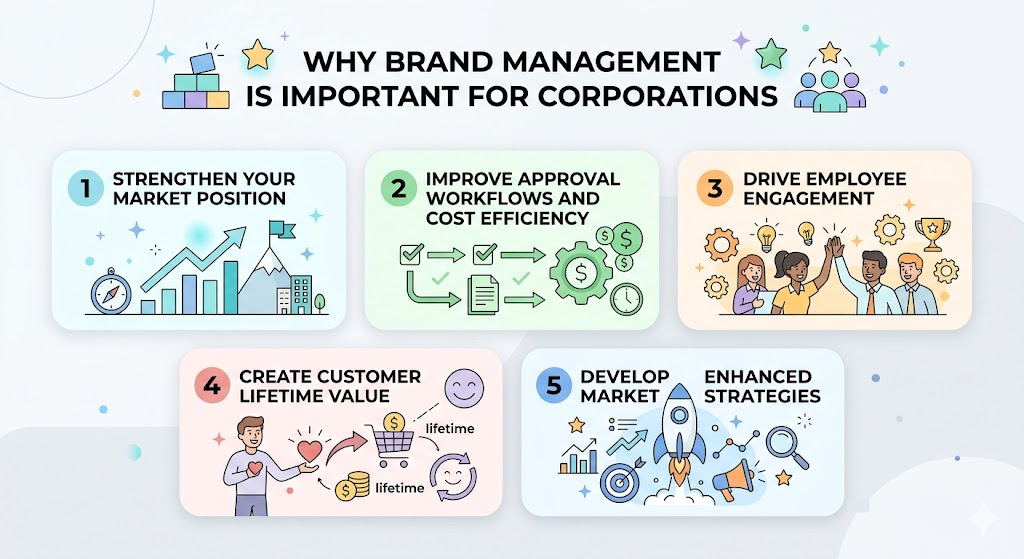
Corporate brand management gives companies a durable competitive edge that’s genuinely hard to copy. A competitor can match your pricing. They can replicate your product features. They can’t replicate what people feel and believe about your brand.
But that’s the long-term view. There are very immediate, operational reasons why it matters too.
Strengthen Your Market Position
A clearly managed corporate brand tells the market exactly where a company stands. It signals what values the business operates by, what kind of customers it serves, and what makes it different from the alternatives.
According to Interbrand’s 2023 Best Global Brands report, the top 100 global brands grew their combined value to $2.9 trillion, with companies like Apple, Microsoft, and Amazon leading not just on product innovation but on brand clarity and consistency. The brands that faltered were almost always the ones sending mixed signals.
In the Indian market, Infosys has done this well at the corporate level. Their brand consistently communicates reliability, technological depth, and client partnership – across decades, leadership changes, and global expansions. That consistency is a market position, not just a feeling.
Improve Approval Workflows and Cost Efficiency
When brand guidelines are clear and assets are centralized, marketing teams stop reinventing the wheel every quarter. Agencies don’t need four rounds of revisions to get the brand tone right. Regional teams don’t create off-brand materials because they couldn’t find the right template.
According to a 2022 Lucidpress report, brand consistency can increase revenue by up to 23% on average. A significant chunk of that gain comes from operational efficiency, not just perception shifts. Fewer approvals needed. Fewer errors reaching the public. Less time fixing brand violations after the fact.
Drive Employee Engagement
This one gets overlooked constantly. A strong corporate brand isn’t just an external tool. It’s an internal one.
Employees at companies with a clear, well-managed brand know what they’re building toward. They can answer “what does your company stand for?” without hesitating. Understanding appreciation vs recognition also plays an important role in building an engaged workplace, as employees who feel valued are more likely to embrace the company’s mission and values. According to Gallup’s 2023 State of the Global Workplace report, companies with highly engaged employees see 23% higher profitability. Brand clarity is one of the inputs that drives that engagement – it gives people a sense of purpose beyond their job description.
Create Customer Lifetime Value
A trusted corporate brand reduces the friction at every step of the customer journey. People are more willing to try a new product from a brand they already trust. They’re more forgiving of mistakes. They’re more likely to recommend.
Amazon is the clearest example. The corporate brand promise – fast, easy, reliable – has extended successfully into completely different categories: cloud computing with AWS, streaming with Prime Video, grocery with Amazon Fresh. Each expansion was made easier because the corporate brand did heavy lifting before the product launched.
Develop Enhanced Marketing Strategies
When the corporate brand is well-defined, every marketing decision becomes easier. Campaigns have a foundation to build on. Channel strategies have a voice to express. And performance marketing spend works harder because it’s reinforcing something people already have a feeling about, not starting from zero.
How Is Managing a Corporate Brand Different From Managing Other Companies?
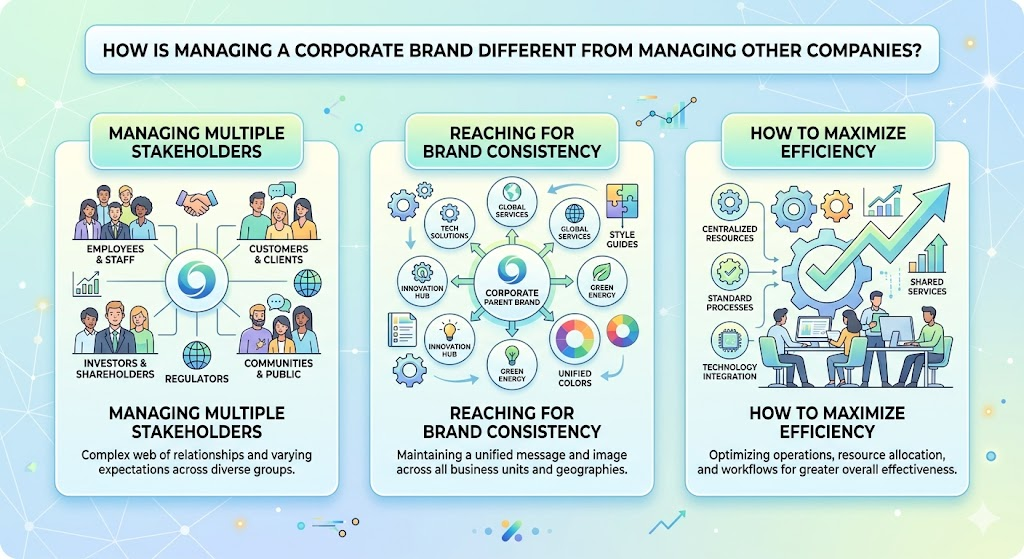
Managing a corporate brand at scale isn’t just a bigger version of managing a startup brand. The complexity is categorically different.
Managing Multiple Stakeholders
A startup has one primary audience: customers. A corporation has at minimum six: customers, employees, investors, regulators, the press, and the communities it operates in. Each of those audiences needs something slightly different from the brand – and all of those versions have to be consistent with each other.
Investors want signals of stability and long-term value. Employees want purpose and direction. Customers want reliability and relevance. Regulators want compliance and accountability. Managing a corporate brand means holding all of those simultaneously without contradicting yourself.
Reliance Industries does this across an extraordinary range of stakeholders – from retail consumers who shop at JioMart, to enterprise clients buying petrochemicals, to government bodies who regulate their telecom operations. The brand’s meaning shifts in register depending on the audience, but the core identity stays consistent.
Reaching for Brand Consistency Across Every Touchpoint
In a smaller company, two or three people can hold brand consistency together through direct oversight. In a corporation with 10,000 employees, 40 agencies, and operations in 15 countries, that’s not possible without systems.
Every external communication, from a press release in Mumbai to a product launch video in São Paulo, has to feel like it came from the same company. That requires centralized brand guidelines, accessible to everyone, and enforceable without becoming bureaucratic.
How to Maximize Efficiency Without Losing Brand Control
The tension in corporate brand management is always between control and speed. Lock things down too tightly, and regional teams can’t move fast enough to be relevant. Loosen the controls, and you end up with brand drift – where the identity slowly shifts until no one’s quite sure what it stands for anymore.
The most effective corporations solve this by establishing what’s fixed versus what’s flexible. The brand values, the visual system’s core elements, the tone of voice – those are non-negotiable. The way they get expressed in a Diwali campaign versus a B2B conference – that has room to move.
Corporate brand management at scale requires a system that distinguishes between what is fixed and what is flexible. Core identity elements – values, visual system, tone of voice – must be non-negotiable. Execution details should have room for regional and contextual adaptation. Without this distinction, corporations either lose brand coherence or lose operational speed.
The Impact of Corporate Brand Management on Business Value
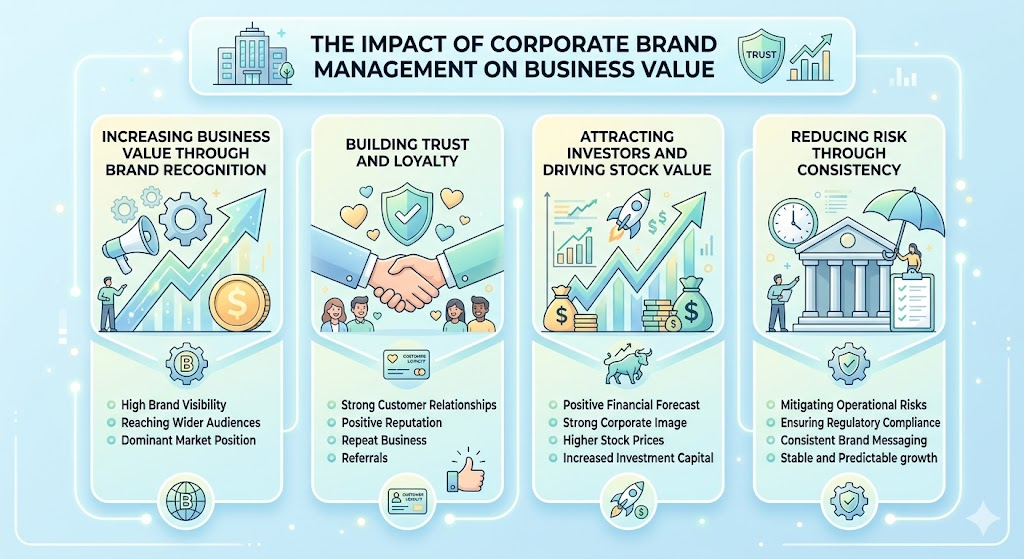
Strong corporate brand management shows up directly in the numbers. Not just in marketing metrics – in valuation, investment, and crisis resilience.
Increasing Business Value Through Brand Recognition
According to Brand Finance’s Global 500 2024 report, the world’s most valuable brands carry brand value that often represents 20-40% of total market capitalization. That’s not soft value. That’s what acquirers pay for, what analysts factor into forecasts, and what gives a company pricing power its competitors can’t match.
Brand recognition – the ability of people to identify a brand from its name, logo, or signals – is one of the key drivers of that value. It’s what allows Apple to charge a 30-40% price premium over comparable Android devices and still grow market share.
Building Trust and Loyalty That Survives a Crisis
When a company with a strong, well-managed brand makes a mistake, the trust buffer makes recovery faster. When a company with a weak or inconsistent brand makes the same mistake, the reputational damage compounds.
Johnson and Johnson’s handling of the 1982 Tylenol crisis is the textbook case. They pulled 31 million bottles from shelves, communicated transparently, and prioritized consumer safety over short-term profit. Their brand not only survived – it became stronger. That kind of response is only credible when the corporate brand has already established a track record of trustworthiness.
In the Indian context, when Zomato has faced public criticism over delivery partner treatment or pricing, the speed of their response and transparency in communication have reflected how seriously they treat the corporate brand – not just the app experience.
Attracting Investors and Driving Stock Value
Investors don’t just look at financials. They look at brand strength as an indicator of future earnings resilience. A company with strong brand equity can sustain margins better, enter new markets more efficiently, and weather competitive pressure more effectively than one without it.
According to a 2021 study published in the Journal of Marketing, companies ranked in the top quartile of brand strength consistently outperformed the S&P 500 by 35% over a 15-year period. That’s not a coincidence. Brand management is a long-duration financial asset.
Reducing Risk Through Consistency
Inconsistent corporate branding is a risk – legally, reputationally, and operationally. If different business units are communicating different things about what the company stands for, it creates vulnerability in regulatory scrutiny, media coverage, and public trust.
Consistent corporate brand management reduces that risk by creating a clear, defensible, documented identity that all communications are anchored to.
A strong corporate brand functions as a financial asset, not just a marketing one. Companies in the top quartile of brand strength have historically outperformed market benchmarks over extended periods. Brand consistency reduces reputational and regulatory risk while improving investors’ confidence in long-term earnings stability.
The Role of Technology in Modern Corporate Brand Management
You can have the best brand strategy in the world and still lose control of it if the infrastructure holding it together is broken.
Centralizing Brand Assets With Digital Asset Management
Digital Asset Management (DAM) is a platform for storing, organizing, and distributing brand assets – logos, photography, video, templates, fonts, brand guidelines – in one place that everyone in the organization can access.
Without a DAM, marketing teams waste hours hunting for the right asset version. Agencies download outdated logos because that’s what came up on Google. Regional teams build their own templates because they couldn’t find the official ones.
Tools like Bynder, Brandfolder, and Frontify are the most widely used enterprise DAMs. They go beyond storage – they include rights management, version control, and usage tracking, so brand managers can see exactly how and where assets are being used.
For fast-scaling Indian companies like Nykaa or boAt, a DAM isn’t a nice-to-have once you’re operating across 20 brand categories and multiple retail touchpoints. It’s the system that keeps the brand from fragmenting.
Automating Workflows to Minimize Human Error
Brand approval workflows – the process of reviewing, approving, and publishing brand communications – are one of the biggest sources of inconsistency in large organizations. Every manual handoff is a risk point.
Automating these workflows through brand management platforms means flagging off-brand content before it goes out, routing approvals to the right people without email chains, and keeping an auditable record of every decision made.
Enhancing Collaboration Across Teams
Corporate brand management involves marketers, designers, legal teams, PR, HR, and external agencies – often working across time zones. Without shared platforms and clear version control, collaboration becomes chaotic.
Centralized brand management tools give every stakeholder visibility into what’s been approved, what’s in progress, and what’s off-brand – without requiring every decision to escalate to a brand manager.
Scaling Brand Management With Ease
The real test of a brand management system is how well it holds up when the company grows. A system that works for a 50-person marketing team may completely break down when the company expands into three new markets and doubles headcount.
Good brand management technology is built to scale – with user permissions that control access without restricting creativity, and asset libraries that can grow without becoming disorganized.
6 Defining Principles of Corporate Brand Management
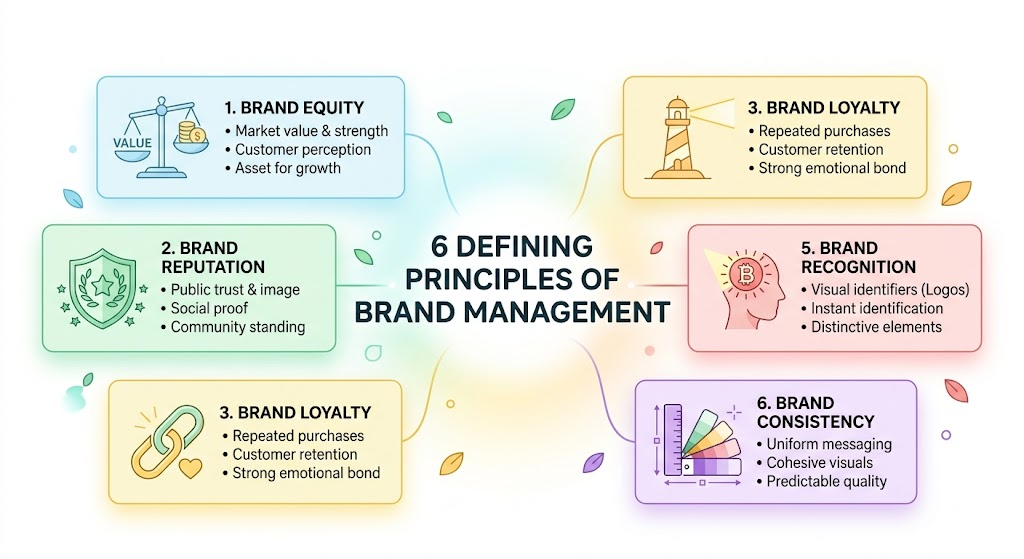
Every effective corporate brand management programme is built on a set of principles that guide every decision. Here are the six that matter most.
1. Brand Equity
Brand equity is the commercial value a brand adds to a product or service beyond its functional attributes. It’s why people pay more for a Sony television than a no-name equivalent, even when the specs are identical.
For corporations, brand equity is a financial asset that can be grown through consistent investment and protected through disciplined management. Companies like McKinsey and Company and WPP produce annual brand equity valuations for this reason – it’s measurable, it moves, and it matters to shareholders.
2. Brand Reputation
Brand reputation is what people say and believe about a company when it’s not in the room. It’s shaped by every interaction – product quality, customer service, employee treatment, public statements, and how the company behaves in a crisis.
Unlike brand identity, which is what a company says about itself, brand reputation is what others say. Managing it means actively monitoring perception, responding to criticism, and making sure the brand’s actions match its claims.
3. Brand Loyalty
Brand loyalty is the tendency of customers to repeatedly choose one brand over its competitors. It’s one of the most valuable assets a company can build because loyal customers cost less to retain, spend more over time, and refer others.
Apple’s retention rate consistently exceeds 90% in developed markets. That’s not just product quality – it’s the result of years of coherent brand experience across every touchpoint.
4. Brand Awareness
Brand awareness measures how familiar your target audience is with your brand. It’s the starting point for everything else – people can’t trust, prefer, or recommend a brand they’ve never heard of.
For corporations entering new markets, brand awareness is often the first and most important metric to move. Zepto built brand awareness extraordinarily fast in tier-1 Indian cities through a combination of speed-of-service and aggressive performance marketing – but awareness needed to come first.
5. Brand Recognition
Brand recognition is a more specific measure than awareness. It’s whether someone can identify your brand from visual or verbal cues alone, without being told the brand name.
McDonald’s golden arches. Coca-Cola’s red. Swiggy’s orange. These aren’t accidental – they’re the result of consistent, disciplined brand management over the years. Recognition is what makes advertising work faster and at a lower cost.
6. Brand Consistency
Brand consistency is the degree to which a company presents the same identity across every channel, market, and audience. It’s what makes a brand feel coherent, whether someone encounters it on Instagram, in a store, in a job listing, or in the news.
Consistency doesn’t mean rigidity. Brands can adapt their tone for different contexts while still feeling unmistakably like themselves. What it rules out is contradiction – saying one thing here and something incompatible there.
The six principles of corporate brand management – brand equity, brand reputation, brand loyalty, brand awareness, brand recognition, and brand consistency – are interdependent. A weakness in one creates drag on the others. Companies that invest equally across all six tend to build brand value that compounds rather than plateaus.
6 Steps to Corporate Brand Management Success
Step 1: Define Your Brand Identity and Positioning
Start by getting absolute clarity on who you are, who you’re for, and why you’re different. This isn’t about wordsmithing a tagline. It’s about answering three questions that every brand decision should flow from: what does this company stand for, who does it serve better than anyone else, and what would be lost if it disappeared?
Your brand positioning should be specific enough to exclude someone. A brand that’s for everyone is for no one.
Step 2: Build Comprehensive Brand Guidelines
Brand guidelines are the operating manual for your identity. They cover visual standards (logo usage, colour palette, typography, imagery style), tone of voice, messaging hierarchy, and usage rules for different contexts.
But guidelines only work if people can find and actually use them. A 200-page PDF on a shared drive isn’t a guideline – it’s a document. Good brand guidelines are accessible, searchable, and built into the tools teams use every day.
Step 3: Strengthen Corporate Communications
Corporate communications – the way the company speaks to investors, employees, the media, and the public – is where brand identity either gets reinforced or quietly undermined.
Every press release, every earnings call, every CEO LinkedIn post, every internal all-hands is a brand moment. The most successful corporations treat all of these as expressions of the same identity, not separate communication streams.
Step 4: Centralize All Digital Brand Assets
Once guidelines are built, assets need a home. Centralize every approved logo, template, photography library, video, and brand document in a single DAM platform with controlled access and clear version management.
This step sounds administrative. But it’s one of the highest-leverage things a brand team can do – because it’s the difference between brand guidelines that exist and brand guidelines that get followed.
Step 5: Measure the Impact of Your Brand
What gets measured gets managed. Establish a small number of brand health metrics and track them consistently. This typically includes brand awareness (unaided and aided), net promoter score, brand sentiment, and share of voice in your category.
Tools like Kantar BrandZ, YouGov BrandIndex, and Qualtrics XM provide ongoing brand tracking for enterprise companies. For mid-size organizations, even a quarterly survey can give you the directional data you need.
Step 6: Implement a Comprehensive Brand Management Platform
Bringing it all together – guidelines, assets, workflows, approvals, collaboration – requires a platform, not a folder. Frontify, Bynder, and Brandfolder are the leading enterprise options. For mid-market, Lingo and Canto are solid alternatives.
The platform should connect to the tools your teams already use: Figma, Adobe Creative Cloud, Slack, and Google Workspace. Friction in the workflow is one of the primary reasons brand guidelines don’t get followed.
Effective corporate brand management follows a six-step sequence: define identity and positioning, build usable guidelines, align corporate communications, centralize digital assets, measure brand health consistently, and implement a platform that connects all components. Skipping steps – particularly steps one and three – is why most corporate brand programmes underperform.
Corporate Brand Management Strategies That Actually Work
There’s no shortage of brand strategy frameworks. But a few specific approaches consistently produce results at the corporate level.
Brand Architecture Strategy
Brand architecture is how a corporation organizes the relationship between its corporate brand and its product brands. There are three main models.
The monolithic model (or branded house): one master brand, all products under it. Virgin Group is the classic example – Virgin Atlantic, Virgin Media, Virgin Hotels all trade on the same equity. The Tata Group in India operates similarly.
The house of brands model: the corporate brand stays largely invisible and each product brand stands alone. Hindustan Unilever (HUL) operates this way. Most consumers have no idea that Dove, Surf Excel, Knorr, and Lifebuoy are all owned by the same company.
The endorsed model: product brands have their own identities but carry a visible corporate endorsement. Marriott International does this – with distinct brands like Westin, Sheraton, and Courtyard, each endorsed by the Marriott name for credibility.
Choosing the right architecture is a strategic decision with long-term implications for how brand equity is built, shared, and protected.
Employer Branding
Employer branding is the corporate brand applied to talent acquisition and retention. It’s the answer to: why would a talented person choose to work here over anywhere else?
Companies like Google, Microsoft, and Infosys invest heavily in employer brand because talent is a competitive market. According to LinkedIn’s 2023 Global Talent Trends report, organizations with strong employer brands see 50% more qualified applicants and reduce cost-per-hire by up to 43%.
In India, companies like Razorpay and Zepto have built strong employer brands in the startup world by being deliberately transparent about culture, compensation philosophy, and growth opportunities – not just posting jobs.
Crisis Communication Strategy
Every corporation will face a reputational challenge at some point. The brands that come out stronger are the ones that have a crisis communication protocol built before they need it.
That means knowing who speaks for the company, what the escalation path looks like, and how quickly the brand can issue a credible response. The worst brand damage in a crisis rarely comes from the original event – it comes from the response being slow, inconsistent, or evasive.
Co-Branding and Brand Partnerships
Co-branding, where two companies collaborate on a product or campaign, can significantly extend brand reach and credibility. But it’s high risk at the corporate level because you’re not just lending your product’s reputation – you’re lending the entire corporate brand.
Partnerships work when both brands share values and target audiences. Tata’s partnership with Apple to become the first Indian manufacturer of iPhones is a strong co-brand signal – it associates Tata’s manufacturing capabilities with Apple’s premium quality reputation. When co-branding goes wrong (think mismatched values or a partner getting embroiled in controversy), the damage touches the entire corporate brand.
3 Major Corporate Brand Management Challenges (And How to Solve Them)
1. Multichannel Marketing
The challenge: your brand needs to show up consistently across Instagram, LinkedIn, YouTube, OTT platforms, in-store, print, and PR – simultaneously. Each channel has different formats, audience expectations, and content norms. Maintaining a coherent identity across all of them without becoming rigid is genuinely difficult.
The fix: build a channel-specific expression guide as part of your brand guidelines. This doesn’t change the core identity – it translates it. The brand’s values, tone, and visual principles stay constant. How they’re expressed in a 15-second Instagram reel versus a 2,000-word LinkedIn article adapts. Mamaearth has done this well in India, maintaining a consistent “natural and honest” brand identity across product packaging, social media, and influencer content, even as the formats vary significantly.
2. Globalisation
The challenge: brands expanding into new geographies face a genuine tension between global consistency and local relevance. A brand that refuses to adapt feels foreign. A brand that adapts too much loses coherence.
The fix: the monolithic elements of the brand – name, core values, and visual identity – stay fixed globally. The cultural translation of those elements – campaign themes, spokesperson choices, product names, local sensitivities – gets handled by local teams with guidelines and oversight. McDonald’s is the clearest example: the golden arches, the core brand promise, and the operational experience are consistent globally. The menu has a McAloo Tikki in India and a Teriyaki Burger in Japan.
3. Rebranding
The challenge: Corporate rebrands are one of the highest-risk things a company can do. Done right, they signal evolution and reinvigorate relevance. Done badly, they confuse loyal customers, alienate employees, and destroy years of built equity.
The fix: rebranding should be a last resort, not a response to a bad quarter or a new CMO wanting to make their mark. When rebranding is genuinely necessary – because the company has fundamentally changed, entered new markets, or needs to shake a negative association – the process needs to be systematic. Extensive research, phased rollout, internal alignment before external launch, and a clear rationale you can communicate publicly. Dunzo’s brand challenges in India are a cautionary tale. Despite real product utility, inconsistent brand communication as the company scaled made it harder to hold customer trust when operational issues emerged.
What’s the Difference Between Corporate Branding and Product Branding?
Corporate branding is the identity of the company as a whole. Product branding is the identity of a specific product or product line.
They’re related but not interchangeable, and conflating them is one of the most common mistakes organizations make.
Corporate branding targets multiple stakeholders simultaneously – investors, employees, the public, regulators, and partners. It communicates the company’s values, purpose, and overall trustworthiness. Product branding targets a specific customer with a specific problem, communicating why this product is the right solution.
The strategic question is how closely you link them. HUL keeps them almost entirely separate – you buy Dove, not an “HUL product.” The HUL corporate brand operates almost exclusively at the B2B, investor, and regulatory level. Apple, by contrast, has a near-seamless alignment between the corporate brand and every product brand – the same design philosophy, the same premium positioning, the same voice.
There’s no universally right answer. The right model depends on your business structure, the diversity of your product portfolio, and how much brand equity you want to share across products versus build independently.
The key is that it’s a deliberate choice, not an accident. Companies that haven’t consciously chosen their brand architecture tend to end up somewhere between the two models without the benefits of either.
Enroll Now: Brand Management course

Conclusion
Corporate brand management is the kind of investment that doesn’t show up on a quarterly dashboard but shows up everywhere that matters – in how much customers trust you, how much investors value you, how quickly your marketing compounds, and how well you survive the inevitable moments of crisis.
The companies that get it right aren’t just the ones with the biggest budgets. They’re the ones that treat the brand as a system, not a project. They define it clearly, document it practically, enforce it consistently, and measure it honestly.
If there’s one thing to take from this: brand consistency isn’t a design standard. It’s a business strategy. Start by auditing how your brand shows up across your top five channels today. If it doesn’t feel like the same company everywhere, that’s your starting point.
If you want to go deeper on brand strategy for your career or your business, the YUP Crystal Clear Newsletter covers brand management, marketing strategy, and growth topics weekly – written for practitioners who actually apply what they read.
FAQ
What is corporate brand management?
Corporate brand management is the process of defining, communicating, protecting, and growing a company’s overall identity across all audiences and touchpoints. It covers everything from visual identity and tone of voice to reputation management and brand governance systems. Unlike product brand management, it operates at the level of the entire organization.
Why does corporate brand management matter more than product branding for large companies?
For large corporations with multiple products, the corporate brand provides the trust foundation that all product brands benefit from. When a strong corporate brand launches a new product, it enters with credibility already built. Product brands start from zero. Companies like Tata and Amazon have used corporate brand strength to expand into entirely new categories faster than competitors could.
How do you build a corporate brand from scratch?
Start with brand identity: define your company’s purpose, values, and positioning. Then develop brand guidelines covering visuals and tone. Align your corporate communications to those guidelines. Centralize assets in a DAM platform. Measure awareness and sentiment from day one. The process is sequential – each step depends on the one before it.
What’s the difference between brand identity and brand image?
Brand identity is what a company intentionally puts out about itself – the name, logo, values, messaging. Brand image is what people actually believe and say about the company. The gap between the two is what brand management works to close. Strong brand management aligns them; weak brand management lets them drift apart.
How do large companies maintain brand consistency across different regions?
The most effective approach separates what’s fixed from what’s flexible. Core identity elements – name, logo system, colour palette, brand values, tone of voice principles – are non-negotiable globally. Execution and cultural expression adapt locally within those parameters. Centralized brand guidelines, accessible DAM platforms, and regional brand managers with clear autonomy frameworks are the operational infrastructure behind this.
Is corporate brand management only relevant for large companies?
No. The principles apply at any scale, but the complexity and infrastructure required increase with size. A 50-person company can manage brand consistency with a well-documented guidelines deck and a shared asset folder. A 5,000-person company needs dedicated platforms, governance structures, and possibly a brand management team. The foundational work – defining identity and positioning clearly – is valuable from day one.
What tools do companies use to manage their corporate brand?
Enterprise companies most commonly use Bynder, Brandfolder, or Frontify for digital asset management and brand guidelines hosting. Canva for Teams handles template creation for non-designers. Qualtrics XM and YouGov BrandIndex are used for brand health tracking. Hootsuite and Sprinklr handle social brand monitoring. The right stack depends on company size and the specific gaps in the current brand management system.
How do you measure whether your corporate brand management is working?
Track four categories of metrics: awareness (unaided brand recall in your target market), reputation (brand sentiment in earned media and social listening), loyalty (net promoter score, repeat purchase rate, customer retention), and financial (price premium commanded versus category average, brand valuation trend). No single metric tells the full story – you need all four to see where the brand is strengthening and where it’s weakening.
What do most companies get wrong about managing their corporate brand?
The most common mistake is treating brand management as a design and communications function rather than a strategic and governance function. When a brand is owned by the creative team rather than senior leadership, it gets overridden whenever a business decision is more convenient than a brand-consistent one. The second most common mistake is investing in brand expression without investing in brand infrastructure – guidelines nobody can access, assets nobody can find, and approvals that take so long that teams just go off-brand to meet deadlines.
How often should a corporate brand be refreshed or rebranded?
A visual refresh – modernizing typography, tightening the colour palette, refining the logo – is reasonable every 7 to 10 years as design standards evolve. A strategic rebrand should only happen when the business itself has fundamentally changed. The bar is high because rebrand costs aren’t just financial – you’re spending down equity that took years to build. Most companies that rebrand would have been better served by consistent, disciplined execution of the brand they already had.