

Ask ten marketers to define brand architecture and you’ll get ten vague answers about “brand hierarchy” or “portfolio structure.” Then ask them why their company chose the structure it has, and most go quiet. That gap is the whole problem. Brand architecture gets treated as a design decision when it’s actually a business decision that happens to show up on a logo sheet.
Get it wrong and the damage is slow and invisible. You cannibalize your own products because two brands under the same house are chasing the same customer. You cap the value of a business unit because it’s too entangled with the parent brand to sell separately. You confuse a customer for a decade because nobody can explain why your budget hotel brand and your luxury hotel brand share a name.
This guide breaks down what brand architecture actually is, the three core models you’ll choose between, real examples of each done well, and the practitioner-level judgment calls that decide which one is right for a specific company at a specific stage. If you’re managing a brand portfolio or aiming to, this is the framework that separates people who can execute a brand guideline from people who can design the system the guideline sits inside.
Table of Contents
What is Brand Architecture?
Brand architecture is the structural system that defines how a company’s brands relate to each other and to the parent organization, covering everything from naming and visual identity to how much equity flows between brands.
That’s the clean definition. Here’s the messier truth: brand architecture is really an org chart for perception. It answers questions that sound like branding questions but are actually strategy questions. If this new product fails, does it damage the parent brand or stay contained? If we want to sell this business unit in five years, can we separate it cleanly, or is it welded to everything else we own? If we enter a new market, do we lead with trust we’ve already built, or do we need a brand nobody associates with our other categories?
Marketing teams often inherit brand architecture rather than design it. A product launches, someone picks a name that seemed right at the time, and three years later there are eleven sub-brands with no consistent logic connecting them. That’s not architecture. That’s accumulation. Real brand architecture is chosen deliberately, and it gets revisited every time the business changes shape.
The Three Core Brand Architecture Models
Most brand architecture sits somewhere on a spectrum between two extremes, with a wide middle ground that does most of the actual work in the real world.
| Model | Master Brand Visibility | Flexibility | Risk Containment | Cost to Run |
|---|---|---|---|---|
| Branded House | Always visible, front and center | Low | Low, one brand carries all risk | Lower, one brand to build |
| House of Brands | Invisible or nearly invisible | High | High, each brand isolated | Higher, every brand built from scratch |
| Hybrid / Endorsed | Visible but supporting | Moderate to high | Moderate | Highest, funding master and sub-brands both |
None of these is inherently better. Each one trades something for something else. The mistake most companies make is picking based on what looks impressive rather than what their actual risk tolerance and growth plan require.
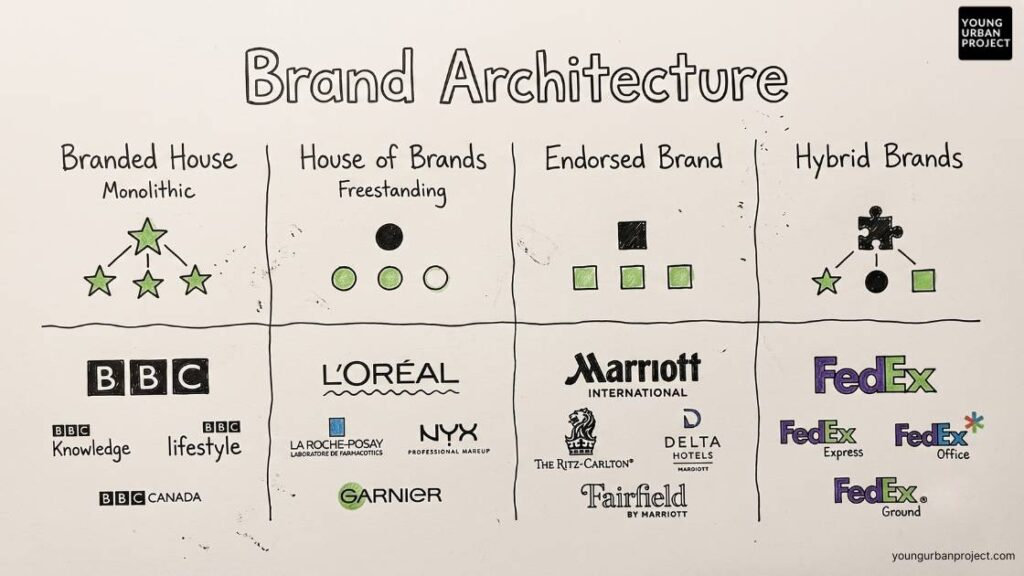
Branded House – One Brand, Many Offers
A branded house is a company where a single master brand sits visibly across every product, service, or division, and the sub-offerings are essentially named extensions rather than independent identities.
FedEx runs one of the cleanest branded house structures in business. FedEx Express, FedEx Ground, FedEx Freight, and FedEx Office all carry the same name, the same purple-and-orange identity, and the same core promise. The divisions do genuinely different things, air freight is not the same business as retail printing, but the company made a deliberate bet that one strong brand across all of them beats four separate brands each starting from zero.
Google followed the same logic for years. Google Search, Google Maps, Google Docs, and Gmail all lead with the house name because the underlying bet is straightforward: trust built in one product transfers to the next. A person who trusts Google Search extends some of that trust to Google Drive without having to be convinced from scratch.
Here’s the part most people miss. Google eventually hit the limit of a pure branded house. When the company started making genuinely different bets, autonomous vehicles, life sciences, biotech longevity research, the branded house model became a liability rather than an asset. Attaching the Google name to an experimental self-driving car program meant every setback in that unproven category put pressure on the core search and advertising brand that actually pays the bills. That’s why Alphabet exists. Waymo, Verily, and Calico now operate under Alphabet rather than Google specifically, which lets Alphabet ring-fence the reputational risk of long-shot bets away from the brand that generates the overwhelming majority of revenue. Google itself remains a branded house for its core consumer products. Alphabet, sitting above it, behaves more like a house of brands for the riskier ventures.
That’s the honest lesson from Google’s structure: branded house is excellent for efficiency and halo effect, but it has a ceiling. The moment a company takes on a bet risky enough that failure could damage the core brand, a pure branded house stops making sense.
A branded house puts one master brand across every product, which is why FedEx names every division FedEx and Google carries its name across Search, Maps, and Docs. The tradeoff is concentration risk, which is exactly why Google created Alphabet as a separate holding structure once it began funding riskier ventures like Waymo and Verily that it didn’t want tied to the core Google name.
House of Brands – Many Brands, One Owner
A house of brands is the opposite structure. A parent company owns a portfolio of brands that share no visible connection to each other or to the parent, and most customers never realize they’re all owned by the same business.
Procter & Gamble is the textbook example, and for good reason. P&G’s portfolio includes Tide, Pampers, Gillette, Olay, Crest, and dozens more, each with a completely distinct identity, tone, and target customer. Most shoppers buying Tide detergent have no idea it’s the same company that makes Gillette razors, and that’s not an accident, it’s the entire point of the structure. Each brand can occupy its own shelf space, sometimes competing directly with another P&G brand in the same category, without either brand’s equity contaminating the other.
The strategic logic here goes beyond just avoiding confusion. A house of brands lets a company dominate shelf space across a category by owning multiple entries that appear to be independent competitors. It isolates risk completely, if one brand has a product recall or a PR disaster, the damage stays contained to that single brand. And it makes individual businesses far easier to sell. When P&G divested Pringles, the buyer wasn’t purchasing a piece of P&G’s identity. They were purchasing a standalone brand with its own equity, largely untangled from the parent.
Marriott International runs a version of this in hospitality, though it blends into the hybrid model as well. The distance between The Ritz-Carlton and Courtyard by Marriott is enormous. Ritz-Carlton competes with Four Seasons and Mandarin Oriental at the ultra-luxury tier, while Courtyard serves business travelers who want reliable, mid-range convenience. Marriott runs both because a single brand promise can’t credibly stretch across that range of price points and guest expectations. Trying to force Ritz-Carlton-level prestige and Courtyard-level accessibility under one identity would weaken both.
The honest downside of a house of brands is cost. You’re not building one brand, you’re building many, each requiring its own marketing budget, its own awareness campaign, its own customer trust from the ground up. That’s a viable strategy for a company with P&G’s scale. It’s usually the wrong choice for a smaller company that can’t fund multiple brand-building efforts simultaneously.
A house of brands architecture, used by companies like Procter & Gamble with Tide, Pampers, and Gillette, deliberately hides the parent company so each brand can occupy distinct market positioning and shelf space without cross-contamination. The tradeoff is cost, since every brand in the portfolio needs its own marketing investment to build awareness independently.
Hybrid / Endorsed Brand Architecture – The Middle Path
This is the model most companies actually end up running, and it’s also the most misunderstood, because it gets confused with both of the models on either side of it.
An endorsed brand architecture sits a parent brand visibly behind a set of sub-brands, without making the parent the front-facing identity. The sub-brand keeps its own personality, name, and positioning. The parent shows up as a credibility signal, not as the star of the show.
Nestlé is the clearest global example. KitKat, Nescafé, and Nesquik all carry distinct identities that most consumers engage with directly, but Nestlé’s name or logo appears in small print on the packaging as an endorsement. The strategic reasoning is precise: a new or entering-a-market product gets a trust boost from the Nestlé name without KitKat having to look, sound, or feel anything like corporate Nestlé branding. Meanwhile, other Nestlé brands like Purina operate with almost no visible connection to the parent at all, which is why brand architecture experts often describe Nestlé’s actual structure as a hybrid of house of brands and endorsed branding, not a pure single model. Very few large companies run one model in isolation. Nestlé runs several at once, depending on the brand.
Marriott shows the endorsed pattern too, from a different angle than its house-of-brands framing above. “Courtyard by Marriott” explicitly puts the parent name in the sub-brand’s name, a strong endorsement, while The Ritz-Carlton carries almost no visible Marriott branding at all, a weak endorsement. Same parent company, two very different endorsement strengths, chosen deliberately based on how much the sub-brand needs to borrow trust versus how much it needs distance from the parent’s mass-market positioning.
Nike and Jordan Brand illustrate a related but distinct pattern: the sub-brand. Jordan Brand generates more than $6.5 billion in annual revenue, representing roughly 13% of Nike’s total corporate revenue, and it operates with real autonomy in product development and athlete endorsements. But it isn’t fully independent of Nike the way Purina is independent of Nestlé branding-wise. Jordan Brand borrows just enough distance from core Nike branding to build its own cultural identity in basketball and streetwear, while staying close enough that Nike’s manufacturing, distribution, and financial infrastructure all sit underneath it. That’s the sub-brand pattern: less separation than an endorsed brand, more independence than a simple product line extension.
The reason hybrid architecture is the most common real-world outcome is simple. Very few companies are pure branded houses or pure houses of brands throughout their entire portfolio. Most have some products that benefit from full parent visibility, some that need complete separation, and a large middle group that benefits from a visible but supporting parent endorsement. Trying to force every brand in a portfolio into a single rigid model usually creates more problems than it solves.
Hybrid or endorsed brand architecture puts a parent brand visibly behind a sub-brand without making it the primary identity, as Nestlé does with KitKat and Nescafé. The strength of the endorsement varies deliberately, Marriott names Courtyard directly after itself for trust transfer, while keeping The Ritz-Carlton nearly unbranded to protect its luxury positioning from mass-market association.
How to Choose the Right Brand Architecture for Your Company
Here’s where most brand management training stops short, because choosing the right model isn’t a formula, it’s a set of tradeoffs that depend entirely on where your company actually is.
Start with audience overlap. If every product you sell targets roughly the same customer with roughly the same needs, a branded house usually wins, because you’re not fighting internal cannibalization and the halo effect compounds fast. If your products serve genuinely different customers with different expectations, forcing them under one brand creates confusion rather than efficiency.
Then look at risk tolerance. A branded house means every product shares reputational risk. If your company operates in a category where product failures, recalls, or controversy are a real possibility, a house of brands or a weak-endorsement hybrid gives you containment. This is precisely why pharmaceutical and consumer packaged goods companies lean toward house of brands far more than tech companies do.
Consider your M&A plans honestly. If you expect to acquire businesses that don’t naturally fit your existing brand story, or if you expect to eventually sell off individual business units, a house of brands or hybrid structure keeps those units cleanly separable. A branded house makes future divestment much harder, because the business unit’s identity is entangled with the parent’s.
Factor in category credibility needs. Entering a new category where your existing brand carries no relevant trust, luxury entering budget, or budget entering luxury, usually calls for a new brand, potentially with a light endorsement rather than full branded house treatment.
And be honest about internal complexity you’re willing to manage. A house of brands isn’t just expensive in marketing dollars. It requires separate brand teams, separate governance, separate go-to-market processes. Many companies that choose house of brands underestimate the organizational overhead until they’re three brands deep and struggling to keep positioning consistent within each one.
Here’s my direct opinion after watching this decision get made badly more times than well: most companies default to branded house early on because it’s cheaper and faster, and that’s usually the right call at the start. The mistake is not revisiting it. A branded house that made perfect sense with three products often stops making sense at fifteen products spanning three customer segments, but by then the company has built years of equity into the single brand name and switching feels too expensive to consider. It isn’t. The cost of switching later is almost always smaller than the cost of confused positioning compounding for years.
Common Brand Architecture Mistakes (What I would Flag in a Brand Portfolio Audit)
If I were auditing a company’s brand portfolio, here’s what I’d actually be looking for, because these are the mistakes that quietly erode brand equity for years before anyone notices.
Architecture drift is the most common one. A company starts with a clean structure, then launches a product line, then a regional variant, then a partnership co-brand, and five years later there are a dozen sub-brands that exist for reasons nobody currently at the company remembers. No one decided to create this mess. It just accumulated, one reasonable-seeming decision at a time. The fix isn’t a rebrand, it’s governance: a clear rule for when a new brand name is warranted versus when it should be a product line under an existing brand.
Conflating brand architecture with visual identity is another one I see constantly, especially from teams that come up through design rather than strategy. A shared color palette or logo treatment across sub-brands doesn’t create coherent architecture if the underlying positioning logic is inconsistent. Visual consistency is the output of good architecture, not a substitute for it.
Ignoring internal resistance to consolidation is a mistake that’s rarely discussed openly. When a company decides to fold multiple sub-brands into one, there are usually people internally, often the ones who built those sub-brands, who resist the change because their role, budget, or internal status is tied to the sub-brand’s continued existence. Good brand architecture decisions get made on customer and market logic. They frequently get blocked or watered down by internal politics that have nothing to do with what’s best for the portfolio.
And the mistake that costs companies the most money: not revisiting architecture after M&A. An acquired company almost never fits cleanly into the acquirer’s existing brand logic. Too many companies either force the acquisition into an ill-fitting sub-brand slot or leave it running as a completely disconnected brand indefinitely, neither of which is a decision, both are just avoidance of one.
How Brand Architecture Changes During M&A and Growth
This is where brand architecture stops being theoretical and becomes genuinely difficult, because acquisitions rarely arrive pre-labeled with the right architectural slot.
When a house-of-brands company acquires a business that doesn’t fit any existing sub-brand cleanly, there are really only two honest paths. Absorb it fully into an existing brand, which captures cost efficiency but risks destroying whatever distinct equity the acquired brand had built with its own customer base. Or let it run semi-independently under a light endorsement, which preserves its equity but adds a brand to manage and fund.
Unilever’s approach to its portfolio over the years illustrates this tension well. The company has both acquired and divested consistently, expanding into premium beauty and wellness brands while periodically shedding food and home care brands that no longer fit its strategic direction. Each of those moves is a brand architecture decision disguised as a portfolio management decision. Keeping a brand meant deciding it still deserved its own identity and investment. Divesting one meant deciding it made more sense as someone else’s brand entirely than as part of the existing structure.
The practical lesson for a brand manager involved in post-acquisition integration: the architecture decision should happen early and deliberately, not by default. Waiting too long to decide whether an acquired brand gets absorbed, endorsed, or left standalone usually means the market decides for you, and not in a way you’ll like.
The Bottom Line
Brand architecture isn’t a decision you make once at company founding and forget. It’s a living structure that needs revisiting at every growth inflection point, every acquisition, every time you enter a genuinely new category. The companies that get this right, P&G, Marriott, Nestlé, treat it as an ongoing strategic discipline, not a branding exercise finished at launch.
If you’re managing a brand portfolio right now, the most useful thing you can do this week isn’t redesigning a logo. It’s mapping every brand and sub-brand you currently own against the models above and asking honestly whether the current structure still matches your risk tolerance, your audience segmentation, and your growth plans. Most portfolios have at least one brand sitting in the wrong place.
Want more frameworks like this delivered weekly? The Crystal Clear Newsletter breaks down brand and marketing strategy every Friday, the kind of practitioner-level thinking that doesn’t make it into most marketing courses.
Frequently Asked Questions About Brand Architecture
What is brand architecture in simple terms?
Brand architecture is the structural system that organizes how a company’s brands relate to each other and to the parent organization, covering naming, visual identity, and how much trust and risk flow between brands. It determines whether customers see one unified brand across all your products or many seemingly independent ones.
What’s the difference between House of Brands and Branded House?
A branded house puts one master brand visibly across every product, like FedEx or Google, so trust transfers easily between offerings. A house of brands, like Procter & Gamble with Tide and Gillette, keeps each brand separate and largely invisible from the parent company, isolating risk but requiring separate marketing investment for each brand.
What is hybrid brand architecture?
Hybrid, or endorsed, brand architecture places a parent brand visibly behind sub-brands without making it the primary identity, as Nestlé does with KitKat and Nescafé. It gives sub-brands room to build distinct positioning while still borrowing credibility from the parent company’s reputation.
How do I audit my company’s current brand architecture?
Start by mapping every brand and sub-brand your company owns, then classify each by how visible the parent brand is in its naming and identity. Compare that current state against your actual audience overlap, risk tolerance, and M&A plans to see where the architecture no longer matches business reality.
Does a startup need brand architecture?
Most early-stage startups don’t need complex brand architecture because they’re operating with one product and one clear audience, making a simple branded house approach the natural default. The question becomes relevant once a company launches a second product line, enters a new customer segment, or considers an acquisition.
Is brand architecture just a rebrand exercise?
No, and treating it that way is a common mistake. Brand architecture is a strategic decision about risk containment, M&A flexibility, and customer trust transfer, while a rebrand is often just the visual execution layer that follows an architecture decision, not a substitute for making one.
What are the signs your brand architecture is broken?
Common signs include internal confusion about which brand should be used for a new product launch, customers expressing confusion about how two of your brands relate to each other, and sub-brands multiplying without any clear governance rule for when a new brand name is actually warranted. If nobody at the company can explain why a specific sub-brand exists separately, that’s a strong signal.
What’s the difference between a sub-brand and an endorsed brand?
A sub-brand, like Jordan Brand under Nike, sits closer to the parent with less independent separation, often sharing infrastructure and some brand equity directly. An endorsed brand, like KitKat under Nestlé, operates with a fully distinct identity and only a visible but secondary parent endorsement for credibility.
Can a company use more than one brand architecture model at once?
Yes, and most large companies do. Nestlé runs a genuine hybrid across its own portfolio, with some brands like Purina operating almost independently and others like Nescafé carrying a visible endorsement, because different products in the portfolio have different needs for parent trust transfer versus independent positioning.
Why do companies change their brand architecture over time?
Companies typically revisit brand architecture after acquisitions, when entering categories that require different risk containment, or when a business unit’s growth trajectory diverges enough from the core brand that shared branding starts limiting rather than helping it. Google’s creation of Alphabet to house riskier ventures like Waymo separately from its core search brand is a clear example of this kind of deliberate architectural shift.