
Sales have gone flat. Or a merger just happened and two logos now sit awkwardly on the same letterhead. Or maybe the brand just feels off and nobody in the room can even say exactly why. But whatever triggered the conversation, someone eventually asks the question. Is this a repositioning vs rebranding problem? And that’s where the next six months and the next few crores go.
If you get the answer wrong, the cost isn’t just all of the money spent. Any rushed rebrand can erase years of your brand equity in a single announcement. A repositioning that ignores a genuinely broken identity just delays the real fix. Jaguar found out what that looks like in public. We’ll get to exactly what happened there later in this piece.
This article walks through what each term actually means and how Indian brands like Vi and Mamaearth are handling the decision. You can use this practical framework the next time this question lands on your desk.
Table of Contents
What Is Brand Repositioning?
Brand repositioning means changing how customers perceive your brand relative to competitors. This is all done without touching the name, logo, or any core visual identity. It’s simply a shift in message and market space instead of appearance.
The perception layer is what actually moves during a repositioning. This is about who you’re talking to, what problem you claim to solve and where you sit compared to rivals. A B2B SaaS tool marketed that is marketed as “affordable” can reposition itself as “enterprise-grade”. That’s a normal decision to make once it lands bigger clients. All while the name and the logo are the same on every deck.
So, everything visual and nominal is not touched. The brand name doesn’t change. The logo doesn’t change. Everything, including the colour palette, the typography, the overall look and feel stays put. Customers who’ve built trust in the visual identity don’t have to relearn anything. They just start hearing a different story from a familiar face.
Brand repositioning changes how a company is perceived in the market involving its target audience, promise or competitive space. This leaves the name, logo and visual identity untouched. It’s a strategic and messaging shift instead of a design shift. It works best when brand equity is still strong but the story around it has drifted out of date.
Read More: Top Brand Positioning Examples and Strategies
What Is Rebranding?
Rebranding means changing fundamental identity elements of a brand, including its name, logo, or visual identity system. This is sometimes practiced alongside a shift in mission or positioning. It’s a visible and structural overhaul rather than a message tweak.
This is the version most people picture when they hear “brand change.” A new name. A new logo. A new colour system, a new tone of voice, new packaging and new signage. Sometimes the mission changes too. That especially happens after a merger, an acquisition or a pivot into a different category altogether. When Vodafone India and Idea Cellular consolidated their operations, the underlying business didn’t just get a new coat of paint. It needed one identity where two used to compete.
There’s a distinction worth making here that a lot of sources blur together: a full rebrand versus a brand refresh. A full rebrand touches the name and the core mark. This kind of change requires new legal filings, new signage and a public announcement moment. A brand refresh is smaller. A modernised logo. Updated colour palette. Tighter typography. The name and brand recognition stay intact. Starbucks trimming its logo over the years is a refresh. Vodafone Idea becoming Vi is a full rebrand.
Rebranding changes a company’s core identity assets, typically the name, logo, and visual system and sometimes its underlying mission. A full rebrand is unlike a brand refresh and doesn’t modernise visual elements while keeping the name intact. It is usually triggered by a merger, a reputational break or a business that has outgrown its original name.
Read More: Key Functions of Branding in Marketing

Repositioning vs Rebranding: What’s the Actual Difference?
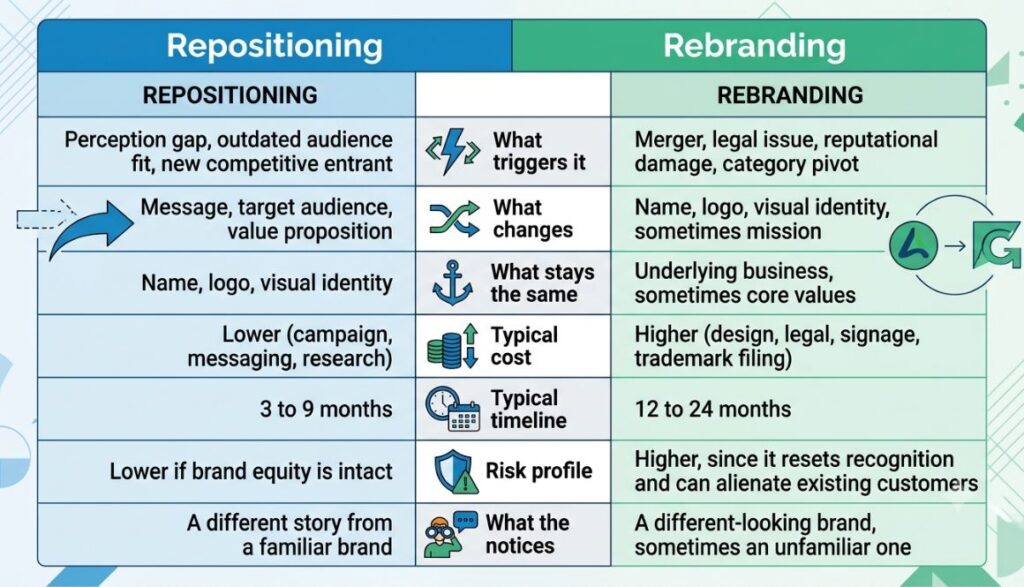
Repositioning changes perception without changing identity assets. Rebranding changes the identity assets themselves, sometimes taking the perception shift along with it. The simplest way to separate them: repositioning is a change of story and rebranding is a change of face.
That’s the one-line version. But most real decisions sit in a grey zone. So it helps to see the two side by side across the variables that actually decide cost and risk.
| Repositioning | Rebranding | |
| What triggers it | Perception gap, outdated audience fit and new competitive entrant | Merger, legal issue, reputational damage and category pivot |
| What changes | Message, target audience and value proposition | Name, logo, visual identity and sometimes mission |
| What stays the same | Name, logo and visual identity | Underlying business and sometimes core values |
| Typical cost | Lower (campaign, messaging and research) | Higher (design, legal, signage and trademark filing) |
| Typical timeline | 3 to 9 months | 12 to 24 months |
| Risk profile | Lower if brand equity is intact | Higher, since it resets recognition and can alienate existing customers |
| What the customer notices | A different story from a familiar brand | A different looking brand and sometimes an unfamiliar one |
These two paths aren’t exactly mutually exclusive. A brand can reposition and rebrand at the same time, and often does. That is especially common after a merger where both the perception and the identity need work. Vi’s 2020 launch is a good example. The new name and logo were the rebrand. The messaging around agility and customer centricity that came with it was the repositioning layered on top. The mistake is assuming one always implies the other. It doesn’t.
Read More: Positioning vs Messaging: Key Differences
When Should a Brand Reposition Instead of Rebrand?
Signs You Need Repositioning, Not Rebranding
If your brand equity is still working for you but the market around it has changed, then that is the clearest sign. Maybe a new competitor has entered with a sharper angle. Maybe they made your category look generic by comparison. Maybe your original audience has aged out or moved on. Or a newer segment doesn’t see themselves in your messaging even though your product would suit them fine.
Honestly, this is the more common scenario. It gets skipped over more often than it should. Founders and CMOs jump to “we need a new look” when the actual problem is something else. Nobody has explained, clearly, why this brand still matters to the customer they’re trying to reach today. Repositioning is almost always the cheaper and faster fix if your name still carries weight and your logo still gets recognised in a crowded shelf or feed.
Also Read: Types of Positioning in Marketing
Real Example: Asian Paints and Mamaearth
Asian Paints has spent decades expanding what “Asian Paints” really means to an Indian household. All while it never touched its name or its core identity. The brand built its long running “Har Ghar Kuch Kehta Hai” campaign with ad veteran Piyush Pandey and agency Ogilvy over a three-decade partnership. That same emotional platform helped it stretch from a paint company into a home decor and design authority. The name never moved. The logo never moved. What moved was the story: from “we sell paint” to “we help you express who lives in this home.”
Mamaearth took a different but related path. It started in 2016 as a direct-to-consumer brand focused initially on baby care products. The products were built around toxin-free and natural formulations. As the company grew, it expanded into other categories including skincare, haircare, and body care. That’s what moved its audience and its value proposition from new parents to a much broader health-conscious buyer. The Harvard Business School case study on the brand is literally titled “Mamaearth: Navigating Growth Beyond Baby Care”. This very well captures the repositioning challenge in a single line. Same name and same visual identity. Think a completely repositioned promise to a completely different sized audience.
Asian Paints and Mamaearth both repositioned without rebranding. Asian Paints stretched its identity from paint retailer to home decor authority. It used the same name and the same decades-old emotional campaign platform. Mamaearth expanded from a baby-care specialist to a full personal-care brand. That moved its target audience and value proposition while keeping its name and visual identity untouched.
When Should a Brand Rebrand Instead of Reposition?
Signs You Need a Full Rebrand
Repositioning can’t fix a name that legally or practically doesn’t describe the business anymore. That’s the clearest trigger for a full rebrand. A merger or demerger that leaves two identities competing for the same customer. A name carrying legal or reputational baggage too heavy to message your way around. Or a business that has outgrown the category its original name was built for.
There’s a harder truth underneath this. If your brand’s problem is trust, not perception, then repositioning cannot fix it. A messaging campaign can’t undo a data breach, a safety scandal or a name that’s become a punchline. A new identity isn’t cosmetic in those cases. It’s the only way to give customers permission to reconsider you.
Real Example: Vodafone Idea Becoming Vi
As per Wikipedia, Vodafone India and Idea Cellular merged in August 2018. Both formed the largest telecom operator in the country by subscriber count. The company kept running Vodafone and Idea as two separate customer-facing brands for two years after that. That was, without a doubt, an awkward setup for a business that was legally one entity but market facing as two.
That changed in September 2020. “India’s Vodafone Idea rebranded itself as ‘Vi’ three years after the merger between Vodafone India and Idea Cellular,”. The company was describing this integration as the largest network integration in the world. Vodafone Group CEO Nick Read called it “an important next step”. This is the moment when two histories finally become one identity.
This is exactly the kind of situation repositioning can’t solve. You can’t message your way out of running two brand names for the same network. The merger created a structural identity problem, and only a new name and a new mark could resolve it. What the rebrand didn’t solve, worth noting honestly, was the underlying business pressure: the company had been losing subscribers to newer entrant Jio Platforms well before and after the name change. A rebrand fixes identity confusion. It doesn’t fix a competitive or financial problem on its own, and treating it as if it does is one of the mistakes covered further down.
Vodafone Idea’s 2020 rebrand to Vi resolved a structural identity problem created by its 2018 merger. This unifies two customer-facing brands under one name three years after the underlying businesses are already combined. The case shows what repositioning alone cannot fix, which is a legally and operationally merged company still running two separate market identities needs a new name, not just a new message.
What Happens When a Rebrand Goes Wrong? Lessons from Jaguar’s 2024 Rebrand
A rebrand that changes visual identity faster than it changes customer perception is when it goes wrong. This can cost a legacy brand nearly all of its sales in a matter of months. Jaguar’s November 2024 relaunch is the clearest recent proof of that. So walking through it in detail is worth it because almost every mistake in the later checklist of this article shows up somewhere in this case.
Jaguar unveiled a new visual identity in November 2024. It dropped the launch campaign “Copy Nothing,” alongside slogans like “Delete Ordinary.” The ad featured models of varying ages, genders, and races accompanied by abstract phrases. That is set to a minimal techno soundtrack, with no cars shown at any point in the film. Elon Musk’s public response, “Do you sell cars?”, captured the immediate reaction better than any brand consultant could have.
The backlash was loud, but the sales numbers are what make this a genuine case study rather than a social media pile-on. By April 2025, Jaguar’s European sales had dropped 97.5% year-over-year, down to just 49 units from 1,961 the year before, with year-to-date European sales down 75.1% and global FY24/25 sales falling to 26,862 units, an 85% drop from 2018 figures. That collapse wasn’t purely a branding failure either. Marketing commentary pointed out that Jaguar had pulled most of its existing product line, including the XE, XF, F-Type, E-Pace, and I-Pace, ahead of new electric models that wouldn’t arrive until 2026, leaving dealerships with almost nothing to actually sell.
That’s the compounding lesson here. The rebrand didn’t just fail to land emotionally. It also came at the exact moment the company had no product to back it up. This turns a controversial launch into a full blown sales crisis. A rebrand can survive bad reviews of an ad campaign. It struggles to survive an ad campaign with nothing behind it.
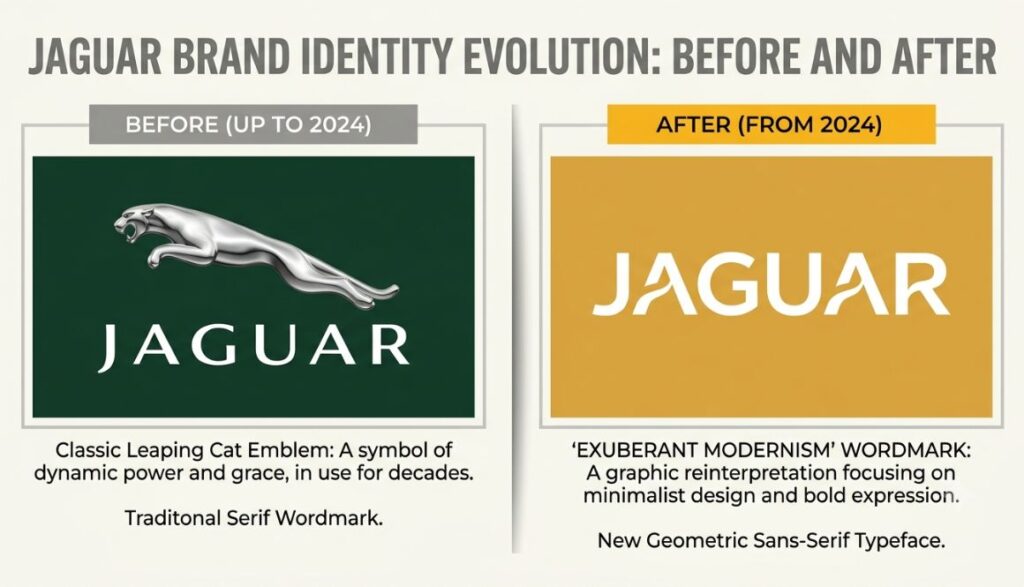
What this teaches about sequencing matters more than the specific ad. A visual overhaul without a positioning strategy that’s been tested with existing customers first is a coin flip, and Jaguar bet its entire heritage customer base on the flip. The company had tried to move toward an all-new EV-only lineup arriving in 2026 by its own leadership’s framing. That is a legitimate repositioning goal. But it executed that shift as a rebrand-first move. It worked on changing the logo and the entire visual language before the audience had any reason to trust the new direction, and before there was a product to point to.
Jaguar’s November 2024 rebrand replaced its identity and launched a car-free ad campaign before its new electric lineup was ready to sell. European sales fell 97.5% year-over-year by April 2025. The case shows that a visual overhaul executed that is ahead of a tested repositioning strategy and ahead of an actual product to sell, can alienate a legacy customer base faster than it attracts a new one.
How to Decide: A Practical Framework
Deciding between repositioning and rebranding comes down to four steps. Audit what you currently have, diagnose whether the problem is perception or identity, map the real cost and risk of each path and test before committing fully.
Step 1: Audit brand equity and customer perception. Find out what customers actually think of you right now, before deciding anything, not what your team assumes they think. Run surveys, mine customer support tickets and social comments for recurring language. Check whether your NPS or repeat-purchase numbers are actually declining or just feel stagnant. If people still recognise and trust your name, that’s brand equity worth protecting, not discarding.
Step 2: Diagnose the actual problem, perception or identity. Ask a blunt question: if we changed nothing but the message, would the core complaint go away? It’s a perception problem and repositioning territory if customers are confused about what you stand for or who you’re for. An identity problem and rebranding territory involves customers not knowing who you even are because of a merger, a name that no longer fits or a reputational event.
Step 3: Map cost, timeline, and risk tolerance. Repositioning is almost always cheaper and faster. It is typically a matter of months and a campaign budget rather than a design and legal overhaul. Rebranding carries real costs beyond design fees: trademark filings, signage replacement, packaging reprints and the risk of temporarily confusing loyal customers during the transition. Be honest with leadership about which budget and timeline you’re actually working with before recommending either path.
Step 4: Test before you commit. Neither path should launch cold. Run message testing with a sample of your actual target audience before a full repositioning rollout. For a rebrand, soft-launch the new identity with a smaller segment. Or market first, watch the reaction, and adjust before the full public reveal. Jaguar’s mistake wasn’t attempting a bold repositioning. It was skipping the testing step entirely and finding out how the market felt at the same moment the whole world did.
Common Mistakes Brands Make With Both
Most repositioning and rebranding failures trace back to a handful of avoidable mistakes. They show up across nearly every case examined in this piece.
- Skipping the audit. Deciding based on internal frustration (“we’re bored of this logo”) rather than actual customer perception data.
- Redesigning without a strategy brief. Bringing in a design agency before agreeing internally on what the brand needs to communicate differently, which usually produces a good-looking identity attached to no clear message.
- Moving too fast and losing loyal customers. Treating a legacy customer base as an obstacle to a younger audience rather than an asset to bring along.
- Treating repositioning as “just a campaign.” Running new messaging for a quarter, seeing no immediate lift, and abandoning it, when repositioning genuinely takes sustained repetition to shift perception at scale.
Most repositioning and rebranding failures come from skipping a genuine perception audit, commissioning a visual redesign before agreeing on a strategy, or abandoning a repositioning campaign too early because results didn’t show up in one quarter. Each of these mistakes is avoidable with a proper diagnosis step before any creative work begins.
Repositioning and Rebranding in the Age of AI Search and Social Media
The stakes of a public rebrand reveal are higher now than they’ve ever been, because the reaction is no longer confined to trade press. Jaguar’s launch film became a viral moment within hours, dissected across X, Instagram, and YouTube reaction videos long before most traditional marketing publications had run a single piece on it. A rebrand reveal today is effectively a live, unscripted focus group happening in public, in real time, with competitors and commentators piling in.
There’s a second layer to this that most brand teams haven’t fully priced in yet. AI Overviews and answer engines like ChatGPT and Perplexity increasingly summarise “how did this rebrand go” queries directly on the results page. So, the first wave of social sentiment can end up baked into the answer that shows up for anyone researching your brand for months afterward. A repositioning misstep is recoverable through sustained follow-up messaging. But a viral rebrand backlash can get cited, summarised and referenced by AI systems long after the news cycle itself has moved on.
What Indian brands should watch for given this speed: soft launch any major identity change with a limited audience first. Monitor sentiment in the first 48 hours rather than waiting for a formal post-campaign review. Have a response plan ready before launch day, not after the backlash starts. The window to shape the narrative before it calcifies into “the story” is measured in hours now, not weeks.
Conclusion
Repositioning vs rebranding was never really a fork in the road. It’s a diagnosis question. The answer depends entirely on whether your brand has a perception problem, an identity problem or both at once.
Asian Paints and Mamaearth show what disciplined repositioning looks like: protecting a name customers already trust while quietly expanding what that name means to them. Vi shows what a rebrand actually needs to solve, a structural identity conflict that no amount of clever messaging can paper over. And Jaguar shows what happens when a brand skips the audit, skips the testing and lets the visual overhaul run ahead of a tested strategy and an actual product.
Run the four-step framework above before you commit budget to either path. Audit first. Diagnose honestly. Map the real cost. Test before the full reveal. That sequence, more than any single creative decision, is what separates a repositioning or rebrand that lands from one that becomes the next cautionary case study.
Figuring out how to build that positioning strategy or communication plan properly? Whether for a repositioning campaign or a full brand overhaul, the Crystal Clear newsletter breaks down real brand strategy decisions like this one every week. This is the kind of detail you can actually apply to your own brand’s next move.
FAQ
What is the difference between repositioning and rebranding?
Repositioning changes how customers perceive a brand, its message, audience, or competitive space. This doesn’t change the name, logo, or visual identity. Rebranding changes the identity assets themselves, the name, logo or full visual system and sometimes the underlying mission too. One is a story change and the other is a face change.
Repositioning vs rebranding, which one is riskier?
Rebranding generally carries more risk because it resets brand recognition all at once. That can alienate existing customers during the transition, as Jaguar’s 2024 relaunch showed. Repositioning is usually lower risk if brand equity is still intact. This is because customers keep the familiar name and logo while the message evolves around them.
How do I know if my brand needs repositioning or rebranding?
Ask whether customers are confused about what you stand for, or confused about who you actually are. Repositioning is the fix if it’s the former and your name still carries trust. If a merger, a name that no longer fits the business, or serious reputational damage is the root cause, a rebrand is likely the only real solution.
How do you reposition a brand without changing its name?
Start with a genuine perception audit to understand where the current gap actually sits. Then build a new positioning statement and messaging strategy around the existing name and visual identity. Test the new message with a segment of your real audience before a full campaign rollout. Keep in mind the way Asian Paints layered new home-decor messaging onto a name it never changed.
Is rebranding worth it if my brand equity is already strong?
Usually not. If your name and logo are still recognised and trusted, a full rebrand can be risk of throwing away equity you’d otherwise have to rebuild from scratch. Strong existing brand equity is one of the clearest signals that repositioning, is the right move instead of rebranding.
Why do most rebrands fail to land with customers?
Most rebrand failures trace back to skipping a real perception audit, commissioning a visual redesign before agreeing on the underlying strategy, or moving too fast without testing the new identity on a smaller audience first. Jaguar’s case adds a second failure mode: launching a new identity before there was an actual product to back it up.
Can a brand reposition and rebrand at the same time?
Yes, and it’s common after a merger or major pivot. Vi’s 2020 launch combined both: a new name and logo to resolve the structural identity conflict from the Vodafone-Idea merger. That is layered with new messaging around agility and customer focus. The key is sequencing the strategy work before the visual work, not doing both blind.
How long does a brand repositioning or rebranding process usually take?
Repositioning typically takes three to nine months, covering audience research, message development, and campaign rollout. A full rebrand usually takes twelve to twenty-four months once you account for design, legal trademark filings, packaging changes, and a phased public rollout. full rebrand usually takes twelve to twenty-four months once you account for design, legal trademark filings, packaging changes, and a phased public rollout.