

Reps used to win by doing more: more calls, more emails plus more demos booked. But that math stopped working. Sales teams spent the last decade adding dialers, sequencers, and CRMs, but quota attainment kept sliding anyway. Salesforce’s 2025 State of Sales report found that only 28% of reps actually hit their annual quota that year. That is the lowest figure in six years, even though reps now use eight tools on average just to be able to close one deal.
Generative AI in sales is exactly what’s replacing that logic now. Instead of just pushing more activity through the funnel, it helps you target the right seven accounts. It doesn’t blast two hundred and can draft an outreach message that actually looks like someone wrote it for that one buyer. Buyers, on the other hand, are just done tolerating any generic pitches. They’ve researched your product on their own and compared it to three competitors. That said, they’ve half written their own requirements document before a rep ever gets on a call. So it’s natural that they expect the vendor side to show up with the same level of preparation.
This piece breaks down what generative AI in sales actually is, where it earns its keep across the funnel, which tools matter right now (including the ones built for Indian B2B teams), and how to roll it out without setting fire to your enablement budget.
Table of Contents
What Is Generative AI in Sales, and How Is It Different from Older Sales AI?
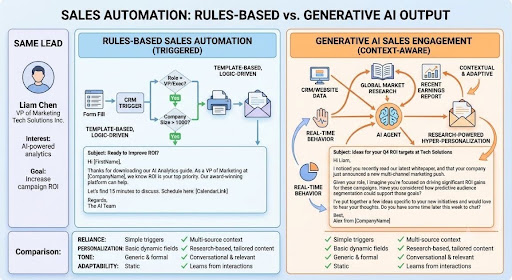
Generative AI in sales refers to AI systems that can create new content, such as emails, call summaries, and forecasts, rather than simply sorting or flagging data against pre-set rules. That’s the entire distinction in one sentence, and it’s the one most vendors blur when they slap “AI-powered” on a rules-based feature that’s existed since 2015.
The rules-based kind is deterministic as an Older sales AI. It scores a lead with a fixed formula: job title plus company size plus email opens equals a score. This is where it routes a ticket based on if-then logic, or triggers a follow-up email on day three because someone told it to. It’s useful, but it can’t write anything it wasn’t explicitly told to write plus it can’t handle a situation nobody anticipated.
Generative AI is built on large language models like the ones powering ChatGPT, Claude, and Gemini and works differently. If you feed it a call transcript, a CRM record, and a product one-pager, it can draft a follow up email that references something the prospect said about forty minutes into the call. If you feed it six months of deal data, it can actually flag which open opportunities look healthy on paper but are quietly stalling, then also explain why in plain language. It isn’t just retrieving information. It’s synthesizing new content and new judgment calls from whatever you feed it.
Generative AI in sales differs from traditional rules-based sales automation in the way it creates new content, insight, and judgment from data instead of following any pre-set logic. Rules-based tools score, route, and trigger; generative AI drafts, summarizes, and explains. That difference means generative AI can handle situations nobody explicitly programmed for.
That difference sounds academic until you watch it in a demo. A rules-based lead scoring tool tells you a lead is “hot.” A generative tool tells you why it’s hot, all in a sentence that you could paste straight into a Slack message to your AE.
Why Generative AI in Sales Is Becoming Non-Negotiable in 2026
Generative AI in sales moved from optional to something expected somewhere between 2024 and 2026. The numbers actually back that up on both the adoption side and the pressure side. Gartner forecasts that more than 80% of enterprises may have used generative AI APIs or deployed generative AI-enabled applications by the end of 2026 which is up from less than 5% in 2023. McKinsey’s Q1 2026 Global AI Survey found that 65% of organizations now use generative AI in at least one business function which is double the rate from ten months earlier.
Sales specifically has kept pace. HubSpot’s 2024 AI Trends for Sales report found that AI adoption among salespeople rose from 24% in 2023 to 43% in 2024, a 79% year-over-year increase. LinkedIn’s 2025 sales research puts daily AI usage among sales professionals at 56%, and those daily users are twice as likely to exceed their sales targets if you compare them to reps who don’t touch the tools. Gartner has also found that sellers who partner effectively with AI are 3.7 times more likely to hit quota than those who don’t.
Here’s the part that should make you uncomfortable: none of that adoption has fixed the underlying number. Salesforce’s 2025 State of Sales report found only 28% of sales reps hit their annual quota, the lowest figure in six years, and reps spend just 28% of their working time on direct selling. HubSpot’s 2025 data still shows 51% of sellers hitting 75% or less of quota. Call this the productivity paradox: teams are buying more AI tools than ever, usage is climbing, and the number that actually pays the bills, quota attainment, keeps sliding.
Generative AI adoption in sales has roughly doubled between 2023 and 2026, with Gartner projecting over 80% enterprise usage by end of 2026 and HubSpot reporting rep-level adoption rising from 24% to 43% in a single year. Despite this, Salesforce’s 2025 data shows quota attainment falling to 28%, the lowest in six years, a productivity paradox where tool adoption and outcomes have decoupled.
Part of the gap comes down to how the tools actually get used. HubSpot’s 2025 report found that only 19% of sales reps use the AI features already built into the sales tools they pay for. The tools are there. The habit isn’t.
Read More: Main Goal of Generative AI: Benefits, Use Cases, and Limitations

Where Generative AI Delivers the Most Value Across the Sales Funnel
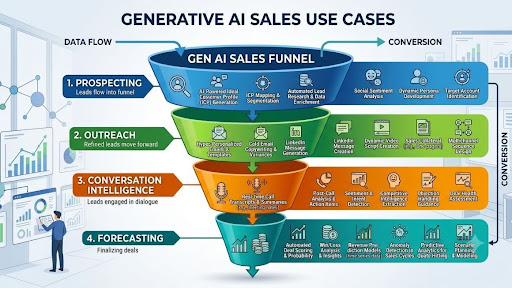
Not every stage of the funnel benefits equally. The teams that spread a fixed AI budget evenly across the whole pipeline usually get mediocre results everywhere instead of strong results anywhere. Four stages very consistently show up in the data as the highest-leverage spots.
Prospecting and Predictive Lead Scoring
Predictive lead scoring uses historical win and loss data for ranking incoming leads on their likelihood to convert. Generative AI is the one that adds a layer on top: it writes the reasoning behind the score instead of a bare number. A rep opens a lead and sees “82 out of 100, because this account visited the pricing page twice, matches your ICP on company size, and their VP of Sales just posted about scaling outbound,” not just “82.”
This matters way earlier in the funnel than most reps even realize. G2’s 2025 Buyer Behavior Report have found that generative AI chatbots are now the single most influential source to be shaping B2B vendor shortlists. This is cited by 17.1% of buyers, ahead of software review sites at 15.1% and vendor websites at 12.8%. Sometimes the prospects ask ChatGPT or Perplexity to shortlist vendors in your category before your SDR ever calls. In that case, the scoring model flagging “high intent” needs to account for signals that your CRM was never built to see.
Salesforce Einstein and HubSpot’s Breeze both run this kind of scoring natively now. They are pulling from CRM activity, firmographic data and intent signals in one pass instead of needing a whole separate data science project.
Hyper-Personalized Outreach and Email Drafting
Generic cold email is also dying by the numbers. The rates of average cold email open dropped from 36% to 27.7% over the past year with a 23% decline. A fully generic email now pulls a 1 to 5% reply rate. Any personalization that actually references something specific about the prospect’s company, role or recent activity is pushing that same reply rate to around 18%.
The catch is that “personalization” used to mean when a rep manually reads a LinkedIn profile and inserts a first name into a template. That doesn’t scale past fifty accounts a week. Generative AI changes the math here when you feed it a prospect’s recent LinkedIn post, their company’s latest funding round, and a case study from a similar customer. As a result, it drafts an opening line in under fifteen seconds that may otherwise have taken a rep fifteen minutes. Tools like 11x’s Alice run this as a fully autonomous outbound agent. This includes handling list building, drafting, and reply handling without a rep touching the sequence until a prospect responds.
The real risk is that AI-personalized outreach can start to look uncannily similar across an entire industry once every SDR team runs the same three prompts through the same three tools. The teams pulling ahead feed the model something genuinely proprietary, a founder’s actual voice, a specific customer outcome, not the generic “I noticed you’re hiring for X role” opener every AI tool defaults to.
Conversational Intelligence: Call Summaries and Coaching
Conversational intelligence platforms record, transcribe, and analyze sales calls. Then they surface deal-health signals and coaching feedback without needing a manager to sit in on every call. Gong as the category’s reference point, serves more than 4,500 customers including Microsoft and LinkedIn, according to a 2026 platform review.
What generative AI adds isn’t the recording or the transcript. Remember both existed before large language models got good. It’s the synthesis. A call summary that reads like a human wrote it. It flags that the prospect mentioned budget constraints twice without prompting plus drafts a follow-up email referencing the exact commitment made on the call. Analysis of Gartner’s sales technology research found that enterprises who are adopting advanced AI coaching platforms report up to a 25% improvement in sales productivity and a 15% increase in win rates.
For managers, the coaching layer matters more than the transcription layer. Instead of spot-checking three calls a week, a manager can ask which reps handled a pricing objection best this month and pull the actual clips for a training session.
Forecasting and Pipeline Risk Detection
Pipeline forecasting has depended on reps self-reporting deal stages and close dates for a long time. That’s a method which is optimistic by design because nobody in reality wants to tell their manager a deal is slipping. Generative AI forecasting tools instead read the actual signals. These include email response times, meeting cancellations, stakeholder engagement, and conversation sentiment. And then they flag deals that look healthy on paper but are quietly dying.
Predictive analytics applied to forecasting improves accuracy by about 30 to 40% compared to manual methods, according to 2026 research from Phoenix Strategy Group. Some conversation intelligence vendors now claim forecast close-probability accuracy to be approaching 90%. But that figure comes from vendor-reported data. So it is worth verifying against your own pipeline before you can rebuild your forecast process around it.
The practical use case for most teams isn’t really a fully automated forecast. It’s risk detection, a system that pings a manager when a ₹1.5 crore deal has gone twelve days without stakeholder response. This is something that would otherwise surface only when the deal quietly falls off the forecast at quarter-end.
Read More: Generative AI Advertising: Benefits, Use Cases & Best Practices
The Best Generative AI Sales Tools to Watch Right Now
Tool sprawl is its own problem. Salesforce’s 2025 State of Sales found that reps use eight tools on average just to close one deal. 42% feel overwhelmed by the stack. So this isn’t really a “use all of these” list. It’s a map of where each major platform actually fits.
Global platforms: HubSpot Sales Hub, Salesforce Einstein, Gong
HubSpot Sales Hub bakes generative AI, branded Breeze, into email drafting, meeting summaries, and predictive lead scoring. And it’s done inside the same CRM most SMB and mid-market teams already run day to day. Salesforce Einstein does the equivalent for enterprise Salesforce shops. It involves layering generative forecasting, opportunity scoring and Einstein Copilot into a platform, one that many revenue teams already standardize on. Gong sits apart from both. So it’s not a CRM but it’s a conversation intelligence layer that plugs into whatever CRM you use. Turning call and email data into coaching and deal-risk signals is a part of it.
None of the three compete head-on. HubSpot and Salesforce compete with each other as CRM platforms. Gong competes with Chorus, Avoma and Clari Copilot as a conversation intelligence layer that sits on top of whichever CRM wins.
India-relevant tools: Yellow.ai, Haptik, Krutrim
Indian B2B teams have a constraint most that global tools weren’t even built for involving buyers who move between English, Hindi and a regional language mid conversation, often on WhatsApp rather than email. Three Indian platforms are built around that reality.
Yellow.ai, founded in Bangalore, now supports more than 135 languages. It was named as a Challenger in Gartner’s 2025 Magic Quadrant for Conversational AI Platforms, with particular strength in voice-bot pronunciation across Indian languages. Jio Haptik, being majority owned by Reliance Jio since a roughly $100 million stake acquisition in 2019, is one of the largest WhatsApp Business Solution Providers in the country. That said, it says its AI agents serve more than 500 enterprises across BFSI, retail, and e-commerce. Krutrim is the first AI unicorn of India at a valuation north of $1 billion. This is building foundation-model infrastructure instead of a sales tool directly. But the models increasingly power the regional language layer that other Indian sales platforms build on top of.
Indian B2B sales teams increasingly rely on India-built conversational AI platforms such as Yellow.ai, which supports over 135 languages, and Jio Haptik, which serves 500-plus enterprises primarily through WhatsApp. These platforms address a gap global tools like Salesforce Einstein weren’t originally built for: multilingual, WhatsApp-first buyer conversations.
The category isn’t without turbulence. Yellow.ai cut about 30% of its workforce in a December 2025 restructuring while pivoting toward agentic AI. That is a reminder that procurement teams evaluating India-built platforms should weigh vendor stability alongside language depth.
Read More: LLM vs Generative AI: Key Differences
How Indian B2B Sales Teams Are Actually Adopting Generative AI
Adoption in India is real, but uneven. The unevenness has a specific shape: content creation first, everything else later. A 2025 survey of more than 500 Indian businesses across 12 industries by Cloud 9 Digital found that B2B SaaS companies lead adoption at 89% using AI daily for content creation and lead nurturing. The adoption gap between metro and tier-2 cities shrank from 45% in 2024 to just 23% in 2026 which is largely driven by cheaper tools with better regional-language support.
The gap that stays is enablement, not access. Indian B2B sales teams work with longer and more relationship-dependent buying cycles than what most Western playbooks assume. Family-owned businesses and large conglomerates mostly route decisions through hierarchies. A Western-designed lead-scoring model won’t naturally weight it correctly. Regional language diversity across Hindi, Tamil, Telugu, Marathi, and Kannada compounds this: a generative AI tool that is trained mostly on English sales conversations. It misses tone and intent cues that a human rep working in the first language of the buyer can catch instantly.
D2C brands built for the Indian market have moved faster than most B2B teams on the personalization side of this. So it’s worth B2B sellers paying attention to what quick commerce and consumer brands are already doing. Zepto style personalization, tailoring what a customer sees based on real time location, order history and time of day, runs on the same generative and predictive AI infrastructure that B2B sales tools use for lead scoring and next-best-action recommendations. The difference is speed of adoption, not the underlying technology.
We’ve seen something with YUP learners who are working inside Indian B2B sales and marketing teams. WhatsApp-first habit is the biggest single adaptation that Western AI sales playbooks need to make for India. A sequence built around email opens and LinkedIn InMail simply doesn’t match how an Indian SME buyer actually wants to be reached.
How to Roll Out Generative AI in Your Sales Process (Without Wasting Budget)
Most generative AI rollouts fail for a boring reason. Teams buy the platform before they’ve even picked the problem. Here’s the sequence that avoids that.
- Pick one narrow use case. Not “AI for sales.” Pick “AI-drafted first-touch emails for inbound leads” or “AI call summaries for the enterprise pod.” A narrow scope gives you something that can be measurable in weeks, not quarters.
- Pilot with a small pod. Run it with three to five reps for four to six weeks, not the entire team. A small pod surfaces workflow friction, whether the tool actually fits inside the CRM reps already use or creates a second system to check, before you’ve trained forty people on something that doesn’t stick.
- Measure against a real baseline. Track the pilot pod’s reply rates, meetings booked, or forecast accuracy against their own numbers from the prior quarter, not against a generic industry benchmark. Your baseline is the only comparison that accounts for your specific market and product.
- Scale only after the pilot clears the bar. If the pilot pod’s metric moved and reps kept using the tool past week three without being told to, that’s your signal to expand. If usage dropped off once the novelty wore off, fix the workflow fit before rolling out wider.
If we look at it budget-wise, then a narrow pilot on an existing CRM’s built-in AI features, HubSpot Breeze or Salesforce Einstein, mostly costs nothing more than the subscription tier you’re already on. Standalone tools like Gong or an outbound agent typically run somewhere between $10,000 and $60,000 annually. That depends on seat count and volume on the bases of third-party pricing reviews of conversational AI vendors. Budget six to twelve weeks for a proper pilot before committing to a full rollout. Teams that skip the pilot and roll out to the whole floor in week one are the ones showing up in next year’s “why didn’t our AI investment move the number” postmortem.
The Risks Nobody Talks About: Hallucinations, Trust, and Over-Automation
Generative AI in sales makes a specific risk that rules based automation never did. It can confidently state something false, wrapped in language that a prospect has no reason to distrust. A 2025 MIT-linked research note found that AI models tend to use more confident language when they are hallucinating than when stating something true. This makes the errors harder to catch without deliberate verification.
The scale of the problem is bigger than what most sales leaders assume. Deloitte survey data found that about 47% of enterprise AI users made at least one major business decision based on hallucinated content. On the buyer side, trust is falling even as usage rises: TrustRadius’s 2026 report found 94% of B2B buyers now fact-check AI research outputs. 47% say they trust online resources less than they did a year ago, up from 39% the year before.
Buyer skepticism isn’t evenly distributed by age, either. TrustRadius found Gen Z buyers use AI “a lot” at roughly double the rate of the overall sample, 15% versus 8%. They trust AI-generated content at nearly twice the overall rate, 30% versus 20%. But older buyers lean harder on brand reputation and peer validation than anything AI-generated. That is all according to a 2025 Data Axle study surveying more than 450 B2B buyers across four generations. If your buying committee spans a 28 year old procurement lead and a 55 year old VP, then an AI-personalized pitch that lands with one can sound generic or even suspicious to the other.
Generative AI in sales carries a specific trust risk: models state incorrect information with the same confidence as correct information, and 94% of B2B buyers now fact-check AI-sourced claims before trusting them, per TrustRadius’s 2026 report. Buyer skepticism also varies sharply by generation, with Gen Z trusting AI-generated content at nearly twice the rate of the overall buyer population.
Over-automation compounds both problems. According to enterprise adoption research compiled in early 2026, only 27% of organizations trust fully autonomous AI agents, down from 43% a year earlier. That drop tracks closely with the rise in publicized hallucination incidents. The governance response is already visible heading into the back half of 2026. More organizations demand contractual hallucination rate disclosures from vendors. And procurement teams are starting to treat “what’s your model’s verified accuracy rate on our data” as a standard RFP question, not just something that’s nice to have.
What’s Next: Agentic Selling and the Future of Generative AI in Sales
The shift underway right now is from assisted selling to autonomous selling. It is worth being precise about that distinction. Generative AI, in its current mainstream form, writes content when a rep asks it to. Say draft this email, summarize this call. Agentic AI executes multi-step workflows without a prompt at each step: research the account, validate the buying signal, source the right contact, draft the outreach, send the first touch message, all in sequence, within guardrails a human set up front.
Gartner projects that task-specific AI agents can expand from under 5% of enterprise applications in 2025 to 40% by the end of 2026. It forecasts that 15% of day to day work decisions can be made autonomously by 2028. In sales specifically, tools like 11x’s Alice already run the full outbound SDR motion, from list building through reply handling. That is a standing autonomous agent rather than a tool a rep opens and closes.
The branded-agent trend follows naturally from this. Expect more vendors to ship a named AI agent, an “Alice” or an “Astra”, instead of a generic chatbot. That’s something a buyer can interact with repeatedly across the sales cycle and start to recognize the way they’d recognize a specific rep. That’s a deliberate trust-building move. A consistent AI personality with a name is easier to hold accountable. Skeptical buyers can get used to it much more easily, than an anonymous “AI assistant” popup.
Where human reps still win isn’t a hedge but the entire point of the hybrid model most research points toward. It is anywhere a deal requires judgment under ambiguity: a stakeholder giving mixed signals, a pricing negotiation where the real constraint of the buyer isn’t the one they stated, a relationship that needs trust built over multiple quarters before anyone signs anything. Agentic AI handles the volume. Humans still close the deals that matter most.
Conclusion
Generative AI in sales isn’t a single tool decision but it’s a shift in what “more effort” means. The teams pulling ahead aren’t the ones with the most AI subscriptions. They’re the ones who picked one narrow use case, piloted it honestly against their own numbers and only scaled once it actually moved something. The productivity paradox, more tools without more quota attainment, only breaks once teams stop treating adoption itself as the goal.
If you’re building out AI skills for your own marketing or sales content workflow, YUP’s AI Marketing course walks through exactly this kind of narrow-pilot-first approach across real tools, not just theory. And if you want hands-on practice prompting and building with generative AI day to day, the Hotskill app is built for that kind of repeated, low-stakes practice before you take a workflow live with your team.
FAQ
What is generative AI in sales?
Generative AI in sales is AI that makes new content and insight like emails, call summaries, and forecasts instead of following pre-set rules to sort or flag data. It’s built on large language models. The plus point is that it can synthesize a response to a situation nobody explicitly programmed it to handle.
Is generative AI in sales the same as traditional sales AI?
No, traditional sales AI is rules-based and deterministic. It scores or routes data according to fixed logic someone configured in advance. Generative AI creates new content and reasoning from whatever data it’s given, which is why it can draft an email or explain a forecast rather than just flag a number.
AI sales agents vs chatbots, what’s the difference?
A chatbot follows a predefined script and hands off anything outside it. An AI sales agent reads context from the CRM and conversation history, decides what to do next, and can complete multi-step tasks like qualifying a lead or booking a meeting without a human writing the script for that specific scenario.
How do I get started with generative AI in my sales process?
Start with one narrow use case, like AI-drafted first-touch emails, rather than a broad “AI for sales” initiative. Pilot it with three to five reps for four to six weeks, measure it against your own prior-quarter baseline, and only scale once the pilot clears that bar.
How much does generative AI for sales cost?
It depends on what you’re adding. AI features already built into HubSpot or Salesforce often cost about nothing incremental beyond your existing subscription tier. Standalone tools like Gong or a dedicated outbound agent typically run $10,000 to $60,000 annually which depends on seat count and volume.
Is generative AI in sales only for large enterprise teams?
No, small teams often see faster returns because a narrow pilot is easier to run and measure with fewer reps. The tools built into CRMs most SMB teams already use, like HubSpot Breeze, put generative AI within reach without a separate enterprise contract.
Does generative AI in sales work for Indian B2B teams specifically?
It works, but Western-built tools often miss regional-language nuance and WhatsApp-first buyer behavior. India-built platforms like Yellow.ai and Jio Haptik were designed around multilingual and WhatsApp-heavy conversations. This makes them a better fit for many Indian B2B sales motions than a global tool built primarily for English-language email.
Is generative AI in sales actually worth it for a small team?
For most small teams, yes, if the use case is narrow. A five-person team using AI for call summaries or first-touch email drafting sees the time savings almost immediately. That is because there’s no complex integration or lengthy change management process to absorb first.
Can I trust AI-generated sales content without checking it?
No, AI models state incorrect information with the same confident tone as correct information. 94% of B2B buyers now fact-check AI-sourced claims before trusting them. Treat every AI-drafted claim, especially numbers, case studies and pricing, as a first draft that needs a human check before it goes to a prospect.
Why do most generative AI sales pilots fail?
Most fail because teams roll out to the entire floor before testing with a small pod, skip measuring against their own baseline and pick a use case too broad to evaluate cleanly. A pilot that isn’t scoped to one specific, measurable workflow rarely produces a clear enough signal to justify scaling.