
A B2B Marketing Funnel isn’t just a diagram to hang on the wall; it’s a way to actually see how prospects move from first hearing about a business to becoming loyal customers. This blog digs into the full journey, from awareness and lead nurturing to conversions and keeping clients engaged over time. It covers old-school and modern funnel approaches, practical steps to build one, and ways to tweak it for better results. Along the way, there’s advice on measuring performance, re-engaging quiet leads, and creating content that really resonates. For any business trying to make sense of their marketing efforts, a solid B2B Marketing Funnel is a map worth following.
Table of Contents
Introduction
A B2B marketing funnel, at its core, is just a way to make sense of how buyers move from “never heard of you” to “let’s sign this deal.” Nothing fancy about the idea. But in practice, it’s where most marketing either starts to click… or quietly falls apart.
Because here’s the thing: B2B buyers don’t behave neatly.
They don’t see one blog, book a demo, and convert. They circle back. They compare. They involve other people. Sometimes they disappear for weeks and then return as if nothing had happened. A funnel doesn’t control that behavior; it helps you stay relevant through it.
At a basic level, the journey still looks familiar:
- Awareness: Something triggers interest or a problem
- Consideration: Options get explored, often in depth
- Decision: A shortlist forms, and choices get made
Simple on paper. Rarely that clean in reality.
How B2B Funnels Are Different from B2C
This is where a lot of strategies go wrong: treating B2B like a slightly slower version of B2C. It’s not.
A few things stand out pretty quickly:
Time moves differently
A B2C purchase might take minutes. B2B? Weeks, months, sometimes longer. There’s just more to think through.
You’re not selling to one person
Even if there’s a primary contact, decisions usually involve finance, leadership, maybe even operations. Each with their own concerns.
Logic tends to win over impulse
Not completely, but close. Buyers want justification, proof, numbers. Gut feeling alone doesn’t close deals here.
Content carries more weight
Buyers do their homework. If the information isn’t there, they’ll find it somewhere else.
So the funnel isn’t just about moving people forward; it’s about earning trust in small steps. Repeatedly.
Why Implement a B2B Marketing Funnel
Without a funnel, marketing can still “work” in bits and pieces. Traffic comes in. Leads show up. Campaigns run.
But it’s hard to tell what’s actually driving results, and what’s just noise.
A structured funnel changes that. Not overnight, but steadily.
You Start Seeing Your Audience More Clearly
Instead of treating all leads the same, patterns begin to show up:
- Some people are just exploring
- Some are comparing options seriously
- Some are almost ready but need a small push
And once that clicks, messaging gets sharper. Less guessing.
Awareness Becomes More Intentional
A lot of brands publish content and hope it lands somewhere useful.
A funnel forces a bit more discipline. Early-stage content isn’t about selling; it’s about being helpful enough to earn attention. That shift alone tends to improve how people respond.
Content Stops Feeling Random
This is a big one.
Without a funnel, it’s easy to produce content in isolation; blogs here, emails there, maybe a webinar if there’s time. With a funnel in place, each piece has a role:
- Create something that captures attention.
- Develop content that educates the audience.
- Implement strategies that drive conversions.
It doesn’t have to be perfect. Just connected.
Effort Gets Focused Where It Matters
Not every lead is worth the same level of attention. That’s just reality.
A funnel helps separate:
- People who need more time
- People who are actively evaluating
- People are ready for a conversation
That makes prioritization easier, especially for sales teams who don’t have time to chase everyone.
ROI Becomes Easier to Improve (Even in Small Steps)
No dramatic shifts required.
Sometimes it’s just:
- A better call-to-action on a key page
- A follow-up email that actually answers real questions
- A clearer offer at the decision stage
Individually, these tweaks feel small. Together, they move the needle.
Relationships Don’t End at Conversion
This part gets overlooked more often than it should.
In B2B, closing a deal isn’t the end; it’s where expectations really begin. A funnel that extends beyond conversion helps with:
- Keeping customers engaged
- Opening doors for expansion
- Reducing churn without aggressive tactics
It’s quieter work. But it compounds.
Decisions Are Backed by Something Real
Once the funnel is in place, things become trackable:
- Where are the leads coming from
- Where they’re losing interest
- Which content actually helps move them forward
Not everything will be obvious. But it’s a lot better than guessing.
Key Stages of a B2B Marketing Funnel
Most teams start with a simple model and then adjust it over time. That’s usually the right approach. No need to overcomplicate things early.
Traditional Funnel Stages
This is the familiar structure. Still useful, especially as a starting point.
Top of Funnel (TOFU): Awareness
This is where attention is earned.
Not forced. Not rushed.
At this stage, buyers are either just realizing a problem or they’ve been aware of it but haven’t taken it seriously yet. The role of marketing here is to meet them where they are.
Common approaches:
- Educational blog posts that actually answer something
- Social content that sparks interest without overpromising
- Intro-level guides or reports
Hard selling here usually does more harm than good. It creates resistance early.
Middle of Funnel (MOFU): Consideration
Now things get more specific.
Buyers are actively looking for solutions, comparing approaches, maybe even shortlisting vendors quietly in the background.
This is where content needs a bit more depth:
- Case studies that feel real, not overly polished
- Webinars or sessions that go beyond surface-level points
- Comparison content that helps buyers think clearly
Trust builds here, but it’s fragile. Overhyping or being vague tends to push people away.
Bottom of Funnel (BOFU): Decision
At this point, the buyer is close. But “close” doesn’t mean guaranteed.
They’re weighing options, looking for reassurance, sometimes revisiting earlier concerns. Small frictions can slow things down.
What tends to work:
- Clear product demos; no fluff
- Straightforward consultations
- Transparent pricing or proposals, where possible
- Proof. Actual proof, not just claims
Clarity matters more than persuasion here.
Modern B2B Funnel Stages
The traditional model still holds up, but it doesn’t fully capture how buyers behave now. Journeys are less linear, more… layered.
So modern funnels usually expand a bit.
Awareness
Still the entry point, but more scattered. Buyers might discover a brand through search, social, referrals, or sometimes all within a few days.
Consistency across those touchpoints starts to matter.
Consideration
This stage stretches longer than most expect.
Buyers move in and out of it. They pause. They revisit. They compare again. It’s not a straight line; it’s more like a loop.
Action
This is where something concrete happens:
- A deal gets signed
- A trial starts
- A first commitment is made
It’s not always the final step, but it’s a meaningful one.
Re-engagement
A quiet but important stage.
Some leads don’t convert; not because they’re uninterested, but because timing wasn’t right. Re-engagement is about staying present without being intrusive.
A well-timed follow-up can revive opportunities that seemed lost.
Retention
This is where long-term value is built.
Keeping customers engaged, supported, and successful often leads to:
- Renewals
- Upsells
- Referrals
It doesn’t require aggressive tactics; just consistency and relevance.
A B2B marketing funnel isn’t something that gets “finished.” It evolves. Small adjustments here and there, based on what actually happens, not what was planned.
And over time, those adjustments add up.
Step-by-Step Guide to Building a B2B Marketing Funnel
Building a B2B marketing funnel sounds structured, and it is; but in reality, it rarely comes together in a straight line. There’s always some back-and-forth. A few things that don’t quite land. That’s normal.
What matters is getting the fundamentals right, then refining as you go.
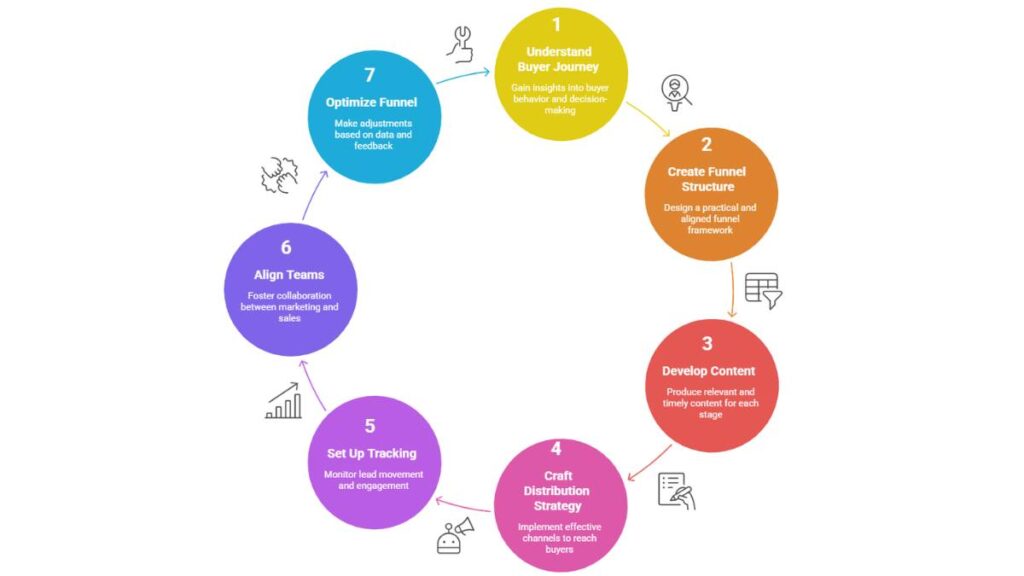
Understand Your Buyer and Their Journey
This step gets rushed more often than it should. And it shows later.
Knowing the buyer isn’t about filling out a persona template and moving on. It’s about understanding how decisions actually get made inside a company… which is usually slower and more layered than expected.
A few things worth digging into:
- Who’s really involved?
Not just the person filling out a form. There’s often a decision-maker, someone from finance, maybe a technical reviewer. Each looks at things differently. - What triggers the search?
Growth? A problem that’s been ignored too long? Pressure from leadership? These triggers shape how urgent the buying process feels. - Where do things stall?
Most funnels don’t break at the top. They break in the middle; when buyers hesitate, compare, or simply pause.
Mapping touchpoints helps here. Not in a complicated way. Just a simple view of:
- where they first notice you
- What they check next
- What makes them hesitate
- What finally pushes them forward
It doesn’t need to be perfect. Just honest.
Create Your Funnel Structure
Once there’s some clarity on the buyer, the funnel starts to take shape. Keep it practical.
There’s a temptation to over-design this part; multiple stages, sub-stages, fancy naming. Usually not needed.
Instead, focus on alignment:
- What should happen at each stage?
- What does a “good” lead look like here?
- What’s the next logical step for them?
That’s enough to get started.
Also, not every business needs the same pace. Some funnels stretch over months. Others move faster. Trying to force a standard structure onto a unique sales cycle… doesn’t work well.
Better to adapt the funnel to how deals actually happen, not how they’re supposed to.
Develop the Right B2B Content
This is where many funnels either start working or quietly fall flat.
Content isn’t the problem. Most teams are already producing plenty of it. The issue is usually a mismatch.
Wrong message, wrong timing.
Think of it this way:
- Early stage (TOFU)
The buyer isn’t ready for a pitch. They’re trying to understand a problem.
Content here should feel useful, not persuasive.
Blogs, short guides, maybe a well-structured report. Keep it clear. - Mid stage (MOFU)
Now they’re comparing. This is where things get a bit more serious.
They want specifics. Examples. Proof that something works.
Case studies, webinars, and product walkthroughs; these tend to land better. - Late stage (BOFU)
At this point, they’re close… but also cautious.
Small doubts can delay decisions. Sometimes for weeks.
Clear demos, direct conversations, solid proposals; no fluff here.
One small thing that helps: answer real objections before they’re even raised. It shortens the cycle more than expected.
Craft Your Distribution Strategy
Content sitting on a website won’t move a funnel. Distribution is what gives it reach.
No need to overcomplicate this, but it does need consistency.
- Use multiple channels, but with intent
Email, social, and paid campaigns; they each play a role. The key is not blasting the same message everywhere. - Show up where buyers already are
Some audiences respond better to email. Others go to industry platforms or search. Figure that out early. - Don’t rely only on big campaigns
Smaller, consistent touchpoints often perform better over time. A steady presence builds familiarity.
Distribution isn’t about pushing content. It’s about placing it where it naturally fits.
Set Up Lead Tracking and Automation
At some point, intuition stops being enough. You need visibility.
Not complicated dashboards. Just clarity on what’s happening.
- Track how leads move
Where are they coming from? What are they engaging with? Where do they drop off? - Segment early
Not all leads behave the same. Some are just exploring. Others are evaluating seriously. Treating them the same slows things down. - Score leads, but keep it practical
Engagement signals, company fit; these are usually enough to prioritize. No need to over-engineer it.
Automation helps, but only if the logic behind it makes sense. Otherwise, it just sends more emails… without impact.
Align Marketing and Sales Teams
This is where things quietly break in many funnels.
Marketing generates leads. Sales follow-up. But if they’re not aligned on what a “good lead” looks like, friction builds.
A few simple fixes go a long way:
- Shared definition of qualified leads
Sounds basic, but often overlooked. - Content that sales can actually use
Not just top-level blogs; real materials that help in conversations. - Regular feedback loops
Sales knows what objections come up. Marketing knows what content is performing. Connecting the two… changes a lot.
Alignment isn’t a big initiative. It’s a habit.
Optimize and Scale Your Funnel
No funnel gets it right the first time. Or the second.
What matters is paying attention to what’s happening and adjusting.
- Look for drop-offs
Where are leads losing interest? That’s usually where the biggest gains are hiding. - Test small changes
A different message. A clearer CTA. A slightly better offer. No need for massive overhauls. - Focus on momentum, not perfection
Slow, steady improvements compound. Big redesigns, less so.
Once the funnel starts performing consistently, even if not perfectly, scaling becomes easier. More traffic, more leads, same structure.
A B2B marketing funnel, when built this way, doesn’t feel forced. It fits how buyers actually move; uneven, sometimes slow, but predictable enough to work with.
And that’s really the goal. Not control… just clarity.
Enroll Now: Product Marketing Course
Advanced B2B Marketing Funnel Strategies
Once the funnel is up and running, the real work begins. Not in a dramatic way; just small, steady improvements that make it sharper over time. This is usually where the gap shows between “we have a funnel” and “this actually drives revenue.”
A few areas tend to make a noticeable difference:
Leaning Into Patterns (Not Guesswork)
After a while, patterns start to show up. Certain types of leads engage more. Some behaviors signal intent pretty clearly.
- People who revisit pricing pages multiple times
- Leads who attend a webinar and download something after
- Accounts that match your best existing customers
These aren’t random signals. They’re hints.
Using them to prioritize outreach or tailor messaging… that’s where things start to feel more efficient. Not perfect, just more focused.
Using Video Where It Actually Helps
There’s a lot of noise around video, but in B2B, it works best in specific moments.
- Explaining something complex quickly
- Showing how a product actually works
- Walking through a use case without overloading with text
Short demos, simple walkthroughs, even recorded sessions; these often do more in five minutes than a long document.
That said, not everything needs to be video. Forcing it everywhere tends to dilute the impact.
Focusing on High-Value Accounts
Some deals are just… bigger. More important. Worth the extra effort.
Instead of treating every lead the same, it helps to identify:
- Accounts with higher revenue potential
- Companies that fit your ideal customer profile closely
Then adjust the approach:
- More personalized outreach
- Content that feels specific to their situation
- Fewer generic touchpoints
It’s slower, yes. But usually more effective.
Keeping Automation Simple (Really)
Automation gets overcomplicated fast.
In most cases, what works is fairly straightforward:
- A follow-up after a download
- A reminder after a webinar
- A check-in when engagement drops
Nothing fancy. Just timely.
When automation starts feeling robotic, it’s usually because there’s too much of it, or it’s trying to do too much. Better to keep it lean and relevant.
Personalization That Feels Natural
Personalization doesn’t mean inserting a company name into an email.
It’s more about context.
- Showing a case study relevant to their industry
- Highlighting a feature they’ve already explored
- Addressing a concern they likely have at that stage
Small details like this make communication feel considered, not mass-produced.
B2B Marketing Funnel Metrics and Analytics
Numbers matter, but not all numbers matter equally. One of the easiest traps is tracking everything and understanding very little.
A better approach is to look at what actually reflects movement through the funnel.
Top of Funnel: Are People Even Noticing?
At this stage, the question is simple: are you getting attention?
- Traffic to key pages
- Engagement with content
- Downloads or sign-ups from early-stage offers
If these are low, it’s usually a visibility or positioning issue. Not a conversion problem yet.
Middle of Funnel: Are They Sticking Around?
This is where things get interesting… and often where funnels struggle.
- Are leads engaging with follow-up content?
- Are they opening emails, clicking through, attending sessions?
- Do they move from “interested” to “actively evaluating”?
If there’s a drop here, it usually points to one of two things:
- Content isn’t answering the right questions
- Or timing is off
Sometimes both.
Bottom of Funnel: Are Deals Actually Closing?
At this point, it’s less about volume and more about quality.
- Sales-qualified leads
- Conversion to actual deals
- Revenue tied to specific campaigns or channels
If plenty of leads reach this stage but don’t convert, it’s often a trust or clarity issue. Something isn’t clicking at the final step.
Improving the Funnel Without Overthinking It
Optimization doesn’t need to be complex.
A few practical moves:
- Look for where people drop off; start there
- Adjust one thing at a time (message, offer, format)
- Revisit leads that went quiet; they’re not always lost
Retargeting helps here, but it needs to be subtle. Overdoing it creates friction instead of interest.
Progress is usually incremental. And that’s fine.
Strategies to Stay Top of Mind in a B2B Funnel
B2B buyers don’t always move fast. Sometimes they pause for weeks. Sometimes longer.
Staying visible during that time, without becoming annoying, is a bit of an art.
Consistent, Useful Content
Not everything needs to be groundbreaking.
But it should be:
- Relevant
- Clear
- Worth the reader’s time
A steady flow of insights, practical ideas, or even commentary on industry shifts keeps the brand in the picture.
People remember who helped them think better.
Being Present Where Buyers Search
When buyers start actively researching, they tend to look for answers first, not vendors.
Showing up in those moments matters.
- Guides that answer specific questions
- Content that explains options without bias
- Pages that are easy to navigate and understand
If the experience feels helpful, trust builds quietly.
Thoughtful Paid Campaigns
Paid channels can keep your brand visible, but only if used carefully.
- Target the right segments
- Keep messaging aligned with where they are in the journey
- Avoid pushing too hard, too soon
Done right, it feels like a reminder. Done poorly, it feels like noise.
Email That Doesn’t Feel Like Email Marketing
This is where many funnels lose people.
Too many emails. Too generic. Too sales-heavy.
What tends to work better:
- Sharing something genuinely useful
- Following up based on actual behavior
- Giving space instead of constant nudging
A good email feels like a continuation of a conversation, not a campaign.
Staying top of mind isn’t about frequency. It’s about relevance.
Show up at the right time, with something worth paying attention to… and the funnel tends to move forward on its own.
Beyond the Funnel: Retention & Re-engagement
Most teams spend a lot of energy getting leads in. Fair enough. But what happens after the deal closes… that’s where things either compound or quietly stall.
Retention doesn’t usually get the same attention. It should.
Loyalty Programs and Post-Sale Communication
Staying in touch with customers isn’t about pushing the next offer right away. In fact, that tends to backfire.
What works better is simple, consistent contact:
- A quick check-in after onboarding
- Updates that actually matter (not just “we’ve added features”)
- Occasional resources that help them do their job better
Nothing over the top. Just enough to stay relevant.
Customers don’t expect constant communication, but they do notice when there’s none.
Customer Success Content and Upsell Opportunities
This part often gets missed.
Once someone becomes a customer, the assumption is they’ll “figure it out.” They don’t always.
A bit of guidance goes a long way:
- Practical guides on getting more value from what they already use
- Use cases that go slightly deeper than the basics
- Clear paths to expand, without forcing it
Upsells don’t need to feel like sales moves. If the product is already working, and the next step makes sense, it tends to happen naturally.
But only if the customer sees it.
Reactivating Dormant Leads (and Customers)
Not every deal happens the first time around. Some go quiet. Some disappear completely.
That doesn’t always mean they’re lost.
Timing plays a bigger role than most teams admit.
Re-engagement works best when it feels… relevant again:
- A new angle on the problem they were trying to solve
- A meaningful update; not just a generic “checking in.”
- Something that reflects where they might be now, not where they were months ago
Pushing too hard here usually does the opposite of what you want. A lighter touch works better.
One thing that becomes clear over time, the funnel doesn’t really end. It just shifts.
Customers move into a different phase. Quieter, maybe. But often more valuable.
Conclusion
A B2B marketing funnel sounds structured, almost rigid. In reality, it’s anything but.
It’s more like a working system. Something that evolves as the business grows, as buyers change, as markets shift a bit.
A few things tend to hold true, though:
- Funnels rarely work the first time perfectly. And that’s fine.
- Small gaps between marketing and sales, or between stages, add up faster than expected.
- Not every metric matters. The ones tied to real movement do.
And maybe the bigger one;
Acquiring leads is only part of the job. What happens after matters just as much, sometimes more.
A well-built funnel doesn’t try to control the buyer. It just makes the path clearer. Removes friction where it can. Stays present without overdoing it.
Done right, it becomes less of a “strategy” and more of a system that quietly supports growth in the background. Not flashy. But reliable.
FAQs: B2B Marketing Funnel
What’s the difference between a marketing funnel and a sales funnel?
A marketing funnel is about getting attention and building interest over time. It brings people in, warms them up a bit. The sales funnel, though, is where decisions happen. That’s where conversations get specific, objections show up, and deals either move forward… or quietly stall. They’re connected, but not the same thing.
What are the benefits of creating a B2B marketing funnel?
A proper funnel removes a lot of guesswork. It shows where leads come from, what’s working, and where things start dropping off. Over time, patterns emerge. Better targeting, stronger messaging, more consistent results. It doesn’t fix everything overnight, but it does make growth feel a lot less random.
Which B2B marketing funnel metrics should I track?
It’s easy to track everything and understand nothing. Better to focus on movement. Are people engaging early on? Are they progressing to the next stage? And eventually, are they converting? Traffic alone won’t tell much. What matters is how many actually move forward, and where they stop. That’s where the real insight sits.
How long does it take to see results from a B2B marketing funnel?
Short answer; longer than most expect. B2B decisions take time, sometimes months. Early signals might show up quickly, like engagement or lead flow. But real results, the kind that tie back to revenue, tend to lag. Consistency matters more than speed here. Keep it running, keep adjusting. That’s where progress comes from.
How to align marketing and sales teams for a B2B funnel?
Alignment usually breaks down in small ways. Different definitions of a “good lead,” different expectations, different timelines. Fixing it starts with clarity. Agree on stages, share feedback regularly, and keep communication open. It doesn’t need to be complicated, but it does need to be consistent; otherwise, things drift fast.
What types of content work best for each stage of a B2B funnel?
At the top, content should educate; nothing too heavy, just enough to spark interest. In the middle, it gets more specific, helping people evaluate options. Toward the bottom, it’s about clarity and confidence. Proof, details, reassurance. Each stage asks for something slightly different, and that shift matters more than most realize.
How can search visibility improve my B2B marketing funnel performance?
If people can’t find you when they’re actively looking, the funnel never really starts. Being visible at the right moment puts you into consideration early. And once that happens, everything else, nurturing, sales, conversion, gets easier. It’s not just about traffic; it’s about showing up when intent is already there.
What is the role of lead scoring in a B2B funnel?
Not every lead deserves the same attention. That’s where scoring helps. It gives some structure to what would otherwise be guesswork. Who’s ready, who’s not, who needs more time. It’s not perfect, but it does help prioritize effort so sales teams aren’t chasing leads that were never going to convert anyway.
How does account-based marketing (ABM) fit into a B2B funnel?
ABM flips the usual approach a bit. Instead of casting wide, it focuses on specific accounts that actually matter. The funnel still exists, but it’s tighter, more tailored. Messaging feels more relevant, and conversations move faster. It’s not for every situation, but when done right, it can shorten the path to conversion quite a bit.
Can small businesses benefit from a B2B marketing funnel?
Yes, maybe even more than larger ones. When resources are limited, focus becomes critical. A simple funnel helps prioritize effort; what to do, what to ignore. It doesn’t need to be complex. Even a basic structure can bring clarity, and that alone can make a noticeable difference over time.
How to measure ROI for a B2B marketing funnel?
At its core, it’s about connecting effort to outcomes. What’s being spent, and what’s coming back from it. But it’s rarely a straight line. Some campaigns influence deals indirectly. So it helps to look at the full journey, not just the final touchpoint. That’s where ROI becomes more realistic.
What tools can be used to automate my B2B marketing funnel?
There’s no shortage of tools, but more isn’t always better. The goal is to simplify repetitive work: follow-ups, segmentation, and tracking. That’s it. When automation becomes too complex, it starts working against you. Keep it practical, keep it manageable. Otherwise, it quickly turns into noise instead of support.
How often should I optimize my B2B marketing funnel?
Not every week, but not once a year either. It’s more of an ongoing process. Small checks, small tweaks. Then every few months, a deeper look; what’s working, what’s slowing things down. Big overhauls aren’t always needed. Most improvements come from fixing small gaps that build up over time.
How do I re-engage leads who drop out of the funnel?
Leads don’t always disappear for a reason you can control. Timing, priorities, internal shifts; it happens. Re-engagement works when it feels relevant again. A fresh angle, a useful update, something that makes them pause. Not a hard push. Just a reminder that the conversation can still continue.
What is the difference between TOFU, MOFU, and BOFU content?
TOFU is about getting attention, starting the conversation. MOFU goes deeper, helping people evaluate and compare. BOFU is where decisions happen, where doubts need to be addressed clearly. The mistake is treating all content the same. Each stage needs a slightly different tone, a different purpose.
What are common mistakes to avoid in B2B marketing funnels?
Overcomplicating the funnel is a big one. So is misalignment between teams. Then there’s ignoring what the data is already showing. Another common issue: focusing too much on acquiring leads and forgetting what happens after. These things don’t fail immediately, but over time, they slow everything down.
How do I create buyer personas for a B2B marketing funnel?
Personas aren’t just job titles. They’re about context; what someone is responsible for, what pressures they’re under, what they’re trying to solve. That usually comes from real conversations and patterns in past deals. The more grounded it is in reality, the more useful it becomes across the funnel.
How does personalization impact B2B funnel performance?
Generic messaging gets ignored. That’s just how it goes. When content feels specific, aligned with someone’s role or situation, it holds attention longer. It doesn’t need to be extreme personalization, just enough to feel relevant. That small shift can make a noticeable difference in how people engage and respond.
What KPIs indicate a high-performing B2B funnel?
It’s less about one metric and more about consistency across stages. Leads are coming in, moving forward, and eventually converting. Drop-offs are minimal or at least understood. Sales cycles aren’t dragging unnecessarily. When those pieces line up, it’s usually a sign the funnel is doing its job properly.