

Running ads is no longer a budget game. Spend more on Meta and costs climb; spend less and the algorithm starves. What separates brands that grow from brands that stall in 2026 is better creatives, cleaner data and faster testing, which is exactly where AI advertising tools for D2C brands come in.
It didn’t start here. Mamaearth and boAt built early traction online on cheap paid social, and that playbook has stopped working the way it used to. Recent coverage in Inc42 and Exchange4media describes Indian D2C brands looking past platform return on ad spend (ROAS) toward contribution margin, blended customer acquisition cost (CAC) and customer lifetime value. Profit is the question now. Not reach.
So the tool you pick matters. Some run campaigns. Some make creatives. A few claim both. This guide sorts the main options by what they actually do, with pricing models, limits and the kind of brand each one suits, plus a selection framework, a workflow and the mistakes that quietly burn budget. Prices move often, so confirm them on each vendor’s site.
Table of Contents
What Are AI Advertising Tools for D2C Brands?
AI advertising tools for D2C brands are software that uses machine learning to write and design ads, set bids, find audiences and report results with far less manual work. Some live inside the ad platforms, like Meta Advantage+ and Google Performance Max. Others sit on top of them. Plenty of AI tools for ecommerce advertising now do a bit of both, which is where the confusion starts.
How AI is changing digital advertising
Platforms now make calls humans used to make: who sees an ad, where, and at what price. Meta’s Andromeda system, introduced in late 2024, moved targeting toward the creative itself, so variety in your ads does more work than audience tinkering. Google is heading the same way. You steer. The model drives.
How these tools help D2C businesses
Five jobs keep coming up: creative generation, automated bidding, audience targeting, performance analysis and campaign management. A small team can’t cover all five by hand. Automated campaign management takes the repetitive checks, like pausing losers and shifting budget, which leaves people free to decide what the brand should say.
Difference between traditional advertising software and AI-powered platforms
Traditional software follows rules you write, like pausing an ad once cost per purchase passes a limit. AI-powered performance marketing platforms look for patterns and make the call themselves. Neither wins outright. Rules are predictable; models catch what you’d never think to write a rule for. Most strong setups use both.
AI advertising tools for D2C brands automate creative generation, bidding, audience targeting, performance analysis and campaign management. Platform-native tools like Meta Advantage+ and Google Performance Max are free to use, while third-party layers charge subscriptions that usually scale with ad spend.
Why D2C Brands Are Adopting AI for Advertising
Because the old maths stopped working. AI advertising tools for D2C brands are the response, not the cause.
Increasing advertising costs and competition
More brands chase the same shoppers. D2C customer acquisition now costs enough that one weak creative or a sloppy audience can wipe out a month of margin.
The need for faster creative production
Ads wear out. One video can’t carry a quarter, so brands need a steady supply of fresh angles.
Managing campaigns across multiple channels
Meta, Google and TikTok each have their own dashboards, rules and quirks. Run them all manually and something slips. AI marketing automation for ecommerce keeps the checks running while your team sleeps.
Understanding customer behaviour and purchase patterns
Models spot patterns across browsing, purchase history and repeat buying that a spreadsheet hides.
Improving campaign efficiency without constantly increasing team size
Same team, more campaigns. That’s the appeal.
Picture a skincare label selling a vitamin C serum, a sunscreen and a night cream. Each needs its own audience, angles and budget watch, so by hand that’s three campaigns plus constant refreshes. With AI, it’s one automated sales campaign per goal, a creative generator making variations and rules that pause laggards. (An illustrative scenario, not a case study.)
15 Best Advertising Tools for D2C Brands in 2026
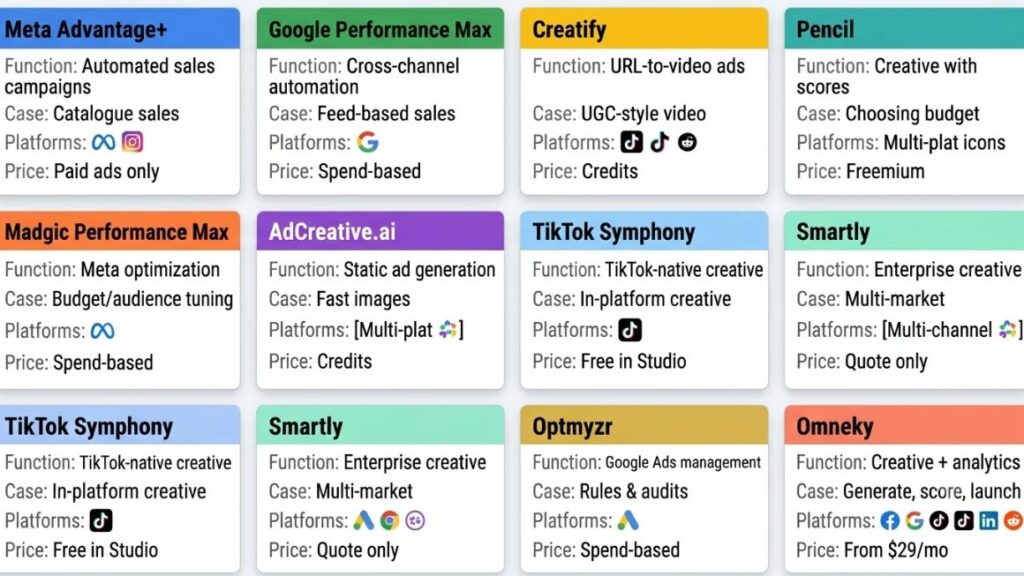
The best AI advertising tools for D2C brands fall into three groups: campaign managers, creative generators and enterprise creative platforms. Skim the table, then read the entries that match your bottleneck.
| Tool | Primary function | Best use case | Supported platforms | Pricing model | Best suited for |
| Meta Advantage+ | Automated sales campaigns | Catalogue sales | Facebook, Instagram | Free; you pay for ads | Stores with steady orders |
| Google Performance Max | Cross-channel automation | Feed-based sales | Google network | Free; you pay for ads | Brands with clean feeds |
| Madgicx | Meta optimisation | Budget and audience tuning | Meta-first | Spend-based, mid-$40s a month up | In-house Meta buyers |
| Optmyzr | Google Ads management | Rules and audits | Google Ads first | Spend-based, from about $209 a month | Heavy Google spenders |
| Birch | Rule-based automation | Pausing and scaling by rule | Meta, Google, TikTok, Snap | From $49 a month, spend-tiered | Hands-on media buyers |
| AdCreative.ai | Static ad generation and scoring | Fast image variations | Major ad platforms | Credits, from about $39 a month | Lean creative teams |
| Creatify | URL-to-video ads | UGC-style video tests | Social video | Credits, from $39 a month | Stores testing short video |
| TikTok Symphony | AI video inside TikTok | TikTok-native creative | TikTok | Free in Creative Studio | Young, video-first audiences |
| Pencil | Creative with predictive scores | Choosing what gets budget | Multi-platform | Listed from $14 a month | Steady creative testers |
| Canva Magic Studio | Design and resizing | On-brand statics | Export anywhere | Free; Pro $15 a month | Small teams |
| Smartly | Enterprise creative and media | Multi-market catalogues | Multi-channel | Quote only | Large brands |
| Omneky | Creative plus analytics | Generate, score, launch | Meta, Google, TikTok, LinkedIn, Reddit | Self-serve from $29 a month | Data-minded growth teams |
AI tools for campaign management and optimization
Five tools here, split into two camps: automation built into the ad platforms, and third-party layers you add on top.
Meta Advantage+
Advantage+ sales campaigns (formerly Advantage+ Shopping) hand audience, placement and budget decisions to Meta’s models, pulling products from your catalogue. Switching it on costs nothing beyond ad spend. Meta’s own global testing reports an average 32% higher ROAS and 17% lower cost per acquisition than manual-only setups, but that’s a vendor benchmark, not a promise for your account. The catch is control: you give most of it up, and bad conversion data poisons the lot. It connects through your catalogue feed and the Conversions API.
Google Performance Max
Performance Max runs one campaign across Search, Shopping, YouTube, Display and more, fed by your product feed and creative assets. Free to use. It has been the black box people love to hate, though Google keeps loosening the lid: channel performance reporting now sits in all campaigns, and from June 15, 2026 product reports pull data from every eligible network. Heads up, that change caused one-time metric jumps, so don’t mistake a July spike for a win. It needs Google Merchant Center and solid conversion tracking.
Madgicx
Madgicx is a Meta-first layer with AI budget and audience suggestions, creative insights and automation rules. Among Meta ads automation tools, it’s worth a trial when Instagram and Facebook drive most of your revenue. Pricing is spend-based, with entry plans in the mid-$40s a month plus a $49 Tracking Pro add-on (Toolradar, October 2026), and there’s a seven-day trial. A Google-heavy brand will get less out of it. Best for founders running Meta in-house without a dedicated media buyer.
Optmyzr
Optmyzr is built for people who live in Google Ads, layering rules, audits and reporting over your accounts. As Google Ads automation software it’s more hands-on than Performance Max: you set the guardrails. Pricing scales with ad spend and starts at about $209 a month (G2, April 2026), which stings on a small account, and it assumes PPC know-how. Best for growing brands, or agencies, with serious Google spend.
Birch
Birch, previously Revealbot, is a rules engine. Pause an ad when cost per purchase crosses a limit, scale budget when returns hold. It works across Meta, Google, TikTok and Snap. Essential starts at $49 a month, but automated rules sit on the $99 Pro plan, and both base prices cover up to $10,000 of monthly ad spend before scaling (Toolradar, October 2026). A fit for media buyers who want control rather than a black box.
AI tools for generating ad creatives and videos
Creative is where most D2C brands run dry first. These five help you make more of it.
AdCreative.ai
AdCreative.ai generates static ads and scores them, so you can ship dozens of variations quickly. It’s a practical AI ad creative generator when you’re short on designers. Plans start around $39 a month, and a credit is spent when you download a creative, not when you generate one. Video features sit on pricier tiers, so read the refund terms and check integrations before the trial ends. Best for small brands that need volume.
Creatify
Paste a product URL and Creatify drafts video ads with AI avatars, scripts and voiceovers in 75+ languages. As an AI video ad generator it’s quick for testing UGC-style hooks. Credit-based plans start at $39 a month for 100 credits (Toolradar, September 2026). The weak spot: URL extraction can miss details or invent claims, so check every draft against your landing page before spending behind it. Best for stores testing short social video.
TikTok Symphony
Symphony Creative Studio is TikTok’s own AI video generator, free for logged-in TikTok for Business accounts. On August 3, 2026 TikTok added Dreamina Seedance 2.5, which doubled the maximum AI video length to 30 seconds (PPC Land). Videos carry an automatic AI-generated label and can feed straight into Smart+ campaigns. The limit is obvious: it’s TikTok-shaped, so it won’t help much elsewhere. Best for brands selling to a young, video-first audience.
Pencil
Pencil, owned by The Brandtech Group, generates ads and attaches a predictive score to each variant, trained on past ad-spend data. Listed plans in late October 2026 were Core at $14 a month and Growth at $55, with Pro on request. Scores sharpen only after you connect ad accounts and test more, so a new brand starts with little signal. Best for brands running steady creative testing across channels.
Canva Magic Studio
Canva has folded Magic Studio into Canva AI 2.0 this year, but the useful bits remain: background removal, Magic Resize, brand kits and AI image generation. Canva Pro costs $15 a month or $120 a year in most markets, and Indian pricing differs. It’s a design tool, not an ad manager. Google has announced Asset Studio integrations with Canva and Adobe, which matters if you already live in Canva. Best for lean teams making on-brand statics.
AI tools for creative intelligence and enterprise advertising
Two heavier options, built for large catalogues, several markets or creative teams that need governance.
Smartly
Smartly is enterprise software, full stop. Its Creative, Media and Intelligence suites cover template-based production, predicted-performance budget shifting and cross-campaign reporting. It publishes no prices, and third-party reports put minimums in the low thousands of dollars a month, so treat that as directional. G2 lists an average implementation of around two months. AI agents were announced in June 2026 with no release date. Best for big brands with in-house media teams.
Omneky
Omneky generates image, video and UGC-style ads, scores them with computer-vision analysis and launches to Meta, Google, TikTok, LinkedIn and Reddit. Its April 2026 release added an eight-format AI video suite and asset-level reporting for Performance Max. Self-serve plans were listed at $29, $99 and $249 a month in late October 2026, with enterprise on request. Credit costs vary by format, so model usage before committing. Best for growth teams wanting analytics and launching together.
How to Choose the Right AI Advertising Tool for Your D2C Business
Start with your bottleneck, not a feature list. Short on creatives? Buy a creative tool. Creatives fine but budget leaking? Buy a management tool.
Consider your monthly advertising budget
A $49 tool on a tiny ad budget eats margin. Madgicx, Birch and Optmyzr all price by spend, so model the bill at the budget you’ll reach in six months, not today.
Check platform compatibility
Most AI advertising tools for D2C brands lean one way. Madgicx favours Meta, Optmyzr favours Google, Symphony lives inside TikTok. Match the tool to where your spend actually sits.
Evaluate integrations with your ecommerce store
Ask how it reads your product catalogue and order data. A clean feed and a working Conversions API beat any clever model guessing in the dark.
Compare automation capabilities
Rules do what you tell them. Models decide for themselves. Know which you’re buying, and who signs off on changes.
Consider reporting and attribution features
Platform dashboards flatter themselves. Look for blended views that tie spend to store revenue, and set up advertising attribution before you trust any number.
Evaluate ease of use and scalability
A tool nobody opens is wasted money. Check the learning curve, the trial length and whether the plan grows without a contract reset.
A simple framework:
- Startups: one platform-native tool (Advantage+ or Performance Max) plus one creative tool.
- Growing brands: add a management layer like Birch or Madgicx, and a weekly testing habit.
- Established businesses: scoring, governance and multi-market tooling, where Pencil, Omneky or Smartly earn their fees.
Choose AI advertising tools by bottleneck and budget. Startups need one platform-native tool and one creative tool, growing brands add a management layer, and established businesses add scoring and governance.
How D2C Brands Can Use AI to Improve Advertising Performance
Used well, AI advertising tools for D2C brands improve performance in three places: how many creatives you test, how fast you spot waste and how clean your data is. Everything else is detail.
Generate and test multiple ad creatives
Make five different angles, not fifty tweaks of one. IAB’s 2025 Digital Video Ad Spend & Strategy Report found 86% of buyers use or plan to use generative AI for video creative, so your competitors are already doing creative testing at volume.
Automate campaign monitoring and budget adjustments
Set rules for the dull stuff: pause when cost per purchase passes your limit, raise budget when returns hold for three days. Rules are cheap. Use them.
Build more relevant customer audiences
Feed Meta and Google your first-party data, like customer lists and purchase values, so audience segmentation starts from people who’ve actually bought. Value-based bidding then hunts for buyers worth more over time, which protects customer lifetime value.
Improve product advertising using catalogue data
Your product catalogue is the targeting engine. Titles, prices and images decide who sees what, and dynamic product ads on Meta and shopping campaigns on Google both live or die on feed quality. Google’s AI Max for Shopping, announced at Google Marketing Live 2026, leans on Merchant Center feeds to match conversational queries.
Analyse advertising results and identify weak campaigns
Judge blended numbers: total revenue against total ad spend, not each platform’s own claims. A weekly ecommerce ad optimization review, backed by solid ad performance tracking, catches the campaigns that look busy but don’t pay.
Here’s how a fashion label might test creatives across Meta and Google (illustrative, with no real results):
- Build four angles for one new kurta range: fit, fabric, styling and offer.
- Run them in one Advantage+ sales campaign on Meta with an even budget.
- Feed the same hero products and assets into Performance Max on Google.
- After a week, compare cost per purchase by angle on each platform.
- Cut the losers, then build two variations of each winner.
Also Read: AI Performance Marketing Strategies That Drive Measurable Growth
Practical AI Advertising Workflow for a D2C Brand
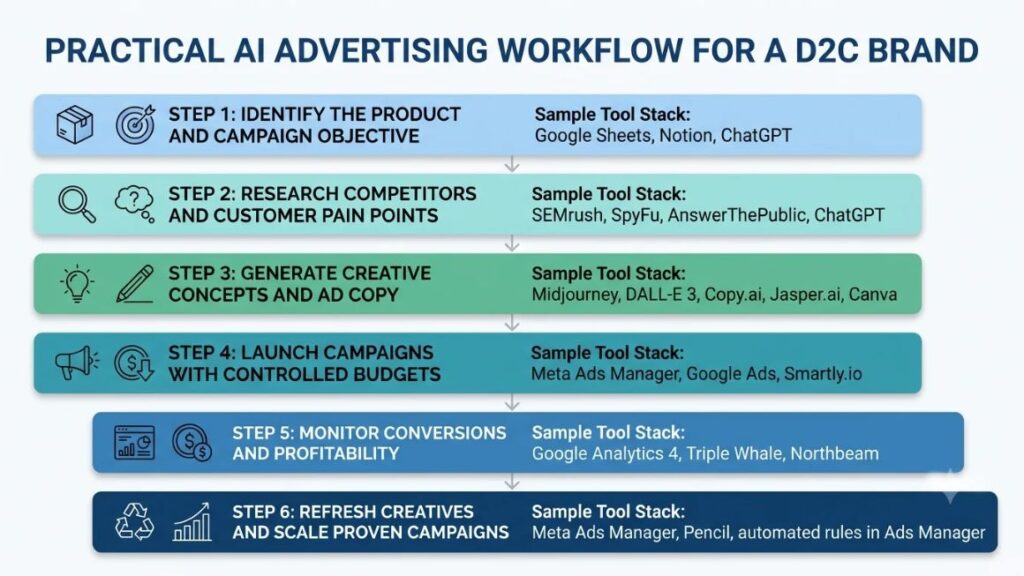
Six steps turn AI advertising tools for D2C brands into a routine. Skip one and the rest wobble.
Step 1: Identify the product and campaign objective
Pick one hero product and one goal: first purchase, repeat purchase or catalogue sales. Work out your break-even ROAS before launch.
Also Read: Marketing Efficiency Ratio (MER): The Metric Smart Marketers Use to Scale Revenue
Step 2: Research competitors and customer pain points
Read your reviews, support chats and Meta’s Ad Library. Pain points make better hooks than product features.
Step 3: Generate creative concepts and ad copy
Use a creative tool for volume, then let a human edit claims, tone and anything legal.
Step 4: Launch campaigns with controlled budgets
Start small, with one campaign per objective, and leave settings alone through the first learning week.
Step 5: Monitor conversions and profitability
Watch conversion rate, cost per purchase and contribution margin. Clicks are a vanity metric here.
Step 6: Refresh creatives and scale proven campaigns
Replace tired ads before fatigue shows. Raise budgets in steps, not jumps.
One sample stack: Creatify and Canva produce assets, Pencil scores them, Advantage+ and Performance Max run them, and Birch guards the budget with rules.
Common Mistakes D2C Brands Should Avoid When Using AI Advertising
AI advertising tools for D2C brands amplify whatever you feed them, good or bad.
Trusting AI-generated creatives without reviewing them
A made-up claim in an ad is your problem, not the tool’s. Creatify-style URL extraction can invent details, so check every one.
Optimizing only for ROAS
A high ROAS on cheap repeat buyers can hide a thin margin. Track contribution margin and CAC payback too.
Ignoring conversion tracking
Bad signals train bad models. Fix your pixel and Conversions API setup first.
Automating campaigns without clear rules
Decide in advance what counts as a loser, and who approves budget jumps.
Using too many disconnected tools
Four tools, four dashboards, four versions of the truth. Start with two.
Forgetting brand identity and customer trust
IAB and Sonata Insights’ 2026 research found 30% of Gen Z consumers call brands that use AI for ads “inauthentic”, against 13% of Millennials, and 89% of advertisers disclose AI use at least sometimes, though fewer than half always do. Your voice still has to sound like you.
The Future of AI Advertising for D2C Businesses
Where AI advertising tools for D2C brands are heading is already announced, not guessed.
AI-generated video and personalized advertising
Symphony now makes 30-second AI videos, and Google’s Asset Studio gained Gemini Omni for video generation at Google Marketing Live 2026.
More advanced creative automation
Asset Studio adds one-click creative testing against existing top performers.
Predictive campaign optimization
Google announced Meridian inside Analytics 360 for measurement, and Pencil already scores creatives before spend. Predictive advertising analytics is moving from reports to decisions.
AI agents and human-supervised advertising
Google’s Ask Advisor works across Ads, Analytics and Merchant Center, while AI Brief lets advertisers steer AI Max with written guidelines. Humans still set the brief.
Privacy, transparency and responsible AI
TikTok labels Symphony videos as AI-generated automatically. Expect disclosure to become routine.
Conclusion
The right AI advertising tools for D2C brands fit the problem you actually have, not the one a demo invents. Keep a human on every claim, budget jump and brand decision. And judge everything by profit, not platform ROAS.
If you want to build the Meta and Google fundamentals behind all this, Young Urban Project’s Performance Marketing course is a sensible next step.
FAQ: Frequently Asked Questions
Which AI advertising tool is best for a small D2C business?
Start free: Meta Advantage+ or Google Performance Max, plus Canva or TikTok Symphony for creative. Add a paid layer such as Madgicx or Birch only once spend justifies it.
Can AI manage Meta and Google advertising campaigns?
Largely, yes. Advantage+ and Performance Max automate bidding, placements and audiences, though you still own the budget, creative and tracking.
Are AI advertising tools worth the investment?
If you’re short on creatives or time, usually yes. If your tracking is broken, no tool will save you.
Can AI generate product ads and videos?
Yes. AdCreative.ai makes statics, Creatify and Symphony make video, but review every output for accuracy and brand fit.
How can D2C brands use AI to reduce customer acquisition costs?
Test more creatives, cut losers faster and feed platforms clean first-party data. Among AI advertising tools for D2C brands, the savings come from less waste, not magic.
Do AI advertising tools replace performance marketers?
No. They take over repetitive execution. Strategy, creative judgement and profitability decisions still need a person.