

A shopper lands on a fashion site looking for a jacket. She scrolls for four minutes, opens six product pages, and leaves without buying anything. Nothing was wrong with the catalog. She just never found the one jacket that matched her budget, her size history, and the vague “something for winter travel” idea in her head. That gap between what a store has and what a shopper can actually find is where most ecommerce revenue quietly disappears.
This is exactly the gap an AI agent for product recommendations is built to close. Not a static “customers also bought” widget bolted onto a product page, but a system that reads intent, reasons over a catalog in real time, and acts on what it finds. Google’s AI Overviews now answer a large share of searches directly on the results page, so brands can’t rely on shoppers clicking through ten blue links to discover a product anymore. The discovery layer has to do the work itself.
By the end of this guide, you’ll know exactly what separates an AI agent for product recommendations from a traditional recommendation engine and how the underlying architecture actually works. Check which platforms are worth evaluating in 2026, and how to build and measure one step by step.
Table of Contents
What Is an AI Agent for Product Recommendations?
An AI agent for product recommendations is a system that reads a shopper’s behavior and intent, retrieves matching products from a catalog, and suggests, explains or acts on those suggestions without a human writing the rule for that specific case. That’s the whole idea in one sentence. Everything else in this article is detail on how that sentence gets built.
The word “agent” is doing real work here. A static recommendation widget follows a fixed rule: show items from the same category, or items other buyers purchased together. An agent reasons. It can combine a shopper’s stated budget, their past returns, a live inventory check, and a promotional rule, then decide what to show and how to phrase it, without a developer having pre-written that exact combination.
How AI Product Recommendation Agents Work
At a mechanical level, most agents run a loop: understand what the shopper wants. Pull candidate products from the catalog. Rank and filter those candidates against constraints like price or stock. Then present the result in a way a human would find natural. Some agents stop at suggesting. Others go further and can add an item to a cart or start a checkout flow on the shopper’s behalf.
What Can a Recommendation Agent Do?
In practice, a recommendation agent for product discovery can hold a conversation (“I need something for a rainy trek, not too bulky”), answer follow-up questions about fit or material, adjust suggestions when a shopper says “cheaper” or “different color” and explain why it picked a specific product. That last part matters more than most teams expect. We’ll come back to it under best practices.
Also Read: AI Agents for E-commerce Marketing: 10 Ways to Boost Sales and Automate Growth
AI Agent vs. Traditional Product Recommendation Engine
AI Agent vs. Recommendation Engine
A traditional product recommendation engine is a scoring system. It takes signals, in the form of clicks, purchases, or ratings and outputs a ranked list of products for a given user or page. It doesn’t converse, it doesn’t explain itself and it can’t handle a query it wasn’t designed for. It’s a scoreboard, not a conversation partner.
An AI agent for product recommendations wraps that same scoring logic in a layer that can understand open-ended language. It can reason across multiple constraints at once and take an action. Honestly, most teams still need both. The engine supplies the candidates. The agent decides what to do with them and how to talk about it.
AI Agent vs. AI Shopping Assistant
The line between a recommendation agent and a broader AI shopping assistant is blurrier. Vendors don’t always draw it the same way. A shopping assistant typically covers a wider job, order tracking, returns, sizing questions, alongside product discovery. A recommendation agent is narrower by design. Some platforms bundle both into a single agent. That is fine, as long as the recommendation logic underneath doesn’t get lost in a general-purpose chatbot that tries to do everything and does none of it particularly well.
Why Ecommerce Brands Are Adopting AI Recommendation Agents in 2026
Retailers aren’t adopting recommendation agents because it’s trendy. They’re adopting them because the return on investment is unusually direct compared to most AI spend, and because search itself has changed shape under their feet.
Conversational Product Discovery
Search used to mean typing a keyword and scrolling results. Now a growing share of discovery happens through conversational commerce. That is where a shopper describes what they need in plain language and expects a direct answer rather than a list of links. According to Elogic’s 2026 ecommerce AI report, recommendation engines now drive between 25% and 35% of total ecommerce revenue. AI-referred traffic to retail sites converted at meaningfully higher rates than traffic from other channels during the 2025 holiday season. That’s not a marginal channel anymore.
Personalization at Scale
Personalized product recommendations used to require a data science team and months of tuning. Large language models changed the cost curve. A brand can now stand up a reasonably capable recommendation agent without building a collaborative filtering pipeline from scratch, which is why smaller D2C brands are showing up in this space alongside enterprise retailers.
From Recommendation to Action
The industry is also moving past “suggest and hope.” Newer agents can add items to a cart and apply a size filter mid-conversation, or flag when a preferred size is out of stock and offer an alternative. According to SQ Magazine’s 2026 ecommerce statistics report, AI-powered product recommendations alone contribute to roughly 26% higher conversions on average. AI-driven personalization can lift revenue by up to 40% in high-traffic stores.
The Rise of Agentic Commerce
Perhaps the biggest shift is that recommendations are starting to happen inside chat interfaces themselves, not just on a brand’s own website. This is the world of agentic commerce, where an AI agent acting on a shopper’s behalf can discover, compare, and in some cases purchase products across merchants. We’ll dig into what that actually requires technically in a moment.
An AI agent for product recommendations reads shopper intent and catalog data in real time rather than following a fixed rule. Recommendation systems already drive an estimated 25% to 35% of total ecommerce revenue, and AI-powered recommendations alone are linked to roughly 26% higher conversion rates on average, according to Elogic’s 2026 AI in Ecommerce report and SQ Magazine’s 2026 ecommerce statistics.
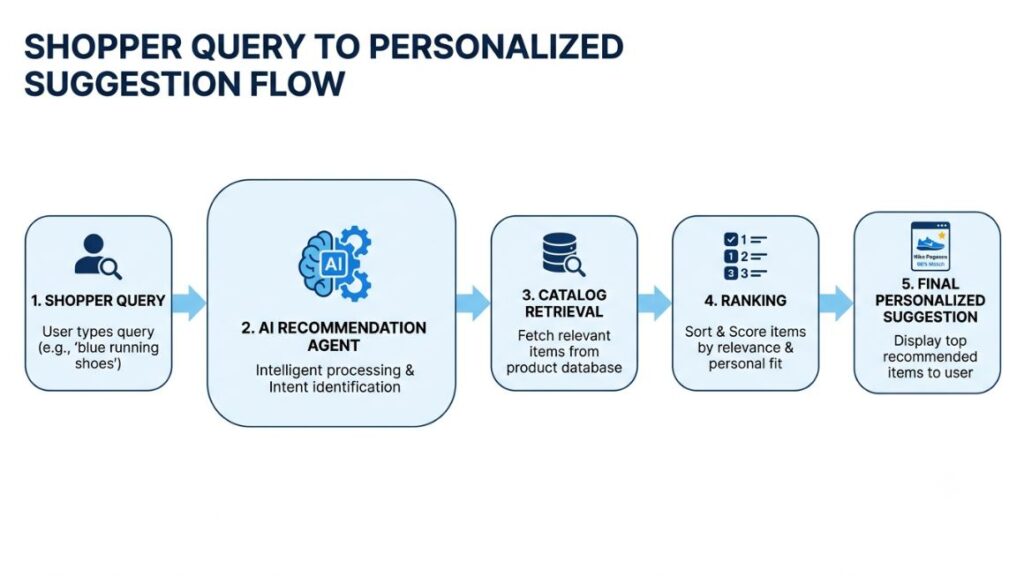
How an AI Agent for Product Recommendations Works
Strip away the vendor marketing and every AI agent for product recommendations runs some version of the same seven-step loop. Not every agent implements all seven with equal sophistication, but this is the shape.
The Product and Shopper Data Layer
Nothing works without clean data underneath it. The agent needs a structured product catalog (price, category, stock, attributes like material or size) and, ideally, shopper-side signals: browsing history, past purchases, cart activity, and stated preferences. Fin AI’s 2026 research on agentic retrieval for ecommerce found that when a merchant’s catalog isn’t well categorized, structured search adds no real value and the system degrades to plain semantic matching, which is noticeably less precise.
Understanding Shopper Intent
The agent parses what the shopper actually said, or did, and turns it into something machine-usable: a semantic intent (“cozy winter jacket for travel”) plus hard constraints (“under 3000 rupees,” “size M,” “in stock”). This split matters. A vague semantic query alone tends to return near-random results, because similarity search has no way to enforce a hard budget or size filter on its own.
Product Retrieval
Once intent is parsed, the agent pulls candidate products. This is usually done through vector search, keyword filtering, or, in more advanced setups, a hybrid of both, running against the catalog described above.
Filtering and Ranking
Candidates get filtered against the hard constraints, then ranked by relevance, popularity, margin, or a blend the merchant defines. This is where a lot of the actual “intelligence” in an AI agent for product recommendations lives, even though it’s the least visible part to the shopper.
Explaining Recommendations
A good agent doesn’t just show three products. It says why: “This one’s water-resistant and packs down small, which fits what you described.” That explanation step is small technically but large in terms of trust, and it’s frequently skipped by teams racing to ship.
Taking Commerce Actions
Some AI agents for product recommendations stop at suggesting. Others can add an item to cart, apply a discount code, or hand the shopper to checkout. This is the layer where agentic commerce protocols come in, and it’s where liability and guardrails matter most, which we’ll cover shortly.
Learning From Feedback
Whether a shopper clicked, ignored or purchased a recommendation feeds back into the system, gradually sharpening future suggestions for that shopper and for others like them.

Which Recommendation Algorithms Can an AI Agent Use?
An agent’s reasoning layer is only as good as the underlying scoring method feeding it candidates. There isn’t one correct algorithm. Most production systems in 2026 blend several.
Collaborative Filtering
Collaborative filtering recommends products based on what similar shoppers bought or liked, without needing to understand the products themselves. It’s the oldest and still one of the most reliable techniques. Its weakness is well known: a brand-new shopper or a brand-new product has no history to draw on, which is the cold-start problem we’ll return to under best practices.
Content-Based Filtering
This approach matches products to a shopper based on item attributes, category, material, brand, rather than what other people did. It handles new products reasonably well since it doesn’t need prior purchase data, but it can get repetitive, showing the shopper more of the same thing rather than genuine discovery.
Hybrid Recommendation Systems
Most serious platforms combine collaborative and content-based signals, using each to cover the other’s blind spots. This is close to the industry default now, not a niche technique.
Semantic and Vector Search
Instead of matching on keywords, the system converts both the shopper’s query and each product into a numeric representation and finds the closest matches by meaning. This is what lets an agent understand “something for a rainy trek” without that exact phrase appearing anywhere in the product descriptions.
LLM-Based Recommendations
Large language models add a reasoning layer on top of all the above: taking retrieved candidates and using natural-language judgment to pick, rank, and explain them in a way that fits the conversation. DZone’s 2026 review of RAG architectures found that splitting this work across multiple specialized agents working in parallel cut task completion time from roughly 30 seconds down to about 8 seconds compared with a single agent handling everything sequentially.
Where MCP, ACP, AP2 and UCP Fit Into AI Commerce
This is the part of the landscape most articles on this topic skip entirely, and it changed fast in 2026. If an AI agent for product recommendations is going to do more than suggest, if it’s going to check live stock, complete a cart, or hand off a purchase, it needs a shared language to talk to merchants across different platforms.
Model Context Protocol, built by Anthropic, gives an agent a standard way to call tools like “search products” or “check inventory” against any connected system. The Agentic Commerce Protocol, from OpenAI and Stripe, standardizes checkout sessions so a purchase can happen inside a chat interface.
Google’s Agent Payments Protocol uses cryptographically signed mandates, essentially a tamper-proof chain of consent, so a merchant can verify a shopper genuinely authorized an agent to spend on their behalf. Shopify and Google’s Universal Commerce Protocol, unveiled at NRF 2026, ties discovery, cart, and fulfillment together and was made self-serve for any developer from June 2026 onward.
Worth knowing before you invest here: OpenAI quietly shut down its in-chat Instant Checkout product in March 2026 after roughly five months of near-zero sales, even though the underlying ACP protocol survives. The practical takeaway for most brands right now isn’t “build in-chat checkout.” It’s “make sure your catalog is readable by agents at all,” since discovery, not checkout, is where the volume actually is today.
Four protocols now govern how AI agents interact with merchants: MCP for tool access, ACP for in-chat checkout sessions, AP2 for cryptographically verified payment authorization, and UCP for end-to-end discovery through fulfillment. As of 2026, discovery and recommendation remain far more mature and widely used than in-chat purchasing.
Also Read: AI Agent for Shopping Campaigns: A Complete Guide for Marketers
Real-World Examples of AI Product Recommendation Agents
Theory is only useful once you’ve seen it deployed at scale. Here’s how some of the biggest names in Indian and global ecommerce are actually using this technology right now.
Myntra
Myntra’s AI shopping assistant, Maya, built on ChatGPT and rolled out in 2023, now covers sizing through its Size and Fit Intelligence system across roughly 85% of its eligible apparel range. According to Myntra’s own reporting, users who engage with its AI shopping assistant are three times more likely to purchase and add products from 16% more categories than users who don’t.
Flipkart
Flipkart launched its AI assistant Flippi in 2023. It more recently introduced SLAP which is a prompt-based shopping tool that lets shoppers describe what they want in natural language instead of navigating filters. The company also rolled out a voice-based assistant supporting Hindi and English for its Supermart grocery vertical.
Amazon
Amazon India’s Rufus assistant has been used by more than one crore Indian customers, per company figures. Globally, Amazon’s recommendation system is widely cited as driving roughly 35% of the company’s total sales, still one of the most-referenced proof points for personalization ROI in the industry, even though the underlying figure traces back to older analysis and shouldn’t be read as a fresh 2026 measurement.
Rep AI
Rep AI is an agentic commerce platform built specifically for Shopify stores. It identifies high-intent moments during a shopping session and proactively surfaces personalized recommendations. It handles objections and lets shoppers add to cart without leaving the conversation.
Alhena
Alhena AI runs a full-funnel agent that combines product discovery, personalized recommendations, and post-purchase support in one conversational thread. It is trained specifically on a merchant’s own catalog and policies rather than general web knowledge.
Klaviyo
Klaviyo’s K:AI Customer Agent delivers recommendations consistently across web chat and SMS. It draws from the same underlying engine so a shopper gets the same suggestion regardless of channel.
Myntra’s AI assistant users convert three times more often and browse 16% more product categories than non-users. Amazon India’s Rufus has already reached more than one crore customers. Flipkart has moved from a single assistant to a broader prompt-based shopping layer called SLAP. This is a sign that recommendation agents in India have moved past pilot stage into core infrastructure.
Best AI Product Recommendation Tools and Platforms in 2026
Choosing a platform depends heavily on your catalog size, technical resources and whether you want a no-code widget or a fully custom build. Here’s a practical breakdown.
| Platform Type | Examples | Best For | Key Strength |
| No-code, quick deploy | Recomi | Small D2C brands, fast setup | Live in three steps, minimal engineering |
| Shopify-native agentic | Rep AI, Alhena | Mid-size Shopify stores | Full-funnel discovery to support |
| Search and discovery specialists | Algolia | Stores with weak on-site search | Combines search with recommendation ranking |
| Enterprise personalization suites | Optimizely | Large retailers with dev resources | Deep real-time personalization, needs setup investment |
| Lifecycle and email-integrated | Klaviyo K:AI | Brands wanting cross-channel consistency | Same engine across web, chat, and SMS |
| Custom build | MCP + vector database + LLM | Teams needing full control | No vendor lock-in, tailored to catalog structure |
Optimizely’s involve.me review notes that despite strong automation capabilities, it requires a solid development foundation to configure key functionality properly, which rules it out for teams without in-house engineering support. If your catalog is under a few thousand SKUs and your team is lean, a no-code option or a Shopify-native agent will get you further and faster, than a custom build.
How to Build an AI Agent for Product Recommendations?
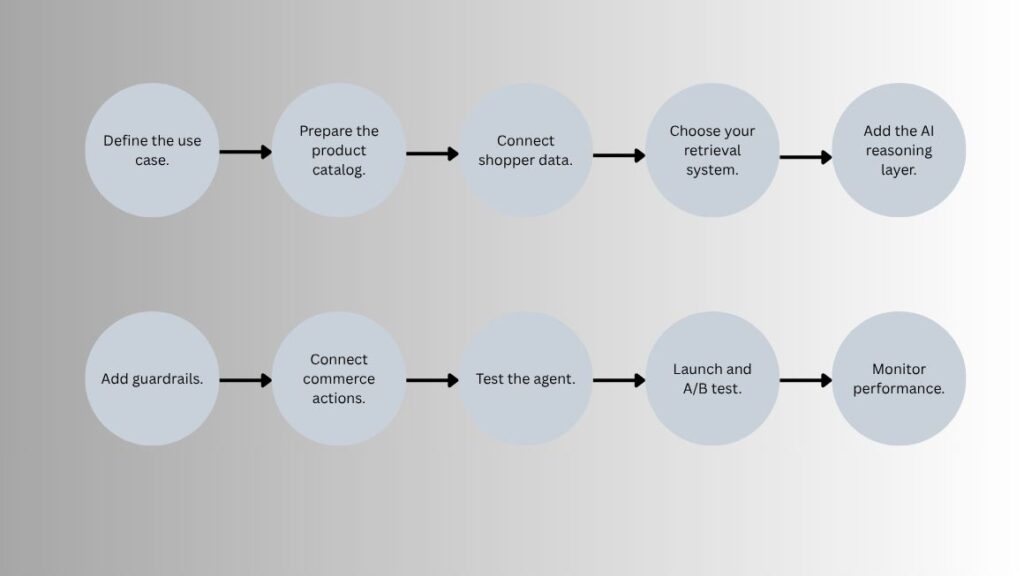
Here’s the step-by-step process, whether you’re using a no-code platform or building from scratch with your own stack.
- Define the use case. Decide what problem you’re actually solving, higher average order value, lower cart abandonment, better product discovery on a large catalog, before picking any tool.
- Prepare the product catalog. Clean, structured product data (category, price, attributes, stock status) is the single biggest predictor of recommendation quality. Messy data produces messy suggestions no matter how good the model is.
- Connect shopper data. Pull in browsing history, purchase history, and cart events where privacy policy allows, since this is what personalization actually runs on.
- Choose your retrieval system. Decide between keyword search, vector search, or a hybrid of both, based on how varied your product descriptions are.
- Add the AI reasoning layer. This is where a large language model interprets intent and picks from the retrieved candidates in natural language.
- Build recommendation ranking. Layer in business rules, margin, promotions, inventory priority, on top of relevance so the agent isn’t just optimizing for similarity.
- Add guardrails. Restrict the agent to recommending only products that actually exist in your live catalog, and block it from inventing prices, specs, or stock status.
- Connect commerce actions. If you want the agent to add to cart or check out, this is where MCP or ACP integration comes in.
- Test the agent. Run it against real shopper queries, including vague ones, before launch, and check for hallucinated products or broken links.
- Launch and A/B test. Roll out to a subset of traffic first and compare conversion, not just click-through, against your existing recommendation setup.
- Monitor performance. Review conversation logs regularly. Failure patterns compound quietly if nobody’s watching for them.
How to Measure the ROI of AI Product Recommendations?
None of this matters if you can’t tie it back to revenue. Track these six metrics from week one.
- Conversion rate: the percentage of sessions with a recommendation interaction that end in a purchase, compared against sessions without one.
- Average order value: whether shoppers exposed to recommendations spend more per order than those who aren’t. This is usually the fastest metric to move.
- Revenue per session: a broader view that captures both conversion and basket size together.
- Recommendation click-through rate: how often shoppers actually engage with what the agent suggests. That is a leading indicator before revenue metrics catch up.
- Assisted revenue: purchases where a recommendation played a role somewhere in the path, even if it wasn’t the final click.
- Return rate: whether AI-recommended purchases get returned more or less often than unassisted purchases. This one gets ignored constantly. It shouldn’t, since a recommendation that drives a sale followed by a return isn’t actually a win.
Best Practices for Relevant and Trustworthy AI Recommendations
Getting the technology deployed is the easy part. Getting shoppers to trust it is where most teams stumble.
Solve the Cold-Start Problem
Every new shopper and every new product starts with zero history, and collaborative filtering has nothing to work with in that gap. GoPractice’s cold-start research found that a workable fix is running a separate rule for new users, showing popular items until enough behavioral data accumulates, then switching them into the personalized system once there’s something to personalize against. A short onboarding question about preferences works even faster, since it gives the system something to match on immediately.
Keep Catalog Data Fresh
Stale stock status or outdated pricing is one of the fastest ways to break trust, and it’s also one of the most common causes of hallucinated recommendations, where the agent confidently suggests something that’s no longer available.
Avoid Over-Personalization
There’s a line between helpful and unsettling. Recommending a product based on a browsing pattern is fine. Referencing a specific past purchase too explicitly can feel invasive rather than smart. Test this with real users before assuming more personalization is always better.
Explain Why Products Are Recommended
A one-line explanation (“based on what you viewed” or “matches your stated budget”) does more for conversion than an extra layer of algorithmic sophistication most shoppers will never notice.
Respect Customer Privacy
Data privacy has become a genuine trust issue, not a compliance afterthought. According to GenAIEmbed’s 2026 conversion optimization report, 81% of shoppers say they’ve abandoned a cart over concerns about weak privacy practices, which should reframe how aggressively any recommendation system uses personal data.
Give Shoppers Control
Let people dismiss a recommendation, say “show me something else,” or opt out of personalization entirely. An agent that can’t be redirected feels less like an assistant and more like a wall.
Common Mistakes That Reduce Recommendation Agent ROI
The most expensive mistake is skipping guardrails entirely. Research on agentic shopping benchmarks has documented AI agents fabricating product URLs and product links that don’t resolve to anything real, frustrating shoppers and burning trust in a single bad interaction. Retrieval-grounded responses, where the agent can only recommend products a live catalog query actually returns, cut this failure mode by a wide margin. Grounding techniques like this have been shown to reduce hallucination rates by roughly 70% to 80% in production deployments.
The second common mistake is treating the agent as a one-time project instead of an ongoing one. Conversation logs need regular review. A pattern that looked fine at launch can drift as the catalog changes or as shoppers start asking questions the system was never tuned for.
The third mistake is ignoring the cold-start gap and launching the same experience for new and returning shoppers. That quietly tanks first-session conversion for exactly the audience a brand most needs to win over.
What’s Next for AI Product Recommendations in 2026 and Beyond
The protocol layer is still consolidating. Expect UCP, ACP and AP2 to keep converging rather than compete outright. Shopify, Google, and OpenAI have each said their standards are meant to interoperate rather than replace one another. Visual and multimodal search is also gaining ground quickly. This lets shoppers upload a photo instead of describing what they want in words, which matters enormously for visually driven categories like fashion and home decor.
The bigger shift, though, is less technical and more behavioral. Nine in ten retail executives now expect AI to be used ahead of traditional search by shoppers. A growing share expect today’s multi-step shopping journey to compress into a single AI-driven interaction over the next year or two. Brands that treat their recommendation layer as core infrastructure, not a plugin, are the ones positioned to benefit when that shift lands.
Conclusion
An AI agent for product recommendations isn’t a nice-to-have widget anymore. It’s becoming the layer that decides whether a shopper finds what they need or leaves empty-handed, especially as more discovery happens through conversation instead of browsing. Start small: clean catalog data, a clear use case. Guardrails against hallucinated suggestions will get you further than chasing the most advanced model on the market.
If you want to go deeper into building and deploying agents like this for real ecommerce use cases, YUP’s AI Marketing course walks through the exact frameworks covered here, from retrieval architecture to protocol integration, with hands-on practice you can apply directly to your own store or your clients’ stores.
FAQ
What is an AI agent for product recommendations?
An AI agent for product recommendations is a system that interprets shopper intent and retrieves matching products from a catalog. It suggests or acts on recommendations without a developer having pre-written a rule for that exact scenario.
AI agent vs. recommendation engine, what’s the difference?
A recommendation engine scores and ranks products based on signals like clicks or purchases. An AI agent for product recommendations wraps that scoring in a layer that can understand natural language, reason across constraints, and in some cases take an action like adding an item to cart.
How do I set up an AI agent for product recommendations on my store?
Start by cleaning your product catalog data, then choose a platform that matches your technical capacity, a no-code tool for a lean team, a Shopify-native agent for mid-size stores, or a custom build for full control. Connect shopper data. Add guardrails against hallucinated recommendations, and A/B test before a full rollout.
Who should actually use a recommendation agent?
Any store with more than a handful of SKUs benefits, but the ROI is clearest for catalogs large enough that shoppers genuinely struggle to browse everything manually, and for brands seeing high cart abandonment or low repeat purchase rates.
Is it worth it for a small D2C brand, or only for large catalogs?
Small D2C brands can now deploy no-code recommendation agents without a data science team. That has meaningfully lowered the barrier to entry. The economics still favor larger catalogs, but a small brand with even 200 to 300 SKUs can see a measurable lift.
Why isn’t my AI recommendation agent improving conversions?
The most common causes are stale or poorly structured catalog data, a missing cold-start strategy for new shoppers or recommendations that lack any explanation. That reduces shopper trust even when the suggestions are technically accurate.
Is AI product recommendation the same thing as personalization?
They overlap but aren’t identical. Personalization is the broader goal, tailoring the entire shopping experience to an individual. AI product recommendation is one specific mechanism for delivering that personalization, focused narrowly on which products to surface.
Do recommendation agents need protocols like MCP or ACP to work?
Not for basic on-site recommendations. Those protocols matter once an agent needs to take commerce actions, checking live inventory across systems, completing a checkout or interacting with a shopper through a third-party chat interface rather than your own site.
How much does an AI agent for product recommendations cost?
Costs vary widely by approach. No-code platforms typically run on monthly subscription pricing scaled to catalog size or traffic. Custom builds involve engineering time upfront plus ongoing model and infrastructure costs. Most teams should pilot with a no-code or platform-native option before committing to a custom build.
Can it work without much customer data, the cold-start problem?
Yes, though not with collaborative filtering alone. Content-based filtering using product attributes, plus a short onboarding preference question, gives the system something to match against even before any behavioral history exists.
Do AI product recommendations actually work, or is it overhyped?
The data suggests it’s genuinely working, not just hype. Recommendation engines already contribute an estimated 25% to 35% of ecommerce revenue industry-wide, and Myntra alone reports three times higher purchase likelihood among users of its AI shopping assistant. The caveat is that results depend heavily on data quality and guardrails against hallucinated suggestions, not the technology alone.