

Your competitors’ stores run campaigns while the owners are asleep. Their emails hit inboxes at the exact moment a customer is likely to open them. Prices change before anyone else even notices the market shift. This isn’t because they have a bigger team. They use AI agents for e-commerce marketing. These agents manage tasks that once took five people and three tools.
Most online stores are still stuck in the old-school way of marketing. Employees schedule emails by hand. They check inventory each day. They also guess which product to promote next. It works, but it’s slow, and sluggishness gets crushed by speed in e-commerce every single time.
By the end of this article, you’ll know what an AI agent is. You’ll see ten real-world examples of stores using them today. Plus, you’ll learn how to pick the right one for your business without wasting money on tools you won’t use.
Table of Contents
What Are AI Agents in E-commerce Marketing?
An AI agent is software that makes its own decisions. It acts on its own, so it doesn’t need manual help for every task. It’s not a basic chatbot or a set of static automation rules. A chatbot sticks to a script. An agent looks at the data, figures out the next move, and executes the task.
Think of it this way: A regular tool sends the same discount email to all. It does this every Friday. An agent analyzes each customer’s browsing history, past purchases, and cart abandonment risk. It identifies the ideal recipient, adjusts the message, and picks the best time to deliver it for the most impact.
It’s a bigger deal than it sounds. McKinsey says companies that personalize generate 40% more revenue. This is much better than average. But when you have a few hundred customers, manual processes become unsustainable. It can feel overwhelming.
AI agents in e-commerce marketing are autonomous decision-making engines. By analyzing customer data, these agents act independently rather than following rigid rules. They check browsing and purchase histories. Then, they personalize emails. They also change prices or suggest products. All this happens without needing manual approval.
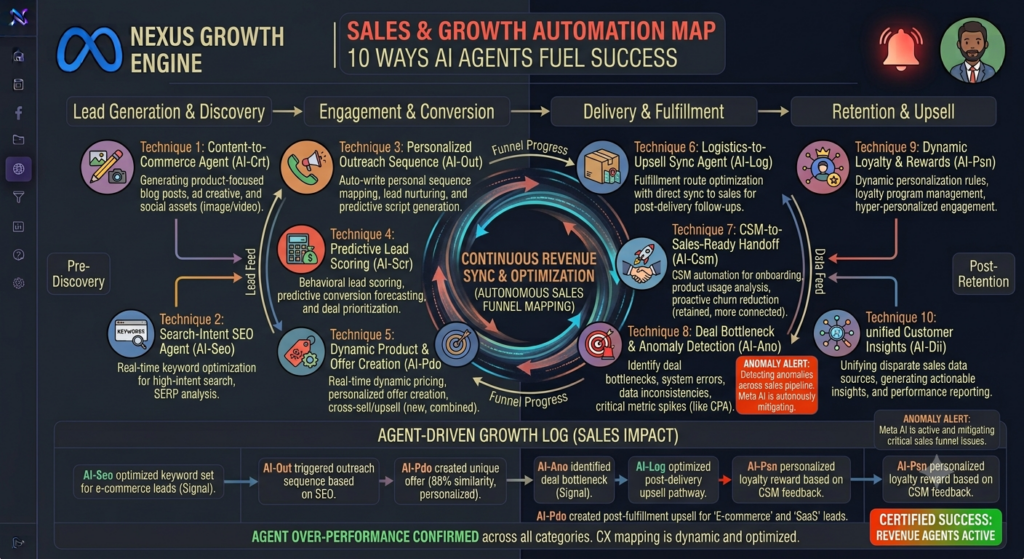
10 Ways AI Agents Can Boost Sales and Automate Growth
Let’s get practical. Here are ten ways stores use AI agents. We’ll look at how they work and the top tools in the market today.
1. Personalized Product Recommendation Agents
AI agents track what customers browse, click, and buy. They then decide what to show next at once. This goes beyond basic “customers also bought” lists. This gives tailored recommendations that update in real time as users browse your site.
Nosto and Dynamic Yield are the leaders in e-commerce personalization. Many mid-sized and large D2C brands use them for live personalization. Many Shopify stores use Algolia Recommend. It shows product recommendations on pages. It also appears in search results.
Nykaa built its discovery experience with personalized recommendations. Each user sees a unique homepage. The product grid changes based on past actions. It’s not guessing. It’s the recommendation engine choosing products for each visitor in every session.
63% of shoppers say AI product recommendations affect their buying choices. This data comes from 2025 Gauss research on AI in e-commerce. That is the majority of your customers.
2. AI Chatbots for 24/7 Customer Support
The benefit of a support agent that doesn’t sleep sounds obvious, but the impact is huge. If someone browses your store at 2 AM with a sizing question, they either get an answeror they leave. No middle ground.
Intercom’s Fin and Gorgias are two of the most popular AI chatbot agents built for e-commerce. They don’t just answer FAQs. They fetch order status. They process returns. They recommend products. All of this happens in the chat window and is fully automated.
Here’s the thing: People expect this now. 61% of shoppers value chatbots mainly for their 24/7 availability, Gauss’s 2025 stats say. That’s a bigger lure than speed or accuracy for a lot of folks.
Luxury Escapes, a travel brand, saw its AI chatbot bump retargeting response rates up 89%. That’s a stat every marketer should notice retargeting is usually the toughest channel to budge.
3. Dynamic Pricing Agents
Automatic price updates based on demand, competitor actions, and inventory. Airlines have been doing this for years, but AI agents brought it to stores without a data science team.
Prisync and Competera are made for this. They scan competitor prices round the clock and tweak your prices inside your preset rules so you’re never manually checking what five other sites charge for the same item.
This one freaks marketers out at first. Letting software decide prices feels risky. But if you set guardrails minimum margin, max discount it turns into an employee you don’t have to pay.
Amazon’s done dynamic pricing at a massive scale for years, tweaking prices millions of times daily. Smaller brands now get a piece of that tech, thanks to tools that used to be only for big companies.
4. AI Agents for Abandoned Cart Recovery
The numbers make this impossible to overlook. Average cart abandonment for e-commerce is 70.19%, Baymard Institute’s 2025 data shows that’s seven out of ten shoppers walking away before checkout.
That’s not a leak, that’s most of your potential revenue disappearing just before you get paid.
AI recovery agents like Klaviyo and CartStack don’t just send one generic reminder. They choose the channel email, SMS, push notification and timing based on each customer’s behavior. Some buyers respond best to an email inside the hour; others need a discount nudge a day later.
Timing is key. Emails sent within an hour convert at 20.3%, but after 24 hours, that drops to 12.2%, according to 2026 Ringly cart abandonment data. An agent firing reminders in minutes, no dashboard check required, closes that gap.
Cart abandonment averages 70.19% in e-commerce, Baymard Institute’s 2025 research says, about $260 billion in recoverable revenue for US and EU retailers. AI recovery agents close the gap by picking the right channel and timing per customer never just one generic reminder.
5. Automated Email and SMS Marketing Agents
This is more than scheduling. Klaviyo AI and Postscript decide who gets which message, on what channel, and when, all based on individual behavior not some calendar set weeks ago.
Most brands still batch-and-blast, same email, same time, whole list. An agent notices one group opens emails at 8 PM, another only responds to SMS, and routes messages accordingly without a marketer building ten flows manually.
Mamaearth ran its early growth with aggressive, hyper-segmented email and WhatsApp outreach, treating first-time buyers and repeat customers differently. That’s the logic an AI agent scales up instantly.
6. AI-Powered Ad Campaign Optimization
Manual ad management means constantly checking spend, pausing losers, and shuffling budgets. An AI agent does this nonstop, not just once a day.
Google Performance Max and Meta’s Advantage+ Shopping Campaigns are the big names here most e-commerce marketers touch these already, whether they know it or not. Both use AI agents to test creative, shift budget to what’s working, and bid in real time.
Smartly.io pushes further for brands handling ads on several platforms at once, using AI to optimize creative and spend across Meta, TikTok, and Google, all from a single dashboard.
72% of US digital retailers say generative AI and personalization have the biggest effect on their business, per Insider Intelligence’s 2025 Bolt survey. Ad optimization is usually the first clear win, since it’s easy to track.
7. Inventory and Demand Forecasting Agents
Marketing and inventory rarely cross paths, but they should. There’s no sense running a campaign that spikes demand for a product that’s about to go out of stock.
Inventory Planner and Lokad use AI agents to forecast demand (based on seasonality, sales, future campaigns), then flag restock points before you run out. That closes a gap that’s cost many D2C brands real money during big sales.
Zepto, the Indian quick commerce brand, relies on these forecasts. Their whole ten-minute delivery model collapses if inventory prediction is off, even just a little. Their system predicts demand down to the neighborhood.
If you run a small shop with slow-moving, low-SKU inventory, the gains from forecasting aren’t as dramatic as they are for brands with thousands of SKUs in several warehouses.
8. AI Content and Creative Generation Agents
Someone needs to write product descriptions, ad copy, and email subject lines. More often, that someone is an AI agent not a copywriter staring at a blank screen.
AdCreative.ai generates and tests ad creative variations automatically, then the agent decides which versions stay based on performance. Pencil does this too, built for e-commerce and D2C ad creative.
It doesn’t replace your creative team. It chops out the grunt work dozens of headlines, product drafts so your team can focus on the big ideas that need real brainpower.
9. Customer Segmentation and Retention Agents
Most stores segment customers once in a while, maybe a couple of times a year. An AI agent does this constantly, shuffling customers between segments as soon as their behavior changes.
Klaviyo and Ometria offer live segmentation, flagging churn-risk customers before they drop off. That’s where the value is: catching someone before they go is way cheaper than winning them back after.
Swiggy, known for food delivery, uses this retention logic across its entire platform. It predicts which users are likely to order less and triggers targeted offers before drop-off happens.
58% of business leaders say AI chatbots will matter most for personalization in the next five years, and 55% say predictive analytics will boost recommendations, Twilio Segment’s 2024 State of Personalization shows. Retention sits right in the middle of both.
10. Social Media and Influencer Outreach Agents
Finding the right influencers used to mean hours of manual research. Now, agents inside platforms like Grin and Upfluence scan creator data, engagement rates, and audience overlap, then deliver matches automatically, cutting research time big-time.
Some tools manage outreach, too, drafting personalized pitches and tracking replies so a marketer steps in only when a creator answers.
boAt, the Indian audio and wearables brand, built massive growth with influencer marketing at scale, working with thousands of creators. Managing that manually would take an army. AI-powered outreach is what makes that scale actually doable.
How to Choose the Right AI Agent for Your Store
Not every store needs all ten. That matters, because it’s easy to buy every tool and end up with five overlapping platforms nobody uses.
Start with your biggest problem not the shiniest opportunity. If your cart abandonment is above 70%, fix that before you worry about ad optimization. If your support inbox is drowning, a chatbot agent delivers value quicker than a recommendation engine.
Find your biggest bottleneck: abandoned carts, slow support, manual ad management.
Pick one agent that tackles this problem, not some “do-it-all” platform.
Set guardrails before you launch, especially for pricing and discounts so the AI doesn’t make decisions that kill your margin.
Run the agent alongside your current process for two to four weeks, compare results, then fully switch.
Don’t add a second agent until the first one’s proven never before.
Common Mistakes Brands Make When Adopting AI Agents
Most failures with AI agents come from setup, not bad tools.
The top mistake? Turning an agent on and leaving it alone. These systems need boundaries. A pricing agent with no margin floor will tank prices if competitors do. An email agent with no frequency caps burns your audience fast.
Second mistake: expecting instant results. Data-driven agents need time to learn your patterns. Recommendation engines launched last week won’t work as well as ones fed three months of sales data.
And, really, a lot of brands skip cleaning their data first. An AI agent using messy, duplicated, outdated data will make wrong decisions with absolute confidence. Garbage in, garbage out no matter how advanced the AI.
With YUP learners experimenting on these tools, we see the brands getting the most value start narrow: one agent, one clear problem, then scale up. The ones who try to automate everything at once, usually just automate confusion.
Most AI agent implementation failures come from launching without clear rules, expecting quick results before systems learn, and feeding messy data. Brands that start with one agent and one specific problem setting rules upfront consistently outperform those trying to automate everything.
Conclusion
The brands leading the pack right now aren’t just throwing more money at marketing. They’re investing in tools that speed up decision-making. These systems recover carts within an hour. They adjust prices quickly and answer customer questions 24/7.
Start small. Choose one agent and focus on your biggest issue first. Lost sales can happen for a few reasons. Abandoned carts are one. Slow customer support adds to it. Also, managing ads by hand can cause issues. Get that up and running, show that it delivers, then keep building from there.
Want to set up an AI-powered marketing system? YUP’s AI Marketing course guides you step by step. Plus, the Hotskill app lets you practice with real campaigns.
FAQs
What is an AI agent in e-commerce marketing?
An AI agent is software that analyzes customer data and makes marketing decisions like sending emails, changing prices, or recommending products without a human approving each step. It goes further than basic automation because it adapts to real-time behavior, not just a fixed script.
AI agents vs marketing automation, what’s the difference?
Marketing automation uses preset rules like emailing everyone every Friday. AI agents make dynamic decisions, picking who to email, which channel to use, and when, based on each customer’s unique behavior. Automation is static. Agents are flexible.
How do I set up an AI agent for abandoned cart recovery?
Connect a tool like Klaviyo or CartStack to your checkout data. Set triggers like carts idle 15-30 minutes. Build a sequence: email inside the first hour, SMS the next day. Let the agent decide when to send, per customer, based on engagement data.
Who should use AI agents for e-commerce marketing?
Any store with enough customers for meaningful behavioral data roughly a few hundred transactions a month. Very small stores might not have the data volume agents need, so manual personalization is still fine at that scale.
Are AI agents actually worth it for a small D2C brand?
For most small D2C brands, yes especially for cart recovery and support, since both directly tackle revenue leaks. The payoff depends on your starting point. If your cart abandonment is already low, you’ll see less lift than brands sitting above 70%.
Do AI agents replace a marketing team?
No, and that’s a common misconception. Agents handle repetitive, data-heavy tasks well, but strategy, brand voice, and creative direction still need humans. Best results come when agents manage execution, freeing your team for true decision-making.
Why isn’t my AI recommendation engine showing relevant products?
Usually, it’s low or messy data feeding the agent. Recommendation engines need weeks of sales and browsing history to learn. If the tool is fresh or tied to a messy catalog, performance lags until the data builds up and cleans out.
What’s the biggest mistake brands make with dynamic pricing agents?
Going live without margin guardrails. If you don’t set price floors, a pricing agent chasing competitors can trigger a race to the bottom, killing profits fast. Set minimum and maximum boundaries before the agent goes live.
Can AI agents work across email, SMS, and social at once?
Yes, and that’s where they offer maximum value over manual marketing. Klaviyo AI picks the best channel for each customer. This is better than running separate campaigns by channel, which is hard to do manually at scale.
How long does it take to see results from an AI marketing agent?
Most brands see early signs in two to four weeks. Full performance comes in two to three months. That’s when the agent collects enough customer data. Then, it can make reliable decisions. Cart recovery and chatbots get fast results. They react to what people do right away. They focus on immediate actions, not long-term trends.