

Most marketers think they’re already using AI on Facebook ads. They’ve flipped on Meta’s automated bidding, maybe run a few Advantage+ campaigns and called it a day. That’s automation. An AI Agent for Facebook Ads is different. The difference starts to matter a lot once budgets scale past a few thousand dollars a month.
Here’s the gap. Traditional automation follows instructions you write: pause this ad set if cost per acquisition crosses a threshold. Shift budget if ROAS drops below 2x. An AI agent doesn’t wait for your rules. It reads account performance, decides what needs to change, and acts. All of that happens often before you’ve opened Ads Manager that day.
That distinction isn’t marketing spin. It’s the line between a tool that saves you clicks and one that replaces a chunk of your daily media-buying work. By the end of this article, you’ll know exactly what separates a genuine AI agent from repackaged automation and which tools are actually worth paying for in 2026. Learn how to set one up without handing over control you’re not ready to give up.
Table of Contents
What Is an AI Agent for Facebook Ads?
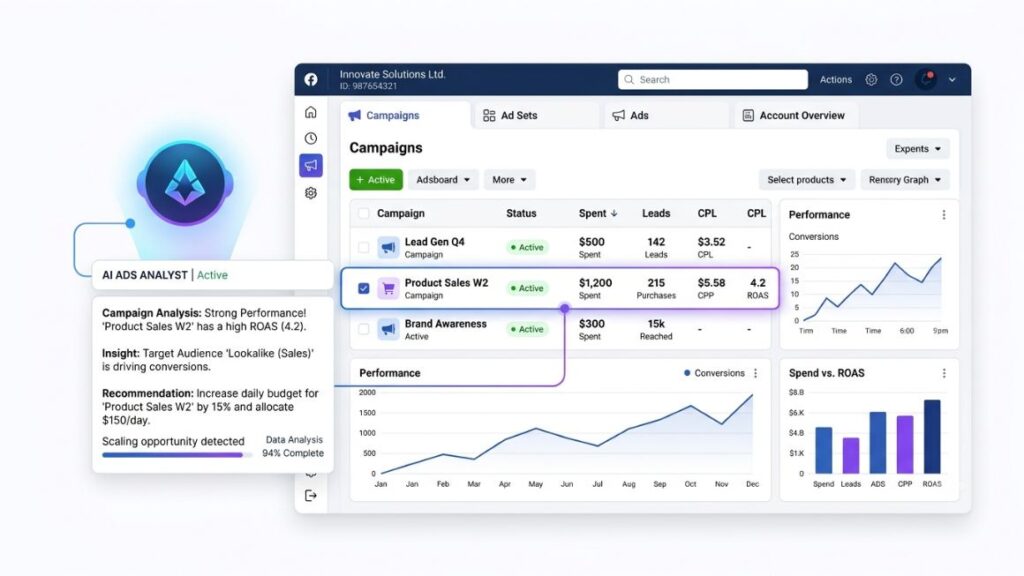
An AI Agent for Facebook Ads is a software system that autonomously analyzes campaign data, makes optimization decisions and executes changes inside your Meta ad account. No human has to approve every step. That’s the core definition.
The idea comes from a broader concept in AI called agentic systems. It rests on three capabilities working together: perception, reasoning and action. Perception means the agent pulls in real data, your spend history, audience performance, creative fatigue signals and competitor moves where visible. Reasoning means it interprets that data against a goal you’ve set. That could be a target cost per lead or a minimum ROAS. Action means it actually executes, adjusting a bid, reallocating a budget, pausing a losing ad set, without waiting for you to click “apply.”
Compare that to what most marketers call “AI” today. A tool that suggests three headline variations you still have to approve isn’t an agent. A rule you built yourself (“if spend exceeds ₹5,000 with zero conversions, pause”) isn’t an agent either, no matter how many conditions it has. That’s automation doing exactly what you told it to do. An agent decides what to do.
An AI Agent for Facebook Ads is a system that perceives campaign data, reasons about performance against a defined goal, and takes action inside Meta Ads Manager autonomously. Unlike rule-based automation, it doesn’t need pre-written conditions to know when or how to act.
AI Agents vs Traditional Facebook Ads Automation: What’s the Real Difference?
This is the question that trips up most marketers evaluating tools in 2026. That’s mostly because every vendor calls their product “AI-powered” whether it qualifies or not. The honest answer: the difference is whether the system needs you to write the logic or figures the logic out itself.
Rule-Based Automation
Rule-based tools like Revealbot built their reputation on exactly this model. You set a condition; the platform monitors for it. When it’s triggered, an action fires. If cost per result exceeds a number, pause the ad set. If ROAS beats a threshold for three days, increase budget by 20%. It’s dependable and transparent. Every action traces back to a rule you wrote. This makes it easy to audit and explain to a client.
The limitation shows up the moment your account gets complicated. Rule-based systems can’t analyze your landing page copy and connect it to why one audience converts better than another. They can’t notice that your top three creatives share a visual pattern. They also can’t suggest you test more like them. They execute. They don’t understand.
Agentic Systems
Genuine agentic systems remove the rule-writing step almost entirely. You state a goal, not a condition. Ryze AI, for instance, markets itself around exactly this model. No automation rules to configure. The system decides and acts on its own, recovering wasted spend during off-hours that manual management typically misses. Whether the marketer likes it or not, that’s a meaningfully different job than what Revealbot does.
This matters more than the marketing copy suggests. It really does. A rule engine can only handle scenarios you anticipated. An agent handles scenarios you didn’t think to write a rule for, because it’s reasoning from the goal, not from a checklist.
Why AI Agents Are Reshaping Facebook Advertising in 2026
Skip the theory for a second. The numbers from this year explain why every serious media buyer is paying attention to this shift, not just the AI-curious ones.
Meta’s Q2 2026 earnings, released in July, showed advertising revenue up 27% year-on-year to $59.36 billion. The company credited AI directly for improving delivery, targeting and conversion rates. On Facebook specifically, updates to its ranking and recommendation models drove an 8.3% increase in ad clicks and a 15.7% rise in conversions during the quarter, according to Meta’s own reporting. That’s not a marginal tweak. That’s a platform-level shift in how ads get shown to people.
Zoom out further and the picture gets bigger. Meta’s Advantage+ automated ad suite has reportedly crossed a $75 billion annual revenue run rate, and nine million small businesses are now using at least one of Meta’s AI ad creative tools, based on figures shared in the company’s Q2 2026 results. In March 2026, Meta also published details on its Ranking Engineer Agent, an autonomous AI system that doubled average accuracy across six ad-ranking models and delivered a 5x increase in engineering output, according to Meta’s own engineering blog. The infrastructure deciding which ads reach which people is now being built and improved by AI agents, not just human engineers.
India tells a similar story, though from a different starting point. A 2026 Amazon Ads study found 71% of Indian SMB marketing leaders are already using or actively testing AI tools for advertising. 89% believe AI in advertising will free up time for higher-priority work. The same study estimated SMBs could save roughly 5.2 hours a week, close to 30 working days a year, by adopting AI in their ad workflows. Separately, LinkedIn research found 78% of Indian marketers feel confident using AI tools, with 83% expecting it to meaningfully change how they work within a year.
Put those two data sets together and the trend is obvious. Big platforms are automating more of the decision layer, and marketers, including a lot of them in India, are ready to hand more of that work over. The businesses sitting this out aren’t being cautious. They’re falling behind competitors running the same category on autopilot.
Meta’s Advantage+ suite has reached a $75 billion annual revenue run rate, and nine million small businesses now use at least one Meta AI ad creative tool, according to Meta’s Q2 2026 results. In India, 71% of SMB marketers are already testing AI advertising tools, per a 2026 Amazon Ads study.
Also Read: AI Performance Marketing Strategies That Drive Measurable Growth
How AI Agents for Facebook Ads Actually Work Behind the Scenes
Strip away the buzzwords and an AI agent for Facebook ads runs on three connected layers. Data ingestion, prediction and execution. Understanding this helps you evaluate any tool you’re considering. Vendors love to skip straight to the results slide without explaining what’s actually happening underneath.
Data ingestion comes first. The agent pulls your historical campaign data, audience-level performance, creative-level performance, landing page signals where accessible, and often broader market data too. This is the perception step from earlier, just with more technical detail. The richer this data, the better the agent’s decisions, which is exactly why accounts with low conversion volume struggle to get much value from these tools. There’s simply not enough signal to learn from.
Prediction is the reasoning layer. Machine learning models are trained on millions of historical campaigns across accounts. They forecast what’s likely to happen if a specific change is made. Will increasing this ad set’s budget by 30% improve or hurt ROAS? The model has seen thousands of similar situations. It predicts an outcome before committing to it. This is where a genuine agent separates from a glorified dashboard. Reinforcement learning techniques let some systems improve this prediction over time. This allows them to refine their decision-making the way an experienced media buyer builds intuition, except at machine speed.
Execution is the action layer. It’s the part that actually differentiates an agent from a reporting tool. Through direct Meta API integration, the agent adjusts bids, shifts budgets, rotates creative or pauses underperformers in real time, without a human clicking “confirm” first. Some platforms build in guardrails here, staging changes for review before they go live. That is a sensible middle ground for teams not ready to hand over full autonomy.
Meta’s own infrastructure illustrates this at platform scale. The company’s Generative Recommender system, introduced in 2026, analyzes ad content and user preferences together rather than scoring each ad in isolation, a shift the company says is driving the click and conversion gains mentioned earlier. And Meta’s Andromeda algorithm has reportedly shifted targeting from an audience-first model to a creative-first one.
That means your ad’s content now plays a bigger role in who sees it than your manual targeting settings do. If that’s true even in part, it changes how much weight creative testing deserves in your strategy going forward.
Also Read: How to Automate Meta Ads Reporting With Claude Code: A Step-by-Step Guide
The Different Types of AI Agents in Meta Advertising
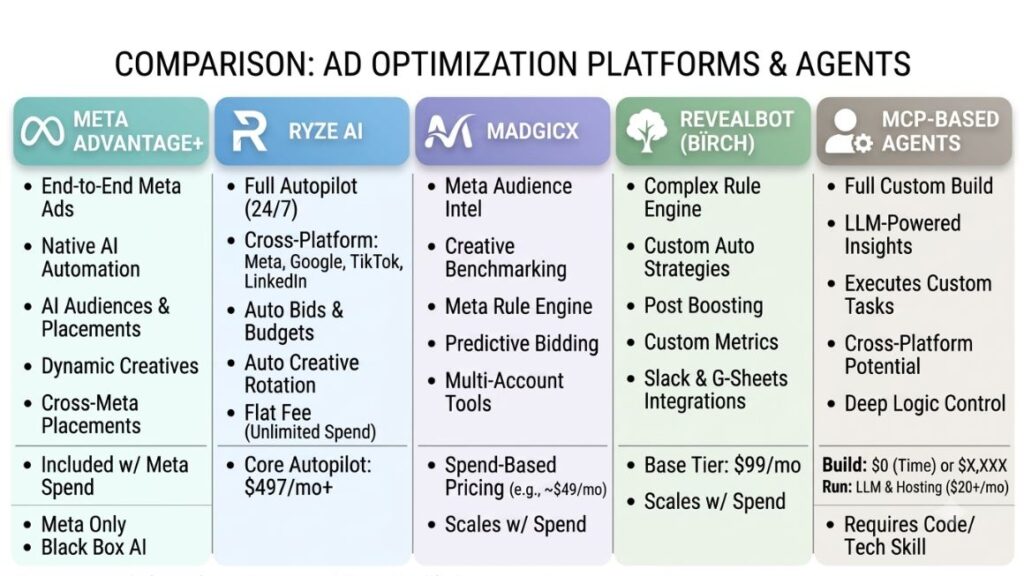
Not every AI agent does the same job. Lumping them together is how marketers end up buying the wrong tool. Broadly, four categories exist right now, and most accounts eventually need more than one.
Native Platform Agents
Meta Advantage+ sits in this category. It’s built directly into Ads Manager, free to use, and handles targeting, placement and increasingly creative optimization using Meta’s own first-party data. The upside is deep platform access no third party can match. The downside is limited visibility into why it made a specific decision, and no ability to layer in cross-platform logic if you’re also running Google or TikTok ads.
Creative Agents
Tools built specifically to research, generate, and test ad creative fall here. This is where an AI ad copy generator or AI ad creative generator earns its place, producing headline and copy variations, sometimes full visual concepts, based on your brand’s past top performers. Superscale AI and Omneky are examples pushing further into full creative-agent territory, owning research, production and publishing rather than just suggestion.
Media-Buying Agents
These agents own the budget and bid side: audience refinement, spend reallocation, bid strategy. Platforms like Madgicx and Birch (Revealbot’s newer agentic product) sit here, focused on optimizing what already exists in your account rather than generating new creative from scratch.
Full-Stack Autonomous Agents
The newest category, and arguably the most interesting for 2026. These are chat-driven and connect to Meta through the Model Context Protocol (MCP). They let you describe a campaign in plain English and have the agent build it end to end. Tools like Adspirer and Synter fall here and are often priced dramatically lower than traditional dashboard software because there’s no UI to maintain. This is a conversational layer sitting on top of the ad platform’s API.

Best AI Agents for Facebook Ads in 2026 (Compared)
This is the part most guides turn into a thinly disguised affiliate page. We’ll keep it straight: what each tool actually does well, where it falls short, and who it’s genuinely built for.
Meta Advantage+
Free, native, and the obvious starting point for anyone not yet ready to pay for a third-party tool. It automates targeting and placement using Meta’s own signal, and increasingly handles creative variation testing too. Meta’s own data claims a 22% ROAS improvement for advertisers who turn on Advantage+ creative features after not previously using them. The catch: it needs a minimum of roughly 50 weekly conversion events per campaign to optimize effectively. Below that, the model doesn’t have enough signal, and delivery gets pushed into smaller, more expensive auction pools.
Best for: Any account, as a baseline. There’s no reason not to be running at least some Advantage+ campaigns in 2026.
Ryze AI
Positioned as fully autonomous campaign management, no rules to configure and flat-rate pricing starting around $10 a week according to comparisons published in 2026. It handles bid adjustments, budget reallocation, creative rotation and audience refinement without ongoing manual oversight and specifically targets the off-hours waste that manual management tends to miss.
Best for: Lean teams or solo media buyers who want autonomous optimization without hiring a dedicated specialist.
Madgicx
An AI-driven platform combining audience discovery, creative performance analytics. An autonomous budget optimizer that reallocates spend toward winners in real time. It connects Meta Ads, Google Ads, GA4, Shopify, Klaviyo and TikTok data into one reporting layer, which appeals to accounts already juggling multiple tool subscriptions. Pricing scales with ad spend rather than sitting at a flat rate.
Best for: DTC and e-commerce brands wanting audience automation and creative analytics bundled together, without producing net-new creative.
Revealbot (Birch)
The rule-based veteran, and a fair baseline for comparison even though it’s not a true agent by the definition used in this article. You build conditions with a visual editor: if spend exceeds a number with zero conversions, pause. It supports Meta, Google Ads, TikTok and Snapchat, and its audit trail, every action logged against the exact rule that triggered it, is stronger than most agentic tools offer. Revealbot’s newer product, Birch, pushes closer to genuine automation with more granular condition logic.
Best for: Teams that want full transparency and control over every automated decision, especially agencies needing a clean audit trail for client reporting.
MCP-Based Chat Agents (Adspirer, Synter)
The category worth watching most closely heading into 2026’s second half. These connect ChatGPT, Claude or Cursor directly to Meta through MCP, with no dashboard at all. You describe a campaign, “launch a Facebook campaign targeting SaaS decision-makers with an ₹6,000 daily budget and a ₹2,500 CPA target across Feed and Reels,” and the agent builds the structure, writes copy, sets targeting, and monitors it. Pricing sits well below traditional dashboard software, often $0 to $199 a month against $500 to $3,000 for established players. Most of these tools stage actions for review and explicitly can’t delete campaigns, a deliberate guardrail.
Best for: Marketers already comfortable working inside ChatGPT or Claude who want agentic execution without learning a new interface.
Before choosing a platform, it helps to understand where each tool fits into the wider AI tools for performance marketers ecosystem.
How to Choose and Set Up the Right AI Agent for Your Campaigns?
Picking a tool off a “best of” list without checking it against your own account is how most of this budget gets wasted. Match the tool to three things: your conversion volume, your team’s bandwidth, and how much decision-making authority you’re actually comfortable giving away.
Start with conversion volume, because it’s a hard technical constraint, not a preference. Meta’s own systems, and most third-party agents layered on top of them, need a minimum signal density to optimize well, generally cited around 50 weekly conversion events per campaign. An account generating 15 conversions a week doesn’t have enough data for any AI agent to meaningfully outperform a sharp human media buyer. In that case, focus spend into fewer, better-structured campaigns before adding automation on top.
Next, be honest about team bandwidth. A solo marketer running five accounts benefits enormously from a fully autonomous agent like Ryze AI, because there’s no one available to review staged recommendations daily anyway. A team with a dedicated media buyer might get more value from Madgicx’s analytics layer paired with manual approval, keeping a human in the loop for strategic calls.
Finally, decide how much control you’re willing to hand over. This isn’t a technical question, it’s a comfort one, and it’s fine to start conservative.
Setup, once you’ve picked a tool, follows a fairly consistent pattern across platforms:
- Step 1: Connect your Meta Ads account through the platform’s official authorization flow. Never share login credentials directly, only use OAuth-based connection.
- Step 2: Define your goal explicitly, whether that’s a target cost per acquisition, a minimum ROAS, or a lead volume threshold. Vague goals produce vague optimization.
- Step 3: Set guardrails. Most platforms let you cap maximum daily budget changes or exclude specific campaigns from full autonomy. Use this, especially in the first month.
- Step 4: Let the agent run in a review-first or “staged” mode if available, checking its recommendations against your own judgment for at least two weeks before switching to full autonomy.
- Step 5: Review performance weekly against your original goal, not against the agent’s own reporting dashboard, which will always frame results favorably.
Also Read: Meta Ads Optimization Checklist: The Complete Guide for Andromeda-Era Campaigns (2026)
Best Practices, Risks and What Most Marketers Get Wrong
Honestly, this is where most articles on this topic get soft, offering nothing but upside. That’s not useful to anyone actually spending money on it.
The biggest operational risk is creative fatigue outpacing your ability to produce fresh assets. AI-driven campaigns consume creative faster than most teams can design it, and failing to refresh assets regularly can trigger a CPM inflation penalty of up to 30%, according to 2026 figures from Ryze AI, as the algorithm penalizes low-engagement ads.
If you’re not prepared to produce roughly ten times more ad variations than your old manual workflow required, an autonomous agent will burn through your creative library and performance will slide, not because the agent failed, but because you didn’t feed it.
The second risk is incrementality, and it’s the one marketers think about least. Meta’s automation is genuinely good at claiming credit for conversions, but it offers limited native guardrails to confirm those conversions wouldn’t have happened anyway. Advertisers need to actively verify their AI agent is generating net-new demand, not just capturing bottom-of-funnel buyers who were going to purchase regardless of ad exposure. Run periodic holdout tests if your platform allows it. Don’t just trust the reported ROAS number at face value.
Third, over-reliance without strategic oversight. An agent doesn’t know your brand positioning. It doesn’t understand why your festive-season creative in India needs a different emotional register than a January prospecting ad. It optimizes for whatever metric you feed it, and choosing the right metric, at the right moment, for the right audience segment, is still a human call. That’s not less work for you. It’s different work, shifted from execution toward judgment.
A few best practices worth locking in from day one:
- Refresh creative on a fixed weekly cadence, not reactively after performance drops
- Keep at least one campaign running manually as a performance baseline to compare against
- Review agent decisions weekly for the first month, even in fully autonomous mode
- Set hard spend caps until you trust the agent’s judgment on your specific account
- Document what changed and why, especially for agency accounts reporting to clients
From what we’ve seen with YUP learners running performance accounts for D2C clients, the mistake isn’t adopting these tools too fast. It’s adopting them and then walking away from the account entirely, assuming autonomous means unsupervised. Those aren’t the same thing.
Failing to refresh ad creative regularly on an AI-managed Facebook account can trigger a CPM penalty of up to 30%, according to Ryze AI’s 2026 data. Treat creative supply as the bottleneck, not the AI agent itself, when performance drops.
Conclusion
The shift here isn’t subtle. Meta’s own infrastructure is now built and improved by AI agents, its Advantage+ suite is running at a $75 billion annual pace, and nine million small businesses have already adopted at least one AI ad tool. Waiting to test an AI Agent for Facebook Ads on your own account isn’t caution anymore. It’s just falling behind competitors already running theirs on autopilot.
Start where the risk is lowest: turn on Advantage+ if you haven’t, get your conversion volume to a level these systems can actually learn from, and layer in a third-party agent only once you trust what it’s doing with staged, reviewable changes. The tools will keep getting better through 2026. Your job is deciding what to hand over and what to keep.
If you want to build this skill properly, YUP’s AI Marketing course walks through setting up, auditing, and managing AI agents across Meta and Google accounts, with real campaign data instead of theory. It’s a practical next step if this article raised more questions than it answered about your own account.
FAQ
What is an AI Agent for Facebook Ads?
An AI Agent for Facebook Ads is a software system that autonomously analyzes your campaign data and executes optimization decisions, like adjusting bids, budgets, or creative rotation, without needing pre-written rules or manual approval for each action.
Is an AI agent the same as Facebook ads automation?
Not quite. Automation follows conditions you configure yourself, like “pause if CPA exceeds a set number.” An AI agent reasons from a goal you set and decides its own actions, which means it can respond to situations you never explicitly programmed it to handle.
How do I get started with an AI agent for my Facebook ads?
Start with Meta Advantage+ since it’s free and native to Ads Manager. Once your account has consistent conversion volume, roughly 50 weekly conversions per campaign, layer in a third-party tool like Madgicx or Ryze AI, connecting through official OAuth authorization and setting clear performance goals before switching to full autonomy.
Do small businesses actually need an AI agent for Facebook ads?
If your account generates enough conversion volume to give the model signal to learn from, yes, it typically saves significant time. A 2026 Amazon Ads study found Indian SMBs expect to save around 5.2 hours a week using AI advertising tools. Accounts with very low conversion volume usually see limited benefit until spend and volume grow.
Is it worth paying for an AI agent when my ad budget is small?
It depends on your conversion volume more than your budget size. A ₹20,000 monthly budget generating strong conversion volume in a low-cost vertical can benefit meaningfully. The same budget spread across a high-CPA category with few conversions won’t give any AI agent enough data to outperform careful manual management.
AI agent vs Meta Advantage+, what’s the difference?
Advantage+ is Meta’s own native automation, free and deeply integrated with platform data, but limited to what Meta chooses to expose. Third-party AI agents often add cross-platform reporting, more granular guardrails, and sometimes creative generation capabilities Advantage+ doesn’t offer on its own.
Why did my results get worse after turning on full AI automation?
The most common cause is creative fatigue outpacing your production capacity, which can inflate CPMs by up to 30%. The second most common cause is insufficient conversion volume for the model to optimize accurately, generally below the 50-weekly-conversion threshold most systems need.
Can an AI agent completely replace a media buyer?
Not for strategic decisions. It can absolutely replace the repetitive execution work, monitoring dashboards, adjusting bids, rotating creative. But choosing the right campaign objective, reading brand context into a metric choice, and catching incrementality issues still require human judgment, at least as these tools stand in 2026.