

AI in eCommerce marketing isn’t some distant shift anymore. It’s already shaping how online stores run, often in ways people don’t notice right away. This guide goes into what’s actually happening behind the scenes. How personalization shows up, why recommendations feel more relevant now, where ads are getting sharper and where things still fall short.
It also digs into the less obvious parts. Data issues, over-automation, the learning curve are most teams underestimate. And then, the practical side of getting started without making it messy. Nothing overcomplicated here. Just a clearer look at how AI in eCommerce marketing is influencing real decisions, day-to-day performance, and long-term growth.
Table of Contents
What is AI in eCommerce Marketing? (Definition + Examples)
AI in eCommerce marketing: meaning and core concepts
AI in eCommerce marketing is, at its simplest, about using data in a smarter way. Not just collecting it and staring at dashboards, but actually letting systems learn from it and act on it.
Most online stores today sit on a huge amount of behavioral data. Clicks, scrolls, purchases, drop-offs. The issue has never really been access to data. It’s been what to do with it, and how fast.
That’s where AI steps in. It looks at patterns across thousands or millions of users, then makes decisions automatically. Which product to show? Which email to send? Which customer is worth targeting right now? Small decisions are constantly happening in the background.
And it’s not just reactive. That’s an important shift. AI doesn’t only respond to what users did. It starts predicting what they might do next. Sometimes it gets it slightly wrong, sure. But over time, it gets surprisingly accurate.
How AI is transforming digital commerce marketing
There’s been a quiet shift in how eCommerce marketing works. It used to be very campaign-heavy. Launch something, measure it, tweak it, repeat.
Now it feels more… fluid.
AI is pushing marketing toward always-on systems instead of one-off campaigns. Product recommendations update in real time. Emails adapt based on behavior. Even pricing can shift depending on demand or user intent.
Another big change is speed. Earlier, teams would review reports weekly or monthly. Now, decisions are happening instantly. The system adjusts before a human even notices a trend.
Platforms like Amazon are a good example of this in action. The homepage rarely looks the same twice. What shows up depends entirely on who’s browsing, what they’ve done before, and what similar users are doing.
That level of responsiveness is becoming the norm, not the exception.
Difference between traditional eCommerce marketing and AI-powered marketing
The gap between traditional and AI-driven marketing isn’t just about tools. It’s about how decisions get made.
Traditional eCommerce marketing tends to rely on fixed rules. Segments are defined in advance. Campaigns are scheduled. Optimizations happen after results come in.
AI changes that flow.
Instead of setting rules manually, the system learns from behavior. Instead of waiting for results, it adjusts in real time. Instead of broad segments, it starts treating users individually.
A simple way to look at it:
- Traditional marketing asks: what worked last time?
- AI-powered marketing asks: what’s likely to work right now for this specific user?
That shift sounds small on paper. In practice, it changes how everything runs.
Real-world AI in eCommerce marketing examples (Amazon, Shopify, etc.)
Most shoppers interact with AI more often than they realize.
On Amazon, recommendations like “frequently bought together” or “you might also like” are driven by machine learning models analyzing past behavior. It feels simple on the surface. Underneath, it’s doing a lot of heavy lifting.
Then there’s Shopify, which has been gradually adding AI features into its ecosystem. Things like automated product descriptions, smart segmentation, and marketing suggestions are becoming more accessible, even for smaller stores.
Outside pure eCommerce, Netflix has set a kind of expectation benchmark. Users are used to seeing content tailored to their taste. That expectation carries over. When an online store feels generic, it stands out, and not in a good way.
Even smaller D2C brands are now using AI for:
- Email timing and personalization
- Product recommendations on-site
- Retargeting ads that actually make sense
- Basic predictive insights
It’s no longer just enterprise territory. That barrier has dropped quite a bit.
Why AI is becoming essential for online retailers
At this point, ignoring AI is starting to feel risky.
Customer expectations have shifted quietly but firmly. People expect relevance. Not perfection, but at least some level of understanding. Showing completely random products or sending generic emails doesn’t just underperform; it feels off.
There’s also the cost side. Acquisition is getting more expensive. Margins are tighter. Wasted spending shows up quickly.
AI helps tighten that loop. It focuses effort where there’s actual intent. It reduces guesswork. And maybe most importantly, it scales without needing a proportional increase in resources.
That’s why many retailers aren’t debating whether to adopt AI anymore. The real question tends to be where to start and how fast to move.
Why AI in eCommerce Marketing Matters
Rise of hyper-personalization in online shopping
Personalization used to mean adding someone’s first name to an email. That was enough for a while.
Not anymore.
Now, users expect product suggestions that feel relevant. Homepages that adjust. Emails that don’t look like mass sends. It doesn’t have to be perfect, but it should feel intentional.
AI makes this possible by looking beyond basic data. It considers browsing patterns, purchase cycles, and even subtle signals like how long someone pauses on a product.
The idea of a “segment” is slowly fading. Instead, it’s moving toward individuals. Sometimes called a segment of one, though that term gets overused.
Still, the direction is clear. Broad targeting is giving way to highly specific experiences.
Shift from rule-based marketing to predictive marketing
Rule-based systems have limits. They depend on what’s already known.
Predictive marketing tries to move a step ahead.
Instead of reacting to actions, it estimates what might happen next. Which users are close to buying. Which ones are drifting away. Which products are likely to trend soon.
This isn’t about being perfectly accurate every time. It’s about improving the odds consistently.
A small lift in prediction accuracy can lead to noticeable gains in conversion or retention. Over time, that compounds.
Data explosion and need for automation in eCommerce
Every interaction creates data. And it adds up fast.
Clicks, searches, cart additions, drop-offs, repeat visits. For most growing eCommerce brands, the volume becomes unmanageable pretty quickly.
Manual analysis starts to break down at that scale. Reports get delayed. Insights get missed. Decisions slow down.
AI handles that volume differently. It processes large datasets continuously and pulls out patterns that aren’t obvious at a glance.
More importantly, it acts on those patterns. Not later, but immediately.
Without automation, a lot of valuable data just sits unused. With AI, it starts influencing decisions in real time.
Customer expectations for personalized shopping experiences (statistics)
There’s a noticeable gap between what customers expect and what many brands still deliver.
Users are more likely to engage with content that feels relevant to them. That part isn’t surprising. What’s more interesting is how quickly disengagement happens when it doesn’t.
Irrelevant recommendations, generic messaging, poorly timed emails these things add friction. Not dramatic friction, but enough to push users away.
Meeting expectations isn’t about delight anymore. It’s more about not falling behind.
How AI improves marketing ROI and efficiency
AI tends to improve ROI in fairly practical ways.
It narrows targeting, so budgets go toward users with higher intent. It adjusts campaigns in real time, reducing wasted spend. It tests variations faster than manual setups ever could.
Efficiency improves as well. Tasks that used to take hours, like segmenting audiences or optimizing bids, get handled automatically.
That doesn’t remove the need for strategy. If anything, it shifts focus toward higher-level decisions.
AI-driven personalization can increase engagement and conversions by aligning experiences more closely with user behavior. It sounds obvious when phrased like that, but the impact is often bigger than expected.
Key Benefits of AI in eCommerce Marketing
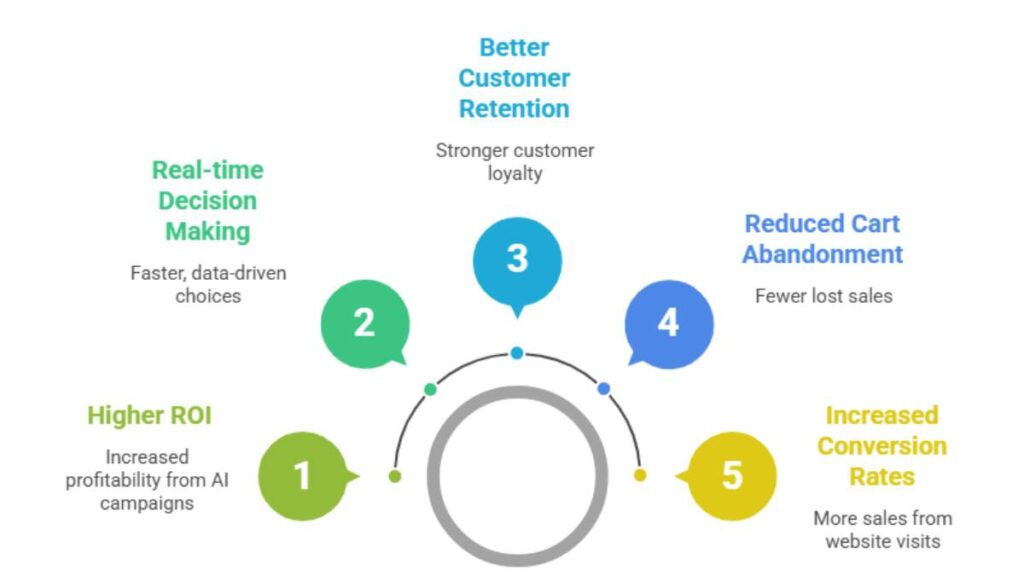
Improved customer experience with AI personalization
A smoother experience is usually the first noticeable benefit.
When product suggestions make sense, users spend less time searching. When pages adapt to behavior, navigation feels easier. There’s less friction overall.
It’s not about making things flashy. It’s about reducing effort for the customer.
AI helps surface the right options at the right time. Not always perfectly, but often enough to make the journey feel intuitive.
Increased conversion rates and sales using AI
Better experiences tend to translate into better conversions.
AI identifies signals that indicate intent. It then responds with relevant prompts, whether that’s a recommendation, an offer, or a reminder.
These aren’t dramatic changes on their own. But small improvements across multiple touchpoints can add up to a meaningful lift in sales.
Especially at scale.
Reduced cart abandonment with predictive targeting
Cart abandonment is still a major issue for most eCommerce stores.
AI approaches it differently. Instead of reacting after abandonment, it looks for signs earlier in the journey.
If a user shows hesitation, the system might trigger a reminder, adjust messaging, or highlight a relevant incentive. Sometimes it’s a discount. Sometimes just reassurance.
Follow-ups also become more targeted. Instead of generic emails, users receive messages tied to their specific behavior.
That difference matters more than it seems.
Better customer retention and loyalty using AI insights
Retention is where long-term value sits.
AI tracks behavior over time and identifies patterns linked to repeat purchases or drop-off risk. That makes it easier to act early.
Loyal customers can be rewarded more precisely. At-risk users can be re-engaged before they disappear completely.
It’s less about broad loyalty programs and more about tailored interactions.
Real-time decision making with AI analytics
Speed is often underestimated in marketing.
AI enables decisions to happen as data comes in. Recommendations update instantly. Campaigns adjust on the fly. Website experiences shift based on current behavior.
This kind of responsiveness is especially useful during high-traffic periods. Sales events, launches, seasonal spikes.
Instead of waiting for reports, the system adapts in the moment.
Higher ROI from AI-driven marketing campaigns
All of this feeds into ROI.
Better targeting, faster optimization, more relevant experiences. Each contributes a small improvement. Together, they create a noticeable difference.
Recommendation systems alone can drive a significant share of revenue in some cases. Not always obvious from the outside, but the impact is there.
In the end, AI isn’t just about doing more. It’s about reducing waste and making each interaction count a bit more.

Enroll Now: AI Marketing Course
How AI is Used in eCommerce Marketing (Use Cases + Strategies)
AI-Powered Personalization in eCommerce Marketing
Personalization in eCommerce used to be surface-level. A first name in an email, maybe a product category match, and that was considered “good enough.” That bar has moved. Quite a bit.
What’s happening now is less visible, but more meaningful. Systems are constantly picking up on small behavioral cues. Not just what someone clicks, but how long they hover, what they skip, when they come back, how often they return before buying. None of this looks dramatic on its own. Together, it starts shaping the experience.
The end result isn’t perfect personalization. It’s something more subtle. The store just feels easier to browse. Products feel more relevant. Fewer dead ends.
Behavioral data analysis (clicks, browsing, purchase history)
Most stores already track this data. The difference now is how it’s used.
Clicks show curiosity. Browsing depth hints at intent. Past purchases reveal patterns, sometimes seasonal, sometimes impulse-driven. AI connects these signals across users and sessions, building a kind of evolving profile.
Not static. It keeps changing as behavior changes.
What matters here is timing. Insights are only useful if they can be acted on quickly. Otherwise, they’re just interesting observations sitting in a dashboard.
Dynamic product recommendations (real-time personalization)
This is where things become obvious to the user.
Product recommendations adjust while someone is browsing. A few clicks into a session, and the feed already starts shifting. It’s not random. It’s reacting to what’s happening in that moment.
On platforms like Amazon, this is almost invisible because it’s so consistent. Recommendations aren’t fixed blocks. They’re constantly being recalculated. Same user, different session, different suggestions.
That responsiveness is what makes it work.
Personalized landing pages and website experiences
Landing pages don’t need to be static anymore. And honestly, they probably shouldn’t be.
Returning users can see different messaging. High-intent visitors might land on pages that push them closer to checkout. Even product sorting can shift depending on what’s likely to convert.
These aren’t massive design overhauls. More like small adjustments in what shows up first, what gets highlighted, what gets pushed down. But those small changes tend to influence behavior more than expected.
AI-driven email personalization and segmentation
Email is one of the clearest areas where this shift is visible.
Instead of fixed segments, audiences are becoming fluid. Someone who browsed twice but didn’t buy gets treated differently from someone who abandoned a cart yesterday. Timing changes too. Not everyone gets emails at the same hour anymore.
Even the content adjusts. Product picks, subject lines, frequency. It’s less about blasting campaigns and more about aligning messages with behavior. That alignment is what drives performance.
One-to-one marketing (“segment of one” strategy)
“Segment of one” gets thrown around a lot. In reality, most brands are somewhere in the middle.
But the direction is clear. Instead of grouping users broadly, systems are moving toward treating each user individually. Not perfectly, not yet. Still, close enough to make a difference.
It’s not about creating unique campaigns for every person. That would be unrealistic. It’s about letting systems adjust experiences automatically, at scale, without needing constant manual input.
AI enables highly tailored shopping journeys by analyzing user data and predicting preferences.
AI in Product Recommendations & Upselling
If there’s one area where impact shows up quickly, it’s recommendations.
Not surprising, really. Showing the right product at the right time tends to work.
How recommendation engines work (machine learning models)
At a basic level, recommendation engines look for patterns across users.
If a large number of people buy product A and then product B, that relationship gets reinforced. Over time, the system starts layering in more signals. Browsing behavior, timing, frequency, even how similar users behave.
It’s not a fixed model. It keeps adjusting as new data comes in. That’s why recommendations improve over time.
Cross-selling and upselling with AI
Cross-selling used to be fairly blunt. Add a few related products and hope something sticks.
Now it’s more precise. Recommendations are based on what actually complements the product being viewed. Or what similar users ended up buying next.
Upselling follows a similar logic. Instead of pushing a more expensive option blindly, the system suggests alternatives that align with user behavior. Slightly better fit, slightly higher value.
When it works, it doesn’t feel like upselling. It just feels like a better option.
Increasing average order value (AOV) using AI
AOV improvements rarely come from big changes. It’s usually small nudges.
A relevant add-on before checkout. A bundle that makes sense. A suggestion that feels obvious once it’s shown.
AI helps identify those moments. When to suggest, what to suggest, and when to stay quiet. That last part matters more than expected.
Examples: “Frequently bought together”, “You may also like”
These modules are everywhere for a reason.
“Frequently bought together” leans on collective behavior. “You may also like” leans more on individual patterns. Both rely on underlying models that keep updating as more data flows in.
Simple interface. Complex logic underneath.
Impact on revenue and customer lifetime value
Over time, recommendation systems influence more than just immediate sales.
They shape how users discover products. How often do they return? How easily they move through the catalog.
That compounds. Higher order values, more repeat purchases, better overall engagement. In some cases, a significant portion of revenue ties back to recommendations, even if it’s not obvious at first glance.
AI in eCommerce Advertising & Paid Marketing
Paid marketing has probably changed more than most people realize. A lot of the control has shifted quietly toward automation.
Not entirely, but enough to notice.
AI for Facebook Ads, Google Ads optimization
Platforms like Meta and Google rely heavily on machine learning to manage campaigns.
Targeting, placements, delivery. Even how ads are rotated. Much of this happens automatically now.
The role of the marketer has shifted. Less time spent adjusting settings, more time thinking about strategy and creative direction.
Predictive audience targeting and lookalike modeling
Audience targeting isn’t as manual as it used to be.
Instead of defining segments from scratch, systems build audiences based on patterns. Lookalike modeling is a good example. It analyzes existing customers and finds similar users.
These audiences keep evolving. As performance data changes, so does targeting.
Automated bidding strategies using AI
Bidding used to be tedious. Constant adjustments, watching performance, tweaking numbers.
Now bids adjust in real time based on likelihood to convert. Multiple signals get considered at once. Device, timing, behavior, competition.
It’s not perfect. But it reacts faster than manual bidding ever could.
Creative optimization (AI-generated ad copy & visuals)
Creative testing has become more dynamic.
Instead of running a few variations, multiple versions can be tested and rotated quickly. Performance data feeds back into the system, which then adjusts what gets shown more often.
The challenge now isn’t testing. It’s feeding the system strong creative to begin with.
Performance marketing with machine learning
Performance marketing is becoming more fluid.
Campaigns don’t run in fixed cycles as much anymore. They evolve continuously. Budget shifts, targeting adjusts, creatives rotate.
Machine learning ties these pieces together, optimizing toward outcomes rather than individual metrics.
AI Chatbots & Conversational Commerce
Customer interaction has changed quietly. Not replaced, just redistributed.
A lot of basic conversations are now handled automatically.
AI-powered chatbots for customer support
Chatbots handle common queries like order tracking, returns, and product details.
The difference now is flexibility. Responses aren’t strictly scripted. They adapt based on how the question is asked, even if it’s phrased awkwardly.
That alone reduces friction. Users get answers faster. Support teams handle fewer repetitive queries.
Conversational AI for product discovery
Some users don’t want to browse endlessly.
They prefer asking. “Looking for something under this price,” or “something similar to this.” Conversational systems respond with suggestions, narrowing down options.
It’s a different way of navigating. Not for everyone, but useful when browsing feels overwhelming.
Reducing friction in the buying journey
A lot of drop-offs happen because of unanswered questions.
Shipping timelines. Sizing doubts. Product comparisons. Small uncertainties that stop someone from buying.
Chatbots step in at those points, offering quick answers. That’s often enough to keep the user moving forward.
AI sales assistants and guided selling
Guided selling is becoming more common, especially for larger catalogs.
Instead of leaving users to scroll endlessly, the system asks a few questions and filters options. Almost like a store assistant, but digital.
It works well when decision fatigue becomes an issue.
24/7 support and automation benefits
Availability matters more than it used to.
Users shop at different times, across time zones. AI systems don’t rely on working hours. Queries get answered instantly, regardless of when they come in.
That consistency improves overall experience, even if users don’t consciously notice it.
AI chatbots can handle a large portion of customer queries, improving efficiency and satisfaction.
AI in Search, Discovery & Visual Search
Search tends to get overlooked until it breaks. Then it becomes obvious.
A good search experience feels effortless. A bad one feels frustrating within seconds.
AI-powered search engines in eCommerce
Search is no longer just about matching keywords.
Modern systems try to interpret intent. A search for “comfortable office chair” isn’t treated the same as “office chair.” Context matters.
AI helps bridge that gap, connecting what users type with what they actually mean.
Semantic search vs keyword-based search
Keyword-based search is literal. It matches exact terms.
Semantic search looks at meaning. Synonyms, related concepts, phrasing variations. It understands that “running sneakers” and “jogging shoes” likely mean the same thing.
That shift improves relevance, especially for more complex queries.
Visual search using image recognition
Visual search is gaining traction, particularly in categories like fashion and home decor.
Users upload an image and find similar products. No need to describe it perfectly in words.
It reduces friction, especially for users who know what they want but can’t quite phrase it.
Improving product discovery and UX
Better search leads to better discovery.
Users find products faster. They also stumble upon items they weren’t actively searching for.
That balance between intent and discovery improves both experience and engagement.
Impact on conversion rates
Users who use search often have higher intent.
If results are relevant, conversions follow. If not, they drop off quickly.
AI helps keep those results aligned with user expectations.
AI for Content Creation in eCommerce Marketing
Content production has always been resource-heavy. That hasn’t changed. What’s changed is how it’s handled.
AI-generated product descriptions
Writing descriptions for large catalogs is time-consuming.
AI helps generate structured drafts quickly. Not perfect, but a solid starting point. Tone and nuance usually need refining, especially for brands with a strong voice.
Still, it speeds things up significantly.
AI for SEO content and blog writing
Content output has increased across most eCommerce brands.
AI assists with drafting blogs, category pages, and informational content. It reduces the time needed to get a first version out.
Editing becomes more important here. Raw output often needs adjustment to avoid sounding generic.
AI-generated ad creatives and email copy
Ad copy and email content benefit from faster iteration.
Multiple versions can be generated and tested quickly. Performance data then influences which variations continue running.
The process becomes more dynamic, less dependent on single ideas.
Scaling content production using generative AI
Scaling used to hit limits quickly.
AI removes some of those constraints. More content can be produced in less time, across more channels.
The trade-off is consistency. Without oversight, content can lose its distinct tone.
Maintaining brand voice with AI
Brand voice doesn’t automatically carry through.
AI needs direction. Guidelines, examples, adjustments. Without that, content starts sounding interchangeable.
Consistency still depends on human input.
AI in Pricing, Promotions & Demand Prediction
Pricing strategy has become more flexible. Static pricing struggles in fast-moving environments.
Dynamic pricing using AI
Prices can adjust based on demand, competition, and user behavior.
Not always visible, but happening behind the scenes. The goal is to balance conversion and margin, which isn’t always straightforward.
It requires constant adjustment.
Demand forecasting and inventory alignment
Forecasting demand accurately helps avoid stock issues.
AI analyzes historical patterns, seasonal trends, and current signals to predict demand more effectively.
That alignment between inventory and marketing reduces waste.
Personalized discounts and offers
Not every user needs the same incentive.
Some are ready to buy without a discount. Others need a push. AI identifies these differences and adjusts offers accordingly.
This selective approach protects margins while improving conversions.
Competitor price tracking using AI
Pricing doesn’t exist in isolation.
AI monitors competitor pricing and helps adjust strategies in response. It reduces the need for constant manual checks.
Revenue optimization strategies
All of this feeds into revenue optimization.
Pricing, promotions, and demand forecasting aren’t separate anymore. They’re connected, and AI helps manage that connection.
Adjustments happen continuously, not in fixed intervals.
AI in Customer Journey Optimization
The customer journey is rarely linear now. It moves across devices, channels, and time.
Understanding that journey is where things get complicated.
AI mapping the entire customer journey
AI tracks interactions across touchpoints.
Website visits, ad clicks, email engagement, repeat sessions. These signals are combined to build a broader view of user behavior.
Not perfect, but more complete than isolated data points.
Predictive analytics for user behavior
Predictive models estimate what users might do next.
Who’s likely to convert. Who might drop off. Who needs re-engagement?
These insights guide where attention should go.
AI-driven funnel optimization
Funnels are no longer fixed.
AI identifies drop-off points and adjusts experiences to reduce friction. Messaging, timing, layout. Small changes at key stages.
Those small changes often have a 5. Types of AI Technologies Used in eCommerce Marketing
Machine Learning (ML) in eCommerce marketing
Most of what people call “AI in marketing” is really machine learning doing the heavy lifting.
At a practical level, it’s pattern recognition. But not the obvious kind. It’s picking up on things that don’t stand out in reports. Subtle behaviors. Repeated actions across thousands of users. Timing patterns that don’t look important until they are.
Over time, these models get better simply because they see more data. Not smarter in a human sense, just more calibrated. They adjust based on outcomes. If a recommendation works, it gets reinforced. If it doesn’t, it fades out.
That feedback loop is what makes ML useful in eCommerce. It doesn’t stay static. It keeps learning quietly in the background.
Natural Language Processing (NLP) for chatbots & content
NLP is what allows systems to deal with language that isn’t clean or structured.
Most users don’t type perfect queries. They mix words, skip context, phrase things oddly. NLP tries to make sense of that. It looks at intent, not just keywords.
This shows up in chatbots, support interactions, even search bars. A user might ask something vague, and still get a relevant response. Not always perfect, but good enough to move the conversation forward.
Content is another area. Drafting emails, product descriptions, basic copy. It speeds things up. But raw output often feels a bit flat. Needs shaping.
Computer Vision for visual search
Computer vision is more niche, but when it fits, it really fits.
Instead of typing, users upload an image. The system scans it and finds similar products. Sounds simple. It’s not, but the experience is.
This works especially well in visual-heavy categories. Fashion, furniture, decor. Areas where describing a product in words can be frustrating.
It removes a layer of friction. And honestly, it’s something users tend to remember when it works well.
Predictive analytics for customer behavior
Predictive analytics is where things start shifting from hindsight to foresight.
Instead of asking what happened, the system asks what’s likely to happen next. Not with certainty, but with probability.
Which users are close to buying. Which ones are drifting away. Which products might spike in demand.
These predictions aren’t always obvious. Sometimes they feel counterintuitive. But over time, even small improvements in accuracy can influence outcomes in a big way.
Generative AI for marketing automation
Generative AI is more about output than analysis.
It helps produce content at scale. Product descriptions, emails, ad variations. Useful when volume is high and timelines are tight.
But there’s a trade-off. Without direction, content starts sounding similar. Slightly generic. That’s usually where human input comes back in, shaping tone and adding nuance.
So it’s not a replacement. More like a starting point that speeds things up.
AI in eCommerce Marketing Funnel (Top to Bottom Breakdown)
Awareness stage (AI ads, targeting, content generation)
At the awareness stage, attention is everything. But attention is expensive now.
AI helps narrow the field. Instead of pushing ads broadly, it focuses on users who show early signs of interest. Not just demographics, but behavior patterns. Who tends to click, who tends to engage.
Content also becomes more flexible here. Different variations can run simultaneously. The system gradually leans toward what’s working.
It’s less about finding the perfect ad upfront. More about letting performance guide direction over time.
Consideration stage (recommendations, reviews, personalization)
Once someone shows interest, the experience needs to hold up.
This is where personalization becomes noticeable. Product recommendations start aligning more closely with behavior. Reviews get surfaced more intelligently. Not just the highest rated, but the most relevant.
Users are comparing options here. Small frictions matter. If finding the right product takes too long, they leave. Simple as that.
AI helps reduce that effort. Quietly.
Conversion stage (chatbots, dynamic pricing, urgency triggers)
Conversion is usually where things break down.
Users hesitate. Questions come up. Sometimes small ones. Shipping timelines, sizing concerns, return policies. If those aren’t answered quickly, momentum drops.
Chatbots help here. Immediate responses, even if they’re basic, keep things moving.
Pricing and urgency signals also play a role. Limited stock, time-bound offers. When applied thoughtfully, they nudge decisions. When overused, they backfire. That balance matters.
Retention stage (email automation, loyalty programs, AI CRM)
Retention doesn’t get as much attention as acquisition, but it probably should.
AI tracks behavior over time and picks up on patterns. Who comes back regularly. Who hasn’t engaged in a while. Who responds to certain types of offers.
Email automation becomes more targeted. Instead of broad campaigns, messages align with behavior. Timing shifts. Content adjusts.
Loyalty programs also benefit. Rewards can be tailored instead of generic. It makes them feel more earned, maybe.
Advocacy stage (reviews, referrals, community building)
Advocacy is harder to force. It usually comes from a good experience.
AI helps identify users who are more likely to engage. People who’ve purchased multiple times, left positive feedback, interacted with the brand.
These users can be prompted to leave reviews or refer others. Timing matters here. Too early, and it feels pushy. Too late, and the moment passes.
Community building fits in here too. Encouraging interaction, highlighting user-generated content. It creates a loop where engagement feeds more engagement.
Best AI Tools for eCommerce Marketing (2026)
AI tools for personalization (Nosto, Dynamic Yield, etc.)
Personalization tools have become more practical over the years.
Platforms like Nosto and Dynamic Yield focus on adjusting on-site experiences. Product recommendations, content blocks, even navigation elements.
They don’t require a complete overhaul of the store. That’s part of the appeal.
But results depend on data. Without enough behavioral signals, personalization stays shallow. There’s only so much the system can infer early on.
AI tools for ads and performance marketing
Ad platforms already have AI baked in.
Google and Meta handle a lot of optimization automatically now. Targeting, bidding, placements.
There are additional tools layered on top, but the core shift has already happened within the platforms themselves.
The role of marketers has changed slightly. Less manual control, more strategic input. Setting direction, feeding the system the right signals.
It takes some adjustment.
AI content generation tools for eCommerce
Content tools are everywhere now.
Companies like OpenAI and Jasper make it easier to generate drafts quickly. Product descriptions, emails, basic ad copy.
They’re useful, especially for scale. But raw output often needs editing. Tone, clarity, brand voice. Otherwise, content starts blending together.
It’s a speed tool, not a final output tool.
AI chatbots and conversational tools
Chatbots have moved beyond simple scripts.
Platforms like Intercom and Drift focus on more flexible conversations.
They handle support queries, guide users, sometimes assist with conversions. When implemented well, they reduce friction. When overdone, they can feel intrusive.
That balance tends to decide whether they help or annoy.
AI analytics and customer data platforms
Data platforms tie everything together.
Tools like Segment and Salesforce centralize customer data and make it usable across systems.
This is often where things either work or don’t. If data is fragmented, insights stay limited. If it’s connected, actions become more consistent.
It’s not the most exciting layer, but probably one of the most important.
Real-World Examples of AI in eCommerce Marketing
Amazon recommendation engine case study
Amazon is usually the first example that comes up, and it still holds.
A large portion of its revenue is influenced by recommendations. Not just the obvious ones like “frequently bought together,” but how products are surfaced across the platform.
The system has been refined over years. It doesn’t just react to what users do. It anticipates what they might want next, based on patterns across millions of interactions.
That consistency is what makes it effective.
Shopify AI tools and automation
Shopify has been pushing AI features into its ecosystem gradually.
Automated descriptions, smarter segmentation, basic marketing suggestions. Nothing overly complex on the surface, but useful.
The bigger shift is accessibility. Smaller brands can now use capabilities that were once limited to larger players.
That changes how quickly AI adoption can happen.
Netflix personalization (cross-industry learning)
Netflix isn’t eCommerce, but the lessons carry over.
Its entire interface is driven by personalization. What shows up, how it’s presented, even the thumbnails.
Users have gotten used to that level of relevance. So when they browse an online store that feels generic, it stands out.
Expectations don’t stay within one industry.
D2C brands using AI for growth
Many D2C brands are using AI, just not always in obvious ways.
It’s spread across different areas. Email targeting, ad optimization, product recommendations, pricing adjustments. Each piece adds a small improvement.
What tends to work is combining these use cases rather than relying on one. Layering them together.
No single feature drives growth on its own. It’s the combination that moves the needle.
Case study: AI increasing conversion rates and AOV
In most cases, the impact of AI shows up in increments.
A slight increase in conversion rate. A small lift in average order value. Better retention over time.
Individually, these changes might not look dramatic. But combined, they shift overall performance in a noticeable way.
That’s usually how AI works in eCommerce. Not through one big leap, but through steady, compounding improvements.
outsized impact.
Personalizing each stage (awareness → retention)
Different stages require different messaging.
New users need discovery. Returning users need reassurance or incentives. Loyal customers expect recognition.
AI adjusts content based on where users are in that journey.
Omnichannel AI marketing strategies
Users move between channels constantly.
AI connects these interactions, keeping messaging consistent across platforms. What someone sees in an ad aligns with what they see on-site or in email.
It creates a smoother experience overall, even if it goes unnoticed.
Challenges of AI in eCommerce Marketing
Data privacy and security concerns
This is probably the first real friction point most brands run into.
AI depends heavily on user data. The more it knows, the better it performs. But that creates a tension. Customers are more aware now. Regulations are tighter. And honestly, trust is harder to earn than it used to be.
Collecting data is one thing. Using it responsibly is another.
There’s a thin line between personalization and intrusion. Cross that line, even slightly, and it can feel uncomfortable for users. That’s where things start to break.
So it’s not just about compliance. It’s about perception, too. Being transparent, giving users control, and not overstepping. Sounds obvious, but it’s easy to get wrong.
Algorithm bias and ethical issues
AI systems learn from data. And data, as it turns out, isn’t always neutral.
If the underlying data has biases, the outputs will reflect that. Sometimes subtly. Sometimes not.
In eCommerce, this can show up in product visibility, pricing differences, or even which users get targeted more aggressively. None of it is usually intentional. But that doesn’t mean it’s harmless.
Catching these issues early is difficult. They don’t always show up in standard reports. It takes a more deliberate effort to question outcomes, not just measure them.
Ethics in AI isn’t a separate conversation anymore. It’s part of how these systems need to be managed.
High implementation cost for small businesses
There’s a perception that AI is expensive. And in some cases, that’s still true.
Advanced implementations can require investment. Not just in tools, but in setup, integration, and ongoing management.
That said, the gap has narrowed. Many entry-level solutions are more accessible now. Still, for smaller businesses, even modest costs can feel significant, especially without immediate returns.
The bigger challenge isn’t always cost, though. It’s knowing where to start without overcommitting.
Going too big too early tends to backfire.
Dependence on data quality
AI is only as good as the data it works with. That sounds simple, but it’s often underestimated.
If data is incomplete, inconsistent, or outdated, outputs suffer. Recommendations fell off. Targeting misses the mark. Insights become unreliable.
Fixing this isn’t glamorous work. It involves cleaning data, structuring it properly, and connecting different sources.
But without that foundation, even the best systems struggle. It’s one of those things that doesn’t get attention until something goes wrong.
Over-automation vs human creativity balance
There’s a tendency to automate everything once the capability is there.
But full automation doesn’t always lead to better outcomes.
AI is strong at optimization, pattern recognition, and scale. It’s less effective when it comes to nuance, storytelling, or brand differentiation. That still requires human input.
The challenge is finding the balance.
Too much automation, and things start feeling generic. Too much manual control, and the scale becomes a problem.
Most brands are still figuring this out. It’s not a fixed answer.
Future Trends of AI in eCommerce Marketing
AI agents and autonomous shopping assistants
AI agents are starting to move from concept to reality.
Instead of just assisting brands, these systems begin assisting users directly. Helping them search, compare, decide, and even complete purchases.
Think less about chatbots and more about ongoing assistants that understand preferences over time.
This could change how discovery works. Users might rely less on browsing and more on guided suggestions. Which shifts where brands need to focus.
It’s early, but the direction is clear.
Hyper-personalization at scale (“segment of one”)
Personalization is already moving toward individuals, but it’s not fully there yet.
The idea of a “segment of one” keeps coming up because it’s where things are heading. Every user gets a slightly different experience. Not just in recommendations, but across the entire journey.
Homepage, emails, ads, offers. Everything adjusts based on behavior.
At scale, this becomes complex. But systems are getting better at handling that complexity.
It won’t feel like personalization anymore. It’ll just feel normal.
Voice commerce and AI assistants
Voice-based interactions are still underused in eCommerce, but they’re evolving.
As voice assistants improve, more users may start searching and even purchasing through voice commands. Especially for repeat purchases or simple queries.
It’s not replacing visual browsing. But it adds another layer.
The challenge here is intent. Voice queries tend to be more conversational, less structured. Systems need to interpret that accurately.
If that gap closes, adoption will likely increase.
AI-driven immersive shopping (AR/VR + AI)
Immersive shopping has been discussed for years, but it’s becoming more practical.
Combining AI with AR or VR allows users to visualize products in their own space, try variations, and explore options interactively.
Furniture, fashion, even electronics. Categories where seeing the product matters.
AI enhances this by personalizing what users see within those environments. Not just static experiences, but adaptive ones.
Still developing, but moving steadily forward.
Predictive commerce and zero-click buying
Predictive commerce is about reducing steps.
If a system can accurately predict what a user wants, it can surface it at the right moment, sometimes before the user actively searches.
Zero-click buying takes this further. Purchases happen with minimal interaction. Subscription models already hint at this.
It raises questions around control and transparency, but from a convenience standpoint, it’s compelling.
The balance between automation and user control will matter here.
How to Implement AI in eCommerce Marketing
Step 1: Define goals and use cases
Starting with tools is usually where things go wrong.
It’s better to begin with clarity. What problem needs solving? Higher conversions, better retention, improved targeting, reduced cart abandonment?
AI works best when tied to specific outcomes. Not vague goals.
Trying to do everything at once spreads effort thin. Picking one or two clear use cases tends to work better.
Step 2: Collect and structure customer data
Data is the foundation. Without it, nothing else really works.
This includes behavioral data, transaction history, and engagement metrics. But more importantly, it needs to be structured properly.
Disconnected data creates gaps. Systems can’t see the full picture.
Cleaning, organizing, and connecting data sources isn’t the most exciting step. But skipping it usually leads to poor results later.
Step 3: Choose the right AI tools
Once goals and data are clear, tool selection becomes easier.
Not every tool fits every business. Some focus on personalization, others on ads, others on analytics.
The key is alignment. Does the tool solve the specific problem identified earlier?
There’s also a tendency to overbuy. More features don’t always mean better outcomes. Simplicity often works better, especially in the early stages.
Step 4: Start with personalization and recommendations
Personalization and recommendations are usually the easiest entry points.
They show impact relatively quickly. Users see more relevant products. Engagement improves. Conversions often follow.
It’s also easier to test and iterate here. Changes can be observed in real time.
Starting small reduces risk while still delivering measurable results.
Step 5: Optimize campaigns using AI insights
Once systems are in place, insights start coming in.
Which segments perform better? Which products get more traction? Where users drop off.
These insights should feed back into campaigns. Adjust targeting, refine messaging, test new approaches.
AI provides the data. The value comes from acting on it.
Step 6: Measure performance and ROI
Implementation doesn’t end at setup.
Performance needs to be tracked continuously. Not just overall metrics, but specific improvements tied to AI use cases.
Conversion rates, AOV, retention, engagement. These indicators show whether the system is actually adding value.
If something isn’t working, it needs adjustment. AI isn’t a one-time fix. It’s an ongoing process.
Over time, the gains tend to compound. Small improvements, layered together, start making a noticeable difference.
AI in eCommerce Marketing Best Practices
Focus on data quality before tools
There’s a tendency to jump straight into tools. New platform, new feature, new capability. It feels like progress.
But if the underlying data is messy, disconnected, or incomplete, the results rarely hold up.
Clean data doesn’t just improve accuracy, it changes how confident decisions feel. Segments make more sense. Recommendations stop feeling random. Campaign performance becomes easier to trust.
It’s not glamorous work, and it doesn’t show immediate wins. Still, skipping this step usually creates bigger problems later. Quietly at first, then all at once.
Start small, then scale AI implementation
Going all-in too early is where many implementations lose momentum.
It’s better to start with one clear use case. Something measurable. Something that actually matters to the business. Then test, adjust, and expand from there.
Small wins compound. They also build internal confidence, which matters more than people admit.
Trying to overhaul everything at once tends to stretch teams thin. Results get diluted. And eventually, interest fades.
Combine AI with human creativity
AI handles scale well. Patterns, repetition, optimization. That part is solid.
But brand voice, positioning, emotional nuance… those still need human input. Otherwise everything starts sounding the same. Slight variations, but the same underlying tone.
The strongest results usually come from combining both.
Let AI handle volume and data-driven adjustments. Let humans shape the message, the story, the differentiation. It’s not a clean split, but that tension is where good marketing tends to happen.
Maintain transparency with users
Users are more aware now. Not necessarily of the technology itself, but of how their data is being used.
Transparency doesn’t need to be overly technical. Just clear enough. What’s being tracked, why it’s being used, what users get in return.
When personalization feels helpful, people rarely question it. When it feels invasive, they do.
That difference often comes down to communication as much as capability.
Continuously test and optimize
Nothing really stays fixed.
Customer behavior shifts. Markets change. What worked six months ago might quietly lose effectiveness without anyone noticing.
Continuous testing helps catch that drift.
Not everything needs to be tested all the time, but there should be a steady rhythm. Adjusting segments, refining messaging, experimenting with different approaches.
AI provides signals. But those signals still need interpretation. That part doesn’t automate itself.
AI in eCommerce Marketing vs Traditional Marketing
Manual vs automated decision-making
Traditional marketing relied heavily on manual decisions.
Campaigns were planned in advance, optimized periodically, adjusted based on reports that were often already outdated by the time they were reviewed.
AI shifts that dynamic. Decisions happen continuously. Small adjustments, happening in real time, often without direct human input.
It’s faster, no doubt. But it also requires a different kind of oversight. Less about controlling every move, more about guiding direction.
That shift can feel uncomfortable at first.
Generic campaigns vs hyper-personalized campaigns
Traditional campaigns were built for segments. Broad groups defined by a few characteristics.
It worked, to a point. But there was always a gap between what the brand showed and what the user actually wanted.
AI narrows that gap.
Instead of one message for thousands of people, it moves toward tailored experiences. Not perfect, but noticeably more relevant.
And once users experience that level of relevance, going back to generic messaging feels… off.
Static vs real-time optimization
Static campaigns have a fixed structure.
Creative, targeting, budget allocation. These elements stay relatively stable during a campaign, with occasional adjustments.
AI introduces real-time optimization. Budgets shift dynamically. Creatives rotate based on performance. Targeting evolves as new data comes in.
It’s more fluid. Sometimes unpredictable. But generally more responsive.
The trade-off is control versus adaptability.
Cost and scalability comparison
Traditional marketing scales with effort. More campaigns, more manual work, more resources.
AI changes that equation.
Once systems are in place, scaling doesn’t require the same linear increase in effort. Campaigns expand, personalization deepens, but the workload doesn’t rise at the same rate.
Costs can still be significant upfront. But over time, efficiency improves.
That said, scalability without strategy doesn’t lead anywhere. It just amplifies whatever is already happening, good or bad.
Conclusion: Is AI the Future of eCommerce Marketing?
Key takeaways on AI adoption
AI in eCommerce marketing isn’t a future concept anymore. It’s already embedded in how many brands operate, even if it’s not always visible on the surface.
The real shift isn’t just technological. It’s how decisions are made. Faster, more data-driven, less dependent on fixed assumptions.
At the same time, fundamentals haven’t changed as much as it might seem. Relevance still matters. Timing still matters. Understanding customers still matters.
AI just changes how those things are executed.
When businesses should adopt AI
There’s no single “right time,” but waiting too long creates its own risks.
Competitors improve targeting. Personalization becomes expected. Customer experiences evolve.
Adoption doesn’t need to be aggressive. Starting small, focusing on specific use cases, building gradually. That tends to work better than trying to catch up all at once later.
The key is not treating AI as a separate initiative. It should tie directly into existing marketing goals.
Otherwise, it becomes a side project that never fully delivers.
Final thoughts on AI-driven growth
AI can drive growth, but not on its own.
It amplifies what’s already there. Strong strategy becomes more effective. Weak strategy becomes more obvious.
That’s probably the simplest way to look at it.
The brands that benefit most aren’t necessarily the ones using the most advanced systems. They’re the ones using them thoughtfully. With clarity. With restraint where needed.
In the end, it’s still marketing. Just with better tools, faster feedback, and higher expectations from users.
FAQs on AI in eCommerce Marketing
What is AI in eCommerce marketing and how does it work?
At a basic level, it’s just systems learning from behavior and adjusting what customers see. Clicks, searches, purchases, even hesitation. All of that gets processed and used to shape the next interaction. It doesn’t “think” in a human way, obviously. But it reacts fast. Fast enough that the experience starts to feel… almost personal.
How is AI used in eCommerce marketing strategies?
It tends to show up quietly across the stack. Product suggestions, ad delivery, email timing, pricing tweaks. Instead of fixed campaigns running the same way for everyone, things shift based on what’s working. Some parts perform better, some don’t. The system adjusts. Not perfect, but definitely less rigid than old-school setups.
What are the main benefits of AI in eCommerce marketing?
Relevance improves first. That’s usually the most visible change. Then efficiency follows. Less wasted spend, fewer missed opportunities. The bigger benefit, though, builds slowly. Lots of small wins stacking over time. Nothing dramatic in isolation, but together, they move the needle in a way manual efforts struggle to match.
How does AI improve personalization in eCommerce?
It pays attention to patterns most teams don’t have time to track manually. What people browse, what they skip, when they return. Based on that, it reshapes the experience. Products, offers, even messaging. It’s not always accurate, and sometimes it gets things wrong. Still, it’s usually closer than generic targeting.
What are examples of AI in eCommerce marketing?
Think about those product carousels that actually feel relevant. Or emails that land at the right time, not randomly. Search results that make sense. Support chats that don’t leave users waiting. Pricing that shifts slightly depending on demand. None of these feels revolutionary on its own, but together, they define modern eCommerce.
Which AI tools are best for eCommerce marketing?
There isn’t a single “best” option, and that’s where many go wrong. The right choice depends on what needs fixing. Personalization? Ads? Retention? Starting with a clear problem works better than chasing features. Often, simpler tools with a focused use case end up delivering more value than complex, all-in-one setups.
How does AI help increase conversion rates in eCommerce?
Mostly by removing friction. Users find what they want faster, get relevant suggestions, and don’t have to think too much. That matters more than it sounds. Conversions rarely spike overnight. Instead, they improve gradually. Small percentage gains here and there. Over time, those add up in a meaningful way.
Can small businesses use AI in eCommerce marketing effectively?
Yes, though it’s easy to overcomplicate things early on. Starting with one clear use case tends to work better. Maybe email personalization or basic recommendations. Build from there. Tools are more accessible now, which helps. Still, clarity and focus matter more than budget at the beginning.
What is an AI-powered product recommendation in eCommerce?
It’s essentially a system predicting what someone might want next based on behavior. Not just individual behavior, but patterns across similar users. Done well, it feels helpful, almost intuitive. Done poorly, it feels random or pushy. The difference usually comes down to data quality and how thoughtfully it’s implemented.
How does AI improve customer experience in online shopping?
It reduces the little annoyances. Search works better. Navigation feels smoother. Support responds faster. Users don’t always notice these improvements directly, but they feel them. Less effort, fewer dead ends. That’s really the shift. Not flashy, just a cleaner, more seamless experience overall.
What role does machine learning play in eCommerce marketing?
It’s what allows systems to keep improving instead of staying static. Past interactions feed into future decisions. Over time, patterns become clearer. The system adjusts. Slowly at first, then with more confidence as data builds. That ongoing refinement is what makes it useful in a dynamic environment like eCommerce.
How does AI help reduce cart abandonment?
It identifies signals that someone might drop off. Repeated visits, hesitation during checkout, abandoned carts. Based on that, it can trigger reminders or adjust incentives. Timing matters here. Reach too late, and it’s lost. Reaching the right moment, and recovery rates improve, even if only slightly.
Is AI in eCommerce marketing expensive to implement?
It can be, depending on how deep the implementation goes. But it’s not always a heavy investment upfront. Many solutions offer entry-level options. The bigger challenge is often the setup. Data needs to be clean and structured. Without that, even expensive systems won’t deliver much value.
What are the challenges of using AI in eCommerce marketing?
Data quality comes up again and again. Poor data leads to poor decisions, simple as that. Privacy is another concern, especially as regulations tighten. Then there’s over-automation. When everything runs on autopilot, experiences can start feeling generic. Finding the right balance is where most teams struggle.
How does AI improve digital advertising for eCommerce brands?
It makes campaigns more responsive. Budgets shift automatically, audiences refine themselves, and underperforming ads get replaced quicker. Instead of constant manual adjustments, optimization happens in the background. It’s not foolproof, but it reduces inefficiencies and helps maintain performance more consistently.
What is the future of AI in eCommerce marketing?
Things are moving toward deeper personalization and less manual control. Experiences adapting in real time, sometimes down to the individual level. At the same time, there’s a risk of everything starting to feel the same if overdone. The brands that stand out will be the ones that stay intentional.
How does AI impact SEO and content marketing for eCommerce?
It increases speed and scale, no question. Content can be generated, tested, and adjusted quickly. But that also creates a risk. When everything is optimized the same way, differentiation drops. The real advantage comes from combining scale with a clear voice and strong positioning. Otherwise, it all blends together.
Can AI automate email marketing for eCommerce businesses?
Yes, and it does a solid job at it. Segmentation, timing, personalization are all handled dynamically. Emails become more relevant, which improves engagement. Still, automation alone isn’t enough. The message itself needs to connect. Without that, even perfectly timed emails won’t perform as expected.
How to start using AI in eCommerce marketing step by step?
Start simple. Pick one area that needs improvement and focus there. Get the data sorted first, then choose a solution that fits the use case. Test, measure, adjust. Only then expand. Trying to implement everything at once usually creates more confusion than progress.
Is AI replacing marketers in eCommerce marketing?
Not really replacing, more like reshaping roles. Routine work is getting automated, which shifts focus toward strategy and decision-making. That’s where the real value sits anyway. Those who adapt tend to do well. Those who rely only on execution may find it harder to keep up.