

Most marketing teams aren’t short on ideas. They’re short on hours. Dashboards pile up. Channels multiply. The same small decisions eat the week before anyone gets to think. These are the ones that lead to chase, ad to pause and report to send.
An AI agent for marketing strategy is made for that gap. It’s a system that reads information and actually reasons through a defined task. That said, it uses connected tools and acts toward a goal you set.
Adoption is still early, though. Things look clearer when we look at Salesforce’s 2026 State of Marketing report, based on 4,450 marketers. It found that 75% of marketing organisations use AI in some form. Only 13% say they use agentic AI.
So here’s the argument. Agents can surely support and even execute parts of your plan. But what they can’t do is replace strategic judgement. You decide where to play and why. The agent helps you act on it faster. The rest of this guide covers what agents do, how to build one, which platforms exist and where it all goes wrong.
Table of Contents
What Is an AI Agent in Marketing?
An AI agent for marketing is a system that: Interprets marketing data. Makes decisions within defined rules. Uses connected tools. Takes action toward a specific goal. Varying levels of human oversight help. It doesn’t just answer you. It does something.
That “does something” part is where people get confused, because nearly every vendor now claims it. Gartner calls the problem agent washing: chatbots and basic automation relabelled as agents. Gartner estimated something in its June 2025 analysis. According to that, only about 130 of the thousands of agentic AI vendors are real.
What makes an agent different from a normal AI tool?
An AI agent for marketing is a system that interprets marketing data, decides within defined rules, uses connected tools and acts toward a specific goal. Unlike marketing automation, it can adapt. Unlike an assistant, it doesn’t wait for every instruction.
Think of a ladder. Traditional AI tools score or predict. They’re like a lead-scoring model. AI assistants respond when you prompt them. Marketing automation runs fixed rules. An agent works toward an outcome instead of waiting for instructions.
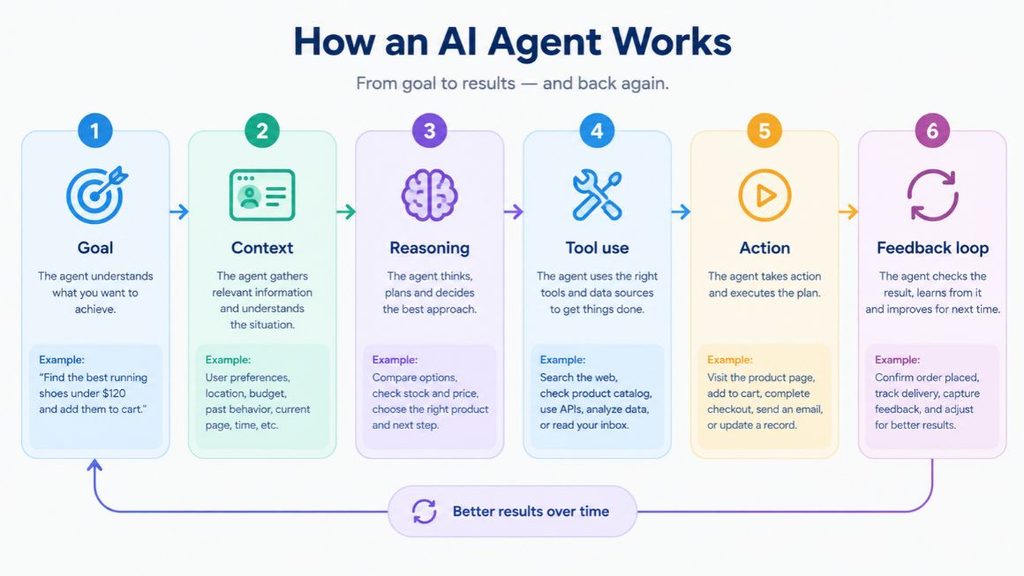
The loop runs like this: goal, context, reasoning, tool use, action, feedback. It takes a goal. Pulls in context. Decides the next move. Uses a tool to act. Then checks what happened and adjusts. Drop any link and you’ve got something less than an agent. A tool that drafts an email and stops has no feedback step. A tool that sends it blindly has no reasoning step. Neither is an agent.
Where Does an AI Agent Fit Into Marketing Strategy?
An agent fits inside your strategy as an analyst and executor. It’s not the strategist. You set the business goal. The agent helps turn it into decisions and actions, then reports what happened.
Strategy still starts with the business goal
No agent tells you whether it’s better to chase enterprise buyers or double down on small businesses. Revenue targets, margins and market position make that call. An AI agent for marketing strategy works inside that frame.
The agent helps translate goals into actions
The flow is: business goal, customer insight, marketing decision, execution, measurement, learning. Agents earn their keep in the middle four. They surface insight. They recommend a decision. They carry out the approved action and measure the result. That feeds the next round. Skip the first step and you’ve just automated confusion.
This is also why an AI agent for marketing strategy isn’t one big robot running your brand. It’s a set of narrow agents. Each is tied to a decision your strategy already defines. Gartner’s 2026 marketing predictions make a similar point. Data, content and governance need to be in place before agents interact with customers.
What Can an AI Agent Do in Marketing?
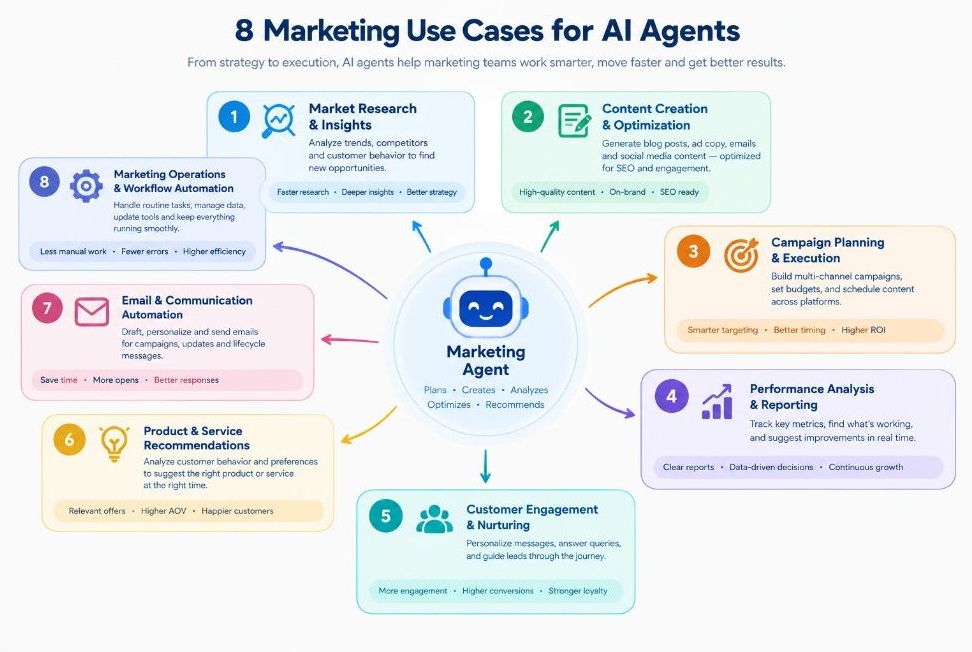
Eight jobs come up again and again. Salesforce’s Connections 2026 launch of specialised marketing agents, covering pipeline, content, execution, optimisation and reporting, shows how quickly AI agents for marketing are moving from slideware to product.
1. Market and Competitor Research
An agent can watch: competitor pricing, product launches and messaging changes. Then it sends a short summary of what actually moved. No more checking ten websites every Monday. It only flags changes, though. Whether you respond is still your call, pair it with a rule such as “alert me only when a rival changes price by more than 10%”. That’s how the noise drops sharply.
2. Customer and Audience Analysis
Feed an agent behaviour data, support tickets and reviews and it can spot patterns a quick skim misses. This is like feature complaint clustering in one segment. That’s AI customer insights doing real work, as long as your data is clean enough to trust.
3. Campaign Planning
An agent can draft campaign options with channels and budget splits. All you have to do is give it a goal, an audience and past results. It’s a sensible use of AI for campaign planning. The agent crunches the numbers while you choose the angle.
4. Content Planning and Production
Agents can research topics, build briefs, produce variations and queue posts. HubSpot’s Breeze Content Agent is one example. Keep a person on anything brand-sensitive. Teams that chain these steps together are building AI marketing workflows, not one-off prompts.
5. Audience Segmentation and Personalisation
An agent can read behaviour and context. It can then recommend the next message or offer for each segment. Gartner expects 60% of brands to use agentic AI for one-to-one interactions by 2028. Done well, AI marketing personalisation feels helpful. Done badly, it feels creepy.
6. Campaign Execution
Agents need the right permissions to build audiences, schedule sends and shift budgets across connected platforms. That’s AI-powered campaign management. It’s where guardrails matter most. Wondrlab’s WondrAgents was launched in India in September 2026. It runs influencer campaigns from brief to reporting with seven agents. The 70% faster go-live is Wondrlab’s own claim.
7. Campaign Monitoring and Optimisation
Agents don’t sleep. They can watch spend, click-through and conversions all day. They can flag unusual swings before you open a dashboard. That’s AI campaign optimisation at its most useful. This is like catching the problem on Tuesday instead of finding it in Friday’s report.
8. Reporting and Strategic Insights
Scattered numbers become a recurring report, with alerts and suggested next steps. Good AI marketing analytics doesn’t just show what happened. It points at what to test next. Treat those suggestions as hypotheses. They aren’t orders. Salesforce says marketers expect to save up to eight hours a week with agents. Reporting is usually where those hours come from.
AI Agent Platforms for Marketing
You’ve got three routes: build on an agent platform, connect your existing systems with workflow automation, or use agents already built into your CRM. Treat these AI marketing tools as a map, not a ranking. The problem you’re solving should pick the route.
Agent-building platforms
These let you create and customise agents for specific jobs. Zapier Agents builds conversational agents that call Zap actions across thousands of apps. Make has an AI Agents module inside its visual scenarios.
Workflow automation platforms
These connect marketing apps and trigger multi-step actions. n8n is open-source. It can be self-hosted and has an AI agent node. Its wait nodes can pause a workflow for approval. Comes in handy when an agent shouldn’t send the email itself.
CRM and marketing platforms
Here the agents live inside the system that already holds your customer data. HubSpot’s Breeze agents cover customer service, prospecting, content and data, and run on a credit system. Salesforce offers Agentforce for Marketing grounded in its unified CRM data. The trade-off with built-in agents is lock-in. They work best when your data already lives in that one system.
What to look for in an AI agent platform
- Integrations with your existing stack
- Tool access you can restrict
- Autonomy controls
- Human approval steps
- Clear data handling
- Monitoring and logs
- Room to scale
Pricing models vary a lot, from per-task to per-outcome to credits. So check current rates before you commit. They changed several times in 2026 alone.
How to Build an AI Agent for Your Marketing Strategy
You build it in seven steps. Pick one problem. Define the goal. Add context. Connect tools. Set guardrails. Start with human approval. Measure before scaling. The pattern holds whether you’re using agentic AI in marketing through a no-code tool or custom code. Follow it and your first AI agent for marketing strategy stays small, testable and easy to switch off.
Step 1: Start With One Marketing Problem
Choose a specific and measurable workflow. It can be like following up on demo requests. Don’t try to automate the whole marketing function. That’s how projects stall. With a narrow problem, you get a clean baseline to measure against later.
Step 2: Define the Agent’s Goal
Write down: what the agent should achieve. What success looks like. What it must never do. “Improve lead response time” works. “Do better marketing” doesn’t.
Step 3: Give It the Right Context
Supply business rules, customer context, brand guidelines and relevant history. An agent with thin context guesses, and guesses are expensive at scale.
Step 4: Connect the Necessary Tools and Data
Link only what the job needs: your CRM, analytics, ad platforms and content systems, usually through APIs. Every extra connection is another place for things to break.
Step 5: Set Guardrails
Define permissions, approval rules and escalation triggers. List the actions the agent can’t take alone. These can be changing budgets above a set limit or emailing your whole database.
Step 6: Start With Human Approval
Move through three levels as trust builds.
Level 1: Recommend
The agent analyses and suggests an action.
Level 2: Prepare
The agent prepares the work for a person to approve.
Level 3: Execute
The agent performs approved actions within set boundaries.
Step 7: Measure Before Scaling
Run a controlled pilot. Compare it with your baseline. Only then widen the agent’s responsibilities. Gartner’s advice on agentic AI is to pursue it only where it delivers clear value or ROI. A pilot is how you find out.
Also Read: AI Agent for Marketing Operations: How to Automate Campaigns, Data, and Reporting in 2026
A Practical Example of an AI Agent Marketing Workflow
HubSpot’s Prospecting Agent works this way: it watches for buying signals, researches accounts and drafts outreach. Here’s the same logic as a lead-conversion workflow.
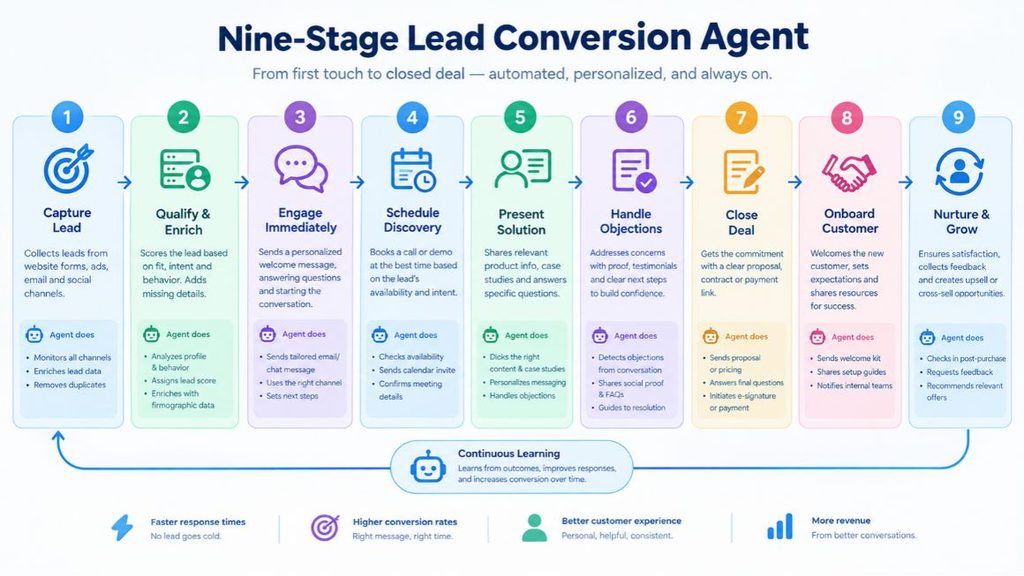
Example: Improving Lead Conversion
Detect, evaluate, identify intent, check history, select action, execute, update, monitor, escalate. In plain terms:
- The agent detects a lead visiting your pricing page three times.
- It evaluates fit against your ideal customer profile.
- It identifies intent from the pages viewed.
- It checks past emails and calls.
- It selects an approved follow-up.
- It sends it or queues it for review.
- It updates the CRM record.
- It monitors whether the lead replies or progresses.
- It escalates to a salesperson if the lead goes quiet or asks something unusual.
Notice what’s missing: strategy. The agent never decided who your best customer is, or what you’re selling. It just worked the lead faster than a person could at 2 a.m. Someone decided which leads matter. This is autonomous marketing inside a very small box, and the box is the point.
How AI Agents Change the Role of a Marketer
Agents shift marketers from doing the work to directing it. Less time goes to manual execution. More goes to judgement, testing and oversight. Less manual work doesn’t mean less human involvement. It means your involvement moves upstream, to the decisions that matter. Salesforce describes the shift as marketers going from producers to operators.
Before
Days went to repetitive execution, manual reporting, data gathering and routine campaign management.
Increasingly
Time moves toward strategic judgement, experimentation, creative direction, reviewing AI outputs, setting goals and boundaries and interpreting business results. The job looks more like supervising than producing in AI-powered marketing teams. That’s a real skill. Gartner’s 2025 Marketing Transformation Survey found 65% of CMOs expect AI to change the CMO role dramatically within two years.
Data Is the Foundation of an Effective Agent
An agent is only as good as what it can see. Give it incomplete or stale data and it will make confident, wrong decisions. Salesforce’s 2026 research found marketers with unified data are 60% more likely to deploy AI agents successfully.
What data should an agent have access to?
Customer data, campaign data, website behaviour, CRM records, product data, historical performance and brand information. Start with the least the job needs. An agent that handles lead follow-up doesn’t need your full finance data.
Why customer data needs governance
Check quality, freshness and consistency. Control access and permissions. Confirm consent. Keep audit trails so you can explain what the agent did. Adobe’s 2026 India findings say data integration and quality are the main barriers to scaling agentic AI.
Also Read: A Beginner’s Guide to Marketing Analytics in 2026
What AI Agents Still Cannot Reliably Do Alone
Agents are good at bounded tasks and shaky at open-ended judgement. Gartner’s Anushree Verma says current models lack the maturity to autonomously achieve complex business goals.
Strategic judgement
Choosing a market, a position or a trade-off is yours. Even an AI agent for marketing strategy works toward one goals a human has set.
Brand judgement
An agent can follow brand rules. It can’t feel when a joke lands wrong.
Context and incomplete data
When information is missing, agents tend to fill gaps instead of flagging them.
Causation
An agent sees that sales rose after a campaign. It can’t prove the campaign caused it.
Sensitive decisions
Pricing exceptions, complaints and anything touching trust need a person. Gartner notes even AI-enthusiastic consumers hesitate to let agents make purchases on their own.
Creativity and differentiation
Agents remix what exists. Standing out still takes a human idea.
How to Measure Whether an AI Agent Is Actually Helping Marketing
Measure four things: efficiency, marketing performance, quality and business impact. Any AI agent for marketing strategy that you can’t measure is a cost, not an asset. This matters because adoption is outrunning proof. Jasper’s 2026 State of AI Marketing report found 91% of marketers use AI. Only 41% can prove its ROI.
| Area | What to measure |
| Efficiency | Time saved, tasks completed |
| Performance | Conversion, revenue, retention |
| Quality | Accuracy, error rate |
| Business impact | Cost, revenue, profitability |
Efficiency
Track time saved, processing time and reduction in manual work.
Marketing performance
Look for gains in conversion, engagement, acquisition or retention.
Quality
Watch accuracy, consistency, error rates and how often humans correct the output.
Business impact
Tie the agent’s output to cost, revenue and profit. Compare against the baseline you captured before the pilot, not against a gut feeling. AI marketing optimisation that doesn’t move those numbers is a hobby.
Common Mistakes When Using AI Agents in Marketing
Most failures come from poor process design, weak governance or unclear objectives. They’re not always because of wrong technology. Gartner predicts over 40% of agentic AI projects may be cancelled by the end of 2027. That cites costs, unclear value and weak risk controls.
Automating a bad process
AI marketing automation speeds up whatever you feed it, including a broken funnel. Fix the process first.
Giving the agent too much autonomy
Start narrow. Widen permissions only after the agent earns it. An agent that can spend money should have a spending ceiling.
Connecting too many tools
More connections mean more failure points and more data risk.
Ignoring data quality
Messy inputs produce messy actions, just faster.
Measuring activity instead of outcomes
Emails sent isn’t a result. Revenue influenced might be.
Removing human review too early
Pilots look fine because people are watching. Keep watching.
Using one agent for everything
Specialised agents with clear jobs are easier to test and control.
Treating AI as the strategy
An AI marketing strategy is a strategy first. AI is how you carry it out.
How to Choose the Right AI Agent for Your Marketing Team?
Start with the problem. Then work backwards to the tool. Choose the agent that solves your workflow, not the one with the longest feature list.
Check what the agent can actually do
Test it against your real workflow. Given Gartner’s agent-washing warning, ask whether it takes actions or just chats. Marketing AI agents that only generate text are assistants.
Gartner predicts over 40% of agentic AI projects will be cancelled by the end of 2027. That’s because of rising costs, unclear value and weak risk controls. Marketing teams reduce that risk by starting with one measurable workflow and keeping human approval in place.
Check integrations
Confirm it connects to your CRM, analytics, advertising and content systems.
Check governance
Look at permissions, approvals, audit trails, security and data handling.
Check whether it solves your actual problem
Don’t buy features. Buy a fix for the problem you named in Step 1. If a vendor can’t show the agent handling a task like yours on a real account, keep looking.
Also Read: Best AI Agent for Marketing: How to Choose the Right One for Your Stack in 2026?
AI Agent vs Marketing Automation vs AI Assistant
| AI Agent | Marketing Automation | AI Assistant | |
| Primary role | Acts toward a goal | Runs predefined workflows | Helps a person |
| Decision-making | Can evaluate and adapt | Mostly rule-based | Supports human decisions |
| Autonomy | Higher | Limited to workflow rules | Usually user-directed |
| Example | Optimises lead follow-up | Sends scheduled email | Drafts campaign copy |
Marketing automation runs predefined rules, an AI assistant supports a person, and an AI agent works toward a goal and adapts along the way. Pick automation for fixed steps, an assistant for drafts, and an agent when the path varies.
Use automation when the steps never change, like a welcome email. Marketing automation with AI added is still rule-based at heart. Use an assistant when you want a faster draft. Use an agent when the path varies and the goal stays fixed.
The 2026 Trends Marketers Should Watch
Five shifts are worth tracking. None is a safe bet yet. Treat them as signals, not a forecast.
From assistants to agents
AI is moving from answering prompts to completing multi-step tasks.
Multi-agent marketing workflows
Specialised agents may split research, content, campaigns and analytics. Salesforce and Wondrlab both ship multi-agent setups.
Real-time marketing decisions
Agents can react to live signals. Salesforce found marketers with unified data are 42% more likely to respond to customers in real time.
AI agents as a new audience
Gartner says machine customers may control trillions of dollars over time. Your content may need to work for AI systems, not just people. Salesforce reports 88% of marketers already optimise for AI search. AI search behaviour is changing how marketers think about content visibility.
One-to-one interactions
Gartner expects agents to take over routine customer engagements. That means every AI agent for marketing strategy you build will eventually need a customer-facing layer. In India, Adobe found 60% of consumers want a personal AI agent. That makes AI-driven marketing more personal and more scrutinised.
A 30-Day Roadmap to Start Using AI Agents in Marketing
This differs from the build steps. Those explain how to design the agent. This is how to implement your AI agent for marketing strategy over a month. Go with a realistic workload for a small team.
Week 1: Identify the workflow
Pick one repetitive, measurable process, such as weekly reporting or lead follow-up.
Week 2: Document it
Map inputs, decisions, actions, approvals and expected outcomes.
Week 3: Build a controlled pilot
Connect only the data and tools you need. Keep approval in the loop.
Week 4: Measure
Compare results against your baseline.
After the pilot
Expand only if the agent improves the outcome without creating unacceptable risk or quality problems.
Conclusion
Here’s the whole framework: Set the goal. Give the agent context. Define the boundaries. Let it act. Measure the result. Improve the system.
An AI agent for marketing strategy can support and execute parts of your plan. It doesn’t replace strategic thinking. That part stays with you.
Your next step is small. It doesn’t need a big budget. Start with one well-defined workflow, keep human oversight and measure the outcome. Scale only when the system proves useful.
If you want hands-on practice building and supervising agents, the YUP AI Marketing course walks you through it with real marketing workflows.
Frequently Asked Questions About AI Agents and Marketing Strategy
What is an AI agent for marketing?
A system that interprets marketing data, decides within set rules, uses connected tools and acts toward a goal. It differs from a chatbot because it takes action, not just answers.
How is an AI agent different from marketing automation?
Automation follows fixed rules you write. An agent evaluates the situation and adapts toward a goal, so it handles variation that would break a rule-based workflow.
Can AI agents create a complete marketing strategy?
No. They can research, analyse and recommend. But goals, positioning and trade-offs need human judgement. An agent works inside your strategy.
What marketing tasks can AI agents automate?
Research, reporting, content drafts, segmentation, campaign monitoring and lead follow-up are common. Brand-sensitive and high-spend decisions should keep human approval.
Are AI agents replacing marketing jobs?
Not wholesale. They take over repetitive execution. Marketers move toward judgement, experimentation and oversight. Roles change faster than headcount.
What data does an AI agent need for marketing?
Customer, campaign, website, CRM, product and historical performance data, plus brand guidelines. Clean, current, permissioned data matters more than volume.
Are AI agents safe for marketing?
Safe enough with guardrails: limited permissions, approval steps, audit logs and escalation rules. Skip those and the risk rises quickly.
How should a small business start using AI agents?
Pick one repetitive task, like lead follow-up or weekly reporting. Run a small pilot with approval on, measure it, then expand.
What should I measure after implementing an AI agent?
Track time saved, conversion or retention changes, error rates and human corrections, then connect results to cost and revenue.