

Your organic traffic numbers have probably done something strange this year. Rankings look fine. Impressions might even be up. But clicks are down, and nobody on your team can point to a single reason why. The reason is AI search behavior, and it has shifted faster and harder than almost any change search marketing has seen. This isn’t a slow, theoretical trend anymore. Adoption crossed a tipping point in 2026, and if your content strategy still treats Google as the only surface that matters, you’re already behind.
This article breaks down what actually changed, where Indian users are searching now, and what it takes to get your content picked up by AI answers instead of being skipped over by them.
Table of Contents
What Is AI Search Behavior?
AI search behavior is the way people find and consume information when an AI system generates, summarises, or mediates the answer instead of a traditional list of search results. That covers a wider range of experiences than most marketers realise, and the differences between them matter for strategy.
There are four things people lump together under “AI search,” and they behave differently.
Google AI Overviews are the AI-generated summaries that appear above traditional organic results on a normal Google search. You didn’t ask for an AI answer. It just showed up.
Google AI Mode is a separate, conversational search experience inside Google, built for multi-part questions and follow-ups. You’re choosing to have a back-and-forth, not scanning a results page.
Standalone AI chatbots like ChatGPT, Perplexity, and Gemini are where a user goes with intent to have a full conversation while often skipping Google altogether for the entire research phase of a decision.
AI-assisted traditional search covers everything else: Google’s AI-powered features inside normal search (like AI-enhanced snippets), Bing Copilot, and voice assistants that pull from AI-summarised web content.
AI search behavior refers to how people find information when an AI system generates or mediates the answer, spanning four distinct experiences: Google AI Overviews, Google AI Mode, standalone chatbots like ChatGPT and Perplexity, and AI-assisted traditional search. Each surface pulls from different signals and requires a different optimisation approach, which is why a single “SEO strategy” no longer covers the whole picture.
Read More: The Role of SEO in Digital Marketing in 2026
Why AI Search Behavior Changed So Fast in 2026
If it feels like this happened overnight, that’s because the underlying user numbers moved that fast too.
OpenAI confirmed 900 million weekly active users on February 27, 2026, and that figure was more than double the 400 million reported a year earlier, in February 2025. By late July 2026, The Information reported ChatGPT was nearing 1 billion weekly active users, a milestone that came about seven months later than OpenAI had originally projected, but still one of the fastest adoption curves any consumer product has ever posted.
Google moved just as fast, and it moved on a surface most people don’t even think of as “AI search.” Sundar Pichai said at Google I/O 2026 that AI Overviews now has over 2.5 billion monthly users. That’s not a niche feature anymore. AI Overviews now appear on roughly 48 to 50% of all US Google searches, up from just 6.49% in January 2025, a nearly eightfold increase in fifteen months, according to BrightEdge data and Google’s own disclosures from February 2026.
India is where this shift has hit hardest and fastest. Sam Altman said India has crossed 100 million weekly ChatGPT users. This makes OpenAI the second-largest market worldwide, behind only the United States. That growth didn’t happen by accident. OpenAI launched a sub-five-dollar ChatGPT Go tier in India, priced at roughly ₹399 a month, then made it free for twelve months for eligible Indian users starting in November 2025. Google answered with distribution instead of price: a deal with Reliance Jio giving eighteen months of free Gemini AI Pro access to Jio’s subscriber base, initially targeted at users aged 18 to 25 before expanding further.
Multiple things pulled in the same direction at once. Cheaper access, aggressive distribution deals through telecom and Android, and genuinely better models all landed in the same eighteen-month window. That combination is why AI search behavior didn’t creep up on marketers. It arrived.
ChatGPT crossed 900 million weekly active users in February 2026 and was nearing 1 billion by mid-2026, while Google’s AI Overviews reached 2.5 billion monthly users the same year. In India specifically, ChatGPT hit 100 million weekly users, driven by a sub-$5 ChatGPT Go tier and a free-access deal between Google and Reliance Jio. The scale and speed of this adoption is why 2026 is the year AI search behavior became a mainstream marketing problem, not a future one.
Read More: Impact of AI on Consumer Behavior
How AI Search Queries Differ From a Normal Google Search
The words people type into an AI search box don’t look like the keywords you’ve spent years optimising for. That gap is the single biggest reason old SEO playbooks fall short here.
Query Length
The average AI Mode query runs about three times as long as a traditional search query. Instead of “best CRM for small business,” someone typing into AI Mode is more likely to write something closer to a full sentence describing their team size, budget, and what they’ve already tried. Google’s own VP of Search, Robby Stein, told TechCrunch the questions people ask are “about twice the query length of traditional search,” and that people are also following up with additional questions roughly a quarter of the time.
Short answer: if your content only targets three-to-four-word keyword phrases, you’re optimised for a search pattern that’s shrinking, not the one that’s growing.
Context and Personalisation
The thing is, longer queries aren’t just longer. They’re specific. Users now fold in budget, location, prior attempts, and constraints directly into the query itself. That is because the AI can actually use that context to shape the answer. A user who is researching a performance marketing course won’t just search “digital marketing course India” anymore. They’re more likely to describe their current role, their experience level and what outcome they want, all in one prompt.
That changes what “search intent” means for content planning. You’re no longer writing for a keyword. You’re writing for a scenario.
Follow-Up Behaviour
Follow-up queries in AI Mode have increased by more than 40% on average per month in the U.S. People aren’t running five separate searches and comparing tabs anymore. They’re having one extended conversation and refining it in real time.
This matters for what SEOs call search density: fewer total sessions, but each session covers more ground and produces a deeper, more specific intent signal before the user ever reaches a decision point. A single AI Mode conversation might now do the work that used to take four or five separate Google searches spread across a browsing session.
Read More: AI in Advertising: Use Cases, Benefits, Tools
What Happens After an AI Answer – The Zero-Click Shift
Here’s the uncomfortable part. Most users don’t scroll past the AI answer. They read the first few lines, decide whether it solves their problem, and move on. If it does, there’s often no reason to click anything at all.
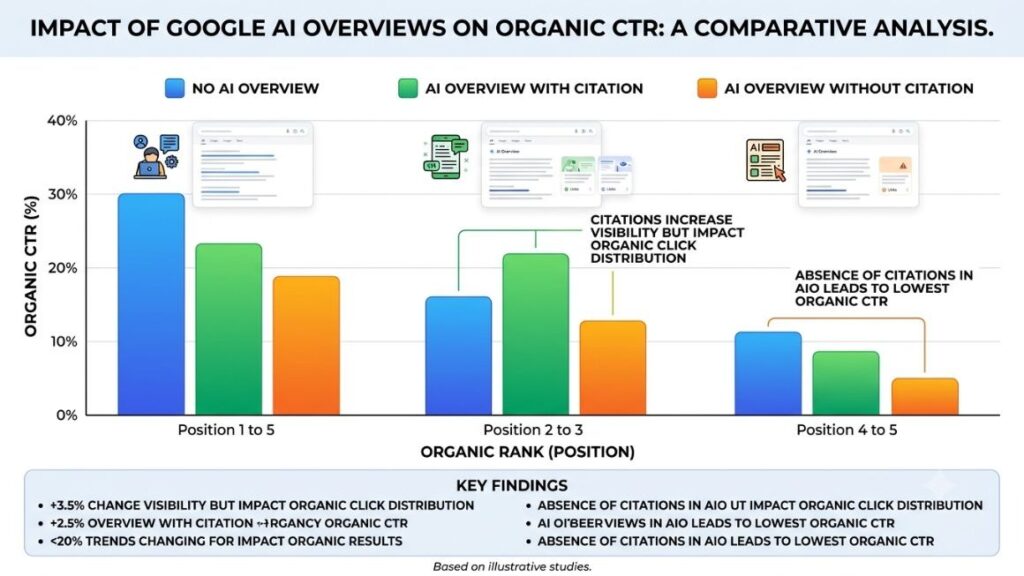
The click-through data backs this up, and it’s more nuanced than the doom-and-gloom headlines from 2025 suggested. Seer Interactive tracked 53 brands, 5.47 million queries, and 2.43 billion organic impressions from January 2025 through February 2026. Organic click-through rate on queries with an AI Overview bottomed out at 1.3% in December 2025, then climbed to 2.4% by February 2026, an 85% jump in two months. That’s real recovery. But it’s still well below the 3.2% CTR recorded in January 2025, before AI Overviews became this widespread.
The gap between winners and losers on this new SERP is stark. When Google shows no AI Overview at all, organic CTR sits around 3.3%. When an AI Overview appears and your page is cited inside it, CTR runs about 2.1%. When an AI Overview appears and you’re not cited, CTR drops to roughly 0.9%.
Read that again. Being cited inside the AI Overview isn’t a nice-to-have anymore. It’s close to a three-to-one difference in traffic against pages that get left out. This is exactly why the shift from SEO to GEO (covered in the next section) isn’t optional busywork. It’s the difference between showing up in the answer and being invisible next to it.
For YUP specifically, this shift shows up most clearly on high-intent, competitive terms like “performance marketing course” and “SEO course India,” where AI Overviews and AI Mode summaries now sit above organic results for a growing share of queries.
Organic click-through rates on queries with an AI Overview fell sharply through 2025 before rebounding 85% between December 2025 and February 2026, according to Seer Interactive. But the recovery is uneven: pages cited inside an AI Overview get roughly 2.1% CTR, compared to just 0.9% for uncited pages on the same results page, more than double the traffic for brands that earn the citation.
Read More: AI in Marketing Strategy
Where Indian Users Are Actually Searching
The India picture doesn’t split neatly along one AI tool. It’s a genuine three-way contest, and the age skew is sharper here than almost anywhere else.
ChatGPT holds the lead with over 100 million weekly active users in India, and Sam Altman has said India has the largest number of student users on ChatGPT anywhere in the world. Google isn’t standing still, though. India has become one of Gemini’s largest education markets globally, and Google’s distribution deal with Jio gives free Gemini AI Pro access to Jio’s massive subscriber base, backed by an advantage OpenAI simply can’t match: Android runs on roughly 95% of smartphones in India, so Gemini reaches users by default rather than by download.
This skews young, and it skews toward students first, working professionals second. That’s an important distinction for YUP’s core audience of 25 to 45-year-old marketing professionals. The mass-adoption headlines are largely a student and Gen Z story. Working professionals in India are adopting AI search more gradually, often starting with work-specific queries (campaign benchmarks, tool comparisons, course research) before it becomes their default research habit for everything else.
What this means practically: if your content targets India’s early-career marketing professionals, don’t assume they’re all living inside ChatGPT the way a college student might be. Many are still Google-first for work research, encountering AI Overviews and AI Mode as a layer inside their existing search habit rather than a replacement for it. That’s actually good news. It means ranking well in traditional SEO and earning AI citations aren’t competing priorities for this audience. They’re the same job.
From SEO to GEO and AEO – What Marketers Need to Rebuild
Traditional SEO answers one question: does Google trust this page enough to rank it? GEO and AEO answer a different one: can an AI system lift a piece of this content cleanly enough to quote it? Every YUP article now has to do both jobs.
Answer Engine Optimisation (AEO)
AEO targets the surfaces built for direct answers: featured snippets, AI Overviews, voice search results. The core discipline is writing content that can be extracted and understood without the rest of the page.
That means direct-answer blocks at the top of every major section, question-phrased headings where they genuinely reflect how people search (“How Do You Calculate MER?” instead of “MER Calculation”), and structured FAQs that answer one question completely in two to five sentences. None of this is new advice exactly. What’s new is that it’s no longer optional polish. It’s the minimum bar for being extractable at all.
Generative Engine Optimisation (GEO)
GEO targets something SEO never had to care about directly: getting your content pulled into a generated answer as a cited source. This is a different game because AI systems evaluate individual passages, not whole pages, and they favour content that’s citation-worthy over content that merely ranks.
Three things drive GEO performance. Named entities instead of vague references (“Meta Ads Manager’s Advantage+ Shopping Campaigns,” not “the ad platform”). Statistics with full source attribution, because a fabricated or uncredited number gets skipped by extraction systems built to avoid unreliable claims. And earned media mentions, because most AI citations come from third-party coverage of a brand, not from the brand’s own website. A YUP course getting referenced in a marketing publication’s roundup does more for AI visibility than the same claim published only on youngurbanproject.com.
AEO and GEO are related but distinct disciplines. AEO optimises for direct-answer surfaces like featured snippets and voice search, using extractable answer blocks and question-phrased headings. GEO optimises for AI citation specifically, favouring named entities, sourced statistics, and earned third-party mentions over owned content alone. A page can rank well for SEO and still be invisible to AI answers if it skips both.
Read More: AI Search Engine Optimization
How to Optimise Content for AI Search Behavior
- Open every major section with a direct answer. Answer the section’s implicit question in the first one to three sentences, before the full explanation. Keep it to roughly 40 to 60 words. This is the passage AI Overviews and AI Mode are most likely to lift whole.
- Define every key term as a standalone sentence. Write it precisely enough to be quoted in isolation: “MER is total revenue divided by total ad spend across all channels,” not a hedged, vague description that needs the rest of the paragraph to make sense.
- Build topical depth, not just keyword coverage. AI systems reward pages that answer the full range of related questions a reader would ask next, not just the one exact-match keyword. Cover the follow-up questions, the sceptic questions, and the “how do I actually do this” questions in the same piece.
- Turn steps, comparisons, and data into real structured elements. An ordered list, a comparison table, an FAQ block. AI extraction pipelines render structured content directly far more often than they parse it out of dense prose.
- Earn third-party mentions deliberately. Since most AI citations trace back to earned media rather than owned pages, pitch data points and original framing to marketing publications, not just SEO tags on your own blog.
A useful real-world reference point here: boAt, the Indian D2C audio brand, has leaned hard into named-entity clarity in its own content and PR, specifically naming product lines, features, and campaign results rather than speaking in vague category terms. That specificity is exactly the kind of signal GEO rewards.
Common Mistakes Marketers Make With AI Search Behavior
- Optimising for keywords instead of intent clusters. A single exact-match keyword covers a shrinking share of how people actually phrase AI search queries now.
- Ignoring earned media entirely. Owned content alone rarely earns AI citation. If nobody outside your own site is naming your brand or data, GEO has almost nothing to work with.
- Skipping structured data and clean heading hierarchy. Vague H2s like “Overview” or “Benefits” give AI extraction pipelines nothing to scope the content against.
- Treating GEO as a bolt-on instead of a rebuild. Adding a citation capsule to an old article after the fact rarely works as well as writing extractable structure in from the start.
- Fabricating or vaguely citing statistics. “Studies show” gets filtered out by systems designed to avoid unreliable claims. Named sources and years don’t.
What’s Next for AI Search Behavior
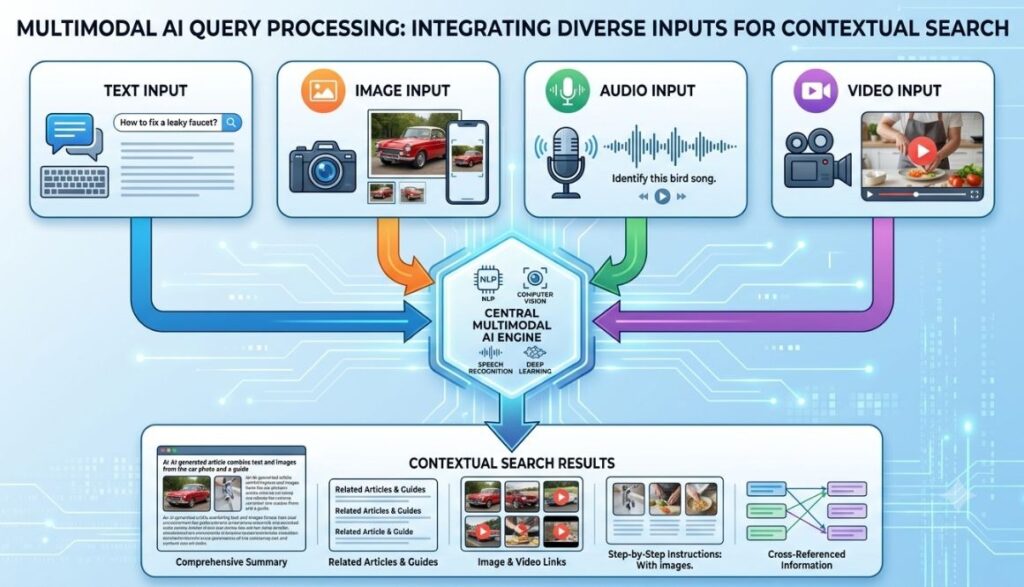
The next shift is already visible in the data: search is going multimodal, fast. More than one in six AI Mode searches are already multimodal, meaning voice, image, or video rather than typed text, and image-based queries are growing by more than 40% month over month. Google’s AI Mode also now supports visual search directly inside the search box, so a user can upload a photo of a product or a screenshot of a competitor’s ad and ask a fully conversational follow-up about it.
For the rest of 2026, watch three things: how fast AI Mode’s query volume keeps doubling each quarter, whether India’s ChatGPT-versus-Gemini split stabilises now that both companies have finished their aggressive pricing and distribution pushes, and whether Google keeps merging AI Overviews and AI Mode into a single default search experience rather than two separate products.
AI search is shifting toward multimodal input, with more than one in six AI Mode queries in 2026 already using voice, image, or video instead of text, and image-based queries growing over 40% month over month. Marketers optimising purely for typed keyword queries are already behind a meaningful and fast-growing slice of real search behavior.
Conclusion
AI search behavior isn’t a future trend marketers can plan for later. It’s already reshaping how close to half of all Google searches get answered, and it’s the default research habit for over 100 million weekly ChatGPT users in India alone. The three biggest shifts to hold onto: queries are longer and more specific, clicks increasingly go to cited sources rather than top-ranked ones, and earned third-party mentions now matter as much as your own site’s content for AI visibility.
None of this means starting from scratch. It means rebuilding your existing content with extractable, citable structure, and treating GEO as core strategy rather than an SEO afterthought. If you want a structured way to work through that rebuild, YUP’s SEO course walks through exactly this shift from traditional ranking tactics to AI-era visibility. The Crystal Clear Newsletter tracks these changes as they happen so you’re not catching up on a quarterly basis.
FAQ
What is AI search behavior?
AI search behavior describes how people find information when an AI system generates, summarises, or mediates the answer, rather than presenting a traditional list of links. It spans Google AI Overviews, Google AI Mode, standalone tools like ChatGPT and Perplexity, and AI-assisted features inside traditional search.
How is AI search different from Google search?
AI search queries run longer, often three times the length of a typical Google search, and include more context like budget, location, and prior attempts. Traditional search rewards ranking for the right keywords. AI search rewards having content that can be extracted, cited, and trusted enough to quote directly in a generated answer.
How do I optimise my website for AI search?
Write direct-answer blocks at the top of major sections, define key terms as standalone extractable sentences, use structured lists and tables for comparable data, and earn mentions from third-party publications rather than relying only on your own site. These are the core AEO and GEO practices covered above.
Does AI search behavior affect small businesses in India?
Yes, and often more directly than larger brands. Smaller businesses tend to rank on fewer, more specific long-tail terms, which is exactly the query pattern growing fastest in AI Mode and AI Overviews. Getting cited in an AI answer can matter more for a small brand’s visibility than a traditional top-three Google ranking.
Is GEO actually worth investing in yet?
Given that AI Overviews already reach 2.5 billion monthly users and pages cited inside them get more than double the click-through rate of uncited pages on the same results page, GEO has moved past the experimental stage. It’s now a measurable, direct driver of organic traffic, not a speculative bet on the future.
Why isn’t my content showing up in ChatGPT or AI Overviews?
The most common reasons are vague, uncredited claims, content structured as dense prose instead of extractable passages, and a lack of third-party mentions that would signal credibility to the AI system. Content that ranks fine on Google can still be completely invisible to AI answers if it fails on structure or sourcing.
What is the difference between AEO and GEO?
AEO optimises content to be directly extracted for answer surfaces like featured snippets and voice search. GEO optimises content to be cited as a trusted source inside a generated AI answer. They overlap heavily in practice, but AEO is about extractability and GEO is about earned authority and sourcing.
Will AI search replace traditional Google search?
Not entirely, and not soon. Google itself is merging AI Overviews and AI Mode into search rather than replacing traditional results with them, and a large share of queries, especially transactional and local ones, still favour the traditional results page. What’s changing is that AI-mediated answers now sit above or alongside traditional results for close to half of all searches, which is a fundamentally different environment even without full replacement.