

Most marketing teams don’t have an AI problem. They have a gap between what leadership expects and what’s actually running in production. AI adoption is already widespread, but AI agents are still early in the adoption curve. Stanford’s 2026 AI Index found that 88% of organizations used AI in at least one business function in 2025. Scaled AI-agent use remained in the single digits across most functions. That gap is where the conversation about an AI Agent for Marketing Workflows actually starts to matter.
An AI agent for marketing workflows is a system that takes a goal you give it. It figures out the steps and tools needed to get there. It also adjusts as new information comes in. That’s a meaningfully different thing from the chatbot or copy generator most teams already have running. And it’s why 2026 is turning into the year marketers stop asking “can AI write this for me”. Now is the time to start asking “can this run the whole workflow while I focus on strategy.”
This guide breaks down what an AI Agent for Marketing Workflows actually does. See where it fits across campaign planning, content, data, and reporting. Discover which platforms are worth evaluating right now, and how to roll one out without blowing up your existing stack.
Table of Contents
What Is an AI Agent for Marketing Workflows?
An AI Agent for Marketing Workflows is a system that combines an AI model’s reasoning with the ability to use tools, pull data, and take multi-step action toward a defined goal, without a human specifying every individual step along the way. That’s the standalone definition. Now here’s why it matters in practice.
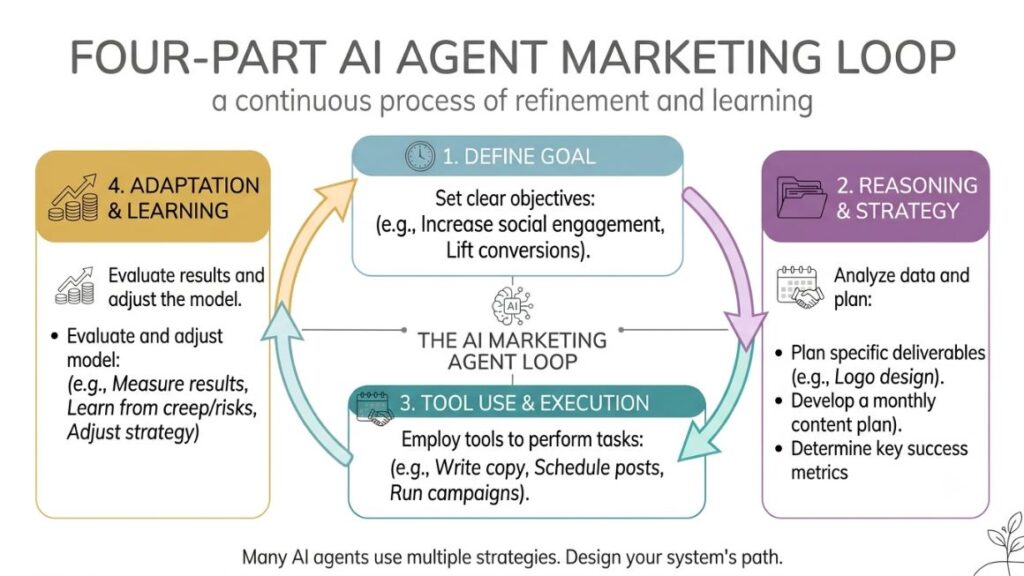
Think about the last time you asked an AI assistant for help with a campaign. You probably said something like “compare CPA this week against last week across Google Ads and Meta.” You’d already decided what to compare, which platforms mattered, and roughly how to read the output. The assistant filled in a gap you defined. An agent works from the other direction: you’d tell it “keep CPA under our target across paid channels this week,” and it decides which platforms to check, what counts as underperforming, whether to pause a set or shift budget, and when to flag you instead of acting on its own.
How an AI Agent Differs from Traditional Marketing Automation
Marketing automation, the Marketo and HubSpot workflow-builder kind you’ve used for a decade, runs on rules someone wrote in advance. Send email A if a lead fills out a form. Add them to segment B if they click a link. It’s dependable, but it’s also rigid. It does exactly what it was told and nothing more, even when circumstances change.
By contrast, an AI agent reasons about the situation before it acts. It’s not following an if-this-then-that rule. It’s evaluating context and deciding what the next best action is. That’s a genuine shift in how much judgment you’re handing off, not just a faster version of the same automation you already had.
The Core Loop: Goal, Reasoning, Tool Use, Adaptation
Every AI agent runs on the same basic loop, no matter the vendor. You give it a goal. It reasons about how to reach that goal given the tools and data it has access to. It uses those tools to take action, whether that’s a CRM, an ad platform API or a content management system. Then it evaluates the result and adjusts before repeating the cycle.
An AI Agent for Marketing Workflows is a system that takes a goal, reasons about the steps needed to reach it, uses connected tools to act, and adapts based on results, without a human scripting each individual step in advance. This is the core difference between an AI agent and traditional rule-based marketing automation.
Why Marketing Teams Are Adopting AI Agents Now
The honest answer is pressure from the top, not grassroots demand. Most teams aren’t experimenting because a channel manager got curious. They’re experimenting because leadership set a mandate. Now the marketing org has to figure out how to actually deliver on it.
That’s not necessarily a bad thing. It just means most current AI agent marketing tools are being deployed faster than the underlying data and process maturity can support, which is a theme you’ll see repeat later in this article.
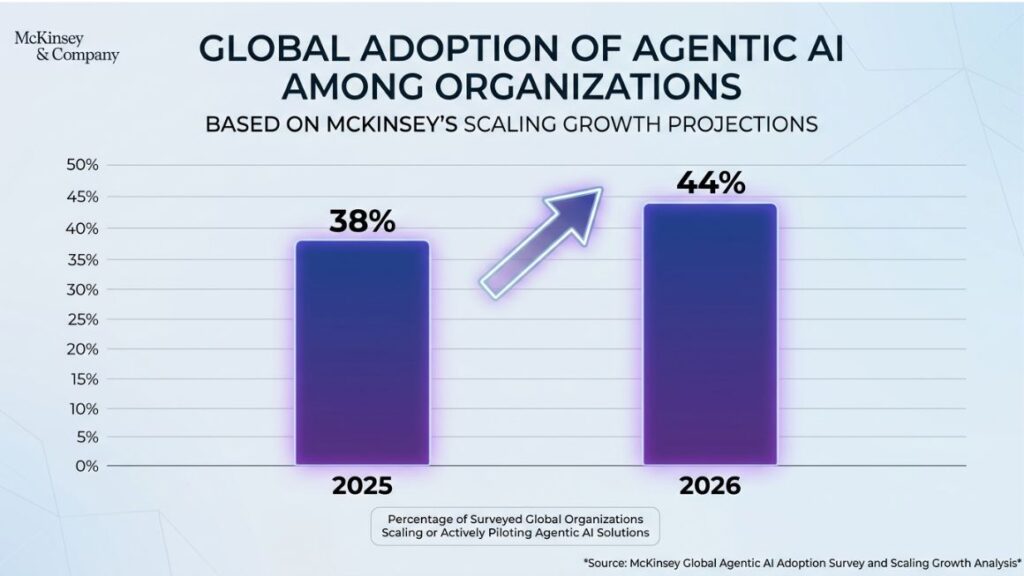
The adoption numbers back this up at a broader level too. McKinsey’s State of AI research is based on a global survey run in late 2025. It found that 62% of organizations are at least experimenting with AI agents. About only 23% report scaling an agentic system in any single business function. By August 2026, McKinsey’s follow-up survey showed that number climbing to 44% of organizations scaling AI somewhere across the enterprise. That is up from 38% a year earlier. Progress is real. It’s just slower and more uneven than the vendor marketing suggests.
Marketing specifically shows a familiar pattern of low-hanging fruit first. Supermetrics found that 87% of marketers already use AI for content creation, copywriting, and creative ideation, which is the easiest and lowest-risk entry point. Agentic AI marketing goes further than that. It’s not generating a paragraph and handing it back to you; it’s deciding what content to generate, for which segment, and when to publish it.
There’s also a hard commercial reason this is accelerating. MarketsandMarkets projects the global agentic AI market may grow from $19.33 billion in 2026 to $205.88 billion by 2033. That is a compound annual growth rate of 40.2%. Gartner separately forecasts that 40% of enterprise applications will embed task-specific AI agents by the end of 2026, up from less than 5% in 2025. Every major software vendor your marketing team already pays for is racing to ship an agent layer, whether or not your workflows are ready for one.
Where AI Agents Fit Across the Marketing Workflow
An AI Agent for Marketing Workflows isn’t one thing bolted onto your stack. It shows up differently depending on where in the funnel you put it to work. Here’s where the real AI agent use cases in marketing are landing in 2026.
Campaign Planning and Brief Generation
This is where most enterprise vendors are placing their bets right now. Salesforce’s Agentforce Marketing Goals Agent, currently in pilot, lets a marketer define campaign objectives, budget, guardrails, and approval requirements, then generates and optimizes the campaign against customer context and performance signals. The marketer isn’t building the journey step by step anymore. They’re setting direction and reviewing what the agent proposes.
That’s a real shift in job description, not just a productivity boost. Instead of managing individual workflows, the marketer manages the agent that manages the workflows.
Content Production and Repurposing
Content is the most mature use case because it’s the lowest-stakes one to get partly wrong. HubSpot’s Breeze Content Agent generates blog posts, landing pages, and case studies by pulling from your CRM data and existing brand voice. Its Content Remix feature takes one long-form asset and turns it into social posts, email copy, and ad variants automatically. Salesforce’s Agentforce Content Agent does something similar at the campaign level, generating omnichannel assets across email, SMS, RCS, and mobile from a single brief, with localization built into the same pass.
The catch with any marketing AI agent example in content. Agents are strong at repurposing existing, brand-approved material. They are noticeably weaker when generating something from a blank page that still needs to sound like your brand.
Read More: AI Agents for Content Marketing: How Autonomous Workflows Are Replacing Manual Content Ops in 2026
Lead Scoring, Segmentation, and Data Enrichment
This is quieter work than campaign generation, but arguably higher-value. HubSpot’s predictive lead scoring and Breeze Intelligence enrich contact records automatically and flag which leads are worth sales time before a human ever looks at the list. Salesforce’s approach leans on Data 360 (formerly Data Cloud) to unify customer signals across CRM, web, and commerce so agents have a single, current view of each customer to reason from.
Here’s the catch that shows up in almost every agentic AI marketing deployment: the agent is only as good as the data underneath it. Feed it a fragmented CRM with duplicate records and stale fields, and it will confidently make bad decisions at machine speed.
Performance Analysis and Reporting
Marketers already ask AI assistants to summarize dashboards. An agent goes a step further by monitoring performance continuously, flagging anomalies, and, in more advanced setups, adjusting spend or pausing underperforming ad sets without waiting for someone to open a report. For instance, Salesforce’s Campaign Agent continuously reconciles the original campaign brief and budget against each customer’s real-time behavior once a campaign is live, rather than waiting for a weekly review.
Read More:
Customer Journey and Lifecycle Orchestration
This is the most autonomous end of the spectrum and the one teams should approach last, not first. It involves agents deciding, in real time, which message a specific customer receives next based on their behavior, rather than a human pre-building every branch of a journey map. It’s powerful, and it’s also where a bad decision is hardest to catch before it reaches a customer.

Single-Agent vs. Multi-Agent Marketing Systems
Early AI agent deployments were single-purpose: one agent, one job, like drafting social captions or scoring leads. That’s changing fast. The bigger trend in 2026 is orchestration, where several specialized agents work together under a coordinating layer. Each handles a narrow piece of the workflow and passes context to the next.
Salesforce’s rollout is a good illustration of where this is headed. Its Agentforce Marketing suite now includes separate agents for pipeline development, content creation, campaign execution, and performance optimization, plus a coordination layer that lets a marketer manage all of them through a single Slack interface. Rather than one generalist agent trying to do everything, you get a team of specialists, the way a real marketing org is actually structured.
Multi-agent marketing systems bring real advantages: better task specialization, easier troubleshooting when one piece breaks, and the ability to swap out or upgrade a single agent without rebuilding the whole system. They also bring new complexity. When four agents are handing work off to each other, a mistake in one step can compound before a human ever sees it. This is exactly why governance, which we’ll get to later, matters more as systems get more agentic rather than less.
Resist the urge to build a multi-agent system on day one if you’re just starting out. Master one narrow, single-agent workflow first. The orchestration layer is worth adding once you understand how a single agent actually behaves in production.
Read More: AI Agents for Marketers: The Complete 2026 Guide
Top AI Agent Platforms for Marketing in 2026
The AI agent marketing tools landscape has consolidated around a few clear categories: CRM-native platforms from the vendors you probably already pay, and lighter no-code automation layers built for teams that want agentic capability without an enterprise contract.
Salesforce Agentforce Marketing sits at the top end. It’s built on Salesforce’s Data 360 CDP and includes the Campaign Agent, Content Agent, and Marketing Goals Agent, plus campaign management inside Slack. Campaign Agent reaches general availability in Marketing Cloud Next Advanced by October 2026, with some agentic content generation available at additional cost. This is the right fit if your team already runs on Salesforce and needs deep CRM context behind every agent decision.
HubSpot Breeze is the more accessible enterprise option. It bundles a Content Agent, Social Media Agent, Prospecting Agent, and Data Agent across HubSpot’s Marketing, Sales, and Content Hubs, all grounded in the same CRM data you’re already using. Breeze Studio also lets teams build custom agent workflows without a developer, which matters a lot for lean marketing teams.
Zapier Agents takes a different approach. Instead of a CRM-native suite, it layers an agent capability onto Zapier’s existing 8,000-plus app integrations. It’s the pragmatic choice for teams whose marketing stack is a patchwork of tools rather than one central CRM, starting from a low monthly cost.
Gumloop is a newer and AI-native no-code platform. It is built specifically around agents and LLM reasoning rather than rigid if-this-then-data logic. That said, it supports connecting your own Anthropic, OpenAI, or Google API keys on paid tiers, and it’s become a common pick for marketing ops teams that need fuzzy, context-dependent decisions Zapier’s rule-based model can’t handle.
| Platform | Best For | Starting Price | Standout Capability |
| Salesforce Agentforce Marketing | Enterprise teams already on Salesforce | Custom / enterprise | Full-funnel agent suite grounded in Data 360 CDP |
| HubSpot Breeze | Mid-market teams on HubSpot | Included on Professional+ plans | Content, Social, and Data Agents in one hub |
| Zapier Agents | Teams with a fragmented, multi-app stack | From roughly $20/month | 8,000+ app integrations plus an agent layer |
| Gumloop | Marketing ops teams needing AI-native logic | From roughly $37/month | Visual canvas, bring-your-own-LLM flexibility |
For Indian marketing teams, pricing accessibility matters more than feature depth in the early stages. Zapier and Gumloop’s lower entry price points make them realistic starting points for growing brands, while Agentforce and Breeze tend to make more sense once a company already has an enterprise Salesforce or HubSpot contract to build on. AI in digital marketing India is moving fast on this front. Google’s research found that AI adoption could add over $490 billion to Indian MSMEs, with nearly 60% already achieving double-digit revenue growth through digital adoption and AI expected to unlock a further 30 to 35% improvement in profitability.
Read More: Agentic Marketing Platforms: The Complete Guide to AI Agents That Plan, Execute & Optimize Marketing
How to Roll Out an AI Agent in Your Marketing Workflow?
Here’s the verdict up front. AI agents are useful enough to put to work today. But they’re not trustworthy enough to run unchecked from day one. The right sequence is analysis first, then narrow execution, then wider autonomy as trust builds.
- Audit your data foundation before you touch an agent. Supermetrics found that 52% of marketing teams don’t own their data strategy and 37% are blocked by poor systems integration. An agent built on top of that mess will make confident, wrong decisions. Fix duplicate records, connect your core data sources, and confirm your CRM fields are actually reliable before agent one goes live.
- Start with analysis, not execution. Give your first agent read-only access to a specific reporting task, like summarizing weekly channel performance, before letting it touch a live campaign. This is the lowest-risk way to see how it reasons without any downside if it gets something wrong.
- Review the agent’s reasoning, not just its output. Most platforms let you see the steps an agent took to reach a conclusion. Read them. If the logic doesn’t hold up, the output isn’t trustworthy even when it happens to look right.
- Pick one narrow workflow to automate end to end. Resist the temptation to hand an agent your whole campaign process at once. Choose something contained, like drafting and scheduling a week of social posts from an approved content calendar, and let it run there first.
- Set explicit guardrails before granting autonomy. Define budget caps, approval thresholds, and which actions require human sign-off before the agent can take them without asking. This is the step teams skip most often, and it’s the one that causes the expensive mistakes.
- Expand scope only as confidence grows. Once an agent has run reliably for a defined period with minimal correction needed, extend its autonomy to the next adjacent task. Scaling agent autonomy gradually, function by function, is the difference between McKinsey’s 23% who’ve actually scaled agents and the 62% still stuck experimenting.
Read More: How to use Zapier to automate marketing workflows?
Risks, Limits, and Where Humans Still Need to Stay in Control
Autonomous marketing campaigns sound appealing until you consider what happens when an agent makes a bad call with your ad budget or, worse, your customer’s inbox. The risks here are real and worth naming plainly rather than glossing over.
Data quality is the single biggest point of failure. An agent doesn’t know your CRM data is wrong. It just acts on it, quickly and at scale, which means a bad data foundation doesn’t just produce a bad report anymore, it produces a bad campaign that’s already live.
Governance hasn’t caught up with deployment speed, and that gap has a name now: AgentOps. It’s the set of operational practices, orchestration controls, and monitoring needed to run agents safely in production, and most marketing teams simply haven’t built it yet.
Gartner’s own forecast is the clearest warning sign in the whole agentic AI conversation. The firm expects more than 40% of agentic AI projects to be cancelled by the end of 2027, driven by rising costs, unclear ROI, and inadequate risk management. Anushree Verma, Senior Director Analyst at Gartner, has pointed to a pattern of “agent washing,” where vendors rebrand existing chatbots and automation tools as agentic without the underlying autonomy to match the label. Gartner estimates only around 130 of the thousands of self-described agentic AI vendors actually deliver on that definition.
Gartner forecasts that more than 40% of agentic AI projects will be cancelled by the end of 2027, driven by escalating costs, unclear business value, and inadequate risk controls, with much of the current market suffering from “agent washing,” where existing chatbot and automation tools are rebranded as agentic without genuine autonomous capability.
This works well for content production and repurposing, where a mistake is cheap to catch and fix before publishing. It’s a different story for anything touching live customer communication or real ad spend, where B2B sales cycles and high-consideration purchases need far more human review before an agent gets to act unsupervised. That’s a limitation worth acknowledging rather than talking around.
The practical answer isn’t to avoid agents. It’s to keep a human reviewing outputs at every stage that touches money or customers directly, and to expand autonomy only where the cost of an error stays low.
What’s Next: AgentOps and the Future of Agentic Marketing
The next 18 months in agentic AI marketing will be less about new capabilities and more about operational maturity catching up to what’s already been shipped. AgentOps, the governance and monitoring layer that sits underneath every agent deployment, is becoming its own discipline, the same way MLOps did for machine learning a few years back.
Expect vendor pricing to shift too, from flat seat licenses toward consumption-based and hybrid models that charge per agent action rather than per user. And expect the market itself to keep growing fast regardless of how bumpy individual deployments get. Every forecast agrees on direction, even if the exact numbers vary: agentic AI spending is heading toward the hundreds of billions within a few years, and marketing is one of the functions absorbing that investment fastest.
From what we’ve seen with YUP learners experimenting with these tools, the teams getting real value aren’t the ones chasing full autonomy first. They’re the ones treating an agent like a very capable, occasionally overconfident new hire: given a narrow job, checked closely at first, and trusted with more only once it’s earned it.
Conclusion
The gap between AI pressure and AI adoption isn’t closing because teams lack ambition. It’s closing slowly because most marketing orgs are still fixing the data and process foundations an agent actually needs to work reliably. That’s not a reason to wait. It’s a reason to start narrow, on a task where a mistake costs you nothing more than a redo, and build trust in the agent’s reasoning before handing it your budget or your customer relationships.
The teams that figure this out in the next year, not the ones chasing full autonomy on day one, will be the ones with a real competitive edge once agentic marketing stops being a pilot and becomes standard practice.
If you want a structured way to build these skills rather than piecing it together from scattered tool documentation, YUP’s AI Marketing course walks through exactly this: how to evaluate agent platforms, set up your first automated workflow safely, and scale it without losing control of your brand or your budget. It’s built for marketers who want to move past experimentation without the trial-and-error most teams are stuck in right now.
FAQ
What is an AI agent for marketing?
An AI agent for marketing is a system built on a foundation model that takes a defined goal. It decides which tools and data it needs to reach it, and adapts its approach as new information comes in, rather than just answering a single prompt or following a fixed rule.
Is an AI marketing agent the same as marketing automation?
No. Traditional marketing automation follows pre-written rules, like “if a lead fills out a form, send this email.” An AI agent reasons about the situation first and decides what action makes sense given the current context. That means it can handle scenarios nobody explicitly programmed for.
How do I start using AI agents in my marketing workflow?
Start with a low-risk, read-only task like performance summarization before giving an agent execution power. Fix your underlying data quality first, since an agent built on messy CRM data can make confident and wrong decisions quickly.
Who should use an AI agent for marketing workflows?
Teams with a reasonably clean data foundation and at least one repetitive, well-defined workflow, like content repurposing or lead scoring, are the best starting point. Teams still fixing basic data integration issues should solve that first.
Is agentic AI marketing actually worth it for small teams?
It can be, particularly for content repurposing and reporting, where tools like Zapier Agents or Gumloop offer a low-cost entry point. Full campaign orchestration agents from platforms like Agentforce or Breeze tend to make more sense once a team has enterprise-level budget and data infrastructure.
What’s the difference between a single agent and a multi-agent marketing system?
A single agent handles one narrow task, like drafting social copy. A multi-agent system coordinates several specialized agents. Each handles a different piece of a workflow, under an orchestration layer that passes context between them.
Why isn’t my AI agent giving accurate outputs?
The most common cause is poor underlying data. If your CRM has duplicate records, stale fields, or fragmented sources, an agent will act on that bad information just as confidently as it would act on good information. Fixing data quality solves the majority of accuracy complaints.
Can AI agents run entire marketing campaigns without human input?
Some platforms are heading in that direction, but full autonomy isn’t recommended yet for anything touching live ad spend or direct customer communication. Gartner expects over 40% of agentic AI projects to be cancelled by 2027. That is largely due to organizations granting more autonomy than their governance could support.
How much does an AI marketing agent cost?
It ranges widely. No-code platforms like Zapier Agents and Gumloop start around $20 to $37 a month for smaller teams. Enterprise platforms like Salesforce Agentforce Marketing and HubSpot Breeze are typically priced as part of existing CRM contracts, with some advanced agentic features costing extra.
What is AgentOps?
AgentOps is the set of operational practices, monitoring tools, and governance controls used to deploy, manage, and scale AI agents safely within a business. It covers things like orchestration, performance monitoring, cost management and audit trails. It’s becoming essential as marketing teams move from single agents to coordinated multi-agent systems.
Do AI agents replace marketers?
Not in their current form. They shift the job from executing individual tasks to setting goals, defining guardrails, and reviewing agent output, which is a different skill set rather than a smaller one.
What industries are adopting marketing AI agents fastest?
E-commerce, B2B SaaS and financial services lead adoption. That is largely because they have cleaner first-party data and higher-volume, repeatable marketing workflows that make agent deployment easier to justify.