

Seven in ten online carts never become orders. Baymard Institute’s average, calculated from 50 studies, is 70.22%. An AI agent for cart recovery exists because that single number hides very different shoppers.
Those carts don’t die for one reason. One shopper hit a surprise delivery fee. Another was comparing prices in a second tab. A third wanted to know whether the kurta runs small, and nobody was around to say. Basic reminder flows treat all three alike: a fixed timer, a fixed message, maybe a coupon.
An AI agent reads the situation instead. It looks at what’s in the cart, how far the shopper got and what they’ve done before, then picks an action. Sometimes that’s a WhatsApp reply about delivery time. Sometimes it’s no message at all.
This guide covers how an AI agent for cart recovery works and which channels suit Indian D2C brands. Learn how to really set one up and how to measure whether it’s earning its keep.
Table of Contents
What Is an AI Agent for Cart Recovery?
An AI cart recovery agent is a decision layer that interprets shopper intent, chooses an appropriate intervention, handles objections and stops when recovery is no longer useful. It isn’t a message template with a language model attached. The difference is judgment: whether to contact someone, what to say and when to leave them alone.
Simple definition
Picture a sharp retention executive with a strict rulebook. It sees the cart. Checks the customer record. Decides what to do. Logs the result. When the order lands, it stops. An AI agent for cart recovery simply does this for thousands of shoppers at once.
AI Agent vs Abandoned-Cart Automation
Rule-based abandoned cart recovery automation still earns its place on simple stores. The table shows where an agent goes further.
| Rule-Based Automation | AI Agent |
| Fixed trigger | Interprets context |
| Fixed timing | Can choose timing |
| Fixed message | Adapts response |
| Predefined branches | Handles objections |
| Usually limited channels | Can orchestrate channels |
| Fixed incentive rules | Applies approved incentive rules |
| Stops on predefined conditions | Adjusts next action based on outcomes |
Both can run on the same stack. The agent adds judgment on top.
What the agent should never decide on its own
Some decisions belong to people or to hard-coded business rules. The agent can read them. It can’t rewrite them.
- Maximum discount
- Price
- Refunds
- Payment authorisation
- Inventory promises
- Delivery promises
- Policy exceptions
That boundary is what stops an agent from becoming an uncontrolled autonomous system. It’s also what lets a finance team say yes.
Why Do Shoppers Abandon Carts?
Most shoppers leave because of friction at checkout: surprise costs, forced accounts, low trust, slow delivery or a clunky form. But many aren’t really abandoning. They’re browsing, and no recovery tactic changes that.
The Latest Cart-Abandonment Benchmark
Baymard Institute’s documented average cart abandonment rate is 70.22%. That is drawn from 50 studies and last updated in September 2025. Treat it as a market reference, not a target. Category, device and traffic source all push your own number up or down.
The Biggest Reasons Shoppers Leave
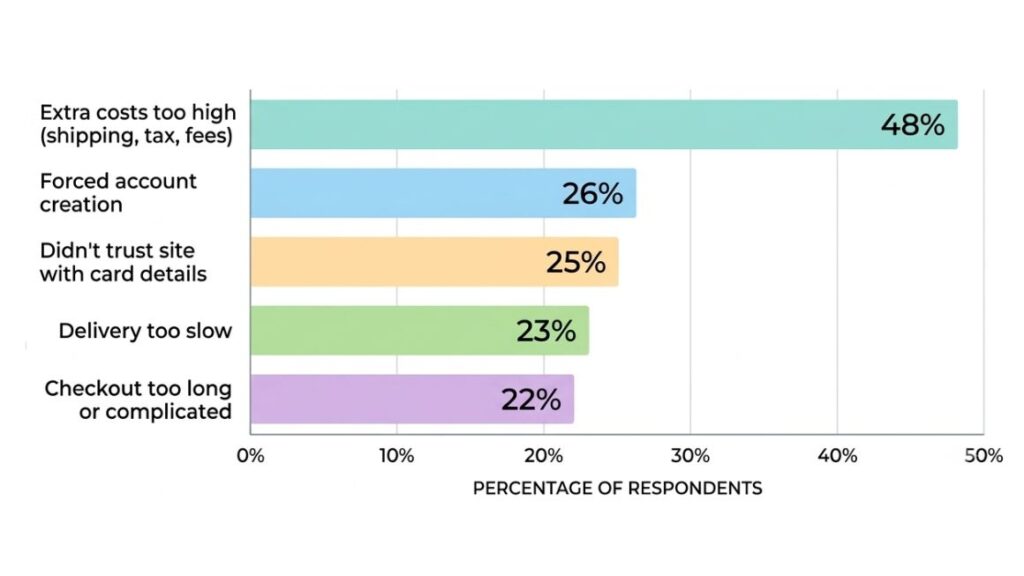
Baymard’s 2024 survey of US shoppers, with the “just browsing” answer removed, ranked the reasons like this:
- Extra costs too high (shipping, tax, fees): 48%
- Forced account creation: 26%
- Didn’t trust the site with card details: 25%
- Delivery too slow: 23%
- Checkout too long or complicated: 22%
Notice how many of these are design problems rather than messaging problems. That matters later.
Not Every Abandoned Cart Should Be Recovered
Baymard’s latest quantitative study found that 42% of US online shoppers have abandoned a cart. The reason? Because they were just browsing or not ready to buy. Chasing those people wastes budget and irritates them.
Some situations deserve an intervention and some don’t. Just browsing, price comparison and low purchase intent rarely justify one. Accidental abandonment, genuine checkout friction and unresolved product questions often do.
This is why an AI agent for cart recovery needs to assess intent instead of simply sending another reminder.
Baymard Institute’s average abandonment rate across 50 studies is 70.22%, and 42% of US shoppers have abandoned a cart simply because they were browsing. Recovery works best on carts with a fixable blocker.
How Does an AI Agent for Cart Recovery Actually Work?
An AI agent for cart recovery works in eight steps: it detects the abandonment, builds a context profile, scores intent, identifies the likely blocker, picks a channel and timing, starts a relevant conversation, resolves or escalates, and stops once the order is placed. Some vendors sell this as an abandoned cart AI agent. The label matters less than the loop.
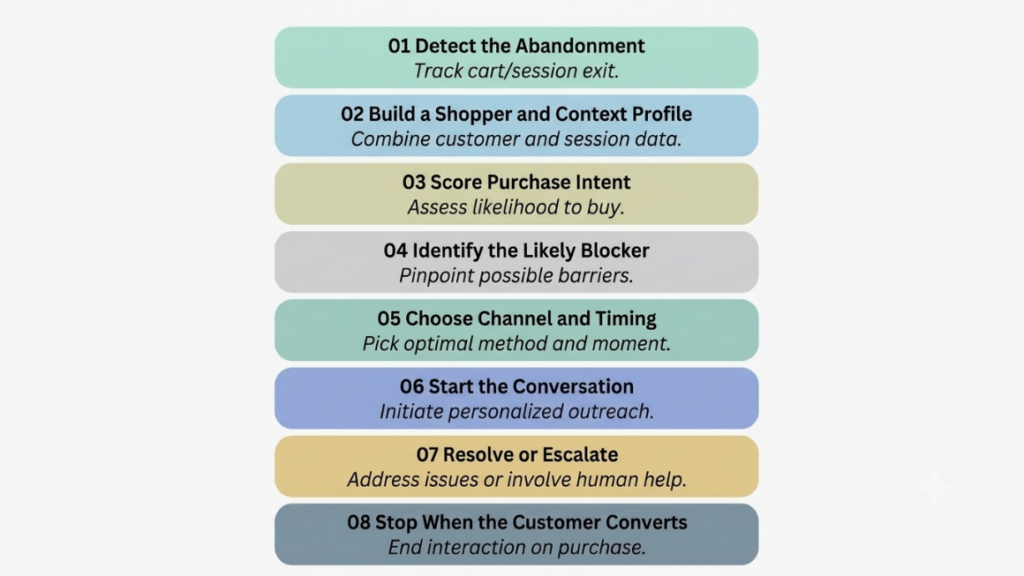
1. Detect the Abandonment
The agent notices a shopper leaving a cart or checkout without an order. That event is just the trigger. What happens next is where agents and simple automation part ways.
2. Build a Shopper and Context Profile
It pulls signals: cart value, products, customer history, checkout stage, device, previous interactions, payment method, inventory, consent and time since abandonment. A first-time mobile shopper holding a ₹4,000 cart is a different case from a repeat buyer with ₹600 in the basket.
3. Score Purchase Intent
Shoppers get classed as high, medium or low intent. High might mean they reached the payment step. Low might mean one product view and a cart that’s sat idle for two days.
4. Identify the Likely Blocker
Next comes a best guess at what stopped them: price, shipping, delivery, sizing, payment, trust, a missing coupon or plain distraction. It’s a probability, not a fact, so the first message should invite a reply.
5. Choose Channel and Timing
Timing should depend on context rather than one universal rule. Someone who dropped at the payment step may welcome a quick nudge. Someone weighing a ₹15,000 purchase may need a day. Treat timing as something you test.
6. Start the Conversation
A weak message says, “You left something in your cart.” A useful one answers the likely objection: “Delivery to your pincode takes three to four days, and COD is available.” Specific wins.
7. Resolve or Escalate
The agent answers within its permissions, such as sizing, delivery or payment options. Anything beyond them, like a refund exception, goes to a human with the full conversation attached.
8. Stop When the Customer Converts
Once the order is placed, recovery messaging stops on every channel. Obvious, yes. Yet it’s one of the most common failures in stitched-together setups.
This workflow is what separates an AI agent for cart recovery from an AI-generated abandoned-cart message. Writing the email is the easy bit. Deciding whether to send it is the job.
An AI agent for cart recovery detects an abandonment, scores intent, guesses the blocker, picks a channel and timing and handles the conversation within set permissions. It stops once an order is placed. Its value is the decision, not the copy.
Pre-Abandonment vs Post-Abandonment AI Cart Recovery
Pre-abandonment recovery steps in while the shopper is still on your site. Post-abandonment recovery reaches them after they’ve left. Most D2C brands end up wanting both, since the cheapest recovered cart is the one that never gets abandoned.
Pre-Abandonment Recovery
On-site intervention can detect hesitation, answer product questions, show delivery information, help with sizing and explain payment options. Hesitation shows up as exit intent. Long pauses on the payment step or repeat visits to the returns policy are clear signs. A specific answer at that moment beats an email tomorrow.
Post-Abandonment Recovery
The options are WhatsApp, email, SMS, voice and retargeting ads once the shopper has gone. Most AI abandoned cart recovery today lives here. The tooling is mature and the contact details are already captured.
Which Approach Should a D2C Brand Use?
Run a hybrid where traffic and resources allow. A good AI agent for cart recovery covers both moments. Start post-abandonment, since it’s easier to deploy. Then add on-site help at the steps where shoppers stall. Recovery doesn’t have to begin after the shopper has already left. Sometimes it should begin while they’re still deciding.
Which Channel Should an AI Cart Recovery Agent Use?
The right channel depends on the shopper, their consent and what a recovered order is worth. WhatsApp usually leads for Indian D2C. Voice suits high-intent carts. Email is a dependable baseline. SMS or on-site chat fill specific gaps.
WhatsApp cart recovery fits India because shoppers already live there. DataReportal figures, cited by several business messaging providers, put India at roughly 535 million monthly WhatsApp users. A reply takes one tap, which beats clicking an email link and logging in.
It also makes recovery a two-way thread, the core of conversational commerce. The agent can answer a sizing question, explain payment options or confirm a COD order inside the same chat. One condition isn’t optional: Meta’s WhatsApp Business Policy requires opt-in before you send marketing messages.
AI Voice Calls
GoKwik’s September 2026 data covers 30 D2C brands over six months. Adding AI calls to WhatsApp reminders doubled cart recoveries. It delivered more than 10x incremental return on spend versus WhatsApp alone and averaged a 60 to 65% answer rate. Shoppers reached on both channels were 2.5 times more likely to complete a purchase.
Read these as vendor-reported results, not an industry benchmark. GoKwik sells the product. The sample is brands that chose to adopt it.
Why would voice work? High-intent shoppers often have one unanswered question. A call answers it in seconds. AI voice cart recovery is a poor fit when you lack call consent, when the cart value is low or when the shopper has already opted out. An AI voice agent for cart recovery should also respect calling hours and stop after a clear no.
Klaviyo’s 2024 benchmark report, built on 2023 data. It puts the average abandoned cart flow at a 3.33% placed-order rate. Abandoned cart emails stay worthwhile because they’re cheap and reach shoppers who left an email address. Brands building this channel into a broader ecommerce email marketing strategy can also connect cart recovery with post-purchase and retention flows. Just don’t assume email should be the agent’s only channel.
SMS and On-Site Chat
SMS suits short, time-sensitive nudges for shoppers who aren’t reachable on WhatsApp. In India it also needs DLT registration, which adds setup work. On-site chat belongs to pre-abandonment, where it can answer a question before the shopper leaves.
Why the Best Agent May Use More Than One Channel
An AI agent for cart recovery should choose the channel based on shopper context, consent and expected value, rather than forcing every shopper into the same sequence.
GoKwik’s vendor-reported data from 30 D2C brands found that adding AI voice calls to WhatsApp reminders doubled cart recoveries. Klaviyo’s average abandoned cart email flow converts 3.33% of recipients, so email keeps a role.
Why Indian D2C Brands Need a Different Cart Recovery Playbook
D2C cart recovery in India works differently because cash on delivery (COD) changes what a recovered order is worth. A COD order that ships and gets refused costs you freight both ways. So a recovered cart isn’t revenue until it’s delivered and accepted.
COD Changes the Recovery Equation
Prepaid orders are already paid for. COD orders aren’t, and the gap shows up in returns. Unicommerce’s India D2C Report 2026, built on 410M+ shipments across 6,000+ D2C brands, found COD orders returned at 58% in the festive quarter, against under 15% for prepaid.
COD Confirmation vs Cart Recovery
These are two jobs. Recovering an abandoned cart means bringing back someone who didn’t buy. Confirming a COD order means checking that someone who did buy still wants the parcel. Different consent, different message, different success metric. One AI agent for cart recovery can do both, but report them separately.
COD-to-Prepaid Nudges
An agent can offer a prepaid incentive once, at the moment a shopper picks COD on a risky pincode or a high-value cart, then accept the answer. Unicommerce’s report says brands keeping COD profitable use prepaid incentives that convert 20 to 30% of COD intenders. Mamaearth, working with Unicommerce, added QR codes to COD invoices so customers can pay online at delivery.
WhatsApp-First Customer Behaviour
Indian shoppers already ask brands questions on WhatsApp, so a recovery thread feels familiar rather than intrusive.
Vernacular Conversations
Unicommerce’s data shows Tier 2 and Tier 3 cities drove 66% of new D2C orders in FY26. Many of those shoppers prefer Hindi or a regional language. Let the agent reply in the language the shopper writes in. Test product terms with native speakers first.
RTO and Recovery Economics
RTO (return to origin) is when a shipment comes back undelivered. Unicommerce reports RTO peaking at 39.2% in November 2025, then falling to 21.0% by March 2026 among optimised brands. So judge COD recovery by orders delivered, not orders recovered.

How to Set Up an AI Agent for Cart Recovery in 7 Steps?
Setting up an AI agent for cart recovery takes seven steps: audit where abandonment happens, fix checkout friction, identify recoverable shoppers, choose channels, connect live business data, set guardrails and consent and run a holdout test. Do them in that order.
Step 1: Audit Where Abandonment Happens
Separate cart abandonment (added items, never started checkout), checkout abandonment (started, didn’t pay) and payment abandonment (reached payment, failed or left). Each needs a different fix. Customer funnel analysis tools can help identify where shoppers are dropping out.
Step 2: Fix Checkout Friction First
Don’t deploy an AI agent to compensate for a broken checkout. Baymard estimates the average large ecommerce site could gain 35.26% in conversion rate through better checkout design alone. Show total costs early and offer guest checkout, as LEGO does.
Step 3: Identify Recoverable Shoppers
Sort shoppers by known or anonymous, purchase intent, cart value and previous interactions. Only known shoppers with consent can be contacted off-site. Anonymous ones need on-site help.
Step 4: Choose Your Channels
Pick from WhatsApp, email, voice, SMS and on-site chat.
Start with two. If you’re comparing AI cart recovery Shopify apps, check the channel list before the feature list. Support varies a lot.
Step 5: Connect Live Business Data
The agent needs cart, inventory, price, delivery, customer, order status and discount rules. Stale data is how it promises stock you don’t have.
Step 6: Set Guardrails and Consent
Define what the agent can say, what it can offer, what needs human approval, which channels it can use and when it must stop.
Step 7: Run a Holdout Test
Compare agent-exposed shoppers against a control group. Measure incremental outcomes rather than relying only on attributed conversions. Your abandoned cart recovery strategy is only as good as the test behind it. Treat first-message timing as a test variable too. There’s no universal number.
What Data Does a Cart Recovery Agent Need?
An AI recovery agent needs nine kinds of data: cart contents, cart value, customer history, inventory, price, shipping, payment options, consent and order status. Without live access to them, it guesses. Guessing is how it invents things.
| Data | Why It Matters |
| Cart contents | Personalise message |
| Cart value | Prioritise effort |
| Customer history | Understand intent |
| Inventory | Avoid false promises |
| Price | Prevent hallucinations |
| Shipping | Resolve delivery objections |
| Payment options | Resolve checkout friction |
| Consent | Determine permitted channel |
| Order status | Stop after conversion |
The quality of an AI agent for cart recovery depends heavily on the quality and freshness of the business data it can access.
Build vs Buy: Which AI Cart Recovery Approach Is Right?
Small stores should start with native automation, growing stores with an AI recovery tool, Indian brands needing wider commerce infrastructure with a D2C platform, and larger teams with engineers with a custom or hybrid build.
Shopify / Native Automation
Shopify AI cart recovery rarely starts with AI. It starts with the built-in abandoned checkout emails. Best for simpler requirements.
AI-Enabled Cart Recovery Software
Best for brands wanting faster deployment. Comparing abandoned cart recovery software is mostly a question of channels, data access and guardrails.
D2C Platforms
Relevant for Indian ecommerce brands needing broader commerce infrastructure. GoKwik, for example, bundles checkout, WhatsApp engagement and AI calling.
Custom AI Agent
Best when the brand needs greater control and has technical resources. This route needs engineers, not just a marketer.
Hybrid
For mature teams combining existing automation with AI decision-making. Many of the best abandoned cart recovery tools slot into this model.
| Option | Best For | Setup | Control | Complexity |
| Native automation | Small stores | Low | Low | Low |
| AI recovery tool | Growing stores | Low to medium | Medium | Medium |
| D2C platform | Indian brands | Medium | Medium | Medium |
| Custom agent | Larger brands | High | High | High |
| Hybrid | Mature teams | Medium to high | High | High |
Also Read: Agentic Marketing Platforms: The Complete Guide to AI Agents That Plan, Execute & Optimize Marketing
How Do You Measure AI Cart Recovery?
Measure an AI agent for cart recovery by incremental outcomes. These are the extra orders and revenue the agent created that wouldn’t have happened without it. Attributed recovery counts every order that follows a message. Also include those that would have happened anyway.
Recovery Rate
The formula is recovered orders divided by abandoned carts in your target group, times 100. Choose the denominator carefully. Cart recovery rate looks very different depending on whether you divide by all abandoned carts or only the contacted ones.
Incremental Recovery Rate
This is the conversion rate of exposed shoppers minus that of the control group. It’s far more meaningful than attributed recovery, because it strips out shoppers who’d have come back anyway.
Incremental Revenue
Additional revenue created by the intervention: revenue per exposed shopper minus revenue per control shopper, multiplied by the number exposed.
Revenue per Contacted Shopper
Recovered revenue divided by shoppers contacted. Useful for comparing channels and agents on efficiency.
Discount Leakage
Track how much margin you give away to recover orders that may have converted anyway.
Opt-Out Rate
A useful signal of customer fatigue. Watch it by channel.
RTO on Recovered COD Orders
Recovery isn’t a win if the order becomes an RTO. Track delivery, not just checkout.
Holdout Testing
Randomly keep a small group of eligible shoppers out of the agent’s reach, then compare outcomes. Keep the group fixed for the full test window.
Also Read: What is Multitouch Attribution? How It Works and Why It Matters
Why a Vendor’s “30% Recovery Rate” May Not Mean What You Think
Klaviyo’s average abandoned cart flow converts 3.33% of recipients into placed orders. A vendor claiming 30% isn’t necessarily wrong. It may just be measuring something else. Five differences usually explain the gap:
- Denominator: all abandoned carts, or only reachable shoppers who were contacted
- Attribution window: hours, or seven days
- Audience: known shoppers with consent, or everyone
- Channel: email, WhatsApp or voice
- Definition of recovery: any order, or an order driven by the message
Ask for the formula before the number.
Incremental recovery compares agent-exposed shoppers with a holdout group. So it counts only orders the agent caused. Vendor claims rarely match Klaviyo’s 3.33% benchmark because denominators, windows, audiences and channels differ.
WhatsApp, Consent and Privacy: What Should Indian Brands Watch?
Watch four things: opt-in for each channel, honest disclosure that shoppers are talking to AI, limits on how often you message and India’s phased data protection rules.
WhatsApp Consent
Meta’s WhatsApp Business Policy requires opt-in. Collect it at checkout with a clear checkbox. Keep order updates and marketing consent distinct.
AI Disclosure and Opt-Outs
Tell shoppers when they’re talking to an A. Make stopping easy. A “STOP” reply should work on every channel, not just the one where it was sent.
Frequency Caps
Cap total contacts across channels. Three polite channels can still bury a shopper.
DPDP Act and Rules
India’s Digital Personal Data Protection Rules were notified in November 2025 and roll out in phases. Consent manager provisions follow around November 2026. Core duties such as notice, consent and security safeguards are scheduled for May 2027. That isn’t a single enforcement switch, so build consent logic now. This isn’t legal advice, so check specifics with counsel.
What Can Go Wrong With AI Cart Recovery?
Most failures of an AI agent for cart recovery are boundary failures. The agent discounts too fast, misreads browsing as buying, invents facts, contacts someone who already paid, ignores an opt-out, hangs on to a conversation it should have escalated or takes credit it didn’t earn.
It Discounts Too Quickly
An agent shouldn’t train customers to wait for discounts.
It Mistakes Browsing for Buying Intent
Low-intent shoppers shouldn’t get aggressive recovery sequences.
It Invents Product Information
No unsupported claims about price, stock, delivery or product specifications.
It Contacts Someone Who Already Purchased
Without real-time order status, this happens constantly.
It Keeps Messaging After an Opt-Out
Suppression logic must work across channels.
It Doesn’t Hand Off Difficult Conversations
Define escalation rules before launch.
It Reports Attributed Revenue Instead of Incremental Revenue
See the measurement section.
What Will AI Agents Change About Ecommerce Cart Recovery?
More shopping journeys will begin in AI assistants, not on your site. Agentic commerce is already moving where AI agents discover and compare products for shoppers. Google and Shopify’s Universal Commerce Protocol (UCP) arrived at NRF in January 2026. Shopify’s Agentic Storefronts syndicate catalogues to AI channels while merchants keep control of checkout.
In March 2026, OpenAI shifted away from its initial Instant Checkout approach, saying it was moving to Apps and focusing on discovery. The direction is merchant-controlled checkout. Your job shifts toward keeping data accurate and the checkout trustworthy, the same foundation any AI agent for cart recovery relies on.
Conclusion
Three things carry the whole article. Fix the checkout before automating recovery. Use agents for context and decisions, not just message generation. And measure incremental revenue, not attributed recovery alone.
Recovery pays off when it helps a brand make better decisions about whom to contact, what problem to solve, which channel to use and when to stop.
If you want to put AI to work on your own funnel, the Advanced AI Marketing Course at YUP is the natural next step. It’s built for marketers who want to move from reading about agents to using them.
FAQs
What is an AI agent for cart recovery?
An AI agent for cart recovery is software that reads shopper context, decides whether and how to intervene, handles objections within set permissions and stops once the order is placed. It decides, rather than just sends.
How is an AI cart recovery agent different from an abandoned-cart email?
An abandoned-cart email fires on a fixed trigger with fixed content. An AI agent for cart recovery chooses timing and channel, adapts to the likely blocker, escalates tricky cases and adjusts based on outcomes.
How do I set up AI cart recovery on Shopify?
Start with Shopify’s native abandoned checkout automation, then fix checkout friction. Add an AI layer for channels and decisions, connect live inventory and order data, set guardrails and run a holdout test. That’s cart recovery for Shopify done properly.
What is a realistic cart recovery rate?
Klaviyo’s average abandoned cart email flow shows a 3.33% placed-order rate. Higher channel-specific claims exist, such as GoKwik’s reported doubling with AI calls, but definitions vary. Benchmark against your own holdout.
Can AI recover COD abandoned carts?
Yes, but judge it by delivered orders. Unicommerce reported COD returns of 58% in the festive quarter. So pair recovery with COD confirmation and prepaid nudges.
Can an AI agent recover carts through WhatsApp?
Yes, if shoppers have opted in and your templates are approved. WhatsApp suits sizing, delivery and payment questions, and hands off cleanly to a human.
Should an AI cart recovery agent offer discounts?
Only within approved rules, and only when a discount is the blocker. Always test against a holdout to see how much discount leakage you’re paying.
Will AI cart recovery annoy customers?
It will if it ignores intent, frequency caps and opt-outs. Done well, it contacts fewer people and watches the opt-out rate.