
On a card that charges 3.5% plus GST, a ₹1 lakh swipe abroad costs ₹4,130 more than the price on the receipt. That’s before an ATM fee, a poor exchange rate, a terminal that offers to bill you in rupees, or a transfer fee on the way in. The visible bank charge is often the smallest part of the bill.
That’s why the best banking apps for digital nomads rarely arrive as a single product. The setup that works is usually three pieces. A way to receive money. A card to spend it with. A backup card for the day the first one gets blocked.
This guide to banking apps and cards for digital nomads focuses on Indian residents. So the cards, TCS rules and paperwork are India-specific. It also covers what changes once you establish eligible residency in another country, which is when Revolut, N26 and Schwab start to make sense.
Table of Contents
What Makes a Good Banking Setup for a Digital Nomad?
A good setup matches how your money actually moves. Most banking apps for digital nomads do one job well and fumble another. So separate the five jobs first: receiving, spending, withdrawing, holding and backing up.
Receiving money from overseas
Clients pay through a bank transfer, a payment platform or a receiving account with local details. For Indian freelancers, the money eventually settles in an Indian bank account in rupees. Check who converts it, what they charge and what paperwork they hand back. If you’re freelancing internationally, choosing the right freelance payment tools matters just as much as choosing the right card.
Spending across currencies
Spending comes down to card acceptance and cost. Look at the forex markup, the conversion rate used, and whether online and offline payments behave the same. A card that works at a Bangkok café but fails on a Lisbon coworking portal isn’t doing its job.
Withdrawing cash
Cash still matters across much of Southeast Asia. Three layers stack up: your issuer’s ATM fee, the machine operator’s own charge and the daily withdrawal limit. Some products reimburse part of it. The operator’s fee is the one nobody mentions.
Holding or converting currencies
A multi-currency account lets you hold several currencies and convert when the rate suits you, instead of at every swipe. On a three-month stay in Thailand, you can load baht once and spend it down. You don’t have to pay a conversion cost on every coffee.
Keeping a backup card
Cards get frozen, skimmed, swallowed by ATMs and lost. Two cards on different networks, stored in different places, turn a crisis into an inconvenience. Relying on one card is the cheapest mistake to prevent.
Where Digital Nomads Lose Money on Banking
Whichever of the banking apps for digital nomads you choose, most overseas costs sit in places a fee table doesn’t show. Four of them do most of the damage.
Forex markup and foreign transaction fees
Forex markup is the percentage your issuer adds to the conversion rate. Foreign transaction fees are a separate per-purchase charge some banks add. The exchange-rate spread is the gap between the rate you get and the real one. Take a generic card with a 3.5% markup: on ₹1 lakh, that’s ₹3,500, plus ₹630 GST or ₹4,130 in extra cost. Your own card may charge more or less.
Why the exchange rate matters more than the headline fee
The mid-market exchange rate is the midpoint between wholesale buy and sell prices, the rate you see on Google. A card can advertise no fee and still convert at a worse rate. Niyo’s own fee statement, for instance, says Visa’s exchange rates apply, which isn’t the same as the Google rate. Compare what lands in your account, not what the brochure promises.
ATM fees and withdrawal limits
Three charges stack at an ATM: your bank’s fee, the operator’s fee and any conversion. Fees come as a fixed amount or a percentage, and that difference matters. A flat ₹499 on a ₹5,000 withdrawal stings, while the same fee on ₹50,000 barely registers. Free monthly allowances, like Wise’s $200 of free withdrawals, reward fewer, larger withdrawals.
Dynamic currency conversion
Dynamic currency conversion happens when an overseas ATM or terminal offers to bill you in rupees instead of the local currency. It sounds helpful. It isn’t. The operator sets that rate, and Visa tells cardholders to decline if the conversion details aren’t shown clearly. Choose the local currency every time and let your issuer convert.
Overseas banking costs stack in layers: forex markup, GST on that markup, the exchange-rate spread, ATM fees and conversion offered at the terminal. On a card charging 3.5% plus GST, ₹1 lakh of spending costs ₹4,130 extra. Choosing the local currency at every terminal removes the last layer entirely.
Best Banking Apps for Digital Nomads: Quick Comparison
Here’s how six banking apps and cards for digital nomads compare on what decides cost. Learn what each is best for and how it treats exchange rates. See whether an Indian resident can actually get one. This is a snapshot from October 2026, and fees and eligibility change often. Check each provider’s fee page before you apply.
| Provider | Best for | Account/card type | FX approach | ATM | Indian resident? |
| Wise | Travel and currency conversion | Travel card on a multi-currency balance | Mid-market rate plus a conversion fee | Free up to $200 a month | Yes, with proof of travel |
| Niyo | Indian international spending | Debit card | Zero forex markup, Visa rate | Fixed rupee fee | Yes |
| Scapia | Zero-forex spending | Credit card | Zero forex markup | Cash-advance fee | Yes |
| IDFC FIRST | Zero-forex spending | Credit card | Zero forex markup on all its cards | Card-specific | Yes |
| Revolut | Foreign-base nomads | App, account and card | Plan and currency dependent | Plan dependent | Residency dependent |
| Schwab | US-based nomads | Checking and debit | No FX fee | ATM fee rebates | US-focused |
Best Banking Options for Indian Resident Digital Nomads
Indian residents have more workable choices than a year ago, mostly because zero-forex options stopped being rare. Here’s where each option fits and where it doesn’t.
Wise Travel Card: Best for Multi-Currency Travel
Among the banking apps and cards for digital nomads open to Indian residents, Wise is the closest to a multi-currency travel wallet. The Wise Travel Card is a debit card linked to a Wise balance that holds 40+ currencies. Conversions use the mid-market rate with a visible fee on top, which Exiap, a comparison site operated by Wise, lists from 1.16%. Spending a currency you already hold costs nothing extra, and withdrawals up to $200 are free, with a fee after that.
Indian residents can apply with Aadhaar, PAN, video KYC and proof of travel. That shapes the limits. You can’t hold a rupee balance, the card doesn’t work in India, Nepal or Bhutan, and it’s for personal use only. It also isn’t a digital nomad bank account. It gives you no local USD or EUR details to hand a client, and it won’t replace your Indian savings account. Check the monthly card limit before you plan to pay rent with it.
Still, for a long stay across several currencies, it’s the cleanest of the banking apps for digital nomads at converting once and spending many times. There’s no annual fee, though Wise has run a free-card launch offer, so confirm the current card-order fee.
Niyo Global: Best for Indian Travellers
Niyo Global is a neobank-style product, one of the few banking apps for digital nomads that starts from a rupee balance: a debit card issued with partner banks DCB Bank or SBM Bank, managed in the Niyo app and funded in rupees. It advertises zero forex markup, meaning no extra margin on top of Visa’s rate. That isn’t a zero-cost conversion, because Visa’s exchange rate still applies.
ATMs are the weak spot. For the credit variant, Niyo publishes ₹423 plus GST or 2.5%, whichever is higher, and debit-card terms have varied by variant, so confirm yours. Niyo says debit-card users can get a reversal for one international withdrawal in Niyo Coins each quarter.
It suits frequent short trips from India. Against a dedicated multi-currency platform, it’s limited: it supports INR only, so there are no foreign balances and no receiving details.
Scapia: Best for Zero-Forex Credit-Card Spending
Strictly speaking, Scapia isn’t one of the banking apps for digital nomads, but its card belongs in the spending slot. It’s the simplest zero forex markup credit card in India. Federal Bank issues it, and it’s lifetime free, with no joining or annual fee. The terminal price is what hits your statement. You also get domestic lounge access, subject to spend thresholds.
The catches are small but real. Rewards don’t apply to forex transactions or ATM cash withdrawals, and cash advances cost 2.5% or ₹500, whichever is higher. Approval depends on your credit profile, and existing Federal Bank or BOBCARD cardholders may not be eligible.
A credit card also can’t receive a client payment. Scapia handles the spending half of your setup. It complements your receiving account and doesn’t replace it.
IDFC FIRST: Current Zero-Forex Credit-Card Option
IDFC FIRST Bank made zero forex markup standard across its credit-card portfolio from 9 September 2026. According to the bank’s 17 September announcement, existing cardholders get it with no new card, no upgrade and no spend threshold. Before that, markups varied by card.
There’s a trade-off. International transactions stop earning reward points from 26 October 2026 on cards covered by the offer, though premium cards continue to earn rewards on top of zero forex. Check your specific card before you commit.
If you already hold an IDFC FIRST card, that’s a free upgrade for overseas use. Paired with Scapia, it also covers the backup role on a second card.
IDFC FIRST Bank made zero forex markup standard on all its credit cards from 9 September 2026, for existing and new customers with no spend condition. Reward points on international spends stop for cards covered by the offer from 26 October 2026, so the saving comes with a rewards trade-off on many cards.
Traditional forex cards: when they still make sense
Prepaid cards from HDFC, SBI and Axis still have a role. HDFC’s ForexPlus charges ₹500 plus GST to issue, ₹75 plus GST per reload and a 2% cross-currency markup, with USD 2 per ATM withdrawal. Axis lists a 3.5% cross-currency fee and SBI lists 3%. Loading a specific currency locks in a rate when you load, which works when you’re paying a known amount in one currency. For everyday spending, a zero-forex credit card or Wise usually costs less, and every forex card load counts toward your LRS threshold.
What Changes When You Become a Foreign Resident?
Many banking apps and cards for digital nomads ask for residency documents. Being an Indian resident who travels is different from establishing residency abroad. Once you hold a residence permit, a local address and often a local tax ID, local accounts open up. A tourist stamp and a rental booking don’t count.
Revolut
Revolut is where residency matters most. Its standard account is open to residents of supported countries, and India isn’t one of them: it began a controlled beta of its India app in May 2026, built around a prepaid wallet and UPI. For UK and EEA residents, the free plan allows £1,000 of exchange a month before a 1% fee and £200 of ATM withdrawals a month. Exchanges between Friday 5pm and Sunday 6pm Eastern carry a 1% weekend fee on the Standard plan, which is why your card can show a different rate on a Saturday. Paid plans raise the allowances and drop the weekend fee.
N26 and European bank accounts
N26 opens accounts only for residents of a list of European countries, with a local address and tax details. That makes it a post-move product, not a travel tool. With a residence permit, a European account gives you local euro details, so clients can pay you without an international transfer fee.
Charles Schwab for US-based nomads
Schwab’s High Yield Investor Checking is the standout among banking apps for digital nomads with US status: no FX fees and unlimited ATM fee rebates worldwide. It’s primarily a US banking solution. You need a Schwab brokerage account first, and an Indian resident can’t simply open one from abroad.
Also Read: Best Countries for Digital Nomads in 2026: Visas, Cost of Living, and Time Zone
How Digital Nomads Get Paid by Overseas Clients
Banking for travel and banking for work are different problems, and most banking apps for digital nomads solve only the first. A card moves money out. Your clients need something that moves it in.
Receiving international freelance payments
Wise Business gives Indian residents receiving details but caps receipts at $10,000 per transaction and charges a 1.6% to 1.8% conversion fee plus GST and $2.50 per eFIRC. Payoneer charges 1% on US ACH receipts, 3.2% plus $0.49 on cards and 3% to convert to rupees. PayPal lists 4.4% plus a fixed fee, with a 3% to 4% forex markup on top. Skydo, built for Indian exporters, charges a flat $19 up to $2,000 and $29 up to $10,000, plus GST. A direct SWIFT transfer needs no new account, but each intermediary bank can deduct a fee. Most of these figures come from Skydo’s own comparisons, so verify them with each provider.
What happens when USD or EUR reaches India?
Your Indian bank converts dollars or euros into rupees at its own rate. That carries a spread. Bank wires typically cost ₹200 to ₹500 plus a markup. Every inward credit also needs a purpose code. P0802 covers software consultancy. P1006 covers business and management consultancy. A missing code can leave the money in a suspense account until you send an invoice. Keep the invoice, contract and bank advice together.
FIRA and proof of inward remittance
A FIRA, short for foreign inward remittance advice, is your bank’s proof that foreign money arrived through official channels. Your CA needs it to treat your work as an export of services, which is zero-rated under GST, and for income-tax records. Some platforms issue it free and instantly. Others charge per certificate. Ask before you pick one.
Why a travel card is not a freelancer payment account
A card built for spending abroad doesn’t fix the problem of receiving business income. Wise’s India card can’t hold rupees, can’t be used in India and is for personal use only. A client can’t pay into it. Treat the two jobs as separate accounts with separate paperwork.
Also Read: From Freelancer to Agency Owner: Scale Your Freelance Career
India’s LRS, TCS and Tax Rules for Digital Nomads
What is the Liberalised Remittance Scheme?
The Liberalised Remittance Scheme lets a resident individual send up to USD 250,000 abroad each financial year for permitted purposes without prior RBI approval. That covers education, travel, medical treatment, family maintenance and investment. The limit applies per person across all banks. For nomads, loading a prepaid card or wiring money to your own overseas account counts. Receiving client payments doesn’t.
When TCS applies to overseas spending
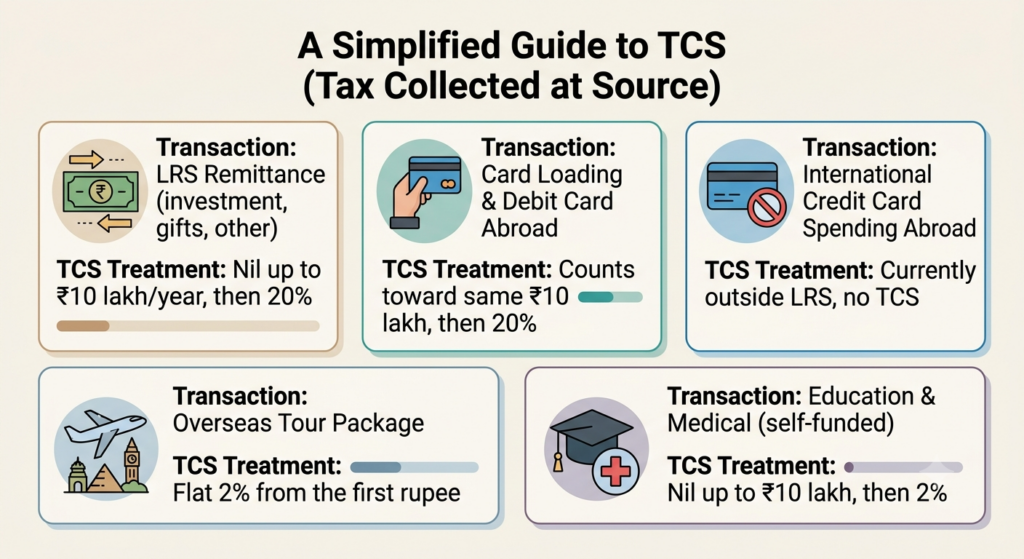
Tax collected at source (TCS) is advance income tax your bank collects, and you can claim it back in your return. These are FY 2026-27 rates, from 1 April 2026, per chartered accountant Somesh Chandak’s September 2026 review.
| Transaction | TCS treatment |
| LRS remittance (investment, gifts, other) | Nil up to ₹10 lakh a year, then 20% |
| Prepaid card loading and debit-card spending abroad | Counts toward the same ₹10 lakh, then 20% |
| International credit-card spending abroad | Currently outside LRS, no TCS |
| Overseas tour package | Flat 2% from the first rupee |
| Education and medical (self-funded) | Nil up to ₹10 lakh, then 2% |
The ₹10 lakh threshold is cumulative across every bank and purpose under your PAN.
Does TCS apply to international credit-card spending?
As of October 2026, international credit-card spending made while you’re overseas remains excluded from LRS for TCS purposes. The government postponed its 2023 plan to include these transactions, and the exemption remains in place until further orders. Debit cards and prepaid forex cards are treated differently, with TCS potentially applying once eligible spending exceeds ₹10 lakh in a financial year. That’s one reason zero-forex credit cards have become the default for big overseas spends. Rules here have changed before, so check the current position before a large spend.
International credit-card spending made while overseas currently attracts no TCS in India, because the government’s 2023 plan to bring it under LRS remains deferred as of October 2026. Prepaid card loads and debit-card spending count toward the ₹10 lakh annual threshold, with 20% TCS above it.
What counts as an LRS transaction?
Four things get confused:
- Spending abroad on a credit card: not LRS for now.
- Loading a prepaid card: LRS, and it counts toward the ₹10 lakh threshold.
- Sending money abroad, including to your own overseas account: LRS.
- Receiving money from overseas clients: not LRS. That’s an inward remittance with its own documentation.
Debit-card spending abroad is also treated as LRS by Indian banks, with TCS collected in real time above the threshold.
Compliance note
TCS treatment depends on the transaction and your circumstances, and the rates changed in each of the last two Union Budgets. Before you use any of these banking apps for digital nomads for a large remittance, check the current RBI and income-tax rules, and ask your bank or a CA which purpose code applies. This guide explains the rules. It isn’t tax advice.
The ₹1 Lakh Test: Which Setup Costs Less?
One standard scenario to compare how banking apps and cards for digital nomads price the same spend: ₹1 lakh of card spending abroad, paid in local currency, using the same underlying exchange rate for every setup so only fees differ. GST is 18% on fees where it applies. Wise’s conversion fee uses 1.16%, the lowest figure it lists, with GST added to stay conservative. ATM costs show one ₹10,000 withdrawal and exclude machine-operator fees. No live exchange rate is hard-coded, because rates move daily.
| Setup | Forex markup | GST | Conversion fee | Total on ₹1 lakh | One ₹10,000 ATM withdrawal |
| Regular 3.5% card | ₹3,500 | ₹630 | None assumed | ₹4,130 | Varies by card |
| Zero-forex credit card | ₹0 | ₹0 | None assumed | ₹0 | Cash-advance fee applies |
| Wise | None | ₹209 | ₹1,160 | ₹1,369 | ₹0 within $200 a month |
| Niyo | ₹0 | ₹0 | None assumed | ₹0 | ₹499 (₹423 plus GST) |
| Scapia / IDFC FIRST | ₹0 | ₹0 | None assumed | ₹0 | Scapia: ₹500 minimum |
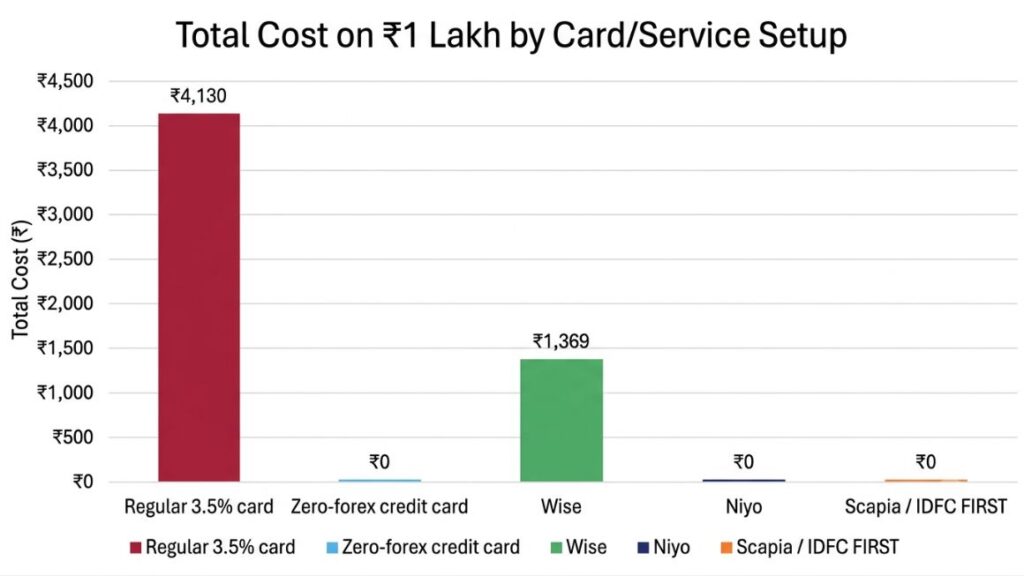
The point isn’t a permanent ranking. It’s the shape of the result. The zero-markup options carry no explicit fee on ₹1 lakh, Wise shows a visible ₹1,369 and the 3.5% card costs ₹4,130. The gaps that don’t show up here matter too: network rates, operator fees and lost rewards. Scapia pays no rewards on forex spends, and many IDFC FIRST cards stop earning on them from 26 October 2026. Wise’s cost buys you a currency balance and a transparent rate, which Niyo’s Visa-rate model doesn’t offer.
Which Banking Setup Fits Your Nomad Style?
Which of the banking apps for digital nomads you lean on depends on your nomad style. Pick the row that looks like your life, then adjust.
| Nomad type | Primary setup | Backup |
| Short international trips | Zero-forex credit card | Wise/Niyo |
| Long Southeast Asia stay | Wise + zero-forex credit card | Second card |
| USD-paid freelancer | Payment platform + Indian bank | Travel card |
| Frequent ATM user | Card with strong ATM terms | Second network |
| European resident | Revolut/N26 + Wise | Local bank |
| US-based nomad | Schwab + Wise | Second card |
The answer shifts because the three jobs shift. Someone paid in dollars needs a receiving route before anything else, since spending cards are the easy part. Someone who withdraws cash weekly should care more about ATM terms than markup. A person living in Lisbon on a residence permit can open European accounts that an Indian resident in Chiang Mai can’t. Ask how you earn first, then how you spend, then how you withdraw. The third answer is usually where the backup card earns its place.
7 Banking Mistakes That Cost Digital Nomads Money
Most expensive errors with banking apps for digital nomads are small and repeatable.
- Choosing INR at an overseas terminal. That’s DCC at work. Pick the local currency every time.
- Ignoring the exchange rate. A zero-fee card with a poor rate can cost more than a low-fee one with a fair rate.
- Using only one card. One block or one lost wallet leaves you with no money.
- Assuming zero forex means zero cost. Network spreads, ATM charges and lost rewards still apply.
- Using a travel card to receive freelance income. Cards spend money. They don’t collect client payments.
- Ignoring ATM operator fees. The machine’s own charge lands on top of your bank’s.
- Forgetting residency and KYC restrictions. Accounts like Revolut and N26 can refuse or freeze you if your residency doesn’t match.
Conclusion
There’s no single best option among banking apps and apps for digital nomads. For an Indian resident, the strongest setup splits the work: one route for receiving income, one card for spending abroad, a way to hold or convert currencies, a plan for ATM access and an emergency backup on a different network. Fees and rules will keep shifting. So build around functions, not brand names.
If you’re mapping out how digital work, money and career moves fit together, the Crystal Clear Newsletter tracks practical updates on exactly that. Follow it, and you’ll see the next fee change before it shows up on your statement.
Frequently Asked Questions
What is the best banking app for a digital nomad?
No single one of the banking apps for digital nomads wins. Wise is the strongest all-rounder for converting and spending across currencies. A zero-forex credit card like Scapia or IDFC FIRST covers everyday spending. Add a receiving platform for client income.
What is the best bank account for a digital nomad from India?
Keep your Indian savings account as the base, since client money settles there. Add a receiving platform such as Wise Business, Payoneer or Skydo, plus cards for spending. Foreign accounts need foreign residency.
Can Indian residents use Revolut?
Not for a standard account yet. Revolut began a controlled beta in India in May 2026, built on a prepaid wallet and UPI, with broader access promised. A full account needs residency in a supported country.
Is Wise safe and legal for Indians?
Wise’s India page says its services work through RBI-regulated partners. Using it doesn’t exempt you from LRS limits, so keep records and use it for permitted purposes only.
Niyo Global vs Wise: which is better for travel?
Niyo suits short trips funded from your rupee account, with zero markup on Visa’s rate. Wise suits longer stays across several currencies, since it holds 40+ currencies at the mid-market rate for a visible fee. If you withdraw cash often, compare each fee table first.
Is a zero forex markup credit card completely free?
No. The markup is gone, but cash advances, late fees, operator charges and the network’s rate still apply. Some cards also stop earning rewards on forex spends.
Does TCS apply to international credit-card spending?
Not currently. Credit-card spending made overseas stays outside LRS for TCS purposes under the continuing deferral. Prepaid card loads and debit-card spending count toward the ₹10 lakh threshold, with 20% above it.
How many cards should a digital nomad carry?
Two at minimum, on different networks and stored separately, such as a Visa credit card and a Mastercard debit card. Long stays justify a third for emergencies.
What is the cheapest way to withdraw cash abroad?
Withdraw rarely, in large amounts and always in the local currency. Use a card with a free allowance, like Wise’s $200 a month. Avoid credit-card cash advances, which carry a fee and usually charge interest immediately.
Do freelancers need a separate account for overseas payments?
Usually, yes. A dedicated receiving route keeps client income, remittance paperwork and personal spending apart. That makes GST and tax filing easier. Your Indian bank account can serve if it issues proper inward remittance advices.