

Your prospect visits the pricing page at 11 PM, scrolls twice and leaves. Nobody follows up because nobody was awake. That gap between interest and action is exactly what an AI agent for conversational marketing is built to close. It’s why more marketing teams are replacing static forms and scheduled broadcasts with something that actually talks back. Marketers have used chatbots for a decade. What’s changed is that these tools can now reason through a conversation, pull real data and act on it instead of just following a script.
This article breaks down what an AI agent for conversational marketing actually is, how it’s different from the chatbot on your website today and where it fits across the funnel. See which platforms are worth looking at if you’re running a D2C, SaaS or services business in India or anywhere else. We’ll also walk through setup, common mistakes and how to measure whether it’s working.
Table of Contents
What Is an AI Agent for Conversational Marketing?
An AI agent for conversational marketing is a system that holds real-time, natural-language conversations with prospects and customers, and can take action, like updating a CRM record or booking a meeting, instead of just answering questions. That’s the whole idea in one sentence. Everything else is detail.
The word “agent” is doing real work in that definition. Older bots respond. Agents decide. Give one access to your calendar and it can check availability and book a slot without a human touching it. Give it access to your order database and it can tell a customer exactly where their shipment is. This is not a generic “please check your email” reply.
An AI agent for conversational marketing is a system that uses natural language processing and connected tools to hold real-time conversations with prospects. It qualifies them based on intent and takes actions like booking meetings or updating CRM records without waiting for a human to intervene.
Practically, this shows up as a chat widget on a website, a WhatsApp thread that starts the moment someone clicks an ad or a voice agent that calls a lead back within seconds of a form submission. The channel varies. The underlying capability, holding context and acting on it, doesn’t.
AI Agent vs Chatbot: What’s Actually Different?
People use “chatbot” and “AI agent” interchangeably. Honestly, most marketers don’t need to care about the distinction until it starts costing them leads. But once you’re choosing a platform, the difference decides what you can actually build.
Rule-based bots vs LLM-powered agents
A classic chatbot runs on a decision tree. If the user types “pricing,” show the pricing menu. If they type something the tree didn’t anticipate, it falls back to “Sorry, I didn’t understand that” or hands off to a human. It’s cheap, predictable and brittle the moment a conversation goes off-script.
An LLM-powered agent works differently. It reads the actual sentence a person typed, however messy, and infers intent from it. Someone typing “does this work for a team of 40 people spread across two cities” gets a real answer, not a menu. This is the same shift that happened in customer support. It’s why 91% of organizations with more than 50 employees already use some form of chatbot in their customer journey, per Gartner-sourced industry tracking. The infrastructure was already there. What changed is the intelligence sitting inside it.
Why “agentic” means it can take actions, not just answer
Here’s the part most comparisons skip. An agent isn’t just a smarter chatbot brain bolted onto the same old widget. It’s connected to tools: your calendar, your CRM, your product catalog and your payment gateway. That connection is what lets it do something instead of just describing what you should do next.
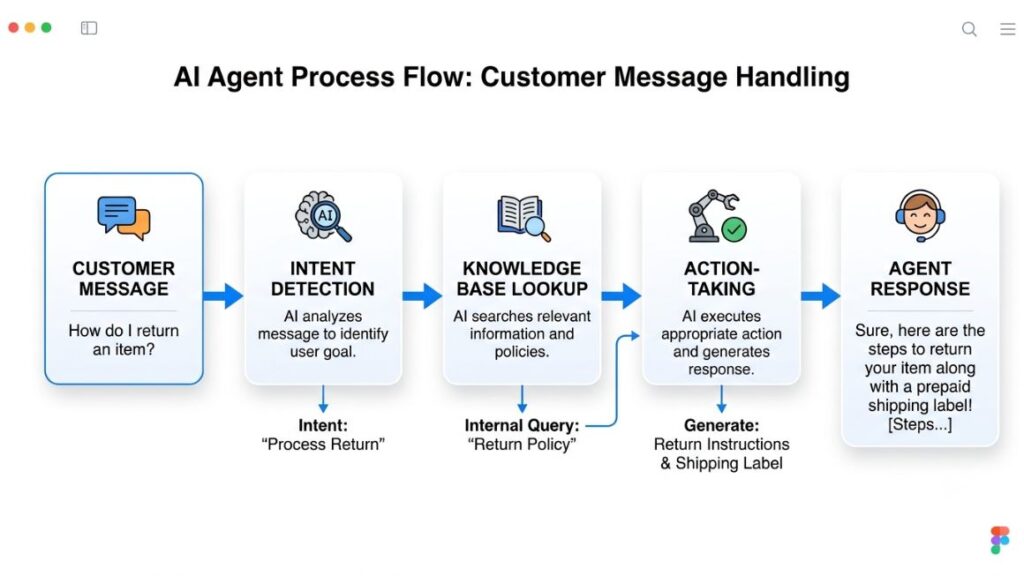
A chatbot tells a visitor “you can book a demo on our calendar page.” An agent asks two qualifying questions, checks your sales rep’s calendar, and confirms a slot inside the same chat window. The visitor never leaves the conversation. That’s the practical difference. It’s the reason “agentic AI” has become the term marketing teams reach for when describing this generation of tools.
Why Conversational Marketing Is Becoming Non-Negotiable in 2026
The shift isn’t theoretical anymore. It shows up in the numbers, and it shows up hardest in markets where messaging apps already dominate daily behavior. India is the clearest example of that.
According to a 2026 analysis citing Meta’s business reporting and the IAMAI Digital India Report, 78% of Indian small and medium businesses now use WhatsApp for some form of customer communication. Although far fewer have moved beyond replying manually to running structured, automated campaigns. That gap between “we’re on WhatsApp” and “we’re running an AI agent on WhatsApp” is where most of the opportunity sits right now.
The broader chatbot market backs this up. Market trackers including Gartner and Grand View Research put the global chatbot market at close to $11.8 billion in 2026, and separate research from Zendesk found that websites running a chatbot see a 23% lift in conversion rates compared to those that don’t. Nextiva’s research on conversational AI goes further, finding that leads generated through a chat conversation convert at roughly three times the rate of a static web form.
Why the gap? A form is a wall. It asks for information before giving anything back. A conversation gives something in every exchange, an answer, a recommendation, a confirmation, so the person stays engaged instead of abandoning halfway through. That’s not a copywriting trick. It’s a structural advantage that static marketing simply can’t replicate.
Conversational marketing outperforms static lead capture because it exchanges value at every step instead of asking for information upfront. Nextiva’s research found chat-generated leads convert at roughly three times the rate of traditional web forms, and Zendesk found chatbot-enabled sites see a 23% conversion lift overall.
None of this means every business needs a voice agent calling leads at midnight. It means the businesses ignoring conversational channels entirely are increasingly the exception, not the norm.
Also Read: Conversational AI Trends 2026: What’s Actually Reshaping Customer Experience
Where AI Agents for Conversational Marketing Fit in the Funnel
An AI agent isn’t a single feature you bolt onto your site once. It shows up at multiple points in the buying journey. Each one solves a different and specific leak in the funnel.
Lead qualification and instant follow-up
Most B2B teams still take hours, sometimes days to respond to an inbound lead. By the time a sales rep replies, the prospect has often already talked to two competitors. An AI agent asks qualifying questions the moment someone lands on a pricing or demo page. It scores the response against your ICP and either books a meeting directly or routes a hot lead to the right rep instantly.
This matters more than it sounds like it should. Speed to lead is one of the most under-discussed levers in the B2B pipeline. An agent that responds in seconds rather than hours changes how many of those leads actually convert before they go cold. For broader campaign workflows beyond the conversation itself, an AI agent for marketing campaigns can also help connect audience signals, campaign execution and optimisation across the funnel.
Product discovery and recommendations
For D2C and e-commerce, the agent replaces the “browse 40 product pages” experience with a short back-and-forth. A skincare brand’s agent might ask about skin type and concern, then recommend three SKUs instead of making the shopper filter a category page manually. This is closer to how a good in-store salesperson works than how a website traditionally works.
Cart recovery and re-engagement
A generic “you left something in your cart” email that gets ignored. Instead, an agent can open a WhatsApp thread with a specific nudge, answer a size or shipping question that was the actual reason for the drop-off and close the sale inside the same conversation. This is where conversational marketing starts overlapping directly with conversational commerce.
Post-purchase support that upsells
Support tickets are usually treated as pure cost centers. An agent handling a delivery-status question can also flag a relevant add-on or a restock reminder. That turns a support touchpoint into a soft marketing moment without feeling pushy, as long as it’s done with restraint and genuinely useful timing.
Inside an AI Agent: How It Actually Works
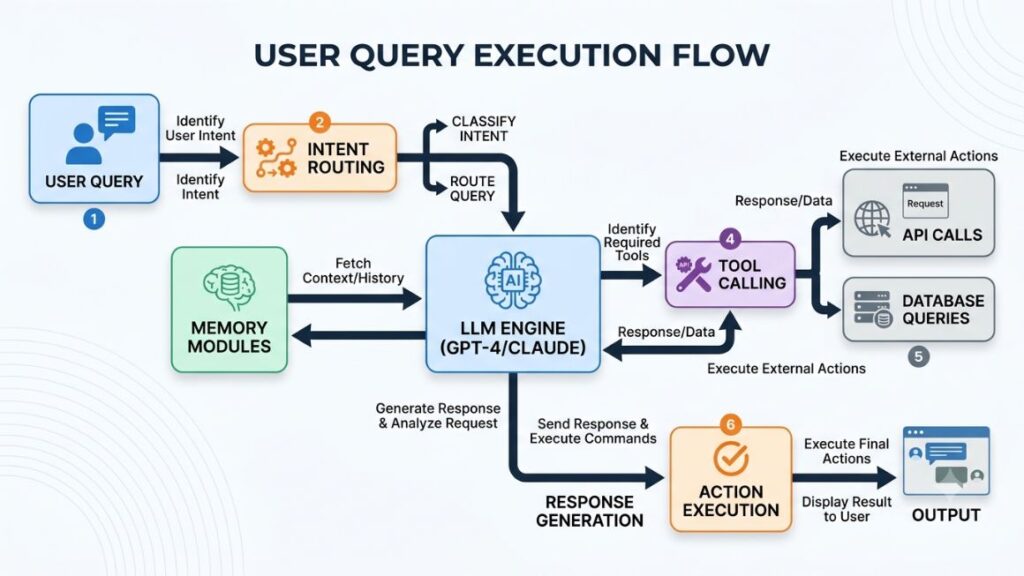
Marketers don’t need to write code to use one of these tools. But understanding the moving parts makes it much easier to evaluate a platform or brief a developer correctly.
The reasoning layer (LLM + intent)
At the core sits a large language model that reads the incoming message and figures out what the person actually wants, even if they phrase it oddly or ask two things at once. This is what separates an agent from a decision tree. It doesn’t need the user’s exact words to match a pre-written pattern.
Knowledge base and CRM connection
The reasoning layer is only as good as what it can look up. A well-built agent is connected to your product catalog, FAQ documentation, order history and CRM records. So it answers with your actual data instead of a generic guess. This is also what stops it from hallucinating a return policy that doesn’t exist.
Memory and tool-calling
Memory means the agent remembers what was said three messages ago in the same conversation, so it doesn’t ask the same question twice. Tool-calling means it can trigger an action, sending a calendar invite, applying a discount code, updating a lead score, rather than just describing what should happen next. Frameworks like LangChain and Haystack are common choices for teams building this from scratch, though most marketing teams will use a platform that has already wired this together.
Also Read: AI Agent for Marketing Operations: How to Automate Campaigns, Data, and Reporting in 2026
Best AI Agent Platforms for Conversational Marketing Right Now
The tool you pick depends heavily on whether you’re running a global SaaS motion or an India-first and WhatsApp-heavy D2C business. Here’s a working comparison across both.
| Platform | Best For | Strength | Watch Out For |
| Drift | B2B website chat and meeting booking | Turns inbound site traffic into qualified, booked meetings 24/7 | Scoped mainly to on-site chat, not a full campaign engine |
| HubSpot Breeze | Teams already inside the HubSpot CRM | Native integration means CRM updates and content creation happen in the same conversational layer | Best value shows up only if you’re already deep in HubSpot |
| LimeChat | Indian D2C and e-commerce brands | Built specifically for eCommerce, with WhatsApp marketing, human-level chatbot, and helpdesk in one suite; brands including Mamaearth and Wow Skin Science run on it, per its G2 listing | Narrower focus than general-purpose platforms; not built for B2B lead gen |
| Haptik | Enterprise and government-scale deployments | Proven at massive scale; Haptik’s WhatsApp-based MyGov Corona Helpdesk for the Government of India was used by more than 21 million people, according to Hindustan Times reporting | Enterprise pricing and implementation timelines |
| Verloop.io | eCommerce support-to-sales handoff | Strong WhatsApp Business API integration for order tracking, support, and upsell in one thread | Setup requires more configuration for complex catalogs |
| Hello24.ai | WhatsApp-first commerce for SMBs | Lets brands sell, run marketing campaigns, and support customers entirely inside WhatsApp | Feature depth is narrower than platforms built for omnichannel |
If you’re a founder or marketing lead at an Indian D2C brand, start by checking whether your current WhatsApp Business Provider even supports agentic, LLM-based responses. A surprising number of Indian businesses are still on the free WhatsApp Business app, not the API, which caps what any AI layer can actually do.
Also Read: Agentic Marketing Platforms: The Complete Guide to AI Agents That Plan, Execute & Optimize Marketing
How to Set Up an AI Agent for Conversational Marketing in 7 Steps?
- Define the one job the agent should own first. Don’t try to automate lead qualification, support and upsells on day one. Pick the single highest-leak point in your funnel, usually lead response time or cart abandonment and build for that.
- Connect your knowledge base before you write a single conversation flow. Feed it your actual FAQ docs, return policy, and product catalog. An agent without real data will guess. Guessing in a customer-facing tool is how trust gets lost fast.
- Wire up the CRM and calendar integrations. This is what turns the agent from a chatbot into an agent. Without these connections, it can talk but it can’t act.
- Write the escalation rules first, not last. Decide explicitly when the agent hands off to a human: a frustrated tone, a refund request over a certain value and a legal question. Build this before launch, not after your first bad conversation goes viral on Twitter.
- Choose your channel based on where your buyers already are. For most Indian D2C and SMB audiences, that’s WhatsApp. For B2B SaaS, it’s usually the website chat widget plus email.
- Run a closed pilot with real traffic, not a demo script. Route a small percentage of live conversations through the agent for two to three weeks before rolling it out fully.
- Set your KPIs before launch, not after. Response time, qualification accuracy, and conversion lift need a baseline from before the agent existed, or you’ll have no way to prove it worked.
Best Practices, Common Mistakes, and How to Measure ROI
What good implementations do differently
The brands getting real results treat the agent as a specific tool for a specific leak, not a blanket replacement for marketing strategy. They keep the conversation short. Nobody wants to answer six qualifying questions before getting a straight answer. And they test the actual conversation transcripts weekly, not just the dashboard metrics. That’s where you catch the weird edge cases a report will never show you.
Where most teams get it wrong
The most common failure is deploying an agent with no clear escalation path. So a frustrated customer gets stuck in a loop with no way out. The second most common mistake is over-personalizing to the point of feeling invasive. An agent referencing a customer’s exact browsing history in the first message can read as clever or as creepy. The line depends entirely on tone and timing.
This may not apply to every setup, but in most cases, launching with a narrower scope and expanding gradually beats trying to cover every use case at once. From what we’ve seen with YUP course learners building their first agent projects, the ones who start with a single well-defined workflow ship faster and iterate with far less rework.
KPIs to track
The core KPIs for an AI agent in conversational marketing are response time, lead qualification accuracy, conversation-to-conversion rate, and cost per conversation. Tracking all four together, rather than any single metric in isolation, is what shows whether the agent is actually improving pipeline quality or just automating noise.
Track these four together:
- Response time: how fast the first meaningful reply lands, ideally under a minute
- Qualification accuracy: what percentage of agent-qualified leads a human sales rep also considers qualified
- Conversation-to-conversion rate: how many chats end in a booked meeting, a sale, or a resolved ticket
- Cost per conversation: total platform and integration cost divided by conversation volume, so you can compare it honestly against your current support or SDR cost
Don’t judge success purely on volume. An agent handling 10,000 conversations that convert at 1% is doing worse than one handling 800 conversations that convert at 12%.
Conclusion
The gap between a business that replies to leads in minutes and one that replies the next morning has never mattered more. An AI agent for conversational marketing is the most direct way to close it. Start narrow: pick one leak in your funnel, wire up the right integrations, and set your escalation rules before you launch, not after something goes wrong.
If you want to go deeper into how agentic AI is reshaping campaign execution, lead scoring, and personalization beyond just chat, the YUP AI Marketing course page walks through building and deploying these systems step by step. The Hotskill app has hands-on modules for setting up your first conversational workflow without needing an engineering team behind you.
FAQ
What is an AI agent for conversational marketing?
It’s a system that uses natural language processing and connected business tools to hold real-time conversations with prospects and customers, qualifying leads and taking direct actions like booking a meeting or updating a CRM record, rather than following a fixed script.
Is an AI agent the same as a chatbot?
Not quite. A traditional chatbot follows a rule-based decision tree and can only respond within a scripted flow. An AI agent uses a large language model to understand free-form language and can take actions through connected tools, which a basic chatbot cannot do.
How is AI agent for conversational marketing different from conversational commerce?
Conversational marketing focuses on the top and middle of the funnel, engagement, lead qualification and re-engagement. Conversational commerce specifically covers completing a purchase inside the chat itself. Many platforms, like LimeChat and Hello24.ai, now do both in the same thread.
Do I need a developer to set one up?
For a basic website chat agent, most platforms offer no-code setup. You’ll usually need at least light developer support for the initial integration for deeper CRM integrations, custom escalation logic or WhatsApp Business API deployment.
Which businesses should use WhatsApp-based AI agents specifically?
Any business where your customers already live in WhatsApp day to day. For most Indian D2C, SMB and services businesses, that’s the default channel, given how deeply WhatsApp is embedded in daily communication across the country.
Is an AI agent actually worth it for a small business?
It depends on volume. If you’re getting a handful of inquiries a day, a human can handle that fine. Once inbound volume outpaces what one or two people can respond to instantly, the case gets much stronger. The cost of a missed lead usually outweighs the platform cost.
What do most people get wrong when they first set one up?
They skip defining a clear human handoff point. The agent ends up stuck looping a frustrated customer instead of escalating, which does more brand damage than having no bot at all.
Can an AI agent handle WhatsApp marketing campaigns in India specifically?
Yes, provided you’re on the WhatsApp Business API rather than the free app. Platforms like LimeChat, Verloop.io and Hello24.ai are built specifically around this. They let Indian brands run both marketing broadcasts and post-purchase support through the same number.
How do I calculate ROI on a conversational AI agent?
Compare cost per conversation against your current cost per lead or cost per support ticket, then layer in the conversion lift. If a chat-qualified lead converts at three times the rate of a form-captured one, even a modest volume shift can outweigh the platform’s subscription cost.
Does adding an AI agent replace my support or sales team?
No and treating it that way usually backfires. It’s built to handle repetitive, high-volume interactions so your human team can spend time on the complex and high-stakes conversations that actually need a person.