

In 2011, Harvard Business Review audited 2,241 US companies by sending each one a test web lead. The average first response took 42 hours, while nearly a quarter never replied. An AI agent for lead nurturing is designed to close that gap. It responds quickly, decides what should happen next and brings in a human when needed.
That study is old, so don’t treat it as today’s average. But the 2026 picture isn’t flattering either. Blazeo’s 2026 benchmark report covered 573 companies. It found that 74% missed the five-minute response window. Blazeo sells lead-response software. So read the number with that in mind, though it points the same way as everything else.
Buyers are also becoming more independent. Gartner’s March 2026 survey of 646 B2B buyers found that 67% prefer a rep-free experience. 45% had used AI during a recent purchase. Your lead may be researching and comparing before anyone on your team responds.
So what should you build? This guide explains how an AI agent for lead nurturing differs from a drip sequence, how it works and which tools to shortlist in 2026. Learn how to set one up in seven steps, five practical playbooks, the metrics that matter and what India’s DPDP Rules and WhatsApp policies mean for your setup.
Table of Contents
What Is an AI Agent for Lead Nurturing, and How Is It Different From a Drip Sequence?
An AI agent for lead nurturing watches how a lead behaves, decides what should happen next, sends or drafts the appropriate message and passes the lead to a person when necessary.
A drip sequence follows a fixed schedule. For example, email one goes on day zero. Email two on day three. Email three on day seven regardless of what the lead does.
The key difference is who decides the next step.
A sequence is planned in advance. An AI agent uses the lead’s latest behaviour and available data to choose from a set of actions.
For example, a lead downloads your pricing guide and then asks whether you support Hindi and Tamil. A sequence sends email three anyway. An agent can read the reply, answer from approved content, record the language requirement and notify a rep.
Drip campaigns still have a place. They are predictable, inexpensive and easy to audit. They simply cannot respond intelligently to unexpected behaviour.
Also Read: AI Agents for Marketers: The Complete 2026 Guide
Chatbot vs Workflow vs Agent: Where the Lines Fall
A chatbot answers questions inside a chat window. A workflow runs predefined steps after a trigger. An agent combines conversation with decision-making and can choose the next action within defined rules.
| Feature | Chatbot | Workflow or drip sequence | AI agent |
| Who decides the next step | The visitor, by asking | You, in advance | The agent, within your rules |
| Handles an unexpected reply | Sometimes, inside chat | No | Yes, and can update the record |
| Remembers the lead across channels | Rarely | Only through mapped fields | Yes, if the data layer is connected |
| Typical failure | Dead end or weak handoff | Wrong message at the wrong time | Confident but incorrect answer |
| Best for | Answering website questions | Predictable follow-ups | Multi-step nurturing based on behaviour |
Every option has limitations. Many nurturing tasks still do not require an agent, so choose the simplest system that solves the problem.
The Four Jobs a Nurturing Agent Does
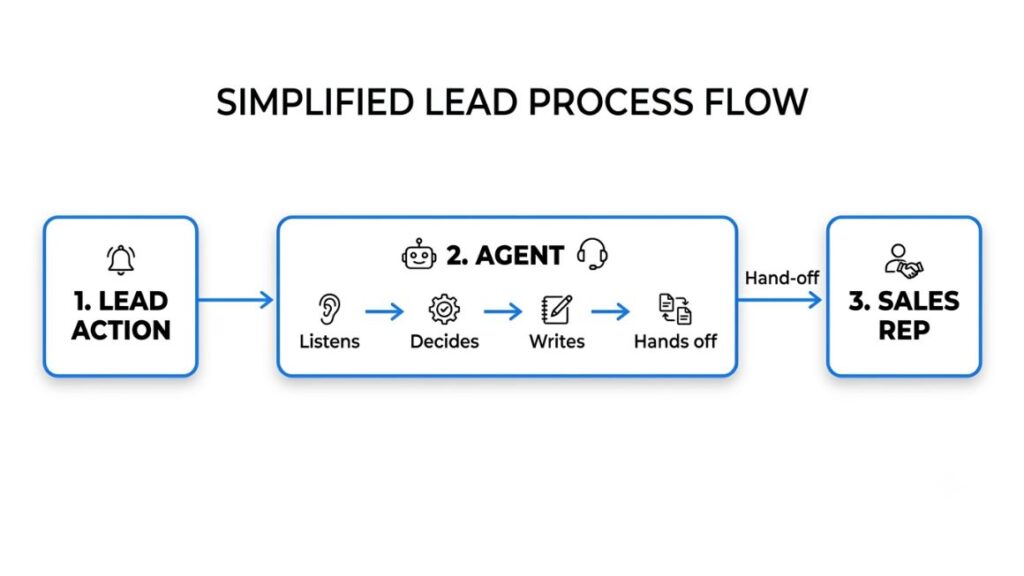
Strip away the vendor language and an AI agent for lead nurturing does four things:
- Listens. It reads replies, forms, page visits, email clicks and call outcomes.
- Decides. It chooses whether to message, wait, ask a question, book a meeting, stop or involve a human.
- Writes. It creates messages using approved content, brand guidelines and the lead’s preferred language and channel.
- Hands off. It gives a human the relevant context at the right moment.
The handoff is critical. An agent can identify an interested lead, but if the information sits unread in an inbox, the original response-time problem remains.
An AI agent for lead nurturing watches lead behaviour, chooses the next action, writes the message and hands the lead to a person when appropriate. Unlike a drip sequence, it responds to the lead’s latest actions within rules you define.
Why Is Lead Nurturing Breaking in 2026?
Lead nurturing is under pressure because buyers research independently and expect quick answers, while many teams still rely on slow responses and static sequences.
Gartner’s March 2026 survey found that 67% of B2B buyers prefer a rep-free experience, while Blazeo’s 2026 benchmark found that most companies miss the five-minute response window.
The Speed Gap
Speed to lead measures the time between a prospect’s action and your first useful response.
One widely cited study by MIT and InsideSales.com, led by James Oldroyd, found that the odds of reaching a lead fell about 100 times, while the odds of qualifying one fell about 21 times, when the first call happened after 30 minutes rather than five.
The 2011 Harvard Business Review audit of 2,241 companies found that 37% responded within an hour, 24% took more than a day and 23% never responded. Among companies that replied, the average response time was 42 hours.
More recent data from Blazeo’s 2026 survey of 573 companies found that 74% missed the five-minute response window. Among companies taking more than an hour to respond, 81.2% said they lose leads to competitors, compared with 46.6% among those responding within 15 minutes.
The underlying problem is operational. People sleep, travel, attend meetings and manage multiple prospects. An AI agent can cover the gap between the lead’s action and a human’s availability.
Buyers Who Don’t Want a Rep
Gartner surveyed 646 B2B buyers in August and September 2025 and published the findings in March 2026. Sixty-seven percent said they prefer a rep-free experience, while 45% had used AI during a recent purchase.
Rep-free does not mean help-free. Buyers still need answers about pricing, features, integrations and fit. They simply do not always want to book a call to get them.
An AI agent for lead nurturing can provide those answers immediately while escalating questions that require human judgment.
Why Static Sequences Lose
Static sequences have a basic weakness: they do not listen.
A lead may book a demo and still receive a “Want to see a demo?” email. Someone may say “try me after Diwali” and continue receiving messages.
The HBR study also identified process problems such as daily CRM lead pulls, busy sales reps and routing rules that prioritised other considerations over speed.
Good AI lead nurturing cannot fix poor routing or bad data. What it can do is reduce the delay and respond to what the lead actually says.
Speed to lead remains a major nurturing issue. HBR’s 2011 audit found a 42-hour average response among companies that replied, while Blazeo’s 2026 report found 74% of surveyed companies missed the five-minute window. Gartner’s March 2026 survey found 67% of B2B buyers prefer a rep-free experience.
How Does a Lead Nurturing Agent Work Under the Hood?
An AI agent for lead nurturing typically relies on five layers: data, triggers, decision logic, channels and guardrails.
The Five Layers
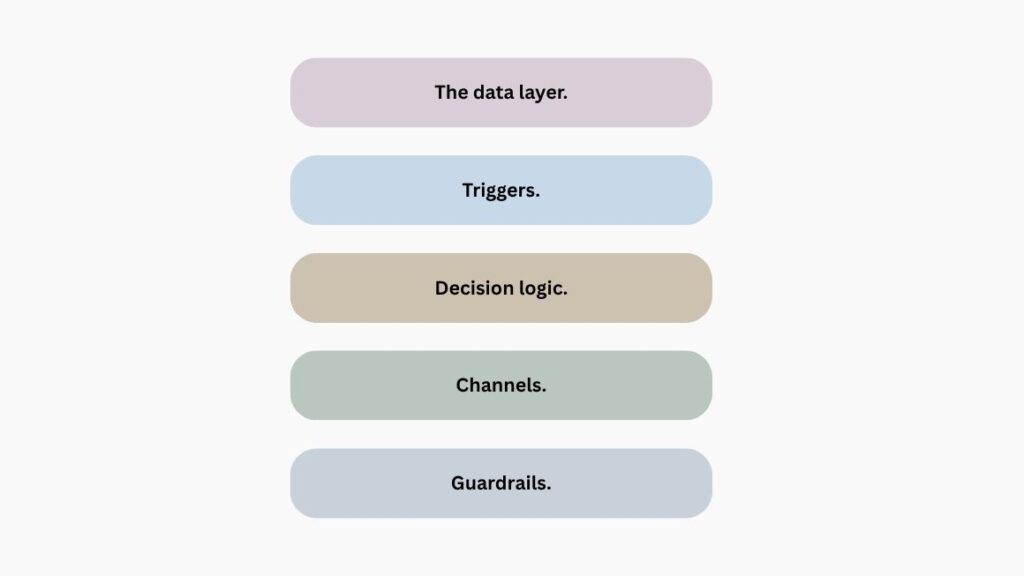
The data layer. The agent needs lifecycle stage, source, previous conversations, deal history, product usage and consent status. Weak CRM integration makes the agent generic because it lacks context.
Triggers. A form fill, reply, pricing-page visit, webinar no-show or period of inactivity can trigger the agent. These behaviours become buyer intent signals that help determine timing.
Decision logic. The agent chooses what to do next. Many teams combine predictive lead scoring, which estimates which leads resemble previous buyers, with the latest conversation. The score tells you who; the conversation tells you what.
Channels. Email, WhatsApp, SMS, web chat and voice can all be used, depending on the audience and consent.
Guardrails. Approved content, message limits, opt-out handling and human escalation rules keep the agent within acceptable boundaries.
A Real Setup: ServiceNow’s Four-Agent Team
ServiceNow’s documentation for its “Help nurture new leads” workflow shows a four-agent approach within Now Assist for Sales Force Automation.
One agent handles outreach, another reads inbound replies, another manages appointments, and a fourth handles lead disinterest and opt-outs.
That final agent highlights an important principle: knowing when to stop is part of lead nurturing.
The workflow can run independently or under a sales representative’s supervision. For a first deployment, supervised operation is the safer starting point.
A Real Handoff: Chat to Email With Kommo and ActiveCampaign
ActiveCampaign has published an example combining Kommo’s AI agent with its email sequences.
The agent starts the conversation in chat and asks for an email address at an appropriate point instead of forcing the visitor through an email form immediately. Once captured, the contact enters the email nurture.
The useful lesson is timing: an email address provided after a useful interaction can be more valuable than one requested before the conversation has started.
Which Tools Are Worth Shortlisting in 2026?
The right AI agent for lead nurturing depends on your CRM, channels, team size and audience.
CRM-native tools such as HubSpot Breeze and Salesforce Agentforce suit teams already using those platforms. Indian teams with WhatsApp-heavy lead flows can also consider Interakt, Haptik, Yellow.ai and Gupshup.
| Tool | Best for | Pricing model | Channels and fit for Indian teams |
| HubSpot Breeze | Teams using HubSpot Sales or Service Hub | Outcome-based from April 2026: $1 per recommended lead and $0.50 per resolved conversation | Uses HubSpot CRM data; confirm WhatsApp, voice and language availability |
| Salesforce Agentforce | Larger Salesforce teams | $2 per conversation, Flex Credits at about $0.10 per standard action, or per-user options from $125/month | Deep CRM integration; check channel and language options |
| Jio Haptik and Interakt | WhatsApp-first sales and support | Interakt offers platform plans with AI-agent add-ons; WhatsApp charges apply separately. Haptik pricing varies | Strong fit for WhatsApp and voice-based Indian lead flows |
| Yellow.ai | Large enterprises using multiple channels | Custom enterprise pricing | Supports many channels, but may be excessive for small teams |
| Gupshup | Enterprise and developer teams | Usage and platform fees | Strong messaging infrastructure for WhatsApp, SMS and RCS |
| ServiceNow | Enterprises already using ServiceNow | Licensed with ServiceNow products | Prebuilt outreach, reply, appointment and opt-out agents; documentation focuses on email |
CRM-Native vs Standalone Agents
A CRM-native AI agent for lead nurturing starts with an advantage: customer data is already available. The trade-off is that you’re limited by what the CRM captures and which channels the platform supports.
Standalone agents can be stronger on channels such as WhatsApp and voice, but require more CRM integration work.
For a small team already using HubSpot, a native solution may be the simplest starting point. For teams whose leads arrive through Click-to-WhatsApp ads, a WhatsApp-first platform may make more sense.
How to Spot Agent Washing
Gartner uses the term agent washing for vendors that present assistants, RPA or chatbots as agents without meaningful agentic capabilities.
Before buying an AI agent for lead nurturing, ask:
- Can the agent make a decision that nobody explicitly scripted?
- What happens when a lead says something unexpected?
- Can you see why the agent sent a particular message?
- What stops the agent, and who gets notified?
If the demonstration only shows a flow builder followed by an AI-written email, you’re likely looking at a workflow with AI features rather than a truly adaptive agent.
The Cost Most Price Pages Leave Out
Software pricing is only part of the cost.
Since July 2025, Meta has charged for WhatsApp template messages based on factors including template category and recipient country. Providers have also reported changes to service-message pricing, so check Meta’s current rate card before budgeting.
Meta says eligible India-billed accounts must move WhatsApp Business Accounts to INR billing by 31 December 2026 to avoid delivery disruption from 1 January 2027.
Outcome-based pricing can help, but understand what the vendor counts as a “resolved conversation” or “recommended lead” before comparing plans.
HubSpot moved Breeze Customer Agent and Prospecting Agent to outcome-based pricing in April 2026, including $0.50 per resolved conversation and $1 per recommended lead. Salesforce Agentforce offers conversation, action-credit and per-user pricing, making costs dependent on usage and deployment.
How Do You Set Up Your First Nurturing Agent in 7 Steps?
To set up an AI agent for lead nurturing, clean your CRM, define the rules, connect sources and channels, train the agent on approved content, establish handoffs, run a controlled pilot and review conversations regularly.
- Clean your CRM and fix lifecycle stages. Remove duplicates, update stale records and define each lifecycle stage clearly. If your team cannot agree on what a sales-qualified lead means, the agent cannot either.
- Write the rules. Define who gets nurtured, who does not, message limits, stop conditions and restricted topics such as pricing exceptions, legal claims and complaints. Put your lead qualification criteria in plain language.
- Connect lead sources and channels. Start with forms, ads, webinars, chat and the sales inbox. Add email first, then WhatsApp and voice. Make sure consent status travels with the contact.
- Train it on approved content. Use product pages, pricing, case studies, FAQs and objection-handling material. Add examples from strong sales reps to establish tone. Tell the agent what to do when it does not know an answer.
- Define handoff triggers. Escalate questions about pricing or contracts, meeting requests, competitor comparisons, complaints and high-intent leads. Set a human response-time target too.
- Pilot on one segment with a holdout group. Choose a segment such as webinar no-shows. Keep 10–20% on the existing process and compare meetings and opportunities, not just opens and replies.
- Review conversations weekly. Read 20–30 conversations and look for incorrect answers, awkward wording, missed handoffs and opt-outs. Fix the content or rule rather than simply changing the prompt.

What Does It Look Like in Practice? Five Playbooks
Five useful starting points for an AI agent for lead nurturing are cold lead reactivation, webinar no-shows, pricing-page visitors, post-demo stalls and WhatsApp or voice qualification.
Cold Lead Reactivation
Set a trigger for 60–90 days of inactivity with no open deal. The agent reads the lead’s history and sends a short message connected to their previous activity instead of a generic “just checking in.”
After two unanswered messages, it stops. Replies mentioning budget, timing or a specific problem go to a rep.
Webinar No-Shows
Webinar registrants are already warm. Within an hour, send the recording with a short summary based on their registration information.
If they watch most of the recording or visit pricing, increase their priority. If nothing happens after a week, send one relevant resource and stop.
Pricing-Page Visitors
Two pricing-page visits within a week can act as a high-intent trigger.
The agent can start a conversation, ask about team size or use case, and offer a meeting when the lead fits your ideal customer profile. A human should see high-intent leads quickly.
Post-Demo Stalls
When a demo goes well and the buyer goes quiet, the agent can use the rep’s notes to send a relevant recap and approved resources covering objections such as security or pricing.
Mentions of competitors, legal review or budget freezes should trigger a human handoff rather than an automated response.
Indian Use Case: WhatsApp and Voice Qualification
For Indian teams, leads often arrive through ads and need fast follow-up.
Jio Haptik, whose Interakt platform supports WhatsApp sales for small businesses, published a case study of a voice AI agent calling new leads immediately and passing qualified leads to sales.
Haptik reported that its call-to-qualified rate increased from 14% in July 2025 to 19% in September 2025, compared with an industry benchmark of 15–17%.
Treat those numbers as vendor-reported and specific to one deployment. The broader model is still useful: fast first contact, short qualification and a clear human handoff.
Also Read: Mastering B2B Lead Generation: A Comprehensive Guide to Boost Your Sales Pipeline
What Should You Measure to Know It’s Working?
Measure response time, lead-to-opportunity rate, meetings booked, sales acceptance rate, cost per qualified lead, opt-out rate and human override rate.
Use a holdout group to determine whether the agent actually caused an improvement.
The Seven Numbers Worth Tracking
- Response time. Measure time from lead action to first useful response, including the slowest 10%.
- Lead-to-opportunity rate. The percentage of leads becoming genuine opportunities.
- Meetings booked. Track both total meetings and the rate by segment.
- Sales acceptance rate. The percentage of handed-off leads that sales considers worth pursuing.
- Cost per qualified lead. Include software, messaging fees and review time.
- Opt-out rate. Track how often contacted leads ask to stop.
- Human override rate. Measure how often reps change or take over the agent’s actions.
How to Read a Holdout Test?
A holdout is a random group that stays on the existing process while the rest receives the agent. Keep the source, time period and sales conditions as similar as possible.
For example, if the agent group books meetings at 8% and the holdout at 6%, that is an illustrative 2-percentage-point difference. The result is useful only if the sample is large enough and both groups receive comparable treatment.
Also track opt-outs. More meetings are not necessarily useful if they come with a sharp increase in unwanted messages.
The seven core metrics are response time, lead-to-opportunity rate, meetings booked, sales acceptance rate, cost per qualified lead, opt-out rate and human override rate. A holdout group helps establish whether the agent caused the change.
What Can Go Wrong, and What Does India’s Compliance Picture Look Like?
An AI agent for lead nurturing can fail because of unclear value, poor data, uncontrolled costs or weak risk controls. In India, consent and WhatsApp requirements add another layer.
Why Projects Get Cancelled
In June 2025, Gartner predicted that more than 40% of agentic AI projects would be cancelled by the end of 2027. That could happen because of escalating costs, unclear business value and inadequate risk controls.
The prediction concerns agentic AI generally, not lead nurturing specifically. Gartner also noted that some use cases marketed as agentic do not require an agentic architecture.
That is an important point for marketers: some lead nurturing automation belongs in a conventional sequence. Start with the simplest system that can achieve the outcome.
DPDP Rules 2025: What Changes for Your Agent
India’s Digital Personal Data Protection Rules, 2025 were notified on 13 November 2025 and published in the Gazette the following day. The framework is being implemented in phases, with major business obligations, including notice, consent, security safeguards and breach reporting, applying from May 2027.
For an AI agent for lead nurturing, consent must be tied to a specific purpose. A phone number provided for an OTP, for example, should not automatically become permission for promotional messages.
Withdrawal must also be as easy as giving consent.
The headline penalty of up to ₹250 crore applies to certain failures such as inadequate security safeguards, while consent and notice violations have lower specified slabs.
Four practical steps help:
- Record consent by purpose, timestamp and the wording shown.
- Pass consent status to the agent and block marketing messages without the required consent.
- Make withdrawal stop the agent across channels.
- Ask vendors where data is processed and which model providers can access it.
This is not legal advice. Have your implementation reviewed by counsel familiar with the DPDP Rules.
WhatsApp Rules: Opt-In and the AI Policy
Meta’s WhatsApp Business Messaging Policy requires businesses to obtain opt-in before messaging people. The opt-in should clearly indicate that the person wants messages and identify the business.
Messages initiated outside the 24-hour customer-service window generally require approved templates.
There is also a separate AI policy issue. From 15 January 2026, Meta’s Business Solution terms restrict AI providers from using WhatsApp to distribute general-purpose assistants. This targets general-purpose AI assistants as the primary product, rather than businesses using AI to manage their own sales and support conversations.
For lead nurturing, keep the agent focused on your own products, services and approved topics.
Over-Automation and Tone-Deaf Messages
The most obvious failure is not always a technical one. An agent can send a perfectly valid message at the wrong moment.
A cheerful demo invitation immediately after a support complaint damages trust even if it violates no rule.
Three safeguards help:
- Cap message frequency.
- Route complaints to a human regardless of lead score.
- Tell users when they are interacting with an AI assistant.
Gartner predicted that more than 40% of agentic AI projects could be cancelled by the end of 2027 because of cost, unclear value or risk controls. India’s DPDP Rules 2025 introduce purpose-based consent requirements, while WhatsApp requires business opt-in before messaging users.
Where Is This Heading?
Gartner has forecast that by 2028, 90% of B2B buying will be intermediated by AI agents, representing more than $15 trillion in spending. This is a forecast rather than a current fact, so treat the exact figure as directional.
The practical implication is more important than the number.
If AI agents increasingly help buyers research and compare products, your content needs to be easy for both people and machines to understand. Pricing, integrations, security information and comparison points should be clearly written rather than buried in PDFs or image-heavy content.
Use descriptive headings, maintain current FAQs and date important claims.
The same content your AI agent for lead nurturing uses to answer prospects may also be consumed by a buyer’s AI agent.
Also Read: AI Agent for Customer Engagement: How to Deploy One That Works (2026)
Conclusion
Three things carry most of the weight. Speed matters, but speed without judgment just sends the wrong message sooner. Rules matter more than prompts, especially stop rules, consent rules and handoff rules. And proof matters most: run a holdout, read the conversations, and widen your AI agent for lead nurturing only when the numbers justify it.
If you’re building in India, add one more. Put consent into the agent now, ahead of May 2027, instead of retrofitting it later.
This week, pick one segment, such as webinar no-shows. Write the stop rule first, set up the holdout before you switch anything on, and see what the first 30 conversations teach you.
Agents like this are only as good as the marketer steering them. Knowing what to automate, how to test it and when to stop is a skill you can learn, and the YUP AI Marketing course is the place to start.
Frequently Asked Questions
What is a lead nurturing agent in simple terms?
It’s software that follows each lead, decides what to do next, does it, and calls in a person at the right time. A good AI agent for lead nurturing reads replies and behavior instead of running a fixed schedule. Think of it as a junior SDR who never sleeps, follows your rules to the letter and knows when to ask for help.
AI agent vs chatbot vs drip: what’s the difference?
A chatbot answers questions inside a chat window. A drip sequence sends fixed messages on a schedule. An agent decides the next step from the lead’s behavior and acts across channels, then hands the lead to a human when the moment is right. Pick the simplest one that does the job.
How do I set one up?
Follow seven steps: clean your CRM and lifecycle stages, write the rules including stop conditions, connect sources and channels, train the agent on approved content, define handoff triggers, pilot on one segment with a holdout group, and review conversations weekly. Start with cold lead reactivation or webinar no-shows, where mistakes are cheap.
Who should use one?
Teams with more leads than they can follow up, a CRM with reasonably clean data and a clear handoff to sales. It suits B2B teams with inbound leads, D2C brands that sell over WhatsApp, and education or services firms with long decision cycles. If you get ten leads a week, a sharp sequence and a fast rep may be enough.
Is an AI nurturing agent worth it for a small team?
Often, yes. An AI agent for lead nurturing pays off when your problem is slow response rather than too few leads. Outcome-based pricing, such as HubSpot’s $1.00 per recommended lead, lets small teams pay for results instead of seats. Run a pilot with a holdout before you commit, and hold off if your CRM data is a mess, because the agent will only automate the mess.
How much does it cost?
The cost of an AI agent for lead nurturing depends on the pricing model. HubSpot charges $1.00 per lead recommended for outreach and $0.50 per resolved conversation since April 2026. Salesforce Agentforce offers $2 per conversation, about $0.10 per action, or per-user licenses from $125 a month. On WhatsApp, add Meta’s per-message charges and your provider’s platform fee, and budget for the hours someone spends reviewing conversations.
Will AI replace SDRs?
Not entirely, going by the evidence so far. Gartner predicts at least 15% of day-to-day work decisions will be made autonomously through agentic AI by 2028, which leaves most decisions with people. Agents take the repetitive first touch and the follow-up. Reps keep the conversations that need judgment, trust and negotiation.
Is it legal to nurture leads on WhatsApp in India?
Yes, with valid opt-in. Meta requires an opt-in that names your business, and India’s DPDP Act requires consent that’s specific to the purpose, with easy withdrawal. The main DPDP duties apply from May 2027, but building the habits now is cheaper than retrofitting later. This isn’t legal advice, so check with counsel.
Why isn’t my agent converting?
Usually it’s one of four things: messy CRM data, vague rules, weak handoffs, or content that doesn’t answer the questions leads actually ask. Read 20 conversations and the pattern tends to show up fast. Also ask whether the leads were a fit in the first place, because an agent can’t turn a bad lead into a good one.
What do most teams get wrong?
They treat launch as the finish line. There’s no holdout, no weekly review, no stop rule, and the handoff goes to an inbox nobody watches. Gartner expects over 40% of agentic AI projects to be cancelled by the end of 2027 over cost, unclear value or weak risk controls, and all three are things you can plan for.