
Picture a founder who has spent a year getting a product right. The formula works, the packaging looks sharp, and the first fifty buyers left glowing reviews. Then launch week arrives and almost nobody shows up. The product isn’t bad. Nobody who needs it has heard it exists.
That gap is what product awareness is meant to close. It’s the stretch of the buying journey where a stranger first learns your product exists and starts to see why it might matter to them. Skip it, and even well-built product launch marketing ends up talking to an empty room.
This guide covers what product awareness campaigns are, why they matter before anyone buys, which campaign types and channels are worth considering, and how to plan one step by step. You’ll also see three real cases with their published numbers (and the limits of those numbers), a measurement framework, a list of common mistakes, and a 30-day checklist you can adapt to your own budget.
Table of Contents
What Are Product Awareness Campaigns?
A product awareness campaign is a planned set of marketing activities that helps the right people recognise a product and understand what it does. The aim is recognition and understanding, not an instant sale. Success sounds like a stranger saying, “Oh, that’s the one that fixes X.”
The purpose of introducing a product to new audiences
It’s about relevance, not volume. Ten million views from people who’ll never need an ergonomic laptop stand are worth less than ten thousand from remote workers with sore backs. A good campaign puts one clear idea in front of the right people: this exists, it solves this problem, and it’s probably meant for someone like you.
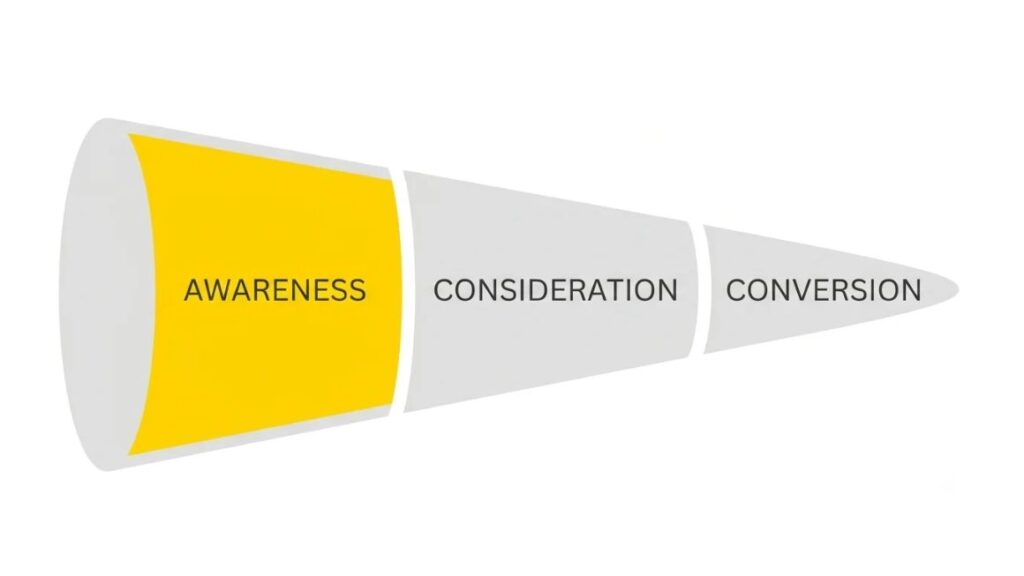
How awareness differs from consideration and conversion
Buyers ask three questions, in order. What is this? Is it better than the alternatives? Should I buy it now? Awareness answers the first, consideration the second, conversion the third. Awareness sits at the top of the funnel, which is why it gets called top-of-funnel marketing, and it needs different content and different metrics from the stages below it.
Also Read: Product Marketing vs Brand Marketing: Key Differences Explained
When a business should prioritise awareness
Put awareness first when the product is new, when you’re entering a market where nobody knows your name, or when you solve a problem people haven’t put a label on yet. Don’t, though, if people already search for you by name and simply aren’t buying. That’s usually a pricing or landing page problem, and more reach won’t fix it. A wider brand awareness strategy only pays off once the basics convert.
Why Awareness Matters Before a Customer Buys
People can’t consider, let alone buy, something they’ve never come across. Product awareness starts the buying journey. It doesn’t finish it, and exposure alone guarantees neither trust nor sales.
Helping customers recognise a problem and its solution
Plenty of people feel a problem long before they know a product category exists. Loftie’s founder noticed friends and colleagues struggling to unplug from their phones, a problem everyone recognised. The product he built around it still had to be explained. Awareness does that explaining. It links “my phone keeps wrecking my sleep” to “there’s a product for that.”
Building familiarity and trust over time
Familiarity builds slowly. Someone sees your name in a creator’s video, then in a search result, then on a friend’s shelf. None of those moments sells anything. Together, they make the name feel less foreign, and that can lower the effort a buyer feels when they finally compare options. It isn’t automatic. A forgettable or irritating ad builds the wrong kind of familiarity.
Supporting future demand and sales activity
Awareness often pays off later, and not always where you can see it. Someone who learns about your product today might not need it for months. When the need shows up, the brands they already know get searched first. That’s the quiet link between awareness and sales, and it’s why a product marketing strategy should treat awareness as demand you’re building, not demand you’re collecting.
Also Read: Product Growth Strategy: A Step-by-Step Guide to Sustainable Growth in 2026
Awareness gives buyers a reason to remember a product before they need it. It doesn’t produce trust or sales on its own, but it makes a brand familiar enough to be searched, compared, and considered when a need appears.
Types of Campaigns Businesses Can Use
Businesses usually run product awareness campaigns through four routes: paid advertising, educational content, creator and press work, and in-person or partnership activity. Each one trades speed, cost, and control differently, and the strongest campaigns combine two or three.
Paid advertising across social and video platforms
Paid ads buy speed and control. You choose who sees what, and when. That makes awareness advertising the quickest route to a defined audience, particularly on YouTube, Instagram, and other Meta placements. The limits are real: results stop when the spend stops, and costs climb once a small audience has seen your ad a few times. It suits products with a clear visual hook and a budget that can survive a few weeks of testing.
Educational content and organic discovery
Articles, tutorials, and explainer videos work slowly, then compound. A guide that ranks in search keeps introducing your product for months without extra spend. The catch is patience. It suits products people research before buying, like software, finance, or health products.
Creator collaborations and public relations
Influencer marketing lends you an audience’s trust, which a brand can’t buy directly. Press coverage does something similar with credibility. Both are hard to control and uneven to scale. Reach for them when your product needs to be seen working, or when someone else’s voice carries more weight than yours.
Events, sampling, demonstrations, and partnerships
Handing someone the product beats describing it. Sampling and demos fit food, beauty, and anything with a sensory pull. They cost more per person reached, but the people reached remember. Partnerships borrow another brand’s audience, which is exactly what Heinz did with Mattel (more on that below).
So don’t pick just one. A creator video sparks interest, a paid ad reaches similar viewers, and an article answers the search that follows.
Also Read: Product Marketing Campaigns: How to Plan, Launch & Measure Success in 2026
How to Plan a Successful Campaign Step by Step?
A strong product awareness campaign starts on paper: one objective, one audience, one message, matched channels, a realistic budget, and a measurement plan written before launch. Skip any of them and results turn into guesswork.
Define one clear objective
Pick one. “Get known” isn’t an objective. “Get 2,000 people in our target group to recognise the product and say what it does” is closer. Typical awareness objectives are reach inside a defined audience, recall, or growth in branded searches. Chase two at once and neither gets enough budget.
Research the audience and its needs
Find out who actually has the problem, and what words they use for it. Read reviews of competing products. Skim forums, comment sections, and search suggestions. The goal is customer awareness among people who already half-know their problem, so their language matters more than yours.
Identify the product’s main differentiator
What’s the one thing your product does that alternatives don’t, or do worse? That’s the base of your product positioning. If you can’t say it in one sentence, buyers won’t manage it either.
Build a simple, memorable message
Keep it simple enough to repeat. One idea, plain words, no jargon. Here’s a quick test: could someone describe it to a friend after seeing it once? If they’d need your deck to explain it, it isn’t ready.
Choose the right platforms and creative formats
Go where your audience already pays attention, in formats they already watch. A product that needs demonstrating belongs in short video. A product people research belongs in search and articles. Two channels done properly beat five done badly.
Set a realistic budget and campaign timeline
Work backwards from what you can spend without needing instant returns. Awareness rarely pays back in week one, so plan a testing phase and a scaling phase. Four to six weeks is a reasonable first window for a small test, though the right length depends on the product and the channel.
Establish a measurement plan before launch
Decide what you’ll measure and what “good” looks like. Record baselines now: branded searches, direct traffic, follower counts. Without a “before” number, any “after” number is just a number.
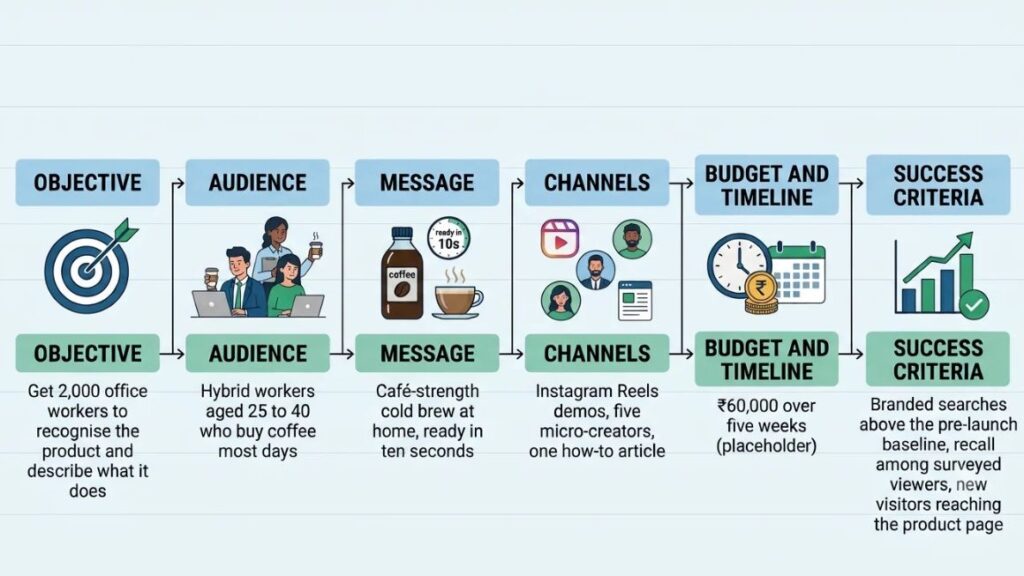
An illustrative planning example. This one is hypothetical, not a real case. A small brand is launching a cold-brew coffee concentrate for office workers in Bengaluru. The figures are placeholders to show how the pieces connect.
| Element | Illustrative choice |
| Objective | Get 2,000 office workers to recognise the product and describe what it does |
| Audience | Hybrid workers aged 25 to 40 who buy coffee most days |
| Message | Café-strength cold brew at home, ready in ten seconds |
| Channels | Instagram Reels demos, five micro-creators, one how-to article |
| Budget and timeline | ₹60,000 over five weeks (placeholder) |
| Success criteria | Branded searches above the pre-launch baseline, recall among surveyed viewers, new visitors reaching the product page |
Read left to right and every cell depends on the one before it. The message follows from the audience, the channel from the message, and the success criteria from the objective.
Channels and Creative Formats to Consider
The best format depends on how much explaining your product needs. Simple products suit short video and paid social. Considered purchases suit search and long-form content. Either way, adapt each asset to the platform instead of pasting the same file everywhere.
Short-form video and product demonstrations
The first two seconds decide whether anyone stays, so open on the problem or the surprising result, not the logo. Show the product doing its job. Caption for viewers on mute, and close with one call to action, not three.
Paid social and display placements
Social media advertising gives precise audience controls, which suits a small, well-defined group. Display placements stretch reach cheaply but earn weaker attention. Resize creative for every placement, because a vertical video cropped into a square usually looks cropped.
Search, educational articles, and landing pages
Search catches people who are already looking. Articles answer the question that comes before a purchase, and a landing page turns that curiosity into a clear next step. Keep the page’s promise identical to the ad or article that sent the visitor there.
Creator content and customer stories
A real person using the product reads as more believable than a polished brand claim. Give creators a brief with the one message but freedom over how they say it. Customer stories work the same way, provided they’re real and specific.
Email, community, and offline touchpoints
Email lists and communities reach people who’ve already shown interest, so they deepen awareness more than they create it. Offline touchpoints like pop-ups, packaging inserts, and local events suit physical products. Whatever you choose, decide what you want the person to do next.
Real-World Examples and Lessons to Learn
Three published cases show different sides of awareness work: a playful launch, a creator-led push, and a small brand sharpening its difference. Each one below separates what was published from our own interpretation, because no brand’s results transfer neatly to yours.
A memorable product launch
- Context. Heinz had hinted at the Barbiecue sauce in an Instagram post in August, when the Barbie film was everywhere, and fan enthusiasm helped push it into production.
- Mechanism. An initial limited run of 5,000 bottles went on sale online first, and a limited run reached Tesco stores from 17 April, timed with Barbie’s 65th anniversary.
- Published results. None found for this sauce. Heinz did say, in a separate case, that 60% of incremental sales from its Absolut Vodka pasta sauce partnership came from new shoppers, but that’s a different product.
- Interpretation. The smart move was testing public reaction before committing to production. A small business can copy that on a smaller scale: float the idea to your audience and see who responds.
A campaign built around creators or communities
- Context. Instacart ran a summer promotion built around 1999-style prices.
- Mechanism. According to agency Linqia, creators posted nostalgia-led content across Instagram, TikTok, and YouTube, producing 76 assets, with the best material reused in paid social.
- Published results. A Dynata brand lift study found a 20-point lift in unaided brand awareness and a 5.6-point lift in purchase intent, with Reels engagement of 6.9% against a benchmark of 3.5% to 4.0%.
- Interpretation. This is a large, well-known brand, and the numbers come from the agency that ran the work. Copy the structure, not the scale: one idea, many creators, and content reused in ads.
An example of clear product differentiation
- Context. Loftie, a small US brand, sells a smart alarm clock and didn’t want shoppers to see “just an alarm clock.”
- Mechanism. In 2022, Loftie ran Sponsored Products, Sponsored Brands, and display ads on Amazon, using video to show how its clock stands out, stressing the white-noise machine, Bluetooth speaker, and ongoing content.
- Published results. Sponsored Products campaigns averaged a $5.66 return on ad spend and 17.68% advertising cost of sale, while Sponsored Brands ads had a 1.06% click-through rate, in the 75th percentile for the category.
- Interpretation. ROAS is a sales metric, so this shows ads working on people already shopping, not awareness in its purest form. It’s also Amazon’s account of its own customer. The lesson is simpler: say the difference plainly, in the format that proves it.
Published awareness cases show what happened for one brand, in one market, with one budget. Heinz tested demand in public before production, Instacart reused creator content in paid ads, and Loftie made its difference explicit. Smaller businesses can borrow the structure without expecting the same numbers.
How to Measure Whether the Campaign Is Working?
Measure product awareness with metrics that match your objective, compared against a baseline recorded before launch. No single number proves it. Reach shows exposure, brand lift shows recall, and search and traffic trends hint at what came after.
Reach, impressions, and frequency
Reach counts unique people who saw your ad. Impressions count total views, repeats included. Frequency is impressions divided by reach. All three show exposure, not understanding, so a million impressions spread across five thousand tired viewers looks bigger than it is.
Brand recall and awareness lift
Brand lift studies survey a group that saw your ads and a group that didn’t. Google says the gap between the two groups shows your ads’ influence on metrics like ad recall and awareness. It’s the nearest thing to a controlled test, but platforms set minimum requirements, and recall is imperfect. UK firm On Device reported in October 2025 that, across more than 2,000 brand lift studies from 2019 to 2025, ad recall gave inaccurate results in eight out of ten cases when compared with passively measured exposure. Treat recall as a signal, not a verdict.
Branded search trends and direct traffic
If more people type your brand name into Google, awareness may be rising. Google announced a branded queries filter for Search Console in November 2025, which splits branded from non-branded searches. It uses automatic classification that can make mistakes, and it needs enough query volume to work. A spike can also come from press or a viral post that has nothing to do with your campaign.
Engagement quality and product-page visits
Likes are cheap. Saves, shares, comments that ask real questions, and visits to product pages from new visitors say far more. Look at how long those visitors stay.
Connecting awareness with later business results
Watch for delayed movement: more branded searches, better conversion among people who return, shorter sales cycles. Awareness rarely shows up in last-click reports, so read campaign performance metrics next to a holdout test where feasible, such as pausing the campaign in one city and comparing.
Common Mistakes to Avoid
Most product awareness campaigns stumble in boring, avoidable ways.
Targeting everyone instead of the right audience
Broad targeting feels safe and burns budget. Write a one-line description of your buyer, then target the interests and search terms that match it.
Focusing on features without explaining benefits
Spec sheets don’t stick. For every feature, finish the sentence “which means you can…” and use that version.
Repeating the same creative until people tune out
Audiences stop noticing. Rotate three or four variations, and watch frequency and engagement for the first signs of decline.
Expecting immediate sales from every awareness activity
Awareness pays later. Judge the campaign on awareness metrics first, then check sales over a longer window.
Ignoring attribution, privacy, and creative fatigue
Tracking gaps are real, and consent rules limit data. Lean on first-party data and brand lift surveys, say plainly what you can’t attribute, and check each platform’s current rules before launch.
A Practical 30-Day Launch Checklist
Four weeks is a planning frame, not a promise. Some products need longer before any signal appears, and others move faster. Use it to organise your product promotion strategy, then stretch it if the data says so.
Week 1: Research and planning
- Write one objective and one audience description
- Study competitor messaging and customer reviews
- Record baselines for branded searches, traffic, and followers
- Draft the message and the one-sentence difference
Week 2: Creative production and setup
- Produce three or four creative variations
- Build or tidy the landing page
- Set up tracking and, if possible, a lift or survey method
- Brief any creators with the message, not a script
Week 3: Launch and initial testing
- Launch at a modest budget
- Test two hooks against each other
- Check early engagement and frequency every few days
Week 4: Review results and refine
- Compare results with your baselines
- Pause weak creative and keep what worked
- Decide what to scale, what to stop, and what to test next
Conclusion
Product awareness campaigns work when four things line up: a clear message, a defined audience, steady exposure, and measurement that matches the goal. Miss one and the whole effort gets noisy.
Start small. Pick one objective, record your baselines, run a four-week test, and let the numbers decide what comes next. If product launches are part of your job, or soon will be, YUP’s Product Marketing course is a good next step for building positioning, launch, and measurement skills with guided practice.
Frequently Asked Questions (FAQ)
What is the main purpose of an awareness campaign?
To help the right people recognise a product and understand what it does, so it feels familiar when they start comparing options. Sales may follow, but they aren’t the main measure of success at this stage of a product awareness campaign.
How long does it take to build product awareness?
It depends on the channel, the budget, and the product. Paid campaigns can shift recall within weeks, while content and word of mouth often take months. Treat the first 30 days as a test, not a verdict.
Which platforms are best for reaching new customers?
Wherever your specific audience already spends attention. YouTube and Instagram suit visual products, search and articles suit researched purchases, and Amazon suits products shoppers browse for. Check where your buyers already are before choosing.
How much should a small business spend?
There’s no universal figure, because it depends on your industry, audience size, and platform costs. Start with an amount you can spend for four to six weeks without needing returns, and increase it only when your metrics show something working.
How do you measure awareness without tracking sales?
Use brand lift surveys, branded search trends, direct traffic, and engagement quality, and compare each against a baseline from before launch. Together they show whether more people know you, even before purchases follow.
Can a campaign increase awareness without paid advertising?
Yes. Content, search, creators, community, press, and partnerships can all build awareness, usually more slowly and with less control. Heinz’s Barbiecue idea began as a social media post, not a media plan.