

Most business analysts feel it before they can name it. Fewer requirements docs get requested. Automation quietly absorbs the reporting work that used to fill a Tuesday. The role hasn’t disappeared, but it feels smaller than it did three years ago, and the growth path from here is not obvious.
Product management is not a random pivot for a BA looking for something new. It is the most direct next step available, because a BA already does a meaningful chunk of a PM’s job every single day: talking to stakeholders, gathering requirements, prioritizing what matters, making sense of data. What is missing is not the raw material. It is ownership.
This is not a case for treating the transition as automatic or guaranteed. It is a real career change that takes deliberate work, and BAs who go in assuming their existing title alone will carry them tend to get stuck. What follows is the honest version: the data behind why this shift is happening, what genuinely transfers, what does not, and a concrete sequence for closing the gap.
In this article, we make the case for the transition from business analyst to product manager honestly, including the parts that do not transfer automatically, and we also lay out a practical sequence for making the move.
Table of Contents
Why the Business Analyst Role is Shrinking
This needs to be said carefully, because the honest version is more useful than the alarmist one.
Avasant Research’s staffing data shows business analyst headcount inside IT departments fell sharply, from a median staffing ratio of 8.0% in 2023 to just 3.7% in 2024. That is not a rounding error. Avasant’s own principal analyst, Asif Cassim, put it plainly: the number of business analysts in IT may be declining, but their value is rising. Those two things are true at the same time, and understanding why matters more than the headline stat.
What is actually shrinking is the narrowest version of the BA job, the one built around writing requirements documents, producing status reports, and translating between business stakeholders and an IT team. That work is exactly the kind AI tools and automation absorb fastest, because it is structured, repeatable, and document-heavy. It is also, not coincidentally, the least strategic part of what a good BA does.
What is not shrinking is the underlying skill: understanding a business problem well enough to know what should happen next. That skill is not being automated. It is being repositioned, often into roles like product management, where the same analytical instinct gets applied earlier in the process, to decisions instead of documentation.
If you are a BA reading this and sensing that your role feels more precarious than it used to, that instinct is probably correct. The useful response is not panic. It is recognizing that the skill underneath the job title is more valuable than ever, and moving it toward a role built to use it fully.
This pattern is not unique to any one industry or geography. The same shift is showing up across IT-heavy sectors globally, where organizations are decentralizing BA responsibilities out of a standalone department and embedding them directly inside product, operations, and engineering teams instead. The job title is disappearing from org charts faster than the underlying work is disappearing from the business. For a BA planning their next move, that distinction should shape the decision: this is a good moment to reposition the skill set deliberately, not a signal to abandon the analytical foundation you have built.
Avasant Research’s 2025 staffing report found business analyst headcount ratios in IT departments fell from 8.0% in 2023 to 3.7% in 2024, even as the report describes the underlying BA skill set as increasingly critical to organizations navigating AI and automation. The role is not disappearing so much as being decentralized and repositioned, with core BA responsibilities increasingly embedded inside other functions rather than sitting in a standalone BA department.
Why Product Management is the Logical Next Step for BAs
Look at what a business analyst actually does in a normal week, and the overlap with product management is hard to miss.
A BA runs stakeholder interviews to understand a business need. A PM does the same thing to understand user and business needs before defining a feature. A BA gathers and prioritizes requirements, deciding what matters most among competing asks. A PM does exactly this when building a roadmap. A BA translates data into a recommendation for a business decision-maker. A PM uses the same skill to decide what a team should build next. A BA works across departments, IT, operations, finance, to align everyone around a shared understanding. A PM’s entire job depends on that same cross-functional fluency.
The one real gap, and it is worth stating plainly rather than glossing over: a BA documents what the business needs. A PM decides what gets built, and owns the outcome when that decision is right or wrong. That shift, from insight to ownership, is the actual delta between the two roles. It is learnable, but it is not automatic, and pretending otherwise sets up a rough first year in the new role.
The demand data backs this direction up. In India, product managers typically start around ₹10 to 15 lakh a year, with mid-career professionals earning ₹25 to 45 lakh, according to 2026 industry compensation data, a meaningfully higher ceiling than most standalone BA career tracks offer. Globally, product management hiring has rebounded strongly, with TrueUp’s tracking showing PM hiring up 54% from its early 2023 low point, and open PM roles at their highest level in over two years as of mid-2025. This is not a move into an equally crowded, equally uncertain field. It is a move toward one of the more resilient, better-compensated paths available to someone with strong analytical and stakeholder skills already in hand.
There is also a structural reason this transition tends to work better than BAs expect going in. Recruiters hiring for PM roles are explicitly told to look favorably on candidates with business or analytical backgrounds, since a PM’s core job is bridging business needs with what gets built, exactly the muscle a BA has already spent years developing. Candidates coming from pure engineering or design backgrounds often have to build stakeholder and business fluency from scratch. A BA making this move is not catching up on that half of the job. They are already ahead on it, and only need to build the other half.
What a Typical Week Looks Like: BA vs. PM
Comparisons in the abstract are easy to nod along to and hard to act on. A concrete week makes the overlap, and the gap, much clearer.
A BA’s week typically includes stakeholder interviews to clarify a business requirement, writing or updating a requirements document, coordinating with an IT or development team to confirm feasibility, running a status update with business stakeholders, and analyzing data to answer a specific business question someone else raised.
A PM’s week typically includes many of the same activities, stakeholder conversations, data analysis, cross-functional coordination, layered with a different set of responsibilities: deciding what goes on the roadmap and what gets cut, defending that prioritization to stakeholders who wanted something else built first, writing a product requirements document that reflects the PM’s own judgment rather than a stakeholder’s stated ask, and reviewing metrics to decide whether a recent release actually worked or needs to change.
The overlap in day-to-day activity is real. The difference sits in who is ultimately accountable for the call, and that accountability is exactly the muscle a BA-to-PM transition needs to build deliberately rather than assume will develop on its own.

What Actually Transfers From Business Analyst to Product Manager (and What Doesn’t)
Being honest about what carries over, and what does not, is what separates a BA who transitions successfully from one who gets stuck applying for months without traction.
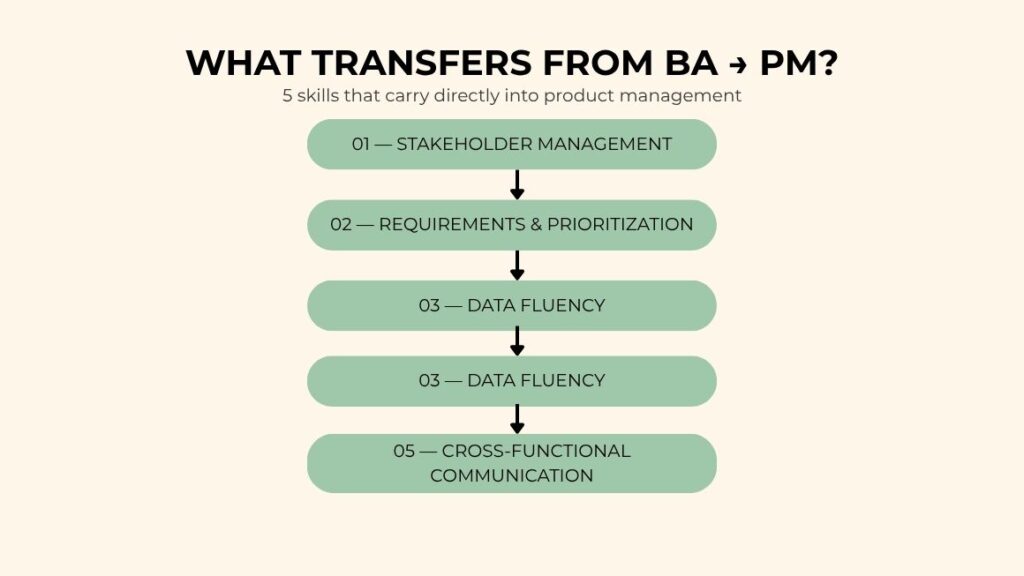
Skills That Transfer Directly
Stakeholder management. Running conversations across departments, managing competing priorities, and building trust with people who do not report to you is core to both roles, and BAs typically enter this transition with more of it than most other candidates PMs compete against.
Requirements gathering and prioritization. Knowing how to extract what a stakeholder actually needs, as opposed to what they initially ask for, and then ranking competing needs against limited resources, maps almost directly onto how PMs build and defend a roadmap.
Data fluency. Comfort pulling insight out of a dataset and turning it into a clear recommendation is exactly what PMs do when deciding what to prioritize, and it is a skill many PM candidates from purely business or design backgrounds lack.
Process mapping. Understanding how work actually flows through a system, where the friction points are, where handoffs break down, translates directly into the kind of systems thinking PMs need when scoping a feature or diagnosing why something is not working.
Cross-functional communication. Years of translating between technical and non-technical stakeholders is not a soft skill footnote. It is one of the hardest things to teach a PM candidate who has not had to do it under real pressure.
The Real Gaps to Close
Outcome ownership versus documentation. A BA’s job is often done once the requirements are clear and agreed. A PM’s job has barely started at that point, since they now own whether the resulting feature actually solves the problem and moves a metric. This mental shift, from being accountable for clarity to being accountable for results, is the single biggest adjustment.
Product sense beyond requirements gathering. Understanding what users actually need, sometimes before they can articulate it themselves, and having a point of view on product direction rather than just documenting stated requirements, takes deliberate practice most BAs have not had structured exposure to.
Commercial and user-centric thinking. BAs are often optimizing for internal process efficiency. PMs are usually optimizing for user value and business outcomes at the same time, which is a different, harder balancing act, especially early on.
Comfort with ambiguity and saying no. A BA’s job is frequently to resolve ambiguity into a clear document. A PM’s job often means operating inside ongoing ambiguity, making calls with incomplete information, and saying no to stakeholders whose requests do not make the roadmap. That discomfort is real, and underestimating it is a common reason first-time PMs struggle.
How to Know You’re Actually Ready to Make the Move?
A few honest signals matter more than how long you have held the BA title. You are likely ready when you find yourself disagreeing with a stakeholder’s stated requirement because you can see a better path to the underlying goal, and you say so rather than documenting the request as given. You are likely ready when you have started tracking whether a feature you helped scope actually performed well after launch, not just whether it shipped on time. And you are likely ready when the idea of being wrong about a prioritization call, and owning that outcome, feels uncomfortable but not disqualifying.
If none of those signals feel familiar yet, that is not a reason to abandon the goal. It is a signal to spend more time in step two of the playbook below, getting close to real product decisions, before investing heavily in the job search itself.
Also Read: How to become a Product Manager without technical skills
The BA-to-PM Transition Playbook
A practical sequence, not a theoretical one, for making this move without quitting your job on faith alone. Most BAs who make this transition successfully spend somewhere between three and nine months on it, working the steps below in parallel with their current role rather than treating the transition as a single leap.
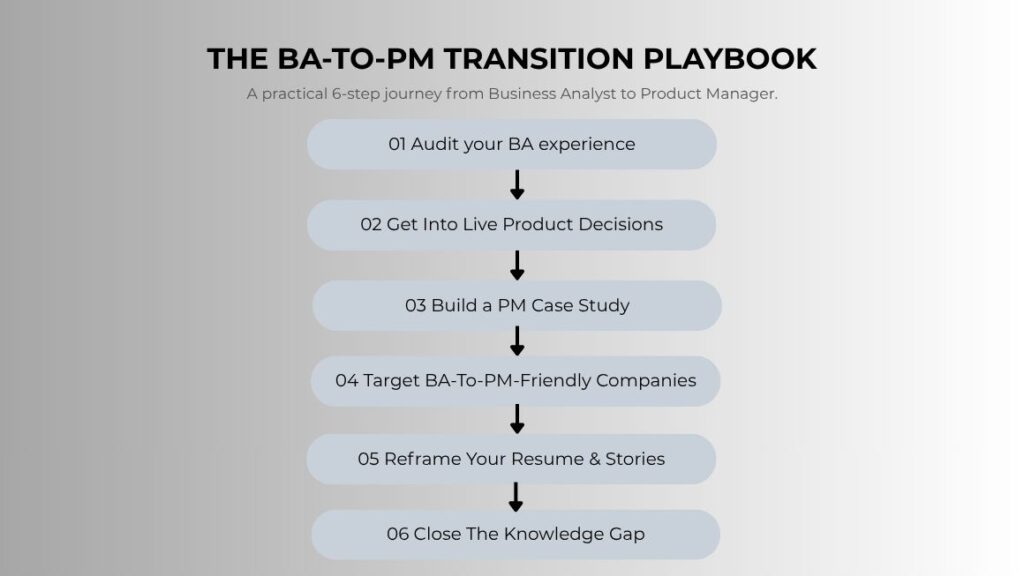
- Audit your current BA work for PM-adjacent responsibilities you can already claim. Most BAs are doing more product-like work than their job title suggests, prioritization calls, feature scoping input, stakeholder alignment on what ships next. Name it accurately on your resume instead of underselling it as pure documentation. Go back through your last two or three projects specifically looking for moments where you influenced, rather than just recorded, a decision.
- Get close to a live product decision, even informally, inside your current role. Volunteer for the parts of a project closest to deciding what gets built, not just documenting what was decided. Even a small, informal contribution to a real product call is worth more than a certificate with no applied evidence behind it. If your current role genuinely offers no path to this, look sideways within your organization before looking outside it, a product owner or program manager might be more willing to loop you in than you expect if you ask directly.
- Build a portfolio artifact, a case study, not a certificate. Write up a real problem you worked on: the context, the decision you would have made as the owner rather than the analyst, the trade-offs, and what you would measure to know if it worked. This single document does more in interviews than any credential alone. Aim for one to two pages, specific enough that an interviewer could ask follow-up questions and you would have real answers, not generic ones.
- Target BA-to-PM-friendly companies and industries first. Fintech, insurance, and enterprise software companies often have BA and PM roles sitting close together organizationally, and hiring managers there are more likely to see the transferable skill set clearly than in industries where the two roles never interact.
- Reframe your resume and interview stories from “I documented X” to “I decided X, and here’s the outcome.” This single language shift matters more than most candidates realize. Interviewers are listening for ownership language, not process language, and BAs who do not consciously make this shift often undersell themselves without realizing it.
- Close the structured-knowledge gap rather than assuming experience alone will carry you. Frameworks for prioritization, metrics definition, and product strategy are learnable in weeks through structured training, and having them gives you a shared vocabulary with hiring managers that raw on-the-job exposure alone does not.
Also Read: Common Product Management Interview Questions
Common Mistakes BAs Make When Trying to Break Into PM
A few patterns show up repeatedly in BAs who struggle to land their first PM role.
Leading with “I’ve always wanted to build products” instead of evidence. Enthusiasm is not a qualification. Hiring managers want to see even a small, concrete instance of you making a product-style decision, not a statement of interest.
Underestimating how different outcome-ownership interviews are. PM interviews test for how you would decide, prioritize, and defend trade-offs under ambiguity, not how well you can document a known requirement. Walking into these interviews with BA-style answers is one of the most common reasons strong candidates get passed over.
Trying to transition without ever having influenced a real product decision. Reading about product management and actually shaping a product decision, even a small one, are not the same preparation. The gap shows up immediately in interviews when a candidate cannot speak to a real trade-off they made.
Applying to every PM opening instead of targeting roles where the transition story makes sense. A BA with deep domain knowledge in insurance claims processing has a genuinely compelling story for a PM role at an insurance-tech company, and a much weaker one applying cold to a consumer social app. Casting too wide a net dilutes what should be your strongest asset: relevant context a generalist candidate does not have.
Waiting for permission instead of creating the evidence yourself. Some BAs wait for a manager to formally expand their scope into product-adjacent work before they consider themselves ready to apply elsewhere. That wait can take years, and it is rarely necessary. Building a portfolio case study on your own initiative, even without a formal title change, is usually faster and entirely within your control.
Conclusion
The business analyst role is not disappearing, however it’s not growing like before. The narrow version of the BA role built around documentation is defintiely shrinking, and that is exactly the part of the job that was always going to be the easiest to automate. What remains, and what is becoming more valuable, is the analytical and cross-functional skill underneath it.
Product management is where that skill set finds its widest application. The transition is real work, closing the gap between documenting decisions and owning them does not happen by accident, but it is a shorter distance than it looks from the outside, and BAs are better positioned to close it than almost any other adjacent role.
If you are ready to close that gap deliberately rather than hoping experience alone gets you there, Young Urban Project’s 10-week Product Management course is built specifically for professionals making exactly this move, structured around the frameworks and applied practice that turn BA experience into a real PM portfolio.
FAQs on How to transition from Business Analyst to Product Manager
Is business analyst a dead-end career?
No, but the narrowest version of the role, focused purely on requirements documentation and reporting, is shrinking as automation absorbs that work. The underlying analytical and stakeholder skills a good BA builds remain in high demand, particularly when redirected toward roles like product management that use them more fully.
How long does the BA-to-PM transition typically take?
For a BA already close to product decisions in their current role, 3 to 6 months of deliberate positioning, portfolio building, and targeted applications is realistic. For a BA in a purely documentation-focused role with little product exposure, expect closer to 6 to 8 months, since building real evidence of product thinking takes time.
Do I need a certification to become a product manager?
While a certification is not mandatory, but structured training in prioritization frameworks, product strategy, and metrics can meaningfully close the knowledge gap and give you a shared vocabulary with hiring managers faster than learning purely on the job. A certification like Young Urban Project’s Product Management Course can help your profile get shortlisted by recruiters.
What if my current company has no product manager roles?
Look for the closest adjacent role first, product owner, business systems analyst with roadmap input, or a program manager role with product exposure, as a bridge, or start building your portfolio case study using a real problem from your current work even without a formal transfer.
Is an MBA necessary to become a product manager?
No. Many product managers, including those in Indian companies earning ₹25 lakh and above, do not hold an MBA. Demonstrated product thinking and outcome ownership matter more to most hiring managers than the specific credential on a resume.
How does product manager compensation compare to business analyst pay?
Product manager compensation in India typically starts around ₹10 to 15 lakh a year and climbs to ₹25 to 45 lakh at mid-career, generally outpacing standalone BA compensation tracks over the same experience range, since PM roles carry direct accountability for business outcomes.
Do I need a technical background to become a product manager?
Not necessarily, though comfort discussing technical trade-offs with engineering teams helps significantly. Many successful PMs come from business, analytics, or operations backgrounds rather than engineering, particularly in growth-stage and mid-size companies rather than deeply technical infrastructure roles.
What’s the biggest red flag hiring managers look for when a BA applies for a PM role?
Answers that describe documenting a decision rather than making one. Hiring managers are listening specifically for ownership, how you weighed trade-offs and what you would measure, not how thoroughly you captured what stakeholders asked for.
What’s the best first move if I’m a BA wanting to eventually become a PM?
Find the smallest real opportunity in your current role to influence what gets built, not just document what was decided, and treat that as your first case study. A small, real example of product thinking beats a large amount of theoretical preparation every time.
What’s the best first move if I’m a BA wanting to eventually become a PM?
Find the smallest real opportunity in your current role to influence what gets built, not just document what was decided, and treat that as your first case study. A small, real example of product thinking beats a large amount of theoretical preparation every time.