
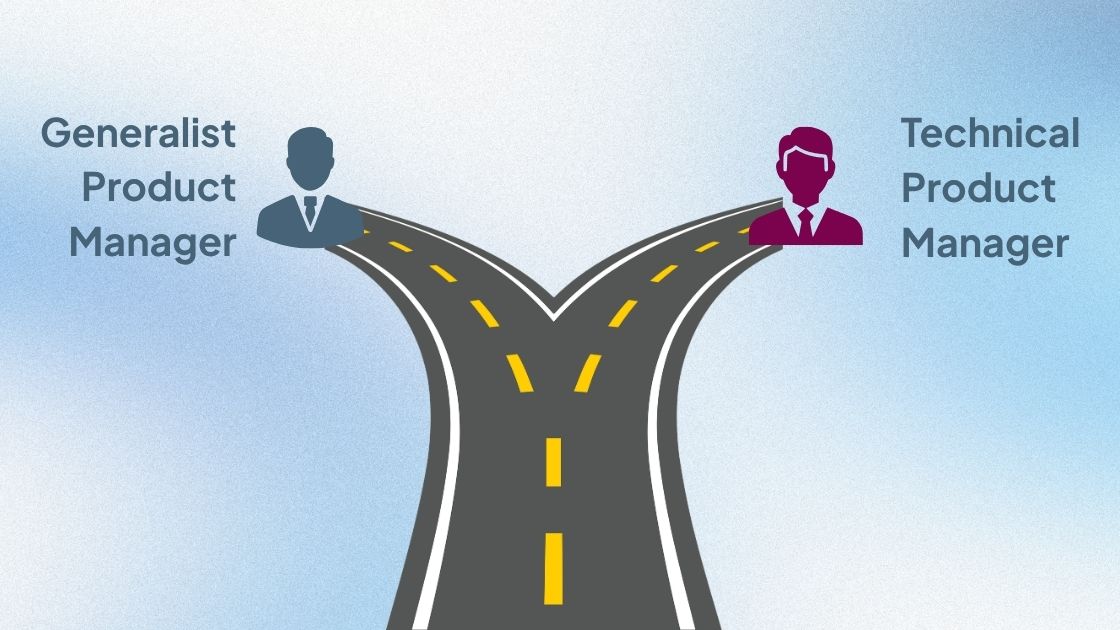
Here’s an assumption worth challenging directly: that “technical product manager” is simply a more advanced, more serious version of “product manager,” and that generalist PM is what you do until you’re ready for the real thing. That framing is wrong, and believing it leads people to chase the technical PM title for status reasons rather than fit, then struggle once they’re actually doing the job.
Technical PM and generalist PM aren’t a hierarchy. They’re two different specializations, solving different kinds of problems, for different kinds of products, requiring genuinely different day-to-day skills. Here’s what the difference between technical PM vs generalist PM, actually separates them, and how to figure out which one fits the way you think.
Table of Contents
What a Technical Product Manager Actually Does
A technical product manager (TPM) owns products where deep technical understanding isn’t optional context, it’s core to making good decisions. This usually means infrastructure, developer tools, APIs, data platforms, or B2B products where the end user is frequently another engineer, not a general consumer.
The day-to-day reflects that. A TPM sits close to architecture discussions, weighs in on technical debt tradeoffs, and needs enough fluency to have a real opinion when engineering proposes two different implementation approaches with different long-term costs. According to a 2026 comparison published by career research platform DigitalDefynd, technical product managers typically begin their careers as engineers, developers, or technical analysts before transitioning into product leadership, often holding degrees in computer science, information systems, or electrical engineering, sometimes paired with certifications in cloud architecture or Agile methodologies.
Salesforce is a company frequently cited for this pattern. A TPM there might have spent years in backend engineering before moving into product strategy, work where credibility with the engineering org, earned through genuine technical depth, directly shapes how much influence the TPM actually has in architecture conversations. That credibility is the whole point of the role. A TPM without it struggles to be taken seriously in exactly the discussions the role exists to own.
Technical product managers typically enter the role from engineering, development, or technical analyst backgrounds, often holding degrees in computer science or a related technical field, according to 2026 career research from DigitalDefynd. This background matters because the role centers on products, like infrastructure, APIs, and developer tools, where deep technical credibility directly shapes a PM’s influence in architecture and technical tradeoff discussions.
What a Generalist Product Manager Actually Does
A generalist PM owns products where business judgment, user empathy, and market strategy carry more weight day to day than deep system-level technical fluency. This is the more common path across consumer products, B2B SaaS with a broad user base, and most product roles that don’t require sitting inside architecture reviews as a core function.
A generalist PM at a company like Airbnb, for example, might focus on improving the booking experience, optimizing conversion rates, or ensuring design consistency across the product, work that depends far more on understanding user behavior and business impact than on backend system architecture. The core skill set here leans toward customer research, competitive positioning, and cross-functional influence across marketing, sales, and design, alongside enough technical literacy to have an informed conversation with engineering without needing to own the technical decision itself.
This doesn’t mean generalist PMs work on “easier” problems, a common and inaccurate assumption. It means the hardest part of the job lives in a different place: reading ambiguous market signals, making a defensible prioritization call with incomplete data, and getting a room full of stakeholders with competing priorities aligned behind one direction.
Skills and Background: What Actually Separates the Two Paths
The clearest way to see the difference is in where each path typically starts and what it demands day to day.
Technical PMs usually arrive with a computer science, engineering, or related technical degree, and often spend real time as engineers before moving into product. The core skill being tested is technical judgment: can you evaluate an architecture tradeoff, understand a system’s scalability constraints, and speak credibly to an engineering team about implementation risk.
Generalist PMs arrive from a much wider range of backgrounds, business, marketing, UX, operations, consulting, and the core skill being tested is different: can you read a market accurately, build a defensible business case, and align a cross-functional team around a strategic direction using influence rather than technical authority.
Neither of these is a “harder” or more rigorous test than the other. They’re different muscles. A technical PM without strong communication skills struggles just as much as a generalist PM without any technical literacy at all, both roles require a baseline of the other skill set, they just weight the core competency differently.
Side-by-Side Comparison
| Technical Product Manager | Generalist Product Manager | |
|---|---|---|
| Typical background | Engineering, CS, technical analyst roles | Business, marketing, UX, operations, varied |
| Core skill emphasis | Technical judgment, architecture fluency | Market judgment, cross-functional influence |
| Common product type | Infrastructure, APIs, developer tools, platforms | Consumer apps, broad B2B SaaS, services |
| Primary stakeholder | Engineering teams, technical leadership | Users, business leadership, sales, marketing |
| Career optionality | Deep within technical/platform domains | Broad across industries and product types |
Salary and Demand: Is One Path Actually Worth More?
The honest answer is closer than the internet debate around this topic suggests, and the framing matters more than the raw numbers.
According to compensation data compiled by CPO Club, average product manager salaries and technical product manager salaries sit fairly close together, with TPMs typically commanding a modest premium over generalist PMs. Worth flagging directly: those specific published figures reflect broader historical benchmarking rather than a single clean 2026 data point, and the real premium shows up more clearly once you control for seniority, company, and specialization than it does from the technical/generalist label alone. A senior generalist PM at a well-funded company routinely out-earns a junior TPM, and the reverse is just as true.
Where a real, distinct premium does show up is in AI and ML-specific technical specialization, a more specific and currently growing niche within the broader technical PM path.
As covered in more depth there, PMs who can own a model evaluation process or a retrieval pipeline design command meaningfully more than PMs doing general feature work, technical or not. That specific fork is worth understanding on its own terms rather than assuming “technical PM” as a broad category automatically commands a premium.
Also Read: What is AI Product Management and How to become an AIPM
Which Path Should You Choose? A Direct Framework
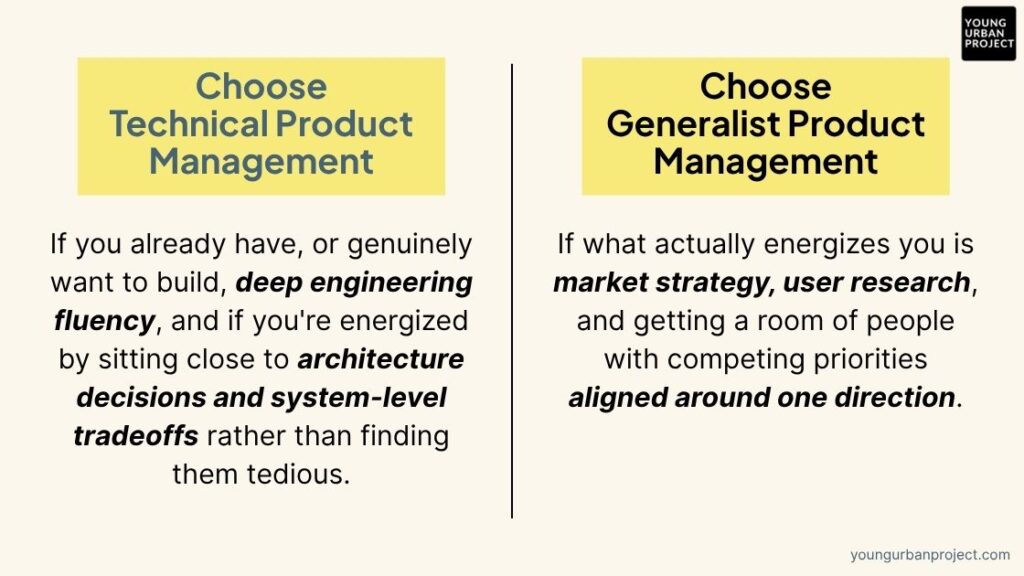
Choose technical PM if you already have, or genuinely want to build, deep engineering fluency, and if you’re energized by sitting close to architecture decisions and system-level tradeoffs rather than finding them tedious. This path fits well if you’re drawn specifically to developer-facing or infrastructure products, where your technical credibility with engineering is the thing that makes you effective, not just a nice-to-have.
Choose generalist PM if what actually energizes you is market strategy, user research, and getting a room of people with competing priorities aligned around one direction. This path also offers more career optionality by design, a generalist PM’s skill set transfers across industries and product types, consumer, B2B, hardware, services, far more easily than a technical PM’s domain-specific depth does.
Neither answer is more prestigious than the other, whatever LinkedIn discourse might suggest. The honest filter is which kind of problem you’d rather spend most of your week actually solving.
Can You Switch Between the Two Paths Later?
Yes, and movement happens in both directions regularly, which is worth knowing before treating this decision as permanent.
A generalist PM can build technical fluency over time, through deliberate effort, project exposure, or additional coursework, and move into more technical product roles as that fluency deepens. A technical PM can move the other direction too, broadening into more strategic, business-facing responsibility as they advance, particularly at senior and director levels where the two paths tend to converge into broader general management responsibility regardless of which specialization someone started in.
The practical takeaway: this choice matters more for where you start and what you’re optimizing to learn in your next few years than it does as a permanent, irreversible fork. Pick based on what’s genuinely interesting to you right now, not based on trying to guess which path sounds more impressive on a resume five years from now.
Finally…
Technical PM and generalist PM aren’t a ladder, they’re a fork. One path rewards deep engineering fluency and sits close to architecture decisions on infrastructure and developer-facing products. The other rewards market judgment and cross-functional influence across a much broader range of product types. Neither is the “real” version of product management, and neither guarantees a meaningfully better salary or career outcome once you control for seniority and company.
The decision that actually matters is which kind of problem you want to spend your week solving, and it’s a decision you can revisit and adjust later, not one that locks you in permanently.
If you’re still narrowing down which path fits, or want to build the core skills either path requires, our Product Management Course covers both technical fluency fundamentals and the strategic frameworks generalist PMs rely on.
Frequently Asked Questions on Technical PM vs Generalist PM
What is the main difference between a technical PM and a generalist PM?
A technical product manager owns products, like infrastructure, APIs, or developer tools, where deep engineering fluency is core to the job, while a generalist product manager owns broader business and consumer-facing decisions where market judgment and cross-functional influence matter more than system-level technical depth.
Does a technical PM get paid more than a generalist PM?
The gap is smaller than commonly assumed, and seniority and company size affect compensation far more than the technical/generalist label itself. A distinct, larger premium does exist for PMs specializing specifically in AI/ML product work, a more specific niche within the broader technical PM category.
Do I need a computer science degree to become a technical PM?
It significantly helps and is the most common path in, but it isn’t strictly required if you can otherwise demonstrate genuine technical fluency through hands-on project experience or a related technical background like data analysis or systems administration.
Do technical PM and generalist PM roles converge at senior levels?
Often, yes. At senior and director levels, both paths tend to require broader strategic and general management responsibility, and the day-to-day distinction between the two narrows considerably, regardless of which specialization someone started their career in.