

Most marketers have exactly one AI habit: open ChatGPT, type a prompt, hope for the best. That’s not a strategy. It’s a coping mechanism.
The gap between marketers who get real output from AI and those who don’t rarely comes down to which model they use. It comes down to what they know exists. There are entire categories of AI resources for marketers that never show up in a LinkedIn feed, buried under newsletter noise and tool-of-the-week posts.
This list fixes that. Seven categories, over 25 resources, each one chosen because it does something the mainstream AI conversation skips entirely.
Table of Contents
Learn AI Better Without Drowning in Hype
Most AI content is either breathless hype or dry academic paper. Neither helps you ship a campaign by Friday. The resources below sit in the narrow middle: informed, current, and written by people who actually use the tools they cover.
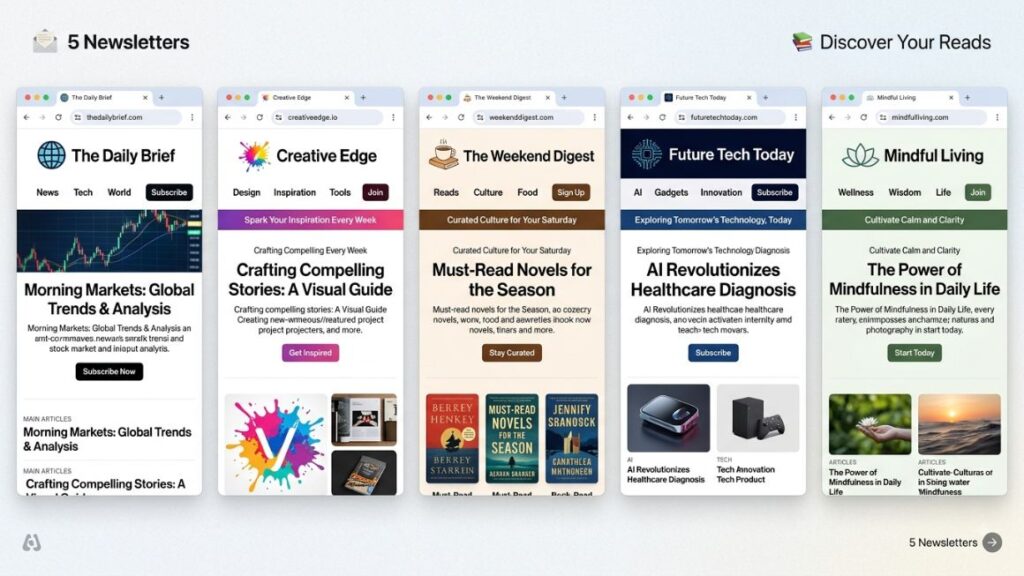
Simon Willison’s Blog is the closest thing the AI world has to a reliable narrator. Willison writes without the marketing spin that clouds most AI coverage, and he tests claims before repeating them. Superhuman AI runs daily tutorials built around workflows, not abstractions, so you leave with something you can apply that afternoon. The Rundown AI has become one of the most-forwarded AI newsletters for a reason. It condenses a chaotic week of AI news into something you can read in under five minutes.
Mindstream takes a similar approach but leans shorter, useful if your inbox is already overloaded. Ben’s Bites built its following on curation with judgment attached. It doesn’t just list what happened, it tells you why it matters for people actually building things. And Young Urban Project’s own blog covers the same ground from a marketing-first angle, breaking down AI tools and workflows specifically for the campaigns and content decisions marketers deal with every week.
The strongest AI newsletters for marketers share one trait: they filter for relevance over volume. Simon Willison’s Blog, The Rundown AI, and Ben’s Bites all prioritize practical signal over hype, which is exactly what busy marketers need from an AI resource in 2026.
Compare AI Models Before You Commit to One
Here’s the problem: most marketers pick an AI model once and never revisit that choice. Meanwhile the leaderboard shifts every few weeks. Model comparison tools solve this by showing you exactly where each model excels, rather than trusting a launch blog post to tell you.
LM Arena runs blind tests where users compare model outputs without knowing which model produced which response, which strips away brand bias entirely. Artificial Analysis goes further, benchmarking ChatGPT, Claude, Gemini, and Grok on speed, quality, and pricing side by side. This matters more than it sounds. A model that’s 20% cheaper but twice as slow might tank your content production pipeline.
OpenRouter lets you test hundreds of models from a single dashboard, which is genuinely useful if you’re running an agency and need to match models to client budgets. AI SDK Playground does something similar but focused on developers who want to compare raw API responses before wiring a model into a product.
Most marketers stick with whatever model they started with out of habit, not performance. That’s an expensive habit if you’re running AI at any real volume.
Prompt Better, Not Just More
A better prompt beats a better model most of the time. That’s not a controversial claim among people who actually use these tools daily, but it’s still underrated advice.
Prompt Engineering Guide documents hundreds of prompting techniques with worked examples, which makes it the closest thing to a reference textbook the space has. Awesome ChatGPT Prompts has become the default starting point on GitHub, with prompts organized by job function so you’re not starting from a blank page.
Snack Prompt runs as a community-built library where users share and rate prompts that actually worked for them, not just prompts that sound clever. FlowGPT operates at a bigger scale, with thousands of user-submitted prompts spanning everything from copywriting to code.
Prompt quality has a bigger impact on AI output than model choice in most marketing use cases. Resources like Prompt Engineering Guide and Awesome ChatGPT Prompts give marketers a structured way to improve prompting instead of relying on trial and error.
Claude-Specific Resources Worth Knowing
If Claude is your primary model, three resources are worth a permanent bookmark.
Claude Skills are ready-made instruction sets that instantly improve how Claude handles writing, research, coding, and analysis tasks, without you having to build a custom prompt from scratch every time. Think of them as pre-built expertise you attach to a conversation. Anthropic Prompt Library offers official examples straight from the company that built the model, which is useful when you want a starting point you know is well-tested.
Claude Artifacts Gallery shows real projects other people have built with Claude Artifacts, from dashboards to interactive tools. It’s less a resource for prompting and more a source of ideas for what’s actually possible.
AI Research, Minus the Jargon
Not every marketer needs to read academic papers to stay informed. But ignoring AI research entirely means making decisions based on vibes and Twitter threads, which is worse.
Epoch AI produces reports on where AI is heading that are genuinely readable, without the dense notation that makes most research inaccessible. FutureSearch focuses specifically on forecasts and trend reports, useful if you’re trying to plan a content or product roadmap around where AI capability is headed next.
Our World in Data’s AI section turns adoption and growth trends into clean, sourced charts. It’s a good habit to check quarterly, if only to sanity-check whether the AI narrative you’re hearing on social media matches what the actual data shows.
This may not change your day-to-day campaigns, but it changes how confidently you can talk about AI in a client pitch or a leadership meeting.
Automate What You’re Still Doing Manually
If you’re still copying AI output between tools by hand, you’re leaving time on the table. AI automation connects models directly to the apps you already use, cutting out the manual handoff entirely.
MCP.so catalogs integrations that connect AI models to your favorite apps, built on the Model Context Protocol standard. Zapier AI Resources offers pre-built automation templates and workflows, a solid starting point if you don’t want to build connections from scratch. Make Academy teaches practical AI automation without requiring you to write code, which matters if your team doesn’t have a dedicated developer.
The marketers who feel like AI “saves them time” are almost always the ones who automated the repetitive parts. The ones who feel like it “adds work” are usually still doing everything manually and just added a chatbot on top.
Discover New AI Tools Before Everyone Else Does
New AI tools launch faster than anyone can track individually. Directories exist specifically to solve that problem.
There’s An AI For That lets you search thousands of tools by specific use case, which beats scrolling Product Hunt hoping something relevant shows up. FutureTools curates new AI tools as they launch, filtered for quality over quantity. Futurepedia runs one of the larger databases in this space, organized by category and updated frequently.
None of these replace actually testing a tool yourself. But they cut down the discovery time from hours to minutes, which adds up across a year.
Conclusion
The marketers pulling ahead with AI right now aren’t using fundamentally different models than everyone else. They’re using better sources. They know where to check model performance before switching tools, where to find prompts that actually work, and where to catch a new automation before it becomes common knowledge.
Bookmark a handful from this list, not all 25. Pick the ones that match a gap in your current workflow, whether that’s staying current, comparing models, or automating something you’re still doing by hand.
If you want a more structured way to build AI into your actual marketing work instead of bookmarking your way there, the Hotskill app walks through practical AI workflows built specifically for marketers, or you can go deeper with YUP’s AI Marketing course.
FAQ
What are the best AI resources for marketers in 2026?
The strongest picks combine a newsletter for staying current, like The Rundown AI or Ben’s Bites, with a model comparison tool like Artificial Analysis, and a prompt library like Awesome ChatGPT Prompts. Together these cover learning, tool selection, and execution.
Is LM Arena the same as Artificial Analysis?
No. LM Arena runs blind human comparisons between model outputs to rank quality, while Artificial Analysis benchmarks models on measurable factors like speed, cost, and quality scores. Use LM Arena for a gut check on output quality and Artificial Analysis when cost and latency matter for your use case.
How do I compare ChatGPT, Claude, and Gemini for my team?
Start with Artificial Analysis for a side-by-side breakdown of speed, pricing, and quality benchmarks. Then run your own test prompts through OpenRouter, which lets you query multiple models from one dashboard so you can judge output quality on tasks specific to your work.
Do I really need a prompt library, or can I just write my own prompts?
You can write your own, but a library like Awesome ChatGPT Prompts or Snack Prompt gives you a tested starting point instead of reinventing structure every time. Most marketers save real time by adapting an existing prompt rather than building one from a blank page.
What’s the difference between AEO tools and AI model directories?
AI model directories like OpenRouter and LM Arena help you pick which model to use. Discovery directories like FutureTools and Futurepedia help you find new tools built on top of those models. They solve different problems entirely.
Is MCP.so worth using if I’m not technical?
It depends on your setup. MCP.so is more useful if you have a developer on your team who can wire up the integrations it catalogs. If you’re not technical, Zapier AI Resources or Make Academy are a better starting point since they’re built for no-code use.
How often should I check AI research sites like Epoch AI?
A quarterly check is usually enough for most marketers. AI capability shifts fast, but the underlying trends that matter for planning a roadmap don’t change week to week. Checking too often just adds noise without changing your decisions.
Are Claude Skills only useful if I already use Claude regularly?
Yes, largely. Claude Skills are built specifically to extend Claude’s capabilities for writing, research, coding, and analysis, so they won’t transfer directly to other models. If Claude is your primary tool, though, they’re worth exploring before building custom prompts from scratch.
Is it worth bookmarking all 25+ of these resources?
Probably not. Most marketers get more value from picking three or four that match an actual gap in their workflow, whether that’s staying current, comparing models, or finding better prompts, rather than bookmarking everything and using none of it consistently.