
You’ve spent months on your portfolio. The screens are clean, the case studies are tidy, and then an interviewer asks, “Why did you pick that layout over the other two?” and your mind goes blank. It happens to strong designers all the time. The work was good. Explaining it out loud, under pressure, is a different skill.
This guide covers 40 product design interview questions across eight areas, from simple introductions to design challenges, metrics and AI features. It’s written for early-career and mid-level designers. Use it for practice, not memorising. Say each answer aloud, using your own projects.
So what do these interviews actually test? Mostly five things. How you solve problems. How well you understand users. How you execute design. How you work with other people. How clearly you explain your decisions and their results. Formats vary by employer. So treat these product designer interview questions as a practice set.
Table of Contents
What to Expect During the Interview Process?
Most product design interviews move through a recruiter screen, a portfolio review and a design exercise, conversations with cross-functional partners and a behavioural round. Each stage tests something different. The order changes from company to company. Which product design interview questions you face depends a lot on the stage you’re in.
Dataford’s Product Designer role guide, updated in September 2026 and built from 4,229 candidate reports, puts the median interview loop at four rounds. Those reports are self-submitted. So read the number as a rough guide. Still, the pattern is useful. Cross-functional collaboration and portfolio presentation were the most common topics. They were showing up in about 32% and 31% of company guides.
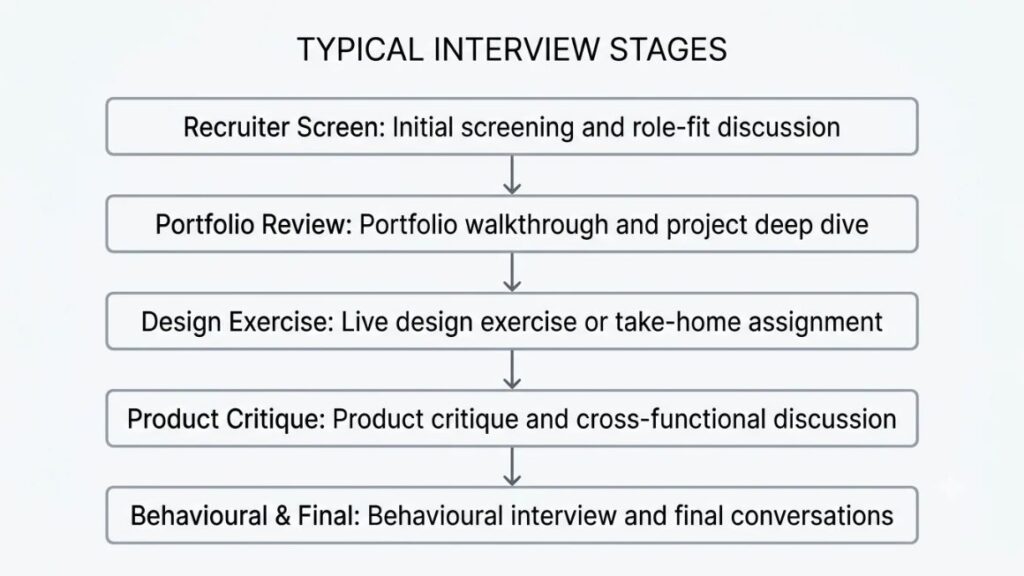
Initial screening and role-fit discussion
A recruiter or hiring manager checks your background, location, expectations and reasons for applying. It’s short. Have a two-minute story ready and one project you can sum up in a single sentence.
Portfolio walkthrough and project deep dive
Here the interviewer wants to see how you frame problems and what you personally did. Expect interruptions and a lot of “why” questions.
Live design exercise or take-home assignment
This can be a whiteboard session or a take-home brief followed by a presentation. It tests how you think about a problem, not how polished your screens look.
Product critique and cross-functional discussion
Product managers and engineers often join this round. They’re asking one thing: would working with this person be easy or exhausting?
Behavioural interview and final conversations
Final rounds usually probe ownership, conflict and values, sometimes with a design leader.
Before any of it, ask the recruiter about the format, duration, permitted tools and what preparation they expect. Most will tell you. Hardly anyone asks.
What are the top Product Design Interview Questions?
General Questions and Answers
General questions test whether you can explain who you are, why you design and how you think, in plain language. Keep each answer under two minutes and anchor it in real projects.
Sample answers help, but only as shapes. A word-for-word script sounds exactly like a script. The product design interview questions and answers below show what the interviewer is looking for and how to structure a reply, and you supply the content.
Q1. Tell me about yourself.
Of all product design interview questions, this one comes first, and it sets the tone. The interviewer is checking role fit and how clearly you communicate. Use a present, past, future structure. What you do now, one or two projects that got you here, and why this role is next. Cut the childhood origin story.
Q2. Why do you want to work as a product designer?
They want to know you understand the job is solving problems, not decorating screens. Name a specific moment that pulled you in. Say what you enjoy about the work. Mention what you want to learn. “I love making things look beautiful” on its own is a weak answer.
Q3. Walk me through your design process.
This tests whether you have a process or just a list of steps. Pick one real project and describe where the textbook version bent. Maybe research got cut short, or engineering constraints changed the scope. That honesty is more convincing than a perfect diagram.
Q4. What makes a product experience successful?
A good answer connects what users need with what the business needs. Choose a product you actually use, such as Google Maps, define success for the user first. Then say how you’d tell whether it’s working. For a food delivery app such as Swiggy, that might mean the order arrives on time and as described, an outcome users and the business both care about.
Q5. Tell me about a project you are proud of.
Interviewers listen for ownership and judgement. Describe the situation, one decision you made and defended, the result and what you learned. Pick a project where you changed your mind at some point.
Q6. How do you handle feedback on your work?
Coachability matters here. Share one example where feedback changed a design. Explain how you separate useful critique from personal preference. Skip the line about loving feedback. Everyone says it.
Questions About Your Portfolio and Past Projects
Portfolio questions ask you to prove you can frame a problem, make decisions and own the outcome. Cover the original problem, constraints, decisions, iterations, collaboration, outcome and lessons, in roughly that order.
Expect product design interview questions about your portfolio to get specific fast. If you’re preparing a product design portfolio presentation, resist the urge to show every screen. Two well-told stories beat five rushed ones. And a product design case study interview isn’t a performance. The interviewer will interrupt, so leave room for it.
Q7. Walk me through a project from start to finish.
Open with one line of context, then the problem, your role, two or three decisions that mattered, the outcome and one lesson. Pause often. Let the interviewer steer you toward what they care about.
Q8. What problem were you trying to solve?
Say it in two sentences: who the user was, what was going wrong and what limited your options. “Redesign the app” is a task, not a problem. A good test: could a stranger repeat the problem back to you after hearing it once?
Q9. How did research influence your decisions?
Name one finding that changed what you built. If you had little research, say so, and explain what you used instead, such as support tickets, analytics or stakeholder interviews.
Q10. What alternatives did you consider, and why did you reject them?
This shows judgement. Describe at least two other options and the trade-off that ruled each out. If you only ever considered one idea, expect a follow-up about that.
Q11. What was your individual contribution?
Be exact about what you owned and what the team did. Claiming a whole project when you did one flow is a risk. That’s because the interviewer may speak to someone who worked on it.
Q12. What would you change if you revisited the project today?
Pick a real flaw. A fake weakness like “I care too much about details” will land badly.
Plenty of product design interview questions assume a shipped product, but not every project is one, and that’s fine. For academic work, say it’s academic and explain how you got real people to react to it. For freelance work, describe the client’s constraints honestly, since budgets often limit research. For projects that never launched, the outcome is what you tested and learned. Never invent numbers to fill the gap.
Also Read: 5 Rules Of Clean Design: How to Create Simple, Professional, and Effective Visuals
Portfolio questions test problem framing, decision-making and ownership, not visual polish. Present the problem, constraints, decisions, iterations, outcome and lessons for each project. State clearly which parts you personally did. For academic, freelance or unlaunched work, say so and describe what you tested and learned instead of inventing results.
Questions About Research, UX, and Design Fundamentals
Research and fundamentals questions test whether you can separate assumptions from evidence. Most weak answers here share one flaw: they treat a guess as a finding.
These UX design interview questions look basic, and that’s the trap. Interviewers use them to find out whether your portfolio decisions rested on anything solid. Plenty of product design interview questions in this area are really asking, “Where did that come from?”
Q13. How do you identify and validate user problems?
Start with sources such as user interviews, analytics and support conversations. Then check whether the problem is frequent and painful enough to solve. Label what you know and what you’re only assuming.
Q14. How do you choose an appropriate research method?
Match the method to the question. “Why do people do this?” suggests interviews. “How many?” suggests surveys or analytics. “Can people use it?” points to usability testing. Time, budget and access to users also shape the choice.
Q15. How do you turn research findings into design decisions?
Group findings into patterns, rank them by how often they occur and how serious they are, and link each design change to a specific finding. If you can’t draw that line, the change was probably a preference.
Q16. How do you approach accessibility?
Accessibility works best when it’s in from the start. The Web Content Accessibility Guidelines (WCAG) 2.2, a W3C Recommendation since 5 October 2023, organise requirements under four principles known as POUR. In plain terms: can people perceive the content, operate the controls, understand what’s happening, and will it still work with assistive technology? Mention colour contrast, keyboard use, clear labels and touch target size as examples.
Q17. How do you decide what information belongs on a screen?
Begin with the user’s task and the one action that matters most. Information architecture, which is how content is organised and labelled, then decides what goes up front and what waits behind a tap. Everything else is a candidate for removal.
Q18. How do you test whether a design is easy to use?
Usability testing means watching real users attempt real tasks. Nielsen Norman Group’s long-standing guidance is that around five participants reveal most major problems in one round of qualitative testing, which is why several small rounds beat one large study. That guidance doesn’t cover quantitative studies, or products with very different user groups.
Practical Design Challenges and Product Critiques
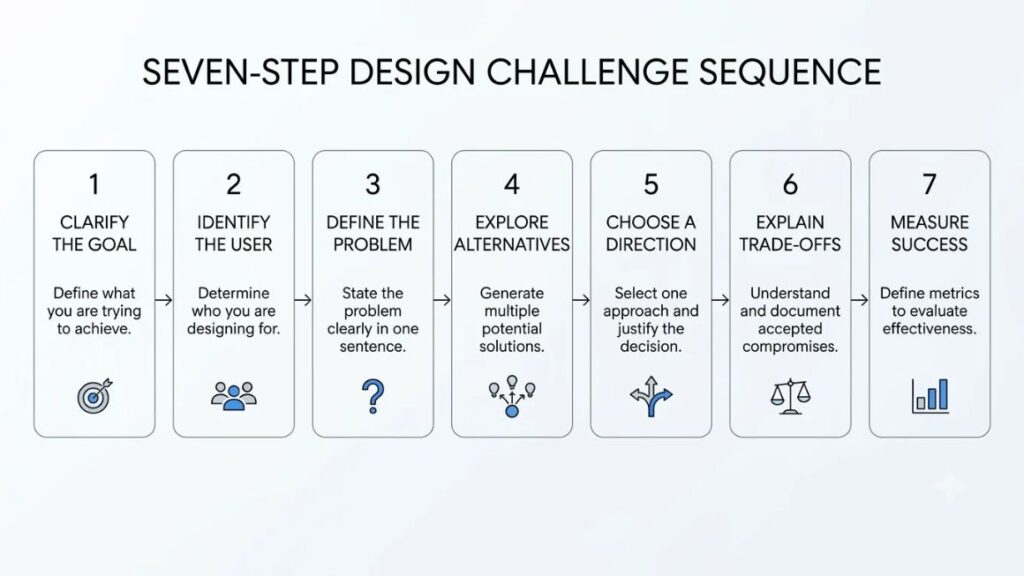
A design challenge tests how you think, not how fast you draw. Whether it’s a take-home brief or a live product design whiteboard challenge, a reusable sequence keeps you calm and visible. Challenge-style product design interview questions all reward the same habit: slow down, then show your thinking.
- Clarify the goal: ask what success means for the business and the user.
- Identify the user: pick one segment and say why.
- Define the problem in a sentence.
- Explore at least two or three alternatives.
- Choose a direction and say why.
- Explain the trade-offs you’re accepting.
- Name how you’d measure success.
Q19. How would you improve an online shopping checkout?
Ask what “improve” means first. Baymard Institute’s research averages roughly 70% cart abandonment across dozens of studies, and unexpected extra costs are among the leading reasons shoppers give. So a strong answer looks at cost clarity, account requirements and form length.
Q20. How would you design an experience for first-time users?
Define what a first success looks like for a new user, then remove everything standing between them and it. Delay setup that can wait.
Q21. How would you improve a product you use every day?
Choose something you truly use, like Swiggy or a banking app, and critique one flow with specifics. Vague praise or complaints are a giveaway that you don’t use it.
Q22. How would you approach a problem with unclear requirements?
Ask questions, then state your assumptions out loud and propose a scope. Interviewers want to see that ambiguity doesn’t freeze you.
Q23. How would you design for users with different accessibility needs?
Think in contrasting needs, such as low vision, limited motor control and cognitive load, and look for one flexible design rather than separate versions.
Q24. How would you respond if your first idea failed in testing?
Treat it as data. Explain what you’d learn from the failure, what you’d change and how you’d retest.
Hypothetical example: imagine a fictional stationery store, Kite & Co., where many first-time mobile shoppers leave at the payment step. The goal is more completed orders. The user is a first-time mobile buyer. The problem: delivery charges only appear on the last screen. The alternatives are a delivery estimate in the cart, a free-delivery threshold or guest checkout. The designer picks the cart estimate, accepts that prices may look higher earlier and watches checkout completion plus support queries about charges.
A reliable design challenge sequence is: clarify the goal, identify the user, define the problem, explore alternatives, choose a direction, explain trade-offs and name how you’ll measure success. Interviewers value visible reasoning over polished screens, and saying your assumptions out loud is part of the answer.
Questions About Collaboration, Conflict, and Leadership
These product design interview questions test how you disagree, share constraints and reach decisions without turning defensive. Back disagreements with evidence, raise constraints early and keep the relationship intact.
Behavioral interview questions for designers are rarely about the conflict itself. They’re about what you did once the conflict started.
Use one simple shape for every story: the situation, what you did, what happened and what you’d do next time. Describe the other person’s position fairly. Interviewers notice when a villain appears in your story, because it often means the same story gets told about them later.
Q25. Tell me about a disagreement with a product manager.
Pick a real, low-drama example. Explain both positions fairly, what evidence you brought and how it was resolved. Even if you lost the argument, say what you took from it.
Q26. How do you collaborate with engineers?
Involve them early, before designs are locked, and ask about feasibility and effort. Mention shared reviews, clear handoff notes and a willingness to adjust a design when a constraint is real.
Q27. What do you do when stakeholders reject your design?
Find out why before you defend anything. Often the objection is a business concern that the design didn’t address, and you can adapt without giving up the user’s needs.
Q28. How do you prioritise competing requests?
Ask which request affects the most users or the most important goal, and weigh it against effort. Then tell people what you’re deferring and why. Quiet reprioritising causes trouble later.
Q29. How do you give and receive constructive feedback?
Describe how you give specific, kind and useful critique, and how you respond to it: listen, ask questions and avoid explaining your way out of it.
Also Read: Product Prioritization Frameworks Every PM Should Know
Questions About Metrics, Testing, and Product Outcomes
Design metrics help you check whether a design worked, but they never prove why on their own. Pick measures that match the goal: task completion, error rate, conversion, retention and user satisfaction are the usual ones. Metrics-based product design interview questions often hide a trap: candidates quote a number without saying what it means.
Google researchers Kerry Rodden, Hilary Hutchinson and Xin Fu proposed the HEART framework in 2010, covering Happiness, Engagement, Adoption, Retention and Task success. Their paper also says teams shouldn’t use every category on every project. Choose what fits.
Q30. How do you measure whether a design is successful?
Start from the goal and pick two or three measures. A checkout redesign might use completion rate and error rate. A new feature might use adoption and retention. Add satisfaction feedback for the “how did it feel” side.
Q31. When would you use A/B testing?
An A/B test shows two versions to different, randomly chosen users and compares results. It works when you have enough traffic, one clear change and a measurable goal. It’s a poor fit for early concepts or low-traffic products.
Q32. What would you investigate if conversion rates declined?
Check the data first, since tracking errors are common. Then segment by device, channel and new versus returning users, and look at recent releases. Only then turn to qualitative research. A drop that coincides with a redesign may not have been caused by it.
Q33. How do you balance user needs with business goals?
Look for overlap first. When there’s a real conflict, name the trade-off and propose a way to test it. A design that lifts conversion by hiding the cancel button isn’t balance, and a good interviewer knows it.
Also Read: 15 Best Product Analytics Tools
Design success is measured against a stated goal using measures such as task completion, error rate, conversion, retention and satisfaction. Google’s HEART framework offers five categories to choose from, but metrics show what changed, not why. Correlation with a redesign is not proof that the redesign caused the change.
8. Advanced Questions and Emerging Design Considerations
Advanced product design interview questions test whether you can think beyond a single screen: systems, new technology and conflicting inputs. Not every employer will ask about AI, but plenty of design teams are working on AI-powered features, so it’s worth having a view.
Q34. How would you approach a complex design system?
Focus on component consistency, shared design tokens, documentation and a clear way for teams to propose changes. Public systems such as Google’s Material Design are good references. And say how you’d stop the system from becoming a bottleneck. Name one trade-off, such as consistency against the speed of a team shipping something unusual.
Q35. How can AI-assisted features create new usability or trust challenges?
Microsoft researchers published 18 Guidelines for Human-AI Interaction at CHI 2019, grouped by when they apply: at the start, during use, when the system is wrong and over time. They include making clear what the system can do, how well it can do it, and making errors easy to correct. Add privacy, user control and AI transparency to your answer. And ask whether the AI solves a real user problem at all.
Also Read: AI Tools for Product Designers: Best Tools in 2026
Q36. How do you make decisions when research, data and stakeholder opinions conflict?
Work out what each source can and can’t tell you. Research explains why, data shows what happened, and stakeholders know constraints. Then choose a reversible decision or run a quick test.
Designing AI-assisted features means telling users what the system can and can’t do, giving them control and making errors easy to fix. Microsoft’s 18 Guidelines for Human-AI Interaction, presented at CHI 2019, offer a tested starting point, though they were never meant to work as a simple checklist.
Questions for Junior and Senior Candidates
Interviewers expect different things at different levels, so the same product design interview questions can have very different good answers. Juniors are judged on learning speed, craft and clear thinking. Senior candidates are judged on ownership, independence and influence on strategy.
If you’re preparing junior product designer interview questions, don’t hide the lack of experience. Show how you made up for it.
Q37. What would you do if you had no professional design experience?
Point to self-initiated work: a redesign tested with real people, a volunteer project or a design challenge. Be clear about what’s practice and what’s real.
Q38. How do you learn from a project that did not succeed?
Choose a real failure. Say what you thought, what happened, what you’d do differently now and how you’ve applied it since.
Q39. How do you influence product strategy as a senior designer?
Talk about bringing research and customer evidence into roadmap conversations early, and about framing design problems in business terms. A senior designer might, for instance, bring a pattern from support conversations to a planning meeting and propose a fix before anyone asked.
Q40. How do you mentor designers and raise the quality of a team?
Give examples: running critiques, writing guidelines, pairing on hard problems. Show that you help other people get better, not only that you do great work yourself.
Also Read: Is a UX Design Career in 2026 Worth It? Salary, Jobs & AI
A Practical Seven-Day Preparation Plan
A week is enough for a sharp refresh, not for rebuilding a weak portfolio. This plan is a good frame for product designer interview preparation, and each day ends with something you can check. Practising product design interview questions aloud, not silently, is the whole point of the week.
Day 1: Research the role and company
Read the job description and try the company’s product. Deliverable: one page with three observations about the product and five questions you’d ask.
Day 2: Refine two portfolio case studies
Cut each to the problem, your role, three decisions and the outcome. Deliverable: two short outlines you can say aloud in five minutes each.
Day 3: Practise research and design fundamentals
Answer the six product design interview questions from Q13 to Q18 aloud. Deliverable: a note listing which answers rested on evidence and which on assumptions.
Day 4: Complete a timed design challenge
Set a 60-minute timer and use the seven-step sequence. Deliverable: sketches plus a written list of assumptions and trade-offs.
Day 5: Practise behavioural answers
Prepare four stories: a disagreement, a failure, a success and a piece of feedback. Deliverable: one bullet outline per story.
Day 6: Run a mock interview
Ask a designer friend or mentor to play interviewer, and record it if they agree. Deliverable: the recording and three things to fix.
Day 7: Review feedback and prepare questions for the interviewer
Rework the weakest answers and write your questions. Deliverable: a final one-page cheat sheet. It’s one of the simplest product design interview tips there is.
Common Mistakes to Avoid
Most interview mistakes come from skipping the thinking and presenting the result. Even candidates who’ve rehearsed product design interview questions still trip on these six, again and again.
- Jumping to solutions before understanding the problem.
- Presenting polished screens without explaining the reasoning behind them.
- Claiming team achievements as individual work.
- Inventing results or overstating the impact of a project.
- Ignoring accessibility, technical constraints or trade-offs.
- Memorising sample answers instead of practising clear thinking.
None of these are about talent. They’re habits, and habits can be fixed in a week.
Before you walk in, run this checklist:
- Can you state each project’s problem in two sentences?
- Do you know what you personally owned?
- Have you prepared one failure story?
- Are your assumptions and trade-offs ready to say aloud?
- Do you have three questions for the interviewer?
Conclusion
Strong interviews show how you understand problems, make decisions, work with others and learn from outcomes. The product design interview questions here are just a way to practise that.
Whatever product design interview questions come your way, the answer underneath is always your reasoning. Don’t aim for perfect. Aim for clear, honest and specific.
Say your answers aloud. Record yourself, and go back through your own case studies looking for the gaps an interviewer would find. You’ll find them before anyone else does.
If you want more practical career reading from Young Urban Project, subscribe to the Crystal Clear Newsletter.
FYQ: Frequently Asked Questions
What are the most common questions in a design interview?
Among product design interview questions, “walk me through a project”, “describe your design process”, “tell me about a disagreement” and “how do you handle feedback” tend to come up most. Portfolio and collaboration questions dominate.
How should beginners prepare without professional experience?
Build two or three projects with real users, even small ones, and practise explaining them aloud. Honest framing matters more than a famous client.
How many projects should a portfolio presentation include?
Usually two, sometimes three. Ask the recruiter for the time limit and plan to leave room for questions.
How long should you practise before an interview?
About a week of focused practice works for many people if the portfolio is ready. Rebuilding case studies takes longer.
Do product designers need coding skills?
Not at most companies. Basic HTML and CSS knowledge helps you talk to engineers, but some roles, such as design engineering, expect more.
What should you ask the interviewer at the end?
Ask how design and product work together, how success is measured for the role and what the first three months look like.