

Two years ago, a six-week Figma course and a tidy Dribbble shot could land you an interview. Not anymore. Hiring slowed. AI took over much beginner-level production work. Companies started asking what design actually earns them.
So is a UX design career in 2026 still a smart bet? Yes, but a narrower one than the bootcamp ads promised. The work hasn’t gone away. The easy way in has.
This guide pulls fresh numbers from the US Bureau of Labor Statistics (BLS), Nielsen Norman Group (NN/g), Figma and Indian salary trackers. It’s for students, career switchers and working designers deciding whether to commit. Short version: UX rewards problem-solvers and punishes people who only polish screens.
Table of Contents
Is UX Design a Good Career in 2026?
Yes, UX design is still a good career for people who can show research, product thinking and sound judgment. It’s a weak bet for anyone expecting a quick, easy entry. The field has stabilised since late 2024. But junior roles stay scarce and competitive.
The short answer
The upside is real. For a UX design career in 2026, the BLS reports a median annual wage of $104,000 for web and digital interface designers in May 2025.
The downside is just as real. NN/g’s State of UX 2026 report says aspiring UX professionals will keep outnumbering open roles this year, especially at the junior level.
Who tends to win? People who are curious about why users do what they do, comfortable defending a decision in front of a sceptical product manager, and happy to keep learning. A UX design career in 2026 suits that person well.
UX also isn’t the “easy creative career” it was sold as. NN/g notes that bootcamps and influencers pitched it as a fast route to a comfortable tech job. Newcomers flooded in just before the market dropped around 2023. Honestly, that pitch has hurt more beginners than AI has.
What’s changed about UX careers?
The old script for a UX designer career was simple. Learn Figma, build three app redesigns, get hired. That script broke. Here’s what replaced it:
- AI-assisted design. Wireframes and layout variations take minutes now. NN/g’s blunt view is that if you only assemble components from a design system, a tool can already do that.
- Tougher entry-level hiring. Teams are leaner, so one role now carries research, UI, systems and stakeholder work that used to be split across several people.
- A drift toward product design. Titles are moving from UI/UX designer toward product designer, with wider ownership.
- More business thinking. Leaders want proof that design moves revenue or retention, not just opinions about it.
- UI is losing its edge. NN/g says standardised design systems and AI-mediated interactions are making the interface less of a differentiator.
The UX design job market is healthier than it was in 2024. It just rewards depth now, and anyone planning a UX design career in 2026 who still runs the old script will struggle.
NN/g’s State of UX 2026 report says the UX job market has stabilised since late 2024, with senior and generalist roles recovering faster than entry-level ones. Teams are leaner and employers want judgment and business impact.
What Does a UX Designer Actually Do?
A UX designer figures out what people need from a product. It then shapes how it behaves so they can get it done with less effort. Most of the job is research, structure and testing. Visual design is only one slice.
User research
It starts with listening. Interviews, surveys and session recordings show what people actually do. That is rarely what stakeholders assume.
Information architecture and user flows
Information architecture is how content and features are organised. A user flow maps the steps someone takes to finish a task. This is like reordering dinner on Swiggy without hunting through menus.
Wireframes and prototypes
Wireframes are low-detail screen layouts. Prototypes make them clickable. So you can test an idea before engineers spend weeks building it.
Usability testing
You watch real people attempt real tasks and note where they stall. A handful of sessions usually exposes the worst friction.
Working with product and engineering teams
Designers sit between product managers and developers. You’ll defend decisions, trade scope for time and explain why a flashy idea won’t help users. Communication carries as much weight as craft.
UX vs UI: What’s the difference?
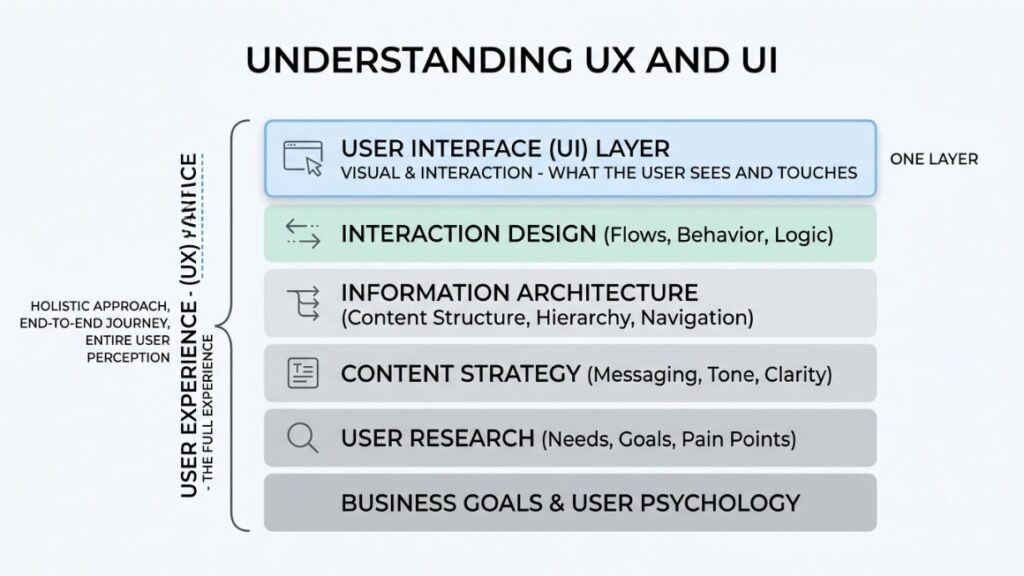
UX covers the whole experience, including logic and behaviour. UI is the visible layer: colour, type, components. NN/g warns that treating the two as the same leads people to wrongly conclude UX is fading, simply because the interface matters less.
Also Read: Product Design Skills: What You Actually Need To Learn
How Much Do UX Designers Earn in 2026?
In the US, the BLS puts median pay for web and digital interface designers at $104,000 (May 2025). In India, Glassdoor-based data puts UI/UX designers near ₹5.8 lakh a year, with product designers and seniors earning far more.
Titles and data sources vary wildly, so treat any single UX designer salary number as a rough guide when you plan a UX design career in 2026.
What UX designers earn in the US
The BLS doesn’t track UX separately. The closest match is web and digital interface designers, at that $104,000 median. The wider group of web developers and digital designers had a $99,520 median for 2025. Entry-level pay runs lower: a 2025 compilation by Lyssna puts US juniors with up to two years’ experience between $56,000 and $82,000.
What UX designers can earn in India
Glassdoor India figures, compiled by AND Academy, show a ₹5.79 lakh average for UI/UX designers. ₹8.65 lakh for UX designers (range ₹5.46 to ₹14 lakh). ₹11 lakh for product designers. Freshers usually start between ₹3 lakh and ₹6 lakh.
A UI UX design career here starts modestly and climbs fast once you own product decisions. Senior product designers average ₹23 lakh on Glassdoor. Its Razorpay listings for senior product designers run ₹23 to ₹40 lakh.
Entry-level vs mid-level vs senior UX salaries
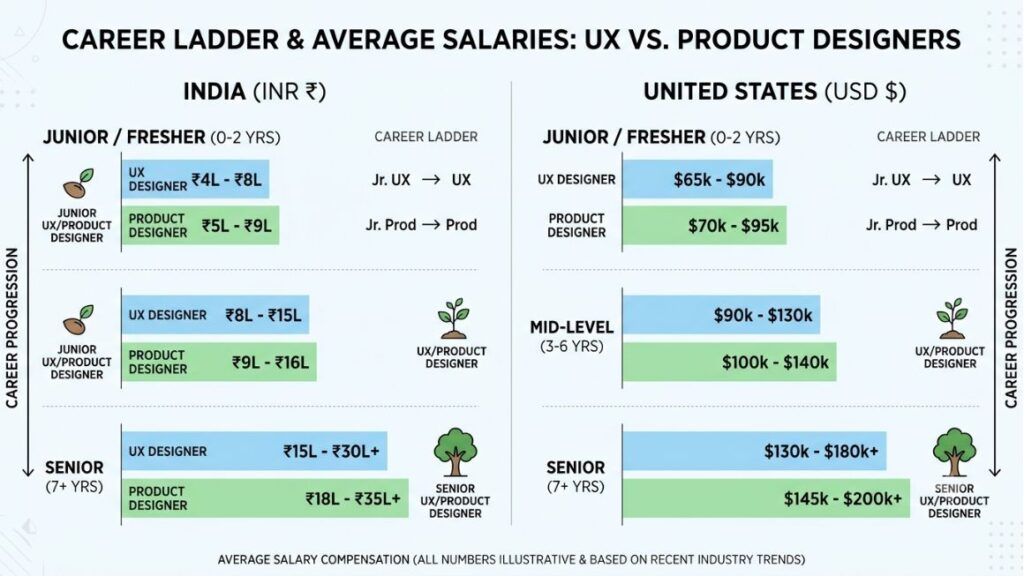
One 2026 guide from AND Academy sketches the Indian ladder as ₹3 to ₹5 lakh for juniors, ₹8 to ₹12 lakh for mid-level designers and ₹14 lakh and above for seniors. Pay can differ sharply between a funded product startup and a design studio at the same level.
What affects how much you earn?
Location moves the number first. Fueler’s 2026 guide puts Bengaluru among India’s highest-paying cities. After that come experience, industry, company size and product complexity, because a payments platform serving millions needs different judgment than a brochure site. Designers who also handle strategy, metrics and systems tend to land in the product-designer pay band rather than the UX one.
The BLS reports $104,000 median pay for US web and digital interface designers in May 2025. In India, Glassdoor-based figures show freshers at ₹3 to ₹6 lakh and product designers averaging ₹11 lakh.
Is UX a Good Career for Freshers in 2026?
It can be, but the first step is hard. Starting a UX design career in 2026 as a fresher means competing for scarce entry-level roles. Employers now expect juniors to show research and judgment, not just tidy screens.
Why getting the first UX job is difficult
Too many applicants, too few junior openings. NN/g expects supply to outpace junior roles in 2026, and leaner teams prefer someone who can work independently. The first job is the hardest rung. After that, experience does the talking.
What companies expect from junior designers
Teams look for UX design skills across research basics, Figma prototyping, clear writing and the ability to explain a decision. Add comfort with AI tools. That mix separates a shortlisted junior from a pile of near-identical portfolios.
Why a certificate alone isn’t enough
Certificates show you finished a course. They don’t show how you think. Hiring managers still open the portfolio first, so treat any credential as a way to structure your learning, not as the proof.
Can you get a UX job without experience?
Yes, if you build the experience yourself. Run a real project for a local business or NGO, redesign a flow after interviewing five actual users, or take an internship or freelance gig. One documented project with real users beats five imaginary app redesigns.
What Should Your UX Portfolio Look Like in 2026?
For a UX design career in 2026, a strong portfolio has two to four deep case studies that show how you think, not a gallery of finished screens. Reviewers want the problem, your decisions, the trade-offs and what changed because of your work.
Build 2 to 4 strong case studies
Depth beats volume. Two thorough studies outperform eight shallow ones, and each should show a different skill, say research-led work in one and a systems problem in another.
Show the problem before the polished interface
Open with who struggled, where and why. The final screens should feel like the answer to something the reviewer already understands.
Include research and decision-making
Show interview notes, a messy affinity map, the insight that changed your direction.
Show iterations
Include the version that failed and what testing taught you. It proves you can take feedback.
Explain trade-offs
Why this layout and not that one? Time, technical limits and business goals shape every real decision, so say so.
Connect design decisions to outcomes
Even small numbers help: fewer drop-offs in a test, faster task completion, a stakeholder quote. With no live metrics, state your success measure.
What recruiters actually look for
Reviewers skim. A UX design portfolio that states the problem, your role and the result on the first screen gets read further.
Common UX portfolio mistakes to avoid
Screens with no context, copied AI-generated interfaces, vague team credit, a dozen thin projects, and tool-heavy write-ups that skip the thinking.
Case study framework:
- Problem
- Context
- Research
- Insights
- User or persona definition
- User flow
- Wireframes
- Iterations
- Final design
- Testing
- Outcome
- What you would improve
Should You Learn UX Through a Degree, Course or Self-Learning?
For most people entering a UX design career in 2026 from another field, a structured course with mentor feedback gives the best balance of cost, speed and accountability. Degrees suit students who want depth. Self-learning works only if you can keep yourself on schedule.
| Learning Path | Cost | Time | Best For | Advantages | Limitations |
| Degree | High | 3-4 years | Students | Structured education | Expensive, slow |
| Bootcamp/Course | Medium | 3-12 months | Career switchers | Faster, practical | Quality varies |
| Self-learning | Low | Flexible | Self-motivated learners | Affordable | Requires discipline |
Which path makes the most sense in 2026?
Start from where you stand. A school leaver with time can justify a degree. Working professionals changing lanes usually do better with a course plus self-made projects. And if you’re only testing the water, plenty of free material on UX design for beginners lets you try before paying. Whichever route you take, the portfolio is what you’re really building.
How Much Does UX Training Cost?
In India, UX learning runs from a few thousand rupees a month for online certificates to over ₹25 lakh for private four-year degrees. Most working switchers land between ₹25,000 and ₹1.5 lakh.
UX degree cost
Published fees for a four-year UI/UX B.Des at Dr. D. Y. Patil School of Design, Pune, total about ₹14 lakh. Ecole Intuit Lab in Mumbai lists its four-year B.Voc in UI/UX Design at ₹25.23 lakh on Shiksha. Degrees buy depth and a campus network, but they cost the most in money and years.
Bootcamp and course costs
Futurense puts typical Indian UI/UX course fees at ₹25,000 to ₹1.5 lakh. International bootcamps cost far more: IIM SKILLS lists Springboard at ₹7.6 lakh, Designlab at ₹7.7 lakh and General Assembly at ₹14.4 to ₹15.8 lakh. The Google UX Design Certificate on Coursera runs on a monthly subscription, listed at about ₹3,750 a month.
Self-learning costs
Mostly your time. Free NN/g articles, YouTube walkthroughs and Figma’s free plan get you surprisingly far. The real cost is feedback, since nobody tells you what’s weak in your work.
What to look for before paying for a UX course
Before you pay for any UX design course, check for:
- Live projects with real constraints
- Portfolio development built into the program
- Mentor feedback on your actual work
- Industry exposure through working designers
- Placement or career support, with honest outcomes
- Curriculum quality: research and strategy, not only tools
- AI and modern product-design workflows
A Practical 6-Month Roadmap to Start UX Design
If you’re wondering how to become a UX designer in six months, the realistic goal is a job-ready portfolio with two case studies. It’s not a finished UX design career in 2026. Here’s the month-by-month plan.
Month 1: Learn UX fundamentals
Study usability heuristics and the design process. Read NN/g’s free articles. Practise spotting bad UX in apps you use daily.
Month 2: Learn research and user flows
Interview five real people about one problem. Turn the notes into insights. Then map the flow that solves it.
Month 3: Learn wireframing, UI and prototyping
Get comfortable in Figma. Sketch low-fidelity wireframes first. Then build a clickable prototype with basic UI.
Month 4: Build your first case study
Take your research project from problem to tested prototype. Write it up honestly, including what went wrong.
Month 5: Build your portfolio and second case study
Publish a simple portfolio site. Start a second project in a different area. Ask working designers for critique.
Month 6: Apply for jobs, internships and freelance projects
Apply in small batches. Tailor each case study summary to the role. Take paid freelance work to build proof.
What you should be able to do after six months
Run a basic research round, produce flows and prototypes, test with users, explain your decisions and show two solid case studies. Six months gets you to the door of a UX design career in 2026. Getting through it takes more projects and patience.
How to Use AI Without Becoming an AI-Generated Designer?
Anyone building a UX design career in 2026 should use AI to speed up routine work, never to replace judgment. Figma’s 2025 AI report surveyed 2,500 designers and developers. 78% said AI boosts their efficiency, but only 32% said they can rely on its output. That gap is where good designers earn their keep.
Learning UX design with AI is now a baseline expectation, since more than 80% of Figma’s respondents say working with AI will be essential to success in their role. Trust remains thin, though. In UX Tools’ Spring 2026 survey of 1,478 designers and builders, just 1.4% trusted AI output with no oversight, while 32.8% trusted it for production after a review.
Good uses of AI
Research synthesis (then check it against the transcripts), brainstorming, UX writing drafts, competitive research support, generating variations, early concepts and automating repetitive tasks like layer cleanup.
Bad uses of AI
Copying generated interfaces, replacing real user research, treating output as validated, building generic portfolios, and using tools without understanding design principles.
Skills AI can’t replace easily
Problem framing, empathy, user interviews, critical thinking, product judgment, communication, stakeholder management and an understanding of business constraints. NN/g’s version: taste, research-informed context and careful judgment are hard to automate.
Also Read: AI Tools for Product Designers
Who Should NOT Start a UX Design Career in 2026?
Skip it if you fit any of these:
- You want a quick six-figure career
- You dislike research
- You only want to make attractive screens
- You’re unwilling to learn continuously
- You dislike feedback and collaboration
- You expect AI to do the thinking for you
Who Should Consider UX/Product Design?
Creative problem-solvers. Researchers and curious thinkers. Graphic or UI designers who want to move up the stack. Developers interested in product thinking. Marketers fascinated by customer behaviour, who often arrive with a head start on funnels and drop-offs. If you enjoy figuring out why users behave the way they do, a UX design career in 2026 will hold your interest.
UX vs Product Design: Which Should You Choose in 2026?
Within a UX design career in 2026, treat UX design as the entry point and product design as the longer-term direction. UX focuses on research and usability; product design adds UI, business goals and product ownership.
| UX Design | Product Design |
| Stronger focus on user experience | Broader product ownership |
| Research and usability | UX + UI + business + product |
| Often specialized | Usually more cross-functional |
| Good entry point | Strong long-term direction |
Which career path has better opportunities?
Product design has the pay edge in India: Glassdoor-based figures show an ₹11 lakh average for product designers against ₹8.65 lakh for UX designers. A product designer career also carries wider ownership, which is where NN/g says the field is heading. UX still opens doors, especially in research-heavy teams.
Can a UX designer transition into product design?
Yes, and it’s a natural move. Add business metrics to your case studies, pick up the UI craft you’ve skipped, and volunteer for roadmap discussions so you start owning outcomes, not just screens.
Is UX Design Still in Demand?
Yes, but demand for a UX design career in 2026 is concentrated in experienced, product-minded roles. The BLS projects 5% growth for web developers and digital designers from 2025 to 2035, which it labels faster than average.
What the employment data actually tells us
The BLS doesn’t count UX separately, so its web developers and digital designers category is only a proxy. The latest edition projects 5% growth for 2025 to 2035, down from the 7% projected for 2024 to 2034. Still faster than average, just less rosy. Meanwhile, NN/g points to UXPA and User Interviews surveys showing UX team sizes holding steady, and possibly growing.
Why broader UX job-market claims need context
A UX designer isn’t a web designer, and neither is a digital product designer, yet job boards blur them together. Titles vary by company, demand differs by city and industry, and AI is changing responsibilities rather than simply deleting roles. So when a viral post says UX design jobs are dead, ask which jobs it actually counted.
Where UX opportunities are growing
No single dataset ranks sectors, but designers commonly find openings in SaaS, fintech, e-commerce, healthcare technology, consumer apps and enterprise software. Razorpay’s senior product designer listings on Glassdoor are one fintech example. Most product design jobs in these areas want research and business sense, not only polish.
AI products add a newer pull. NN/g expects trust to become a major design problem for AI experiences in 2026, which makes AI UX design a growing speciality for people who understand research and transparency.
Is UX Design Still Worth It in 2026? The Verdict
Yes, if you’re ready to build real skills and live with a slow first year. No, if you’re after a shortcut.
UX is worth it if…
You like research, take feedback well, can think in business terms and will keep learning. You also need patience, because the first role can take months.
UX may not be worth it if…
You only want to make attractive screens, expect AI to do the thinking, or need a fast payoff.
The biggest opportunity in 2026: becoming a product-minded designer
Learn how the business makes money, read the metrics your product manager watches, and tie each design decision to an outcome. The future of UX design belongs to people who can do that and still run a clean usability test.
Final recommendation for aspiring UX designers
Start, but start smart: two deep case studies, real users, honest AI use and a target role on a product team. A UX design career in 2026 pays off for people who treat it as a craft and a business skill at once.
Conclusion
Is a UX design career in 2026 worth it? Yes, with conditions. The field has stabilised, it rewards research, product thinking and honest AI use, and it punishes shortcuts. If you can show real projects and keep learning, the career still pays off.
Career decisions are easier with straight answers. YUP’s Crystal Clear Newsletter breaks down what’s actually working in digital careers, minus the hype. Subscribe and get the next one in your inbox.
Frequently Asked Questions
Is UX design a good career in 2026?
Yes, a UX design career in 2026 works for people with research and product skills. Entry-level hiring is tight, so expect a competitive first year before the career compounds.
Is UX design still in demand in 2026?
Demand is steady but uneven. The BLS projects 5% growth for related digital design roles through 2035, and NN/g says senior and generalist roles are recovering fastest.
Is UX design a good career for freshers?
It’s possible but tough. Build two real case studies, take an internship or freelance project, and apply in volume.
Can I become a UX designer without a degree?
Yes. Hiring teams open the portfolio first, and the BLS says educational requirements for digital design roles vary.
How long does it take to learn UX design?
Fundamentals take roughly three to six months of steady work. Getting job-ready takes longer, because the portfolio needs real projects.
How much does a UX designer earn in India?
Glassdoor India figures compiled by AND Academy show ₹5.79 lakh on average for UI/UX designers and ₹8.65 lakh for UX designers. Freshers typically start at ₹3 lakh to ₹6 lakh.
How much does a UX designer earn in the US?
The BLS median for web and digital interface designers was $104,000 in May 2025. Juniors usually earn less, with Lyssna’s 2025 compilation showing $56,000 to $82,000.
Will AI replace UX designers?
AI is replacing tasks, not judgment. NN/g says the claim that tools could rapidly replace designers wasn’t true, though people who only assemble screens are exposed.
Is UX design hard to learn?
The tools are easy. The thinking, like framing problems and defending decisions, takes practice.
What should I put in my UX portfolio?
Two to four case studies covering problem, research, iterations, trade-offs, testing and outcome.
Is paying for a UX course worth it?
Only if it gives mentor feedback, live projects and portfolio support. If it just teaches Figma, free resources do the same job
UX design vs product design: which is better?
Neither wins outright. UX is the easier way in, while product design pays more in India and offers wider ownership.