

Every business has a public face and a back-end engine. Marketing builds the face. Operations management keeps the engine running.
When Swiggy delivers your order in 30 minutes, when Zepto promises 10-minute grocery delivery and actually pulls it off, when Zara restocks shelves within two weeks of a new trend hitting the runway, that’s not luck or magic. Its operations management is working exactly as it should.
Yet most business conversations skip over it. You’ll hear a lot about brand strategy, customer experience, and performance marketing. Operations? It rarely gets the headline. Which is a problem, because without it, everything else falls apart.
This article breaks down what operations management really means, what it involves, and why getting it right is one of the most important things a growing business can do.
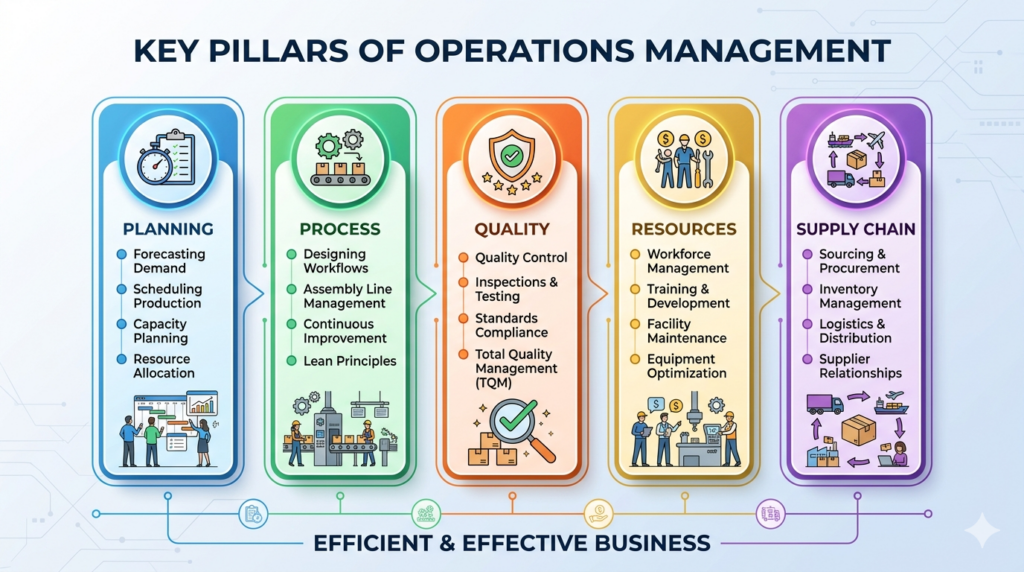
Table of Contents
What Is Operations Management?
Operations management is the discipline of planning, organising, and controlling the processes that produce and deliver a company’s products or services. It covers everything from how raw materials arrive at a factory to how a customer support ticket gets resolved.
Put simply: it’s how a business converts inputs (people, materials, technology, money) into outputs (products, services, results) as efficiently as possible.
The definition sounds dry. The practice isn’t. Every decision about capacity, workflows, staffing, quality standards, and vendor relationships falls within operations management. It connects strategy to execution. Without it, a well-funded company with a brilliant product idea can still fail to deliver.
Operations management is the function that converts business inputs, including labour, materials, and technology, into the products or services customers receive. It sits at the intersection of strategy and execution, covering planning, quality, resource allocation, and supply chain coordination. When operations management works well, businesses deliver consistently and profitably.
Roles and Responsibilities of Operations Managers
The operations manager is the person (or team) responsible for making sure the business actually works day to day. Not theoretical work. Actually works.
Their responsibilities span a surprisingly wide range:
- Setting and enforcing production or service delivery standards
- Managing supplier and vendor relationships
- Monitoring workflow efficiency and spotting bottlenecks
- Overseeing quality control processes
- Budgeting for resources, equipment, and staff
- Coordinating across departments to ensure smooth handoffs
- Tracking performance data and reporting to leadership
In smaller companies, a founder or general manager often handles operations informally. As a company scales, the role becomes its own specialisation, and in large organisations it can involve dozens of people across multiple functions.
The thing is, a good operations manager is rarely the most visible person in the room. But when they leave, everyone notices.
What Are the Goals of Operations Management?
Operations management pursues several interrelated goals, and it’s worth being specific about what those actually are.
Efficiency is the most obvious one: doing more with the same resources, or the same with fewer. A 10% reduction in production time isn’t small. Across a year, it compounds.
Quality is the second goal, and it’s often in tension with efficiency. Cutting corners speeds things up and breaks customer trust. The best operations functions build quality into the process so you don’t have to trade one for the other.
Flexibility matters more than it used to. Markets shift. Customer needs change. Operations that can adapt quickly without falling apart are worth significantly more than rigid systems built for one scenario.
Cost control ties everything together. Operations management isn’t just about what the business produces; it’s about what it costs to produce it. According to a 2023 Deloitte survey, supply chain and operational costs account for over 60% of total revenue for most product-based companies. Getting operations right has a direct line to margin.
Customer satisfaction sits at the end of every operations decision, even if it doesn’t feel that way. Delivery time, product quality, service consistency, and return handling all come down to how operations are run.
The Importance of Effective Operations Management
Here’s what happens when operations management breaks down: companies miss deadlines, overspend, produce inconsistent quality, frustrate customers, and eventually lose to competitors who figured out the basics.
Mamaearth’s early growth in India is a good example of operations done thoughtfully. As a direct-to-consumer (D2C) brand scaling fast, they had to manage ingredient sourcing, manufacturing quality, packaging, fulfilment, and reverse logistics simultaneously. Lapses in any one of those would have shown up in product quality or delivery experience, and in a trust-sensitive category like baby care, that would have been fatal.
Effective operations management doesn’t just reduce problems. It creates compounding advantages. A business that can deliver faster, at lower cost, with better consistency than its competitors isn’t just more profitable in the short term. It’s harder to catch in the long term.
According to McKinsey’s 2023 Operations Report, companies with mature operations management practices achieve 40% higher operational efficiency scores and outperform peers on profitability by an average of 25%.
That number is worth sitting with.
Effective operations management gives businesses a structural edge over competitors. According to McKinsey’s 2023 Operations Report, companies with mature operations practices achieve 40% higher efficiency scores and 25% better profitability than peers. The compounding effect of consistently efficient operations is one of the most durable advantages a business can build.
Types of Operations Management
Not all businesses run operations the same way. The approach depends on what the business makes, how it’s structured, and what it’s optimising for.
Objectives Management
This type focuses on aligning day-to-day operational decisions with overarching business goals. Teams set measurable targets, track performance against them, and adjust processes accordingly. It’s common in companies using Objectives and Key Results (OKR) frameworks.
Task Management
Task management breaks large operational goals into specific, assignable work items. Each task has an owner, a timeline, and a success criterion. Tools like Asana, ClickUp, and Monday.com are built to support this approach. It’s most useful in project-driven operations or agencies managing multiple client deliverables.
Individual Supervision
Some operations models assign dedicated supervisors to small teams or individual contributors. It’s resource-heavy but effective in contexts where quality control is critical, and mistakes are expensive, such as manufacturing, healthcare, or high-stakes client services.
Centralised Operations
In a centralised model, decision-making authority and process control sit with a central team or head office. It creates consistency across locations and reduces duplication, but can slow response times when local conditions change quickly.
Decentralised Operations
Decentralised operations push decision-making authority down to local teams or individual units. It enables faster responses and more context-sensitive decisions, but can create inconsistency at scale. Many franchise businesses and large retail chains use a hybrid of this and centralised control.
Hybrid Operations
The hybrid model combines elements of centralised and decentralised approaches. Strategic and compliance-related decisions stay at the centre; tactical and day-to-day decisions are delegated locally. Most large Indian enterprises and multinational companies operating in India use some version of this.
Core Functions of Operations Management
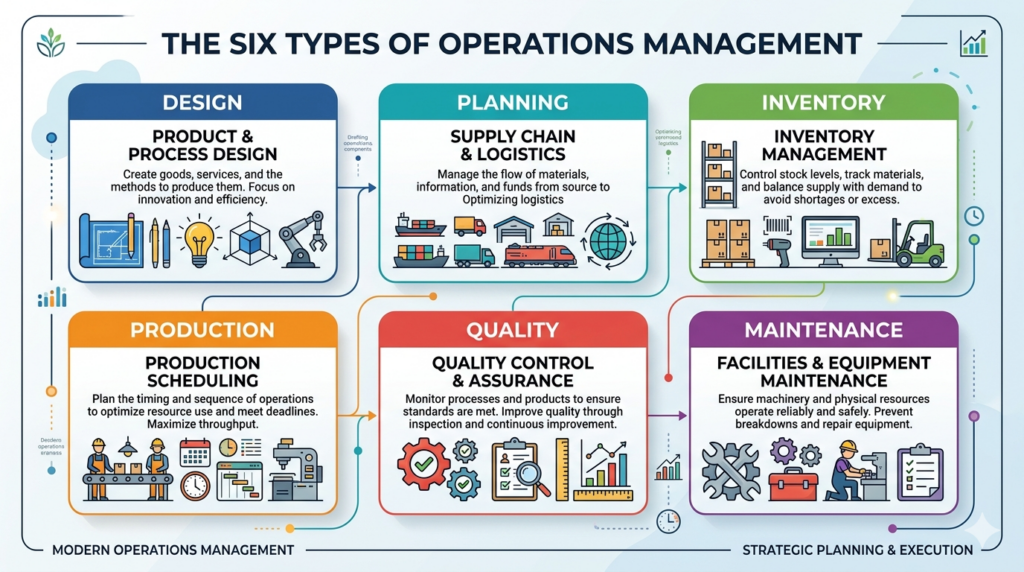
Operations management isn’t one thing. It’s a set of interconnected functions, each of which affects the others.
1. Planning and Forecasting
Every operational decision starts with a plan. Planning in operations management means anticipating demand, allocating resources in advance, and building contingency into workflows so disruptions don’t cause crises.
Forecasting is how you plan for what you don’t know yet. Retailers like Myntra use demand forecasting models to determine inventory levels before peak seasons. Get it wrong, and you either overstock (cash tied up in unsold goods) or understock (lost sales and frustrated customers). Forecasting isn’t perfect, but it’s far better than guessing.
2. Process Design and Optimisation
Process design is how work gets done. It defines the steps, the sequence, the handoffs, and the standards. Good process design removes unnecessary steps, eliminates rework, and makes quality the natural output of the system rather than something you check for at the end.
Process optimisation is the ongoing work of improving those processes over time. Techniques like Lean (eliminating waste), Six Sigma (reducing variation), and Kaizen (continuous incremental improvement) are all frameworks for doing this systematically.
3. Quality Management
Quality management ensures that what you deliver meets the standards customers expect, consistently. It’s not just a final inspection step. In well-run operations, quality is built into the process at every stage.
ISO 9001 is the most widely recognised quality management standard globally. Earning it signals to customers and partners that a company has documented, auditable processes designed to produce consistent output.
4. Resource Allocation
Resources include people, machinery, money, and time. Allocating them well means matching capacity to demand, avoiding underuse (waste) and overuse (burnout or equipment failure), and making trade-offs explicitly rather than by default.
Poor resource allocation is one of the most common reasons projects run late and over budget. It’s rarely about not having enough resources. It’s about not knowing where they are, what they’re doing, and whether they’re being used on the right things. For distributed teams, machinery is the hardest of those resources to keep sight of: laptops and devices scattered across cities depreciate, drift out of use, and tie up money no one is actively tracking, which is why more operations leads favor leasing IT equipment for distributed teams, keeping hardware on a managed refresh-and-return cycle rather than a depreciating capital line to chase.
5. Supply Chain Coordination
Supply chain coordination is how a business manages the network of suppliers, manufacturers, distributors, and logistics partners that get a product to the customer. It involves vendor selection, contract management, inventory planning, logistics optimisation, and risk management across the chain.
Strategic vs. Tactical Operations Management Decisions
Operations decisions happen at two levels, and conflating them is a common mistake.
Strategic decisions are long-horizon choices that define the operating model. Where do you manufacture? Do you own your logistics or outsource them? What quality standards will you set as a brand promise? How much capacity do you build for? These decisions are hard to reverse and shape everything downstream.
Tactical decisions are shorter-horizon choices within the framework that strategy sets. Which supplier do you use for this batch? How do you schedule staff this week? How do you handle the backlog from last week’s system outage? These decisions happen constantly and are made by middle management or operations teams, not the leadership suite.
The mistake businesses make is letting tactical pressures drive strategic choices. When you’re firefighting day to day, it’s easy to make a quick-fix decision (outsource this, cut that) that creates a structural problem six months later. Strong operations management keeps the two levels distinct and decisions at each level appropriately informed.
Operations and Supply Chain Management (OSCM)
Operations and supply chain management (OSCM) is the combined discipline of managing internal operations and the external network of partners that support them. The two are increasingly inseparable.
In a company that sources components from five countries, manufactures in two, sells across fifteen, and delivers via third-party logistics, internal operations and supply chain decisions are completely intertwined. A delay at a supplier ripples into production. A quality failure in manufacturing ripples into customer returns. A spike in logistics costs eats into margins set in the pricing strategy.
OSCM treats these as a single system. It asks: how do you design and manage the entire value chain, from raw material to customer delivery, to be simultaneously resilient, efficient, and cost-effective?
According to a 2024 Gartner Supply Chain Report, companies with high OSCM maturity are 2.3 times more likely to outperform peers on customer satisfaction scores. That’s not a coincidence. When your operations and supply chain are well-coordinated, customers feel it.
Operations and supply chain management (OSCM) treats internal operations and the external supply network as a single integrated system. According to Gartner’s 2024 Supply Chain Report, companies with high OSCM maturity are 2.3 times more likely to outperform peers on customer satisfaction. The connection is direct: supply chain disruptions become customer experience failures without strong OSCM coordination.
The Operations Management Process
The operations management process isn’t a one-time setup. It’s a cycle that runs continuously.
1. Implementation
Implementation is where strategy becomes action. You take the plans, the process designs, and the resource allocations built in the planning phase and put them to work. Implementation includes onboarding the people and tools needed to run new processes, setting up monitoring systems, and establishing clear ownership for each part of the operation.
The most common implementation failure is assuming that once you’ve defined a process, people will follow it. They won’t, not without training, clear documentation, and management attention. Implementation is a people job, not just a systems job.
2. Optimisation
Once processes are running, the next question is: are they running well? Optimisation involves tracking performance against defined metrics, identifying gaps, and making targeted improvements.
Common operations metrics include cycle time (how long a process takes from start to finish), defect rate (how often output doesn’t meet quality standards), capacity utilisation (how much of available capacity is being used), and cost per unit.
Optimisation isn’t about chasing perfection. It’s about continuous, measurable progress.
3. Improvement
Improvement is the longer-arc version of optimisation. Where optimisation tightens what exists, improvement rethinks what exists. It asks whether the current process is still the right one, or whether a different approach would produce better results.
This is where methodologies like Lean and Six Sigma earn their place. It’s also where technology investments get evaluated: would automation here reduce cost or error rates enough to justify the implementation effort?
Required Skills of Operations Management Teams
Operations management attracts people with a specific combination of analytical and interpersonal strengths. Both are non-negotiable.
Analytical thinking is table stakes. You’re working with data constantly, whether that’s production figures, cost reports, delivery timescales, or quality metrics. Being comfortable with numbers and being able to draw the right conclusions from them is fundamental.
Process thinking is different from analytical thinking. It’s the ability to see a workflow as a system, spot where it breaks down, and redesign it. Not everyone who’s good with numbers is also good at process design.
Communication matters more than most people expect in operations. You’re constantly negotiating with suppliers, explaining constraints to leadership, managing the expectations of other departments, and getting frontline teams to adopt new processes. All of that requires clear, credible communication.
Prioritisation is a daily skill in operations. There are always more problems than time. Knowing which ones matter most, which can wait, and which can be delegated is what separates effective operations managers from overwhelmed ones.
Technology fluency has become essential. Modern operations run on tools: enterprise resource planning (ERP) systems like SAP and Oracle, project management platforms, supply chain software, and data dashboards. You don’t need to be an engineer, but you need to understand what these tools can and can’t do.
Operations Management Example
Let’s make this concrete with a company most Indians know: boAt.
boAt is a consumer electronics brand that built a business selling audio gear (earphones, headphones, speakers) at accessible price points to a young Indian audience. By 2023, it had become one of the top-selling wearable brands in India, according to IDC’s India Wearables Market Report.
The operations story behind that growth is instructive. boAt doesn’t manufacture its products. It uses contract manufacturers, primarily in China, and coordinates quality, specifications, and delivery timelines externally. That’s a supply chain management challenge as much as an internal operations one.
To maintain quality while manufacturing at scale and at low cost, boAt invested in tight specification documentation and regular factory audits. It also built its return and warranty handling as an internal operation rather than outsourcing it, because customer trust in that category depends heavily on how the after-sales service feels.
The result: a brand that consistently delivers acceptable quality at a price point where competitors often cut corners. That’s operations management at work. Not glamorous. But decisive.
Best Practices for Operations Management
Use Technology to Gain Efficiency
The right tools reduce manual work, improve visibility, and enable faster decisions. ERP systems give operations teams a single view of inventory, procurement, production, and finance. Project management tools like ClickUp or Notion coordinate tasks across teams. Automation tools handle repetitive processes that don’t require human judgment.
The caution here is buying tools before understanding the process. Automating a broken process doesn’t fix it. It makes the broken process faster. Map and clean your processes first, then bring in technology to run them.
Turn to Data for Decision-Making
Gut instinct has a place in operations, but not where data is available. Modern operations generate enormous amounts of data about cycle times, defect rates, supplier performance, and cost per unit. Using that data systematically to make decisions, rather than relying on what worked last quarter, is what separates companies that improve from those that stay stuck.
Build operations dashboards. Track the metrics that actually matter for your business model. Review them on a defined cadence. Then act on what you find.
Use Operations Management for Business Processes
Operations management isn’t limited to manufacturing or logistics. Every business has processes: how leads are qualified, how content is produced, how customer complaints are resolved, and how new hires are onboarded. Applying operations management thinking to these processes, defining them, measuring them, and improving them, creates efficiency gains across the entire organisation, not just in production.
A marketing agency that applies operations management to its campaign delivery process (clear briefs, defined review stages, documented approval workflows) delivers better work, faster, with less rework. The principles are identical.
Benefits of Operations Management
The benefits of getting operations management right are concrete and measurable.
Optimised budgets: When processes are efficient and resources are allocated well, cost overruns become rare rather than routine. Every percentage point of cost saved in operations is a percentage point of margin gained without needing to grow revenue.
Improved efficiency: Streamlined processes mean more output from the same inputs. For a service business, that might mean more clients served per team member. For a product business, it might mean shorter production cycles or faster delivery times.
Better quality control: Building quality into the process, rather than checking for it at the end, reduces defect rates, customer complaints, and the cost of rework or returns.
Enhanced decision-making: Operations data gives leadership visibility into what’s actually happening in the business, not just what the spreadsheet says happened last month. Better data means faster, more accurate decisions.
Happier customers: Most customer experience problems trace back to operations failures. Slow delivery, inconsistent quality, and poor returns handling. Fix the operations, and the customer experience follows.
Increased competitive advantage: Efficiency compounds. A business that consistently delivers faster, cheaper, and more reliably than its competitors builds a structural advantage that marketing alone can’t replicate.
Challenges in Operations Management
None of this is easy. Operations management comes with real, persistent challenges.
Business dynamics: Markets change faster than most processes can adapt. A demand spike, a new competitor, a regulatory change, these can all break an operations model that was running smoothly last quarter. Building adaptability into the system, rather than optimising purely for current conditions, is harder but more durable.
Global operations: Managing supply chains and operations across multiple countries introduces currency risk, regulatory complexity, cultural differences, and logistics challenges that don’t exist in a single-market business. The COVID-19 pandemic exposed just how fragile global supply chains could be when the unexpected happened.
Advanced technology: Adopting new technology (AI-driven demand forecasting, robotic process automation, IoT sensors in manufacturing) creates real efficiency gains but also real implementation challenges. Training people, managing change, and integrating new tools with existing systems is expensive and disruptive before it pays off.
Time management: Operations teams are constantly managing competing priorities. Long-term improvement work gets crowded out by short-term firefighting. Building protected time for strategic improvement is a discipline most operations teams struggle to maintain.
Sustainability: Increasingly, operational decisions carry environmental and social accountability. Companies like Hindustan Unilever and ITC have publicly committed to supply chain sustainability goals, which means their operations teams must now factor carbon footprint, water usage, and ethical sourcing into decisions that used to be purely about cost and speed.
Human Behaviour and Operations Management
Here’s something textbooks often skip: operations management is fundamentally a people problem.
The best process in the world fails if the people running it don’t understand it, don’t trust it, or don’t feel empowered to flag when it’s breaking down. And the most advanced technology stack delivers zero ROI if teams resist using it.
Change management is an operations skill. When you redesign a process, you’re not just redesigning work. You’re changing how people spend their time, who has authority over what, and what success looks like for them. People don’t resist change because they’re difficult. They resist it because change involves uncertainty, and uncertainty is uncomfortable.
Operations managers who involve frontline teams in process design consistently get better adoption than those who design processes in a head office and roll them down. Partly because frontline people know things that aren’t in any report. Partly because people support what they help build.
Behavioural economics also has real applications in operations. The order in which choices are presented, the default settings in a system, the way metrics are framed, all of these influence how people behave in ways that pure incentive design doesn’t capture. Understanding this doesn’t require a psychology degree. It requires paying attention to how people actually work, not how they’re supposed to work on paper.
Enrol Now: Product Marketing Course
Conclusion
Operations management isn’t the glamorous part of running a business. But it’s the part that determines whether everything else holds.
The three things worth remembering: first, operations isn’t just about manufacturing. If your business has processes (and it does), operations management applies. Second, quality and efficiency aren’t always in tension. Good process design makes both possible together. Third, the biggest operations failures are people failures. Technology and process matter, but adoption, trust, and behaviour matter more.
If you’re building or scaling a business, the question isn’t whether you need to take operations management seriously. It’s whether you’re going to do it deliberately or learn the hard way.
Want to build the marketing skills to match your operational ambition? The YUP Crystal Clear Newsletter covers practical strategy, tools, and frameworks for marketers and founders every week. Subscribe and stay ahead.
Frequently Asked Questions
What is operations management in simple terms?
Operations management is how a business plans, controls, and improves the processes it uses to produce and deliver products or services. It connects strategy with execution and covers everything from resource planning to quality control to supply chain coordination.
What’s the difference between operations management and project management?
Operations management is ongoing. It manages recurring, continuous processes. Project management is temporary. It manages a defined initiative with a start and end date. In practice, most organisations need both: project management to build or change things, operations management to run them once they’re built.
Who is responsible for operations management in a company?
In small businesses, the founder or general manager usually handles it. In larger companies, a dedicated Chief Operating Officer (COO) or VP of Operations owns the function. In very large organisations, operations span multiple departments with specialised leads for supply chain, quality, logistics, and production.
What’s the difference between strategic and tactical operations decisions?
Strategic operations decisions are long-horizon choices that define the operating model (where to manufacture, which logistics partners to use, what quality standards to set). Tactical decisions are day-to-day choices made within that framework (how to schedule this week’s shifts, which supplier to use for this batch). Both matter, but they require different decision-making processes.
How does operations management affect customer experience?
Most customer experience problems, slow delivery, inconsistent quality, and poor returns handling can be traced directly back to operations failures. When operations run well, customers receive consistent, timely, high-quality products and services. The connection between operations quality and customer satisfaction is direct, even if it’s not always visible.
What tools are commonly used in operations management?
Common tools include ERP systems (SAP, Oracle, Microsoft Dynamics) for integrated business data, project management platforms (Asana, ClickUp, Monday.com) for task coordination, supply chain management software for vendor and logistics tracking, and data dashboards (Tableau, Power BI, Google Looker) for performance visibility.
Is operations management only relevant for manufacturing companies?
No. Any business that delivers a product or service to customers has operations. A marketing agency, a software company, a healthcare provider, a restaurant chain, all of them have processes that need to be designed, managed, and improved. The principles of operations management apply across industries.
What is operations and supply chain management (OSCM)?
Operations and supply chain management (OSCM) is the combined discipline of managing internal operations (production, quality, resource allocation) alongside the external network of suppliers, manufacturers, logistics providers, and distributors that support them. It treats the full value chain as a single integrated system.
What are the biggest challenges in operations management today?
The most pressing challenges currently are supply chain resilience after the disruptions of recent years, sustainability and ethical sourcing requirements, technology adoption (especially AI and automation), and managing operations across global networks with different regulatory environments. Human behaviour and change resistance remain persistent challenges regardless of industry or scale.
How do you measure success in operations management?
Key metrics include cycle time (how long processes take), defect rate (how often output doesn’t meet quality standards), cost per unit, capacity utilisation, on-time delivery rate, and customer satisfaction scores. The right metrics depend on the business model, but the principle is the same: what you measure, you can manage.