

The brands getting the most attention right now are not the ones spending the most. They’re the ones doing things differently.
Jio didn’t just enter the telecom market in 2016 -it made every existing data plan look like a scam overnight. Zepto didn’t ask customers to be patient -it made 10-minute delivery feel like the only acceptable standard. Dollar Shave Club didn’t outspend Gillette -it made Gillette look out of touch with a $4,500 video and a direct-to-consumer model nobody had tried at that scale.
That’s what disruptive marketing does. It changes what customers expect, and it makes the old way of doing things feel broken.
This article covers what disruptive marketing actually is, why it’s more relevant than ever in 2026, and how brands -big and small -can use it without throwing everything at the wall and hoping something lands.
Table of Contents
What Is Disruptive Marketing?
Disruptive marketing is a strategy where a brand challenges the existing norms of its market -either through unconventional messaging, a new distribution model, an unexpected price point, or a product experience that makes competitors look ordinary.
It’s not about being loud. It’s not about controversy for its own sake. And it’s definitely not about going viral once and calling it a strategy.
True disruptive marketing shifts the baseline. After Spotify entered the music market, paying per album felt outdated. After Airbnb, booking a hotel for a city trip required an actual reason. After Swiggy and Zomato trained Indian consumers to expect 30-minute delivery, a restaurant without delivery integration was invisible to a huge chunk of its potential customers.
The disruption isn’t always the product itself. Sometimes it’s the channel. Sometimes it’s the price. Sometimes it’s just an honest conversation with customers that your category has been too polished to have.
Disruptive marketing challenges the established norms of a market through unconventional messaging, new distribution models, unexpected pricing, or a product experience that reframes consumer expectations. The goal is not short-term noise but a sustained shift in what customers consider normal for a category.
Disruptive Marketing Is Not New -It Just Feels That Way
People talk about disruption as if it’s a product of the social media age. It isn’t.
In the 1960s, Volkswagen ran print ads with the headline “Think Small” -a direct challenge to the dominant American car culture that worshipped big, powerful vehicles. In a market that was obsessed with chrome and horsepower, VW decided to own its smallness instead of apologising for it. The campaign didn’t just sell cars. It reframed the value system that the entire category was operating on.
In the 1980s, Apple’s “1984” Super Bowl ad positioned IBM as a dystopian authoritarian force and Apple as the challenger bringing freedom to users. One ad. One broadcast. A message so sharp that people still talk about it four decades later.
The tactics have changed. The principle hasn’t.
What has changed is the speed at which disruption can happen -and the number of brands that can attempt it without a massive war chest. In 2026, a well-timed Instagram Reel, a provocative LinkedIn post, or a zero-budget guerrilla activation can spark a conversation that reaches millions. The barrier to attempting disruptive marketing has dropped dramatically. The bar for actually pulling it off has not.
Why Disruptive Marketing Matters More Right Now
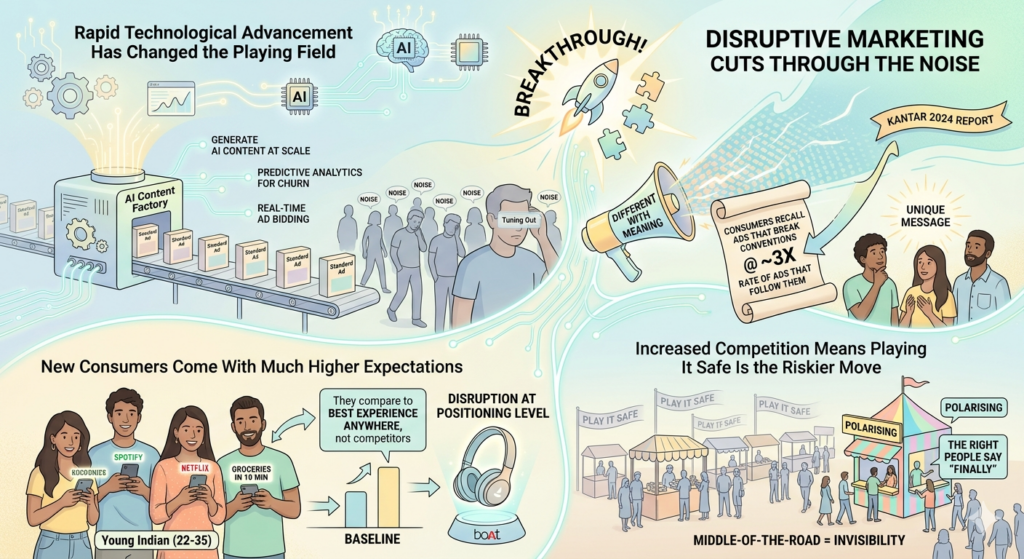
Rapid Technological Advancement Has Changed the Playing Field
The technology available to marketers in 2026 would have seemed excessive five years ago. Generative AI can personalise content at scale. Predictive analytics can tell you which customers are three touchpoints away from churning. Real-time programmatic bidding means your ad creative can change based on who is looking at it, when, and on what device.
But here’s the problem: everyone has access to the same tools.
When every brand uses the same AI-powered copy generator, the same retargeting playbook, and the same automated email sequences, everything starts sounding the same. Consumers notice. Not consciously, but they tune out.
Disruptive marketing cuts through this noise not by being louder, but by being different in a way that means something to the customer.
According to a 2024 Kantar report on media effectiveness, consumers recall ads that break category conventions at roughly 3x the rate of ads that follow them. The channels aren’t the issue. What’s said in those channels is.
New Consumers Come With Much Higher Expectations
The average Indian consumer aged 22 to 35 in 2026 has grown up with on-demand everything. They’ve had Spotify since they were teenagers. They’ve watched Netflix skip credits automatically. They’ve had groceries delivered in 10 minutes.
They don’t compare a brand to its direct competitors. They compare it to the best experience they’ve ever had anywhere.
That means disruptive marketing isn’t just about standing out in your category. It’s about meeting a baseline that was set by someone else entirely.
When boAt entered the audio market in India, it wasn’t just competing with Sony or JBL on sound quality. It was competing with what young Indian consumers thought premium should look and feel like -and then it priced that experience at a fraction of what those international brands charged. That’s disruption at the positioning level.
Increased Competition Means Playing It Safe Is the Riskier Move
Every market is more crowded than it was three years ago. D2C brands have multiplied. Global players have localised more aggressively. Niche players have found their audiences. In this environment, a middle-of-the-road marketing strategy doesn’t feel safe. It just guarantees invisibility.
The risk of being forgettable is higher than the risk of being polarising. A campaign that makes some people uncomfortable but makes the right people say “finally” is almost always the better bet.
Tips for Embracing Disruptive Marketing Tactics
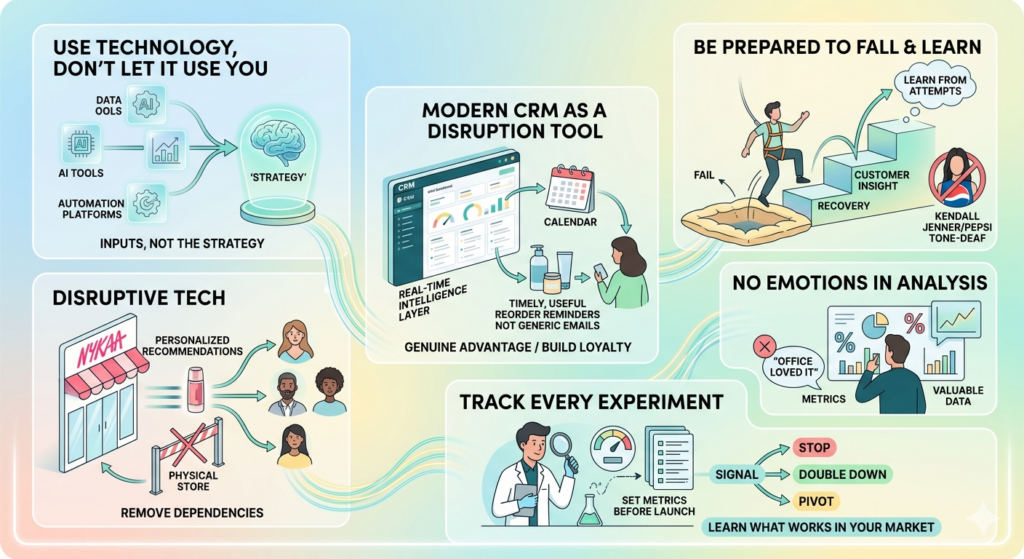
Use Technology -But Don’t Let It Use You
AI tools, marketing automation platforms, and data analytics are inputs, not the strategy itself. The brands that are using technology disruptively right now are using it to do things that weren’t previously possible -not just to do the same things faster.
Nykaa used data to personalise beauty recommendations for customers who had never set foot in a physical store. That’s disruptive because the entire beauty retail industry had been built on the idea that customers needed to try things in person. Nykaa used technology to remove that dependency.
The question to ask is: what does this tool let us do that we genuinely couldn’t do before? If the answer is “send emails faster,” that’s efficiency, not disruption.
The Modern CRM as a Disruption Tool
Most brands treat their CRM as a contact list with some automation on top. The brands using CRM disruptively treat it as a real-time intelligence layer.
When a D2C brand uses CRM data to identify customers who are three weeks away from running out of a product and sends a genuinely useful reorder reminder -not a generic promotional email -that’s different. It’s useful. It earns the kind of loyalty that paid acquisition can’t buy.
Your CRM knows things about your customers that no competitor has access to. That’s a genuine advantage. Using it to send “Hi [First Name], we miss you!” emails is a waste of it.
Be Prepared to Fall
Disruptive marketing doesn’t always work the first time. Sometimes the timing is wrong. Sometimes the execution is off. Sometimes the market isn’t ready.
Pepsi’s 2017 Kendall Jenner ad tried to be culturally relevant and became a case study in brand tone-deafness instead. The intent, presumably, was to connect with a socially conscious younger generation. The result was the opposite.
The lesson isn’t to avoid taking risks. It’s to understand the difference between disruption that comes from genuine customer insight and disruption that comes from a brand trying to appear culturally aware without doing the work.
Failing at disruptive marketing is recoverable. Failing at it repeatedly because you’re not learning from each attempt is a different problem.
Leave Emotions Out of the Analysis
Post-campaign, your job is to look at the numbers, not defend the idea. If a bold campaign didn’t move the metrics it was supposed to move, that information is more valuable than any validation.
The brands that get disruptive marketing wrong are often the ones that confuse internal excitement for external impact. “Everyone in the office loved it” is not a metric.
Stick to Your Convictions -But Not Past the Point of Evidence
There’s a difference between conviction and stubbornness.
Conviction is running with a bold campaign when the preliminary signals are positive, even if some people in the room are nervous. Stubbornness is refusing to adjust when the data is clearly telling you something isn’t working.
The best disruptive marketers are decisive in their choices and honest in their evaluations. They don’t need everyone to like the idea. But they do need the idea to work.
Track Every Experiment With Obsessive Detail
If you’re running a disruptive campaign and you’re not measuring it, you’re doing marketing cosplay. The whole point is to learn what works in your specific market, with your specific audience, at this specific moment.
Set metrics before you launch. Define what success looks like. Decide in advance what signal will tell you to stop, what signal will tell you to double down, and what signal will tell you to pivot.
Put Yourself in the Consumer’s Shoes -Seriously
This sounds obvious. It rarely actually happens.
Most disruptive campaigns fail not because the brand lacked creativity, but because the team creating the campaign didn’t spend enough time with the actual customer. Not the focus group version. The real version -using the product, navigating the purchase journey, dealing with customer service, comparing options.
Swiggy’s early marketing worked not because it had a clever tagline but because it understood the specific frustration Indian consumers had with food ordering. The app experience matched what the marketing promised, and that alignment is what built the habit.
Validate Before You Scale
Disruptive marketing doesn’t mean betting everything on one campaign. It means testing a disruptive idea at a small scale, validating the response, and then scaling what works.
Run a geo-targeted version of a bold campaign in two cities before you roll it out nationally. Test a provocative ad concept on a single audience segment before pushing it to your full database. The idea is to reduce the cost of being wrong.
Follow Innovators Who Are Ahead of Your Industry
The next disruptive idea in your category is probably already running in a different category. Subscription models that disrupted software found their way into FMCG. Community-led growth that built the early crypto exchanges is now showing up in ed-tech. Reverse trials that SaaS companies use are starting to appear in D2C.
The brands doing disruptive marketing well tend to be curious about what’s working outside their own vertical. That cross-category awareness is genuinely rare and genuinely valuable.
Understand Your Customers and Your Industry at a Granular Level
Disruption without customer insight is just noise. Before you decide what to challenge, you need to know what your customers actually resent about the current experience in your category.
Mamaearth disrupted the Indian skincare market not by having a dramatically better formula but by understanding that Indian parents were genuinely anxious about chemical exposure in baby products and that nobody was speaking to that anxiety directly. The disruption was in the positioning. The insight came from talking to actual customers.
Practical Examples of Disruptive Marketing Done Right
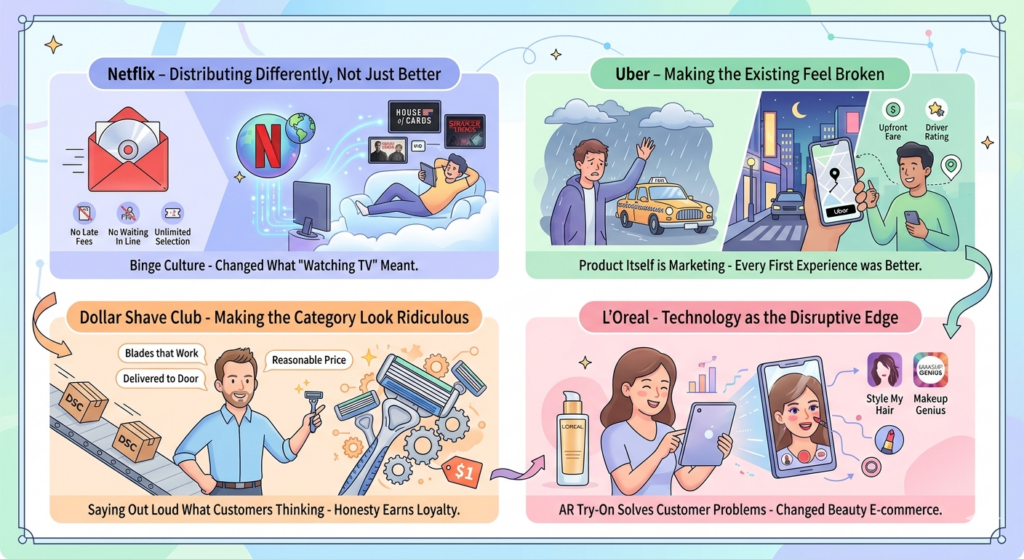
Netflix -Distributing Differently, Not Just Better
Netflix didn’t start as a streaming company. It started by mailing DVDs. The disruption wasn’t the technology. It was the model -no late fees, no waiting in line, no limited selection.
But the second wave of disruption was more interesting. When Netflix moved to streaming, it invested in original content at a scale the traditional TV industry hadn’t seen. And then, with shows like House of Cards and Stranger Things, it released entire seasons at once rather than weekly episodes.
That decision changed what “watching TV” meant. Binge culture wasn’t something Netflix discovered. It’s something Netflix built. And that cultural shift carried enormous marketing weight. Suddenly, Netflix wasn’t just a service. It was the way you watched things now.
The marketing lesson here isn’t to build a streaming service. It’s to ask: what assumption in your category is everyone accepting that customers would happily abandon?
Uber -Making the Existing Feel Broken
Before Uber, hailing a taxi in a major city involved standing in the rain, hoping, and sometimes paying cash to a stranger in a vehicle that may or may not have had a functioning air conditioner.
Uber didn’t just make booking easier. It made the old experience feel like a design failure. Once you’d tracked your driver on a map, seen your estimated fare upfront, and rated the ride on your phone, going back to the old system felt genuinely absurd.
The disruptive marketing insight was that the product itself was the marketing. Uber’s growth was largely word-of-mouth because every first experience was so significantly better than the alternative that users became spontaneous advocates.
This is a model worth studying. The most powerful disruptive marketing often doesn’t look like marketing at all. It looks like a product experience that customers can’t stop talking about.
Dollar Shave Club -Making the Category Look Ridiculous
Dollar Shave Club’s 2012 launch video cost $4,500 to produce and got 12,000 orders in 48 hours. By 2016, Unilever acquired the company for $1 billion.
The video didn’t explain the features. It didn’t compare specs. It made fun of the entire premium razor category -the multiple-blade innovation theatre, the packaging that required a PhD to open, the prices that somehow kept climbing.
The insight was simple: most men buying razors didn’t care about the blade technology. They wanted a razor that worked, delivered to their door, at a reasonable price. And they would find it genuinely funny that nobody had offered them that before.
The disruptive marketing move was to say out loud what customers had been thinking for years. That kind of honesty is rare in advertising. When you find the thing your category is collectively pretending not to notice, and you name it, you earn a very specific kind of loyalty.
L’Oreal -Technology as the Disruptive Edge
L’Oreal’s disruptive move wasn’t a clever ad. It was a technology investment that changed how people buy makeup.
The brand’s augmented reality try-on feature, built into its Style My Hair and Makeup Genius apps, lets consumers virtually try products before buying. In a category where the number one barrier to online purchase was “I don’t know if this shade will suit me,” that was a meaningful intervention.
It didn’t just improve conversion rates. It changed the expectation for the entire beauty e-commerce category. Brands that didn’t offer virtual try-on suddenly felt behind.
The lesson for Indian brands: technology adoption in marketing doesn’t have to be cutting-edge to be disruptive. It just has to solve a real customer problem that the category hasn’t addressed yet.
Disruptive marketing examples from Netflix, Uber, Dollar Shave Club, and L’Oreal share a common pattern -each identified an assumption or frustration in its category that customers had accepted as normal, and then built a product experience or message that made that assumption feel unnecessary. The disruption wasn’t always the loudest campaign. It was often the most honest conversation.
Disruptive Marketing Strategies That Actually Work
Challenger Positioning
Challenger brand marketing is the strategy of positioning your brand as the honest, customer-focused alternative to a dominant player who has grown complacent.
It doesn’t require the dominant player to be doing anything wrong. It just requires you to identify what the category leader prioritises and find the customer segment that has been underserved by those priorities.
Zepto vs BigBasket is an interesting Indian example. BigBasket had scale, range, and trust. But it was optimised for cost efficiency, which meant delivery windows of a day or more. Zepto looked at that model and decided the customers who wanted speed over selection were going unserved. It built an entire brand around that specific underserved need.
Challenger positioning works best when it’s honest. If you’re a smaller, newer, or resource-constrained brand, own that. Customers often find it more credible than the polished messaging of a market leader.
Content That Actually Challenges the Category
Most branded content looks the same because most brands are trying to appeal to everyone. Disruptive content makes a specific choice about who it’s for and speaks directly to that person, even if it alienates everyone else.
Dunzo’s early marketing in India is a good example. The tone was sharp, a little chaotic, and deliberately not corporate. It felt like it was written by someone who actually lived in the city rather than a content team trying to sound relatable. That specificity of voice was itself a disruptive move in a category full of generic app marketing.
Pricing as a Positioning Statement
Price isn’t just a business decision. It’s a marketing signal. It tells customers what you think of them, what you think your product is worth, and who you’re competing with.
Jio made pricing a weapon. By offering data at a fraction of the cost of competitors, it didn’t just acquire customers -it made the existing pricing model look like an extraction exercise. The disruption wasn’t technological. It was economic.
On the opposite end, brands like Lenskart used the premium-for-less model: a premium experience, lower price than optical retail. The disruption was making quality eyewear accessible to a market that had assumed quality required expense.
Community as a Marketing Channel
One of the most durable disruptive marketing strategies of the last decade has been building community before you need it.
Cult.fit (formerly CureFit) built an offline fitness community in Indian metros that created word-of-mouth that no paid campaign could have replicated. The community was the marketing. People didn’t just use the product -they identified with it.
This is harder to manufacture than a paid campaign. But it’s also much harder for a competitor to copy.
Effective disruptive marketing strategies include challenger positioning, community-led growth, pricing as a brand signal, and content that speaks directly to a specific underserved audience. These strategies share a common feature: they require genuine customer insight, not just creative boldness. Without the insight, bold campaigns tend to miss.
Measuring the Impact of Disruptive Marketing
Disruptive campaigns are harder to measure than standard campaigns because the results often show up in unexpected places. A campaign that generates massive earned media won’t always move CTR. A product experience that drives word-of-mouth won’t show up cleanly in last-click attribution.
That said, you still need to measure. Here’s a framework that works:
Short-term metrics (0-30 days): Track reach, share of voice, earned media value, and direct response rates where applicable. If the campaign is truly disruptive, you should see organic amplification -people talking about it without being paid to.
Mid-term metrics (30-90 days): Track changes in brand search volume, new customer acquisition rate, and Net Promoter Score movements. Disruptive campaigns often pull in customers who had previously dismissed the category or the brand.
Long-term metrics (90+ days): Track customer lifetime value changes in the cohort that converted during or after the campaign. Disruptive marketing tends to attract customers who are more aligned with the brand’s positioning, which often means higher retention.
One honest caveat: attribution in disruptive marketing is genuinely difficult. The effect of a campaign that shifted brand perception will show up across channels over time, not in a single trackable funnel. Build that expectation into how you present results internally.
Future Trends in Disruptive Marketing
AI-Powered Hyper-Personalisation
In 2026, the most disruptive marketing experiences are the ones that feel like they were made for you specifically. AI systems that understand purchase history, content consumption patterns, and real-time context are making that level of personalisation technically possible.
The brands getting ahead of this aren’t just using AI to personalise email subject lines. They’re using it to build genuinely different product experiences for different customer segments -different onboarding flows, different messaging hierarchies, different pricing models. The personalisation goes all the way down.
According to McKinsey’s 2024 State of AI in Marketing report, brands that had moved beyond surface-level personalisation to experience-level personalisation were reporting 25-40% improvements in customer lifetime value compared to industry benchmarks.
Creator-Led Brand Building
The relationship between brands and creators is changing. In 2026, the most effective disruptive marketing often comes from deep partnerships with creators who genuinely use the product rather than one-off sponsored posts.
The creator isn’t the media channel. The creator is a co-builder of what the brand means, when a creator’s audience trusts the creator’s recommendations more than any ad format, that trust transfers. Brands that understand this are building editorial relationships with creators rather than transactional ones.
boAt has done this well in India -working with artists and musicians who genuinely represent the audience the brand is after, not just people with large follower counts.
Zero-Click Brand Building
As AI Overviews and LLM-powered search reduce the number of clicks that go to brand websites, smart brands are investing in becoming the answer rather than the destination.
This means producing content so specific, so useful, and so accurate that when someone asks an AI assistant about your category, your brand’s perspective is the one that gets cited. It’s a long game. But in a world where over 65% of searches now end without a click to any website, brand presence inside AI answers is a new and genuinely undervalued asset.
Values-Driven Disruption
The next wave of disruptive marketing will be built less on product innovation and more on value alignment. Consumers in 2026 -particularly in the 20-35 age group -are paying more attention to what a brand stands for than previous generations did.
This isn’t about adding sustainability claims to packaging. That’s table stakes, and most consumers can see through it. The disruptive move is building a brand that genuinely operates differently because of what it believes, and then letting that operating reality be the marketing.
Bombay Shaving Company has done this in the Indian market, a category where most brands compete on price or feature claims; they built a brand around the ritual and the experience of grooming. That positioning is values-led even if it doesn’t look overtly activist.
Want to master Advanced AI for Marketing? Want to use top AI tools in your workflow and build AI Agents?

The Bottom Line on Disruptive Marketing
The brands that get disruptive marketing right share one characteristic: they do the work before they do the campaign.
They talk to actual customers. They find the frustration that the category has normalised. They build something that solves it. And then they communicate that honestly -without the jargon, without the overproduced polish, without the category conventions that make every competitor sound the same.
That’s it. That’s the strategy.
The tools change. The channels change. What Gen Z responds to in 2026 is different from what worked in 2016. But the underlying logic of disruptive marketing has been consistent since Volkswagen told America to think small in 1962.
Find what your category is pretending is acceptable. Fix it. Tell people you fixed it. Repeat.
Frequently Asked Questions About Disruptive Marketing
What is disruptive marketing in simple terms?
Disruptive marketing is when a brand challenges the normal way things are done in its market. It could mean a different price, a different message, a different channel, or a product experience that makes the existing options feel outdated. The goal is to change what customers expect, not just to get attention.
Is disruptive marketing only for startups?
No. Startups use it because they have no choice -they can’t outspend the incumbents. But large brands use disruptive marketing too. L’Oreal, Nike, and Apple are all large companies that regularly challenge category conventions. The difference is that for large brands, the risk of disrupting their own category has to be weighed against protecting existing revenue.
How is disruptive marketing different from guerrilla marketing?
Guerrilla marketing is a tactic -it’s about doing unexpected things in unexpected places. Disruptive marketing is a strategy -it’s about challenging the fundamentals of how a category operates. Guerrilla marketing can be part of a disruptive marketing strategy, but they’re not the same thing.
What are some disruptive marketing examples from India?
Several Indian brands have executed disruptive marketing well. Jio disrupted telecom through pricing. Zepto disrupted grocery delivery through speed. Mamaearth disrupted beauty through ingredient transparency. boAt disrupted audio through accessible premiumisation. Nykaa disrupted beauty retail by making online discovery feel as good as in-store browsing.
How do I know if my brand is ready for disruptive marketing?
Readiness comes down to three things: a genuine customer insight (not just a creative idea), a willingness to measure honestly and adjust, and leadership that can stay committed when a bold campaign makes some people nervous. If you have those three things, the size of your budget matters less than you think.
Can disruptive marketing backfire?
Yes. When it’s built on surface-level awareness of customer values without genuine understanding -Pepsi’s Kendall Jenner ad is the classic example. When it’s executed in a way that alienates the existing customer base without winning a new one. And when the product experience doesn’t match the promise the marketing is making. The disruption has to go all the way down.
How do you measure disruptive marketing success?
Use a three-horizon framework: short-term (0-30 days) track earned media and organic amplification; mid-term (30-90 days) track brand search volume and new customer acquisition rate; long-term (90+ days) track retention and lifetime value of the cohort acquired during the campaign. Accept that attribution will be imperfect.
What’s the difference between disruptive marketing and innovation in marketing?
Innovation in marketing is improving how you execute existing strategies. Disruptive marketing challenges the strategies themselves. Adding AI to your email personalisation is an innovation. Abandoning the email funnel model entirely in favour of community-led brand building is a disruption.
How much budget do you need for disruptive marketing?
Less than you think. Dollar Shave Club’s launch video cost $4,500. Jio’s disruptive move was a pricing decision, not a campaign spend. Many of the most effective disruptive marketing moments in the last decade have come from brands that were resource-constrained. The constraint often forces creativity.