
A product arrives at your door in two days. You order it on a Monday evening, and by Wednesday morning, it’s sitting on your doorstep. That kind of experience feels almost unremarkable now – but behind it sits a chain of decisions, systems, suppliers, warehouses, and logistics networks that most people never see.
Supply chain management is what makes that possible. It’s also what falls apart when things go wrong – like they did globally in 2020 and 2021, when port backlogs, raw material shortages, and shipping delays put the entire concept on the front page.
If you’re in marketing, operations, product, or business strategy, understanding how supply chains work isn’t optional anymore. Product availability, delivery speed, and cost structure all trace back to SCM decisions. And in a world where customers equate shipping experience with brand quality, the supply chain is a marketing problem too.
This article covers what supply chain management actually is, why it matters, how the five core phases work, what can go wrong, and where it’s heading.
Table of Contents
What Is Supply Chain Management?
Supply chain management is the coordination of all activities involved in sourcing, producing, and delivering a product – from raw materials to the end customer.
That definition sounds simple. The practice isn’t. A supply chain can span dozens of countries, hundreds of suppliers, and thousands of moving parts. SCM is the discipline of designing, running, and continuously improving that network so products reach customers at the right time, in the right condition, at a cost the business can sustain.
The term itself was first used in 1982 by consultants Keith Oliver and Michael Webber at Booz Allen Hamilton, though the underlying practices had existed in manufacturing for decades. Today, it’s a function that sits at the intersection of procurement, logistics, operations, finance, and increasingly, technology.
Supply chain management is the end-to-end coordination of sourcing, production, and delivery activities that move a product from raw material to the end customer. It covers procurement, manufacturing, logistics, and returns. When it works well, it reduces cost and increases customer satisfaction. When it breaks, it can halt entire industries.
Why Supply Chain Management Matters for Business
Poor supply chain decisions don’t stay in the warehouse. They show up in customer reviews, quarterly earnings calls, and marketing campaigns that promise delivery windows the ops team can’t hit.
Here’s why it matters across three specific dimensions.
Boost Customer Service
Getting the right product to the right customer at the right time is a baseline expectation now. According to a 2023 Salesforce State of the Connected Customer report, 80% of customers say the experience a company provides is as important as its products. A strong supply chain is the operational layer that makes that experience possible.
When Zepto built its 10-minute grocery delivery model in India, the supply chain wasn’t a backend concern – it was the product. Dark stores, hyperlocal inventory, and demand forecasting were what they were actually selling. The supply chain was the differentiator.
Reduce Operating Costs
Inventory that sits too long ties up cash. Shipping that isn’t optimised inflates margins. Supplier contracts that aren’t reviewed cost more than they should.
Supply chain management creates visibility across all of those cost centres. According to Deloitte’s 2023 Global Supply Chain Survey, companies with high-performing supply chains generate 15% lower supply chain costs than their peers while achieving better service levels.
That’s not a rounding error – that’s the difference between profitable and not.
Improve Financial Position
Working capital is directly tied to how inventory is managed. Fewer stockouts, shorter cash conversion cycles, and better supplier payment terms all come from disciplined SCM. For publicly traded companies, supply chain efficiency shows up in cash flow statements and directly affects valuation multiples.
Supply chain management affects three core business outcomes: customer service through delivery reliability, operating costs through inventory and logistics efficiency, and financial health through working capital management. Companies that get all three right consistently outperform peers on margin and growth.
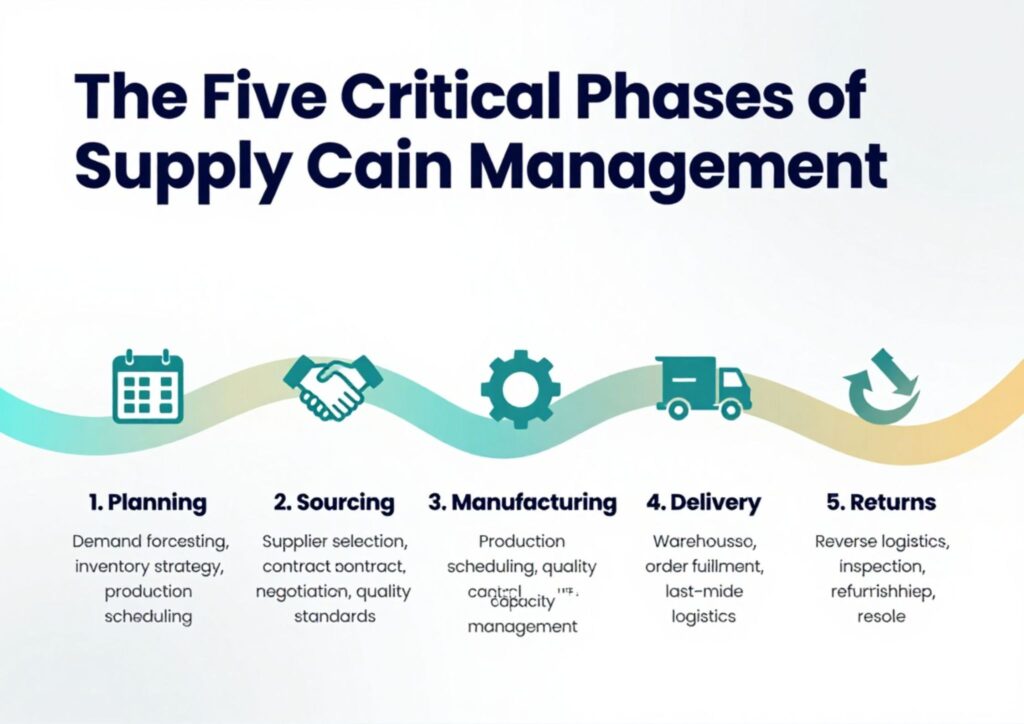
The Five Critical Phases of Supply Chain Management
Every supply chain, regardless of industry, moves through five phases. Understanding what happens in each one is where most SCM education starts – and where most operational failures begin.
1. Planning
Planning is where demand forecasting, inventory strategy, and production scheduling happen. The goal is to match supply capacity to expected demand before either of those things actually materialises.
Bad planning is the root cause of both overstocking (cash locked in unsold inventory) and stockouts (lost revenue and frustrated customers).
This challenge is especially common with multi-room HVAC projects, where several compatible components must be available together. Buyers comparing options for Cooling and Heating for Five Rooms often depend on accurate inventory planning and system availability.
Walmart’s demand forecasting system processes millions of data points daily to predict what each store will need — down to specific SKUs in specific geographies, often adjusted for weather patterns and local events.
2. Sourcing
Sourcing is the process of identifying, evaluating, and contracting with suppliers for raw materials, components, or finished goods.
This phase includes supplier selection, contract negotiation, quality standards, and payment terms. Get it wrong, and you either pay too much, receive inconsistent quality, or build dependency on a single supplier that becomes a single point of failure. That last one was the story of many electronics brands during the 2021 chip shortage – years of sole-sourcing decisions came back hard.
3. Manufacturing
Manufacturing is the conversion of raw inputs into finished products. In SCM, the focus is on production scheduling, quality control, and capacity management.
For brands that don’t manufacture their own products – which is most D2C and consumer brands – this phase is about managing contract manufacturers and setting quality expectations. Mamaearth, for example, works with third-party manufacturers but maintains strict quality protocols that are defined at the sourcing stage and audited through the manufacturing phase.
4. Delivery
Delivery covers warehousing, order fulfilment, last-mile logistics, and transport. It’s the most customer-visible phase, which makes it the one that gets the most attention when things go wrong.
This phase has seen the most technological change in the last decade. Route optimisation, real-time tracking, and last mile delivery software have compressed delivery windows in ways that were operationally impossible five years ago.
5. Returns
Returns management – sometimes called reverse logistics – handles the flow of goods coming back from customers. It includes return authorisation, transportation back to the warehouse, inspection, refurbishment, resale, or disposal.
Returns are expensive and often treated as an afterthought. They shouldn’t be. According to the National Retail Federation’s 2023 report, US retailers handled $743 billion in returned merchandise – approximately 14.5% of total retail sales. For fashion and electronics, the numbers are even higher.
Key Functions Across the Supply Chain
Supply chain management isn’t a single department – it cuts across procurement, logistics, operations, finance, and increasingly, data science.
The core functions include demand planning (forecasting what customers will buy), procurement (buying inputs at the right price and quality), production scheduling (deciding when and how much to manufacture), warehouse management (storing and organising inventory), transportation management (moving goods efficiently), and supplier relationship management (maintaining the partnerships the whole system depends on).
Each function produces data. The best supply chains integrate that data into a single view. Most don’t, which is why cross-functional visibility remains one of the hardest problems in SCM.
Supply Chain Risks You Need to Plan For
Supply chains don’t just fail because of bad decisions – they fail because the world is unpredictable. Understanding supply chain risks is part of managing one responsibly.
The main risk categories:
Demand risk – customer behaviour shifts faster than your inventory can respond. This hit fashion brands hard during the pandemic, when lockdown consumers stopped buying occasion wear overnight.
Supply risk – a supplier fails, faces a natural disaster, or loses certification. If there’s no backup, your production stops.
Logistics risk – port congestion, carrier capacity issues, or fuel price spikes. The 2021 Suez Canal blockage, when the Ever Given ran aground for six days, delayed an estimated $9.6 billion in trade per day.
Geopolitical risk – tariffs, trade bans, and sanctions that change the cost or legality of sourcing from specific countries.
Cybersecurity risk – increasingly relevant as supply chains run on interconnected digital systems. A 2020 ransomware attack on logistics giant Toll Group disrupted operations for weeks.
Most companies manage risk reactively, which is expensive. Managing it proactively – through diversification, scenario planning, and supplier audits – is where the real work is.
How to Build Supply Chain Resilience
Supply chain resilience is the ability to absorb disruption and recover quickly without unacceptable cost or service impact.
It’s different from efficiency. An efficient supply chain is lean and optimised for normal conditions. A resilient one trades some efficiency for the ability to flex when conditions aren’t normal. After 2020, most supply chain leaders will tell you that resilience should never have been treated as optional.
The main levers:
Supplier diversification – don’t rely on one geography or one supplier for anything critical. Apple has been deliberately expanding its manufacturing base in India and Vietnam, partly for cost and partly to reduce China dependency.
Safety stock – holding buffer inventory for high-risk SKUs. Not glamorous, not cheap, but it keeps you fulfilling orders when the preferred supplier goes dark.
Demand sensing – using real-time sales data and external signals (search trends, social data, weather) to update forecasts faster than traditional monthly planning cycles allow.
Scenario planning – mapping out what happens to the supply chain if a key supplier goes offline, a port closes, or a commodity price spikes 40%. Having the decision already framed means response time collapses from weeks to days.
Supply chain resilience means building the capacity to absorb disruption without significant loss of service or margin. It requires supplier diversification, buffer inventory for critical SKUs, faster demand sensing, and pre-built response plans. Resilient supply chains typically carry slightly higher baseline costs, but significantly lower risk exposure during disruption events.
Key Elements That Hold a Supply Chain Together
Supply chains work when their core elements are properly designed and managed. The main building blocks:
Network design – where your plants, warehouses, and distribution centres are physically located. This determines the baseline speed and cost of everything that follows.
Inventory management – how much stock to hold, where to hold it, and how quickly to replenish. Decisions here directly affect both working capital and service levels.
Information flow – the data that connects all the parts. Purchase orders, shipment tracking, demand signals, and quality reports. When information flows slowly or inaccurately, the physical flow suffers.
Supplier relationships – long-term partnerships with key suppliers create better terms, better quality, and more flexibility during crises. Transactional relationships don’t.
Technology infrastructure – the ERP, WMS (warehouse management system), TMS (transport management system), and increasingly AI-based planning tools that run the whole thing.
Get any of these wrong, and the others compensate until they can’t.
The Main Approaches to Supply Chain Management
There’s no single right way to run a supply chain. The right approach depends on your industry, your customer’s expectations, and your margin structure.
Lean Supply Chain Management
Lean SCM borrows from Toyota’s production system. The goal is to eliminate waste – overproduction, excess inventory, unnecessary motion, and defects. In a lean supply chain, you produce only what’s needed, when it’s needed.
It works brilliantly when demand is predictable and supply is reliable. It’s a problem when either of those conditions breaks.
Agile Supply Chain Management
An agile supply chain prioritises speed and flexibility over cost optimisation. It’s designed to respond quickly to demand shifts or disruption.
Fast fashion brands like Zara use an agile model – shorter production runs, more supplier flexibility, and faster inventory turns, even at higher unit cost. The trade-off is intentional: responsiveness matters more than per-unit efficiency in that business.
Six Sigma in Supply Chain
Six Sigma applies statistical process control to supply chain operations. The goal is to reduce defects and variation to near-zero levels – defects being broadly defined as anything that doesn’t meet the specification.
In supply chains, Six Sigma typically applies to quality control in manufacturing, order accuracy in fulfilment, and process consistency across supplier networks.
Total Quality Management (TQM)
Total quality management is an organisation-wide commitment to continuous improvement across all processes and functions. In SCM, TQM means building quality into sourcing decisions, manufacturing specs, and delivery standards – not just inspecting for it at the end.
TQM’s differentiation from Six Sigma is mainly in scope: TQM is a management philosophy, Six Sigma is a methodology. Companies often run both.
Resilient Supply Chain Management
Covered in depth above. The key design principle: don’t optimise only for efficiency. Build in redundancy, flexibility, and response capacity even when it costs more in normal conditions.
Green Supply Chain Management
Green SCM integrates environmental considerations into supply chain decisions – reducing carbon emissions, cutting packaging waste, using sustainably sourced materials, and optimising transport routes for fuel efficiency.
This matters both because regulation is tightening (the EU’s Carbon Border Adjustment Mechanism, for example) and because customers increasingly factor sustainability into purchase decisions. Nykaa has been vocal about its sustainability sourcing commitments, particularly around clean beauty.
Digital Supply Chain Management
A digital supply chain uses technology – IoT sensors, AI-based planning, blockchain for traceability, cloud-based visibility platforms – to give real-time insight and control across the entire network.
The shift from paper-based and ERP-only systems to real-time digital platforms is where most of the transformation investment is going right now.
The Role of Supply Chain Managers
Supply chain managers are responsible for the end-to-end performance of the supply chain. That means procurement negotiation, logistics contracting, supplier relationship management, demand planning, and often, direct responsibility for inventory levels and cost of goods.
The role has changed significantly over the last decade. It used to be primarily operational – track orders, manage warehouses, chase suppliers. Now it’s increasingly analytical and strategic. A strong supply chain manager reads demand signals from marketing data, negotiates with suppliers based on total cost modelling, and works with finance to optimise working capital.
From what we’ve seen with YUP learners who’ve moved into operations and product roles, the biggest skill gap isn’t process knowledge – it’s the ability to connect supply chain decisions to customer and financial outcomes. The best supply chain professionals speak both languages.
A Brief History of Supply Chain Management
Supply chain thinking has roots in the industrial revolution – mass production required raw material procurement, manufacturing coordination, and distribution that didn’t exist before. But the formal discipline emerged much later.
In the 1960s, logistics management became a distinct function as companies recognised that moving goods had its own economics. The 1980s brought just-in-time manufacturing from Japan, lean thinking from Toyota, and the first use of the term “supply chain management” in 1982.
The 1990s brought ERP systems – SAP and Oracle built platforms that integrated procurement, manufacturing, and finance into a single database for the first time. The 2000s brought global outsourcing, as companies moved manufacturing to lower-cost geographies and supply chains stretched across continents.
The 2010s brought e-commerce and the pressure of next-day and same-day delivery. Amazon’s fulfilment network reshaped what customers expected from every brand.
And then 2020 arrived and pressure-tested all of it.
The Future of Supply Chain Management
Supply chains are being rebuilt around three forces: speed, visibility, and resilience.
AI-based demand forecasting is replacing monthly planning cycles with continuous, real-time updates. According to McKinsey’s 2023 Supply Chain Report, companies using AI in supply chain planning reduced forecasting errors by 15% and improved service levels by 65%.
Nearshoring and friendshoring are reversing decades of globalisation. Companies are moving production closer to customers or to politically aligned countries, accepting higher unit costs in exchange for shorter supply chains and lower geopolitical risk.
Sustainability is moving from optional to mandatory. The EU’s Corporate Sustainability Reporting Directive (CSRD) requires large companies to report Scope 3 emissions – which includes supply chain emissions – starting in 2025.
Circular economy principles are reshaping how returns, refurbishment, and end-of-life products are managed.
The supply chain of 2030 will look very different from the one most companies run today.
Supply Chain Management Technology
The technology stack running modern supply chains has layers:
ERP systems (SAP S/4HANA, Oracle ERP Cloud) – the backbone that integrates finance, procurement, manufacturing, and distribution data.
WMS (Warehouse Management Systems) – control picking, packing, and inventory within warehouses. Manhattan Associates and Blue Yonder are market leaders.
TMS (Transport Management Systems) – route planning, carrier selection, freight auditing.
Demand planning tools – Kinaxis, o9 Solutions, and increasingly AI-native platforms that process external signals alongside historical sales data.
Supply chain visibility platforms – project44, FourKites, and similar tools that give real-time shipment tracking across carriers and modes.
Blockchain for traceability – particularly relevant in food and pharmaceuticals, where the chain of custody matters for compliance and consumer trust. Walmart uses IBM Food Trust (built on Hyperledger Fabric) to trace the source of leafy greens to the farm level in seconds rather than days.
Read More: “AI in marketing”
Components and Management Layers
A supply chain has both physical and information components.
Physical components include raw materials, work-in-progress inventory, finished goods, transportation modes, and infrastructure (ports, warehouses, retail points).
Information components include demand signals, purchase orders, production schedules, shipment data, quality reports, and financial settlements.
Management happens at three layers: strategic (network design, supplier strategy, technology investment), tactical (inventory positioning, capacity planning, supplier contracts), and operational (daily order execution, exception management, expediting).
Most supply chain problems that reach the customer are operational failures – but most of them trace back to strategic or tactical decisions made months or years earlier.
Power Dynamics in Supply Chains
Not all supply chain relationships are equal. Power sits with whoever controls the scarce resource or the most in demand.
In the automotive industry, large manufacturers like Toyota have enormous power over their tier-1 and tier-2 suppliers. They set quality standards, payment terms, and often dictate production schedules. Suppliers comply because the volume justifies it.
In commodities, that can reverse. During the 2021 chip shortage, TSMC and ASML had significant leverage over Apple, Ford, and Samsung. The buyers couldn’t dictate terms – they were competing for allocation.
For most brands, understanding where they sit in this power dynamic determines what they can negotiate, how much flexibility they can expect, and how much risk they absorb when things break.
Reverse Supply Chain
A reverse supply chain manages the flow of goods from the end customer back through the supply chain for return, refurbishment, recycling, or disposal.
It’s the operational infrastructure behind your “easy returns” policy. And it’s surprisingly complex. A returned product needs to be transported, received, inspected, graded, and then routed to the right next step – resale at full price, discount channel, refurbishment, component recovery, or disposal.
Companies like Optoro and Returnly (now part of Affirm) have built entire platforms around the logistics and disposition decisions in reverse supply chains. For fashion brands, where return rates can exceed 30%, getting reverse logistics right is the difference between a profitable returns policy and one that destroys margin.
Conclusion
Supply chain management isn’t a back-office function. It’s the operational layer that determines whether your brand promise holds up or falls apart the moment a customer places an order.
The five phases – planning, sourcing, manufacturing, delivery, and returns – are not sequential hand-offs. They’re continuous, interdependent, and all affected by the same demand and supply signals. Managing them well requires visibility, good data, strong supplier relationships, and increasingly, technology that can process information faster than any planning team can.
The supply chains that worked for the last decade are being rebuilt for the next one. Shorter, more resilient, more sustainable, and more digital. If you’re in any function that touches product or customer experience, understanding how supply chain decisions get made is a real advantage.
FAQs
What is supply chain 4.0 all about?
Supply chain 4.0 refers to the application of Industry 4.0 technologies – AI, IoT, robotics, big data analytics, and cloud computing – to supply chain operations. It’s the shift from reactive, batch-based planning to real-time, predictive, and largely automated supply chain management. In practical terms, it means sensors on warehouse shelves that trigger automatic replenishment, AI systems that reforecast daily rather than monthly, and autonomous vehicles handling last-mile delivery.
How can we increase customer responsiveness while lowering inventory?
This is the classic supply chain tension. The answer lies in demand sensing and segmentation. Use real-time sales data, search trends, and social signals to forecast more accurately, which lets you carry less safety stock without increasing stockout risk. Segment your inventory by velocity and criticality – hold more buffer on high-margin, high-velocity SKUs, less on slow movers. And work with suppliers on shorter lead times or vendor-managed inventory for your most critical products.
What is a digital supply chain?
A digital supply chain uses technology to connect every node in the network with real-time data and automated decision-making. Unlike traditional supply chains that rely on periodic data and manual intervention, a digital supply chain gives planners live visibility into inventory levels, shipment status, supplier capacity, and demand signals. The result is faster decisions, fewer surprises, and significantly better cost and service performance.
What are some real examples of digital supply chains?
Amazon’s fulfilment network is the most cited example – demand prediction, robotic picking, dynamic routing, and same-day delivery all run on an integrated digital platform. In India, Swiggy Instamart runs a digital supply chain for grocery delivery, using real-time demand data to manage micro-warehouse inventory across cities. In pharmaceuticals, companies like Pfizer use end-to-end digital traceability systems to track vaccines from manufacturing to patient administration.
How can we quickly improve our supply chain?
Start with visibility. You can’t improve what you can’t see. Map your current supply chain – every supplier tier, every warehouse, every major logistics lane. Then identify where the largest delays, costs, or errors are occurring. Most supply chains have two or three bottlenecks responsible for the majority of performance problems. Fix those first before investing in broader transformation. Quick wins typically come from improving demand forecast accuracy, renegotiating key supplier payment terms, and consolidating carriers.
How can we identify, demonstrate, and reduce waste in our supply chain?
Use a value stream mapping exercise – a lean tool that visually maps every step in a process and distinguishes value-adding steps from non-value-adding ones. In supply chains, common waste categories include excess inventory (storing more than you need), unnecessary transportation (moving goods between locations that could be eliminated), overprocessing (quality checks that duplicate earlier checks), and defects (goods that have to be reworked or scrapped). Once waste is visible and quantified, prioritising which to address first is a straightforward business case.
What is a smart supply chain?
A smart supply chain combines connectivity, data analytics, and automation to make the supply chain self-correcting and predictive rather than reactive. Smart supply chains use IoT sensors to monitor inventory and environmental conditions in real time, AI to predict disruptions before they happen, and automation to execute routine decisions without human intervention. The goal is a supply chain that adapts to demand and supply changes faster than any team of planners could manually.
What is the process view of the supply chain?
The process view of supply chain breaks the supply chain into a series of linked business processes rather than functional departments. The most widely used framework is the SCOR model (Supply Chain Operations Reference), which defines supply chain activities as Plan, Source, Make, Deliver, Return, and Enable. This view is useful because it cuts across organisational silos – procurement, logistics, and sales all share processes – and makes it easier to identify where handoffs break down.
Is supply chain management only relevant for manufacturing companies?
No, and this is one of the most common misconceptions. Supply chain management applies to any business that sources inputs and delivers outputs to customers, which includes retail, e-commerce, healthcare, food and beverage, fashion, and software (for physical goods delivery). Even service businesses deal with supply chain considerations in procurement and vendor management. The principles of demand planning, supplier management, and logistics optimisation apply across industries.
What’s the difference between supply chain management and logistics?
Logistics is a subset of supply chain management. Logistics covers the physical movement and storage of goods – transportation, warehousing, and order fulfilment. Supply chain management is broader: it includes sourcing, supplier relationships, demand planning, manufacturing coordination, and strategic network design, in addition to logistics. You can have excellent logistics and a poorly managed supply chain – and many companies do.
Why do supply chains fail during global disruptions?
Most supply chain failures during global disruptions trace to three structural choices that seemed smart in normal conditions: over-reliance on a single geography (usually low-cost but distant), minimised safety stock (lean in peacetime, fragile in crisis), and poor supplier visibility below tier 1 (brands often don’t know who their suppliers’ suppliers are). When a disruption hits, these three factors compound. The solution – supplier diversification, buffer inventory, and multi-tier visibility – requires investment that delivers no visible return until the crisis hits.
How does supply chain management affect brand reputation?
Directly and sometimes severely. Stockouts make customers buy from competitors, and they may not come back. Late deliveries generate negative reviews and social media complaints. Quality failures in manufacturing reach customers and create recall events. In a world where a customer’s delivery experience is visible and reviewable, supply chain performance is a brand performance metric. Brands like boAt have learned this as they’ve scaled – the supply chain and the brand promise have to be built together, not in silos.