
Most marketing training focuses on tactics. What to post, how to structure a campaign, which metrics to track. Tactics are fine, but they’re surface-level. They shift every year as platforms change and algorithms update.
The underlying psychology of why people buy does not shift. It’s the same in 2025 as it was in 1979.
The problem is that most marketers never study it formally. They learn by doing, which means they replicate what works without understanding why. And when it stops working, they don’t know where to look.
This article covers ten marketing psychology concepts that separate practitioners who understand buyer behaviour from those who just follow playbooks. Each one is grounded in research, explained in plain terms, and connected to real execution decisions.
Table of Contents
1. Jobs To Be Done: People Don’t Buy Products, They Hire Them
Jobs To Be Done (JTBD) is a framework for understanding why a customer chooses a product. The core idea: customers don’t buy products for their features, they “hire” them to make progress in a specific situation.
The framework was developed by Harvard Business School professor Clayton Christensen and first described in a 2005 Harvard Business Review paper titled “The Cause and the Cure of Marketing Malpractice.”
The classic example comes from a McDonald’s consulting project. The fast food chain wanted to boost milkshake sales. They ran the usual playbook – focus groups, flavour tests, tweaks based on customer feedback. Sales didn’t move.
Christensen’s team took a different approach. Instead of asking “how can we make the milkshake better?” they asked “why are people buying it in the first place?”
What they found: a significant portion of milkshakes were sold before 8:30am, to solo commuters who bought nothing else. When interviewed, these customers weren’t describing hunger or craving. They were describing a long, boring drive. The milkshake was thick enough to last the commute, easy to hold with one hand, and kept them full until lunch.
They weren’t hiring a milkshake. They were hiring a boredom-killer for the morning commute.
Once the team understood the actual job, the product decisions changed completely. The milkshake was made thicker (longer to finish), moved to the front of the counter (faster to grab), and a prepaid card system was introduced so commuters could get in and out quickly.
The messaging, the product design, and the store experience all shifted because the job was finally visible.
What this means for your marketing:
Most brands build messaging around product attributes. “High quality.” “Fast delivery.” “100+ features.” But customers aren’t comparing attributes in a vacuum. They’re trying to solve a problem or make progress in a specific moment.
When you understand the job your product is hired for, your positioning sharpens. You stop trying to be everything to everyone and start being exactly right for a specific situation.
Ask yourself: when, exactly, does someone decide to hire my product? What were they doing before they reached for it? What are they trying to accomplish – not in general, but in that specific moment?
The answer to that question is worth more than a hundred customer surveys about features.
Jobs To Be Done (JTBD) is a framework developed by Clayton Christensen that reframes the question of why customers buy. Instead of studying product preferences, it asks what job the customer is hiring the product to accomplish. When marketers understand the actual job – not the demographic, not the category – their messaging, product design, and pricing decisions change fundamentally. The McDonald’s milkshake study is the canonical example: morning commuters weren’t hiring a milkshake for its taste but to make a boring drive more bearable.
2. Loss Aversion: Losses Feel Twice as Painful as Equivalent Gains
Loss aversion is one of the most robust findings in behavioural economics. First identified by psychologists Daniel Kahneman and Amos Tversky in their 1979 paper on Prospect Theory, it describes a consistent asymmetry in how people experience outcomes: losses feel psychologically approximately twice as powerful as equivalent gains.
Losing $50 feels worse than winning $50 feels good. Even when the outcome is identical, the framing changes everything.
This has a direct consequence for marketing. When you frame an offer around what the customer will gain, you’re working against the psychological grain. When you frame it around what they’ll lose or miss out on, you’re working with it.
“Don’t miss out” consistently outperforms “Get access.” “Only 3 spots left” drives more urgency than “Join 97 other students.” “Your competitors are already doing this” lands harder than “This could help you grow.”
None of these are tricks. They’re accurate descriptions of the same reality, framed through a loss lens instead of a gain lens.
Where most marketers get this wrong:
They apply loss aversion bluntly – countdown timers on pages with no actual deadline, or “limited availability” claims that are clearly false. This backfires. When customers realise the scarcity is manufactured, the brand loses trust far faster than it gained the conversion.
Loss aversion works best when the loss is real. A course cohort that genuinely closes. A price that genuinely increases. A feature set that’s genuinely available only during a trial window.
Duolingo’s streak mechanic is one of the most effective applications of loss aversion in product design. Once a user builds a 30-day streak, they become psychologically motivated not to break it – not because they’ll gain something, but because they’ll lose something they’ve already built. Duolingo reinforces this with notifications: “You’re about to lose your streak.” Not “Come back and learn more.”
Loss aversion, identified by Kahneman and Tversky in Prospect Theory (1979), describes the finding that losses feel approximately twice as psychologically painful as equivalent gains feel rewarding. In marketing, this means loss-framed messaging – “don’t miss out,” “last 3 seats,” “price increases Friday” – tends to drive more urgency than gain-framed equivalents. The effect is strongest when the loss is real, not manufactured.
3. The Mere Exposure Effect: Familiarity Creates Preference Without Conscious Awareness
The mere exposure effect is the psychological tendency to prefer things simply because they’re familiar. First formally documented by social psychologist Robert Zajonc in his 1968 landmark paper, it showed that repeated exposure to a stimulus – a word, an image, a face, a logo – increases positive feelings toward it, even without any conscious evaluation or interaction.
People don’t need to remember your ad to be influenced by it. The familiarity builds below the level of conscious attention.
This has a specific implication for how you think about advertising efficiency. Most performance marketers measure success by clicks and direct conversions. But a significant portion of advertising value is invisible to last-click attribution. Someone sees your brand three times on Instagram without clicking anything, then types your domain directly into their browser two weeks later and converts. The awareness campaign gets zero credit. The direct channel gets all of it.
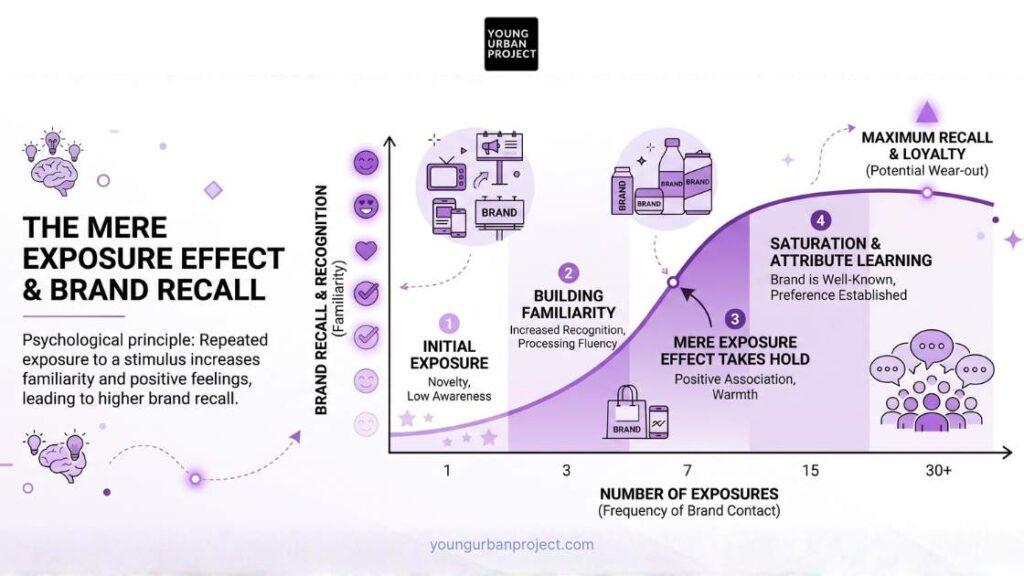
The mere exposure effect is also why reach and frequency matter, not just targeting precision. If your entire budget goes toward retargeting people who’ve already shown purchase intent, you’re skipping the awareness phase that makes purchase intent possible in the first place.
That said, Zajonc’s own research shows that the effect has a ceiling. Meta-analyses of the effect show it typically peaks within 10 to 20 exposures, and that over-exposure can actually reduce preference. This is the creative fatigue problem every brand running paid social eventually hits. Familiarity becomes irritation when the same creative runs past its natural shelf life.
What this means practically:
Consistent brand presence across channels – even when individual placements are brief – compounds over time. Coca-Cola doesn’t run TV ads because people have forgotten what it is. They run them because familiarity drives preference, and preference drives choice at the moment of purchase. You don’t need Coca-Cola’s budget to apply the same logic at your scale.
The mere exposure effect, first documented by psychologist Robert Zajonc in 1968, demonstrates that repeated exposure to a brand or stimulus creates positive preference – even without conscious attention or recall. This means advertising builds value beyond what last-click attribution captures. The effect peaks within roughly 10 to 20 exposures and can reverse beyond that, which explains why creative refresh and frequency management matter as much as reach.
4. Category Entry Points: Awareness Is Not the Same as Salience
Category Entry Points (CEPs) are the specific situations, contexts, and triggers that cause someone to enter a product category and consider buying. The concept was developed by Jenni Romaniuk and Byron Sharp at the Ehrenberg-Bass Institute for Marketing Science, and forms the foundation of the mental availability framework described in the book “How Brands Grow.”
General brand awareness and mental availability are not the same thing.
Awareness means someone has heard of you. Mental availability means your brand comes to mind when they’re about to buy. You can have extremely high awareness and still lose at the point of purchase because your brand isn’t linked to the specific moments that trigger buying decisions.
The example is simple. “Healthy drinks” is general awareness territory. “Something to drink after the gym,” “something to get through the afternoon without crashing,” and “something for a long drive” are category entry points. Each of those triggers a buying moment. If your brand isn’t mentally linked to those specific situations, you don’t win, even if everyone recognises your logo.
Research from the Ehrenberg-Bass Institute shows that brands with stronger links to more category entry points tend to hold higher market share. The relationship is not just correlational – brands actively build CEP links through advertising that consistently shows the brand in specific usage contexts.
How this applies to your messaging:
Most brand communications lead with “what we are.” CEP-aware communications lead with “when you need us.” The difference sounds subtle. In practice, it changes your creative brief, your media placement logic, and your content strategy.
Apple doesn’t just advertise the iPhone as a great phone. They show it in specific situations: a parent filming their kid’s first steps, someone navigating in an unfamiliar city, a creator editing video on the go. Each piece of creative is building a CEP link, not just brand awareness. Concrete example: In the nootropics category, buying moments fire when a marketer faces a deadline sprint, jet lag, or a deep-focus work block. Positioning that speaks to “need mental clarity before a big presentation” or “sustain energy without jitters” builds stronger CEP links than generic “brain booster” claims. For a product-level view of how ingredients, outcomes, and positioning intersect with these triggers, see this performance-focused Mind Lab Pro review, which evaluates the formula through real-world use cases and performance outcomes.
5. The Paradox of Choice: More Options Hurt Conversions
Barry Schwartz introduced the Paradox of Choice in his 2004 book of the same name. The core finding: beyond a certain threshold, more options don’t improve decision-making – they paralyse it. People delay, defer, or abandon the decision altogether.
The canonical research example is Sheena Iyengar and Mark Lepper’s jam study from 2000. Shoppers at a grocery store were offered either 6 or 24 varieties of jam to sample. The display with 24 varieties attracted more initial interest, but the display with 6 varieties resulted in ten times more purchases.
Ten times.
For marketers, this plays out most clearly on landing pages and in pricing structures. A landing page with one clear offer consistently outperforms a landing page with four options. Not because the other options are worse, but because the decision itself becomes harder and the brain defaults to “not right now.”
This is one of the patterns that kills D2C revenue – not bad ads, but a checkout flow that asks too many questions or a homepage that tries to push too many products at once.
What to do about it:
Audit every page on your site where you’re presenting choices. The question isn’t “do we have the right options?” The question is “can we reduce the number of decisions the visitor has to make before they buy?”
Amazon figured this out early. The entire product detail page architecture is designed to make one decision easy: do you want this product, yes or no? Everything else – size selection, add-ons, related items – is secondary and presented in a way that doesn’t interrupt the primary decision.
The principle applies to email too. Newsletters with one CTA outperform newsletters with four. Campaigns with one message outperform campaigns that hedge their bets across multiple offers.
Simplify first. Optimise second.
The Paradox of Choice, described by Barry Schwartz in his 2004 book, holds that beyond a certain threshold, increasing the number of options causes decision paralysis rather than better decisions. Iyengar and Lepper’s 2000 jam study demonstrated this directly: a 24-variety display generated far more browsing than a 6-variety display, but the smaller selection drove ten times more purchases. For marketers, this means fewer choices on landing pages, simpler pricing structures, and single-CTA emails consistently outperform option-rich equivalents.
6. The Availability Heuristic: The Brand People Think of First Wins
The availability heuristic is a mental shortcut described by Kahneman and Tversky where people judge the likelihood or quality of something based on how easily an example comes to mind. In marketing, the application is direct: the brand that surfaces first in a buying situation wins – not necessarily because it’s the best, but because it’s the most mentally accessible.
This is why “being top of mind” is not just a vague brand goal. It’s a commercial advantage that directly affects market share.
The mechanism matters here. It’s not just about recall. The availability heuristic means that ease of recall signals quality. If your brand comes to mind quickly when a category need arises, the brain interprets that ease as a signal that the brand is probably a good choice. The customer doesn’t consciously reason through why – the availability does the work.
Salience beats features in most purchase decisions. Particularly in low-involvement or habitual categories, the customer isn’t running a feature comparison. They’re going with what surfaces first.
The practical implication:
Being remembered is a competitive advantage, and most brands underinvest in building it. They spend on conversion but not on presence. They measure clicks but not mental availability.
Consistent, distinctive creative that shows up regularly across the channels your audience uses builds availability over time. The Ehrenberg-Bass Institute’s research on mental availability and distinctive brand assets – shapes, colours, characters, sounds – shows that recognisable brand cues are the mechanism through which mental availability gets built and maintained.
Red Bull’s brand presence strategy is a good example. Their event sponsorships, their media arm, their athlete partnerships – none of these directly sell a can of energy drink. All of them build the mental availability that makes Red Bull the brand you think of first when a category entry point (need energy, late night, extreme sport) fires.
7. Recency Bias in Attribution: The Last Click Doesn’t Deserve the Credit
Recency bias in attribution describes the tendency to give disproportionate credit to the most recent touchpoint before a conversion. In marketing, this manifests as last-click attribution – a model where the ad someone clicked immediately before purchasing gets 100% of the credit, and every prior touchpoint gets none.
Last-click attribution is the default for most Google Ads and older Meta Ads setups. It’s also one of the most misleading signals in digital marketing.
The problem is causal. The last click rarely caused the conversion. It confirmed a decision that had already been shaped by an awareness ad two weeks ago, an organic post the customer read on their lunch break, a retargeting ad they saw three times but didn’t click, and a friend’s recommendation they remembered when they were finally ready to buy.
When you optimise for last-click attribution, you make several consistently bad decisions: you cut upper-funnel awareness spending because it doesn’t show a direct return, you over-invest in branded search (which captures intent that was built elsewhere), and you attribute most of your revenue to channels that sit at the bottom of a funnel your other campaigns built.
What to use instead:
Data-driven attribution models, now available in Google Ads and GA4, distribute credit across touchpoints based on which ones statistically contributed to conversion paths. They’re not perfect, but they’re far less distorted than last-click.
For a broader view, Marketing Mix Modelling (MMM) allows you to measure the contribution of channels that have no click-through at all – TV, OOH, podcast, organic social. This is the only way to understand the true contribution of brand-building channels.
The combination of a better attribution model and some form of MMM or incrementality testing gives you a materially more accurate picture of what’s actually driving your revenue.
Recency bias in attribution occurs when the last touchpoint before a conversion receives 100% of the credit, ignoring all prior interactions that shaped the buying decision. Last-click attribution, the default for most digital ad platforms, consistently causes marketers to under-invest in upper-funnel channels and over-value branded search and retargeting. Data-driven attribution and Marketing Mix Modelling provide more accurate pictures of cross-channel contribution.
8. The Endowment Effect: People Value What They Already Have More Than What They Could Get
The endowment effect describes the tendency to place higher value on something you already own than on an identical object you don’t. It was first documented by Richard Thaler, who later won the Nobel Prize in Economics in 2017, along with Kahneman and Tversky in a 1990 paper.
The effect is straightforward: if you own a coffee mug, you’ll typically demand more to sell it than you’d be willing to pay to buy the same mug.
In marketing, the endowment effect is the psychological engine behind free trials. When a customer uses your product for 14 days, they don’t just evaluate it on its merits. They start to feel like they own it. The prospect of losing access to something they’ve already been using feels worse than the prospect of gaining access to something new.
This is why Spotify, Netflix, and most SaaS products don’t frame trials as “try it for free.” They frame them as “start your free trial” – positioning it as the beginning of ownership, not a sample.
Practically: if you have a free trial or a freemium tier, the product experience during that period needs to be excellent. You need users to feel genuine ownership of features, settings, data, or progress before the paywall appears. The more they’ve built inside your product, the more the endowment effect works in your favour at the upgrade moment.
The inverse also applies. If a customer has to give up data, history, or customisation to switch to a competitor, they’re unlikely to switch even if the competitor’s product is technically better. This is the stickiness that comes from endowment, not lock-in.
9. Anchoring: The First Number Sets the Frame for Everything That Follows
Anchoring is the cognitive bias where the first piece of information someone encounters about a price, quantity, or value becomes the reference point for all subsequent judgements – even when that first number is arbitrary.
Kahneman and Tversky documented the effect in the 1970s. The classic experiment: when asked to guess the percentage of African countries in the UN, people who first saw a randomly generated high number gave higher estimates than those who saw a low number. The anchor influenced the guess even when participants knew the anchor was random.
In pricing, this effect is enormous.
When you see a product originally priced at $200, discounted to $120, you’re not evaluating whether $120 is a reasonable price. You’re evaluating a saving of $80. The anchor ($200) does the heavy lifting. Remove the anchor and show only $120, and the perceived value drops significantly.
How to use anchoring in your marketing:
Present your highest-priced option first. Not because you expect everyone to buy it, but because it anchors the frame. Your mid-tier option looks like a bargain relative to the premium option, even if it would look expensive relative to a competitor’s entry-level price.
This is exactly how Apple structures its product pages and how almost every SaaS pricing table works. The enterprise plan sits at the top of the page with a high price (or “contact us”). The professional plan below it feels like excellent value by comparison. The starter plan looks like a steal.
Anchoring also applies to negotiation, to influencer deal rates, and to how you present course pricing. Show the full price before any discount. Always.
10. The Decoy Effect: A Third Option Can Make One of Two Options Much More Attractive
The decoy effect (also called asymmetric dominance effect) occurs when a third option is introduced specifically to make one of the existing two options look more attractive by comparison.
The option that makes the other look good is the decoy. It’s not designed to sell. It’s designed to shift the frame.
The Economist subscription example, which behavioural economist Dan Ariely made famous in his book “Predictably Irrational,” is the most-cited case. Three options were presented: digital only at $59, print only at $125, and print + digital at $125. The print-only option at the same price as print + digital is the decoy. Nobody buys it. But its presence makes the print + digital option look like obvious value.
When the decoy was removed and only digital or print + digital were offered, buying patterns shifted significantly. The decoy had been doing real work.
Where to apply this:
In product pricing, in course tiers, in subscription plans – any time you have two options and want to steer customers toward the higher-value one, introduce a dominated third option. It should be clearly worse on the dimensions people care about, which makes the target option’s superiority obvious.
Used thoughtfully, this isn’t manipulation. It’s clarity. You’re helping customers see the value of an option that genuinely is better for most use cases. The decoy just makes it visible.
How to Actually Use These Concepts
Reading about these frameworks is the easy part. The harder part is building the habit of running your decisions through them before you execute.
A useful exercise: take your next campaign brief and ask, one by one, which of these concepts is currently being ignored. Is your messaging framed around loss or gain? Have you audited whether your landing page has too many choices? Do you know what category entry points your brand is linked to – and which ones you’re missing?
These aren’t abstract theories. They’re diagnostics. They tell you where the gap between your intent and your buyer’s psychology actually is.
The marketers who consistently outperform aren’t necessarily smarter or more creative. They understand why buyers do what they do. That understanding doesn’t get outdated when the algorithm changes.
Frequently Asked Questions
What is marketing psychology?
Marketing psychology is the study of how cognitive biases, mental shortcuts, and emotional patterns influence the decisions buyers make. It draws on academic research from behavioural economics, social psychology, and cognitive science to explain why people respond to marketing the way they do, beyond rational product evaluation.
What is the Jobs To Be Done (JTBD) framework?
Jobs To Be Done (JTBD) is a framework developed by Clayton Christensen that explains buying decisions in terms of the “job” a customer is trying to accomplish. Customers don’t buy products for their features – they hire them to make progress in specific situations. Understanding the job reframes how you build messaging, positioning, and product.
Is loss aversion the same as FOMO?
Not exactly. Loss aversion is the broader psychological principle – identified by Kahneman and Tversky – that losses feel roughly twice as painful as equivalent gains feel rewarding. FOMO (fear of missing out) is a social manifestation of loss aversion, specifically around social belonging and exclusion. Both operate on the same psychological mechanism, but loss aversion applies far more broadly in marketing contexts.
How does the mere exposure effect relate to brand awareness?
The mere exposure effect explains why brand awareness drives preference. People who have seen a brand repeatedly feel more comfortable with it, even if they can’t consciously recall the individual exposures. This makes consistent brand presence valuable beyond what direct-response metrics capture – awareness campaigns build familiarity that converts later, often in channels that get attributed to other touchpoints.
What are category entry points in marketing?
Category entry points (CEPs) are the specific situations, triggers, and contexts that cause someone to enter a buying mindset for a product category. Developed by Jenni Romaniuk and Byron Sharp at the Ehrenberg-Bass Institute, CEPs represent the mental links that determine whether your brand gets considered at the right moment. Building links to more relevant CEPs increases the probability your brand surfaces when it matters most.
What’s wrong with last-click attribution?
Last-click attribution gives all the credit for a conversion to the final touchpoint before purchase, ignoring every prior interaction that shaped the decision. It causes brands to systematically under-invest in upper-funnel channels that build awareness and intent, and over-invest in branded search and retargeting that capture – rather than create – demand. Data-driven attribution models and Marketing Mix Modelling provide more accurate views of cross-channel contribution.
How can I use anchoring in my pricing?
Present your highest-priced option first. It sets the reference frame and makes lower-priced options feel like better value. This is the principle behind most SaaS three-tier pricing tables: the enterprise plan anchors the professional plan. Show the full undiscounted price before any promotion. In negotiations, the first number put on the table disproportionately shapes the outcome.
What is the endowment effect in marketing?
The endowment effect is the tendency to value something you already own more than an identical item you don’t own. In marketing, it explains why free trials are so effective – users begin to feel ownership of the product during the trial period, and losing access feels worse than the cost of subscribing. The more deeply a user builds data, settings, or habits inside your product, the stronger the endowment effect at the paywall moment.
Does the paradox of choice apply to all marketing contexts?
It applies most strongly in low-familiarity situations, where the buyer doesn’t already have strong preferences and finds decision-making cognitively taxing. In high-familiarity categories, where buyers know exactly what they want, more choice can be appropriate. The clearest marketing application is landing pages and pricing structures – one clear offer consistently outperforms multiple options for most audiences.
Is the decoy effect ethical to use in marketing?
The decoy effect is ethical when used to help customers see the genuine value of an option that is actually better for most use cases. It becomes problematic when the decoy is designed to obscure the real cost or steer customers toward something that doesn’t serve their interests. Used transparently in pricing design, it’s a legitimate tool for reducing decision friction.
The Tactics Will Change. The Psychology Won’t.
Every concept in this article was true before digital marketing existed. Most of them were documented in academic research decades before the first digital ad was served.
That’s the point. Platforms change. Formats change. The cost-per-click on any given channel will be different in twelve months. But the psychological patterns that govern how humans make decisions are remarkably stable.
Understanding this psychology doesn’t make you cynical about buyers. It makes you more useful to them. You can build messaging that actually matches how they think, pricing structures that reduce friction, and brand experiences that build genuine trust over time.