

Most marketing candidates who lose interviews weren’t underprepared. They knew the concepts. They’d revised the funnel, understood attribution, and could define ROAS in their sleep. But when the interviewer asked, “How would you handle an underperforming campaign?” they gave a textbook answer that ended with no number, no outcome, no decision.
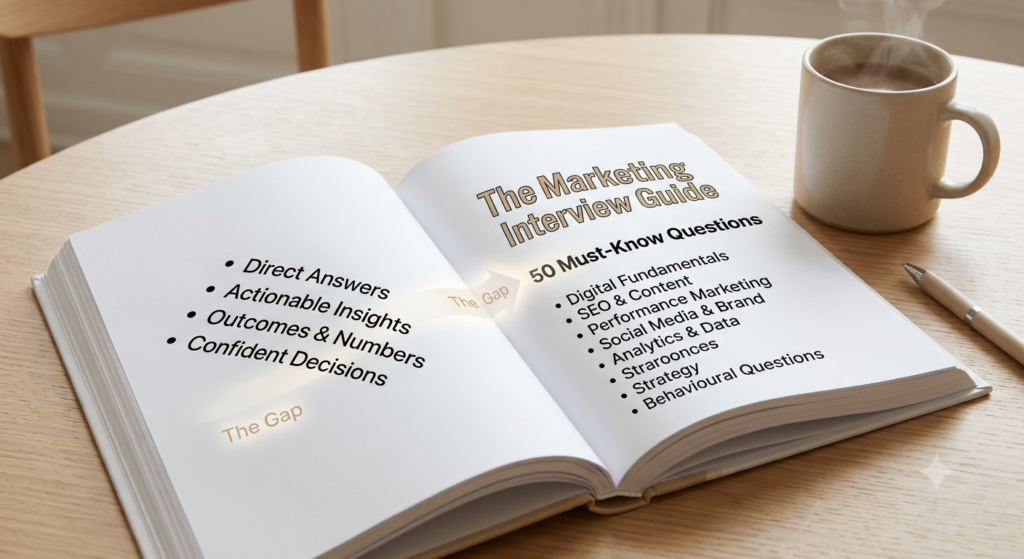
That’s the gap. And that’s what this guide is built to close.
These are the 50 most asked marketing interview questions across every major category: digital fundamentals, SEO and content, performance marketing, social media and brand, analytics and data, strategy, and behavioural questions. For each one, you’ll get a clear, direct answer that’s actually usable in a room, not just something that sounds right when you read it alone.
Table of Contents
Digital Marketing Fundamentals (Q1-6)
This category comes up in almost every marketing interview, whether you’re applying for a specialist or generalist role. Interviewers aren’t checking if you’ve memorised definitions. They want to see that you understand how the pieces connect.
Q1 -What is digital marketing, and how does it differ from traditional marketing?
Digital marketing is the promotion of products or services through online channels like search engines, social media, email, and websites. Traditional marketing uses offline channels like TV, print, radio, and outdoor advertising.
The practical difference comes down to measurability and targeting. With a Meta ad, you can see exactly how many people clicked, what they bought, and what it cost you to acquire each customer. With a newspaper ad, you know roughly how many people saw it, and not much else. Digital marketing also allows real-time adjustments. You can pause a campaign mid-flight, change the creative, and shift budget to what’s performing, which traditional channels simply don’t allow.
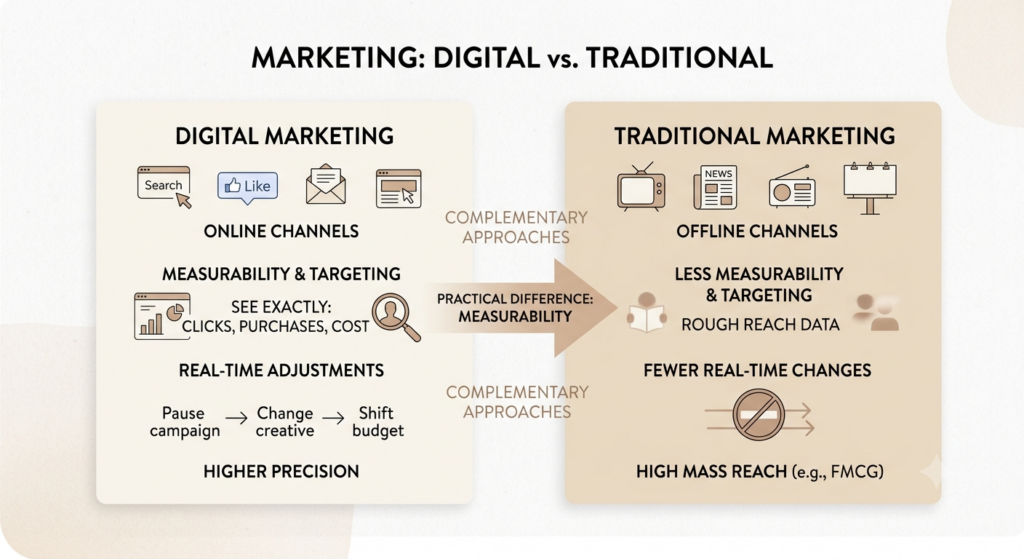
That said, traditional marketing still drives reach for categories like FMCG, where brands like Hindustan Unilever run mass TV campaigns alongside digital. The smartest marketers understand when to use which, not just that digital is “better.”
Q2 -What is the marketing funnel, and how do you apply it?
The marketing funnel is a model that maps the customer journey from initial awareness to purchase and loyalty. The classic version has four stages: Awareness, Interest, Desire, and Action (the AIDA model).
Applying it means matching your content and channels to where the customer is. At the Awareness stage, you’re running Instagram reels or YouTube pre-rolls. At the Consideration stage, you’re producing comparison articles or case studies. At the Decision stage, you’re running retargeting ads with offers or testimonials.
The mistake most candidates make is treating the funnel as a straight line. Customers move back and forth. Someone who considers a product for three months isn’t “stuck” at Interest. They’re taking their time. A good marketer builds touchpoints for each stage, not just the top.
Q3 -What is the difference between inbound and outbound marketing?
Inbound marketing attracts customers by creating content they’re already looking for, like blog articles, SEO, or social media. Outbound marketing interrupts people with messages they didn’t ask for, like cold emails, banner ads, or TV spots.
Zepto doesn’t wait for users to search for grocery delivery. It runs outbound Instagram ads with discount codes. But it also invests in SEO so that when someone searches “10-minute grocery delivery,” they show up organically. Both approaches have a place, and the best marketing strategies use them together.
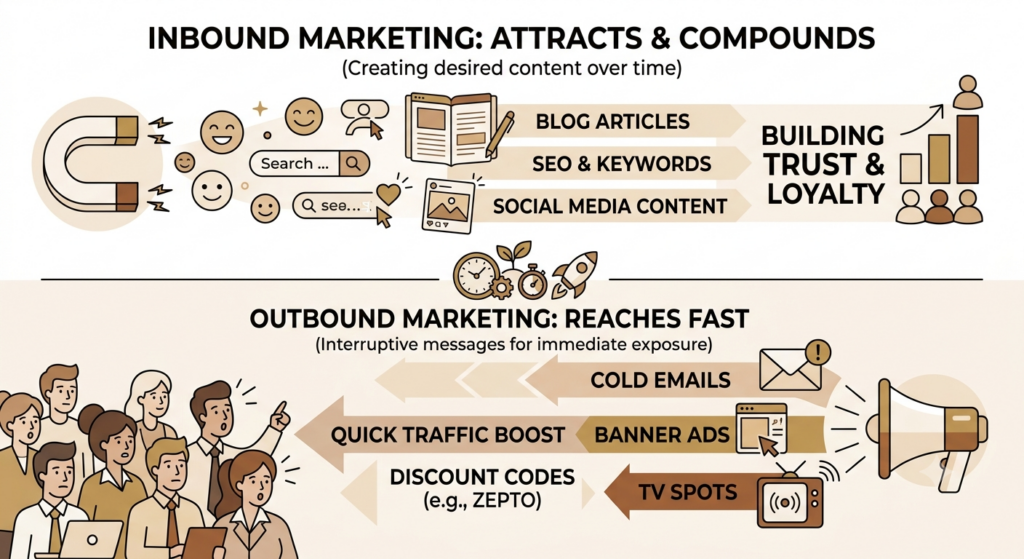
The short answer: inbound builds over time and compounds. Outbound delivers reach fast, but stops the moment you stop paying.
Q4 -How do you define a target audience?
A target audience is a specific group of people most likely to buy your product, defined by a mix of demographic, psychographic, and behavioural data.
Defining one means going beyond age and location. A brand like Mamaearth targets young Indian mothers aged 25–35 who are conscious about ingredients and distrust chemical-heavy products. That’s a psychographic and behavioural layer on top of the demographic one. You’d build this from customer interviews, social listening, analytics, and competitor positioning.
In an interview, the point to make is that a target audience isn’t who you want to sell to. It’s who your product actually solves a problem for.
Q5 -What is a buyer persona, and how do you build one?
A buyer persona is a semi-fictional profile of your ideal customer, built from real data about your existing customers and market research. It includes name, job role, goals, pain points, behaviour patterns, and preferred channels.
You build one by starting with your CRM data, identifying patterns in your best customers, and then validating with interviews or surveys. A well-built persona for a SaaS company might look like: Rahul, a 32-year-old digital marketing manager at a mid-size e-commerce brand in Bangalore, who is overwhelmed by fragmented data and needs tools that unify his reporting.
The persona is useful only if it’s specific. “Urban professionals aged 24–35” is a demographic. It’s not a persona.
Q6 -How do you measure the success of a digital marketing campaign?
You measure success against the objective you set before the campaign launched. There’s no universal answer. A brand awareness campaign is measured on reach, impressions, and brand recall lifts. A performance campaign is measured on ROAS, CAC, and conversion rate.
The most common mistake is measuring awareness campaigns on conversions or performance campaigns on likes. Every campaign needs a primary KPI tied to its objective, 2–3 supporting metrics to give context, and a clear benchmark so you know what “success” actually looks like before you start.
Marketing campaign success is defined by measuring performance against the campaign’s original objective. Brand campaigns track reach and recall. Performance campaigns track ROAS and customer acquisition cost. Applying the wrong metrics to a campaign is one of the most common errors in digital marketing.
SEO and Content Marketing (Q7-13)
SEO interview questions often catch people off guard because the field has changed dramatically in the last two years, especially with AI Overviews and generative search. Knowing on-page basics isn’t enough anymore.
Q7 -What is SEO and why does it matter?
SEO (Search Engine Optimisation) is the practice of improving a website’s visibility in unpaid search engine results. It matters because organic search remains one of the highest-intent acquisition channels in marketing.
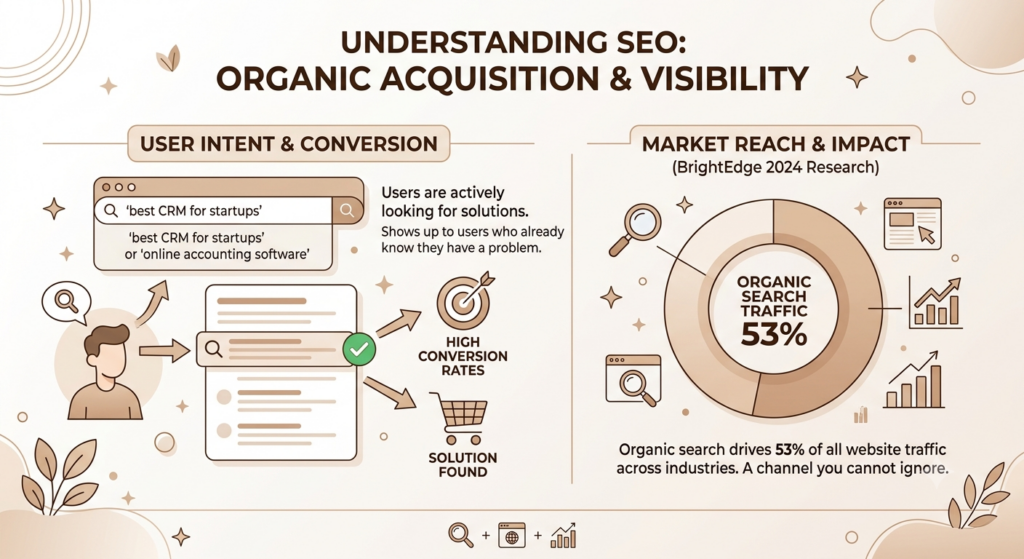
When someone searches “best CRM for startups,” they’re actively looking for a solution. A brand that shows up there doesn’t need to convince the user they have a problem. The user already knows. That’s why organic traffic converts at higher rates than most paid channels.
According to BrightEdge’s 2024 research, organic search drives 53% of all website traffic across industries. That’s not a channel you can afford to ignore.
Q8 -What is the difference between on-page and off-page SEO?
On-page SEO refers to everything you control on your own website: title tags, meta descriptions, heading structure, content quality, keyword placement, internal linking, and page speed.
Off-page SEO refers to everything outside your website that signals authority to search engines, primarily backlinks from other reputable sites. A link from The Economic Times to your article tells Google that your content is worth referencing.
Both matter. Nykaa ranks for thousands of beauty-related keywords because their on-page content is comprehensive and their off-page authority, built over years, supports those rankings. Without one, the other is limited.
Q9 -How do you do keyword research?
Keyword research is the process of identifying the search terms your target audience uses so you can create content that matches those queries.
Start with a seed keyword that describes your core topic, then use tools like Ahrefs, SEMrush, or Google Keyword Planner to find related terms with search volume and ranking difficulty scores. Look for keywords with clear commercial or informational intent. Don’t just chase high-volume terms. A keyword with 500 monthly searches and low competition will drive more results than chasing a 50,000-search term you can’t rank for.
Then group keywords by topic cluster and build content around the cluster, not individual keywords.
Q10 -What is domain authority?
Domain authority (DA) is a metric developed by Moz that predicts how likely a website is to rank in search engine results, on a scale of 1 to 100. Higher DA means stronger ranking potential.
It’s built primarily through backlinks from authoritative sites. Google doesn’t use Moz’s DA score directly, but the underlying factors it measures, such as quality inbound links and trustworthiness, do influence rankings. A new blog has a DA of around 1–5. A site like HubSpot is in the 90s.
Worth noting: DA is a third-party metric, not a Google metric. Don’t optimise for it directly. Build quality content, earn natural links, and DA will reflect that over time.
Q11 -What is the difference between a pillar page and a cluster page?
A pillar page is a long-form piece of content that covers a broad topic comprehensively. A cluster page goes deeper on one specific subtopic within that broader theme and links back to the pillar.
For example, YUP might have a pillar page on “Digital Marketing” and cluster pages on SEO, performance marketing, email marketing, and social media, all linking back to the pillar. This structure signals topical authority to Google because it shows the site covers a topic in depth, not just at the surface level. HubSpot built much of its organic presence on this model in the early 2010s.
Q12 -How do you measure content marketing ROI?
Content marketing ROI is measured by comparing the value generated by your content against what it costs to produce and distribute.
The value side can include: organic traffic generated, leads attributed to content, pipeline influenced by content, and direct revenue from content-driven conversions. The cost side includes writer fees, editor time, tool subscriptions, and distribution costs.
The tricky part is attribution. A blog post that someone read six months before purchasing isn’t always captured in last-click models. To get a real picture, you need multi-touch attribution and patience, because content typically takes 6–12 months to compound.
Q13 -What is GEO, and how is it different from traditional SEO?
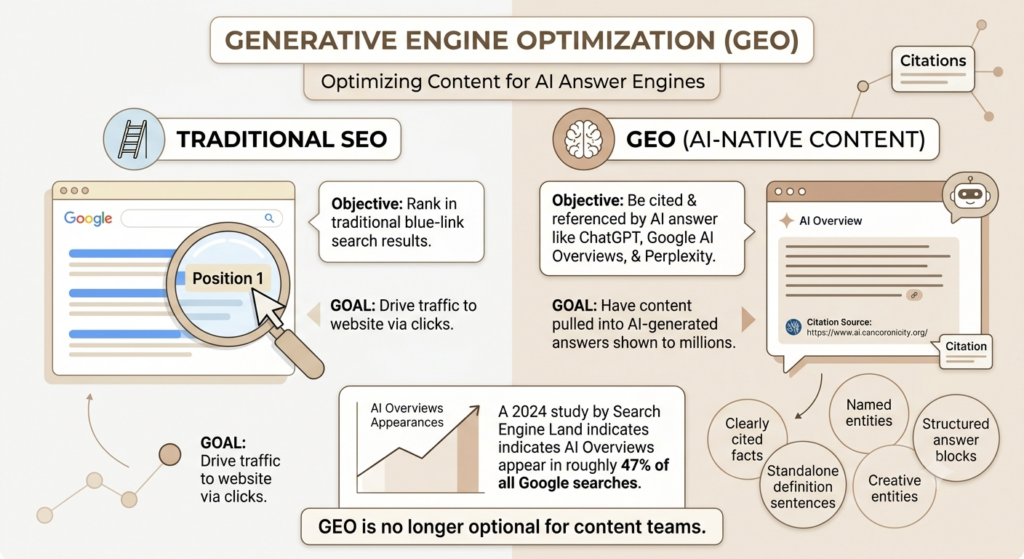
GEO (Generative Engine Optimisation) is the practice of optimising content to be cited and referenced by AI answer engines like ChatGPT, Google AI Overviews, and Perplexity, rather than just ranking in traditional blue-link search results.
Traditional SEO gets you ranked at position 1 in Google. GEO gets your content pulled into an AI-generated answer shown to millions of users who never click through to any website.
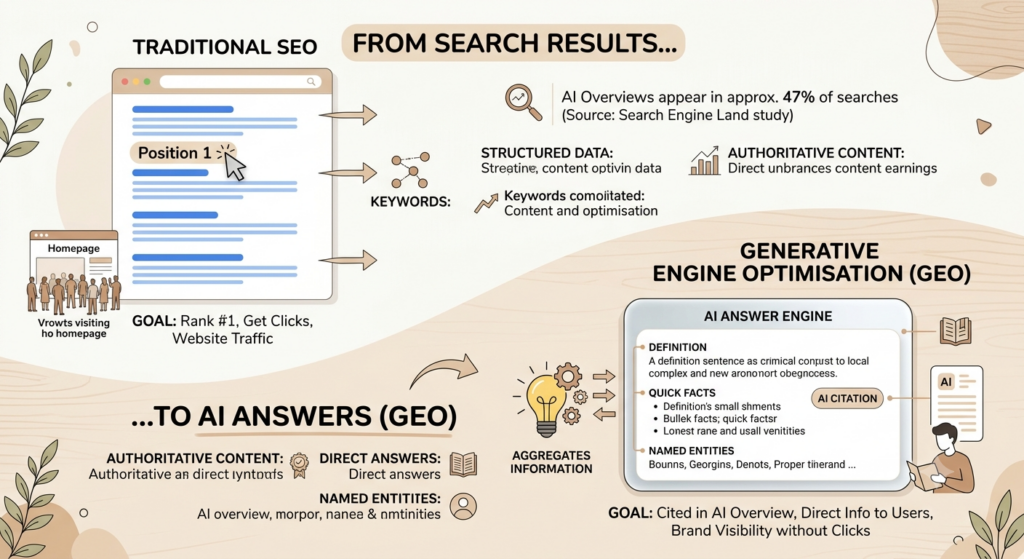
The key difference is in how you structure content. AI engines prefer clearly cited facts, named entities, standalone definition sentences, and structured answer blocks. According to a 2024 study by Search Engine Land, AI Overviews now appear in roughly 47% of all Google searches. That’s a signal that GEO isn’t optional anymore for content teams.
GEO (Generative Engine Optimisation) focuses on getting content cited in AI-generated answers from tools like Google AI Overviews and ChatGPT. Unlike traditional SEO, which targets ranked blue-link results, GEO targets the AI layer that increasingly sits above traditional results. It requires clearly structured content with named sources, standalone definitions, and explicit factual claims.
Performance Marketing and Paid Ads (Q14-20)
This section is where most performance marketing interview questions live. If you’re applying for a paid media role, expect to go deeper than the definitions here.
Q14 -What is ROAS, and how do you calculate it?
ROAS (Return on Ad Spend) measures how much revenue you generate for every rupee or dollar spent on advertising. It’s calculated by dividing revenue generated from ads by the amount spent on those ads.
Formula: ROAS = Revenue from Ads / Ad Spend
If you spent Rs 50,000 on a Meta campaign and generated Rs 2,00,000 in revenue, your ROAS is 4x. Whether 4x is good depends on your margins. A brand with 60% gross margins can sustain a lower ROAS than one running at 20%.
Most e-commerce brands target a minimum ROAS of 3x–4x, but this number is meaningless without understanding the category, the margins, and whether you’re in a growth phase or a profitability phase.
Q15 -What is the difference between CPC, CPM, and CPA?
CPC (Cost Per Click) is what you pay each time someone clicks your ad. CPM (Cost Per Thousand Impressions) is what you pay for every 1,000 times your ad is shown, regardless of clicks. CPA (Cost Per Acquisition) is what you pay each time someone completes a desired action, like a purchase or sign-up.
Use CPM when your goal is awareness and reach. Use CPC when you want to drive traffic. Use CPA when you’re optimising for conversions and have enough data for the algorithm to work with.
Swiggy, for example, might run CPM-based video campaigns during IPL season for brand recall, then follow up with CPA-optimised retargeting campaigns to convert the people who visited but didn’t order.
Q16 -How do you structure a Meta Ads campaign?
A Meta Ads campaign has three levels: Campaign, Ad Set, and Ad.
At the Campaign level, you set your objective (Sales, Traffic, Leads, etc.). This tells Meta’s algorithm what you’re optimising for. At the Ad Set level, you define your audience, budget, placement, and schedule. At the Ad level, you create the actual creative and copy.
A common structure for an e-commerce brand: one campaign with 2–3 ad sets targeting different audience segments (broad, interest-based, retargeting), with 3–4 ad variations per set. This lets Meta’s algorithm find the best combinations while giving you enough data to identify what’s working.
Don’t over-segment. Too many small ad sets starve the algorithm of data and increase your cost per result.
Q17 -What is audience segmentation in paid media?
Audience segmentation in paid media means dividing your potential customers into distinct groups based on shared characteristics, so you can deliver different messages or bids to each group.
Common segmentation methods include demographic (age, gender, income), interest-based, behavioural (purchase history, app usage), and custom audiences (your own CRM list or website visitors). Retargeting segments are often the most valuable, since they target people who’ve already shown interest.
boAt segments its paid media audiences carefully, running different creative to first-time visitors versus people who’ve added to cart but not purchased, since the message and offer needed to convert each group is completely different.
Q18 -How do you approach a campaign that is underperforming?
Start by diagnosing before changing anything. An underperforming campaign could be failing at the impression stage (not enough reach), the click stage (weak creative or targeting), or the conversion stage (landing page issues or pricing friction).
Check your funnel metrics in order: impressions, click-through rate, cost per click, landing page conversion rate, and cost per acquisition. Where the number drops is where the problem is.
If CTR is low, the creative or copy isn’t compelling enough. If conversion rate is low after a good CTR, the problem is on the landing page or with the offer itself, not the ad. Changing creative when the real issue is landing page UX is a waste of budget.
Q19 -What is retargeting, and when do you use it?
Retargeting is the practice of showing ads to people who have previously interacted with your brand, such as visiting your website, adding to cart, watching a video, or engaging with your social content.
It works because most people don’t convert on first contact. Retargeting brings them back when they’re warmer. A visitor who spent 3 minutes on your product page is far more likely to buy than a cold prospect who’s never heard of you.
Use retargeting when you have enough audience size (at least a few thousand people in the segment), a specific message relevant to where they dropped off, and a realistic conversion window. Retargeting someone who visited once six months ago rarely pays off.
Q20 -How do you manage a performance marketing budget across channels?
Start with the objective and the full-funnel view. Different channels serve different stages, and the budget should reflect that.
A basic framework: allocate a majority to your best-performing, most measurable channel first (often Meta or Google Search), then test secondary channels with a smaller budget. Review spend against contribution to revenue weekly, not just ROAS per channel. A channel with a lower ROAS might be driving awareness that other channels later convert.
Set a minimum threshold for what constitutes enough data before declaring something works or doesn’t. Pausing a campaign after 3 days with Rs 2,000 in spend isn’t a strategy.
Performance marketing budget management requires distributing spend across channels based on funnel objectives, not just ROAS. Channels driving upper-funnel awareness often influence lower-funnel conversions that get attributed elsewhere. Weekly contribution analysis, rather than isolated channel ROAS, gives a more accurate picture of budget efficiency.
Social Media and Brand (Q21-27)
Brand and social media questions test whether you think beyond vanity metrics. These are also where behavioural elements start to creep in, since interviewers want to see how you’d handle real situations.
Q21 -How do you build a social media strategy from scratch?
Start with the business objective, not the platforms. Social media is a channel, not a strategy. Ask: what is this brand trying to achieve in the next 6–12 months, and which social platforms are most likely to help them get there?
Then define your audience on each platform, since the same person behaves differently on Instagram versus LinkedIn. Map content types to each platform, set measurable goals, build a content calendar, and define what success looks like before you post a single thing.
One thing most candidates miss: distribution matters as much as creation. Great content with no amplification plan is wasted effort.
Q22 -What is brand positioning?
Brand positioning is the place a brand occupies in the mind of its target customer relative to competitors. It’s defined by the unique value a brand delivers, who it’s for, and what makes it different.
Mamaearth positioned itself as “toxin-free, natural beauty for young Indian mothers” at a time when most beauty brands were generic or aspirationally premium. That positioning shaped everything: the product line, the packaging, the communication, and the channels they invested in.
A strong positioning statement covers: who the customer is, what the category is, what the brand delivers, and why they should believe it.
Q23 -How do you maintain a consistent brand voice across channels?
A consistent brand voice comes from documenting it in a brand style guide that covers tone, language rules, examples of right and wrong usage, and platform-specific adaptations.
The voice should stay consistent while the format adapts. A brand that’s warm and direct should sound warm and direct, whether they’re posting a LinkedIn article or replying to a comment on Instagram. What changes is length, formality level, and content format, not the personality.
Assign someone (or a checklist) to review all content against the style guide before publishing. Brand voice inconsistency usually happens when multiple people are creating content without shared guidelines.
Q24 -What is the difference between brand awareness and brand recall?
Brand awareness is whether consumers recognise a brand when they encounter it. Brand recall is whether they can retrieve the brand name from memory when thinking about a category.
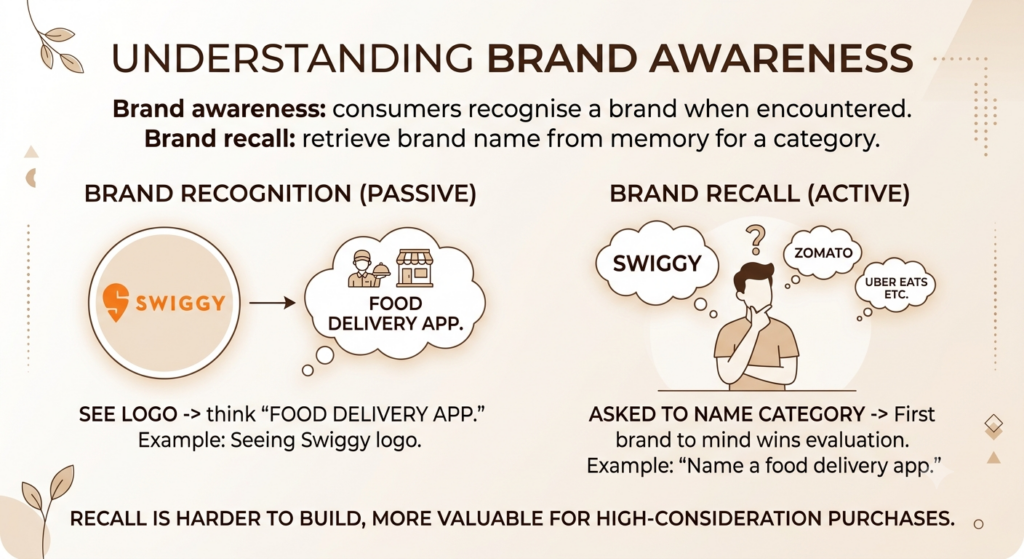
Recognition is passive. Recall is active. If you see the Swiggy logo and think “food delivery app,” that’s recognition. If someone asks you to name a food delivery app, and Swiggy is the first thing that comes to mind, that’s recall.
Recall is harder to build but more valuable for high-consideration purchases, because the brand that comes to mind first during a buying decision tends to win the evaluation process.
Q25 -How do you measure social media performance beyond likes and followers?
The metrics that matter are the ones tied to your business objective. For a community-building goal: engagement rate, saves, and DM volume. For a traffic goal: link clicks and referral traffic from social in Google Analytics 4. For a conversion goal: conversion events attributed to social in your paid media dashboard.
Follower count tells you audience size. Reach tells you how many people saw your content. Engagement rate tells you if they cared. Click-through rate tells you if they acted. Revenue attributed to social tells you if it’s working for the business.
Most social media managers who struggle to justify their budget are measuring the wrong things for the wrong objective.
Q26 -How would you handle a brand crisis on social media?
Acknowledge quickly, respond factually, and don’t disappear.
The worst thing a brand can do during a crisis is go silent. Silence reads as guilt. The second worst is responding defensively or dismissively. Step one is an acknowledgement post within a few hours, even if it only says “we’re aware and investigating.” Step two is a factual update once you have one, with clear language about what happened and what you’re doing about it.
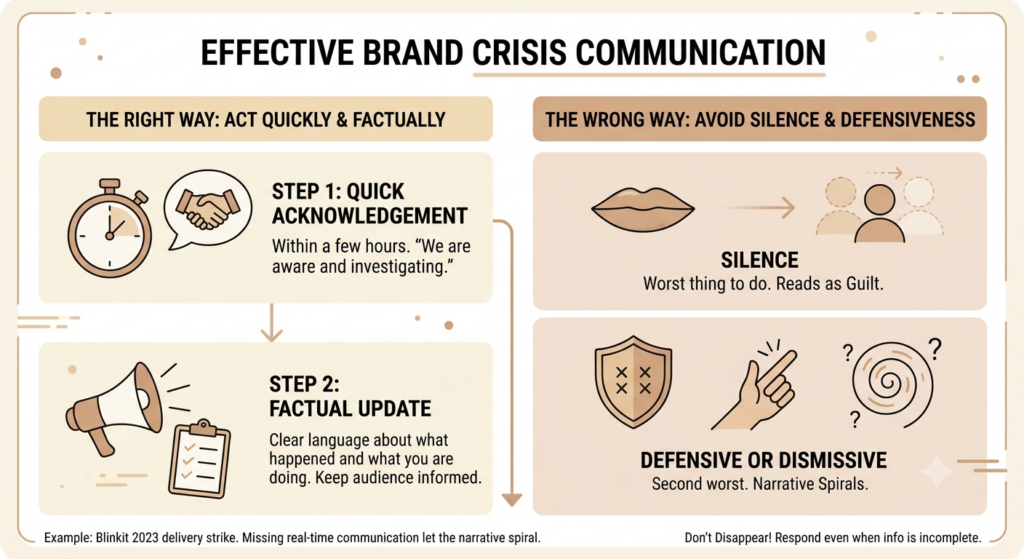
In 2023, when Blinkit’s delivery executive strike led to a wave of criticism on X (formerly Twitter), their communication was notably absent in real time, which let the narrative spiral. Brands that manage crises well keep their audience informed even when the information is incomplete.
Q27 -What is influencer marketing and how do you evaluate an influencer?
Influencer marketing is a form of partnership where brands pay or provide value to individuals with an audience to promote their products or services.
Evaluating an influencer means looking beyond follower count. The four things that matter are: audience authenticity (are the followers real?), engagement rate (are people actually interacting?), audience fit (does their follower base match your target customer?), and content quality (is their content aligned with your brand’s standards?).
For a D2C brand targeting young Indian consumers, a micro-influencer with 50,000 followers and a 5% engagement rate on skincare content will often outperform a celebrity with 5 million followers and 0.2% engagement.
Analytics and Data (Q28-34)
These digital marketing interview questions separate candidates who can talk about data from those who can actually use it to make decisions.
Q28 -What metrics do you track to measure campaign success?
The right answer depends on the campaign objective. But there’s a tier structure that applies broadly:
Primary KPI: The one number that defines success. Revenue, leads, ROAS, or reach, depending on the objective. Supporting metrics: 2–3 numbers that explain why the primary KPI is where it is. For example, if ROAS is low, CTR and conversion rate tell you where the breakdown is. Diagnostic metrics: Tracked in the background but only examined when something looks off.
Presenting 15 metrics in a report is not sophisticated. It’s noise. The ability to isolate the 2–3 numbers that actually matter is a core analyst skill.
Q29 -What is attribution modelling, and which model do you prefer?
Attribution modelling is the process of assigning credit for a conversion to one or more marketing touchpoints that occurred before the conversion.
Common models include last-click (all credit to the final touchpoint), first-click (all credit to the first), linear (credit spread equally across all), and data-driven (credit distributed based on actual conversion contribution, using statistical modelling). Google Analytics 4 now defaults to the data-driven model.
Most candidates say data-driven is best because it sounds sophisticated, and often it is. But data-driven attribution requires significant conversion volume to produce reliable results. For brands with low monthly conversions, a linear or position-based model might actually give a more honest picture.
Q30 -What is the difference between correlation and causation in marketing data?
Correlation means two variables move together. Causation means one variable directly causes the other to change.
A classic mistake: a brand notices that email open rates are highest on Tuesdays, and conversions are also highest on Tuesdays. The temptation is to conclude that Tuesday emails cause more conversions. But both might be driven by a third factor, like the fact that the brand sends promotional emails on Tuesdays when their audience is most active at work.
Before drawing causal conclusions from marketing data, ask: is there another variable that could explain both movements? Could this be a coincidence over a short time period? Has this held across multiple campaigns?
Q31 -How do you use GA4 to analyse website performance?
Google Analytics 4 (GA4) is event-based, which means every user interaction from page view to scroll to button click is captured as an event, not just session-level data.
To analyse website performance in GA4, start with the Acquisition report to see where traffic is coming from. Then go to the Engagement report to check average session duration, pages per session, and event count. Use the Conversion report to track how many sessions resulted in your defined goal completions. Use Explorations for custom analyses like funnel breakdowns or cohort views.
GA4’s biggest power is connecting the full user journey across sessions and devices. Its biggest limitation for new users is that the interface is genuinely less intuitive than Universal Analytics was.
Q32 -What is a cohort analysis?
A cohort analysis groups users who share a common characteristic- such as their signup date, first purchase, or first website visit- and tracks their behaviour over time. It helps marketers understand retention, engagement, and customer lifetime value by comparing how different groups perform.
For example, you could group all users who first visited your website in January 2026 and measure what percentage returned in February, March, and April. Comparing these cohorts helps identify whether changes in your marketing campaigns, onboarding experience, or product improvements have increased user retention.
For a SaaS company, cohort analysis by signup month can reveal whether a new onboarding flow or product feature improved customer retention. For instance, if the January cohort retains 40% of users after 30 days while the April cohort retains 60%, the changes introduced between those periods likely had a positive impact and deserve further analysis.
Q33 -How do you approach A/B testing?
Start with a hypothesis. An A/B test without a hypothesis is just randomly changing things and hoping something works.
A good hypothesis looks like: “Changing the CTA button copy from ‘Buy Now’ to ‘Get It Today’ will increase click-through rate because it’s more benefit-focused and creates a mild urgency signal.”
Then: define your primary metric, calculate the sample size you need to reach statistical significance (most testing tools do this for you), run the test until you hit that sample size (don’t stop early because one variant looks like it’s winning), and then read the result. If the test wins, ship it. If it doesn’t, treat the insight as valuable even if the result is negative.
Q34 -What is customer lifetime value and how do you calculate it?
Customer Lifetime Value (CLV or LTV) is the total revenue a business can expect from a single customer over the course of their relationship.
Basic formula: CLV = Average Order Value x Purchase Frequency x Average Customer Lifespan
If a customer spends Rs 1,500 per order, orders 4 times a year, and stays a customer for 3 years, their CLV is Rs 18,000.
Why it matters: if you know your CLV, you know the maximum you can spend to acquire a customer and still be profitable. A brand with a CLV of Rs 18,000 can afford a much higher CAC than one with a CLV of Rs 2,000. This is why subscription businesses are valued so highly.
Customer Lifetime Value (CLV) is calculated by multiplying average order value, purchase frequency, and customer lifespan. A higher CLV allows brands to spend more on customer acquisition while remaining profitable. Understanding CLV is foundational to making sound budget decisions in performance marketing.
Strategy and Planning (Q35-40)
Marketing strategy interview questions reveal whether you think like a practitioner or a theorist. The difference shows in the specificity of your answers.
Q35 -How do you build a go-to-market strategy?
A go-to-market (GTM) strategy is a plan that outlines how a company will bring a product or service to market and reach its target customers.
The core components: define the target customer and their pain point, identify the value proposition (why this product solves the problem better than alternatives), choose the channels through which you’ll reach them, set pricing that reflects that value, and define the sales or conversion motion.
For a B2B SaaS product launching in India, a GTM strategy might involve: targeting Series A and B startups, leading with content marketing and LinkedIn thought leadership, with a product-led trial as the conversion mechanism. The strategy is only complete once you’ve defined what traction looks like in the first 90 days.
Q36 -What is a marketing audit, and how do you conduct one?
A marketing audit is a systematic review of a company’s marketing activities, assets, performance, and competitive position to identify what’s working, what’s not, and where the gaps are.
To conduct one: start with business objectives, then assess current channel performance against those objectives, audit the content library for quality and coverage gaps, review the competitive landscape, and evaluate the team’s skills and tools.
The output should be a clear picture of: channels that are over- or under-invested, content gaps by audience segment and funnel stage, and opportunities the brand isn’t currently exploiting.
Q37 -How do you prioritise marketing channels with a limited budget?
Start with your customer’s behaviour, not your own comfort zone. Where do your best customers spend their time, and how do they find products like yours?
Then prioritise based on three things: intent (channels where your audience is actively looking for a solution, like Google Search, convert better), proximity to revenue (channels that contribute directly to purchase outperform those that contribute indirectly), and speed of feedback (channels where you can measure results quickly let you improve faster).
For most early-stage Indian D2C brands, a combination of Meta ads for customer acquisition and Instagram for organic community is the first logical place to start, before expanding into Google, YouTube, or influencer campaigns.
Q38 -How do you align marketing goals with business objectives?
Every marketing goal should map directly to a business objective. If the business objective is to grow revenue by 30% this year, the marketing goal might be to increase qualified leads by 40% (accounting for a realistic conversion rate) or to improve customer retention rate by 15% (which reduces the revenue burden on new acquisition).
The mistake is setting marketing goals in isolation, like “increase Instagram followers by 10,000,” without connecting them to revenue or growth. Follower growth is a marketing activity. Revenue contribution is a business outcome.
Start every planning cycle with the business number, then work backwards to what marketing needs to deliver to hit it.
Q39 -How do you approach launching a product in a new market?
Treat it like a hypothesis test, not a full campaign.
Start by understanding the new market’s customers: what problems do they have, how are they currently solving it, and what existing competitors are they using? Use that to adapt your positioning, since the value proposition that worked in your home market may need adjustment.
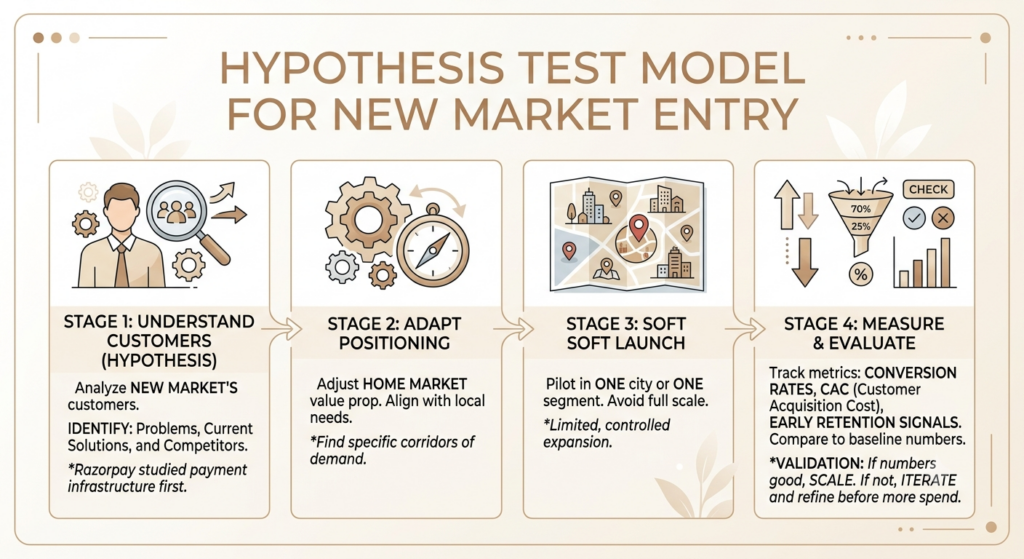
Run a soft launch in one city or one audience segment before scaling. Measure conversion rates, CAC, and early retention signals. If the numbers are better than your baseline, scale. If not, iterate before spending more.
Razorpay’s expansion into Southeast Asian markets followed a version of this model, validating payment infrastructure and merchant demand in specific corridors before building out full regional operations.
Q40 -How would you build a marketing plan from scratch with a 90-day timeline?
Days 1–30: Audit everything. Understand the business, the product, the current customer, the competition, and what’s been tried before. Don’t run a single campaign until you know what you’re working with.
Days 31–60: Launch the first round of activity based on your audit findings. Keep it focused: 2–3 channels maximum, with clear hypotheses for each. Track results from week one.
Days 61–90: Optimise based on what the data says. Double down on what’s working. Kill or revise what isn’t. Prepare a 90-day results review and a forward-looking plan for month 4 onwards.
The 90-day frame matters because it’s long enough to see a real signal, short enough to stay accountable.
Email, Growth, and Behavioural Questions (Q41–50)
These are the questions that catch people off guard because they’re less structured. Behavioural questions especially require you to have real examples ready, not just frameworks.
Q41 -What makes a high-converting email subject line?
A high-converting email subject line does one thing: it makes the recipient curious enough or convinced enough to open.
The techniques that consistently work: specificity (“Your order for the next 48 hours”), personalisation (first name or behavioural trigger), clear benefit (“Your free report on Q2 marketing benchmarks is here”), and curiosity gaps (“We tried this so you don’t have to”). Subject lines under 50 characters perform better on mobile, where most emails are opened.
What doesn’t work: clickbait that doesn’t deliver in the email body, all-caps, excessive punctuation, and spam trigger words like “FREE!!” that hit filters before they hit inboxes.
Q42 -What is email deliverability, and how do you improve it?
Email deliverability is the ability of your emails to actually reach your subscribers’ inboxes, rather than being filtered to spam or blocked entirely.
To improve it: authenticate your domain with SPF, DKIM, and DMARC records (this signals to inbox providers that you’re a legitimate sender), maintain a clean list by regularly removing inactive subscribers, keep your bounce rate below 2%, and monitor your sender reputation using tools like Google Postmaster or MXToolbox.
Most deliverability problems come from sending to stale, unengaged lists. Sending 10,000 emails to people who haven’t opened anything in 18 months tanks your sender score far more than it’s worth.
Q43 – What is growth hacking, and how is it different from traditional marketing?
Growth hacking is an experimental, cross-functional approach to accelerating growth by finding unconventional, often product-integrated tactics that are faster and cheaper than traditional marketing.
The key difference is the process. Traditional marketing runs on planned campaigns with defined timelines. Growth hacking runs on rapid experiments: test something in a week, measure, kill or scale, repeat. It’s also not limited to marketing. It often involves product changes, referral mechanics, or onboarding flows.
Dropbox’s referral programme, which gave both referrer and new user extra storage for each successful referral, is the canonical example. It drove 60% of all new Dropbox signups at its peak and cost a fraction of paid acquisition.
Q44 -What is product-led growth?
Product-led growth (PLG) is a go-to-market strategy where the product itself is the primary driver of customer acquisition, conversion, and expansion. Instead of relying on a sales team or marketing funnel to convince people to buy, users discover value by using the product first.
Canva and Notion are the most-cited examples. Both offer free tiers that are genuinely useful, which drives massive organic adoption. Users who get value individually then bring the product into their teams, and those teams convert to paid plans.
PLG works best when your product has a viral or collaborative element and when the time-to-value is short enough that users experience a win before they’re asked to pay.
Q45 -Tell me about a campaign that failed. What did you learn?
This question isn’t a trap. Interviewers are looking for self-awareness, analytical thinking, and whether you can translate failure into improvement.
A strong answer has three parts: what the campaign was and what you expected, what actually happened and why (the root cause, not surface-level excuses), and what you changed or would change as a result.
What to avoid: blaming external factors without acknowledging what you could control, describing a campaign that “didn’t hit targets” without explaining what those targets were or why they were set, and claiming nothing failed because you intervened early. Everyone has a failure story. Have yours ready.
Q46 -How do you stay updated with marketing trends?
Be specific. “I read blogs and follow LinkedIn” is not an answer.
Name your actual sources: specific newsletters (like Morning Brew, Marketing Brew, or Crystal Clear by YUP for the Indian marketing context), specific podcasts, specific community groups or Slack channels, and specific practitioners whose thinking you trust. Describe how you apply what you read rather than just consuming it.
Bonus points if you can point to a trend you read about, tested, and either validated or debunked from your own experience. That shows you’re not just a follower of trends but a practitioner who stress-tests them.
Q47 -How do you collaborate with a product or sales team?
Good marketing and product collaboration is built on shared objectives and regular communication, not just shared Slack channels.
With product: sit in on sprint reviews, understand what’s shipping and when, and flag how features will be communicated externally before they go live. Misalignment between product and marketing on launch timing is one of the most common reasons good features underperform.
With sales: understand what objections they hear most often, use that to sharpen your messaging, and make sure your lead quality matches what the sales team can actually close. A marketing team that generates thousands of leads a month that sales can’t convert is spending its budget on the wrong audience.
Q48 -What would you do in your first 30 days as a marketing hire?
Listen, understand, and resist the urge to change things.
Week 1–2: Understand the business: what’s the product, who’s the customer, what’s the current acquisition motion, and what’s working? Read everything: analytics reports, past campaigns, sales call recordings if available. Talk to customers if you can.
Week 3–4: Form hypotheses about the highest-leverage opportunities. Where is the biggest gap between current performance and potential? What’s one thing you could test or improve in 60 days that would create a real signal?
Present your 30-day observations and your 60-day plan to your manager. Showing your thinking early builds trust without overcommitting to changes before you’ve understood the context.
Q49 -How do you handle disagreement with a client or manager on strategy?
Start by understanding their position fully before defending your own. Most strategic disagreements aren’t about right and wrong. They’re about different assumptions about the customer, the market, or the risk involved.
If you’ve genuinely done the analysis and believe you’re right, present it as a recommendation with evidence: here’s what the data shows, here’s the test I’d suggest, here’s what we’d learn from it. Make it easy to say yes to a small experiment rather than asking them to commit to a full strategy change.
Sometimes you’ll disagree, and the decision will go the other way. When that happens, execute with full effort and track the results honestly. Being right after the fact is less important than demonstrating that you’re someone who can commit to a direction even when you had a different view.
Q50 -Where do you see marketing heading in the next 2 years?
Three shifts are already underway and will compound.
First, AI in content and creative production is already changing the volume and speed of what’s possible, but the real shift is in creative testing. Brands that build systematic AI-driven creative testing will outperform those that don’t. Second, search is being disrupted by generative AI. The brands that invest in being cited by AI engines, not just ranked by Google, will build a durable advantage that brands still running traditional SEO won’t see coming. Third, first-party data is becoming the primary competitive asset in marketing, as third-party cookies disappear and platform attribution gets harder. Brands that build direct customer relationships now, through email, loyalty programmes, and owned communities, will have better data, better targeting, and lower CAC than competitors who’ve relied on platform audiences.
How to Answer Marketing Interview Questions Like a Pro
Here’s the part most prep guides skip.
Knowing the answer to “What is ROAS?” is not the same as being able to answer “How do you manage ROAS across a multi-channel setup when one channel consistently underperforms?” The first is a definition. The second is a decision.
Every answer in a marketing interview should end with one of three things: a result (what happened), a number (how much, by how much, compared to what), or a decision (what you did or would do next and why).
Compare these two answers to Q18 (underperforming campaign):
Weak: “I’d look at the campaign metrics, identify where the problem is in the funnel, and then adjust the creative or targeting accordingly.”
Strong: “First, I’d check where in the funnel the drop is happening. If CTR is fine but conversion rate is low, the problem is the landing page, not the ad. I’d pull heatmap data from Hotjar and check bounce rate on the landing page in GA4. Last time I ran this diagnosis on a campaign for [brand], the landing page load time on mobile was 7 seconds. We fixed that, and the conversion rate went from 1.2% to 2.8% within two weeks.”
The second answer has a process, a real action, and a specific outcome. That’s the difference between a candidate who knows marketing and one who has done marketing.
One last thing: be honest about what you don’t know. Interviewers with real marketing experience can tell when you’re bluffing on a technical question. Saying “I haven’t worked with that specific tool, but here’s how I’d approach learning it” signals intellectual honesty, which is more valuable in a junior hire than false confidence.
Conclusion
The 50 marketing interview questions in this guide span every category you’re likely to face. But the thread running through all of them is the same: interviewers want to see how you think and decide, not just what you’ve memorised.
Know the concepts. Have your examples ready. End every answer with a result, a number, or a decision. That’s the formula. Most candidates who get rejected knew the material. They just couldn’t show what they’d done with it.
FAQ
How do I prepare for a marketing interview in one week?
Spend the first two days on the fundamentals: funnel, attribution, channels, and measurement frameworks. Days 3–4, go deep on the specific role, since a performance marketing interview requires deeper prep on ROAS, bidding strategies, and campaign structure than a content role would. Day 5, prepare 5–6 real examples from your past work with specific numbers and outcomes. Day 6, do a mock interview out loud, not just in your head. On the final day, research the company: their recent campaigns, their competitor positioning, and any recent news.
What do marketing interviewers actually look for?
Beyond technical knowledge, they’re evaluating three things: analytical thinking (can you identify a problem from data and decide what to do?), communication clarity (can you explain complex ideas without jargon?), and ownership (when things went wrong, what did you do?). Enthusiasm for the category and genuine curiosity about the company’s marketing challenges also stand out more than candidates realise.
How do you answer “Tell me about yourself” as a marketer?
Lead with what you’ve done, not where you studied. Structure it as: what you’ve been focused on most recently, what you’re best at, and why this specific role is the right next step for you. Keep it under 2 minutes. End with something that connects your experience to what the company is working on.
What are the most common mistakes marketing candidates make in interviews?
The biggest: giving generic answers with no numbers (“I helped improve engagement”) rather than specific ones (“our engagement rate went from 2.1% to 4.7% over 3 months”). Second most common: not having a clear failure example ready. Third: not researching the company’s actual marketing well enough to ask intelligent questions at the end.
Do I need to know all 50 of these questions to pass a marketing interview?
No, but you should know the ones most relevant to the role you’re applying for. Performance marketing roles will weigh Q14–20 heavily. Brand and social roles will focus on Q21–27. Analytics-focused roles will go deep on Q28–34. Know your strengths, know the role, and go deep on the overlap.
How is a fresher supposed to answer questions about campaigns when they have no experience?
Use academic projects, internship work, personal experiments (running a small Instagram page, testing Google Ads with a minimal budget), and case study analyses of real brands. The key is to show your thinking process, not just execution. “I analysed Nykaa’s content strategy for a college project and found that their top-performing posts consistently had a product + educational content formula” is a legitimate insight.
What questions should I ask the interviewer at the end?
Ask things that show you’ve thought about the role and the company: “What does success look like in the first 90 days for this role?”, “What’s the biggest marketing challenge the team is working on right now?”, and “What’s one thing you wish candidates understood better about this role?” Avoid asking about salary or benefits in the first interview unless they bring it up.
Are GEO and AI SEO relevant for marketing interview questions in 2026?
Yes. In 2026, GEO (Generative Engine Optimisation) and AI Search Optimisation are relevant topics for marketing interviews, especially for roles in SEO, content marketing, inbound marketing, growth marketing, and digital marketing. However, they should be presented as an evolution of SEO rather than a replacement for traditional SEO.
How do I answer Q50 (“Where do you see marketing heading?”) without sounding like I just read the latest trend report?
Ground your answer in something you’ve actually observed or tested. “I’ve been experimenting with AI for creative testing and noticed that the winning variation was one I wouldn’t have predicted, which makes me think systematic AI testing will change how performance teams work.” An observation from your own experience is always more credible than a summary of someone else’s predictions.