

Pragmatic marketing gets thrown around quite a bit, and honestly, it can start to feel like just another buzzword. But it’s not really about terminology. It’s about how teams decide what to build and why. This guide breaks that down in a more practical way. It looks at the framework, yes, but also the thinking behind it… where decisions come from, where they go wrong. Some ideas might seem straightforward, almost obvious. Still, they’re easy to overlook once things get busy. When pragmatic marketing is actually followed through, though, things tend to line up better. Products land closer to what people need, and growth feels a bit less forced.
Table of Contents
What Is Pragmatic Marketing?
Pragmatic marketing, stripped of the buzzwords, is really about one thing: making sure what gets built actually matters to the market.
Not what seems valuable internally. Not what a roadmap says should work. What the market has already shown it cares about.
At its simplest, pragmatic marketing is a customer-centric, market-driven approach where decisions are shaped by real demand, not assumptions. That sounds straightforward… but it’s surprisingly rare in practice.
A lot of companies still operate in reverse. They start with an idea, build around it, and only later ask whether anyone actually needed it. By then, budgets are spent, timelines are locked, and changing direction becomes… messy.
Pragmatic marketing flips that sequence.
Pragmatic marketing definition
A more grounded way to define it:
Pragmatic marketing is an approach that focuses on identifying, validating, and solving real market problems using data, customer insight, and continuous feedback.
There’s a quiet but important shift in that definition. The focus isn’t on promoting products. It’s on solving problems first, and letting everything else follow.
What “pragmatic” means in marketing
“Pragmatic” in this context doesn’t mean conservative or cautious. It means practical in a very deliberate way.
- Decisions are based on evidence, not internal enthusiasm
- Ideas are tested before being scaled
- Effort is directed toward outcomes, not activity
And maybe more importantly, it means being willing to let go of ideas that don’t hold up in the real world.
That part tends to be harder than it sounds.
Marketing teams, product teams… people get attached. To campaigns, to features, to positioning angles. Pragmatic marketing introduces a bit of discipline there. If the market doesn’t respond, that’s the signal. Not something to explain away.
Pragmatic marketing vs product-first marketing
The contrast with product-first thinking makes things clearer.
In a product-first setup:
- Something gets built based on internal belief or vision
- Marketing comes in later to create demand
- Customer feedback is reactive
In pragmatic marketing:
- The problem is identified before the product exists
- Demand is validated early
- Marketing and product thinking happen together, not in sequence
It changes the starting point.
Instead of asking, “How do we sell this?”, the question becomes, “Is this worth building at all?”
That shift alone filters out a lot of weak ideas before they consume time and resources.
Core idea: solving validated market problems, not assumptions
Everything comes back to validation.
Not gut feeling. Not stakeholder opinions. Not even past success.
Validation.
That usually comes from patterns:
- Repeated customer complaints
- Clear gaps in competitor offerings
- Behavioral signals that point to unmet needs
Once those signals are strong enough, decisions become… calmer, in a way. There’s less guesswork.
Positioning feels sharper. Messaging lands better. Sales conversations don’t feel forced.
Because the product isn’t trying to create a need. It’s stepping into one that already exists.
Why Pragmatic Marketing Matters
The environment has changed quite a bit over the last few years. Not just in terms of tools or channels, but in how quickly markets react.
Customers notice more. Expect more. Switch faster.
That alone has made guesswork expensive.
Pragmatic marketing matters now because the margin for being wrong has shrunk. A product that misses the mark doesn’t just underperform… it gets ignored almost immediately.
Shift toward customer-led product development
There’s been a noticeable shift from internally driven product decisions to customer-led ones.
Not because it’s trendy, but because it’s necessary.
Customers today:
- Compare options in minutes
- Read reviews before even visiting a site
- Share feedback publicly, often bluntly
That changes the power dynamic.
Companies no longer control the narrative the way they used to. The market responds in real time, and those responses are visible to everyone.
So naturally, product development has adjusted:
- Ideas get validated earlier
- Releases happen in smaller increments
- Feedback loops are tighter
Pragmatic marketing fits neatly into this because it’s already built around listening first and building second.
Role of AI, analytics, and real-time feedback loops
Data isn’t new. What’s different is how quickly it shows up and how much of it exists.
Every interaction leaves a trace. Clicks, drop-offs, usage patterns… it all adds up.
That creates an opportunity, but also a bit of noise.
Without a clear approach, teams end up reacting to everything. One metric goes up, another goes down, and suddenly priorities shift without much direction.
Pragmatic marketing acts as a filter.
It helps answer:
- Which signals actually matter?
- What indicates a real problem versus a temporary fluctuation?
- When is something worth acting on?
Real-time feedback is powerful, but only if it’s interpreted correctly. Otherwise, it just creates urgency without clarity.
Why product failures often come from poor market validation
Most failed products don’t fail because they were poorly built.
They fail because they weren’t needed.
That’s uncomfortable, but it shows up again and again.
Common patterns:
- The problem wasn’t painful enough
- The audience wasn’t clearly defined
- The willingness to pay was assumed, not tested
In some cases, everything looks right internally. Good design, strong messaging, and even initial interest. But when it comes to sustained demand… it drops off.
That usually traces back to weak validation early on.
Pragmatic marketing tries to catch that early. Before scaling. Before heavy investment. Before teams commit fully to a direction that might not hold.
How pragmatic marketing aligns with modern search and content expectations
There’s also a broader shift in how content and messaging perform.
What stands out now tends to be:
- Directly relevant
- Clearly useful
- Focused on solving a specific problem
Generalized messaging gets ignored quickly.
Pragmatic marketing naturally leads to more focused communication because it starts with real problems. Not abstract personas or broad assumptions.
So instead of saying everything to everyone, messaging becomes tighter. More specific. Sometimes, even narrower than teams are initially comfortable with.
But that specificity is usually what makes it work.
Core Principles of Pragmatic Marketing
The framework and process get most of the attention, but without the underlying principles, they don’t hold up for long.
These principles shape how decisions are made. Quietly, but consistently.
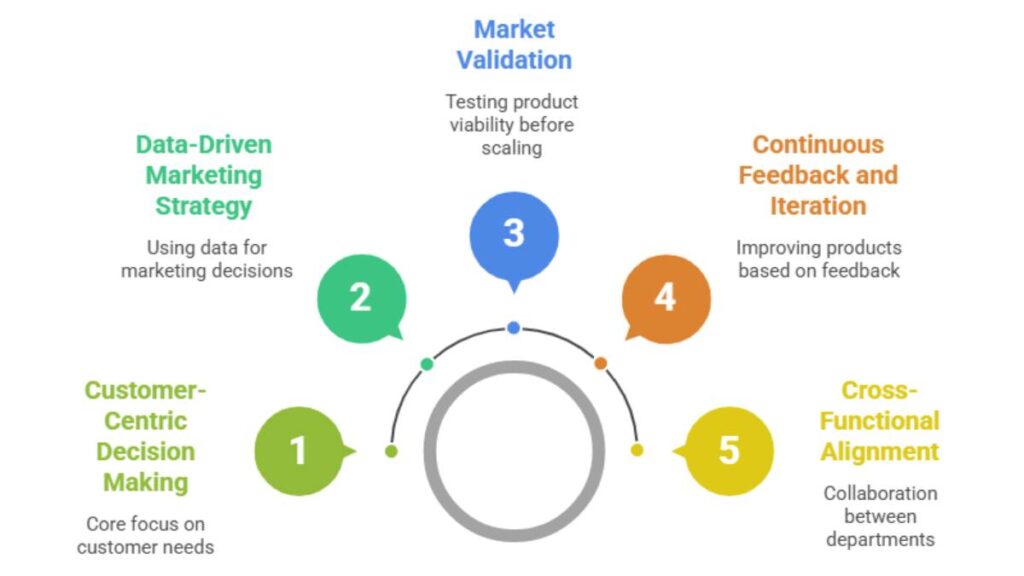
Customer-centric decision making (voice of the customer)
This goes beyond collecting feedback.
It’s about actually using it.
Customer input shows up in different forms:
- Direct conversations
- Support tickets
- Reviews and complaints
- Behavioral patterns
The key is not just gathering this information, but letting it influence decisions across teams.
Product changes. Messaging adjustments. Even pricing.
In many organizations, customer insights are collected but not fully integrated. They sit in reports, get discussed briefly, and then… fade out.
Pragmatic marketing treats that input as a primary driver, not a secondary reference.
Data-driven marketing strategy (evidence over intuition)
Experience still matters. There’s no replacing pattern recognition that comes from years in the field.
But intuition alone isn’t enough.
Decisions need support:
- Quantitative data to show what’s happening
- Qualitative input to explain why it’s happening
Sometimes they align neatly. Sometimes they don’t.
That tension is useful.
It forces a closer look before committing to a direction. It slows things down just enough to avoid obvious mistakes, without stopping progress entirely.
Market validation before product scaling
Scaling too early is a common issue.
Something shows early traction, teams get excited, budgets increase… and then performance flattens out.
Usually, because validation wasn’t deep enough.
Pragmatic marketing leans toward:
- Smaller initial releases
- Controlled testing environments
- Gradual expansion
It can feel slower at the start. There’s often pressure to move faster, especially in competitive markets.
But skipping validation tends to create bigger delays later.
Continuous feedback and iteration
Launch isn’t the finish line. It’s more like the midpoint.
Once something is live, the real signals start coming in:
- How people actually use the product
- Where do they drop off
- What they complain about
That information feeds back into:
- Product improvements
- Messaging tweaks
- Positioning adjustments
Iteration becomes ongoing. Not in a chaotic way, but as a structured loop.
The market shifts. Expectations change. Competitors respond.
Staying static isn’t really an option.
Cross-functional alignment (product, marketing, sales)
This is where things either come together or fall apart.
If product, marketing, and sales operate on different assumptions, friction shows up quickly.
- Marketing promises something the product doesn’t fully deliver
- Sales hears objections that don’t match the messaging
- Product builds features that aren’t clearly communicated
Alignment doesn’t mean constant meetings or heavy processes. It’s more about shared understanding.
- Who the customer is
- What problem is being solved
- Why it matters
When that’s clear across teams, execution becomes smoother. Decisions feel less fragmented.
And overall… things just move with less resistance.
Pragmatic Marketing Framework Explained
This is where things usually start to click… or fall apart.
A lot of teams like the idea of being customer-driven. It sounds right. But when it comes to actually making decisions across product, marketing, and sales, things get messy. Everyone works with slightly different assumptions. Priorities drift.
The framework exists to fix that. Or at least reduce the chaos.
Not by forcing rigid steps. More by giving teams a shared way to think through problems. A common reference point. That’s the real value.
What Is the Pragmatic Marketing Framework?
At its core, the pragmatic marketing framework is a structured way to connect market insight with business decisions.
It answers a very practical question:
How does a company go from “there’s a problem in the market” to “here’s a product people actually want and understand”?
Without that structure, decisions tend to be fragmented.
- Product builds based on internal priorities
- Marketing shapes messaging based on what’s available
- Sales fills in the gaps during conversations
It kind of works… until it doesn’t.
The framework brings everything back to a shared starting point. The market. Not timelines, not internal excitement, not feature lists.
And it forces some discipline around key questions:
- Is this problem real, or just assumed?
- Who actually cares about it enough to act?
- What makes this solution meaningfully different?
- Can the business sustain it?
When those questions are answered clearly, teams move faster. Not slower. There’s less second-guessing and fewer internal debates that go nowhere.
It also creates alignment almost by default. Everyone is working from the same context. Same assumptions. Same priorities.
And that’s usually where most organizations struggle, if we’re being honest.
Key Components of the Pragmatic Marketing Framework
The framework is broken into a set of components. They’re often shown as layers or sections, but in reality, they overlap quite a bit.
Still, separating them helps. Makes it easier to see where things might be going wrong.
Market (customer problems, segmentation, personas)
This is the part teams rush through. Or worse, assume they already understand.
The market component is about getting very clear on the problem space.
Not just “what problem exists,” but:
- How often does it show up
- How painful it actually is
- how people are currently dealing with it
Sometimes the problem exists, but it’s not urgent. That’s a different situation entirely.
Segmentation comes next, and it’s more important than it looks on paper. Saying “our product is for everyone” usually means it’s for no one in particular.
Better questions to ask:
- Who feels this problem most strongly?
- Who is actively looking for a solution?
- Who has the budget or willingness to pay?
Personas can help, but only when they’re grounded in real conversations or data. Otherwise, they turn into polished profiles that don’t reflect reality.
At this stage, clarity matters more than completeness. You don’t need to know everything. But you do need to know enough to avoid guessing blindly.
Strategy (positioning, differentiation, competitive analysis)
Once the market is clearer, strategy defines how to play in it.
Positioning is the big one here. And it’s often misunderstood.
It’s not just messaging. It’s the decision about how the product should be perceived relative to alternatives.
That includes:
- What it focuses on
- What it deliberately ignores
- Who it’s best suited for
Strong positioning tends to feel a bit narrow. That’s usually a good sign.
Differentiation builds on that. But it has to be real. Not “better UI” or “faster performance” unless those things genuinely matter to the customer.
If the difference doesn’t influence buying decisions, it doesn’t count.
Competitive analysis helps sharpen this. Not by copying competitors, but by identifying where they’re already strong… and where they’re not.
That gap is often where opportunity sits. Quietly.
Business (product viability, pricing, planning)
This is where the excitement gets tempered with reality.
A product might solve a real problem, but still fail as a business. Happens more often than expected.
The business component looks at whether the idea actually works commercially.
- Can it be built and maintained efficiently?
- Is there a clear path to revenue?
- Does the pricing reflect the value delivered?
Pricing deserves more attention than it usually gets.
It’s not just about covering costs or maximizing revenue. It signals value. It shapes perception before the product is even experienced.
Price too low, and it raises questions. Price too high, and expectations spike instantly.
Finding that balance… takes iteration.
Planning also sits here, though it overlaps with the next component. It’s about making sure resources are aligned with priorities. Not everything can be done at once, even if it feels like it should.
Planning (roadmaps, prioritization)
Planning turns ideas into something actionable.
Roadmaps are part of it, but they shouldn’t be treated as fixed commitments. Markets shift. Feedback comes in. Things change.
Rigid roadmaps break under pressure.
Prioritization is where most of the work happens.
- Which features actually move the needle?
- Which opportunities are worth pursuing now?
- What can wait, even if it sounds important?
There’s always more to do than capacity allows. That tension doesn’t go away.
Good planning accepts that and forces trade-offs early. Instead of trying to do everything and spreading effort too thin.
Programs (go-to-market strategy, campaigns)
This is the visible part. Campaigns, messaging, launches… the things people usually associate with marketing.
But by this stage, a lot of the important decisions should already be made.
If market understanding and strategy are clear, programs become more focused. Less guesswork.
You’re not trying ten different messages to see what sticks. You already have a strong sense of what matters to the audience.
Programs then become about execution:
- How to reach the audience
- where to engage them
- What message will resonate most clearly
When earlier components are weak, programs start compensating. More campaigns, more variations, more testing without direction.
That’s usually a signal that something upstream needs attention.
Readiness (sales enablement, launch preparation)
This part gets overlooked until something goes wrong.
A product can be solid. Messaging can be sharp. But if the internal teams aren’t aligned, the launch struggles.
Sales enablement is central here.
Sales teams need more than high-level messaging. They need clarity.
- Who exactly is this for?
- What problem does it solve?
- Why should someone choose this over alternatives?
If those answers aren’t clear, sales conversations become inconsistent. And inconsistency kills trust quickly.
Readiness is about making sure the entire organization can support the product. Not just understand it.
Support (post-launch feedback, optimization loops)
After launch, the real signals start showing up.
Usage patterns. Drop-offs. Complaints. Unexpected behaviors.
This is where many teams lose focus. Attention shifts to the next initiative, and the current product doesn’t get the iteration it needs.
Support, in this framework, isn’t just customer service. It’s an ongoing feedback system.
- What’s working as expected?
- What’s confusing or unclear?
- What’s missing entirely?
Those insights feed back into earlier components. Sometimes forcing a rethink of positioning. Sometimes, just small adjustments.
The loop keeps running. It has to.
Key Activities Within the Framework
Market research and segmentation
Market research doesn’t need to be overly complex to be useful.
What matters is depth, not volume.
A handful of strong insights often beats large amounts of shallow data.
Questions that tend to reveal the most:
- When does the problem show up?
- What triggers it?
- What frustrates people about current solutions?
Segmentation follows naturally once patterns emerge.
Instead of grouping customers by surface-level traits, it becomes about shared problems and behaviors.
That kind of segmentation holds up better when decisions need to be made quickly.
Competitive positioning and messaging
Positioning sets the direction. Messaging brings it to life.
There’s often a gap between the two.
Teams define positioning internally, but when it comes to communicating it, things get vague or overly complicated.
Clear messaging tends to feel simple. Almost too simple at times.
That’s usually a good sign.
If it takes too long to explain what the product does and why it matters, something is off. Either in positioning or in understanding the audience.
Product lifecycle management
Products evolve. Even if teams don’t always plan for it.
Early stages are messy. There’s experimentation, uncertainty, and constant adjustments.
As the product grows, things stabilize. Focus shifts toward optimization, scaling, and defending position.
Ignoring lifecycle stages creates mismatches.
Pushing aggressive growth before validation is complete. Or holding back when the market is ready for expansion.
Recognizing where the product actually sits helps avoid those missteps.
Pricing and distribution strategy
Pricing and distribution shape how the product is experienced before anyone even uses it.
Pricing sets expectations.
Distribution determines accessibility.
If the product is positioned as premium but distributed in a way that feels mass-market, there’s friction. Same the other way around.
Distribution also affects how easily customers can adopt the product.
- Is it easy to access?
- Does it fit into existing buying behavior?
- Are there unnecessary barriers?
These decisions often look tactical on the surface, but they’re closely tied to strategy.
When pricing, positioning, and distribution align, things feel natural. When they don’t… performance suffers, usually quietly at first. Then more obviously.
Pragmatic Marketing Strategy: How It Works
Strategy in pragmatic marketing doesn’t follow a rigid playbook. It’s less about steps and more about how decisions are made over time. The thinking behind it.
And the thinking is very clearly outside-in.
Outside-in approach (market – product – marketing)
Most companies still operate inside-out, even if they don’t say it openly.
They start with:
- what they can build
- What leadership wants to push
- What worked in the past
Then they try to fit the market around it.
Pragmatic marketing flips that. It starts with the market and works backward.
- What problems exist right now?
- Which of those are underserved or poorly solved?
- Where is demand already visible?
Only after that does the product take shape. And marketing becomes a reflection of that clarity, not a patch for confusion.
It sounds simple. In reality, it requires discipline. Because internal pressure almost always pulls in the opposite direction.
How businesses identify and prioritize opportunities
Not every opportunity is worth chasing. That’s one of the harder truths.
Markets are full of problems. But only a few are:
- urgent enough
- frequent enough
- valuable enough
to justify building a solution around them.
So prioritization becomes a filtering exercise.
Strong opportunities usually have a few signals:
- Customers are already trying to solve the problem
- existing solutions feel inadequate or frustrating
- There’s a willingness to pay, not just interest
Weaker opportunities often look appealing on the surface but lack urgency. People might agree the problem exists, but they’re not actively looking for a solution.
That difference matters more than most teams expect.
Role of product-market fit in strategy decisions
Product-market fit isn’t a milestone you check off once. It’s more fluid than that.
At any point, the question is:
- Does this product solve a problem well enough for a defined group of people?
If the answer is unclear, the strategy needs to stay cautious.
Aggressive scaling before product-market fit is usually where things break. Marketing spend increases, acquisition grows… but retention doesn’t follow.
And without retention, growth stalls.
So strategy, in a pragmatic sense, adjusts based on where the product stands:
- Early stage – focus on validation and learning
- Mid stage – refine positioning and improve conversion
- Growth stage – scale what’s already working
Skipping stages tends to create friction later.
How data shapes positioning and messaging
Positioning isn’t created in isolation. It’s shaped by what the market reveals.
Customer feedback, usage patterns, buying behavior… all of it points toward:
- What customers care about most
- What language do they naturally use
- What outcomes do they expect
That insight feeds directly into messaging.
Instead of crafting clever lines, the focus shifts to clarity:
- Does the message reflect the real problem?
- Does it match how customers describe it?
- Does it make the value obvious?
Data doesn’t replace judgment, but it grounds it. Keeps messaging from drifting into assumptions.
Aligning business goals with customer needs
This is where things can get tricky.
Business goals often focus on growth, revenue, and expansion. Customers focus on solving their own problems. Those two don’t always align neatly.
Pragmatic marketing tries to bridge that gap.
The idea is not to force customers toward business goals, but to find where both intersect.
- Where solving a customer problem also drives revenue
- Where delivering value leads to retention
- Where growth comes from satisfaction, not pressure
When alignment is strong, growth feels more natural. When it’s weak, marketing starts compensating… and that usually shows.

Enroll Now: Advanced Digital Marketing Course
Pragmatic Marketing Process
This is the execution layer. Where ideas get tested, refined, and either validated or rejected.
The process isn’t perfectly linear in real life, but the sequence helps keep things grounded.
Step 1: Identify and validate market problems
Everything starts here.
Not with ideas, not with features. With problems.
The goal is to understand:
- What’s actually causing friction for customers
- How often does it occur
- how they’re dealing with it today
Validation matters more than discovery.
A problem mentioned once is interesting. A problem mentioned repeatedly, across different customers… that’s something to pay attention to.
Step 2: Segment audience and define buyer personas
Once the problem is clearer, the next step is narrowing down who experiences it most.
Not everyone will feel the same urgency.
Segmentation helps answer:
- Who is most affected
- Who is easiest to reach
- Who is most likely to act
Personas can help here, but only if they reflect real behavior and needs. Otherwise, they tend to oversimplify.
Step 3: Develop MVP or prototype
Instead of building a full product, the focus is on creating something testable.
An MVP doesn’t need to be perfect. It needs to be functional enough to validate the core idea.
That might mean:
- a simplified version of the product
- a limited feature set
- even a manual workaround in some cases
The goal isn’t scale. It’s learning.
Step 4: Test with real users (beta testing)
This is where assumptions meet reality.
Real users interact with the product in ways that are often unpredictable.
Some things work as expected. Others don’t.
That’s the point.
Testing reveals:
- where users struggle
- what they find valuable
- What they ignore completely
Internal opinions tend to fade here. Actual behavior takes over.
Step 5: Collect and analyze customer feedback
Feedback comes in different forms:
- direct conversations
- usage patterns
- drop-off points
- support requests
Not all feedback should be acted on immediately. Patterns matter more than individual opinions.
When the same issue shows up repeatedly, it usually points to something deeper.
Step 6: Refine product and messaging
Based on feedback, adjustments are made.
Sometimes small:
- improving a feature
- clarifying messaging
Sometimes larger:
- rethinking positioning
- shifting focus to a different segment
This step is often repeated multiple times. It’s not a one-off correction.
Refinement continues until there’s a clearer sense of what resonates.
Step 7: Launch with a go-to-market strategy
Once confidence builds, the product moves toward a broader launch.
By this stage:
- The problem is validated
- The audience is defined
- The messaging is clearer
The go-to-market strategy focuses on reaching the right audience with the right message.
Not just generating attention, but driving meaningful adoption.
Step 8: Continuously optimize using feedback loops
After launch, the process doesn’t end.
Feedback continues:
- New users bring new insights
- usage patterns evolve
- expectations shift
Optimization becomes ongoing.
- improving retention
- refining messaging
- adjusting features
The loop keeps running. And that’s what keeps the product relevant over time.
Pragmatic Marketing vs Other Marketing Approaches
Pragmatic marketing often gets compared with other approaches, but the differences aren’t always obvious at first glance.
They overlap in places. But the intent behind them is different.
Pragmatic marketing vs traditional marketing
Traditional marketing tends to focus on promotion and brand building.
The sequence usually looks like:
- The product is developed
- Marketing creates awareness
- campaigns drive demand
The product is often treated as fixed.
Pragmatic marketing shifts that.
The product itself is still evolving based on market input. Marketing isn’t just promoting; it’s informing what gets built and how it’s positioned.
So instead of marketing adapting to the product, both adapt to the market.
Pragmatic marketing vs agile marketing
Agile marketing focuses on speed, iteration, and flexibility.
Campaigns are tested, adjusted, and improved in short cycles.
That aligns well with pragmatic marketing, but the focus is different.
Agile marketing optimizes execution.
Pragmatic marketing focuses on whether the underlying direction is right.
You can run highly efficient agile campaigns… for a product that isn’t solving a meaningful problem. That’s where pragmatic thinking becomes necessary.
Pragmatic marketing vs product-led growth
Product-led growth puts the product experience at the center of acquisition and retention.
Users engage with the product directly, often before interacting with sales.
Pragmatic marketing doesn’t conflict with that, but it starts earlier.
Before the product drives growth, it asks:
- Is this the right product to build?
- Does it solve the right problem?
Product-led growth is about scaling adoption. Pragmatic marketing is about making sure what’s being scaled actually works.
Key differences in focus, execution, and outcomes
Across these approaches, the differences usually come down to focus:
- Traditional marketing – promotion and awareness
- Agile marketing – speed and iteration
- Product-led growth – product experience
- Pragmatic marketing – problem validation and market alignment
Execution varies, but the underlying question in pragmatic marketing stays consistent:
Are we solving something that truly matters?
When to use pragmatic marketing
Pragmatic marketing is especially useful when:
- entering new markets
- launching new products
- facing unclear demand
- dealing with inconsistent performance
It’s less about replacing other approaches and more about grounding them.
Without that grounding, even well-executed strategies can drift.
Benefits of Pragmatic Marketing
When pragmatic marketing is applied properly, the impact shows up across multiple areas. Not instantly, but steadily.
And usually in ways that reduce friction rather than just increase activity.
Improved product-market fit
Products align more closely with real needs.
Instead of pushing features, the focus stays on solving problems that customers already recognize.
That tends to improve:
- adoption
- engagement
- retention
Because the product feels relevant from the start.
Reduced development risk and wasted resources
Building without validation is expensive.
Time, budget, effort… all committed before knowing whether the idea will hold.
Pragmatic marketing reduces that risk by validating early.
- smaller initial investments
- faster feedback cycles
- fewer large-scale failures
Not every idea works, but failures happen earlier and cost less.
Higher customer satisfaction and retention
When products address real problems, satisfaction improves naturally.
Customers don’t need to be convinced as much. The value is clearer.
That translates into:
- better retention
- more consistent usage
- stronger long-term relationships
Retention, in particular, becomes easier to maintain.
Better alignment across teams
Product, marketing, and sales operate with a shared context.
- same understanding of the customer,
- same definition of the problem
- same positioning
That reduces internal friction.
Decisions move faster because there’s less confusion about direction.
Stronger long-term growth and scalability
Growth becomes more stable.
Instead of relying on constant acquisition to compensate for weak retention, the focus shifts toward building something that sustains itself.
- Customers stay longer,
- word-of-mouth improves
- expansion becomes more predictable
Scaling still requires effort, but it’s built on a stronger foundation.
And that usually makes all the difference over time.
Challenges and Limitations of Pragmatic Marketing
Pragmatic marketing sounds clean in theory. Start with the market, validate everything, and move forward with confidence. In reality, it’s not always that smooth.
There are trade-offs. And some of them show up pretty quickly once teams try to implement this approach seriously.
Time-intensive research and validation
One of the first friction points is time.
Validation takes effort. Talking to customers, analyzing patterns, testing ideas… none of it is instant.
In fast-moving environments, this can feel uncomfortable. There’s often pressure to move quickly, launch early, and capture opportunity before competitors do.
So the tension becomes:
- move fast with incomplete information
- Or slow down slightly to validate
Neither option feels perfect.
The risk with skipping validation is obvious. But overdoing it can also stall momentum. Teams sometimes get stuck in research mode, waiting for perfect clarity that never really comes.
There’s a balance here. Not always easy to find.
Dependency on accurate customer insights
Pragmatic marketing relies heavily on understanding the customer.
But customer insight isn’t always clean or consistent.
- People don’t always articulate their problems clearly
- Feedback can be biased or incomplete
- What customers say and what they don’t always match
That creates a layer of interpretation.
If the underlying insight is flawed, decisions built on top of it won’t hold up. And sometimes, the issue isn’t a lack of data… It’s misreading the data that exists.
This is where experience starts to matter. Knowing which signals to trust, which to question, and which to ignore.
Risk of over-testing and delayed launches
Testing is valuable. No question.
But too much testing can slow things down.
There’s a point where additional validation doesn’t add meaningful insight. It just delays execution.
Teams sometimes fall into a loop:
- test – analyze – refine – test again
Without moving forward.
At some stage, decisions have to be made with incomplete information. That’s part of the process. Pragmatic marketing reduces uncertainty, but it doesn’t eliminate it entirely.
Waiting for certainty usually leads to missed opportunities.
Difficulty in identifying the right market problem
Not all problems are equal.
Some are visible but not urgent. Others are urgent but hard to detect. And some look important internally but don’t matter much to customers.
Figuring out which problem is worth solving… that’s one of the hardest parts.
Signals can be misleading:
- A few strong opinions might look like a trend
- Early interest might not translate into real demand
- niche problems might feel bigger than they are
It takes time to distinguish between noise and a real opportunity.
And even then, it’s not always clear-cut.
Organizational resistance to change
This one is less about strategy and more about culture.
Pragmatic marketing requires:
- cross-functional alignment
- openness to feedback
- willingness to challenge internal assumptions
Not every organization is built for that.
Product teams might resist changing direction. Marketing teams might be used to working independently. Leadership might push for faster execution without validation.
So even if the framework makes sense, adoption can be uneven.
In some cases, the challenge isn’t understanding pragmatic marketing. It’s getting everyone to actually operate that way.
Real-World Examples of Pragmatic Marketing
The easiest way to understand pragmatic marketing is to look at how it plays out in real scenarios.
Not in theory, but in how decisions change outcomes.
Example 1: SaaS product improving retention via feedback loops
A mid-stage SaaS company noticed a pattern. Acquisition was strong, but retention wasn’t.
On the surface, everything looked fine. The product worked. The onboarding flow was clean. Marketing was bringing in qualified users.
But users weren’t sticking.
Instead of pushing harder on acquisition, the team shifted focus inward.
They started digging into:
- where users dropped off
- What features were actually being used
- What complaints showed up repeatedly
A pattern emerged. The core value wasn’t being realized quickly enough.
So they adjusted:
- simplified early product experience
- refined messaging to set clearer expectations
- removed features that added confusion
No massive overhaul. Just targeted changes based on real behavior.
Retention improved. Not instantly, but steadily.
The takeaway here is simple: growth problems aren’t always solved by more marketing. Sometimes they’re solved by understanding what happens after the click.
Example 2: Tech company validating demand before scaling
A tech company had a strong product concept. Early demos received positive reactions. Internally, confidence was high.
Instead of scaling immediately, they paused.
They ran controlled tests:
- limited releases to a small segment
- tracked actual usage, not just interest
- looked for signs of repeat engagement
The initial excitement didn’t fully translate into sustained usage.
That changed the direction.
Instead of scaling the existing version, they refined the product:
- narrowed the target audience
- adjusted core features
- repositioned the value proposition
Only after those adjustments did they expand.
It delayed the full launch. But it avoided a much bigger problem… scaling something that wasn’t ready.
Example 3: Consumer brand adapting product based on niche audience needs
A consumer brand launched a product aimed at a broad audience.
Sales were steady, but not exceptional.
Over time, they noticed something interesting. A specific niche segment was engaging more deeply than others.
- Higher repeat purchases
- stronger feedback
- more organic referrals
Instead of continuing to target everyone, they leaned into that niche.
They adjusted:
- messaging to speak directly to that segment
- product variations to better suit their needs
- distribution channels to reach them more effectively
Growth became more focused, but also more consistent.
Trying to appeal to everyone diluted the impact. Focusing on a specific group sharpened it.
Key takeaways from each example
Across all three cases, a few patterns show up:
- Real usage data matters more than early interest
- Feedback loops drive meaningful improvement
- Narrowing focus often leads to stronger results
- Validation before scaling reduces risk significantly
None of these decisions is dramatic on its own. But together, they shift how growth happens.
Tools and Techniques for Pragmatic Marketing
Tools don’t define pragmatic marketing, but they support it.
The real value comes from how they’re used. Not the tools themselves, but the thinking behind them.
Customer research tools (surveys, interviews)
Customer understanding starts with direct input.
Surveys can surface patterns at scale. Interviews go deeper, uncovering the context behind those patterns.
Both have their place.
Surveys help answer:
- How common a problem is
- How do different segments respond
Interviews help uncover:
- Why the problem exists
- how customers think about it
- What language do they use
The combination is useful. One without the other tends to leave gaps.
Analytics and behavior tracking platforms
Behavior often tells a clearer story than feedback alone.
What users actually do:
- where they drop off
- what they engage with
- How often do they return
These signals reveal friction points that might not show up in conversations.
Analytics helps answer:
- What’s working in practice
- What’s being ignored
- where attention is concentrated
But interpretation matters. Raw data without context can be misleading.
A/B testing and experimentation tools
Testing allows teams to compare variations in real conditions.
- different messaging angles,
- feature variations
- pricing models
Instead of relying on assumptions, decisions are based on observed outcomes.
That said, testing works best when there’s a clear hypothesis. Running experiments without direction often leads to scattered insights.
CRM and feedback management systems
Customer interactions generate a constant stream of information.
- sales conversations
- support tickets
- customer complaints
CRM systems help organize this input. Feedback systems help categorize and analyze it.
Together, they provide a more complete view of the customer experience.
Patterns that show up here often point to deeper issues or opportunities.
Product roadmap and planning tools
Planning tools help teams prioritize and organize work.
But their effectiveness depends on how they’re used.
A roadmap should reflect:
- validated priorities
- current market understanding
- realistic timelines
Not just a list of features to build.
When planning tools are aligned with real insights, they help maintain focus. When they’re driven by assumptions, they reinforce the wrong direction.
And that difference tends to show up over time.
Best Practices for Successful Pragmatic Marketing
By this point, the framework and process are clear enough. But execution… that’s where things tend to drift. Not because teams don’t understand the ideas, but because consistency is harder than it looks.
A few practices tend to separate teams that get real results from those that just adopt the language.
Focus on real problems, not assumptions
This sounds obvious until you see how often assumptions sneak back in.
Internal discussions, stakeholder opinions, past success… all of these influence decisions. Sometimes more than they should.
A useful check:
- Is this based on something customers have actually expressed or demonstrated?
- Or is it something that feels right internally?
That distinction matters.
Real problems show up repeatedly. In conversations, in behavior, in friction points. Assumptions usually show up once… and get repeated inside the company instead.
Staying grounded in real signals keeps the direction sharper.
Validate before scaling
Early traction can be misleading.
A few positive signals, some initial conversions, maybe even strong feedback… It’s easy to interpret that as validation.
But validation isn’t just an interest. It’s consistency.
- Are people coming back?
- Are they willing to pay repeatedly?
- Does the value hold up beyond the first interaction?
Scaling too early tends to expose weak foundations.
Better to move in phases. Validate deeply, then expand. It feels slower at first, but it usually saves time later.
Use continuous feedback loops
Feedback shouldn’t be a one-time effort tied to a launch or campaign.
It needs to be ongoing. Built into the system.
- What are customers saying now?
- What are they doing differently compared to before?
- Where is friction increasing or decreasing?
The goal isn’t to react to every piece of feedback. That leads to chaos.
The goal is to spot patterns. Consistent signals that point to something worth adjusting.
When feedback loops are active, improvement becomes continuous. Not forced.
Prioritize high-impact opportunities
Not every improvement matters equally.
Some changes create noticeable shifts in performance. Others barely move anything.
The challenge is knowing where to focus.
- Which problem, if solved, would create the biggest impact?
- Which segment is most valuable to serve right now?
- Which change reduces the most friction for the customer?
Without prioritization, teams spread effort too thin. Everything gets a bit of attention; nothing gets enough.
Strong prioritization often feels uncomfortable. It means saying no to ideas that seem good… but not important enough.
Maintain alignment across teams
Alignment is one of those things that sounds simple but breaks easily.
Product, marketing, and sales don’t just need shared goals. They need shared understanding.
- Who exactly is the target customer
- What problem is being solved
- Why it matters
If those answers differ across teams, execution becomes inconsistent.
Messaging doesn’t match the product. Sales conversations don’t match marketing promises. And friction builds.
Alignment doesn’t require constant meetings. It requires clarity that everyone can reference.
Adapt quickly to market changes
Markets don’t stay still. Customer expectations shift. Competitors adjust. New alternatives show up.
What worked six months ago might not hold today.
Pragmatic marketing works best when it stays flexible.
- Revisit assumptions regularly,
- update positioning when needed
- adjust priorities based on new signals
This doesn’t mean constant change. It means staying responsive.
Ignoring change is risky. Overreacting to every shift is equally risky. The balance sits somewhere in between.
Future of Pragmatic Marketing
Pragmatic marketing is evolving, but not in a way that changes its core idea. The fundamentals stay the same. Understand the market. Validate problems. Build accordingly.
What’s changing is how quickly this can happen… and how much information is available at any given moment.
AI-driven customer insights and predictive analytics
Customer signals are becoming easier to capture and interpret.
Patterns that once took weeks to identify can now surface much faster.
- behavior trends
- shifting preferences
- emerging problems
This creates an advantage for teams that can act on these insights quickly.
But there’s a nuance here.
More data doesn’t automatically lead to better decisions. It can just as easily lead to over-analysis or reacting to short-term noise.
The real shift isn’t access to insight. It’s the ability to filter what matters.
Automation in feedback collection and analysis
Feedback loops are becoming more continuous.
Instead of relying only on scheduled research or periodic reviews, feedback flows in constantly.
- product usage
- customer interactions
- support queries
Automation helps organize and surface this input.
The challenge is interpretation.
Not every signal requires action. Some trends matter. Others fade quickly.
So while feedback becomes more accessible, judgment becomes even more important.
Hyper-personalization using data
Customers increasingly expect experiences that feel relevant to them specifically.
Messaging, offers, product experiences… all tailored to individual needs or segments.
This aligns well with pragmatic marketing, since both focus on understanding the customer deeply.
But personalization only works when the underlying problem is clear.
Without that clarity, personalization becomes surface-level. Slight variations that don’t address real needs.
Integration with product-led and growth strategies
Pragmatic marketing doesn’t operate in isolation anymore.
It connects more closely with:
- product-led growth approaches
- growth-focused experimentation
- customer experience strategies
The lines between product, marketing, and growth continue to blur.
This actually reinforces the need for a shared framework.
Without alignment, these approaches compete with each other. With alignment, they amplify each other.
Increasing importance of real-time decision making
Decision speed is becoming more important.
Markets shift quickly. Customer expectations change faster than before.
Waiting too long to respond can create gaps that competitors fill.
At the same time, rushing decisions without enough context leads to mistakes.
So the balance shifts toward:
- faster insight
- quicker validation
- more responsive adjustments
Not perfect decisions, but timely ones.
Conclusion:
Why Pragmatic Marketing Drives Modern Growth
At its core, pragmatic marketing isn’t trying to be complicated.
It’s built on a simple idea that gets overlooked more often than it should: build and market things that people actually need.
Everything else follows from that.
The customer-first, data-informed approach helps reduce guesswork. Not entirely, but enough to make decisions more grounded.
- Problems are validated before solutions are built
- Messaging reflects real needs instead of assumptions
- Products evolve based on actual usage, not internal opinions
The result is usually less friction.
That is in adoption, retention, and between teams trying to execute.
Continuous validation plays a big role here.
Markets change. Customer expectations shift. What works today might not hold tomorrow.
So the process doesn’t stop after launch. It keeps running. Quietly in the background, shaping decisions over time.
That’s where pragmatic marketing stands out.
It doesn’t chase growth for the sake of it. It builds toward it by staying close to the market.
And in the long run, that tends to be more sustainable.
The takeaway is straightforward.
Don’t start with what can be built. Start with what should be built.
Everything else becomes clearer from there.
FAQs: Pragmatic Marketing
What is pragmatic marketing in simple terms?
Pragmatic marketing is really about not guessing. It starts with what customers are already struggling with and builds from there. Instead of pushing a product and hoping it sticks, the focus stays on solving something real. If the problem is strong enough, demand usually follows without much forcing.
What is the pragmatic marketing framework?
The framework is just a structured way to keep everyone on the same page. Product, marketing, sales… all working from the same understanding of the market. It connects problems, strategy, and execution. Without it, teams tend to drift. With it, decisions stay a bit more grounded, even when things move fast.
How does pragmatic marketing improve product-market fit?
It improves fit by slowing things down at the right moment. Instead of building everything up front, teams validate first. Real usage, real feedback. Over time, small adjustments stack up. The product starts matching expectations more naturally. It’s not one big shift… more like steady alignment happening in the background.
How is pragmatic marketing different from traditional marketing?
Traditional marketing often starts after the product is ready. The focus is on promotion. Pragmatic marketing starts earlier, sometimes much earlier. It influences what gets built in the first place. So instead of trying to generate demand, it works with demand that already exists, which changes how everything feels.
What are the key components of pragmatic marketing?
The framework usually covers market understanding, strategy, business logic, planning, execution, readiness, and support. Each part connects to the next. If one piece is off, it shows up somewhere else. The idea is to keep decisions tied to real customer needs, not scattered across different assumptions.
How do you implement pragmatic marketing?
It usually begins with identifying a real problem and checking if it holds up across customers. Then, defining who actually cares about it. From there, building something small, testing it, and learning from it. The process loops. Not a straight line. Each cycle sharpens the product and the messaging a bit more.
What is the role of customer feedback in pragmatic marketing?
Feedback is more like a continuous signal than a one-time input. It shows where things are working and where they’re not. Some feedback is noise, honestly. But patterns matter. Repeated friction points, recurring confusion… those are hard to ignore. Over time, they guide what needs to change.
Is pragmatic marketing suitable for startups and small businesses?
It actually suits smaller teams quite well. There’s less room for wasted effort, so validating early becomes important. Instead of building big and adjusting later, they can test small and learn quickly. It doesn’t remove risk, but it keeps it manageable. Which matters a lot at that stage.
What industries benefit most from pragmatic marketing?
It shows up more in fast-moving industries like SaaS or consumer tech, but it’s not limited to those. Any market where customer expectations shift can benefit. Even in slower industries, assumptions drift over time. This approach just brings things back to what customers are actually experiencing.
What tools are used in pragmatic marketing?
There’s usually a mix… research tools, analytics, testing setups, feedback systems. But tools don’t solve the problem on their own. They just surface information. What matters is how that information is used. Without clear thinking behind it, even good tools can lead teams in the wrong direction.
What skills are required for pragmatic marketing?
It’s a mix of analytical thinking and practical judgment. Reading data is one part, but understanding what it actually means is another. There’s also a need for customer awareness… picking up on patterns, not just statements. And then aligning teams around that insight, which is its own challenge.
How long does it take to see results from pragmatic marketing?
It’s rarely immediate. Early stages are more about learning than growth. That can feel slow. But once the product starts aligning with real demand, results tend to show up more consistently. Retention improves, conversion stabilizes. It builds over time rather than spiking suddenly.
Can pragmatic marketing be used in B2B and B2C markets?
Yes, both. The approach stays the same, though the signals differ. B2B relies more on conversations and longer cycles. B2C leans on behavior and scale. Either way, the core idea holds. Understand the problem, validate it, and build accordingly. That part doesn’t really change.
What are common mistakes in pragmatic marketing?
One common mistake is thinking validation is done too early. Initial interest gets mistaken for real demand. Another is over-testing, where teams hesitate to commit. Misreading feedback is also common. And then there’s misalignment… when teams interpret the same insight differently and move in separate directions.
How does AI impact pragmatic marketing strategies?
AI speeds up how patterns are spotted. It can surface trends that might take longer otherwise. But it doesn’t replace judgment. There’s still a need to decide what matters and what doesn’t. Without that filter, faster insights can actually create more confusion, not less.